
Aniket Roychowdhury
The Road to Kalpa
The rain had stopped somewhere near Karnal, but the highway still carried the smell of wet dust and burnt diesel long after midnight. Trucks moved like exhausted animals through the darkness, their painted backs glowing under weak headlights, while the mountains remained invisible beyond the horizon, waiting silently for morning. Aarav Malhotra kept driving north with the windows half-open, one hand resting on the steering wheel, the other touching the old envelope lying beside him on the passenger seat as though it might disappear if he looked away for too long.
The letter had been hidden inside a rusted camera bag in his father’s cupboard. Folded carefully. Unsent. Untouched for nearly thirty years.
Outside Chandigarh, the plains slowly dissolved into curves and shadows. The air changed first. Colder. Pine-scented. Thin enough to sharpen old thoughts he had spent years trying not to remember. By dawn the roads had become narrower, bending along cliffs that disappeared into grey valleys filled with mist. Small tea stalls began appearing beside the highway like temporary shelters against loneliness. Prayer flags fluttered from broken rooftops. Rivers roared somewhere below the mountains, invisible yet constantly present, like grief itself.
Aarav had not planned this journey. Three weeks earlier he had still been in Delhi, still pretending his life was moving forward. His engagement with Rhea had ended quietly, without betrayal or shouting, which somehow made it worse. Love had not collapsed dramatically; it had simply thinned out over time until there was nothing left to hold. Their apartment in Hauz Khas became unbearable afterward. Every object seemed to belong to two people who no longer existed.
Then his father died.
A sudden cardiac arrest on a humid afternoon in August. No final conversation. No cinematic goodbye. Only hospital corridors, signatures, smoke from cremation wood, and relatives speaking softly about fate while staring at their phones. His father had always seemed emotionally unreachable even during ordinary moments. A man who completed responsibilities carefully but never allowed himself to be fully known. After the funeral, Aarav discovered how little remained of a person once routines vanished. A watch. A few books. Old negatives from forgotten photography assignments. Receipts from places no one remembered visiting.
And the letter.
It was addressed to someone named Mira.
Not his mother.
The handwriting was unmistakably his father’s — neat, restrained, painfully deliberate.
Some loves survive only because life never allowed them to begin.
That single sentence had followed Aarav for days afterward. He read the letter repeatedly inside sleepless Delhi nights while traffic sounds drifted through the apartment windows. There were references to Kalpa, cedar forests, snowfall, and a promise never fulfilled. No explanations. No confession. Only fragments of longing written by a man Aarav suddenly realized he had never truly understood.
Near Shimla the clouds lowered heavily over the roads. Mountain dogs slept beside shuttered shops. Schoolchildren in navy sweaters walked uphill carrying umbrellas larger than themselves. The hills looked ancient and exhausted beneath the drifting fog. Aarav stopped at a roadside café overlooking a valley washed silver by rain. Steam rose from his tea while distant temple bells floated across the mountains.
For the first time in years, nobody knew where he was.
The feeling should have frightened him. Instead it brought a strange relief.
The café owner, an elderly Himachali man with deep lines across his face, asked casually where he was headed. Aarav answered without thinking.
“Kalpa.”
The old man nodded slowly, as though the town carried memories even strangers could recognize.
“Long road,” he said quietly. “Mountains don’t let everyone reach easily.”
Aarav smiled faintly but said nothing afterward.
As the journey continued, the landscape became harsher and more beautiful. The roads narrowed beside terrifying drops. Pine forests thickened across slopes darkened by rain. Occasionally the clouds would part for a few seconds, revealing distant snow peaks glowing above the valleys like forgotten kingdoms. Villages appeared unexpectedly between cliffs — clusters of wooden homes with green roofs, smoke rising from chimneys into the freezing air.
By evening he crossed Rampur, where the Sutlej River thundered beside the highway with violent force. The sound followed the car endlessly afterward. Sometimes the river vanished behind mountains, only to return suddenly beside the road, furious and grey beneath the fading sky.
The higher he climbed, the quieter the world became.
Phone signals weakened. Music stopped playing. Even his thoughts seemed to slow down inside the vast silence of the Himalayas. The mountains possessed a terrifying scale that made human heartbreak appear temporary and insignificant. Yet somehow that realization comforted him.
Near Reckong Peo, snowfall began unexpectedly.
Tiny white flakes drifted across the windshield under the headlights. The roads shimmered dangerously. Aarav slowed the car while cold wind entered through the half-open window. Somewhere far above the dark mountains stood Kalpa — the place mentioned repeatedly inside his father’s letter, the place where another version of the man he knew might still exist inside memory.
He reached the town close to midnight.
Kalpa appeared like a dream emerging from fog. Wooden houses stood silently beneath snow-covered roofs. Apple orchards stretched across the slopes like sleeping shadows. Far away, the white peaks of the Kinnaur Kailash range glowed faintly beneath moonlight breaking through clouds. The cold was immediate and merciless the moment he stepped out of the car.
The guesthouse owner handed him an old brass key without unnecessary conversation. Tourists had mostly disappeared after the season ended. The hallways smelled faintly of cedarwood smoke and damp wool blankets.
Inside the room, Aarav placed the envelope carefully beside the bedside lamp.
For several minutes he simply stood near the window looking at the mountains.
Nothing moved outside except falling snow.
The silence felt alive here. Not empty. Watching.
He opened the letter again beneath the yellow light.
Mira,
If you ever read this, it will mean time has finally forgiven us…
A sudden knock interrupted him.
The guesthouse owner stood outside holding a lantern because the electricity had failed across half the town.
“Roads may close tomorrow,” the man said. “Heavy snowfall expected.”
Aarav nodded absently.
Before leaving, the old man looked once toward the letter lying open on the table.
Then he asked quietly, “You came searching for someone?”
For a moment Aarav almost denied it.
But something about the mountains made dishonesty feel impossible.
“Yes,” he answered finally.
The old man remained silent for several seconds.
Then he spoke a name Aarav had never heard before.
“Nayantara Thakur,” he said softly. “If your search is connected to Mira-ji… you should speak to her daughter.”
The Woman Who Painted Silence
Morning arrived slowly over Kalpa, like light remembering the mountains one ridge at a time. Aarav woke before sunrise to a silence so complete that for several moments he forgot where he was. The room carried the smell of cedarwood and cold stone. Outside the frost-covered window, the Himalayas stood immense beneath a pale silver sky, their snowy peaks burning softly under the first touch of dawn.
The Kinnaur Kailash range looked unreal from this height. Ancient. Detached from time itself. Clouds drifted lazily through the valleys below while prayer flags trembled between rooftops touched by fresh snow. Somewhere distant, a monastery bell echoed once through the freezing air before disappearing again into stillness.
He stood near the window holding a cup of tea the guesthouse owner had left outside his door. His fingers remained wrapped around the warmth longer than necessary. Delhi already felt impossibly far away — its endless traffic, glowing billboards, suffocating apartments, conversations spoken without meaning. Here even loneliness felt cleaner.
Yet the name from the previous night continued circling inside his thoughts.
Nayantara Thakur.
Daughter of Mira.
The woman his father had once loved.
Aarav had imagined many possibilities during the journey north. Perhaps Mira had died long ago. Perhaps the letter belonged to a forgotten mistake his father regretted deeply. Perhaps nobody in Kalpa would remember anything at all. But now the past suddenly possessed a face. A family. A living continuation.
And he had no idea why he felt afraid of meeting them.
The town slowly awakened beneath the weak sunlight. Smoke rose from chimneys. Children crossed narrow icy lanes wearing wool caps and oversized sweaters. Dogs wandered lazily beside closed apple orchards buried under snow. Aarav walked downhill through Kalpa carrying his camera around his neck more from habit than intention. The roads were nearly empty except for a few elderly locals warming themselves beside small fires.
He stopped repeatedly without realizing it — photographing prayer wheels coated in frost, abandoned wooden balconies, old women carrying bundles of firewood through snowfall. The mountains altered his sense of time. Everything here seemed slower, quieter, untouched by urgency.
Near the main square he found a tiny café overlooking the valley. The owner served him butter tea and bread without asking many questions. When Aarav cautiously mentioned Mira Thakur’s name, the woman behind the counter paused for a fraction too long before replying.
“People still remember her,” she said carefully. “She taught at the government school for many years.”
“And her daughter?”
The woman wiped her hands on her shawl.
“Nayantara works near the old monastery above Roghi village. Painting restoration.” She hesitated. “She prefers being left alone.”
That sentence should have been warning enough.
But by afternoon Aarav found himself walking uphill toward Roghi anyway.
The path climbed through cedar forests dense with drifting mist. Snow cracked softly beneath his boots while cold wind moved through the trees with a low whispering sound that resembled distant breathing. Occasionally the forest opened suddenly to impossible views of valleys falling endlessly beneath white mountains. The beauty felt overwhelming in a way photographs could never fully contain.
Halfway up the trail he noticed faded murals painted along broken stone walls — ancient Buddhist figures almost erased by time. Blues turned grey. Gold dissolved into cracks. Faces vanished beneath moisture and snowfall. Yet someone had been restoring them carefully. Fresh pigments glowed faintly against the old surfaces.
That was where he first saw her.
She stood on a wooden scaffold beneath the monastery wall, focused entirely on the painting before her. A thick wool shawl covered most of her figure while strands of dark hair escaped continuously in the mountain wind. One gloved hand held a fine brush; the other steadied a small metal bowl filled with pigment. She worked with complete concentration, unaware of his presence.
For several seconds Aarav simply watched silently.
There was something unusual about the stillness surrounding her. Not coldness exactly. More like distance carefully constructed over years.
The monastery itself looked abandoned by time. Prayer flags hung in faded strips from the roof. Snow collected along stone steps leading toward heavy wooden doors. Beyond everything rose the immense white mountains, silent witnesses above the valley.
A loose patch of snow collapsed suddenly beneath Aarav’s boots.
The sound echoed sharply.
The woman turned immediately.
Her eyes met his with startling directness.
No surprise. No curiosity. Only caution.
Aarav felt unexpectedly unprepared beneath that gaze.
“I’m sorry,” he said awkwardly. “I didn’t mean to interrupt.”
She climbed down slowly from the scaffold without replying. Up close, she appeared slightly older than he first assumed — perhaps twenty-six or twenty-seven. Her face carried the kind of beauty that revealed itself gradually rather than instantly. Sharp eyes. Wind-reddened skin. Paint stains across her fingers. The mountains had shaped her features into something quiet and resilient.
Tourists usually arrived here carrying loud admiration and cameras searching for postcard moments. Aarav realized immediately she had mistaken him for one of them.
“The monastery is closed during winter,” she said calmly.
Her voice carried neither warmth nor hostility. Only detachment.
“I’m not here for tourism.”
“Everyone says that.”
Aarav almost smiled.
The cold wind moved between them, carrying the smell of pine and snow.
He looked toward the unfinished mural behind her. “You restored these?”
She nodded once.
The mural depicted celestial figures emerging through clouds, though time had erased half their faces. Yet the restored sections glowed vividly against the decayed walls like memory refusing disappearance.
“It’s beautiful,” Aarav said quietly.
Something unreadable crossed her expression for an instant before vanishing again.
“You’re from Delhi,” she observed suddenly.
The certainty in her voice surprised him.
“How did you know?”
“The shoes.”
For the first time, the faintest trace of amusement appeared near her eyes.
Then it disappeared again.
Aarav hesitated before speaking the question he had carried across hundreds of kilometers.
“Are you Nayantara Thakur?”
The silence that followed changed instantly.
Her body stiffened almost imperceptibly.
“Yes.”
He felt the weight of the letter inside his jacket pocket.
“I think,” he began slowly, “I knew your mother. Or rather… my father did.”
The mountains seemed to grow quieter around them.
Nayantara’s expression closed completely.
“Who is your father?”
“Rajeev Malhotra.”
The reaction was immediate though controlled. A shadow passing briefly across still water.
She stepped back slightly.
For several seconds she said nothing at all.
Then she looked away toward the mountains.
“You should leave,” she said softly.
Aarav stared at her, confused. “I came all the way from Delhi because of a letter he wrote. I only wanted to understand—”
“There’s nothing to understand.”
The calmness in her voice felt sharper than anger.
“My mother is ill,” she continued. “And she does not meet strangers.”
“I’m not a stranger.”
“You are to us.”
Snow drifted slowly between them. Somewhere inside the monastery, a wooden prayer wheel creaked faintly in the wind.
Aarav noticed then that her hands were trembling slightly beneath the gloves.
Not from cold.
From recognition.
“You know his name,” he said quietly.
Nayantara remained silent.
When she finally looked at him again, something inside her expression had changed. Not hostility anymore. Something sadder. Older.
“My mother spent half her life forgetting your father,” she said. “You should not come here reopening graves.”
Before Aarav could answer, she turned and walked back toward the monastery without another word.
The heavy wooden doors closed behind her slowly.
Leaving him alone beneath the snow-covered mountains, holding a letter written by a dead man whose past had suddenly become far more dangerous than memory.
Snowfall Over Reckong Peo
The snowfall began before dawn and did not stop.
By morning, Kalpa had vanished beneath white silence.
Snow covered rooftops, buried stone pathways, swallowed fences and orchards until the town looked less like a real place and more like a memory slowly fading beneath winter. The mountains beyond the valley disappeared completely behind moving sheets of mist. Even sound seemed altered. Softer. Distant. As though the world itself had lowered its voice.
Aarav stood outside the guesthouse balcony wrapped in a borrowed wool shawl, watching snow gather along cedar branches. The roads leading toward Reckong Peo had already closed. A truck attempting to descend during the night had skidded near a curve above the valley. Nobody died, according to the guesthouse owner, but travelers were advised not to leave for several days.
The news should have worried him.
Instead he felt strangely relieved.
The mountains had decided for him.
He no longer needed to pretend he might leave soon.
Inside the dining room downstairs, a small iron stove burned continuously while a few stranded travelers sat drinking tea in near silence. Electricity came and went unpredictably. Mobile networks disappeared completely after noon. Outside the windows, snow fell endlessly through pale grey light.
The guesthouse owner, Dorje, placed another cup of tea near Aarav without asking.
“You met her,” he said quietly.
It was not a question.
Aarav looked up from his notebook. “Everyone here seems to know everything.”
Dorje laughed softly.
“In mountains, stories travel faster than roads.”
For several moments only the sound of firewood cracking filled the room.
Then Aarav finally asked, “What happened between my father and Mira?”
Dorje became still.
The old man’s weathered face seemed to withdraw into memory.
“Some things,” he said carefully, “belong to people who survived them.”
“That means something did happen.”
Dorje avoided the question entirely.
“Your father came here many years ago. Photography work. Before roads improved. Before tourists.” He stirred the tea absently. “Those days Kalpa was quieter. Hard winters. Different lives.”
“And Mira?”
A faint sigh escaped the old man.
“She was very young.”
The conversation ended there.
Not because Aarav lacked questions, but because the mountains seemed to teach people how to remain silent around pain.
By afternoon the snowfall intensified further. Unable to remain inside any longer, Aarav took his camera and walked toward the lower village despite the cold. Snow reached nearly to his ankles. Smoke rose from chimneys into the white sky while dogs slept curled beneath wooden staircases. Children threw snowballs across empty lanes before vanishing indoors again.
Everywhere he looked, the mountains transformed ordinary life into something cinematic.
Old women sorting apples beneath snowfall. Prayer flags frozen stiff beside monasteries. A shepherd moving silently through white fields with only the bells around his animals breaking the stillness. Aarav photographed endlessly, almost obsessively, as though the act of framing the world through a lens allowed him temporary escape from himself.
Near the edge of town he discovered an abandoned colonial-era house half-buried beneath snowdrifts. Its wooden balconies leaned dangerously toward the valley below. Frost covered shattered windows. Yet traces of beauty remained — carved cedar railings, faded turquoise walls, rusted lantern hooks swinging gently in the wind.
He lifted the camera instinctively.
“You photographers love dead things.”
The voice came from behind him.
Aarav turned sharply.
Nayantara stood several feet away beneath a dark umbrella, snow gathering across her shawl. Today her hair was tied loosely back, though strands escaped continuously in the wind. She carried a cloth bag filled with paintbrushes and rolled papers beneath one arm.
For a second neither of them spoke.
The snowfall blurred the distance between them.
“I didn’t hear you approach,” Aarav said finally.
“That’s because cities teach people noise.” She glanced toward the abandoned house. “Mountains teach silence.”
There was less hostility in her voice today. Not warmth exactly, but exhaustion perhaps. As though she regretted yesterday’s sharpness without fully trusting herself enough to soften.
Aarav lowered the camera slowly.
“You restore old things,” he said. “So do I, in a way.”
She looked at him carefully then.
“You think photographs restore memory?”
“Sometimes.”
“And sometimes they imprison it.”
The statement lingered strangely between them.
Snowflakes collected along her eyelashes before melting instantly.
Aarav hesitated before asking, “Why did hearing my father’s name upset you so much?”
Nayantara looked away toward the valley.
The white landscape stretched endlessly below them, beautiful and indifferent.
“My mother spent years trying not to remember certain people,” she said quietly. “Your father was one of them.”
“But why?”
“That isn’t my story to tell.”
The wind strengthened suddenly through the cedars.
For several moments they stood silently listening to the storm move through the mountains.
Then, unexpectedly, Nayantara asked, “Did your father ever speak about Himachal?”
Aarav shook his head.
“Never. That’s why the letter shocked me.”
Something unreadable flickered briefly across her face.
“My mother never spoke about him either,” she admitted softly. “But sometimes silence says more than stories.”
They began walking downhill together almost unconsciously, following the snow-covered path toward the market. Their footsteps remained the only sound for long stretches. Aarav noticed how naturally she moved across icy roads while he struggled repeatedly for balance.
“You really are from Delhi,” she murmured once after catching him slipping near a frozen turn.
He laughed despite himself.
The sound startled both of them slightly.
Near the marketplace they stopped beneath the awning of a closed shop while heavy snow swept across the valley. Up close he noticed faint traces of blue paint along Nayantara’s fingers despite the gloves. The smell of turpentine clung lightly to her shawl.
“What exactly do you paint?” he asked.
“Mostly damaged murals. Temple ceilings. Monastery walls.” She paused. “Things people stopped noticing.”
“And you stayed here your whole life?”
“Mostly.”
“You never wanted to leave?”
The question seemed to amuse her faintly.
“Everyone asks that.” She watched snowfall gather along the rooftops. “People from cities imagine mountains as peaceful escapes because they’ve never lived through winters here.”
Aarav said nothing.
After a moment she continued more quietly.
“These mountains are beautiful. But beauty can become another kind of loneliness.”
Something about the way she spoke made him think she was describing more than geography.
The market around them remained nearly empty except for drifting snow and shuttered shops. Somewhere distant a temple bell echoed through the storm. The entire town felt suspended outside normal time.
Aarav looked at her carefully.
“What was my father like here?”
The question changed everything again.
Nayantara’s expression closed slowly, like a window against cold wind.
“I barely know anything,” she said.
“But you know something.”
She remained silent.
Then finally: “My mother kept one photograph.”
Aarav’s heartbeat quickened slightly.
“Of him?”
Nayantara nodded once.
“I found it accidentally when I was fifteen. Hidden inside an old book.” Her eyes drifted toward the snowfall. “He was standing beside the Sutlej River holding a camera. Very young. Smiling.”
Aarav struggled to imagine his father smiling freely anywhere.
“My mother burned the photograph the next day.”
The words settled heavily between them.
“Why?”
“She thought memory was dangerous.”
The storm intensified suddenly, wind carrying snow violently through the narrow streets. Nayantara adjusted the shawl tighter around herself before stepping away from the awning.
“I should go.”
Aarav almost stopped her.
Instead he asked quietly, “Can I meet your mother?”
For several seconds she did not answer.
Then she looked at him with something resembling pity.
“You came here searching for your father,” she said softly. “But mountains don’t return people the way cities expect.”
Before he could respond, she disappeared into the snowfall.
Leaving Aarav alone beneath the frozen sky while her words echoed endlessly inside him.
Letters Beneath the Cedar Tree
The storm lasted three more days.
Kalpa disappeared entirely from the outside world during that time. Roads remained blocked beneath thick snow, electricity failed for hours together, and evenings stretched endlessly beside firelight and silence. The mountains became invisible behind shifting white fog while the town survived quietly beneath winter’s weight.
Aarav found himself settling into unfamiliar routines.
Morning tea beside the frozen balcony. Long walks through snow-covered lanes with the camera hanging against his chest. Afternoons spent inside small cafés warmed by iron stoves where locals spoke softly in Kinnauri dialects he could not understand. Nights filled with the sound of wind moving through cedar forests beyond the guesthouse windows.
And always, beneath everything else, the growing presence of Nayantara.
He saw her unexpectedly across town several times after their second meeting. Once carrying paint supplies uphill through snowfall. Once standing outside a grocery shop buying kerosene and wool thread. Once near the monastery bridge feeding pieces of bread to stray dogs while evening mist swallowed the valley below. Their conversations remained brief, careful, almost accidental. Yet each encounter altered the silence between them slightly.
The hostility was fading.
Not trust. But curiosity perhaps.
On the fourth morning the snowfall finally stopped.
Sunlight returned across the mountains with blinding brilliance. Every rooftop, orchard, and cedar branch glittered beneath untouched snow while the sky opened into an impossible shade of blue. The white peaks above Kalpa looked close enough to touch.
Dorje informed Aarav that the roads toward Reckong Peo might reopen by evening.
“You can leave tomorrow,” the old man said casually while cleaning copper cups near the kitchen fire.
The sentence unsettled Aarav more than expected.
Leave.
He realized he no longer knew whether he wanted to.
That afternoon he walked again toward Roghi village carrying the letter inside his jacket pocket. Melted snow dripped steadily from rooftops while sunlight filtered through the cedar forests in long golden shafts. The mountains looked transformed after the storm — sharper, brighter, almost painfully alive.
The monastery stood silent beneath the clear sky.
This time Nayantara noticed him immediately.
She sat alone beneath a massive cedar tree overlooking the valley, surrounded by scattered papers and pigment jars. Several unfinished sketches rested against the stone steps beside her. From a distance she appeared almost part of the landscape itself — still, self-contained, untouched by hurry.
Aarav stopped a few feet away.
“I thought the monastery was closed.”
“It is.”
“Then why are you here?”
She glanced up briefly.
“Because restoration work doesn’t stop for weather.”
The cedar branches above them moved gently in the cold wind, releasing tiny showers of melting snow. Beyond the cliffs, the Himalayas stretched endlessly beneath afternoon sunlight.
For several moments neither spoke.
Then Nayantara gestured toward the empty space beside her.
“You can sit if you want.”
The invitation surprised him enough that he obeyed without answering.
Up close he noticed charcoal stains along her wrists and faint exhaustion beneath her eyes, as though she had not slept properly for days. One of the sketches beside her depicted fragments of ancient Buddhist figures emerging from darkness.
“You draw too?” he asked.
“Sometimes.” She continued working while speaking. “Mostly when I can’t sleep.”
Aarav looked toward the valley below.
“I used to photograph insomnia,” he said absentmindedly.
That earned him the faintest smile.
“How do you photograph insomnia?”
“Railway stations at 3 a.m. Empty hospitals. People smoking alone outside weddings.” He paused. “Cities are full of sleeplessness.”
“And mountains?”
“They sleep better.”
“No,” she said quietly. “Mountains just hide it better.”
The honesty in her voice lingered.
Aarav removed the old envelope slowly from his jacket.
“I brought the letter.”
Nayantara’s hand stopped moving instantly.
For several seconds she stared at the envelope without touching it.
“He never sent it?” she asked softly.
“No.”
The wind moved heavily through the cedar branches overhead.
Finally she extended her hand.
Aarav hesitated only briefly before giving her the letter.
She unfolded it carefully, almost fearfully, as though touching something alive. Her eyes moved slowly across the faded handwriting while silence gathered around them. Aarav watched subtle emotions pass across her face one after another — confusion, recognition, sadness, anger.
Then suddenly she stopped reading.
“He wrote about the cedar tree.”
Aarav looked upward automatically.
“This one?”
Nayantara nodded faintly.
“My mother used to come here.” Her voice had grown distant now, absorbed somewhere inside memory. “When I was little she brought me sometimes during summer afternoons. She never explained why this place mattered.”
She continued reading.
The sunlight shifted gradually across the snow.
A long time passed before she finally lowered the pages.
“There are pieces missing,” she whispered.
“What do you mean?”
She looked at him carefully.
“My mother kept letters too.”
Aarav felt his chest tighten.
“From my father?”
“Yes.”
The word seemed almost impossible.
“She never allowed me to read them. But once, years ago, I saw his name written on one envelope.” Nayantara folded the letter again slowly. “After her illness became worse, she started hiding things around the house. Old papers. Photographs. Journals.”
“What illness?”
She remained silent for a moment.
“Memory loss.”
The mountains suddenly felt colder.
“It began gradually last year,” she continued. “Small things first. Forgotten names. Confused dates. Then entire days disappearing.” Her eyes drifted toward the valley below. “Now sometimes she remembers the past more clearly than the present.”
Aarav struggled to absorb the information.
“And she still lives here?”
“Yes.”
“Alone?”
“With me.”
Somewhere nearby, melting snow slipped heavily from the monastery roof.
Aarav looked again at the letter in her hands.
“Does she remember my father?”
Nayantara gave a faint, almost bitter smile.
“Some memories survive even when everything else disappears.”
The sentence stayed suspended between them.
For the first time since arriving in Kalpa, Aarav felt the full emotional weight of what he had uncovered. This was no forgotten romance buried safely in the past. The wound still existed. Living quietly inside another family.
Nayantara stood suddenly and walked toward the cliff edge overlooking the valley.
Aarav followed slowly.
Below them, sunlight moved across endless white mountains while the Sutlej River cut through the landscape like a dark scar. The world looked impossibly beautiful from this height.
“My mother once told me,” Nayantara said softly, “that people come to mountains believing they’ll find peace. But mountains only return whatever you carried here.”
Aarav watched her profile against the bright sky.
“And what did you carry here?” he asked quietly.
For several moments she did not answer.
Then, almost inaudibly:
“Anger.”
The honesty startled him.
She turned toward him again, holding the letter carefully against her chest.
“You should meet her,” she said.
Aarav stared at her.
“What?”
“My mother.” Nayantara’s voice remained calm but uncertain beneath the surface. “If you came all this way, perhaps some things deserve answers.”
“When?”
“Not today.”
The wind lifted strands of hair across her face.
“She has difficult days after snowfall,” Nayantara explained. “Too many memories return during winter.”
Aarav nodded slowly.
Then his eyes drifted toward one of the sketches lying abandoned beside the monastery steps.
It showed a young man standing beside a river holding a camera.
Even unfinished, the resemblance to his father was unmistakable.
Nayantara noticed his expression immediately.
“That’s from memory,” she said quietly.
“You remember him?”
“No.”
She looked away.
“My mother does.”
The Valley That Swallowed Names
The road to Sangla reopened two days later.
By then winter sunlight had begun melting the upper layers of snow across Kalpa, revealing dark earth beneath the orchards and narrow streams running along stone pathways. The town breathed differently after the storm. Shops reopened. Children returned noisily to school. Smoke rose steadily from kitchens while distant truck engines echoed once again through the mountains.
Yet beneath the ordinary rhythm of life, something inside Aarav had shifted irreversibly.
He no longer felt like a visitor.
Every morning he found himself searching unconsciously for signs of Nayantara — the glimpse of her shawl near the monastery road, the sound of her footsteps on frozen paths, the faint smell of paint and cedarwood lingering after she left a room. Their conversations remained restrained, but the silence between them had grown gentler. Familiar.
Dangerously familiar.
That afternoon she arrived unexpectedly at the guesthouse carrying a folded map beneath one arm.
Dorje raised an eyebrow the moment he saw her.
“You finally decided to rescue the Delhi photographer?”
Nayantara ignored him entirely.
“There’s somewhere you should see,” she told Aarav.
An hour later they were driving slowly toward Sangla Valley in an old local jeep borrowed from Dorje’s cousin. The roads curved dangerously beside cliffs coated in melting snow while the Sutlej River thundered below with terrifying force. Sunlight flashed across icy peaks high above them. Prayer flags trembled from roadside shrines built against falling rock.
Aarav drove carefully while Nayantara sat beside the window wrapped in a dark wool coat, staring silently at the mountains.
The journey itself felt suspended outside time.
Villages appeared briefly between forests before vanishing again around sharp bends. Wooden temples rose unexpectedly beside rivers. Shepherds guided flocks across frozen hillsides beneath skies so blue they seemed unreal. Occasionally Nayantara pointed toward distant landmarks without explanation — abandoned monasteries, avalanche zones, ancient trade routes once connecting India to Tibet.
“You know these roads very well,” Aarav said eventually.
“I grew up on them.”
“And you never wanted another life somewhere else?”
She smiled faintly without looking at him.
“Cities confuse me.”
“They become easier eventually.”
“No,” she said softly. “People just learn how to survive noise.”
The jeep climbed higher through cedar forests darkened by melting snow. Around one curve they encountered the remains of a landslide — enormous boulders scattered across the valley edge like broken monuments. Fresh prayer scarves hung from nearby railings.
Aarav slowed instinctively.
Nayantara’s expression changed immediately.
“This is where it happened,” she said quietly.
“What happened?”
For several moments only the sound of the river filled the silence.
Then she spoke.
“Twenty-seven years ago, an entire section of mountain collapsed during monsoon season.” Her voice remained calm, but something tightened beneath the words. “Road workers. travelers. Local families. Many bodies were never recovered.”
Aarav glanced toward the shattered slope above them.
The mountain still looked wounded.
“And this connects to my father somehow?”
Nayantara finally turned toward him.
“My mother believed someone disappeared here.”
The sentence settled heavily between them.
“Who?”
But she did not answer immediately.
Instead she pointed farther ahead toward a smaller road descending into the valley.
“We’re close.”
The village of Chitkul appeared near sunset like something surviving at the edge of the world. Wooden houses clung to the mountainside beneath snow-covered peaks glowing gold in the fading light. Thin smoke drifted upward through freezing air while prayer flags cracked sharply in the wind. Beyond the village stretched only wilderness and distant borders.
Nayantara led him toward an old riverside structure half hidden behind cedar trees.
At first Aarav assumed it was abandoned.
Then he noticed faded photographs hanging behind dusty glass windows.
“A studio?” he asked.
“It used to belong to my grandfather.”
Inside, the room smelled of old paper, chemicals, and damp wood. Rusted camera equipment covered the shelves. Negatives curled inside cracked boxes. Dust floated slowly through shafts of evening light entering from broken shutters.
Aarav moved carefully between the forgotten objects.
This place felt hauntingly familiar somehow — the same loneliness he remembered from his father’s old photography room in Delhi.
“My grandfather documented landslides, festivals, road construction,” Nayantara explained quietly. “Everything. People trusted cameras more in those days.”
She walked toward a locked cabinet in the corner and removed a small iron key from her coat pocket.
“I found these after my mother became ill.”
Inside the cabinet lay dozens of envelopes tied carefully with cloth string.
Letters.
Photographs.
Newspaper clippings.
Aarav felt his heartbeat quicken.
Nayantara handed him one photograph silently.
The image showed three people standing beside the Sutlej River sometime during the late 1980s. A young Mira. Another man Aarav did not recognize. And his father — smiling openly beneath mountain sunlight, camera hanging around his neck.
It was the first truly happy photograph Aarav had ever seen of him.
“He loved her,” Nayantara said quietly.
Aarav stared at the image.
“Yes.”
“But that’s not the whole story.”
She unfolded a yellowed newspaper clipping carefully and placed it beside the photograph.
LANDSLIDE SWALLOWS VEHICLES NEAR SANGLA PASS
SEVERAL MISSING
Beneath the article, one name had been circled repeatedly in faded ink.
Dev Thakur.
Nayantara noticed his confusion.
“My father,” she said softly.
The room seemed to grow colder instantly.
Aarav looked up sharply.
“You said someone disappeared.”
“He did.”
The sound of the river outside deepened against the approaching night.
“My mother was engaged to Dev Thakur before she met your father.” Nayantara’s voice remained frighteningly steady now, as though she had repeated these facts silently to herself for years. “They grew up together here. Everyone expected them to marry.”
Aarav looked again at the photograph in disbelief.
“But then—”
“Then your father arrived.”
Silence filled the studio.
Old negatives rustled faintly in the cold wind entering through broken wood panels.
“What happened to Dev?” Aarav asked carefully.
Nayantara’s eyes drifted toward the newspaper clipping.
“The landslide happened during road construction near Sangla. He was traveling there with several workers.” She paused. “No body was ever found.”
A terrible possibility moved suddenly through Aarav’s mind.
“You think my father was involved somehow.”
“I don’t know what to think.”
The honesty in her voice hurt more than accusation.
Nayantara sat slowly beside the old desk, exhaustion visible across her face now.
“My mother never spoke clearly about those months. But after the landslide, your father left Himachal suddenly.” Her fingers tightened unconsciously around the photograph. “And she spent the rest of her life pretending none of it happened.”
Outside, evening shadows swallowed the valley.
Aarav struggled to breathe evenly.
The story he had imagined during his journey north — tragic romance, lost love, unfinished longing — now felt darker. More dangerous. The past no longer resembled memory. It resembled concealment.
“Do you believe my father caused Dev’s death?” he asked quietly.
Nayantara looked at him for a very long time before answering.
“No,” she whispered finally. “But I think he knew something.”
The words struck harder than anger.
Aarav looked again at the photograph of his father smiling beside the river — young, alive, carrying secrets no one had survived completely.
Then he noticed something else.
Written faintly on the back of the image in Mira’s handwriting were six words:
The mountain remembers what people bury.
Winter Apples
The return journey from Chitkul unfolded almost entirely in silence.
Night had already fallen across the mountains by the time the jeep began climbing back toward Kalpa. Headlights moved cautiously through narrow roads carved beside black valleys where the Sutlej River roared unseen below. Snow still lingered beneath cedar trees like pale ghosts illuminated briefly by passing light.
Beside him, Nayantara stared out the window without speaking.
The photograph remained inside Aarav’s jacket pocket.
His father’s smiling face now carried unbearable weight.
Until arriving in Himachal, Aarav had spent most of his life believing Rajeev Malhotra was emotionally distant because that was simply his nature — reserved, practical, difficult to reach. But now another possibility had begun haunting him. Perhaps silence had not been personality. Perhaps it had been punishment.
The thought refused to leave him.
Near Reckong Peo, fog descended suddenly across the roads, forcing Aarav to slow almost to walking speed. Visibility disappeared beyond a few feet. The mountains became invisible again.
Nayantara finally spoke.
“You don’t have to keep searching if this becomes too painful.”
Aarav kept his eyes on the road.
“I came here because I wanted to understand him.”
“And now?”
He exhaled slowly.
“Now I’m not sure I knew him at all.”
The fog thickened around them.
For several moments only the windshield wipers moved through the silence.
Then Nayantara said quietly, “Sometimes parents spend entire lives hiding the versions of themselves they fear their children would hate.”
The sentence felt personal.
Aarav glanced toward her briefly.
“You sound like you understand that.”
A faint smile appeared near her lips, though sadness shadowed it immediately afterward.
“My mother raised me with memories she never explained. Do you know what that does to a child?” Her eyes remained fixed on the darkness outside. “You grow up sensing grief inside every room without knowing its name.”
He said nothing.
Because he understood.
Not completely. But enough.
By the time they reached Kalpa, snowfall had begun again — lighter this time, drifting gently through the freezing air beneath streetlamps. The town slept quietly beneath the mountains. Before leaving the jeep, Nayantara hesitated beside the guesthouse gate.
“You should come tomorrow,” she said.
“To your house?”
She nodded.
“My mother asked about you today.”
The words startled him.
“She remembers me?”
“No.” Nayantara looked down briefly. “But she remembers your father.”
Then she disappeared into the snowfall before he could answer.
Nayantara’s house stood at the edge of Kalpa overlooking terraced apple orchards descending toward the valley below. Aarav arrived late the next morning carrying nothing except the old letter and a growing uncertainty he could no longer ignore.
The house itself looked worn by winters.
Wooden balconies leaned slightly under years of snowfall. Prayer flags fluttered softly beside the entrance. Stacks of firewood lined one wall while frozen apple crates remained piled beneath tarpaulin sheets near the orchard path. Yet despite the visible age, the place carried warmth absent from most mountain homes he had seen.
The door opened before he knocked.
Nayantara stood there wearing a thick grey sweater dusted lightly with flour.
“You’re late,” she said.
Aarav blinked in surprise.
“I didn’t know there was a fixed time.”
“There wasn’t.” The faintest trace of amusement touched her expression. “But you’re still late.”
For the first time since meeting her, he heard something almost playful beneath her voice.
Inside, the house smelled of cinnamon, cedarwood smoke, and apples drying near the kitchen fire. Old books filled uneven shelves along the walls. Several unfinished sketches rested near the windows. Somewhere upstairs, soft classical music played from an ancient radio struggling against static.
The space felt lived in.
Not curated for outsiders. Not beautiful in obvious ways. But deeply human.
Nayantara handed him a cup of tea before speaking again.
“My mother is sleeping right now. Good days are unpredictable.”
Aarav nodded carefully.
He noticed baskets of apples spread across the dining table beside glass jars filled with jam.
“You made these?”
“My mother used to.” She adjusted one of the jars absently. “Now I mostly ruin recipes alone.”
Aarav laughed quietly.
The sound lingered warmly inside the room.
For several seconds they simply stood there beside the kitchen fire while snow drifted slowly beyond the windows. The intimacy of the silence unsettled him more than conversation would have.
Then Nayantara tied her hair back loosely and pointed toward the orchard outside.
“Come help me before the snow starts again.”
The orchard stretched behind the house beneath rows of leafless apple trees silvered by frost. Wooden ladders leaned against trunks while half-frozen crates remained scattered across the ground from the late harvest. Above everything towered the immense white mountains, glowing softly beneath afternoon sunlight.
Aarav followed Nayantara between the trees carrying empty baskets.
“This seems unnecessary in winter,” he said.
“Mountain life doesn’t care about convenience.”
She climbed a small ladder effortlessly to remove forgotten apples still hanging from the higher branches. Aarav attempted the same moments later and nearly slipped immediately.
Nayantara burst into unexpected laughter.
Real laughter this time.
Unrestrained.
It transformed her face completely.
“You really weren’t built for mountains,” she managed between breaths.
Aarav stared at her almost helplessly.
Because suddenly she no longer seemed distant or guarded or wrapped in grief. She looked young. Alive. Human in a way he had not seen before.
The realization frightened him slightly.
He climbed down carefully.
“You could pretend to be sympathetic.”
“I could,” she admitted, still smiling faintly. “But this is more entertaining.”
Snowflakes drifted lazily through the orchard while sunlight filtered across the bare branches. The mountains stood impossibly bright behind her. Aarav found himself watching the way winter light touched her face, the way strands of hair escaped continuously in the wind, the way silence no longer felt uncomfortable between them.
Something dangerous was happening slowly.
Neither of them acknowledged it.
Later they sat beneath one of the trees drinking hot tea from steel cups while cold evening gathered across the valley. Somewhere distant, temple bells echoed through the mountains.
Nayantara pulled her shawl tighter around herself.
“When I was a child,” she said quietly, “my mother used to believe apple trees remembered voices.”
Aarav smiled faintly. “That sounds impossible.”
“She said if people loved each other honestly beneath a tree, the tree carried the memory forever.” Nayantara looked toward the orchard around them. “Maybe mountains make people believe strange things.”
“Or maybe loneliness does.”
The words escaped him before he could stop them.
Nayantara became very still.
For several moments only the wind moved through the orchard.
Then she asked softly, “Were you lonely in Delhi?”
Aarav looked down at the untouched tea in his hands.
“Yes.”
The honesty surprised even him.
He spoke slowly afterward, as though the mountains allowed truths he usually kept buried.
“After my engagement ended, everything started feeling temporary. Conversations. Work. Even friendships.” He paused. “I kept thinking maybe adulthood was just learning how to live beside emptiness without naming it.”
Nayantara listened silently.
Then she said, almost to herself, “That sounds exhausting.”
“It was.”
The fading sunlight turned the snow around them pale gold.
For the first time since arriving in Himachal, Aarav realized he no longer felt the constant pressure inside his chest that Delhi had created. The mountains had not healed him exactly. But they had slowed the noise enough for him to hear himself again.
Nayantara looked toward him carefully.
“You’re different here,” she said.
“How?”
“Less guarded.”
Aarav almost replied immediately.
Instead he asked, “And you?”
Something fragile crossed her expression.
“I forgot what it felt like to talk this much.”
The sentence lingered between them with quiet intimacy.
Then suddenly the house door opened behind them.
An older woman stood motionless near the balcony.
Thin. Wrapped in a faded wool shawl. Grey hair moving softly in the wind.
Mira.
Her eyes remained fixed entirely on Aarav.
Not confused.
Not uncertain.
Recognizing.
The cup slipped slightly from her trembling hands.
And in a voice cracked by age, memory, and disbelief, she whispered only one name.
“Rajeev?”
The Monastery of Forgotten Gods
The silence after Mira spoke felt unbearable.
Snow drifted quietly through the orchard while the mountains watched from beyond the valley, enormous and indifferent. Nayantara stood frozen beneath the apple tree, her face drained of color. Aarav remained motionless, unable to breathe properly beneath the weight of the old woman’s gaze.
Mira continued staring at him as though time itself had broken open before her.
“Rajeev,” she whispered again, weaker this time.
Then confusion flickered suddenly across her expression.
The certainty vanished.
Her eyes clouded.
Nayantara reached her first.
“Ma,” she said gently, taking her trembling hands. “Come inside. It’s cold.”
Mira blinked slowly, disoriented now. Her gaze moved between Aarav and the mountains beyond him as though struggling to separate memory from the present.
“You came late,” she murmured faintly. “The roads… the roads closed…”
Nayantara looked toward Aarav once — a silent apology mixed with exhaustion.
Then she guided her mother carefully back inside the house.
Aarav remained alone beneath the orchard trees long after they disappeared indoors.
The wind moved softly through the branches overhead.
For the first time since arriving in Himachal, he understood something terrifying.
His father had not simply been loved here.
He had remained unfinished.
Mira did not come downstairs again that evening.
Nayantara prepared dinner quietly while soft rain began falling over the mountains outside. The warmth of the kitchen contrasted painfully against the tension neither of them knew how to address.
“She has episodes after emotional stress,” Nayantara explained finally while cutting apples near the stove. “Sometimes memories overlap with the present.”
Aarav nodded slowly.
“She really thought I was him.”
“Yes.”
The word landed heavily between them.
The rain intensified against the windows.
Aarav looked toward the staircase leading upstairs.
“Did she ever wait for him to come back?”
Nayantara’s hands stopped moving.
For several seconds she remained completely still.
Then she resumed cutting the apples with careful precision.
“I think,” she said quietly, “part of her never believed he left willingly.”
The sentence settled like cold ash inside the room.
Aarav struggled against the growing ache in his chest — guilt for things he had never done, grief inherited from a father he barely understood, and something more dangerous now taking shape beneath everything else.
Love.
Or the beginning of it.
He recognized the signs unwillingly.
The way silence with Nayantara felt fuller than conversation with anyone else. The way he noticed small changes in her mood before she spoke. The way the mountains themselves now seemed tied somehow to her presence.
It terrified him because the past surrounding them was already poisoned.
And yet he could not stop moving closer.
Later that night, while rain and melting snow slid endlessly across the rooftops, Nayantara knocked softly on his guesthouse door.
Aarav opened it immediately.
She stood beneath the hallway lantern wearing a dark shawl, damp hair falling loosely around her face. Her expression carried the exhaustion of someone who had spent years holding herself together carefully.
“My mother is asleep,” she said softly. “There’s somewhere I need to show you.”
The monastery stood far above Kalpa on a ridge overlooking the entire valley.
They reached it near midnight after climbing narrow forest paths lit only by Nayantara’s lantern. Rain had stopped, leaving the mountains wrapped in silver mist beneath a half-hidden moon. Cedar trees towered silently around them while distant rivers echoed through darkness below.
Aarav followed her without asking questions.
Something about the night felt sacred.
Or dangerous.
The monastery gates creaked open beneath Nayantara’s hands.
Inside, ancient murals covered the stone walls — faded gods, celestial figures, forgotten symbols dissolving slowly beneath time and moisture. Butter lamps flickered weakly near the altar while cold mountain air moved through broken windows.
“This place is older than the town,” Nayantara whispered. “Most people stopped coming years ago.”
Her lantern light moved across the paintings carefully.
Aarav noticed sections recently restored in vivid color while others remained broken and incomplete.
“You did all this alone?”
“Mostly.”
She walked deeper into the monastery until they reached a narrow back chamber hidden behind prayer wheels and cracked wooden screens.
The room smelled of dust and cedarwood.
Against one wall stood several sealed trunks covered in faded cloth.
“My grandfather hid things here before he died,” Nayantara explained. “My mother never returned after the landslide.”
She knelt beside the largest trunk and unlocked it slowly.
Inside lay hundreds of photographs.
Negatives.
Letters.
Old camera reels.
A buried archive of lives no one had spoken about for decades.
Aarav felt his pulse quicken.
Nayantara handed him a stack silently.
The photographs revealed another version of the mountains entirely — road workers laughing beside campfires, monsoon floods swallowing bridges, young travelers crossing dangerous passes long before tourism arrived. Then gradually the images changed.
Mira.
His father.
Again and again.
Standing beside rivers. Walking through apple orchards. Sitting beneath the cedar tree near the monastery. Looking at each other with the kind of closeness impossible to fake.
Aarav stared at the photographs in disbelief.
“He documented everything,” Nayantara said quietly. “Even the things he shouldn’t have.”
One image slipped accidentally from the stack onto the floor.
Aarav bent to retrieve it.
Then stopped breathing.
The photograph showed his father arguing violently with another man beside a construction site near Sangla Pass.
Dev Thakur.
Nayantara saw the image in his hands.
The silence changed instantly.
“What were they fighting about?” Aarav asked.
“I don’t know.”
But her voice lacked certainty now.
Aarav turned the photograph over.
Written on the back in hurried handwriting were four words:
He knows about the blasting.
A coldness spread slowly through Aarav’s chest.
“Blasting?”
Nayantara moved toward another box immediately, searching through papers with growing urgency. Finally she found several folded government documents stained by age and water damage.
Road construction permits.
Geological warnings.
Reports about unstable mountain sections near Sangla.
One paragraph had been underlined repeatedly.
Unauthorized explosive use may trigger structural collapse during monsoon activity.
Aarav looked up sharply.
“The landslide.”
Nayantara nodded slowly, fear entering her expression for the first time.
“My grandfather believed the road contractors ignored safety warnings,” she whispered. “He documented illegal blasting in the mountains.”
“And my father knew?”
“He was photographing the project.”
The monastery suddenly felt claustrophobic despite its size.
Rainwater dripped steadily somewhere inside the walls.
Aarav stared again at the photograph of his father and Dev — anger frozen forever beneath mountain light.
Then another realization struck him.
“Why would my father leave Himachal immediately afterward?”
Nayantara’s face tightened painfully.
“Maybe because Dev disappeared.”
The words echoed through the chamber like accusation.
Aarav stood abruptly, overwhelmed.
“No,” he said instinctively. “My father wasn’t capable of—”
“I didn’t say he killed him.”
“But you think he hid something.”
Nayantara looked away.
“I think everyone buried something after the landslide.”
The lantern flame trembled between them.
Outside, wind moved heavily through the cedar forest surrounding the monastery.
Aarav ran a hand across his face, exhausted suddenly beyond words.
Everything had become tangled now — love, guilt, memory, death. The closer he moved toward truth, the more impossible it became to separate his father from the tragedy consuming this family for decades.
Nayantara stepped closer carefully.
“I didn’t bring you here to punish him,” she said softly.
“Then why?”
Her eyes met his steadily.
“Because I’m tired of ghosts deciding how people live.”
The honesty in her voice broke something fragile inside him.
For a moment neither moved.
The distance between them disappeared almost without notice.
Lantern light flickered softly across the ancient walls while snow began falling again outside the monastery windows. Aarav could hear her breathing now. Feel the warmth of her presence against the freezing mountain air.
Then suddenly Nayantara stepped back.
Too quickly.
As though remembering something dangerous.
“We should leave,” she whispered.
But neither of them moved immediately.
Because somewhere beneath the forgotten gods painted across those ancient walls, both had realized the same terrifying truth.
They were already falling in love.
Before the River Froze
Winter deepened across Kalpa with quiet cruelty.
The mountains grew sharper beneath the cold. Rivers slowed beneath layers of ice. Morning frost covered rooftops like pale ash while the cedar forests darkened under endless grey skies. Tourists disappeared completely from the valley, leaving only locals, snowfall, and silence behind.
And somewhere inside that silence, everything between Aarav and Nayantara began unraveling.
Not suddenly.
Slowly.
Like a thread pulled carefully loose from old fabric.
After the night inside the monastery, they avoided speaking about what almost happened between them. Neither mentioned the unbearable closeness beneath the lantern light. Neither acknowledged the fear that followed afterward. Instead they returned to safer conversations — weather, roads, restoration work, village stories.
But restraint changed nothing.
Love continued growing quietly beneath the surface.
Sometimes Aarav would find himself watching her while she worked inside the monastery, sunlight moving softly across her paint-stained hands. Sometimes Nayantara would pause during conversation and forget to look away quickly enough. Their silences became charged with things neither trusted themselves to say aloud.
And above them, the mountains continued remembering everything.
One evening Dorje handed Aarav an envelope left anonymously at the guesthouse reception.
Inside was a single photograph.
Old. Damaged by moisture.
It showed his father standing near the Sangla construction site beside several contractors and workers. Most faces remained blurred except one.
Dev Thakur.
On the back, written hastily in fading ink:
Rajeev tried to stop them.
Aarav stared at the sentence for a long time without moving.
Then another line beneath it revealed itself gradually beneath the damaged paper.
But someone died anyway.
The photograph trembled slightly in his hands.
For the first time since arriving in Himachal, Aarav felt genuine fear.
Not of his father.
Of the truth itself.
That night he walked through heavy snowfall toward Nayantara’s house carrying the photograph beneath his coat. The town slept beneath winter darkness while distant dogs barked somewhere beyond the orchards. Wind moved violently through the cedar trees, carrying the smell of approaching storm.
Nayantara opened the door immediately, as though she had been expecting him.
One glance at his face was enough.
“What happened?”
Aarav handed her the photograph silently.
She read the words on the back once.
Then again.
The color drained slowly from her expression.
“Where did you get this?”
“It was left for me.”
“By who?”
“I don’t know.”
The fire crackled softly behind them.
Snow struck the windows harder now.
Nayantara walked toward the table and placed the photograph beside the others they had already collected from the monastery archive. Her breathing had become uneven.
“My grandfather suspected corruption during the road project,” she whispered. “But he never accused anyone directly.”
Aarav moved closer.
“What if the landslide wasn’t entirely accidental?”
She looked at him sharply.
“You think the contractors ignored the warnings knowingly.”
“And my father tried exposing it.”
Silence filled the room.
Then slowly, painfully, Nayantara said the words both had been avoiding.
“Or maybe he failed.”
The sentence cut deeper because part of Aarav feared it might be true.
He turned away toward the dark window.
“I spent my entire life thinking my father was emotionally distant because he didn’t know how to love properly.” His voice sounded unfamiliar even to himself now. “But what if guilt hollowed him out long before I was born?”
Nayantara remained silent.
Because she understood.
The room suddenly felt too small for the weight of memory pressing against them.
Then upstairs, footsteps.
Mira appeared slowly near the staircase wrapped in a faded shawl, her face pale beneath the dim light. Her eyes drifted immediately toward the photographs spread across the table.
Recognition struck instantly.
“No,” she whispered.
Nayantara rushed toward her.
“Ma, it’s alright—”
“No.”
This time stronger.
Terrified.
Mira’s hands began trembling violently as she stared at the images.
“The mountain broke,” she murmured. “The whole road… the sound…”
Aarav froze.
Because suddenly her confusion was disappearing.
Memory was returning.
Mira looked directly at him.
“Your father came that night.”
The room became perfectly still.
Nayantara slowly released her mother’s hands.
“What night?” she asked carefully.
Mira’s eyes filled with something ancient and unbearable.
“The landslide.” Her breathing grew uneven. “Rain everywhere… Dev had gone to the upper road camp… Rajeev came looking for him…”
Aarav felt his heartbeat hammering painfully inside his chest.
“What happened?” he whispered.
Mira looked toward the dark mountains beyond the window as though still trapped inside that storm decades earlier.
“The contractors used explosives after the warnings.” Her voice shook. “The mountain became unstable. Rajeev found out.” Tears gathered slowly in her eyes. “He tried stopping the work before more blasting happened.”
“And Dev?”
The silence after the question felt endless.
Then Mira whispered:
“Dev knew too much.”
A terrible cold spread through the room.
Nayantara stared at her mother in disbelief.
“You think they killed him?”
“No!” Mira looked suddenly horrified. “No… no…” She pressed trembling hands against her forehead. “The rain started… the mountain collapsed before anyone could leave…”
Her breathing became faster.
“Rajeev went searching after the landslide. He kept searching even when the road disappeared…” Tears slipped silently down her face now. “But they never found Dev.”
The fire cracked sharply behind them.
Aarav could barely stand beneath the emotional weight crushing the room.
“My father stayed?” he asked quietly.
Mira closed her eyes.
“For three days.”
Everything inside Aarav stopped.
“He wanted to expose the contractors afterward,” she continued weakly. “But powerful people became involved. The deaths were buried beneath compensation papers and government reports.” Her voice faded almost to nothing. “Rajeev blamed himself because he couldn’t save Dev… and because he loved me.”
Nayantara stepped back slowly as though the ground itself had shifted beneath her feet.
All these years.
All this grief.
Built around silence.
Mira suddenly looked toward Aarav again — not confused now, not lost in illness, but heartbreakingly lucid.
“He left because I asked him to.”
The words shattered the room completely.
Aarav stared at her.
“What?”
Mira’s tears continued falling silently.
“I was pregnant.”
The world seemed to disappear for one impossible second.
Nayantara stopped breathing.
Mira looked toward her daughter with unbearable tenderness.
“Everyone already believed the child was Dev’s,” she whispered. “After the landslide… after the funeral prayers… I let them believe it.”
No one moved.
No one spoke.
The truth stood between them now like something alive.
Aarav felt suddenly nauseous.
Nayantara’s face had gone entirely pale.
Slowly, almost mechanically, she looked toward him.
Then toward her mother.
Then back again.
“No,” she whispered.
The single word carried devastation.
Mira broke completely then, sobbing quietly into trembling hands.
“Rajeev wanted to stay,” she cried softly. “But I couldn’t destroy another family with scandal and grief… so I told him never to come back.”
The mountains outside vanished beneath heavy snowfall.
Inside the room, silence collapsed under the unbearable truth both Aarav and Nayantara had not yet fully understood.
They shared the same father.
The Last Fire in Chitkul
The snowstorm swallowed Kalpa by morning.
Wind tore violently through the mountains while thick snow buried roads, rooftops, and orchards beneath blinding white darkness. Electricity failed across most of the valley before dawn. Telephone lines collapsed somewhere near Reckong Peo. The world beyond the mountains disappeared entirely.
Inside Nayantara’s house, silence remained heavier than the storm outside.
No one slept.
Mira stayed upstairs wrapped in blankets and fevered exhaustion after the memories returned too violently for her fragile mind to endure. Sometimes her voice drifted faintly through the wooden floors — fragments of old names, broken prayers, apologies meant for ghosts.
Downstairs, Aarav sat alone beside the dying kitchen fire while the truth hollowed him from within.
Sister.
The word itself felt impossible.
Cruel.
Everything between them — every silence, every look held too long, every moment inside the monastery beneath flickering lantern light — had transformed overnight into something unbearable.
A mistake written long before either of them existed.
Outside, snowfall hammered endlessly against the windows.
Nayantara had not spoken to him since the revelation.
Not properly.
She remained upstairs most of the night beside her mother, moving through the house like someone walking inside a dream she could not wake from. Once Aarav heard quiet crying through the hallway wall before silence swallowed it again.
By dawn he realized he could not remain there any longer.
Not because he wanted to leave.
Because staying had become another kind of cruelty.
He stood slowly, pulled on his coat, and placed his father’s letter beside the extinguished fire.
Then he walked out into the storm.
The roads beyond Kalpa had vanished beneath snowdrifts, but Aarav kept walking anyway.
Past frozen orchards.
Past shuttered cafés and silent monasteries.
Past the cedar tree where he and Nayantara had once sat believing loneliness was the worst thing two people could share.
The mountains looked merciless now.
No longer beautiful.
Only vast enough to bury human lives without effort.
By afternoon he reached the ridge above Sangla Pass where the old landslide had happened decades earlier. Snow buried most of the damaged road, but traces remained visible beneath the storm — broken railings, shattered rocks, the scar where part of the mountain had collapsed into the valley below.
Aarav stood there alone while wind tore through his clothes.
This was where everything had begun.
Love.
Death.
Silence.
His father arriving in Himachal as a young photographer searching perhaps for purpose or escape. Mira loving him despite already belonging to another life. Dev disappearing beneath a mountain broken by greed and corruption. A child born carrying another man’s name.
And then another child years later in Delhi, raised by a father who spent the rest of his life buried beneath guilt.
Aarav suddenly understood something devastating.
Rajeev Malhotra had not abandoned Nayantara.
He had obeyed the woman he loved.
The realization hurt more than anger ever could.
Snow moved violently across the valley below. Somewhere beneath those frozen cliffs lay the remains of roads, workers, secrets, and perhaps even Dev Thakur himself — a man erased so completely that memory became the only grave left behind.
Aarav closed his eyes briefly.
For the first time in his life, he mourned his father honestly.
Not the distant man from Delhi.
The broken one from these mountains.
By evening he reached Chitkul almost unconsciously.
The village stood nearly deserted beneath heavy snowfall. Smoke rose weakly from a handful of homes while the Baspa River moved dark and half-frozen beyond the valley. Wind carried prayer flags violently through the empty streets.
Dorje’s cousin owned a small winter lodge near the riverbank and offered Aarav shelter without questions.
Inside, an old iron stove burned beside wooden walls darkened by years of smoke and snow.
“You look like someone who walked too far with sorrow,” the old man remarked quietly while handing him tea.
Aarav almost laughed.
Instead he sat silently near the fire while night consumed the mountains outside.
Hours passed.
The storm worsened.
Then sometime near midnight, footsteps approached through the snow outside the lodge.
Aarav looked up instinctively.
The door opened.
Nayantara stood there beneath swirling snowfall.
For one impossible second neither moved.
She looked exhausted beyond words — hair damp with melting snow, cheeks pale from cold and grief, eyes carrying the devastation of someone whose entire identity had fractured overnight.
The lodge owner understood immediately.
Without speaking, he disappeared quietly upstairs.
Leaving them alone beside the fire.
Aarav stood slowly.
“You shouldn’t have come.”
Nayantara removed her gloves with trembling fingers.
“I couldn’t breathe in that house anymore.”
The storm roared outside.
She moved closer to the fire but did not sit.
For several moments silence remained between them like broken glass neither knew how to cross.
Then finally she whispered:
“Did you know?”
The question destroyed him because he heard the desperate hope beneath it.
“No.”
Her eyes closed briefly.
Aarav stepped forward instinctively before stopping himself.
The hesitation hurt them both.
“I swear to you,” he said quietly. “I didn’t know.”
“I know.”
Tears gathered suddenly in her eyes despite the calmness of her voice.
“That’s what makes this unbearable.”
The fire crackled softly between them.
Nayantara stared into the flames as though searching for another version of reality hidden somewhere inside them.
“All my life,” she whispered, “I kept wondering why my mother looked at me with grief sometimes. Not regret. Grief.” Her breathing shook faintly now. “Now I understand.”
Aarav felt something collapsing inside his chest.
“She loved him,” he said softly.
“Yes.”
“And he loved her.”
“That doesn’t change us.”
The sentence fell like winter itself.
Outside, snow buried the mountains deeper beneath silence.
Aarav looked at her carefully — the woman he had begun loving without realizing fate had already written impossible boundaries around them long before birth.
“What happens now?” he asked quietly.
Nayantara laughed once through tears.
A broken sound.
“You go back to Delhi eventually.” She wiped her face angrily. “I stay here pretending this never happened.”
“You think I can pretend?”
Her eyes finally met his then.
And beneath all the grief, the truth remained painfully visible.
They still loved each other.
That was the tragedy.
Not ignorance.
Not blood.
Love itself.
Nayantara stepped closer suddenly, close enough for him to feel the cold radiating from her snow-soaked clothes.
“If we had met anywhere else,” she whispered, “do you think we would’ve survived each other?”
The question shattered whatever restraint remained inside him.
Aarav looked at her — really looked — knowing this might become the last honest moment they would ever share.
“Yes,” he answered softly.
Tears slipped silently down her face.
Then, before either could stop themselves, Nayantara leaned forward and rested her forehead gently against his chest.
Not romantic.
Not forbidden.
Only human.
Two people grieving the same impossible loss.
Aarav closed his eyes as the storm raged outside the lodge and the mountains disappeared completely beneath snow and darkness.
Neither spoke again for a very long time.
Because some heartbreaks arrive too late for language.
When the Cedars Remembered Us
Three years later, the mountains remained exactly the same.
That was the cruelest thing about Himachal.
Human lives shattered quietly beneath grief, memory, and time, yet the cedar forests continued breathing through winter winds as though nothing had happened. Snow still arrived over Kalpa in slow white silence. Rivers still carved through valleys older than history itself. Prayer flags still fluttered above forgotten monasteries where fading gods watched generations disappear.
Only people changed.
And even then, not completely.
Aarav returned to Kalpa at the beginning of winter.
The journey from Delhi felt shorter now, though age had settled differently inside him since leaving the mountains three years earlier. His hair carried the first traces of grey near the temples. The restlessness that once haunted him had quieted into something more permanent. Less loneliness perhaps. More acceptance.
After leaving Himachal, he had spent nearly two years unable to photograph anything properly.
Every image felt emotionally dishonest.
Cities became unbearable again. Noise exhausted him. Relationships remained distant and unfinished. Occasionally he would wake in the middle of the night convinced he could still hear snowfall against wooden windows or temple bells drifting through cold mountain air.
And always, somewhere beneath consciousness, Nayantara remained.
Not as desire anymore.
Something deeper.
Family. Grief. Love transformed into another shape.
Mira died during the second winter after his departure.
Nayantara wrote only one letter informing him.
No blame. No emotional explanations.
Just a single sentence written carefully beneath the date.
She waited for snow before leaving.
Aarav never answered the letter.
Not because he did not care.
Because there were no words large enough for what survived between them.
Now, standing once again beneath the pale winter sky of Kalpa, he understood why he had returned.
Not for closure.
For memory.
The town welcomed him quietly.
Dorje had grown older, slower, though his laughter remained unchanged. The guesthouse still smelled of cedarwood smoke and damp wool blankets. Children still ran through the narrow roads carrying schoolbags too large for their bodies. Apple orchards stretched silently beneath frost-covered branches descending toward the valley.
And above everything, the mountains watched with the same terrible patience.
“You took long enough,” Dorje muttered while handing him tea beside the kitchen fire.
Aarav smiled faintly.
“I wasn’t sure I should come back.”
“Mountains decide that themselves.”
Outside, evening snowfall had begun again.
Soft.
Endless.
After sunset Aarav walked alone toward the monastery above Roghi village.
The path through the cedar forest remained unchanged. Snow cracked beneath his boots while cold wind moved between the ancient trees with the same low whisper he remembered from years earlier. Memory returned not in dramatic flashes but through small details — the smell of pine, the distant river below, the particular silence only mountains carried after dark.
The monastery lanterns glowed faintly through snowfall.
And there, beneath the cedar tree overlooking the valley, Nayantara sat exactly where he first remembered truly seeing her.
For a moment time seemed to collapse entirely.
She looked older now, though not dramatically. More settled perhaps. Her hair had grown longer. The quietness around her remained unchanged, but grief no longer hollowed her expression the way it once had.
She looked up before he spoke.
“I knew you’d come eventually,” she said softly.
The familiarity in her voice hurt and comforted him simultaneously.
Aarav stopped beside the tree.
“How?”
A faint smile touched her lips.
“Apple trees remember voices.”
The old sentence settled gently between them.
Snow drifted silently through the mountains.
For several moments neither moved closer.
Not because distance remained between them.
Because it no longer needed crossing.
Nayantara gestured toward the monastery wall behind her.
“I finished the restoration last spring.”
Aarav turned toward the murals.
The faded celestial figures now glowed vividly beneath lantern light — restored carefully without erasing the visible scars left by time. Cracks still remained across the ancient walls, but beauty had learned how to exist beside damage.
He understood the metaphor immediately.
“You stayed,” he said quietly.
“Yes.”
“And the archive?”
“I donated most of it.” She paused. “The photographs exposing the contractors finally became public two years ago. There was an investigation.”
Aarav looked toward her carefully.
“My father’s name?”
“Cleared.”
The words entered him slowly.
Not triumph.
Relief.
Nayantara lowered her eyes briefly before continuing.
“My mother spent years believing love destroyed everything around her.” Her voice softened against the wind. “Near the end… she stopped believing that.”
Aarav felt the mountains growing impossibly quiet around them.
“She spoke about him often?”
“Yes.” Nayantara smiled sadly. “Mostly about the way he photographed snowfall.”
He laughed softly before he could stop himself.
The sound echoed gently through the cedar trees.
For the first time in years, the memory of his father no longer felt unbearable.
They stood together beneath the snow while lantern light flickered across the monastery walls behind them. No forbidden longing remained now. No tragic confusion. Time had transformed their love into something stranger and perhaps more enduring.
Recognition.
Belonging.
A shared inheritance of grief survived honestly at last.
Nayantara reached into her coat pocket slowly.
“There’s something I never gave you.”
She handed him a small photograph protected carefully inside folded paper.
Aarav unfolded it beneath the lantern light.
The image showed Rajeev and Mira sitting beneath this very cedar tree decades earlier. Young. Laughing. Entirely unaware of the futures waiting to wound them both.
On the back, in Mira’s handwriting, were seven words:
Some loves survive by becoming something gentler.
Aarav stared at the sentence for a long time.
Then finally looked up toward Nayantara.
Snow gathered softly along the cedar branches overhead while the Himalayas disappeared slowly into white darkness beyond the valley.
“What are we supposed to be now?” he asked quietly.
Nayantara considered the question carefully.
Then she stepped beside him beneath the ancient tree and looked out toward the sleeping mountains.
“Witnesses,” she whispered.
The wind moved gently through the cedars.
And somewhere deep within the endless silence of Himachal, the mountains finally released the ghosts they had carried for far too long.
END
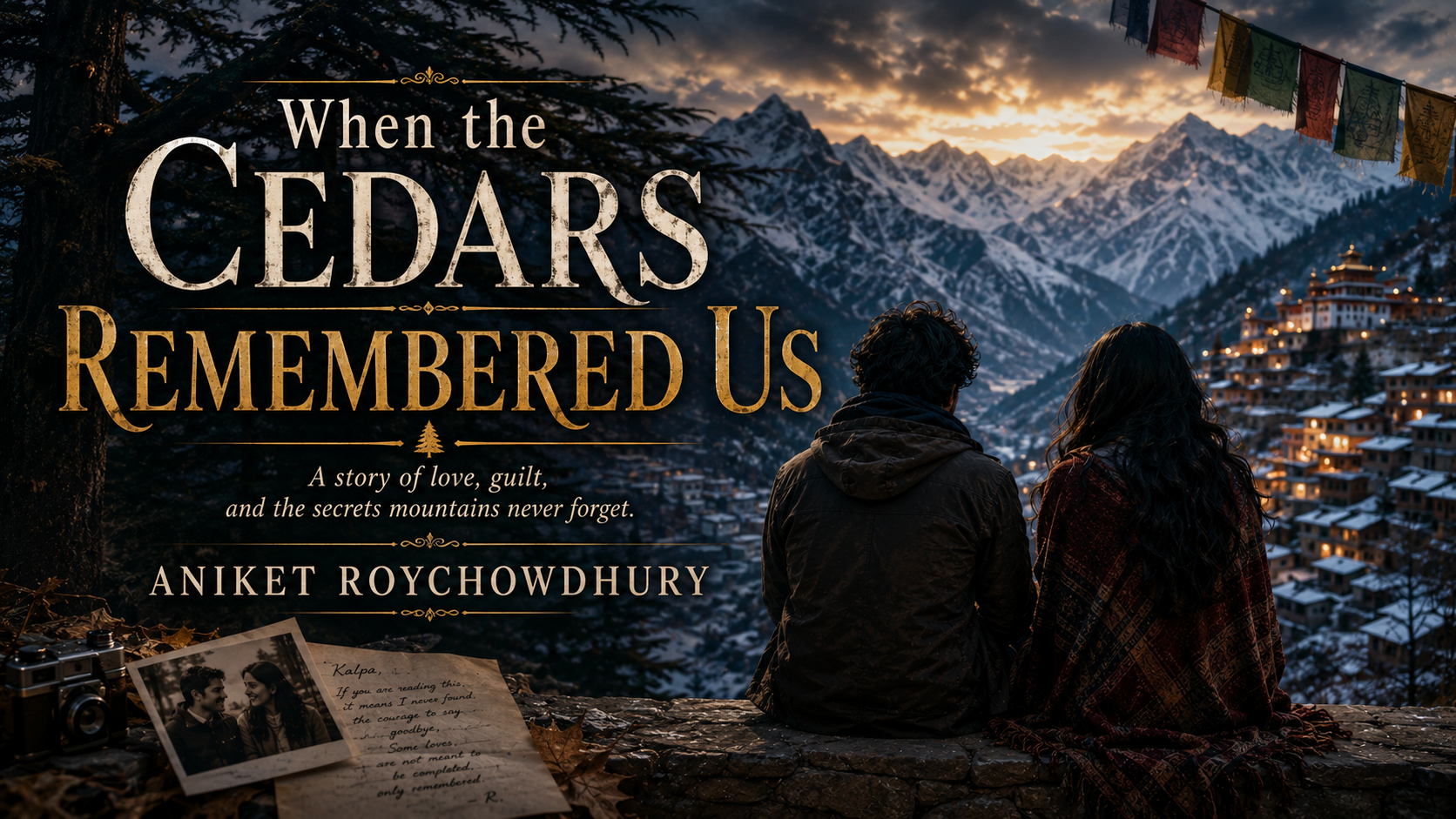
Leave a Reply