
Kritika Anand
One
The sky over Madhubani was bleeding into burnt orange when Dr. Niyati Basu stepped off the rust-covered jeep and onto the damp earth of Bhawanipur village, a place so secluded it didn’t exist on most modern maps. Her shoes sank slightly into the cracked mud as she adjusted the strap of her leather satchel, heavy with notebooks, ink pens, and a brass compass inherited from her grandfather. The village was quiet, save for the rustling of sal leaves and the distant croak of frogs echoing across the paddy fields. A few elders, wrapped in timeworn dhotis and coarse shawls, observed her silently from shaded thresholds, their gaze not curious, but cautious—as if recognizing not just her face but the weight of something she didn’t yet carry. At her side stood Binod Kumar Yadav, her local guide and a former Mithila painter who now made a living guiding foreign anthropologists and wandering scholars. He wiped his brow with his gamchha, his eyes flicking toward the overgrown temple ruin ahead like a man who knew better than to linger in sacred decay. “Madam, this is not a place for drawing,” he murmured, almost reverently, but Niyati was already moving, her fingers twitching with anticipation. She had come chasing the scent of a myth: a mask no scholar had catalogued, a style no museum had framed, a pattern so old it seemed to predate even memory.
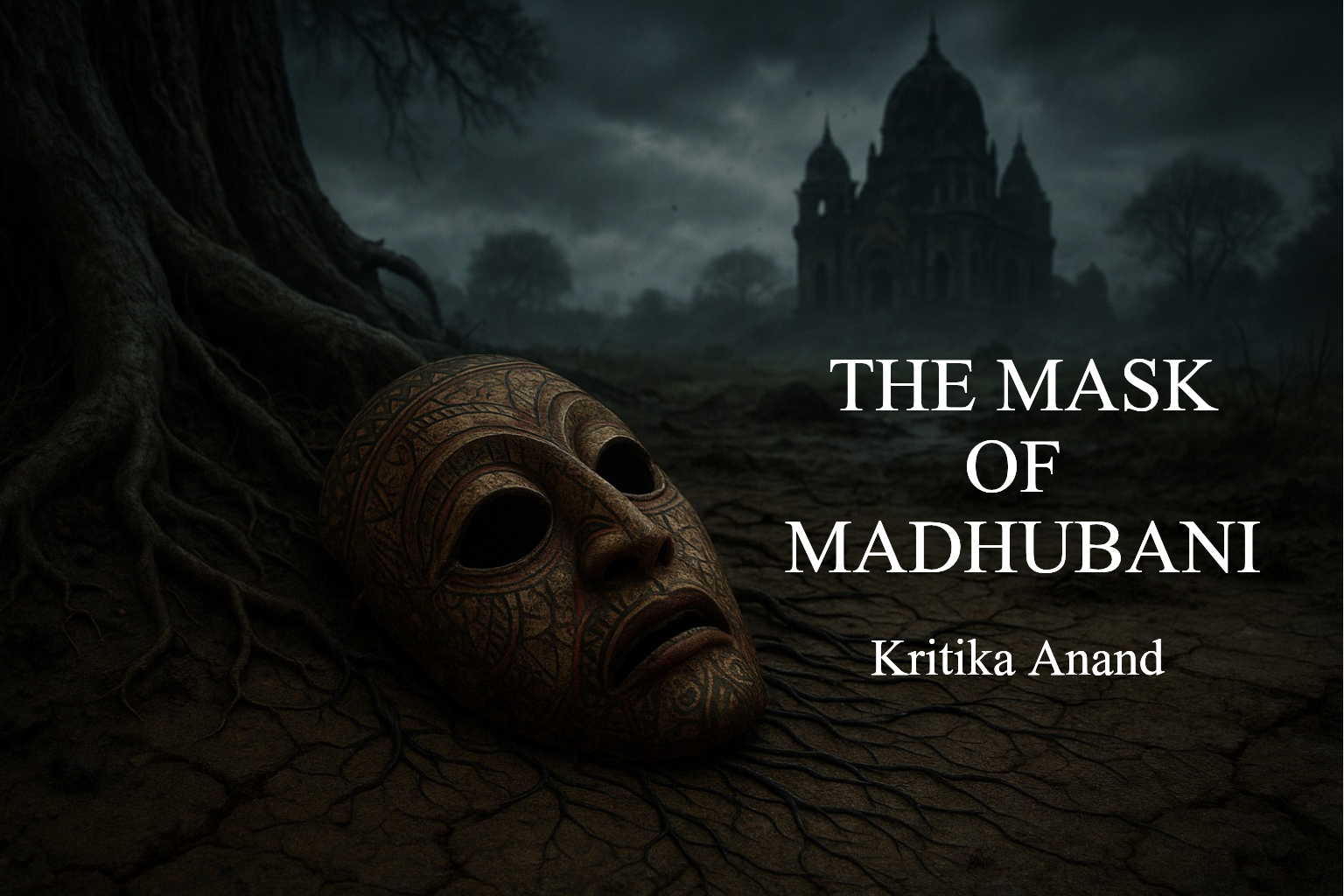
The temple ruin emerged like a slumbering beast from beneath a canopy of vines and dust, bricks darkened by time and moss, its once-proud entrance partially collapsed. Inside, the air was thick with age, moist and metallic, and the only light came from the slits in the broken ceiling, casting long beams across stone idols smothered in soot and cobwebs. Her flashlight skimmed across a cracked wall revealing fragments of fading frescoes—unfamiliar yet strangely familiar, as if someone had tried to recreate traditional Mithila motifs but with sharper, darker angles. In the innermost chamber, almost buried beneath layers of dried leaves and brittle offerings, she found it: the mask. Carved from neem wood and covered in layers of dried pigment, its eyes were hollow voids that seemed too deep for their size. Unlike conventional Madhubani masks, this one bore no symmetry—its face was split by two different expressions, joy and grief, creation and decay, each etched with microfine ink strokes. A faint ring of salt encircled it on the ground. Binod, now standing at the threshold, refused to come closer. “This was left to sleep. Not to be taken,” he said flatly, his voice no longer deferential. But Niyati was already reaching out, her gloved hand brushing the edge of the mask’s painted cheek, the texture warm despite the chamber’s chill. Her breath caught. Something in the air shifted—an inaudible gasp from stone itself. The mask was far older than anything she had seen in fieldwork, possibly pre-Kushana in origin, and yet the stylistic choices hinted at modern interference. It didn’t belong to one era—it belonged to something in between. Carefully, reverently, she lifted it and placed it inside a cloth wrap. Behind her, a crow screamed once and took flight.
Back in the village that night, power failed as it often did, leaving her in the quiet hum of lantern-lit shadow. Binod had returned to his home without a word, refusing dinner and avoiding eye contact. Niyati sat on the floor of the hut she had rented, sketchbook on her lap, the mask resting beside her wrapped in muslin. She should have waited—scanned it first, dated the pigments, consulted with mentors—but she felt an urgency, a pulse in her fingertips as if the artifact itself had burrowed under her skin. She began sketching by candlelight, line after deliberate line, her graphite tracing the twin expressions and irregular motifs with surgical precision. As she reached the mask’s eyeholes, her pencil tip snapped. She blinked. The room seemed darker, as though the walls had pressed closer, the lantern’s flame shrinking in its glass. Outside, the wind picked up, rustling banana leaves like whispers. She looked down at the sketch—something was wrong. The lines were no longer flat. They rippled slightly on the page, almost imperceptibly, like dried ink reacting to heat. A headache bloomed behind her eyes. She looked up at the mirror hung on the opposite wall. Her face stared back at her, but for a fraction of a second, her eyes weren’t hers—they were empty, shadow-pits echoing the mask’s hollows. She jerked back, nearly upsetting the inkpot. Her breath came short, sharp. It must be exhaustion, she told herself. Too much excitement, too little sleep. She packed the sketch into her journal, rolled the mask back into its wrap, and lay down without undressing. But as she drifted toward sleep, the rustle of paper from inside her satchel seemed to whisper something—soft, syllabic, almost like her name being spoken in a voice she didn’t recognize. “Niyati…” it murmured. Then the room went utterly still, as if waiting.
Two
The journey back to Delhi was soaked in monsoon gloom, and Niyati felt it in her bones long before the train even reached the station. The constant rattle of the wheels on the tracks offered no comfort as she sat by the window seat of the second-class compartment, the cloth-wrapped mask pressed tightly inside her leather satchel, which now never left her side. Villagers boarding with bundles of mangoes, women with vermillion-smeared foreheads, and the distant chime of tea vendors’ kettles passed in a blur, but Niyati barely registered them. Her thoughts looped back to the moment she had touched the mask, to the unsettling silence that had followed, and to the dream the night after—Shantha, or someone like her, painting in a hut made of palm bark, her ink pot brimming with something too dark to be dye. That dream had not faded with daylight. If anything, it lingered, weaving itself into her thoughts, tugging at her nerves. After reaching Delhi, she walked straight past her usual auto drivers and took a rickety cab home. Rain chased her all the way to her modest flat in Lajpat Nagar, where the bulb in the entryway flickered like a warning sign. She unlocked the door, stepped inside, and closed it with a dull thud—just as the power failed, plunging her into the hush of humid darkness.
By candlelight, she began transferring her earlier sketches to her archival journal—carefully inking the preliminary graphite lines with a fountain pen she rarely used. She had always been meticulous, almost ritualistic, about her process: paper aligned just so, strokes slow and deliberate, breathing in rhythm with each pen movement. But tonight, the lines seemed to draw themselves, the pen moving with a fluidity that startled her. The more she inked the mask’s features, the heavier the air grew—until it felt like someone was standing just behind her, not touching, not breathing, but present. She turned, but of course, the room was empty, except for her mirror catching the flame of the candle. She stared at her reflection—her eyes were hers again, but her lips seemed slightly parted, as if caught mid-word, and her neck bore what looked like a faint ink mark running down like a brushstroke. She touched it. Nothing there. She tried to laugh it off, but her throat was dry. That night, sleep came reluctantly and then violently, dragging her into another dream: this time, her own hands moved in rhythm, painting circular designs on a human face—half alive, half covered in fine ink vines. The face turned to her slowly. It was her own. She woke up gasping, hands trembling, the pen she had used now uncapped and staining her pillow black. On the wall across her bed, barely visible in the candlelight, was a faint pattern—one she had not drawn. At first glance, it looked like a typical Mithila lotus. But then she noticed the petals were shaped like open eyes, and inside each eye was a black dot that seemed to bleed.
Over the next few days, her apartment transformed into a theatre of subtle horror. Shadows moved faster than their sources, reflections twitched with delay, and objects left in one place reappeared inches away. Her students at the university began commenting on her distracted demeanor; one asked why she had started speaking Maithili under her breath during lectures—something she had no memory of doing. Abhinav Rajan noticed the change too, especially when he visited her studio one afternoon and saw the dozen versions of the mask she had now drawn—each more detailed than the last, the final one showing the mask’s mouth slightly open, revealing ink-smeared teeth. “You’re obsessing,” he said gently, crouching beside her, “This isn’t research anymore, Niyati. This is something else.” But Niyati couldn’t stop. Each time she tried to seal her sketchbook, the urge to open it returned within minutes, as though the pages called to her fingers. One evening, as the rain battered her windows and the city drowned in thunder, she discovered something that sent a chill straight through her chest: a page she didn’t remember sketching. It was dated two days earlier and showed a figure seated cross-legged in front of a mirror, a mask in one hand, and her own likeness on the face. In the margins, words were scribbled in ink that had bled into the paper, but were just legible enough to read—“You brought me out. Now finish me.” As her candle sputtered, Niyati backed away slowly, clutching the satchel like a relic, realizing at last that she had awakened something not with touch, but with ink—and every line she drew had pulled it closer.
Three
The morning was still damp from the night’s storm when Niyati arrived at the university, her satchel heavier than usual, though the only thing inside was her sketchbook and the mask tightly wrapped in layers of cloth. Something compelled her to keep it close. She moved through the halls like a shadow, her footsteps oddly muted, her presence almost unnoticed by the few students loitering near the Department of Visual Anthropology. In the faculty lounge, her colleague Professor Batra nodded at her, then paused, frowning, as if unsure whether he had really seen her. “You’re looking… different,” he said slowly, eyes narrowing. She gave him a tight smile and kept walking, heading toward her classroom. Today she was to give a special lecture on indigenous symbology in Eastern Indian art forms. It was a topic she’d delivered dozens of times, but as she prepared her slides, the images on her laptop flickered unnaturally. One of the masks she had never uploaded before—a distorted one with spiraling lines and ink dripping from its eye sockets—appeared between two slides and vanished before she could delete it. When the students filtered in, they seemed hesitant, unusually quiet, watching her with a strange wariness. As she began to speak, the air grew dense and warm, and she found herself mixing languages without control—Hindi, Maithili, even Bengali, as if the words were leaking out from memories not her own. At one point, while explaining a traditional fish motif in Mithila art, she turned toward the whiteboard and gasped—the image she’d drawn with her marker had rearranged itself, the fish now appearing to consume a faceless human figure.
During the lunch break, Niyati stood by the window of her office, staring at her reflection in the glass. Something about it was wrong. Her lips were unmoving, but the image smirked faintly. Her eyes—once warm and expressive—looked ink-filled and flat. She blinked, and the reflection matched her again, but a lingering unease clung to her skin like sweat. Abhinav dropped by unannounced, leaning against the doorframe with his usual laid-back manner, but even he seemed hesitant. “You haven’t replied to any of my messages,” he said, holding up his phone. She barely heard him. Her mind buzzed, full of sketch fragments, voice echoes, and the feeling that someone was constantly tracing lines on her back. When she finally did respond, her voice sounded distant, like it was being echoed from the end of a corridor. Abhinav stepped inside and glanced at her desk, noticing the sketchbook lying open. The latest drawing showed a woman standing at the edge of a field, with her arms raised to the sky, surrounded by a circle of masked children. “You didn’t draw this,” he said, flipping the page. “This… is like those outsider art pieces. Fevered. Possessed.” Niyati snatched the sketchbook from him, her fingers trembling. “They’re mine,” she snapped, but even as she said it, she doubted it. That night, back at home, she placed the mask face-up on her desk and sat across from it, sketchbook in hand. Her pencil hovered in the air, unmoving. The mask, though silent and inanimate, seemed to look back at her—not with menace, but with expectation. Her hand moved without thought. She drew a room. Then a desk. Then herself. And in the background, just behind her drawn reflection, she sketched a figure with no eyes.
Later, she awoke in the middle of the night with the lamp still on and the mask still on the desk, but everything else felt changed. The walls of her room seemed a little too tall. Her bed had shifted slightly to the left, even though the furniture was bolted to the floor. The mirror on the wall no longer reflected the hanging lantern. Her phone had reset its clock to 3:33 AM. She stood shakily and looked around, hearing a faint scratching sound from the sketchbook. Slowly, dreadfully, she opened it. The last page had a new drawing—one she had no memory of creating. It showed her standing beside her own bed, asleep, while a creature with elongated fingers and a painted face watched her from the corner. The ink was still drying. She dropped the sketchbook, backing away. Her breath fogged up the air, though the room was humid and still. Then came the softest sound: a whisper that emerged from the mask. A breath, not quite words, but a rhythm. As she turned toward it, the mask’s hollow eyes seemed deeper than before, and the colors—once faded—now pulsed gently as though alive. Niyati clutched her chest. Her heartbeat had slowed. Something was drawing her in—line by line, breath by breath—and she knew that this was no longer a case study. This was possession. Not by spirit, but by form. By ink. By image. She was being redrawn from the inside out.
Four
Sleep was no longer a refuge for Niyati Basu—it had become an extension of the ink, a darker canvas upon which the mask painted freely, each night more vivid than the last. That evening, after a day spent restlessly shifting between her cluttered desk, half-finished sketches, and the edge of panic, she finally dozed off by the window. The monsoon winds pressed against the glass panes, humming like the throat of a distant conch shell. In her dream, she was no longer in Delhi, nor in the 21st century. The air was thick with turmeric and ash, and the earth beneath her bare feet was red with clay and blood. She stood inside a circular hut illuminated by flickering firelight and the scent of neem smoke. A woman sat hunched before a stretched cloth on the floor, brush poised between stained fingers, her skin etched in spiraling Mithila motifs—lines inked directly onto her arms, her throat, even her eyelids. This was Shantha. Her back was to Niyati, yet somehow she spoke directly into her mind. “I painted death. I gave it shape. I gave it passage.” The voice was low, cracked like dry riverbed soil. Niyati stepped forward, unable to control her feet, and glanced over the woman’s shoulder. The painting on the cloth was that of a harvest festival—cattle, women, gods dancing—but every face in the image had empty eyes and dark mouths that bled. The ink shimmered. Shantha turned then, slowly, and Niyati recoiled. The woman’s face was a split mask: one half joyful like a goddess during Durga Puja, the other decaying, jawbone exposed beneath flaking skin, with a line of ants crawling from her left nostril. “They buried me,” Shantha said softly, “but not the lines. The lines live longer than the flesh.”
Niyati awoke with a start, her breathing ragged, her palm bleeding from where her nails had dug into it during sleep. She stumbled to the sink to wash her face, and as the water splashed onto the porcelain, she saw something horrifying—a second pair of wet footprints on the floor behind her, leading from her bed to the mirror. She spun, but there was no one. Yet the scent of neem smoke lingered in the air. Drenched in fear and sweat, she opened her sketchbook with trembling hands. A new page had been filled overnight. It showed the same hut from her dream, down to the coiled vines that hung from its roof and the painted cloth spread before Shantha. In the lower right corner, her signature had been added in smudged ink. She hadn’t signed it. That was not her hand. The whispers returned that night, no longer coming from the mask but from the very walls. Sometimes they murmured in Maithili, sometimes in a hybrid tongue she couldn’t place—yet the intent behind them was unmistakable: Finish the painting. Complete the cycle. She no longer trusted her own hands. Twice she caught herself drawing in trance-like states, pages filled with unsettling hybrid motifs—half-flowers with insect legs, elephants weeping ink, trees made of human spines. Every sketch exuded a strange life, the lines too fluid, too alive to be hers. At night, she could feel the weight of unseen eyes watching from corners of her flat, and when she closed her own, they followed her into her dreams.
Desperate for clarity, Niyati dug deeper into archives, folk legends, and anthropological journals, tracing every thread that might explain Shantha. In an obscure academic paper from 1967, she found a footnote referencing a “widowed tribal painter of the southern Mithila belt” who was “expelled for rendering gods with dead men’s eyes.” The paper mentioned a belief that some images, once painted with enough intent, didn’t just represent—they invoked. That night, Niyati called Binod Yadav. He didn’t answer at first, then finally picked up after midnight, his voice a bare whisper. “I warned you,” he said. “The mask you took… it was not a thing. It was a gate. It was sealed with salt and ink and buried in a place where no lines reach.” He urged her to bring it back immediately, before the mask chose her completely. “Shantha never died,” he said, voice shaking. “She became line. She became form. She waits for hands to draw her again. And you…” His voice broke. “You have her hands now.” After the call, Niyati sat in darkness, the sketchbook open on her lap, the mask resting nearby, its painted expressions flickering faintly under the shifting lamplight. She was trembling, not out of fear, but because part of her felt something else—an overwhelming compulsion, a magnetic desire to complete the final image. She lifted the pen. Somewhere in her blood, something moved. Something ancient. And as the ink met the page once more, she whispered aloud without meaning to, “Let the lines live.”
Five
The road to Bhawanipur was drenched in slush, flanked by banana groves and the swollen shadows of trees bending under the weight of the monsoon. Niyati sat in the back of a rented jeep, the mask wrapped in three layers of cotton and plastic, sealed inside a wooden box she had picked up from an old crafts market in Delhi. It still radiated warmth—unnatural, fevered, as if something inside it pulsed with breath. Her eyes were dry from sleeplessness, and Abhinav, beside her, hadn’t spoken since they left the station two hours earlier. He hadn’t wanted to come. She hadn’t wanted him to. But after witnessing her last episode—her standing in the middle of her apartment, sketching blindly on the floor with her fingers dipped in spilled ink—he had refused to let her travel alone. The jeep jerked through the muddy path, and the village slowly appeared like a memory summoned: straw roofs, pale smoke curling into the sky, and the same elders from before, standing at the threshold like stone idols. As the vehicle rolled to a stop, Binod appeared from behind a neem tree. He had aged in weeks—his beard untrimmed, his eyes sunken, carrying an expression that blurred resentment, pity, and fear. He didn’t greet her. He merely pointed toward the temple ruins beyond the rice paddies, now almost swallowed by vines. “It has grown stronger,” he said. “We can feel it. Animals won’t go near the fields. Children wake screaming. The soil remembers what you took.” Niyati nodded, lips trembling, clutching the box tighter. She didn’t speak, for fear that if she did, it wouldn’t be her voice that came out.
The three of them reached the temple just as twilight collapsed over the village. The ruin had changed. The air around it was colder, though the monsoon heat still pressed against their backs. Inside, the moss-covered bricks were marked with fresh patterns—not painted, but grown, as if vines had shaped themselves into Madhubani forms: spiraling fish, mirrored birds, deities with hollow eyes. Niyati knelt at the center of the sanctum, her breath uneven. Binod sprinkled rock salt in a circle around her, then placed a diya in each of the four cardinal points. Abhinav hovered by the entrance, visibly unsettled, flinching every time a wind gust whispered through the cracks. “There was once a rite,” Binod muttered, preparing a paste of turmeric, ash, and ink. “When a cursed image needed to be silenced, it had to be returned to the womb of the earth, buried beneath the roots of a neem tree under the dark moon.” Niyati remembered the dream again—Shantha standing in a circle of masked children—and realized what they had performed wasn’t just exorcism. It was rebirth. The mask had never been sealed away in fear, but in reverence—its power too potent to be destroyed. As the last diya flickered, Niyati placed the mask in front of her. The ground trembled faintly. Then the whispers came, not just from the temple, but from within her—the voice of Shantha echoing through marrow: “You cannot return what has become you.” She reached into her bag and pulled out her sketchbook. The pages fluttered open to the latest drawing: a self-portrait with the mask halfway fused to her face. Her fingers trembled. She turned to Abhinav, who looked at her now with something approaching horror.
The ritual began. Binod chanted in a mixture of Sanskrit and Maithili, his voice unsteady but rhythmic, like a cracked drum echoing through mist. Niyati placed the mask on the ground inside the salt ring and dipped her fingers in the ash-ink mixture. She hesitated—then drew a circle around it, a perfect loop as ancient tradition required. At first, nothing happened. The night deepened. The insects stopped. Even the leaves outside seemed to pause. And then the shadows in the corners of the temple began to thicken—bleeding ink pooling from the stone. A form began to rise—not solid, not spirit, but outline. A figure composed entirely of brushstrokes emerged, tall, faceless, skin painted with the same motifs as her sketches. It stood silently, its feet leaving no mark, its eyes black and wide as if drawn on. Abhinav gasped. Binod fell backward. But Niyati… Niyati reached out. “Are you Shantha?” she whispered. The entity did not nod. Instead, it stepped forward, passing the salt line as if it never existed. She felt her knees give out. The mask on the ground began to shift, its paint liquefying, swirling with color as though resisting dissolution. The figure’s hand stretched toward her face. She couldn’t move. Its fingers hovered near her eyes—and in the split second before they touched, the figure whispered, “Not Shantha. You.” Everything vanished. She woke sometime later, crumpled on the temple floor, her sketchbook beside her. The mask was gone. But burned into the ground was a new image—her own face, lined in ink, the eyes gently closed. Around the image, the salt had formed the shape of open petals. She had returned the mask to the soil, yes. But a seed had been planted in its place. And it had her name.
Six
Back in Delhi, the city felt foreign—grayer, louder, somehow thinner—as if reality had been stretched too tight and might tear with the wrong breath. Niyati returned to her apartment in silence, her clothes damp with sweat and travel dust, her fingers stained faintly with the ash-ink from the ritual. The mask was gone, buried, dissolved, erased—but something inside her had shifted, and that shift hummed beneath her skin like a tuning fork struck by unseen hands. She told herself the worst was over. She repeated it like a prayer. But her reflection no longer followed her movement perfectly, and the mirror in her hallway now flickered once before settling into stillness. In her study, her sketchbook lay open—pages fluttering slightly despite no breeze, as though it was breathing. The most recent image was not one she remembered drawing: a woman—her, unmistakably—walking through a crowd of faceless people, holding a mask that bled black from its eye sockets. She closed the book and shoved it into a drawer. No more drawing, she told herself. No more lines. That evening, she attended the long-postponed gallery event at a friend’s studio in Shahpur Jat. Abhinav had insisted she come. “You need people, light, voices—something to anchor you,” he’d said. She dressed in a handloom saree, covered the mark on her neck with a scarf, and stepped into a room pulsing with ambient music and art students sipping wine from paper cups. But even among laughter and light, the shadows clung to her like oil. Every painting she passed—abstracts, portraits, installations—seemed to distort slightly at the edges when she looked too long, as if the ink within was trying to twist free.
The gallery’s central piece was her own contribution: a series of stylized Madhubani reinterpretations that she had submitted weeks ago, long before the trip to Bhawanipur. One was a triptych of traditional forms—a tree of life, a peacock, and a goddess’s face. But as she walked past it now, she noticed something terrifying. The tree’s roots had extended farther than she remembered, curling into skeletal fingers; the peacock’s feathers were dotted with tiny human eyes; and the goddess—once serene—now grinned, her teeth like ink strokes jagged and black. “Did someone tamper with these?” she asked the curator. He shook his head, confused. “They’ve been sealed in storage since you submitted them.” That night, after the event, one of the gallery guards was found unconscious in the exhibit room, eyes wide open, lips murmuring “so many eyes… so many mouths.” Niyati received the call just past midnight. The incident was written off as heatstroke, but she knew better. She pulled her sketchbook from the drawer and found, pressed between two pages, a dried petal she hadn’t placed there—thin, fragile, shaped like an eye. The sketches had multiplied in her absence. They filled entire spreads with scenes she never remembered imagining: villagers screaming as ink dripped from the sky; a woman pulling threads from her own face to weave a net of lines; a baby cradled inside a mask-shaped womb. Her hands trembled. She grabbed a lighter and tried to burn one of the pages—but as the edges curled and blackened, the lines inside the flame shifted, writhing, and the fire snuffed out on its own. The next morning, the page was whole again.
Niyati stopped leaving the apartment. The city outside became a blur of horns and voices she no longer trusted. Even the crows on her balcony watched her differently now—heads tilted, eyes unblinking. Abhinav came once, pounding on the door until she let him in. She looked at him like she was trying to remember how he fit into her story. “You buried the mask,” he said softly, “but you brought it here first. You fed it. With every sketch.” He sat beside her as she flipped through the journal. “What if… what if the mask wasn’t cursed? What if it was hungry? And you—your hands—were just the vessel it needed?” She didn’t respond. She knew now that the entity wasn’t in the mask anymore. It was in the lines. In the idea of the mask. In her. At night, her walls breathed. Shapes crawled behind the curtains—brushstroke silhouettes that vanished when light touched them. The patterns etched on her arms had returned, invisible in daylight but glowing faintly in the dark, shifting like oil on water. Her voice—when she did speak—echoed slightly, as if another version of her spoke just after. The final straw came one evening when she looked into the mirror and saw herself drawing with her left hand—though in reality she was standing still. The reflection smiled. That night, she sketched one last time. A single line, simple and fluid. It coiled into a spiral and stopped. At the center: an eye. Ink bled from the page, warm and wet. The sketchbook trembled once—and then fell still.
Seven
The boundaries of Niyati’s world began to blur, not slowly, but like a sheet of paper soaked in black water—lines bleeding, corners dissolving. Mornings no longer arrived with light, only with a shift in the tone of silence. The sun, when it came, was pale and indifferent, casting thin shadows that bent in directions they should not. Her apartment, once a quiet academic’s haven of journals and textiles and half-burnt incense, now felt like a trap painted to resemble safety. The walls no longer met at right angles. Doors opened to unfamiliar spaces—her bathroom mirror once revealed a corridor behind her, stretching into a forest of masks hung like drying fruit. Even her own body betrayed her; when she touched her cheek, the sensation came a half-second later, like her nerves lagged behind reality. Her sketches, now numbering in the hundreds, had overtaken every surface—floors, walls, backs of receipts, even her own skin, where she found symbols scrawled in places she couldn’t have reached alone. And in every image, the lines deepened over time as though the ink matured, grew bold, alive. One morning, she found a full-scale mural of her apartment—perfectly replicated—drawn onto her living room wall. But in the drawing, the couch was overturned, her sketchbook lay open on fire, and at the center of the floor stood a figure with her face, eyes hollow and fingers stretched like calligraphy pens. The mural pulsed slightly. She vomited in the sink, and what came up was ink.
Abhinav returned the next evening, summoned not by her but by the building’s elderly security guard, who claimed he’d heard “chanting in broken songs” coming from Niyati’s room every night. He found her sitting cross-legged on the floor, staring at a blank sheet of paper as if watching a film only she could see. Her hair was disheveled, her lips cracked, her eyes red but dry. He took one step into the room and stopped—every inch of the walls was covered in line work, thousands of them, tightly packed, a storm of spirals and symbols and impossible perspectives. A peacock made of hands. A lotus blooming from an open ribcage. Faces layered on top of faces. Niyati looked at him and whispered, “I see the root now.” Her voice was raw, but steady. “It’s not just the mask. That was never the point. Shantha didn’t trap death. She drew it. Line by line. And it… followed.” Abhinav tried to reach for her, but she recoiled. “You don’t understand,” she said. “The more you see, the more it sees you back.” She pulled her sketchbook into her lap, its pages flicking open on their own. “I think I’ve reached the last image. The one she never finished.” Her hand trembled as she lifted the pen. “It’s not about ending it. It’s about containing it.” Suddenly, the lights flickered and died. The room sank into blackness, and from the corners came the subtle slither of ink, wet and alive, crawling like vines toward the center. A hum rose from the floor—not mechanical, not earthly, but like a thousand brushes scratching paper at once. The spiral on her wrist began to glow faintly.
That night, the flat collapsed into unreality. Abhinav swore he saw the windows stretch wider, the ceiling peel back to reveal a night sky covered not with stars but with blinking eyes. The furniture convulsed in slow motion, as if caught in a wind that didn’t touch the skin. Niyati stood at the center of the chaos, hair floating, fingers dancing across the air like she was sketching on the very fabric of space. Her final drawing appeared not on paper, but on the apartment floor—etched in living black, the lines moving, feeding, rearranging themselves. It was a map. A portal. A warning. He shouted her name, but she didn’t turn. Instead, she began to chant—not words, but sounds mimicking brushstrokes, each one triggering a new wave of distortion. The ink on the walls rose like fog, swallowing furniture, melting shelves. Abhinav tried to grab her, but the space between them stretched—what was once a meter became a corridor, then a chasm. Her voice echoed from all directions. “I can hold it,” she cried. “I have the hand. I know the pattern now.” Her body flickered. For one second, she was herself. The next, she wore the mask—not the wooden one, but a new one of ink and skin, shifting, alive. Then everything went white. When Abhinav woke hours later on the apartment floor, the walls were bare. The sketches were gone. The sketchbook lay open to the first page—a simple Madhubani lotus, unfinished. Niyati was nowhere to be found. But on the floor, where she had stood, a spiral glistened—wet, black, and watching.
Eight
The days that followed were filled with questions no one knew how to ask. Niyati Basu had vanished without a trace—no witnesses, no digital activity, not even CCTV footage from her own apartment building. The Delhi police filed a missing person report, but the case went cold within 72 hours, as if the city had agreed to forget her. But Abhinav Rajan couldn’t. He returned to her empty flat again and again, standing for hours before the faded spiral on the floor, the only remaining mark of her presence. The spiral no longer glistened—it had dried, cracked, like old paint—but something about it still pulsed faintly under his feet, like a vein too deep to see. He tried explaining the truth once—to the police, to a friend, to himself—but how could he make them believe that art had become a door, and the artist its threshold? He replayed the final night in his mind over and over: the flickering lights, the room shifting, the impossible space between them, her voice merging with ink. He’d seen the mask, not physically, but through her, as though it had fused with her identity. He couldn’t forget the look in her eyes in that last moment—pure resolve, but also something ancient, like she was not Niyati anymore but something older speaking through her. Something formed of pigment and pattern. He spent days searching through her journals, her academic notes, even the forgotten corners of digital archives she had bookmarked. And in a footnote, buried beneath Shantha’s fragments and dismissed folk legends, he found a phrase that struck him like a blade: “When a line contains the soul, erasing it is not silence—it is sacrifice.”
Convinced there was more, Abhinav travelled alone to Bhawanipur. The village met him with the same wary silence that had once greeted Niyati. The children didn’t speak. The women turned their faces away. And the men looked at him like he carried something cursed in his shadow. He found Binod Yadav at the edge of the fields, sitting on a broken charpai and staring at the neem tree that now stood strangely bare, its roots exposed like ink threads on the earth. The man barely acknowledged Abhinav, only murmured, “She drew too far. The brush didn’t stop.” When asked where the mask had been buried, Binod simply pointed to a spot behind the temple ruin—a place where the grass didn’t grow and the soil seemed to resist touch. There, Abhinav found it: not the mask, but a new sketch, etched into the ground like someone had scratched it in with fingers dipped in black water. It showed a woman curled in a fetal position inside a spiral, her skin tattooed with shifting lines, and her eyes closed—not peacefully, but protectively. Around the spiral were symbols—some he recognized from Niyati’s own studies, others impossibly alien. That night, he dreamed of a narrow corridor lined with mirrors, each reflecting a different version of her—Niyati in a saree, Niyati as a child, Niyati with the mask in place of her face, and one that stood utterly still, holding a brush made of bone. She turned slowly, lips parting, and whispered, “Lines can’t trap us. They only teach us how to step through.” He woke gasping, hand clenched around a piece of torn paper that hadn’t been there before. It was a part of her sketchbook. And it was wet.
Desperate now, Abhinav contacted a retired folklore researcher, Dr. Indira Misra, who had once corresponded with Niyati on obscure art rituals. When he showed her the remaining sketches and the photograph of the ground spiral, she grew pale. “You don’t understand,” she said, trembling. “This isn’t just about one artist. This is lineage. An unbroken ink-path. Shantha didn’t die because of what she painted—she transcended. And every hundred years or so, the brush chooses another.” Abhinav asked the only question left: “Is Niyati alive?” Dr. Misra hesitated. “Not here. But maybe not gone either. Think of her like a myth still being written. Her body may not return, but her lines haven’t finished forming.” That night, Abhinav sat before the cracked spiral in Niyati’s flat, the page from her sketchbook on the floor, and picked up a pen. Slowly, he began to trace the outline of her last known sketch—the spiral, the closed-eyed figure. As he drew, the lines shimmered faintly, and he felt a breath, soft but certain, brush against his ear. “One more line,” it said. “Just one more.” The mask was gone. But the hand had not been severed. The pattern was still unfolding. And somewhere between the strokes, Niyati watched.
Nine
The ink never truly dries—this, Abhinav understood now. Even weeks after Niyati’s disappearance, her presence lingered in the air like pigment in water, her voice nested between paper fibers, her silence etched into the rhythm of Delhi’s wind. Her apartment, though cleared out by university protocol, refused to feel abandoned. On the final night before it was to be sealed, Abhinav returned alone, carrying nothing but a pen and her last torn sketch. The cracked spiral on the floor had faded, but its memory remained under the skin of the space. Sitting where she once had, he pulled out her notes, the ones she’d obsessively compiled on folk art curses, ritual painting, and the artist-as-vessel. He noticed something he hadn’t seen before—a strange symbol Niyati had scribbled in the margins dozens of times: two intersecting spirals with a dot at their center. It wasn’t part of any recorded Madhubani motif. Yet it appeared repeatedly, often beside phrases like “root pattern,” or “the seed brush.” That night, Abhinav copied the symbol in ink, not knowing why. As soon as the spiral met the page, the air thickened, and something began moving—not visibly, but behind the walls, inside the very structure of the building. A sound followed—a low rustling, like hundreds of brushes sweeping across paper. The walls began to shimmer faintly. The pages in Niyati’s sketchbook turned on their own, landing on a page that hadn’t been visible before. It showed a corridor—long, endless, lined with doors. At the far end was a figure. Not Niyati. Not Shantha. But someone holding a brush with an eye at its tip.
What followed was not a dream, nor a vision, but something stranger: a conscious fall into the drawn world. The corridor from the sketch materialized around him, not fully physical, but not illusion either. The air smelled of wet ink, charred sandalwood, and old earth. The walls shifted with patterns that moved like breathing skin. Each door he passed bore a mask above it—Madhubani masks, but warped, half-alive, some smiling, others weeping black tears. One door opened slightly as he approached, and inside, he glimpsed a moment—Niyati as a child, painting in the back garden with her grandmother, unaware that her brush moved with uncanny precision. Another door showed her hunched over her university desk, the very first time she’d encountered Shantha’s name in a forgotten paper. He realized then: this corridor wasn’t a place. It was her timeline. Her memory. Her transformation. He walked slowly, drawn forward by the hum of invisible chanting. At the farthest point stood the final door—larger than the others, pulsating. Its mask bore no features at all, just a blank space waiting to be painted. He touched the handle. Cold. Heavy. The door opened not into a room, but into a canvas—a boundless expanse of white with a single figure in the center. Niyati. She was seated, cross-legged, sketching on nothing, her hand suspended in air, drawing lines that glowed and then vanished. Her eyes were closed, her lips moved silently. She didn’t look up.
He called her name. Once. Twice. Finally, her hand paused. The brush fell, hovering just above the void. Her eyes opened, and for a moment, he saw her—not possessed, not consumed, but aware. “You shouldn’t be here,” she said gently, voice echoing in the emptiness. “This place is not meant to be entered. It’s meant to be drawn.” He stepped closer. “What is this, Niyati? Where are you?” She smiled sadly. “Between lines. Behind ink. I reached the root.” Her fingers brushed the air, and a new spiral formed under her, faintly glowing. “There is no mask anymore. Only the memory of it. And that memory needs a keeper.” Abhinav shook his head. “Come back. Please. We can end this.” Her gaze turned downward. “Ending it would unravel every line it touched. The village. The stories. Even you. It’s too late for that. But… the pattern can be contained. Retold. As myth.” The air began to shudder. The void cracked slightly at its edges, ink bleeding in from invisible seams. “You still have the hand,” she whispered. “You saw the door. That means you can draw. Not like me. But enough to hold the memory without feeding it.” A final smile, brittle but resolute. “Close the door, Abhinav. Let the story end in a line, not a scream.” Then she vanished—drawn inward, her outline folding into the spiral like parchment curling in fire. The corridor collapsed behind him. He awoke in the apartment, drenched in sweat, the spiral now re-inked, pulsing once. In his hand: the brush with the eye at its tip.
Ten
The rain returned to Delhi with unnatural fury, turning the city’s edges to ink-streaked blurs beneath slate skies. Abhinav sat in Niyati’s emptied apartment, surrounded by bare walls and silent windows, the echo of her voice still ringing behind his ears like a song half-remembered. On the floor before him lay a fresh canvas—unprimed, raw, a pale void trembling under the pressure of what it might contain. In his right hand he held the brush she had left him, its wooden body smooth and strangely warm, its bristles black and glistening, as if dipped in something older than pigment. At its tip sat a single unblinking eye—not painted, not carved, but real, living, watching. The room felt breathless. And yet, for the first time in weeks, he did not feel fear. Only a grim acceptance. He remembered Niyati’s final words—Let the story end in a line, not a scream—and with that, he dipped the brush into the inkpot beside him and began to draw. Slowly. Deliberately. The line he pulled was curved, spiraled, reminiscent of the ancient motifs that had once driven her to Bhawanipur. But this time, there was no hunger in the ink, no rising tide of madness. This was not an invocation. It was a sealing. A remembering. As he moved the brush, the air in the room responded—the corners straightened, the walls stopped breathing. The space quieted. The ink line grew into a shape: not a mask, not a monster, but a door. Closed.
He drew for hours, maybe days. Time twisted gently, no longer bound to the ticking of the clock but to the rhythm of his strokes. The brush guided him, sometimes moving before he thought to move it. He drew the neem tree in Bhawanipur, its roots swallowing an ancient wooden mask. He drew Shantha’s hut with its cloth soaked in blood and memory. He drew Niyati, again and again—child, scholar, artist, vessel—each version of her carrying the same spiral on her palm. At one point, he paused, staring at a nearly finished panel that showed her sitting in an empty space surrounded by invisible figures, brush suspended midair, her face calm. It was not a prison, nor a dream. It was a sanctum. The place between creation and collapse. And suddenly, he understood. She hadn’t been taken—she had crossed over. Voluntarily. Because she knew the mask would never be destroyed, only transformed. That its hunger was merely the cost of seeing too deeply. And that someone had to stay on the other side to hold it at bay. His final image was the most difficult: it was of himself, standing before a canvas, painting a spiral while a shadow loomed behind him, watching, but never entering. He signed his name at the bottom with a trembling hand. The moment the ink dried, a gust of air swept through the apartment—not from the window, which was closed, but from inside the walls. And the eye on the brush finally blinked… and shut.
From that day onward, Abhinav Rajan vanished from public life. Some said he had moved to the hills to “find peace,” others claimed he’d suffered a breakdown after the disappearance of Niyati Basu. Her case remained unsolved, filed away in the growing cabinet of Delhi’s ghosts. But among a certain circle of art historians and occult anthropologists, a new name began to circulate—The Spiral Artist. Paintings in forgotten exhibitions began appearing with his unmistakable signature: doorways painted shut, eyes without pupils, trees with no shadows. His works carried a strange energy—haunting but calming, dangerous yet contained. People left his exhibitions disturbed, but always silent, as though they’d glimpsed something forbidden but vital. And in Bhawanipur, villagers whispered of a change: the crops grew again, the neem tree bore new leaves, and the children no longer woke screaming. Yet at the edge of the fields, where the ruined temple still stood, lines sometimes appeared overnight in the dust—spirals drawn with invisible fingers. Lines that moved faintly when no one watched. And though the mask was gone, and the sketchbook sealed, the story remained—not as a curse, but as a caution. A tale retold by ink. By hand. By those who know the power of a single brushstroke, and the danger of a line drawn too deep.
End
Leave a Reply