
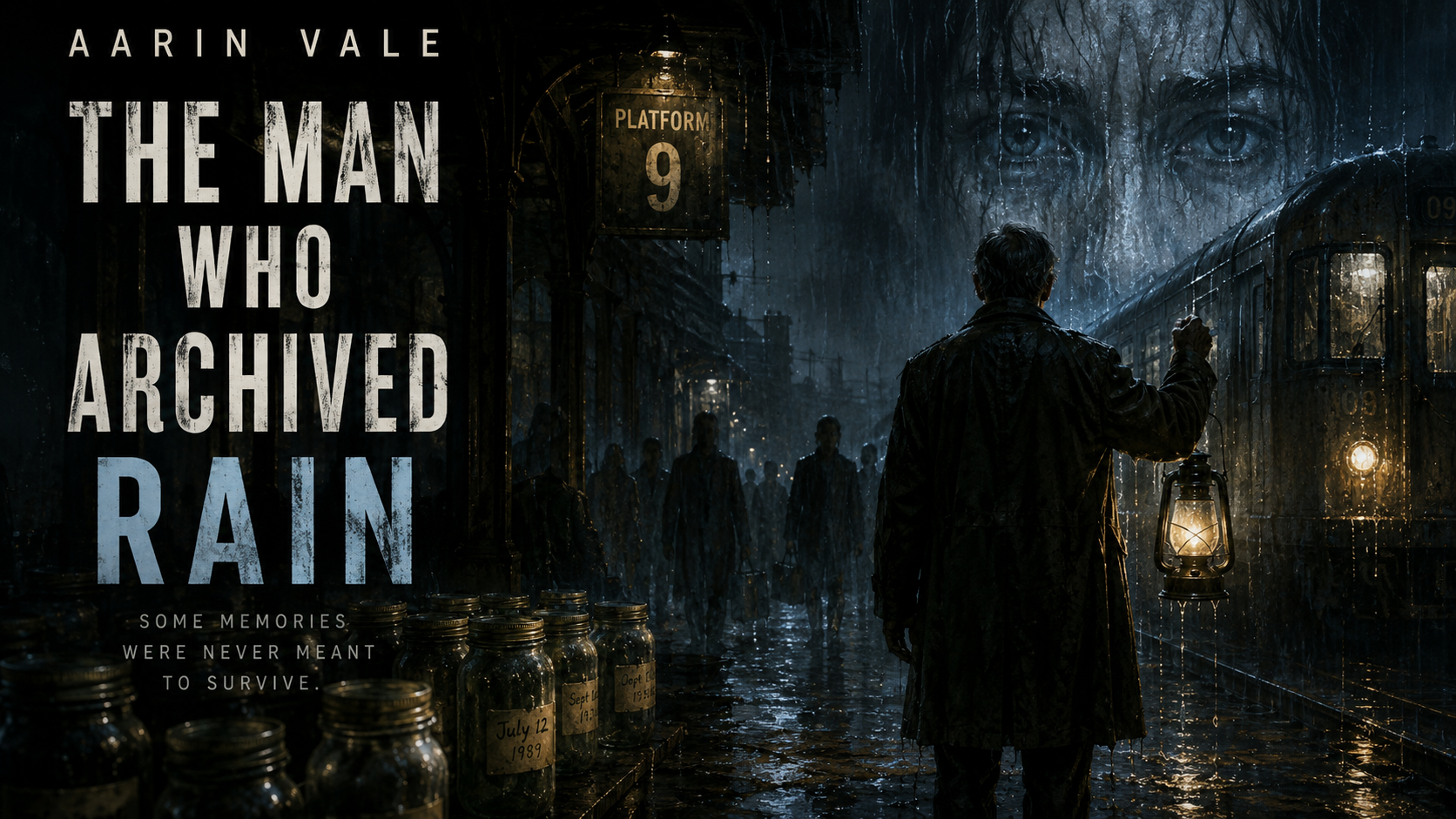
The City That Forgot Itself
No one remembered the city’s real name anymore.
It appeared differently on every surviving map. The rusted railway sign near the station carried one spelling, old municipal records another, while the oldest residents pronounced it with a softness that belonged to a vanished language. Over time the city had become like one of its own citizens — unable to hold onto itself for very long.
Every monsoon, memories disappeared here.
Not dramatically. Not all at once. The forgetting arrived quietly, like dampness spreading through the walls of a house. A woman would wake unable to remember the sound of her mother’s laughter. A shopkeeper would suddenly forget the face of his dead brother. Husbands lost anniversaries. Children forgot songs they had sung only yesterday. Sometimes entire years dissolved overnight.
Doctors called it a neurological phenomenon triggered by seasonal humidity. Priests called it punishment. The city itself offered no explanation.
People learned to live around the forgetting the way coastal towns learn to live around storms.
At the northern edge of the city, near the river where abandoned ferries rotted into the mud, stood a narrow two-storey house covered in moss and rain stains. The house belonged to an old archivist named Ihsan Ali.
No one knew his exact age anymore.
Before retirement he had worked in the Municipal Archive, preserving land deeds, census papers, railway permits, birth certificates, and brittle documents from a century no one discussed aloud. Then one monsoon, floodwater entered the archive basement and destroyed nearly half the collection. Entire neighborhoods vanished from recorded history in a single night. Streets disappeared from maps. Names dissolved from official memory.
Something changed in Ihsan after that.
He began to believe the rain was not erasing memory.
It was collecting it.
And so he started preserving rainwater.
At first people laughed at him. They called him mad, lonely, senile. But year after year he continued filling glass jars with monsoon rain collected from different parts of the city. Every jar carried a handwritten label.
June 13 — Outside Saint Mercy Hospital.
Station Road — 2:11 AM.
Cinema Rooftop After Closing.
Rain Mixed With Someone’s Crying.
His entire house slowly transformed into a museum of transparent ghosts. Shelves bent under the weight of hundreds of jars. Some were clouded with age. Others remained startlingly clear. On sleepless nights, Ihsan sat among them listening.
Because certain jars whispered.
Not loudly. Never clearly. But enough.
A child humming.
A train announcement.
A woman laughing somewhere very far away.
Sometimes a name.
Always forgotten again by morning.
That evening the rain had arrived early.
The city outside dissolved beneath silver-grey water. Electric wires trembled in the wind. Rickshaw wheels dragged through flooded alleys like exhausted animals. Inside the house, Ihsan stood near the window filling a fresh jar from a metal basin placed beneath the leaking roof.
Then someone knocked on the door.
Three soft knocks.
Uncertain knocks.
As though the person outside was afraid they might already have been forgotten.
Ihsan opened the door slowly.
A young woman stood there drenched in rainwater. Her dark hair clung to her cheeks and shoulders. In one hand she carried a black-and-white photograph curled from moisture. Her eyes looked exhausted in the peculiar way people look after too many sleepless nights spent searching for something impossible.
“Are you Ihsan Ali?” she asked.
Her voice trembled slightly.
Ihsan nodded and stepped aside.
The girl entered carefully, then stopped.
Almost everyone reacted the same way upon seeing the jars. Confusion first. Then discomfort. Then fascination. But this woman’s expression was different.
Recognition.
As though part of her had been inside this room before.
“My name is Mira,” she said quietly.
Rain beat harder against the windows.
“I’m looking for someone.”
Ihsan waited.
She handed him the photograph.
A young man stood on a railway platform beneath heavy rain. The image was blurred, as though even the camera had struggled to remember his face. Yet there was something strangely familiar about him.
“What’s his name?” Ihsan asked.
Mira stared at the photograph for a long moment before answering.
“Aryan.”
The name felt fragile in the room.
“We loved each other,” she whispered.
“And the problem?”
Outside, thunder rolled slowly across the river.
Mira looked up at him with terrified eyes.
“The problem is…” she said softly, “…nobody remembers he ever existed.”
The Shape of Forgotten Things
For several seconds after Mira spoke, the room remained filled only with rain.The sound pressed gently against the walls, against the windows, against the countless glass jars sleeping in dim yellow light. Ihsan continued staring at the blurred photograph in his hand. There was something unsettling about the young man’s face — not because it looked strange, but because it looked almost familiar. Like a word resting at the edge of memory.“You’re certain he existed?” Ihsan asked quietly.Mira gave a tired laugh.“That’s exactly what everyone else asks.”She removed her wet shawl and folded it carefully over the back of a chair. Her movements carried the exhaustion of someone who had spent too many days defending reality itself.“I had photographs,” she said. “Messages. Letters. Even recordings.” She paused. “Now they’re gone.”“Gone?”“They disappear slowly. First the digital files became corrupted. Then printed photographs faded.” She pointed toward the picture in his hand. “That’s the last one left.”Ihsan lifted the photograph closer to the lamp. Rain blurred the edges of the railway platform behind the man. The face remained indistinct.“When did this begin?”“Three months ago. Just after the first monsoon storm.”Of course, Ihsan thought.Always the rain.Mira walked slowly through the room, staring at the jars lining the shelves from floor to ceiling. Some reflected distorted fragments of her face as she passed.“My mother says I invented him after a nervous breakdown,” she murmured. “My friends think I’m becoming unstable. Yesterday my own sister asked me why I keep talking about an imaginary man.”“And you?”Mira stopped beside a shelf labeled July 1998 — Floodwater Near the Theatre District.“I don’t know anymore.”That frightened Ihsan more than anything else.Because forgetting in this city usually arrived incomplete. People lost fragments. Names. Dates. Smells. Rarely entire human beings. To erase a person completely required something deeper than the ordinary decay of memory.A draft moved through the room.Several jars trembled faintly.Mira looked toward them immediately. “Did you feel that?”Ihsan nodded slowly.Then it came.A sound.Soft at first.Like distant footsteps crossing wet pavement.Mira turned pale.The sound seemed to emerge from somewhere inside the shelves themselves. Glass vibrated almost imperceptibly. One jar near the far wall began fogging from within, although it had been sealed for years.Ihsan approached carefully.The label read:August 2 — Central Station, Platform Nine.The old man’s fingers tightened around the jar.Platform Nine had been demolished fifteen years ago after a structural collapse killed dozens during a storm. Officially the platform no longer existed.Yet sometimes, on nights of heavy rain, people still reported hearing trains arriving there.“What is that?” Mira whispered.Ihsan did not answer immediately.Instead he unscrewed the lid very slightly.The room temperature dropped at once.And suddenly a voice emerged from the jar.A man’s voice.Distorted. Distant.“…don’t let her forget…”Mira staggered backward.The voice continued for only a few seconds before dissolving again into static-like rain sounds. But the effect on her was immediate. Her breathing became shallow.“That’s him,” she whispered.Ihsan looked sharply toward her.“You recognize the voice?”“Yes.”“You’re certain?”Tears gathered in her eyes, though she seemed unaware of them.“That’s Aryan.”Silence returned.Outside, rainwater flowed through the streets in silver currents beneath flickering streetlights. Somewhere far away, thunder rolled over the river.Ihsan resealed the jar carefully.His heartbeat felt strangely uneven.For decades he had collected fragments of forgotten lives, but never had one spoken so directly. Never had a memory resisted disappearance with such desperation.“Tell me everything about him,” he said finally.Mira closed her eyes.And for a moment it seemed she was struggling not merely to remember, but to hold the memory in place before it escaped again.“We met at the station last year,” she began softly. “During the monsoon.”The lamp beside them flickered once.“In the beginning, I thought he was lonely,” she said. “Now I think he was afraid.”“Afraid of what?”Mira opened her eyes slowly.“Of being erased.”
Platform Nine
The rain continued through the night.
Not violently, but with the steady patience of something determined to outlive the city itself. Water slid down cracked walls, gathered in broken streets, seeped beneath locked doors. Somewhere in the darkness transformers exploded one by one, briefly staining the sky blue before surrendering again to shadow.
Mira sat near the window with a cup of untouched tea growing cold between her hands.
Ihsan listened.
That had always been his gift — not intelligence, not wisdom, but listening. During his years at the archive he had learned that forgotten things rarely disappeared completely. They lingered in pauses, hesitations, unfinished sentences. Human memory decayed unevenly. The truth survived in fragments.
“Aryan appeared during last year’s monsoon,” Mira said softly. “At Central Station.”
“The old station?”
She nodded.
“Platform Nine.”
The words settled heavily in the room.
Even now people avoided speaking about the platform directly. Official records described it as permanently destroyed after the collapse fifteen years earlier, yet train schedules still occasionally glitched around the missing platform number. Conductors sometimes reported hearing announcements from abandoned tunnels. Drunk passengers swore they had seen lights moving beneath sealed staircases during storms.
Most chose not to discuss it.
Cities survive through selective blindness.
“What was he doing there?” Ihsan asked.
“I don’t know.” Mira stared into the darkness beyond the glass. “That was the strange thing about him. He spoke like someone who had arrived from very far away.”
“Far away where?”
She gave a faint smile.
“He never answered questions directly.”
Outside, thunder murmured across the river.
Mira described him slowly, cautiously, as though each detail risked vanishing while she spoke it aloud. Aryan always carried a notebook filled with names he refused to explain. He disliked sunlight but walked comfortably through storms. He remembered obscure streets that no longer existed. Sometimes, in the middle of conversations, he would suddenly become distracted by certain sounds — distant train whistles, public announcements, static from broken radios.
“Once,” Mira whispered, “he asked me whether I believed people could disappear while still alive.”
Ihsan remained silent.
“He said forgetting was worse than death.” Her fingers tightened around the teacup. “Because death at least leaves evidence.”
The old archivist looked toward the shelves surrounding them.
He understood that fear.
Entire generations had vanished from the city through neglect and rain. Neighborhoods erased from maps. Cemeteries demolished. Records destroyed. Memory was fragile infrastructure. Easier to flood than roads or buildings.
“And then?” he asked.
Mira hesitated.
“Three months ago he stopped answering my calls.” She swallowed hard. “At first I thought he had left the city. Then small things began changing.”
“What things?”
“My photographs disappeared from my phone. Messages became blank conversations. Friends who had met him insisted they never had.” Her voice grew thinner. “Even my memories started… slipping.”
Ihsan watched her carefully.
People often adjusted themselves unconsciously around absence. The mind preferred stable realities. If enough evidence vanished, memory reshaped itself to survive.
But Mira was resisting.
That meant emotional attachment alone could not explain this.
Something else was happening.
“Did Aryan ever mention the platform collapse?” he asked.
Her eyes lifted immediately.
“Yes.”
The room seemed colder suddenly.
“What did he say?”
“That not everyone died there.”
A long silence followed.
Rainwater ticked softly from the roof into metal basins placed across the floor. Somewhere upstairs an old pipe groaned.
Finally Ihsan stood.
“You should go home before dawn,” he said.
Mira looked startled. “That’s all?”
“No.”
He crossed slowly toward a locked wooden cabinet near the staircase. From inside he removed an old railway lantern covered in dust.
“There’s somewhere we need to visit tomorrow night.”
Her expression tightened immediately.
“Platform Nine?”
Ihsan did not answer directly.
Instead he lifted the lantern and examined the cloudy glass.
“When memories disappear naturally,” he said quietly, “they fade gradually. But erased memories leave gaps.” He looked toward her. “And gaps behave strangely.”
Mira’s voice lowered almost to a whisper.
“You think someone erased him deliberately.”
“I think,” Ihsan replied, “your Aryan may have discovered something the city was never supposed to remember.”
At that exact moment, somewhere deep within the house, one of the jars shattered.
The Jar That Broke at Midnight
The sound of breaking glass echoed through the house like a gunshot.Mira flinched violently.For one suspended second neither of them moved. Then Ihsan lifted the railway lantern and hurried toward the back corridor where the shelves narrowed into darkness. The old wooden floor groaned beneath his feet.Rain hammered harder outside now.By the time they reached the final room, water and shattered glass already covered the floorboards.One jar had exploded from inside.Not cracked.Exploded.Tiny glittering fragments lay scattered beneath the shelves like frozen rain. The handwritten label, soaked and torn, clung to the wood beside a spreading pool of water.Ihsan crouched slowly.His expression changed the moment he read the remaining words.…tember 17 — Passenger List…The rest had dissolved.Mira stood behind him, breathing unevenly. “What was inside it?”The old man did not answer immediately.Because he remembered this jar.Or rather, he remembered trying not to remember it.Years ago, during his final months at the Municipal Archive, several railway records had vanished after a monsoon flood supposedly damaged the basement storage. Officially the destruction had been accidental. But Ihsan had seen the files before they disappeared.Passenger manifests.Emergency reports.Names crossed out in red ink.And repeated references to Platform Nine.“Ihsan?” Mira whispered again.He looked up slowly.“That jar contained rain collected the week after the station collapse.”A low current of fear passed through the room.Mira stared at the broken glass. “You think it shattered because of Aryan?”“No.”The lantern light trembled faintly in Ihsan’s hand.“I think something inside it was trying to get out.”At that exact moment, the lights in the house went out.Darkness swallowed everything.Mira inhaled sharply.Only the railway lantern remained glowing between them, its pale amber light barely strong enough to hold back the room.Then came the sound.Footsteps.Slow.Wet.From upstairs.Mira grabbed Ihsan’s sleeve instinctively.“You live alone, don’t you?”“Yes.”The footsteps continued.Not loud. Not threatening. Just patient. Crossing the ceiling above them one step at a time. Water dripped somewhere overhead between movements.Ihsan felt an old fear returning to him.Because he had heard these footsteps once before.Fifteen years ago.The night after the station collapse.Back then the city had still believed the disaster killed forty-three people. Bodies recovered from twisted metal and floodwater. Newspapers printed photographs for weeks. Politicians made speeches. Compensation money disappeared.But the number had never felt correct.Some names existed without bodies.Some bodies existed without names.And some passengers had vanished entirely from memory.The footsteps stopped directly above them.Mira’s face had gone pale.“Who is that?”Ihsan whispered only one word.“Listen.”At first she heard nothing except rain.Then slowly — impossibly — another sound emerged beneath it.An announcement.Faint. Distorted.Like an old railway speaker buried underwater.“…arriving shortly on Platform Nine…”Mira’s eyes widened.“That’s the station.”The voice crackled again.“…all passengers must…”Static swallowed the rest.The lantern flickered violently.Upstairs, a door creaked open.Neither of them moved.Water continued dripping steadily through the ceiling now, though the roof above that room had never leaked before. Droplets struck the wooden floor one by one.Tap.Tap.Tap.Then Mira suddenly froze.“I know that sound.”“What sound?”“The announcement voice.”Ihsan turned toward her.She looked terrified.“That’s Aryan.”The lantern dimmed for one terrible second.And somewhere upstairs, a man began coughing.
The Passenger Without a Name
The coughing upstairs continued.Dry.Violent.Human.Mira covered her mouth instantly, as though afraid the sound might recognize her. Ihsan lifted the lantern higher and stared toward the staircase disappearing into darkness.No one had entered the house.He was certain of that.And yet the sound above them carried the exhausted rhythm of someone who had been walking through rain for a very long time.Another cough.Then silence.Mira whispered, “We should leave.”But Ihsan did not move.Fear had lived inside him too many years to surprise him now. Old archivists understood something ordinary people did not: forgotten things rarely stayed buried quietly. Once disturbed, memory behaved like floodwater. It searched relentlessly for openings.Slowly, carefully, he began climbing the stairs.The lantern painted trembling shadows across damp walls. Behind him Mira followed reluctantly, every step hesitant. Halfway up, the smell reached them first.Wet iron.Old paper.Railway smoke.The upper corridor stood empty.Doors remained closed. Windows rattled softly under monsoon wind. Water dripped somewhere nearby, though no leak was visible.Then Ihsan noticed it.At the far end of the hallway, one door stood slightly open.His study.He never left it open.The coughing came again from inside.Mira’s fingers tightened around his sleeve.“Ihsan…”He pushed the door wider.The room was empty.Books lined the walls. Loose papers covered the desk. Rain tapped softly against the windowpanes. Nothing moved.And yet someone had clearly been there.The curtains near the window still swayed gently.Mira stepped inside first.Then suddenly stopped.“There,” she whispered.On the desk lay a notebook neither of them had seen before.Black cover.Water-damaged edges.A railway insignia embossed faintly across the front.Ihsan approached cautiously and opened it.Most of the pages were blank.Not torn.Blank.As though the words themselves had been removed.Only several pages near the middle still contained writing.Lists of names.Dates.Train numbers.And beside many names, a single red mark.Mira leaned closer.“What is this?”Ihsan’s expression darkened slowly.“Passenger records.”Her voice lowered. “From Platform Nine?”He nodded.Rain thundered briefly outside.The ink had blurred across several pages, but one detail remained horrifyingly clear.Certain names repeated again and again across different years.Different trains.Different accidents.As though the same people had died multiple times.Mira pointed suddenly toward the bottom of a page.“What’s that?”There, beneath the final list, someone had written a sentence hurriedly in trembling ink.The city forgets them to survive.A cold silence settled through the room.Then Mira inhaled sharply.Near the center of the page, between faded names and water stains, one name remained visible.ARYAN SEN.Her knees nearly gave way.“That’s him.”Ihsan continued staring at the page.Next to Aryan’s name was no red mark.Instead there was a single handwritten note.Missing after rainfall event.Mira whispered, “What does that mean?”Before Ihsan could answer, the notebook pages suddenly began turning on their own.One after another.Faster.As though caught in invisible wind.The lantern flickered violently.Mira stepped backward.Then the pages stopped abruptly at the very end of the notebook.Only one sentence had been written there.Fresh ink.Still wet.She is beginning to forget me.Mira stared at the words in horror.“No…”Her hand rose slowly toward her own face.“I can’t remember…” she whispered weakly.Ihsan looked at her sharply.“Remember what?”But Mira’s eyes had already filled with panic.“The sound of his voice.”Outside, somewhere beyond the flooded streets of the sleeping city, a train whistle echoed through the rain.Long.Lonely.Impossible.Because no trains had run through Platform Nine in fifteen years.
The Train Beneath the River
Neither of them slept that night.Mira remained seated beside the window in Ihsan’s study while the impossible whistle continued surfacing through the storm at irregular intervals. Every time the sound returned, something inside the house answered — a trembling jar, a flickering bulb, the faint vibration beneath the floorboards.Near dawn the rain finally weakened.The city outside emerged slowly from darkness like a wounded thing dragged from underwater. Rickshaws moved again. Tea stalls reopened. Newspapers arrived damp and smelling of ink. Life resumed with its ordinary rituals of denial.But Mira noticed something terrifying almost immediately.She could no longer remember Aryan’s eyes.Not their color.Not their shape.Only the feeling of being looked at by him remained.She tried describing him aloud several times while Ihsan prepared tea downstairs.“He was tall,” she murmured to herself.Or maybe not.“He laughed quietly.”Did he?Every sentence now felt uncertain.Memory was collapsing from the center outward.By afternoon the rain returned.Ihsan spent hours examining the railway notebook. Certain pages appeared altered each time he reopened them. Names shifted positions. Dates blurred and reformed. Once he could have sworn an entire paragraph disappeared while he was reading it.Finally, near evening, he closed the notebook carefully.“We’re going tonight,” he said.Mira looked up immediately.“To the station?”“Yes.”Fear crossed her face, but exhaustion had weakened her resistance. People can remain afraid only so long before desperation becomes stronger.“What exactly are we looking for?”Ihsan stared toward the shelves of jars surrounding the room.“A place where memory leaks.”The city had once depended heavily on the railway beneath the river. Decades ago underground tracks connected the northern industrial districts to the older quarters across the water. But repeated flooding made parts of the system unstable. Several tunnels were sealed after accidents.Officially.Unofficially, rumors persisted.Conductors spoke about phantom signals appearing during storms. Maintenance workers refused to enter certain flooded sections after dark. Missing-person reports occasionally mentioned passengers boarding trains that did not exist on public schedules.And always, somehow, the stories circled back to Platform Nine.By the time they reached Central Station, evening had already dissolved into rain-heavy darkness.The station remained crowded despite the weather. Vendors shouted beneath leaking roofs. Children slept across luggage piles. Electronic boards flickered with delayed arrivals.Everything looked painfully ordinary.That frightened Mira more than if the station had appeared haunted.Because horror hides best inside routine.Ihsan led her quietly past the active platforms toward an older section closed off by rusted metal gates. Signs marked the area unsafe due to structural damage. Most travelers no longer noticed it.But the deeper they walked, the stranger the station became.The air grew colder.Sounds echoed incorrectly.Announcements arrived several seconds too late, as though the building itself struggled to remember time.Then Mira stopped walking.Ahead of them, beyond a collapsed corridor partially flooded with rainwater, an old platform sign still hung crookedly from the ceiling.9The number had been scratched repeatedly, yet remained visible beneath layers of rust.Mira whispered, “It’s real.”Ihsan raised the lantern.Water dripped steadily from cracked concrete overhead. The abandoned platform stretched into darkness beside dead railway tracks swallowed by shadow.Then came the sound.Footsteps.Not behind them.Below.Mira looked toward the tracks instantly.Something moved far beneath the platform.A figure.Then another.Shapes walking slowly through darkness under the station itself.Passengers.Dozens of them.Silent.Drenched.Carrying suitcases.Their faces remained indistinct, blurred like damaged photographs.Mira’s breathing quickened.“Who are they?”Ihsan answered quietly.“I think they’re the people the city forgot.”The underground darkness suddenly trembled.A distant light appeared far within the tunnel beneath the river.Growing brighter.Closer.And somewhere deep below the flooded station, a train began approaching.
The People the Rain Kept
The light inside the tunnel grew slowly at first.Not like an ordinary train.Ordinary trains announced themselves through vibration, metal, noise. This one arrived with silence. The darkness beneath Platform Nine simply began retreating inch by inch, as though something enormous was breathing inside it.Mira stood frozen beside the broken edge of the platform.Below them, the drowned passengers continued moving soundlessly along the tracks. Some carried umbrellas eaten through by rust. Others dragged suitcases covered in moss and river mud. Their clothes belonged to different decades. A few looked almost transparent beneath the trembling station lights.None of them looked upward.It was as though they existed inside another layer of the city entirely.The approaching light flickered once across their faces.And Mira gasped.Some of them had no faces left at all.Only blurred skin where memory had failed to preserve details.Ihsan gripped the lantern harder.He had spent years collecting fragments of forgotten lives, but witnessing them gathered together like this filled him with unbearable grief. These were not ghosts. Ghosts belonged to death. These people belonged to absence.The train emerged slowly from the flooded tunnel.Old silver carriages covered in rain stains and rust. Several windows were cracked. The railway insignia along the side had faded almost completely. Water streamed continuously from beneath the wheels although the tracks themselves remained dry.And on the front of the train, behind fogged glass, sat the conductor.Mira stopped breathing.“Aryan.”Even from this distance she recognized him instantly.Or perhaps memory recognized him before she could lose him again.He looked exactly like the blurred photograph — young, exhausted, dressed in a dark raincoat. But his face carried something terribly wrong about it. Not injury. Not death.Fading.Like a person standing halfway inside static.The train halted soundlessly below the platform.Its doors opened.None of the passengers entered.Instead they simply stood waiting beneath the station lights while rainwater dripped endlessly through cracks in the ceiling.Aryan stepped out onto the flooded tracks.For several seconds he stared upward directly at Mira.His expression held no surprise.Only sadness.“You came,” he said softly.The voice was real now. Not distorted through jars or announcements. Human. Tired.Mira nearly collapsed hearing it again.“I thought I imagined you,” she whispered.“You almost did.”His words echoed strangely beneath the station.Ihsan studied him carefully. “Who are you?”Aryan looked toward the old archivist.Then toward the silent passengers surrounding the tracks.“We’re what remains,” he answered.Rain intensified suddenly overhead.Water streamed through the ruined platform roof in silver curtains.Mira’s voice trembled. “What’s happening to them?”Aryan glanced around at the faceless figures.“When the city forgets someone completely, they fall here.”“Fall where?”His expression darkened faintly.“Between memory and disappearance.”The train behind him groaned softly like a living thing settling into sleep.Ihsan stepped closer to the platform edge.“And Platform Nine?”Aryan smiled without warmth.“It was never destroyed.”Thunder rolled beneath the river.“The collapse fifteen years ago opened something,” Aryan continued. “A place where forgotten things collect. The city learned to survive by feeding memory into it.”Mira shook her head weakly. “That’s impossible.”“Cities are built from impossible things,” Aryan replied quietly. “Borders. Histories. Names.”One of the faceless passengers nearby suddenly lifted her head toward Mira.For an instant, features flickered across the woman’s blurred face.Recognition.Then vanished again.Mira whispered, horrified, “Who are they?”“The people no one remembers anymore.”“And you?”Aryan looked at her for a very long time before answering.“I stayed too long between worlds.”Rainwater dripped from his hair onto the flooded tracks below.“I tried to leave,” he said softly. “But once forgetting begins, the city doesn’t let go easily.”The train lights flickered violently.Somewhere deep inside the tunnel, another whistle echoed.Longer this time.Hungry.Aryan’s expression changed immediately.“You shouldn’t have come tonight.”Ihsan frowned. “Why?”But before Aryan could answer, every faceless passenger turned upward at once toward the platform.As though they had suddenly remembered something.
The City Beneath Memory
The passengers began climbing.Not quickly.Not violently.But with the slow certainty of floodwater entering a house.Mira stepped backward instinctively as the faceless figures emerged one by one from the tracks below. Their wet shoes scraped softly against concrete stairs hidden beneath the broken platform. Some moved with limps. Others carried bags clutched tightly against their chests as though afraid even now of losing the little they possessed.And all of them stared upward.At Mira.At Ihsan.At the world that had forgotten them.Aryan looked genuinely afraid for the first time.“We have to go,” he said sharply.“Who are they?” Mira whispered.“They’re remembering.”The sentence made no sense.Yet before either of them could ask more, the station lights overhead burst one after another in showers of sparks. Darkness swallowed half the platform instantly. Only the railway lantern in Ihsan’s hand continued burning weakly.Then the whispers began.Hundreds of whispers.Names.Fragments of addresses.Half-finished sentences.A mother calling her child home.A soldier reciting a phone number.A woman repeating the date of her wedding.The forgotten passengers spoke like people trying desperately to preserve themselves before drowning.Mira pressed both hands against her ears.“It’s too loud.”But the voices were not truly sounds. They arrived directly inside memory itself.And suddenly Mira saw things.A boy waiting at Platform Nine in 1987 with flowers hidden behind his back.An old man dying alone during a flood while hospital staff forgot his name.A woman erased from official records after political riots no newspaper mentioned again.Thousands of lives.Unremembered.Unmourned.Stored beneath the city like rainwater trapped underground.Mira nearly lost balance.Aryan caught her before she fell.The moment his hand touched hers, memory flooded back violently.His laughter beneath station lights.The smell of wet tobacco on his coat.Conversations at tea stalls after midnight.The exact shade of exhaustion in his eyes.Mira gasped sharply.“You’re real.”Aryan looked at her sadly.“For now.”The platform trembled beneath them.Ihsan turned sharply toward the tunnel.Something larger was moving below the station.Not the train.Something beneath the train.A deep metallic groan echoed through the flooded darkness, followed by the sound of rushing water far underground.Aryan’s expression hardened immediately.“It’s waking up.”“What is?”But before he answered, one of the faceless passengers reached the platform.An elderly woman in a torn blue sari.Where her face should have been, features flickered uncertainly like damaged film. Yet when she looked at Mira, her mouth slowly formed into a recognizable smile.“I remember you,” the woman whispered.Mira froze.She had never seen this woman before.Or thought she hadn’t.Then memory struck her suddenly.Not her own memory.Someone else’s.A rainy afternoon years ago. A child lost in a crowded station. A stranger offering shelter beneath an umbrella.Mira staggered backward.“How can I remember something that never happened to me?”Aryan answered quietly.“Because memory leaks here.”More passengers climbed upward now.And with every step they became clearer.Faces sharpened.Voices strengthened.As though being remembered — even accidentally — restored them.Ihsan understood then with growing horror.The city had not merely buried forgotten people beneath Platform Nine.It had imprisoned them there.Forgetting kept the balance intact.Memory threatened to break it open.Another violent tremor shook the station.Concrete cracked somewhere below.Water burst upward through gaps in the tracks.The tunnel darkness pulsed strangely, almost like breathing.Aryan looked toward it with dread.“We waited too long.”Mira grabbed his arm. “Tell me what’s happening.”For several seconds he said nothing.Then finally:“The city was built over something ancient,” he whispered. “And every forgotten memory feeds it.”The lights died completely.And somewhere beneath the flooded station, something enormous opened its eyes.
What the Rain Was Feeding
Darkness swallowed the station whole.Only Ihsan’s lantern remained alive now, its small amber glow trembling against walls slick with rainwater. Beneath the platform came the sound again — slow, massive breathing rising through the flooded tunnels like the pulse of something buried long before the city existed.The forgotten passengers stopped moving.Every faceless head turned toward the darkness below the tracks.Waiting.Listening.Mira clutched Aryan’s hand so tightly her fingers hurt.“What is it?” she whispered.Aryan did not answer immediately.Because some truths became more dangerous once spoken aloud.The platform groaned beneath them. Cracks spread slowly through the concrete floor, leaking black water that smelled older than the river itself.Then the breathing changed.It became hunger.A deep pulling sound echoed through the underground tunnels, and suddenly the whispers surrounding them grew frantic. The forgotten passengers began murmuring names repeatedly, desperately, as though trying to hold onto themselves.“Anita.”“Rahman.”“Leela.”“Joseph.”Fragments of identity against annihilation.Ihsan felt cold realization settle into his chest.“The city sacrifices memory,” he said quietly.Aryan nodded once.“Long ago this place flooded constantly. Entire districts vanished every monsoon. Then the disappearances began.” He looked toward the drowned darkness beneath the tracks. “People forgot the dead, and the floods stopped.”Thunder rolled overhead.Mira stared at him in horror. “You mean the city chose this?”“No one chooses it anymore,” Aryan replied. “The forgetting became part of survival itself.”The breathing below them deepened.Water along the tracks started moving inward now, spiraling slowly toward the tunnel as though being drained by something immense.Then Mira saw it.Far beneath the platform, beyond the old train, something shifted inside the darkness.Not fully visible.Never fully visible.Only shape.Enormous.Moving beneath the flooded tunnels with impossible slowness.For one terrible instant it resembled a human face submerged underwater.Then it dissolved again.Mira stumbled backward.“That thing is alive.”Aryan’s expression remained hollow.“It feeds on what the city abandons.”The forgotten passengers began stepping backward toward the train now. Fear moved through them silently. Some had regained nearly complete faces. Others flickered between existence and erasure with every passing second.Ihsan looked at Aryan sharply.“You brought us here for a reason.”“Yes.”“Why?”Aryan’s eyes moved toward Mira.“Because she still remembers me.”The meaning struck her instantly.“No.”“Mira—”“No.”Her voice cracked across the ruined station.“You’re not asking me to let you go.”Aryan stepped closer carefully, like someone approaching a wounded animal.“If you keep remembering me, it will keep searching for you.”The breathing below intensified violently.Concrete split open near the platform edge. Black water burst upward in steaming waves. Somewhere deep underground came a sound unlike anything Mira had ever heard before — half roar, half sorrow.The city itself seemed to shudder in response.Aryan touched her face gently.His fingers already felt less solid than before.“I stayed too long,” he whispered. “That’s why it noticed me.”Tears blurred Mira’s vision.“There has to be another way.”“There isn’t.”Behind them, the train lights flickered weakly.Passengers were boarding again now, silent and resigned. One by one they disappeared into the rain-stained carriages carrying their fading memories with them.Ihsan suddenly understood something horrifying.“Where does the train go?”Aryan looked toward the tunnel beneath the river.“Nowhere people return from.”The lantern flame bent sharply sideways.A violent pressure filled the air.Then, from deep within the darkness below the tracks, hundreds of hands began emerging from the black water.Reaching upward.Searching.Hungry for memory.Mira screamed.The entire station shook violently as the thing beneath the city finally began rising toward them.
The Last Jar of Rain
The station began collapsing around them.Concrete rained from the ceiling. Rusted beams screamed beneath impossible pressure. Black water surged upward through the tracks while the countless hands emerging from below clawed desperately at the platform edge, grasping for anything still remembered.Mira could barely breathe.The thing beneath the city was rising.Not fully.Never fully.Human memory could not contain its true shape. The mind instinctively blurred it the same way eyes refuse to hold certain nightmares after waking. She saw fragments only — a vast face submerged beneath water, thousands of mouths opening and closing soundlessly, eyes like drowned moons staring upward through centuries of forgotten names.And around it echoed the voices of the erased.The city had fed this thing for generations.Every forgotten mother.Every abandoned lover.Every undocumented death.Every name allowed to disappear.Aryan pulled Mira backward as the platform split apart beneath them.“We don’t have much time.”The old train behind him groaned awake. Lights flickered through rain-covered windows. Inside the carriages, the forgotten passengers sat silently waiting like souls prepared for another burial.Mira grabbed his coat desperately.“I’m not leaving you here.”“You already are.”His outline flickered as he spoke.The forgetting was accelerating now.Mira could still remember his smile. His hands. The exact sadness in his eyes. But smaller details had already begun dissolving again. The sound of his footsteps. The first thing he ever said to her. The memory was bleeding away no matter how tightly she held it.Ihsan suddenly stepped forward.“There may be one way.”Both of them turned toward him.Rain streamed across the old archivist’s face as he lifted the lantern higher.“For years I believed memory could be preserved,” he said quietly. “But I was wrong.” His tired eyes moved toward the trembling station around them. “Memory survives only when shared.”Another violent tremor shook the platform.The thing below them roared.This time the sound resembled thousands of people crying at once.Ihsan reached slowly into his coat pocket and removed a tiny glass jar.Unlike the others, this one held almost no water at all.Only a few silver drops.Mira stared at it. “What is that?”“The first rain I ever collected.”His voice softened faintly.“The night the station collapsed.”Aryan’s expression changed.Understanding.Ihsan nodded once.“I think this place feeds on forgotten memory because no one ever mourned the dead properly. They were erased too quickly.” He looked toward Mira. “But remembered grief has power too.”The hands climbing from the black water reached the platform now.Cold fingers grasped Mira’s ankle.She cried out.Aryan tore her free instantly.The station lights exploded overhead.Darkness surged upward with the water.Ihsan opened the jar.For one impossible moment the entire station fell silent.Then the memories came back.Not just to Mira.To everyone.The forgotten passengers gasped collectively as names flooded through them again. Faces sharpened. Eyes cleared. The station filled with voices remembering each other aloud.A mother’s name.A husband’s laughter.A child lost during rain.Forty-three dead passengers.Then fifty.Then hundreds.All the lives the city had buried beneath forgetting.The thing below the station screamed.Not in anger.In starvation.Cracks spread violently through the tunnels beneath the river. Water burst upward in silver torrents. The black shape beneath the city began collapsing inward, its form unraveling beneath the unbearable weight of returned memory.Aryan looked at Mira one final time.Now she remembered everything about him.Every word.Every touch.Every rainy evening together.And because she remembered fully, she finally understood the truth hidden beneath all his sadness.Aryan had died in the collapse fifteen years ago.He had been one of the first forgotten.Tears streamed down Mira’s face.“You stayed for me.”Aryan smiled gently for the first time.“No,” he whispered.“I stayed because you almost remembered.”The train whistle sounded once more.Soft.Peaceful now.Behind him, the forgotten passengers began disappearing one by one — not erased this time, but released, dissolving into rain and light.Aryan stepped backward toward the train.Mira reached for him instinctively.But stopped.Because love was not always holding on.Sometimes it was witnessing someone completely before letting them go.The doors closed.The train departed slowly into white rain beneath the river.And then it was gone.By morning, the storm had ended.The city felt strangely lighter afterward, though nobody could explain why. People began remembering small lost things again — old songs, childhood addresses, faces once blurred by time.And in the northern quarter beside the river, inside a quiet moss-covered house, hundreds of glass jars stood empty beneath the pale monsoon light.Except one.On the highest shelf rested a single jar filled with rainwater clear as memory.
Leave a Reply