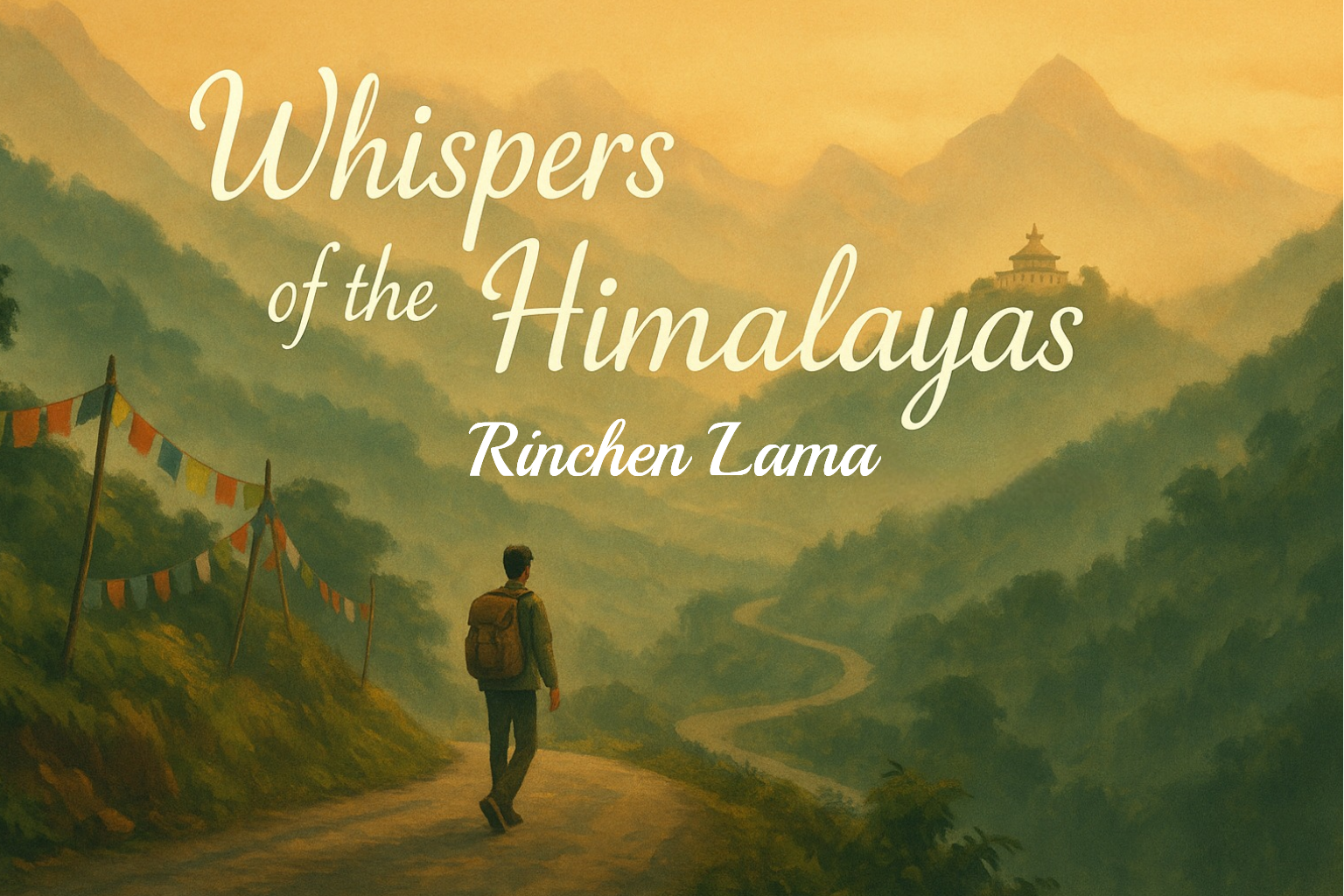

Rinchen Lama
1
I hadn’t planned to go to Sikkim. In fact, Sikkim was a word that had only floated around in conversations—half-remembered from childhood geography classes or heard during travel shows playing in the background of my mother’s living room. What I had planned, after six years of numbing spreadsheets and artificial smiles in a Mumbai office, was to disappear for a while. Not forever, but long enough to breathe air that wasn’t laced with ambition or dust. The idea came quietly, like mist crawling over a windowpane. I was sitting in a mind-numbingly boring client pitch when my phone buzzed—a friend had posted a picture from Ravangla, standing in front of a towering Buddha statue framed by snow. “Reset,” the caption said. That single word hit me harder than any motivational quote ever had. That evening, I closed my laptop, cancelled all meetings for the next ten days, and booked a ticket to Bagdogra. No grand plans, no itinerary, no expectations—just a one-way ticket and a yearning to feel small beneath mountains. As my flight descended into Bagdogra, the clouds parted to reveal the beginning of the mighty Eastern Himalayas. They didn’t rise dramatically like in the movies; they eased into the sky with ancient grace, layered in blue and white. A local cab was waiting—its driver holding a crumpled sign with my name, grinning as though he had been expecting me for years. “Gangtok?” he asked. “Yes,” I said, more to myself than him. And with that, we were off, leaving behind the plains and climbing steadily into the arms of the hills.
The road from Siliguri to Gangtok is a journey that doesn’t ask questions—it just unfolds. Tea gardens ripple past like green ocean waves, and the Teesta River, furious and wild, coils along the mountain’s base like a restless dragon. We stopped for chai at a dhaba just before Rongpo, where I tasted the first hint of the air that would define the days to come—cold, sharp, carrying the scent of pine and smoke. As we crossed into Sikkim proper, the architecture changed subtly—flat-roofed homes, prayer flags fluttering from balconies, mandalas painted on gates. The drive was silent, except for the occasional cough of the engine and the soft Nepali music the driver played. It was in that silence that something inside me began to loosen. I wasn’t yet at my destination, but already, the weight I carried in my shoulders seemed to have lightened. Gangtok revealed itself slowly, perched on hillsides like a sleepy cat stretching at dusk. MG Marg was where I first stepped out. It was cleaner than any hill station I had seen, paved like a European promenade, with no cars allowed. Schoolchildren darted about, monks walked with quiet confidence, and tourists sipped coffee at modern cafés. I checked into a homestay in Vishal Gaon run by a Lepcha couple—Doma and Tenzing—who welcomed me not as a guest but as a long-lost relative. Their home smelled of fermented bamboo shoots and incense. That night, over a dinner of steaming thukpa and shyaphaley, I listened to them speak of spirits in the forests, of snow leopards glimpsed from rooftops, and of winters so harsh that entire villages would shut down to conserve firewood. I stepped onto their balcony just before bed, and for the first time, saw Kanchenjunga—a distant, ghostlike silhouette glowing under a silver moon. I stood there, barefoot and breathless, as the mountains whispered something ancient to me, something I couldn’t yet understand but would spend the rest of this journey trying to hear.
2
Morning came to Gangtok not in a blaze of light, but as a soft unveiling. The mountains did not announce the sun’s arrival; they merely allowed it to seep through, like a secret too precious to reveal all at once. I woke to the sound of faint chants echoing from a nearby monastery, rhythmic and otherworldly, as though the very hills were murmuring their ancient truths. Doma had already laid out breakfast on the wooden table: sel roti, boiled eggs, and a cup of salted butter tea that caught me off guard but quickly grew on me. “You should visit Rumtek today,” she said, as she carefully tied her woolen shawl. “It’s not just a monastery—it’s a place where time folds.” Her words lingered with me as I boarded a shared cab bound for the monastery, a maroon and yellow vehicle already filled with a mix of tourists and locals. The road to Rumtek climbed higher than I’d expected, winding like a hymn around hills laced with prayer flags. With every turn, Gangtok receded, replaced by terraced fields, whispering pine trees, and occasional herds of shaggy mountain goats blocking the way as if challenging us to prove we belonged. As we neared the monastery, a dense mist descended, not menacing but mystical, wrapping the world in gauze. I stepped out and was immediately struck by silence—not the absence of noise, but a full-bodied, sacred silence that seemed to exhale from the red-and-gold walls of Rumtek itself. The monastery stood like a sentinel of serenity, flanked by giant wheels of prayer that spun with the touch of a finger and sent thousands of mantras into the wind. I entered the main hall barefoot, my feet brushing against cool stone, and found myself surrounded by golden statues, thangka paintings, and the soft scent of incense. Monks young and old chanted in deep unison, their voices vibrating through the air like ripples on still water. I sat on the floor beside a group of pilgrims from Bhutan, none of whom spoke my language, yet all of whom offered me a quiet nod of inclusion. There was no need for words here. For the next hour, I simply breathed—each inhale and exhale syncing with the drumbeats and the resonant hum of a world far removed from mine.
Outside, the mist had thickened, blurring the edges of trees and temple spires. I wandered the grounds slowly, tracing the painted walls, watching a group of young monks play cricket in the courtyard with a rubber ball and laughter that echoed like temple bells. One of them, no more than nine years old, ran up to me and offered a butter cookie wrapped in newspaper. “For you,” he said with a grin, and ran off before I could thank him. I sat on a stone bench near the outer stupa and bit into the cookie. It was dry, crumbly, and delicious in its simplicity. The clouds moved like living creatures above me, parting just enough to reveal the snow-covered tip of a distant peak before swallowing it whole again. A bell rang from the watchtower, and I looked up to see an elderly monk performing a slow ritual of lighting butter lamps, his hands steady despite the chill. I found myself thinking not of where I had come from or what waited for me back in Mumbai, but of my grandfather, who used to wake at dawn to perform puja in a tiny room that smelled of camphor and devotion. It had been years since I’d thought of that room, but here, surrounded by chants and clouds, the memory returned as vividly as if it had never left. I realized, sitting there, that something inside me was uncoiling. Perhaps it was the stillness. Perhaps it was the realization that places like this didn’t just exist in photos—they were alive, breathing, waiting for people like me to arrive and remember. I stayed at Rumtek until the late afternoon when the sun finally managed to break through the mist, casting golden patterns on the courtyard stones. I took one last walk through the prayer wheels, spinning each one slowly and whispering a silent wish with each turn—not for success or love or wealth, but for clarity. On the ride back to Gangtok, I sat in silence, watching the hills blur into one another, the sky turning the color of saffron robes. That night, back at the homestay, Tenzing poured me a small glass of millet-based chhang and asked how the day had been. I didn’t have words, so I simply smiled and said, “Quiet.” He nodded in understanding. “Good. That means the mountains spoke to you.” And as I sipped the warm, slightly sour drink, I knew he was right. They had spoken—and I had listened.
3
The third morning in Gangtok dawned differently. I woke earlier than usual, not to the sound of chants or morning bustle, but to an unfamiliar silence, thick and expectant. The mountains outside the window were cloaked in a heavy fog, as if the world was still deciding whether or not to reveal itself. Doma met me in the kitchen with a flask of tea and a folded shawl. “You’re going to Tsomgo today,” she said, her voice gentler than usual. “Dress warm. The lake doesn’t just chill your bones—it stirs your soul.” There was something in her tone, something reverent, that made me tuck the shawl into my bag without question. Karma arrived just after sunrise, his Bolero already dusted with morning dew, and we began the ascent toward Tsomgo Lake. The road was steep, the turns sharp, and the landscape changed rapidly. Houses gave way to cliffs, forests to barren slopes speckled with frost. As we climbed higher, the air thinned, growing colder, cleaner, crisper. We stopped at a checkpoint near Kyongnosla, where my permit was stamped by a gruff but kind army officer who offered us steaming cups of chai. From there, the climb became steeper, and the mist grew thicker. Karma, ever the storyteller, spoke of the lake’s history—that it was once believed to be a mirror of destiny, that ancient shamans would gaze into its waters for visions. “Even now,” he said with a sideways glance, “some say the lake knows what’s inside your heart.” I didn’t respond, too lost in thought, watching as the trees thinned and the sky seemed to lower. And then, without warning, the lake appeared—not as a grand reveal, but like a memory resurfacing. Tsomgo Lake, nestled between the folds of stone and snow, was partially frozen, its edges glassy with frost, its center a still, dark mirror that reflected nothing yet seemed to see everything. I stepped out of the vehicle and was immediately greeted by silence—pure, unfiltered silence. No birdsong, no engines, just the whisper of wind brushing past the slopes. A row of yaks stood by the lakeside, draped in colorful blankets, their handlers offering rides to tourists who weren’t yet here. We were among the first arrivals, and the solitude was complete.
I walked slowly to the water’s edge, each step muffled by the snow-dusted ground. The lake shimmered under the shifting mist, and I knelt beside it, dipping my fingers into the icy water. It bit at my skin, sharp and sudden, but I didn’t pull away. I stared into the water and saw nothing. No reflection, no shape. Just an endless depth that seemed to whisper—not with sound, but with something older, deeper. I thought of my life back in Mumbai—the deadlines, the phone calls, the faces I passed without seeing. I thought of the person I had become: constantly running, endlessly connected, yet deeply lonely. And for a moment, I felt as though the lake saw all of it. It didn’t judge—it simply knew. Karma joined me and handed me a prayer flag, blue and frayed, with mantras printed in delicate script. “Tie it on that fence,” he said, pointing to a wooden rail where hundreds of other flags fluttered in the wind. “And let the wind take what you’re carrying.” I took the flag and stood there for a long time, the cold seeping through my boots. Finally, I tied it beside a red one that had faded almost to white. I whispered—not a prayer, but a confession: I don’t know what I’m looking for. And somehow, that was enough. The wind lifted the flag gently, as if in reply. We stayed by the lake for over an hour, walking its frozen edge, sipping salty tea from a roadside shack manned by a woman who smiled without asking questions. On our way back, we stopped at Baba Harbhajan Singh Mandir—a temple dedicated not to a god, but to a soldier. Karma explained how the soldier, though dead, was believed to still patrol the border, guarding his comrades. The temple was quiet, and the air inside was thick with reverence. I lit a candle and stood still, imagining what it meant to be remembered not just for living, but for protecting even in death. As we drove back toward Gangtok, the mist began to lift, revealing sun-drenched peaks and winding roads etched into eternity. I leaned against the window, exhausted but calm, as if something buried had been unearthed. That night, back in the homestay, I told Doma and Tenzing about the lake. They didn’t ask what I saw. They simply nodded. “Tsomgo shows different things to different people,” Tenzing said. “But always what they need to see.” I slept deeply that night, dreamless, wrapped in layers of wool and silence, while somewhere up in the mountains, a blue flag carried my unspoken truths into the wind.
4
The journey to North Sikkim began before sunrise, when the world was still half-asleep and the stars clung stubbornly to the sky. The Bolero waited in the driveway like a loyal beast, headlights cutting through the fading dark. Karma was already inside, rubbing his palms for warmth, a flask of chai wedged between the gearstick and the dashboard. “Today is a long ride,” he said. “The road to Lachung is not easy, but the sky there is different. It breathes.” With a bag packed with woolens, thermals, and a journal that had begun to fill itself with thoughts I didn’t know I had, I climbed in. The city lights of Gangtok faded behind us quickly, and the hills welcomed us with their usual quiet strength. As we drove north, the landscape began to transform. Where the east had been misty and meditative, the north was wild and raw, carved by wind and water into deep gorges and jagged cliffs. The road to Lachung coiled along the cliffs like a serpent made of tar and stone, bordered on one side by waterfalls that seemed to pour straight from the heavens, and on the other by sheer drops into river valleys a thousand feet below. We passed through sleepy hamlets—Mangan, Chungthang, Singhik—each village a splash of color in the otherwise grey palette of rocks and sky. Prayer flags danced above tin roofs, and children waved from the roadsides, their cheeks red from the cold. Around midday, we stopped at a roadside stall built entirely from salvaged wood and tarpaulin. A woman served us rice, dal, and dried bamboo shoot curry on tin plates, her toddler playing near the fire. She didn’t ask where we were from, or where we were going. She simply smiled and said, “Eat well. The road ahead is stronger than the stomach.” It was the kind of wisdom that didn’t need explanation. Back on the road, the fog began to roll in again, swallowing entire bends before we could reach them, and Karma slowed down to a crawl. “This road is known as the breathless stretch,” he muttered. “Because it takes yours.” And he was right. Just before sunset, we reached a narrow stretch of road where the valley opened wide to reveal the confluence of two rivers—Teesta and Lachung Chu. The moment stilled me. It wasn’t just the scale or the cold or the sheer majesty—it was the feeling that this place had never been seen the same way twice. That each traveler carried back a different image, a different silence. By the time we reached Lachung, night had already swept over the valley like ink spilled across canvas. The village nestled quietly beneath snow-draped peaks, its wooden houses glowing warmly from within. Our homestay, run by an old Bhutia couple, was built like a ship—creaky, warm, and full of stories. The room was basic, with heavy blankets and a small window that opened toward a mountain that had no name. Over dinner—potatoes cooked with chhurpi, fermented spinach, and hot barley soup—the couple shared tales of snowfall so thick that roofs collapsed under the weight, of wolves seen during deep winters, and of monks who walked barefoot into the wilderness and never returned. That night, I stood under a sky pierced with a thousand stars, the Milky Way draped like silk across the dark, and felt something ancient shift inside me. The cold pressed against my chest, but I didn’t shiver. I was not alone, even though I stood miles away from everything I had once called home.
The next morning began in stillness, the kind that blankets high-altitude places just before the sun dares to rise. I stepped out onto the balcony wrapped in a shawl, breath blooming in white clouds before me. The mountain that had been hidden the night before now stood revealed—massive, brooding, its slopes cascading down like frozen waterfalls. Karma joined me quietly and pointed toward the far edge of the horizon. “That ridge there,” he said, “is the path to Yumthang. The Valley of Flowers. But now, it is a valley of snow.” After a quick breakfast of boiled eggs and flatbread, we began the drive to Yumthang Valley. The road was barely visible beneath patches of melting snow and frozen mud, and the air grew thinner with each passing turn. As we climbed higher, the trees began to vanish—first the pines, then the shrubs, until only low-lying bushes clung to the earth, shivering in the wind. And then, suddenly, the valley opened up—a white bowl nestled between giants. Yumthang in winter is a sight that defies adjectives. It is not just beautiful; it is otherworldly. The river Lachung Chu snakes through the valley like a vein of silver, partially frozen in parts, running defiantly in others. Snow blankets everything—boulders, branches, bridges—turning even the ugliest structure into a sculpture of peace. I stepped out and immediately sank ankle-deep into fresh snow. No sound. No movement. Just the sound of my own heartbeat and the faint creak of snow underfoot. I walked toward the riverbank, where someone had placed a lone prayer flag on a stick. It fluttered gently, the only color in the vast expanse of white. And then, without warning, it began to snow. Not a storm—just soft, lazy flakes drifting down like forgotten memories. I tilted my head back and closed my eyes, letting the snow settle on my lashes, my lips. There was something about Yumthang that didn’t feel like a place, but a presence. As if the valley watched, remembered, and forgave. We stayed there for hours, walking in slow silence, stopping now and then to take in the sheer impossibility of it all. On the way back, we passed a cluster of army tents, and Karma saluted the guards without words. “They stay here through everything,” he said quietly. “Blizzards, landslides, loneliness. They keep the roads open. They don’t go viral. But they hold the country together.” His voice cracked slightly, and I understood then that Sikkim was not just about mountains and monasteries. It was about resilience, about dignity in silence. That evening, back in Lachung, I sat by the wooden stove and scribbled in my journal, trying to describe what I had seen. But no words came close. Only drawings—sketches of snow-covered paths, of a lone flag beside a frozen river, of a sky stitched with stars. That night, as I fell asleep wrapped in layers of wool and reverence, I realized I was no longer just passing through these mountains. A part of me was staying behind, tucked into the quiet of Yumthang, folded into its falling snow, watching the world breathe through its timeless stillness.
5
The road from Lachung to Lachen was not just another route; it was a descent into something deeper, colder, quieter—a different side of Sikkim that didn’t speak unless spoken to, and even then, only in riddles. We left before dawn, wrapped in mufflers and layered jackets, with the Bolero’s headlights cutting narrow paths through the morning fog. Karma drove in silence, his hands steady on the wheel, his eyes scanning the mountain road with the calm intensity of someone who had come to know every corner, every landslide, every rockslide scar. “Lachen is older,” he said after a long pause, as we passed a weather-beaten signboard written in faded paint. “Not in years. In feeling. You’ll see.” As we wound higher, the vegetation changed again—pines giving way to stubby oaks, then to nothing at all but wind and scattered stones. The rivers flowed deeper here, faster, wilder, and always by our side like a companion that remembered stories no one else dared to tell. We crossed wooden bridges over thunderous gorges where the water was so loud it felt like the heartbeat of the earth. Along the roadside, shrines stood in solitude—painted stones, bundles of incense, offerings of rice and cloth—silent testimonies to the travelers who hadn’t made it, and to those who had. By midmorning, the sun struggled to push through a veil of clouds, casting a diffused glow over the slopes as we reached Lachen—a high-altitude village perched like a monk on a ledge, watching centuries pass by. Unlike the cozy warmth of Lachung, Lachen was austere, bone-chilling, reserved. The wooden homes were wider here, windows smaller, built to withstand more than cold—perhaps time itself. We stayed with a monk-turned-host who had traded his monastery robes for a kitchen apron but still carried a serenity in his gaze that no other occupation could erase. He welcomed us with tsampa porridge and thick butter tea, and when I asked about the cold, he simply said, “It teaches you what matters.” The afternoon was spent walking through narrow lanes flanked by prayer wheels that hadn’t stopped spinning for decades, fluttering flags, and the quiet murmur of villagers who nodded without smiling, as if happiness was something too personal to show freely but too sacred not to feel. That night, I sat outside our room, wrapped in three layers of wool, watching the stars as they emerged above jagged peaks. They weren’t stars like the ones back home—they were brighter, closer, as if they belonged to the people here, not to the sky. A little boy selling boiled eggs on the corner approached me and said, “You’re going to Gurudongmar tomorrow?” I nodded. He looked at the sky, then at me. “The lake knows who you are.” Then he walked away, leaving behind a question that echoed louder than anything I’d heard in days.
The drive to Gurudongmar Lake began while the village still slept, the only light from the vehicle’s beams and Karma’s small prayer lamp flickering on the dashboard. We carried oxygen cylinders in the back—precautions for the brutal altitude that awaited us, for the lake sat above 17,000 feet, in a realm where breath itself was borrowed. The ascent was fierce. The road turned from gravel to stone, from stone to ice, and finally to what felt like the surface of another planet. Snow-covered plains stretched endlessly on both sides, dotted with the silhouettes of grazing yaks and the distant specks of army camps, silent and selfless in their isolation. We passed checkpoints where jawans greeted us with the soft dignity only those who had stared into white nothingness could possess. The wind up here howled like memory—sharp, cutting, ancient. When we finally reached Gurudongmar, it didn’t feel like arrival. It felt like intrusion. The lake appeared suddenly, like a vision: a sheet of frozen turquoise ringed by mountains blackened by wind and ice, an expanse so vast and silent that it seemed to swallow thought. I stepped out and immediately felt the altitude press against my lungs like an invisible weight. Each breath was hard-won, each movement deliberate. But I walked toward the lake slowly, drawn by something I couldn’t name. The surface was mostly frozen, but at its center, there remained a pool of unfrozen water—clear, deep, undisturbed. Legend said Guru Padmasambhava had touched this spot, blessing it so it would never freeze completely, a symbol of resilience and belief. I knelt beside the water, my fingers trembling from cold and reverence, and stared into it. There was no reflection—only depth, only questions. I thought of the boy’s words the night before, “The lake knows who you are.” And suddenly, I wasn’t just a traveler. I was every version of myself I had tried to forget. I was the mistakes I had buried, the dreams I had dismissed, the love I had lost, the silence I had embraced. And yet, I felt no shame. Only stillness. Only truth. Karma stood a few steps behind me, hands folded in prayer. Neither of us spoke. There was nothing to say. On the way back, we barely exchanged words. The lake stayed with us, like snow stuck in the soles of our boots, like a memory etched in ice. That night, back in Lachen, I couldn’t sleep. Not from the cold, but from the realization that I was changing. The mountains weren’t just places. They were mirrors. And Gurudongmar had shown me a reflection that wasn’t beautiful, but honest. I spent the night writing by candlelight, not to capture what I’d seen, but to remember how it had made me feel. The next morning, as the first rays of light kissed the frost-covered village, I stood by the window and whispered, “Thank you.” I wasn’t sure who I was thanking—the mountains, the lake, the journey, or simply the silence—but it didn’t matter. In that moment, everything did.
6
We left Lachen with silence packed into the seams of our jackets, the kind of silence that doesn’t beg to be broken but demands to be carried. Karma said nothing for the first two hours of the drive; nor did I. The memory of Gurudongmar had settled in our lungs like the altitude, heavy and persistent, lingering long after we’d descended. As the road unwound southward again, the landscape began to warm—not in temperature, but in texture. Sharp, unforgiving rocks gave way to softer slopes, forests crept back onto the hillsides, and the river resumed its song, now more of a lullaby than the roar it had been in the north. Our destination was the western district of Sikkim—Pelling, a name whispered by travelers with a reverence usually reserved for temples. The road meandered past Namok, through Ravangla, a town suspended between cloud and pine. We stopped briefly to stretch our legs and sip tea at a shack run by a blind man who told us he could sense people by how they held their cups. “You’re gentle,” he said, handing me a paper cup. “You’re carrying something too big for your shoulders, but you haven’t put it down yet.” I didn’t ask how he knew. People in the mountains didn’t need sight to see. The air began to smell different as we approached Pelling—wet pine, burnt incense, and something that felt like old pages. Our homestay overlooked a massive green valley that stretched endlessly until it vanished into clouds. Just above us stood Pemayangtse Monastery, perched on a hill like a guardian of lost time. That evening, I climbed the stone steps to its gate alone. Karma stayed behind, claiming he’d been enough times, but I sensed he was giving me space to meet the monastery without interference. The building was ancient, its wood darkened by time, its paintings faded but still alive. Prayer flags fluttered overhead, each gust of wind sending mantras into the dusk. Inside, it smelled of butter lamps, old prayer books, and yak wool. A young monk sat in the corner chanting from a manuscript that looked older than the Republic. I didn’t want to interrupt him, but he looked up and smiled, nodding as if he’d been expecting me. He motioned for me to sit. I did. We sat there for what felt like an hour—me absorbing the stillness, he reciting his verses, the syllables rising and falling like waves on an ancient ocean. When he finished, he asked, “You’re trying to remember something, aren’t you?” I blinked. “I don’t know what exactly.” He nodded, as if that was the right answer. “The mountains remember for us,” he said. “That’s why they call us back.” As I stepped outside, the sky had darkened into velvet, and the stars appeared slowly like distant monks lighting lamps one by one.
The next morning, we visited the ruins of Rabdentse—Sikkim’s old capital, now reclaimed by the forest. Trees grew where thrones once stood, vines curled around stones once carved with royal intent. There was a ghostliness to the place—not frightening, but reflective, like a place caught in meditation. Karma walked ahead while I lingered by the foundations of the palace. It struck me how kingdoms rise and vanish, but the wind stays. The view from the top overlooked layers of hills folding into each other like secrets, and for a moment, I imagined what it would’ve been like to be a ruler here, watching your world both protected and isolated by such terrain. On the way back, we visited Sangachoeling Monastery, accessible only by a steep uphill trek through dense forest. We climbed in near silence, only our breaths and the crunch of gravel beneath our boots marking our passage. At the top, the monastery stood modest, not grand like Pemayangtse, but possessing a humility that made it feel more human. A single monk tended to the courtyard, sweeping leaves in slow arcs. He looked up and gave a small wave, then continued his work, his rhythm unbroken. Inside, I found a wooden bench by the window and sat, watching the clouds crawl across the horizon like pilgrims with no destination. A child monk came in, placed a butter lamp on the altar, and smiled shyly before vanishing behind a door. I closed my eyes and listened—not just to the silence, but to what was beneath it. Faint chants from deeper within the monastery. The rustle of robes. The gentle creak of wood under age. I realized then that monasteries were not buildings, but memories—living, breathing archives of a people’s relationship with time and space. That night, back in Pelling, I had a dream that I was walking through fog with my hands stretched out and someone, somewhere, was guiding me—not with words, but with breath, steady and warm. I woke up with tears on my cheeks and an ache in my chest that I couldn’t explain. I went outside and looked toward the mountains, now only vague shapes in the blue darkness. I whispered the names of places I’d been—Gangtok, Tsomgo, Lachung, Gurudongmar, Pelling—as if they were spells, charms strung along a necklace of remembrance. And with each name, I felt a thread pull tighter, drawing me further into a journey that was no longer just about places on a map. It was about echoes—of prayers, of footsteps, of truths too quiet for city ears. I didn’t know where the road would lead next. But I knew I had to follow.
7
We left Pelling before dawn, not because the road demanded it, but because the sky had turned, heavy with the kind of clouds that announced not a passing drizzle but a prolonged surrender. The hills were wrapped in grey veils, and the trees stood dripping like mourners caught between prayer and silence. Karma, wrapped in his old army poncho, handed me a pair of waterproof boots and simply said, “Today, the mountains test your patience.” Our next destination was Yuksom, the historic cradle of Sikkim’s monarchy, and a place whispered about in legends of saints, kings, and oracles. The drive was slow, the road a tangle of mist and slippery curves, each turn revealing a deeper shade of green—lush, glistening, infinite. Waterfalls poured from every crevice in the hillsides like the mountains were weeping all at once, and we passed through villages that seemed stitched to the land with roots rather than foundations. Children played barefoot in puddles, monks huddled under red umbrellas, and prayer flags flapped like soaked pages trying to dry their stories. When we finally reached Yuksom, it didn’t feel like an arrival. It felt like a return to something ancient, like stepping onto a page that had been waiting for my footprints for years. The village was a handful of houses, all wooden and low-roofed, crouched against the hillside as if in reverence. We checked into a monastery guesthouse, where a young lama with a gap-toothed smile handed me a warm towel and said, “The rain here teaches the mind to sit still.” That afternoon, I walked alone to Norbugang Chorten—the coronation throne of the first Chogyal of Sikkim, a spot surrounded by centuries-old pine trees and wrapped in the eternal hush of ceremony long concluded but never truly finished. The stones were slick with rain, but I knelt anyway, my jeans soaking through, my palms resting on the moss-covered edges of the throne. I imagined the monk who had anointed the king, the chants that had echoed through the forest, the collective breath held by trees and birds alike. Nothing about it felt distant. It felt like a memory I had inherited, like a fragment of belonging passed down not by blood, but by breath. As thunder rumbled across the valley, I closed my eyes and whispered—not a prayer, but a confession: “I came here looking for something, and I don’t know what it is.” Somewhere behind me, a branch snapped, or maybe it was the sound of the past breaking through the present. I stood up, bowed low to the throne, and made my way back down, heart heavy but clear.
The rain didn’t stop for days. It was as if the sky had forgotten any other way to be. We stayed in Yuksom longer than planned, caught between landslides and slippery paths, and in that waiting, I found the slow rhythm of the village—tea served in copper mugs, monks chanting before breakfast, dogs that slept like monks and monks who laughed like children. On the third morning, Karma took me to meet an old woman who lived near Dubdi Monastery, a reclusive oracle known only as Ama Choden. “She speaks when the clouds hide the peaks,” Karma said cryptically, and sure enough, that morning the mountains were veiled completely. We climbed through dense forest trails to her hut, guided by the sound of wind chimes and the scent of burnt juniper. Ama Choden was impossibly old, her eyes milky but alert, her voice raspy like parchment. She didn’t ask for names or purpose. She took my hand, turned it palm up, and said, “You are too full of noise. That is why you came to the land of silence.” Then she offered me a bowl of butter tea, placed her fingers gently on my forehead, and began humming—soft, low, vibrating into the center of my chest. I don’t know how long I sat there, but when she pulled her hand away, I felt emptier, but lighter, as though something inside had been dislodged and set free. “Go to Tashiding,” she whispered, “and don’t speak until you reach the stupa.” That night, the rain fell harder than ever, and I couldn’t sleep. I wrote until dawn—pages of things I didn’t know I had been carrying: regrets, names, places, the image of a face I hadn’t seen in years. When we left for Tashiding the next morning, I kept my promise. Not a word left my lips. The path wound through thickets, up stone staircases slippery with moss, past abandoned prayer wheels, and then—suddenly—there it was. The Tashiding Monastery sat on a ridge, wreathed in mist, with the holy stupa at its heart—silent, immense, weathered by centuries of devotion. I walked to it slowly, bowed, and sat cross-legged in the mud. I didn’t chant. I didn’t pray. I just sat, and listened. And in that silence, I heard something: not words, but permission. Permission to forgive myself. Permission to remember without guilt. Permission to be here. As the clouds finally parted for a moment, revealing the distant white curve of Mt. Pandim, a single tear rolled down my cheek—not from sadness, but from surrender. The mountains hadn’t just whispered. They had spoken. And I had, finally, heard them.
8
The final leg of our journey began not with a departure, but with a pause—the kind that stretches like twilight over the hills, long and reluctant, soaking into skin and memory. We left Yuksom with the sky still grey but gentler, its rains reduced to a soft drizzle like a last benediction. Karma didn’t say much, and neither did I. The air between us was quiet, not with absence, but with presence—thick with everything that had passed between mist and monasteries, between lakes and lungs, between footsteps and silences. We were headed to Namchi, the southern heart of Sikkim, a town known for its blend of myth and modernity, its sprawling Buddha Park, and its sweeping views of the Rangeet valley. The road curved less sharply here, winding through tea gardens that spilled down the hills like green lace and villages painted in bright pastels—lavender roofs, teal walls, saffron railings—as if the people here had decided to color their world louder to make up for the frequent mist. Along the way, we stopped at Temi Tea Garden, a place that smelled of monsoon soil and memory. I walked alone among the rows, palms brushing wet leaves, each step rustling with stories whispered by pluckers and winds. Karma pointed out a small tea stall near the bend and insisted we sip a fresh cup before moving on. As we sat there, watching low clouds chase each other across the valley, I asked him, almost without thinking, “Why do you stay here?” He smiled, eyes on the horizon. “Because here, you don’t lose yourself. You return to yourself.” The words hit something deep—an unnamed ache, a forgotten corner. We reached Namchi by late afternoon. The town, though more developed than the villages we had crossed, still carried a rhythm that was unhurried, thoughtful. Our hotel overlooked the Char Dham complex—where a towering statue of Lord Shiva stood atop Solophok Hill, surrounded by replicas of India’s sacred shrines. It was surreal, almost theatrical, but not without reverence. I visited at sunset, walking barefoot along the marble paths, the chants playing softly through hidden speakers, the lights casting long shadows of the gods across the courtyard. And yet, even amidst this grandeur, what moved me most was a small alcove beneath the main temple, where a child sat alone, drawing the hills with charcoal on a crumpled piece of paper. When I smiled, he looked up and whispered, “I want to live in the sky.” I didn’t know what to say, so I nodded. Somehow, I understood.
That night, as Karma and I ate our final dinner together in a quiet restaurant tucked away near the bazaar, he raised a toast with his cup of tongba and said, “Tomorrow, you return. But only your body.” I laughed, but the truth in his voice stilled me. I looked out the window and saw the lights of Namchi blinking like quiet stars, scattered over dark slopes. I thought of everything—the honking chaos of Gangtok, the cold breath of Gurudongmar, the misted eyes of Ama Choden, the boy selling eggs in Lachen, the monk who chanted without expectation, the trees that remembered the coronation of kings, the rivers that never once paused. I thought of the silence. How it had followed me. How it had seeped into me. And how I was no longer afraid of it. Early the next morning, I stood at the edge of Samdruptse Hill, where another giant statue—Guru Padmasambhava, the patron saint of Sikkim—looked out over the valleys with a gaze both fierce and compassionate. The clouds broke momentarily, and shafts of golden light poured over the hills like a curtain lifting on a final act. I stood there for what felt like hours, and when it was time to go, I didn’t cry. There are some goodbyes that don’t need tears—just breath, just thanks. Karma dropped me off at Bagdogra airport without drama. We shook hands, and then he pulled me in for a brief hug. “The mountains are never done with you,” he said. “They just wait until you’re ready again.” Inside the terminal, I sat by the window and watched the Himalayas retreat into the haze, no longer peaks or trails or temples, but something softer. Something like home. As the plane took off, lifting me above the ridgelines and rivers, I closed my eyes and whispered, “I’ll carry you with me.” Because I knew I would. In the rhythm of footsteps on city sidewalks. In the quiet moments between meetings. In the sip of hot tea on a rainy afternoon. In dreams of fog and flags and frozen lakes. And in the silence—the vast, featherlight silence—that would always hum beneath everything else, reminding me where I had been, and who I had become.
-End-