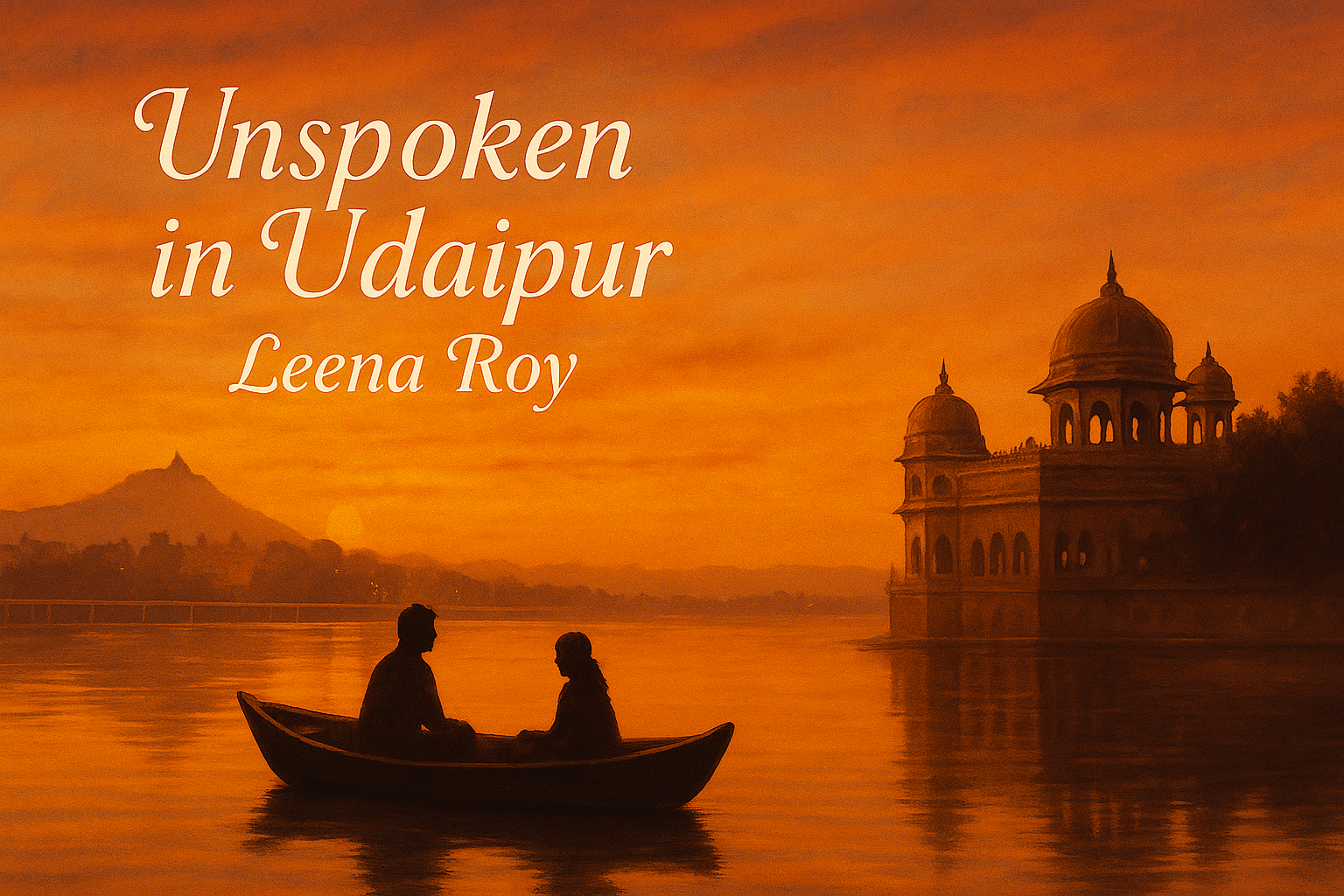

Leena Roy
ONE
The air was thick with the scent of wet stone and jasmine as Clara Reynolds stepped off the rickety bus that had rumbled its way from Jaipur through dust, thunder, and time. Udaipur rose before her like a faded painting—its cream-colored palaces floating on mirrored lakes, its crooked alleys climbing hillsides like vines searching for sunlight. She pulled her rucksack tighter over her shoulders and adjusted the scarf around her neck, a habit she’d picked up to blend in, or perhaps to hide in. The city seemed drenched in something beyond rain—melancholy, perhaps, or memory. Raindrops clung to the wrought-iron balconies overhead, dripping in patient rhythm. Tuk-tuks honked lazily at each other. Somewhere nearby, the faint twang of a sitar echoed off the cobbled streets. She didn’t have a plan beyond her modest guesthouse near Lake Pichola, and that was how she preferred it. Clara had stopped traveling with itineraries a year ago. They always betrayed her with unmet expectations. She had come here for the quiet, but already, Udaipur felt louder than the cities she’d left behind—not in noise, but in presence. There was something about the way the city looked back at her.
By late afternoon, the rain had turned to a whisper, and Clara found herself in a modest chai stall by the lake, scribbling absentmindedly in her journal. She wrote not about the places she saw, but the feelings they left behind. That day, she wrote only one word: suspended. She sipped her cardamom chai slowly, watching a pair of boys fly a neon green kite from a distant rooftop. The wind caught it just right, sending it higher than the rooftops, higher than the temple spires. She smiled without realizing it. Her gaze drifted toward the promenade where a small film crew had set up. Nothing elaborate—just a man with a shoulder-mounted camera, filming an old woman singing into the wind. Her voice was cracked and deep, full of something ancestral. Clara couldn’t hear the lyrics, but she felt the story in it. The man behind the camera was still, focused, barely blinking. He didn’t direct, didn’t interrupt. He simply let the moment unfold. Something about his quiet reverence stirred Clara. As he panned the camera and looked toward the lake, his eyes briefly met hers. Not long enough to say anything, not short enough to forget. Then he turned back to his work, and Clara looked down at her tea, heart inexplicably quickened. She didn’t believe in fate, but she believed in presence—and his had felt strangely familiar.
Night fell like ink on parchment, and the city shimmered in its reflection. Boats with fairy lights cut through the lake, and temples glowed with evening lamps. Clara checked into her guesthouse, its terrace overlooking the water, and stood there under a fraying red awning. A small festival echoed in the distance—bells, flutes, laughter rolling like marbles down narrow lanes. She didn’t go. She stood watching the city breathe. She wondered if the filmmaker was somewhere nearby, listening to the same rain return as a hush on the rooftops. In her sketchbook, she drew the old woman’s face, then shaded the space beside her—nothing specific, just a silhouette holding a camera. She didn’t know why. She never sketched people she didn’t know. Maybe it was the way the moment had framed itself: the song, the stillness, the stranger. She closed the notebook with a soft snap, then lay in the dark with the windows open, letting the city’s nocturne lull her. Sleep came slowly, carrying dreams of faded murals, stone steps vanishing into the lake, and a man with quiet eyes who looked at the world like it was always about to vanish. Somewhere in Udaipur, something unspoken had begun.
TWO
The morning after the rain felt strangely new, as though the city had shed a layer of dust in the night. Clara walked with a camera slung over her neck and her sketchbook tucked under her arm, her steps unhurried through the labyrinth of Udaipur’s old city. The narrow alleys seemed to breathe in rhythm with her curiosity—painted doorways in turquoise and mustard yellow opened onto courtyards where pigeons gathered like old friends. Her fingers brushed against the textured walls as she walked, almost as if she was reading the city in braille. She found herself outside Bagore Ki Haveli, a sprawling heritage museum she’d read about only in passing but decided on a whim to explore. Inside, it was a trove of echoes—echoes of music, dance, noble lives long gone. She moved from room to room slowly, reading plaques but more absorbed by the worn expressions in faded photographs. The haveli’s old windows opened to sunlight that poured in through lattices, painting the marble floors in delicate shadows. It was in one such sun-dappled corridor that she heard it again—that same old woman’s voice, recorded and playing from a corner exhibit on tribal folk songs. Clara turned instinctively, and there he was.
Ankur stood at the far end of the room, his camera bag slung across one shoulder, adjusting settings on a tripod he had already half-assembled. He hadn’t seen her yet. For a long moment, Clara just watched him—his movements were careful, like someone setting up not just a shot but an atmosphere. He was dressed in an earth-colored kurta and faded jeans, and the analog camera from yesterday hung beside a digital one. There was something about him that refused to chase attention, yet drew it anyway. Clara cleared her throat softly, and Ankur looked up. Recognition flickered between them like the glint of lake water at noon. He offered a small nod, the corners of his mouth twitching into the beginning of a smile. “We keep crossing paths,” Clara said, stepping closer. “Or maybe the city is small,” he replied, voice deeper than she expected, smooth like slow jazz. They introduced themselves, names exchanged like pages from different novels meeting mid-chapter. “Documentary filmmaker,” he said when she asked. “I’m working on a project about disappearing musical traditions. This haveli has archived recordings that are… fragments, really. Like ghosts of voices.” Clara didn’t know what to say to that, so she simply said, “I write. Travel things. Small things.” They spent the next hour walking through exhibits, occasionally stopping to share an observation. There was something about the rhythm of walking beside him—neither forced nor expectant. He didn’t fill silences unnecessarily, and she didn’t feel the need to perform interest. At one point, they both stood quietly before an old charcoal portrait of a court dancer, her eyes looking away from the frame. “Some images carry secrets,” he said softly. “This one’s whispering.” Clara smiled faintly and didn’t ask what it said.
Outside the museum, the day had tilted toward golden. They walked along the lakeside promenade, and without any discussion, ended up at the same chai stall as the day before. This time, they sat together. The stall owner didn’t ask for their order—perhaps recognizing her, perhaps sensing the quiet between them was sacred in its own way. Clara learned that Ankur had been in Udaipur for a week already, and he was leaving soon for a shoot in Kutch. He learned that Clara had no fixed destination. “I decide based on whether I sleep well or not,” she said, stirring sugar into her tea. He laughed—a short, breathy sound that startled her by how warm it felt. They talked about their first cameras—hers a gift from her grandfather, his an inheritance. About how some places felt like déjà vu before you even arrived. About silence. About what it meant to leave and not return. There were no confessions, no heavy personal histories. But every glance, every pause felt like a soft touch to the edge of something unspoken. As the sky darkened into that particular shade of dusk that only Udaipur seemed to wear—mauve turning into indigo above the water—they both leaned on the railing beside the lake. Streetlamps flickered on. Somewhere behind them, the echo of temple bells carried into the wind. Ankur lifted his camera, not pointing it at her but toward the reflection of a passing boat. “Do you always film things that might disappear?” she asked, voice almost lost in the hum of the city. He didn’t turn but answered, “Only the things I’m afraid to forget.” Clara said nothing, just looked at him for a long moment. He finally turned and held her gaze—not searching, not asking. Just holding it. The lake moved behind them, gentle ripples catching stars that hadn’t even appeared yet. For the second time in as many days, they parted without saying anything final. Only this time, they both looked back.
THREE
The following day stretched wide and slow, the kind of day that trickled rather than rushed. Clara spent her morning wandering the bazaars of Hathipole, drawn to the chaotic poetry of it all—street vendors balancing pyramids of spices, walls stacked with mirror-embroidered textiles that shimmered like falling stars, and the voices of shopkeepers weaving through it all with practiced rhythm. She didn’t buy much. She rarely did. For her, the market was more symphony than transaction. By noon, the sun pressed heavy on the city’s shoulders, and Clara retreated to her guesthouse terrace, sketching rooftops with their laundry lines fluttering like miniature flags of invisible nations. Udaipur felt denser today—not in a suffocating way, but in the sense that the air was holding onto something. A thickness of meaning, perhaps. As the light began its slow descent toward evening, a quiet restlessness rose in her. Something inside nudged her toward the water again, toward Lake Pichola and its boats that sliced through memory. She made her way there without planning to, as if the city was gently guiding her steps. Reaching the docks, she saw that the last public boat ride of the evening was about to depart. It wasn’t part of her plan. But then again, plans had long stopped mattering. She bought a ticket, stepped aboard, and took her seat at the far end of the wooden bench, clutching her sketchbook, feeling like she was about to step into a memory she hadn’t lived yet.
The boat moved with deliberate grace, gliding over the lake’s surface like a finger tracing the edge of a secret. Water lapped softly against the hull, and the sky above them turned that impossible blend of gold and smoke. The City Palace glowed on one side like something caught between fire and stone. As Clara looked across the lake, she caught her breath—there he was. Ankur stood on the other side of the boat, his camera lowered, eyes scanning the horizon, then landing on her with quiet recognition. Neither of them looked surprised. It felt, somehow, as if the city had arranged this. He crossed over and sat beside her without asking. The silence between them was immediate and full. He raised his camera for a moment, looked through the viewfinder, then slowly lowered it without taking the shot. “Some moments are better left unframed,” he murmured. Clara smiled but didn’t respond. Their shoulders barely touched, but the closeness felt intimate, wrapped in the shared hush of water and twilight. Around them, other tourists pointed at palaces and took selfies, but Clara and Ankur seemed to occupy a separate stillness, as if they were both watching a film only they could see. The boat passed Jag Mandir, its white domes floating like a dream. A breeze carried the scent of damp marble and rosewater. “Do you ever get tired of chasing beauty?” she asked softly. Ankur turned to her, thoughtful. “I don’t chase it,” he said. “I wait for it to speak. And sometimes it speaks through people.” She felt the words settle inside her like stones at the bottom of a lake.
As the boat began its slow circle back, the sky deepened into a cobalt hush, the first stars appearing like shy notes in a fading song. Clara hugged her sketchbook to her chest, and Ankur reached into his bag to pull out a small voice recorder. He pressed it gently between them. “Ambient sound,” he explained. “Each lake sounds different. You can hear the age of a city in its water.” They sat like that, recording the lake’s whisper, not speaking. It was the kind of silence that wrapped around them without need for filling. When the boat docked, neither made a move to leave first. Eventually, Clara stood, and he followed. The streetlamps blinked to life one by one along the promenade, casting long shadows like threads from another realm. They didn’t ask what the other was doing next. Instead, they simply walked together—no decision made, no words exchanged, just a shared sense that parting wasn’t yet the right ending. They passed narrow alleys where shopkeepers rolled down shutters, past a street artist painting a portrait in the glow of a flickering bulb, and past a small temple where a woman rang a bell that echoed like a heartbeat. When they finally reached the fork in the road—his guesthouse one way, hers the other—they paused. “I’m filming the folk puppet troupe tomorrow,” he said, his voice low. “There’s a performance in the old city courtyard.” Clara nodded. “I’ll come,” she said simply. No need for a promise. It was already understood. Then, quietly, they parted. No goodbye, no backward glance—because sometimes when something begins, the heart recognizes it long before the mind does.
FOUR
The courtyard in the heart of the old city was a tapestry of soft lantern light and ancient stone, the kind of space that held a thousand echoes and invited more. Low steps ringed the perimeter, and families and travelers alike gathered on them as dusk deepened, their murmurs weaving through the fading warmth of evening. Clara arrived just as the first puppet was lifted into the spotlight—a vibrant marionette in swirling Rajasthani dress, brought to life by the tug of invisible strings and the rhythm of ancestral hands. She spotted Ankur near the corner of the performance ring, crouched low with his camera, already lost to the moment. He didn’t look up, but something in the air shifted as if he knew she was there. Clara found a space on the steps and folded into it, letting the spectacle unfold before her. The puppet’s wooden limbs moved with a grace that was oddly human, as the puppeteer sang in a gravelled voice about love and exile, mischief and return. The children laughed, the elders watched in silent reverence, and Ankur moved in gentle arcs around them, capturing without intruding. Clara didn’t reach for her sketchbook. Instead, she watched the way Ankur looked at the world—steady, patient, deeply present. There was an art to that kind of seeing. As the performance ended and the small crowd trickled away, Clara remained seated. When Ankur finally straightened, stretching his limbs, their eyes met across the courtyard, and in that look was the soft certainty that they would walk again together tonight.
They wandered without direction, Udaipur once again becoming their shared language. The city glowed beneath an indigo sky, its narrow alleys painted silver by moonlight. They walked through arches and past shuttered stalls, the scent of spice and earth rising from the stones. Somewhere, faint music drifted from a balcony, a sitar or perhaps just the wind humming against strings. “Did you always want to be a filmmaker?” Clara asked as they crossed a stone bridge overlooking the lake. Ankur paused, the question rippling through him like the water below. “No,” he said after a moment. “At first, I wanted to be invisible. Observing was easier than participating. The camera became an excuse. A lens to hide behind, but also a lens that made me feel… useful.” Clara nodded, sensing the weight of that answer, though he offered it with gentleness. “And you?” he asked. “Why writing?” She smiled faintly. “Because speaking never came easy. Words lingered too long in my head. But when I wrote them down, they stopped haunting me.” Their footsteps echoed in unison as they turned down another quiet street. “Funny,” he added, “how we both picked silence in different forms—me in images, you in ink.” Clara laughed softly. “Maybe that’s why we don’t need to talk so much.” Ankur didn’t answer, but his gaze held hers a little longer. They stopped beside a small stepwell lit by hanging bulbs. Its water reflected the city like a secret reversed. They stood there a long time, not filling the night with noise, but simply being in it together.
Later, seated at a rooftop café overlooking the sleeping lake, their conversation deepened. A candle flickered between them, casting uneven shadows on their faces. They spoke not about the usual—travel, favorite places, or fleeting adventures—but about the spaces inside them that rarely saw light. Clara confessed that she sometimes feared disappearing—not literally, but emotionally—into the places she visited. “I leave before I’m remembered,” she said, stirring her tea slowly. “It’s easier that way. Less risk of being missed, or worse, forgotten.” Ankur nodded with a knowing in his eyes that needed no confirmation. “I often document things I know I’ll never fully understand,” he said. “It’s a strange ache—this knowing that something beautiful is slipping through your fingers as you try to honor it.” Clara rested her chin on her hand and studied him. “That’s what your films feel like,” she said. “Like you’re preserving grief without naming it.” He blinked, caught off guard by the precision of her words. “No one’s ever said that before,” he whispered. They sat for a while without speaking, the candle burning low. Then Ankur reached into his satchel and handed her a small set of headphones. “Listen,” he said, cueing a recording on his voice recorder. It was a layered soundscape—boat oars slicing water, temple bells, soft wind through bamboo, laughter in the background—Udaipur in fragments. Clara closed her eyes, letting the city wash through her in ways she hadn’t expected. When she opened them, Ankur was watching her not with the detachment of a filmmaker, but with something tender, uncertain, and unspoken. She didn’t break the gaze. The night curved around them like a secret held too long. And still, neither reached for goodbye.
FIVE
The next morning unfolded slowly, like silk unraveling under the sun. Clara woke to the scent of sandalwood and fried dough wafting in from the street below, her body still carrying the warmth of the rooftop conversation, the kind of intimacy that left no trace except in the breath. She rose, showered, and dressed in quiet thought, tucking her sketchbook into her sling bag and leaving her camera behind—a deliberate choice. She wasn’t in the mood to capture anything, only to feel it. By the time she stepped out, the day had begun to stretch its golden fingers across Udaipur’s domes and terraces. Ankur was already waiting at the chai stall, as if the morning itself had instructed him to be there. They greeted each other without words, smiles curling at the corners like ink on handmade paper. Today, they didn’t ask where to go or what to do. Their legs carried them up winding staircases, through hidden lanes marked by fading murals, past blue-painted doors and old men playing cards. Eventually, they found themselves on a rooftop café higher than the others, almost touching the sky. From up there, the city looked like a dream remembered from childhood—lakes like spilled mercury, temples poking the heavens, pigeons rising in sudden spirals. They sat in silence for a while, each tracing the world with their eyes. Ankur finally pulled out his camera, but instead of shooting, he offered it to Clara. “Here,” he said softly. “Your turn to see how it feels to observe unseen.” She hesitated, then took it gently, surprised by its weight, and raised it to her eye. The world shifted into frames and light, and for a moment, she saw what he saw—not just architecture, but emotion draped over it like forgotten prayer flags.
They spent the day like that—alternating between lenses and laughter, shared glances and soft meanderings. The hours slipped past unnoticed, each moment deepening into something neither had planned for but couldn’t turn from. Over lunch, sitting cross-legged on a terrace carpet under shade, they talked about love—not their own, but the idea of it. Clara spoke of fleeting romances from previous travels, names she no longer remembered, eyes that blurred into one another. “I always left first,” she said, sipping from a steel tumbler. “Before the questions started. Before the need to define anything.” Ankur looked away, then said, “I stayed too long once. Watched it rot. Sometimes staying can be more selfish than leaving.” The confession hung between them like a wind chime with one missing piece. Neither tried to fix it. Instead, they allowed the breeze to carry it where it would. Later, at a lakeside ghat where the evening drifted in like watercolor, Clara showed him pages from her sketchbook—the doorway she drew on her first day, the silhouette of the puppeteer, the lake shaped like a question mark. She flipped to the latest page: An outline of Ankur, seated with a camera, the city behind him like a broken halo. He looked at it a long time and said nothing. But his fingers touched the edge of the page with the same care he used on his camera. “I’ve never been drawn before,” he whispered. She didn’t reply. There were some things that shouldn’t be diluted by words. As dusk began to bloom and temple bells signaled the passing of another day, Ankur pulled a worn envelope from his satchel and handed it to her. Inside was a DVD, unlabeled. “My first film,” he said. “Never released. Never shown. I don’t even know why I brought it on this trip.” Clara turned it over in her hands, unsure what to say. “Why give it to me?” she finally asked. He looked at her with that familiar stillness. “Because you’ll understand it without asking me to explain.” The sun dipped below the hills, and the sky burst into a final flare of vermillion. The city exhaled. And so did they.
That night, they returned to the rooftop—not the café, but Ankur’s own guesthouse terrace, quiet and half-lit with a single lantern. They sat on the cold stone, barefoot, knees pulled up, with the DVD between them like an offering. Clara didn’t ask to watch it. She would later, alone, perhaps on some rainy night in a distant place. Instead, they shared the sky. Stars bloomed slowly above them, and the silence grew louder with things neither could say. “I leave tomorrow,” she said at last, breaking the hush like glass. “Pushkar. Then down south. I think.” Ankur nodded once. “I know.” He didn’t ask her to stay. She didn’t ask him to come. The purity of their bond lay in its impermanence. They leaned back, shoulders brushing lightly, hearts suddenly too close. “Maybe,” she said softly, “we were meant to meet like this. No promises. No endings. Just a frame within a city that never stays still.” Ankur turned to her, expression unreadable, and said, “Or maybe we’re a sentence that forgot its last word.” Neither smiled. There was no need to. In the quiet that followed, they simply existed beside each other—like two books on a shelf written in different languages but holding the same longing. Somewhere down below, a boat horn echoed across the lake. A streetlamp blinked. A pigeon took flight into the velvet night. And though neither of them moved, a part of each began to leave the other gently, like a photograph slowly fading at the edges.
SIX
The next day opened like a page in slow motion, light spilling through sheer curtains, and a silence that felt both full and fragile. Clara had already packed her bag by sunrise, not because she was in a hurry, but because the ritual of folding clothes, zipping compartments, and rolling socks into shoes gave her something to hold onto. Something finite. Outside, Udaipur was waking up—tea stalls grinding ginger, bells ringing from unseen courtyards, and motorbikes sputtering to life like yawns turned mechanical. Her guesthouse keeper asked if she needed help finding the bus station. Clara thanked him but declined; her plan was to walk, but not directly. She wanted to let the city say goodbye in its own language. Before stepping out, she placed the DVD Ankur had given her inside the inner sleeve of her sketchbook, the one place she always checked no matter where she went. It felt like tucking a heartbeat inside a notebook. She wore the same scarf she’d arrived in, not as a loop of cloth now, but as a story already told. By midmorning, she found herself near the Bansi Ghat again, drawn not by logic but by pull, and before she could stop herself, she had taken a small boat across to Jag Mandir—a floating palace so still it looked suspended between memory and marble. She had heard about its mirrored hallways, its stone elephants standing guard, and its gardens that curved with time, but today it felt different, like a place carved out of the need for closure.
Ankur was already there, camera hanging by his side but unused, standing near a window that overlooked the lake where they’d first shared silence. Clara approached slowly, her steps echoing against the polished stone, and when he turned to face her, neither of them smiled. They didn’t need to. Their meeting here felt orchestrated not by whim, but by something older, quieter—like the city had known how to fold them back into each other one last time. Without speaking, they walked into the palace together, the hush between them rich with tension that neither dared name. The mirrored corridors stretched endlessly, light bouncing from wall to wall, reflecting versions of themselves—distorted, multiplied, vanishing in angles. At one point, Clara stopped and looked into the glass. In the reflection, she saw not just herself but Ankur watching her from behind, and for a second, the image felt like a memory stolen from the future. “This place feels like it remembers people,” she said softly, almost to herself. “And forgets them in layers.” Ankur moved beside her. “It remembers the feelings,” he said. “Not the names.” They wandered through the echoing hall, their footsteps a duet. At the central pavilion, wind passed through carved latticework, scattering flower petals on the marble floor. A group of tourists passed by, but the two of them remained in their own sphere—held by something tender and dissolving. Clara turned to him suddenly, as if gathering courage from the silence. “If this were the end of a film, what would you call it?” she asked. Ankur looked at her for a long moment before answering, “The frame that blinked.” She didn’t ask what it meant. She only nodded, letting it settle.
They took the last boat back together, neither one saying it would be their last shared ride. The lake was soft and grey now, the sky overhead heavy with approaching rain again, just like the day they first saw each other. There was a symmetry to it that neither mentioned. When they reached the shore, Clara checked her phone’s time, then slipped it away. Her bus was in an hour. They walked slowly through the old lanes, past a mural of two peacocks facing each other, past the closed puppet courtyard, past the chai stall now being wiped down for the day’s end. Ankur paused by a quiet wall covered in moss and bougainvillea, pulling something from his pocket—a small photo, freshly printed. It was a still from one of his shots, clearly from the boat ride. In it, Clara wasn’t looking at the camera but at the water, her expression soft, almost unreadable. “I printed this last night,” he said. “It felt like the right thing to do.” She took it with both hands, her fingers brushing his, and stared at the image. She didn’t say thank you. Not out of rudeness, but because no thank you could hold what she wanted to say. Instead, she placed the photo inside her sketchbook next to his drawing. When they reached the fork in the road, the same one as before, they both stopped. “No promises,” she said quietly. “No promises,” he repeated. She leaned in and touched her forehead gently to his—not a kiss, not a farewell, just a pause in time. A still frame. Then she turned, walked away without looking back, and Ankur remained where he was, camera by his side, watching her vanish into the maze of lanes as the first drop of rain touched his shoulder. And still, neither of them said goodbye.
SEVEN
The bus station buzzed with the discordant rhythm of too many lives crossing paths and leaving in opposite directions. Clara stood amidst the hum of engines, chai wallahs shouting their last calls, and backpacks thudding against cement, but her world felt unusually still. Her ticket was folded neatly inside her passport, tucked into the front pocket of her sling bag like it had always belonged there, yet her fingers hovered over it absently. Her body moved on instinct—placing her bag on the platform bench, stepping into a small kiosk for water, returning to her seat—but her mind refused to follow. It lingered somewhere else, still perched on the rooftop from the night before, still echoing with Ankur’s voice and the way he had looked at her without needing to say a word. The hours had shrunk overnight, compressing into minutes that now felt unreasonably final. She hadn’t told him her departure time, and he hadn’t asked. That unspoken agreement—of not holding or halting each other—had been their only rule, and she respected it even as it ached. The sun was just beginning to rise over the city’s shoulders, casting a sleepy gold over temple domes and telephone wires, when Clara felt a presence beside her. She didn’t need to turn. She already knew.
Ankur sat down without a word, holding a small paper bag that carried the unmistakable scent of hot kachoris and sweet jalebi. “Breakfast,” he said simply, handing it to her. Clara looked at him, then took it gently, fingers brushing his in a way that said more than she meant them to. “You didn’t have to come,” she said, and he nodded in agreement. “I know.” They ate in quiet bites, steam rising from the food and the space between them. Around them, people moved in a blur—families bidding loud, tearful goodbyes, backpackers checking times and directions, conductors announcing destinations with mechanical certainty. But Clara and Ankur remained still, anchored in a silence that had always defined them. When they were done, he reached into his sling bag and pulled out a notebook—not hers, but one that looked very much like it belonged in the same world. “I took some notes this week,” he said, offering it to her. “Fragments. Moments. I thought maybe they’d find a home next to your sketches.” She opened the first page. Inside, in neat handwriting, were single lines of thought, each dated. ‘The sound of her laugh at the chai stall—like rain hitting wood.’ ‘She watches the world like it’s already a memory.’ ‘Some people don’t enter your life. They seep into it.’ Clara closed it before she read more. Her eyes didn’t sting, but her throat tightened in a way that made it hard to swallow. “Ankur,” she began, unsure how to finish.
He didn’t interrupt her, but instead reached for something else in his pocket. It was a polaroid this time—slightly blurred at the edges, the kind that refused to be perfect. It showed the two of them seated at the rooftop café, from behind, their silhouettes framed by lantern light and a sliver of moon. He handed it to her without commentary. “Just in case the memory fades,” he said. She took it, then held his gaze for a long time. “I don’t think this will,” she whispered. A honk sliced through the morning. Her bus had arrived. People began queuing, luggage being shoved into side compartments, names being called out. Clara stood. He stood too. They didn’t hug. They didn’t cry. The moment didn’t demand it. Instead, she stepped close and touched his chest lightly, over the spot where she imagined his thoughts lived. “You see people,” she said. “Not just film them. That matters more than you know.” He nodded once, eyes soft but unblinking. She turned, walked to the bus, handed her ticket over, and climbed the steps. When she reached her seat by the window, she looked out—and saw him still standing there. Not waving, not moving. Just standing. She pressed her hand lightly to the glass. He didn’t mirror it, but she saw his lips move—just barely. Perhaps her name. Perhaps nothing at all. The bus jolted forward. Udaipur began to slip away. And Clara, with the photo in her notebook and the sound of his stillness in her chest, let it.
EIGHT
Twelve months later, in the softened chill of a London spring, Clara stood before a glass door that led into a narrow art gallery tucked between two florist shops in Notting Hill. The wind tugged at her coat, sharp and playfully cruel, as if testing how much she remembered of warmth. She had seen the exhibition poster only a week earlier—a minimalist flyer tucked beneath a stack of secondhand books at a Saturday market. “India: Fragments of Stillness. Photographic Exhibition by Ankur Mehta.” Her hands had trembled when she pulled it free, the weight of a name she hadn’t spoken aloud in a year falling onto her like a whisper suddenly shouted. She didn’t hesitate to come, didn’t pause to wonder if it would be awkward or painful or disappointing. She had lived an entire year with silence in her spine, images half-developed in the darkroom of memory, and now she found herself crossing a threshold into something suspended—between past and possibility. The gallery was quiet, sparsely filled with patrons who walked slowly, thoughtfully, as if afraid to disturb the hush that hung in the air. The first photograph stopped her cold. It was Udaipur, unmistakably. A rooftop terrace bathed in evening light, with a tea glass still half-full, and a hand—only just visible—reaching for it. The next was a stepwell, deep and solemn, a pair of white sandals left on the edge. The third—Clara exhaled without realizing she’d been holding her breath—was her.
Not posed, not looking into the camera, but laughing, caught mid-laughter, eyes closed, face turned to something unseen. The frame was tight, intimate, the background a blur of rooftops and wind. There was a softness in the image that felt sacred, almost too much to witness. The caption beneath it read only: “Unspoken, Lake Pichola.” She felt something stir in her chest—a release and a pull all at once. It wasn’t vanity or nostalgia. It was something purer: recognition. Not of herself, but of a moment she hadn’t known was being preserved. As she moved through the gallery, every image was a breadcrumb along the path they’d once walked—lanes etched in shadow, puppet strings mid-motion, a boat half-shrouded in mist. None of them named her, but she was in them, not as a subject, but as an absence. The most haunting image of all was the final one: a pair of chairs side by side on a rooftop, one with a camera resting on it, the other empty, a sketchbook laid closed on the seat. That one had no caption. Clara stood before it the longest, her fingers twitching with the urge to touch it, to fall into it. “You came,” said a voice behind her. She didn’t need to turn. She recognized the tone as easily as she would her own reflection in water. When she finally turned, Ankur was there, wearing the same quiet around him, but something in his eyes had shifted—deeper, more open, as though time had gently folded him inward and then back out again.
They didn’t embrace, didn’t rush into words. Instead, they stood side by side, facing the image, letting its silence speak for them. “You didn’t put your name on the captions,” she said finally. “I didn’t need to,” he replied. “Some things are already signed by presence.” She turned to him. “Why this exhibition?” He met her gaze. “Because I needed to release what I couldn’t say.” A pause. Then he added, “And I hoped, quietly, that it might find you.” Clara smiled, not widely, but with the kind of softness that carried forgiveness and understanding in equal parts. “It did,” she whispered. They walked through the gallery together again, this time slower, more like participants than observers. Afterward, they sat in the small café attached to the building, coffee between them, hands occasionally brushing without apology. He told her about his work since Udaipur—projects, festivals, a small grant. She spoke of Pushkar, then Goa, then Lisbon and Naples, and how none of them had felt quite as complete. “You never screened the film,” she said, stirring the foam into a slow whirl. “No,” he answered, then leaned in slightly. “But I brought it with me tonight. There’s a screening room upstairs. Very few seats. Would you watch it?” Clara nodded, her heart folding quietly into itself. “Yes,” she said. “I think I’ve been watching it in pieces for a year.” He stood, held out his hand, and she took it. As they disappeared into the stairwell together, London blinked around them—buses groaned, footsteps hurried past windows, and cherry blossoms clung to late branches. But inside the gallery, in the room where stillness had been curated into frames, two people found themselves again—not through destination, not through explanation, but in the unbroken gaze of something that never truly left.
NINE
The screening room was barely larger than a living room, with low ceilings, a faded carpet that smelled faintly of dust and lavender, and six velvet chairs arranged in two neat rows. The lights dimmed without fanfare as Ankur slipped the DVD into the player. There was no audience, no announcer, no program note. Just the two of them, seated side by side, their elbows nearly touching but not quite. The screen came to life with the first frame: a single flame flickering in the dark—a diya floating on the lake at night. No music. Only the ambient sound of water and wind. Clara leaned forward slightly, as if the film might whisper secrets to her if she listened closely enough. Slowly, the story unfolded—not linear, not narrated, but pieced together like memory: fragments of fading murals, tribal musicians singing under neem trees, women grinding grain beside temple walls, puppet strings swaying like lifelines, and the shadows of birds sweeping across sandstone. And woven between it all—Clara. Not always directly. Sometimes a shoulder caught in passing, or her reflection in a glass pane, or a whisper of her laughter trailing off as the frame turned. She wasn’t the subject of the film. But she was its thread. Her presence, light and quiet, stitched together the visuals like breath between sentences. Clara watched herself not as a protagonist, but as a companion to a place that had become a memory. It was neither romantic nor nostalgic. It was simply… true.
When the screen faded to black, the silence in the room pressed in thickly. No end credits. No applause. Just the hum of the projector cooling off, and the shared knowing that something had been said without being spoken. Ankur didn’t move. Clara sat still too, the emotion sitting in her chest like a page turned too slowly. “It’s not a love story,” she finally said, her voice barely above a whisper. “It’s a remembering.” He nodded. “I didn’t want it to be about us. I wanted it to be about what happens when people meet in places that are already listening.” She turned to him, searching his face in the dim light. “Do you still carry your camera everywhere?” she asked, already knowing the answer. “Not like before,” he said. “Sometimes I leave it behind now, to feel things without the urge to frame them.” Clara smiled faintly, leaning back into her chair. “That’s growth.” They both laughed softly, the tension slipping from their shoulders. “Do you ever think,” she asked, “that if we’d met somewhere else—London, Mumbai, even Delhi—we wouldn’t have noticed each other the same way?” Ankur thought for a moment, then said, “Maybe. But I think Udaipur slowed us down just enough to see clearly.” The silence that followed was not heavy, but full. A still lake before a monsoon. A story catching its breath before the final paragraph.
They left the gallery late, the city outside quiet and glinting under wet pavements and yellow streetlight. They walked without direction, just like they used to, only now with coats and scarves and a deeper awareness of what silence could hold. The wind was gentler in London than in Udaipur, but it still carried the same sense of pause. Clara spoke of a possible return to India in the summer, maybe a piece she wanted to write about forgotten forts in Rajasthan. Ankur mentioned an upcoming collaboration with a sound artist, how he’d begun collecting not just images but textures of time—old walls, weathered windows, the way different cities breathe at night. They crossed a bridge over the Thames, the river pulling along beneath them like a thread between then and now. She stopped midway, turning to face him. “We didn’t finish anything,” she said quietly. “And maybe we never will.” Ankur looked at her, eyes steady. “Or maybe we’re the kind of story that only lives in pieces—always unfinished, always returning.” She stepped closer, and this time, neither flinched when their hands found each other. Not a grand gesture. Just a moment held. A photograph taken in the heart. Somewhere behind them, the clock tower chimed once. A single note. A beat of time. And as they stood there—framed by the city, by memory, by what they had found and never lost—they both understood something for the first time: that some connections aren’t meant to be complete. They are meant to be continued.
TEN
It was the soft season in Udaipur again—the kind of month where the city forgot to rush, where the lakes turned glassy under cloud-curtained skies, and the temples echoed with the slow rhythm of bells and footsteps. A year had passed since Clara had last walked the old stone streets, and yet nothing had quite changed, except the way she moved through them. She arrived alone, without fanfare or itinerary, carrying a new sketchbook, her worn sling bag, and a second-hand camera that still smelled faintly of lavender. The guesthouse keeper recognized her with a startled smile, nodding as if she had returned from a dream he barely remembered. She asked for the same room, and when she opened the window, the same street noises greeted her—the papaya vendor calling in a sleepy baritone, the clink of metal from the tea stall, and the chorus of pigeons that never seemed to leave. Clara didn’t reach for her phone. She didn’t announce her return. Instead, she wandered. The old city folded her into itself with the ease of a scarf around the shoulders. She sat at familiar ghats, sketched crumbling jharokhas and schoolchildren chasing kites, and visited the palace not as a tourist, but as someone who now knew its silences. On her third evening, as the sky turned the color of faded turmeric, she returned to the boat docks at Lake Pichola. She didn’t expect him to be there. She didn’t plan for it. But she bought a ticket, stepped onto the boat, and let the city decide.
Halfway through the ride, just as the boat slowed near the shadow of Jag Mandir, Clara heard the faint click of a shutter behind her. Not loud, not staged—just a gentle punctuation in the soft grammar of the lake. She turned. There he was. Ankur. Camera in hand, wearing a white linen shirt and the same stillness she had once known him for. His hair was longer, slightly curled at the edges, and his eyes held no surprise, only that quiet welcome reserved for things returning after a long wait. He lowered the camera slowly, as if reluctant to break the moment. Neither of them spoke right away. Instead, they sat beside each other, gazing out at the water, the boat’s gentle motion rocking their thoughts into rhythm. “You came back,” he said, voice steady. “I think I never left,” she replied, her words falling into the air like petals. The boat circled slowly. They watched the changing light dance on the palace walls, and Clara reached into her bag, pulling out the notebook he’d given her. It was filled now—not just with sketches, but with writing, ink-stained observations, and reflections scribbled between train rides and foreign towns. She handed it to him. “It’s yours,” she said. “Every line was written with your silence in mind.” He opened it, flipped through slowly, then closed it without needing to finish. “Thank you,” he whispered, not as gratitude, but as acknowledgment. As the boat docked and the evening began to exhale into night, neither of them moved to leave first. They remained seated even after the others disembarked, their stillness once again unbroken.
Later, they walked the same paths they once had—past the puppet courtyard, past the chai stall that had replaced its table, past the alley where the two peacocks faced each other eternally on the painted wall. But this time, there was no uncertainty between them. There was no need for questions, or confessions, or even the promise of time. Their story had already been told—first through glances, then through absence, then through photographs framed in longing. Now, they were simply walking forward. They sat at the rooftop café again, the very one from the beginning, sipping cardamom tea beneath paper lanterns. Clara leaned forward, resting her chin in her hand. “Maybe we’re not unfinished,” she said. “Maybe we were always meant to take the long way.” Ankur nodded, his gaze on the city below, where the water mirrored the moon in perfect silence. “Some stories don’t end,” he said. “They echo.” She smiled, pulling the polaroid from her notebook—the one from the gallery in London—and placed it gently on the table. “Still my favorite frame,” she said. “Not because of what’s in it, but because of what’s just outside it.” Ankur looked at her then, and the space between them dissolved. No grand declarations, no cinematic kiss. Just two people who had once missed each other finding, finally, that the silence between them had always known where to lead. And in the heart of Udaipur, the city that had first whispered them together, the lake listened once more—and held their reflection without ripples.
_THE END_