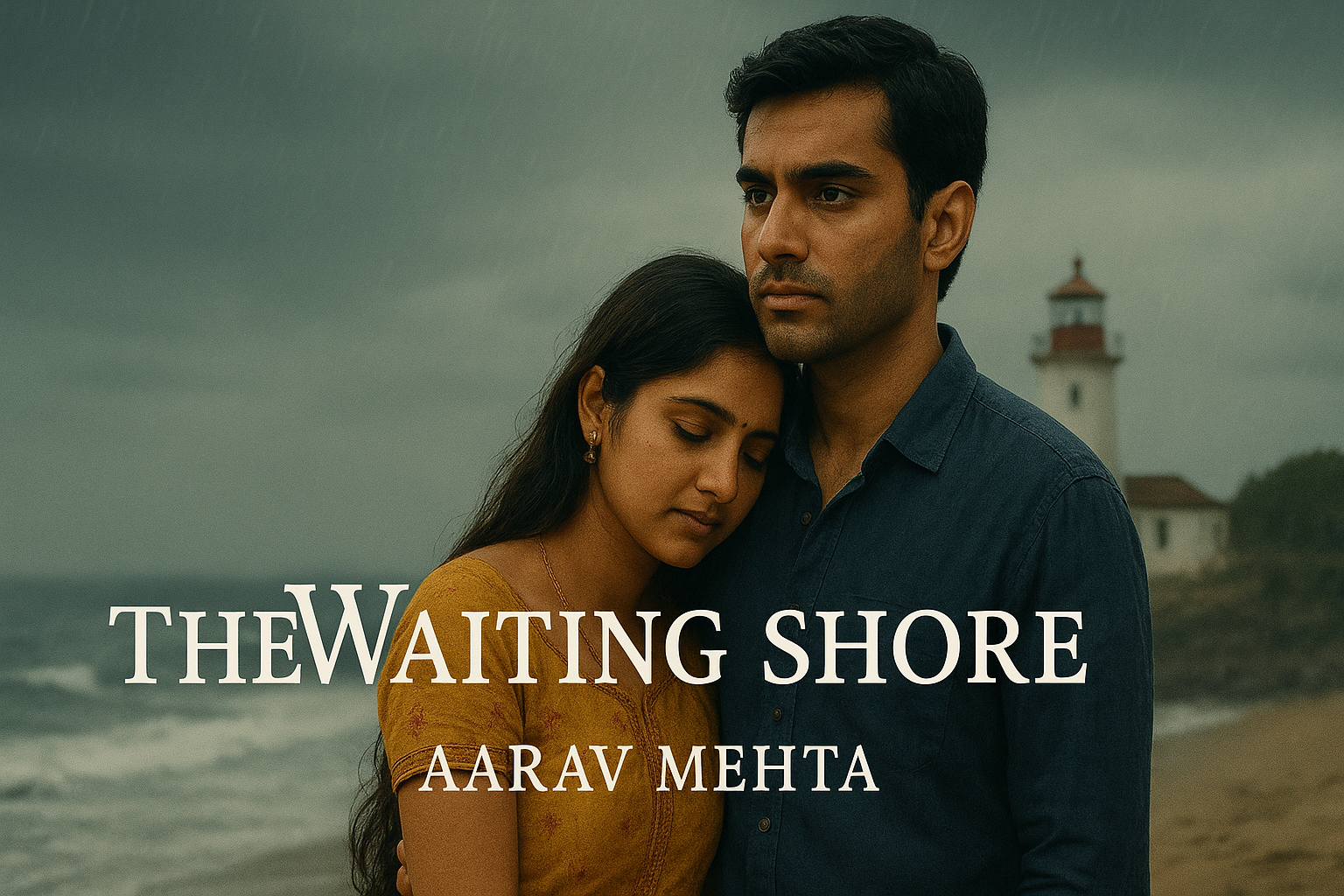

Aarav Mehta
The rain had already begun its ritual when Aarav stepped out of the rickety taxi, his leather bag soaked on one side, his shirt clinging to his back as if Goa itself had wrapped its humid arms around him. It was not the Goa he remembered from his childhood vacations—the postcard beaches, the neon lights of shacks, the loud laughter of tourists spilling beer into the sand. This was an older Goa, a quieter stretch where the sea met the land in whispers rather than shouts, where the narrow roads curled around forgotten Portuguese villas with cracked shutters and moss that grew like ancient tattoos on their whitewashed walls. He had come here to escape. Mumbai had become unbearable after the breakup—his editor calling him into endless meetings to remind him that deadlines did not bend around heartbreak, his friends pretending not to look at him with pity when he avoided the bars they still visited with her, his flat an echo chamber of her voice, her books, her photographs. So when the offer came—a chance to purchase an old house for far less than it should have cost, a property his uncle had once told him about, a place hidden away in a fishing village that tourists never bothered to find—he had taken it without a second thought. Now, as he stood before the wrought-iron gate, rusted and creaking in protest, he felt something both heavy and liberating. The house rose behind it like a memory half-forgotten: long balconies with peeling balustrades, a roof tiled in red clay, windows framed by bougainvillea that had grown wild and unrestrained. For a moment, as thunder cracked across the sky, he thought he saw the silhouette of someone standing at the upper window—a woman, hair caught in the wind, a hand resting lightly on the wooden frame. But when he blinked, there was only emptiness and the reflection of the lightning. He shook his head and pushed the gate open.
Inside, the house smelt of damp paper and sea salt. Furniture was still there, abandoned as if its previous occupants had walked away mid-conversation and never returned. A table lay draped with a lace cloth stained yellow, chairs lined the walls with their wicker backs unraveling, and in one corner, a piano stood silently, its keys grey with dust. Aarav dropped his bag and lit the lantern he had carried from the taxi. The glow revealed shelves upon shelves of books in the back room, their spines bowed, their titles faded in Portuguese and English. The library, his uncle had said, was the pride of the family that once owned this villa. Aarav ran his fingers along the edges of the books, half-expecting them to crumble into his palm. He did not know why, but there was something comforting about the smell of forgotten stories, as if this room had been waiting for someone to open it again. It was here, among the shelves, that he found the letters.
They were tied in a bundle with a red ribbon, the paper brittle and the ink blurred in places. He had been pulling out a book on marine trade when the packet slipped from behind it, landing at his feet. He crouched, picked it up, and felt the weight of time in his hands. Curiosity, that old itch of every journalist, pushed him to untie the ribbon, despite a part of him whispering that these words were not his to read. The first page trembled in his fingers as he opened it. “Dearest Rafael,” it began, the handwriting elegant and precise, the curves of each letter betraying a care that ordinary correspondence rarely carried. Aarav read on, his breath slowing as he stepped into another life. She wrote of rain falling against the verandah, of the sound of the sea pulling against the shore at night, of how every passing ship reminded her of promises yet unfulfilled. She wrote with longing, with restraint, with the kind of pain that came from waiting too long for someone who may never return. By the time he folded the letter back, his throat had tightened with an emotion he could not explain.
Who was she? Who was Rafael? And why were these letters unsent, hidden behind the spine of a book? He turned the bundle over and saw that there were dozens of them, each marked with a date that spanned nearly three years. He sat on the floor of the library, cross-legged like a boy with a new discovery, and began to read. Hours slipped by as the rain drummed on the roof, as lightning flared through the windows, as the old house seemed to breathe with the rhythm of his heart. He felt as though the woman was speaking directly to him across time, her words filling the silence he had been carrying since his own heartbreak.
It was past midnight when exhaustion overcame him. He placed the letters back into their ribbon, returned them carefully to the table, and leaned against the wall. Outside, the sea roared with the monsoon tide, waves crashing against the rocks like voices demanding to be heard. Aarav closed his eyes and, for the first time in months, slept without dreaming of her.
The morning brought with it a different light—pale and silver, diffused by clouds that still lingered, though the rain had lessened. Aarav walked out to the verandah, sipping the bitter coffee he had made from an old tin in the kitchen. From here he could see the road that led down to the fishing jetty, where women in bright saris carried baskets of the morning’s catch and men prepared their nets. Children ran barefoot, their laughter sharp as gull cries. He felt almost invisible, an outsider standing at the edge of their everyday world. And yet, as he leaned against the railing, he could not shake the thought of the letters.
Who could tell him their story? He needed to know—not just for his own curiosity but because, deep inside, he felt that uncovering the truth of this forgotten love might anchor him in a way nothing else had since leaving Mumbai. He gathered the bundle into his satchel and walked down towards the village. The air smelt of wet earth and frying fish, and as he approached the market, he asked around for anyone who might have known the family that once owned the villa. Most shook their heads or shrugged, but one old man, sitting by the steps of the church with a rosary twined in his fingers, raised his eyes when Aarav mentioned the name scribbled on the envelope: Isabella D’Costa.
The old man smiled faintly, his eyes misting with recognition. “Ah, Isabella,” he murmured, his Konkani lilt softening the name. “Her voice was like rain on stone. My father used to say she could make the sea stop with her singing.” He coughed and looked at Aarav more closely. “But why do you ask, stranger? Isabella’s story is not for everyone to tell. Some wounds remain in the soil.” Aarav’s heart quickened, but before he could speak again, the old man rose, shaking his head. “If you wish to know, go to the lighthouse. Her granddaughter works there with the marine institute. She carries her blood, her memories, maybe even her sorrow. Ask her—if she is willing.”
Aarav watched him walk away, the church bell tolling behind him, and felt the rain begin again, soft and insistent. He tightened his grip on the satchel, on the letters that had pulled him into another world, and knew that the path ahead would not let him remain an outsider for long.
The road to the lighthouse was narrow and half-swallowed by rain-fed grass, curling uphill along the cliff that overlooked the restless sea. Aarav carried the satchel close to his side, his shoes caked with red mud that slipped underfoot, the monsoon wind pressing against him as if to test his resolve. From below, the waves crashed against black rocks, sending spray into the air, their roar mingling with the cries of seabirds. At times the path seemed to vanish under the green, but each bend brought the tall white tower into view again, its paint peeling but its lantern steady, a sentinel against time. He paused once to catch his breath, turning back to see the village shrinking into a scatter of red roofs and blue tarpaulins, smoke rising from the kitchens where fish was being fried for lunch. For a moment, he wondered if he was chasing ghosts. What did he really expect from this? A stranger’s granddaughter, busy with her own life, to hand him the missing pieces of an old romance simply because he had stumbled upon unsent letters? Yet something stronger than reason pushed him forward—the same pull that had kept him reading until midnight, the sense that his own loneliness was somehow tethered to the words of a woman long gone.
By the time he reached the gate at the base of the lighthouse compound, the drizzle had thickened into sheets again, forcing him to duck under the overhang of a tin shed. Through the curtain of rain, he saw her. She stood by a line of glass tanks set against the wall of an annex, wearing a faded blue raincoat open at the front, her hair tied in a messy knot, her hands moving with careful precision as she adjusted the water levels inside the tanks. Fish swam in quick silver darts beneath the surface, their movements catching the dull light. She looked up briefly, her profile sharp against the sea behind her, then bent again to her task. Aarav hesitated. How did one begin such a conversation? Good morning, I’ve been reading your grandmother’s unsent love letters? He almost laughed at himself, but the weight of the satchel kept him from turning back.
He cleared his throat and stepped forward. “Excuse me,” he called over the rain. She turned, straightening with a wary glance, her eyes dark and steady. “Yes?” she asked, her voice carrying an accent softened by years of living between English and Konkani. Aarav fumbled with his words. “I—my name is Aarav. I’ve just moved into the old villa near the church… the D’Costa house.” At that, her expression shifted, the caution deepening into something unreadable. She wiped her hands on the cloth slung at her waist and walked toward him slowly, her boots leaving imprints on the wet earth. “That house has been empty for a long time,” she said. “Why would anyone move there now?”
“I needed a place,” Aarav replied, feeling suddenly as though he were being measured. “And it came to me through an uncle. But when I was exploring the library yesterday, I found something… something I think belonged to your grandmother.” He unbuckled the satchel and drew out the bundle of letters, the ribbon damp but intact. For a second, she froze. Her eyes flicked to the papers and then back to his face, suspicion hardening. “Why are you carrying those?” she asked. “They are private.”
“I didn’t mean to intrude,” Aarav said quickly. “They fell from a shelf. I started reading only the first few, but—I thought you should know. They seemed important.” He extended them toward her, but she did not take them immediately. Instead, she crossed her arms and tilted her head, studying him as though deciding whether to dismiss him or hear him out. At last she sighed, a sound mingled with the wind. “Come inside,” she said. “The rain won’t stop for a while.”
The annex smelled of saltwater and iodine, with charts of marine life pinned to the walls, equipment stacked in orderly disarray. She set the letters on a table and peeled off her raincoat, revealing a simple cotton kurta tucked into dark jeans. She poured water into two steel tumblers and pushed one toward him. “I’m Mira,” she said, finally giving her name. “Marine biologist. This place is part of our research outpost.” Aarav nodded, sipping gratefully. The water was cold, metallic. “Nice to meet you,” he said, though he sensed the distance in her tone.
She touched the letters but did not open them, as if afraid of what might spill out. “These are my grandmother’s,” she said quietly. “Isabella. People in the village still remember her songs, though most have forgotten her story. She wrote often, I knew that. My mother once told me she kept letters in secret, but she never showed them to us. I didn’t think they survived.” She glanced at him again, her gaze searching. “What exactly did you read?”
“Only one in full,” Aarav admitted. “It was addressed to someone named Rafael. It sounded… unfinished, like she was writing into the silence. I didn’t mean to pry. I just felt—there was something alive in those words. Something that shouldn’t be left hidden.” Mira’s eyes softened for a moment, then clouded again. She paced the narrow space, her hands clasped behind her back. “Rafael was a sailor,” she said at last. “Portuguese, if the family stories are true. My grandmother was barely twenty when she met him. They say he promised to return after the war, but he never did. My mother was born years later, with no father at her naming. That is all anyone ever told me. The rest was silence.”
The rain hammered the tin roof above them, a steady percussion. Aarav felt the weight of the story pressing between them. “Maybe the letters fill that silence,” he offered. “Maybe she wanted someone to read them, someday.” Mira shook her head. “Or maybe she wanted them to remain hidden. We cannot know.” She leaned against the table, crossing her arms. “Why bring them to me, Aarav? You could have kept them as curiosities, or even sold them to a collector in Panjim. People pay for such fragments of tragedy.”
“Because I thought they belonged with her family,” he said simply. “And because…” He paused, unsure whether to confess the truth. “Because they made me feel less alone. I don’t know why. I’ve been carrying my own ruins these past months. Reading her words—she seemed to understand what it means to wait, to ache for something that may never come. It felt like she was speaking to me, across time.”
Mira’s expression softened despite herself, the edge of suspicion giving way to something gentler. She looked at him as though seeing the fracture lines beneath his calm. For a long while neither spoke, only the sea filled the silence. Finally, she gathered the letters, retied the ribbon with careful hands, and placed them in a drawer. “If you want to know more, you’ll have to be patient,” she said. “Stories here do not give themselves easily. My grandmother’s life is tangled in half-truths, family shame, and songs that no one sings anymore. I am not sure I am ready to dig into it.”
“I can wait,” Aarav said, surprising himself with the certainty of his voice. “I’m not going anywhere.”
Mira studied him, then allowed the faintest curve of a smile to touch her lips, fleeting as the sun breaking through clouds. “Then perhaps the monsoon has brought you here for a reason,” she murmured. She reached for her raincoat again. “Come, let me show you the lighthouse. If you are to disturb our ghosts, you should at least see the sea they loved.”
Together they stepped back into the storm, climbing the spiral stairs as waves pounded the cliffs. At the top, beneath the steady lantern, Aarav looked out over the horizon blurred with rain, and for the first time since arriving, he felt as though the monsoon was not erasing him but washing something clean.
The days that followed blurred into the rhythm of rain, the lighthouse standing against the storm like a patient witness. Aarav found himself returning each morning, at first under the pretense of offering help—carrying supplies from the market, repairing a broken latch on the annex door, stacking sacks of salt to keep them dry. Mira never asked for assistance, yet she did not turn him away either, and slowly the silences between them thinned. They would drink tea brewed on a small stove, its steam curling against the damp walls, while she explained the habits of fish or the patterns of the tide with a voice that was precise and careful, as though every fact were a shell she placed deliberately in his palm. He listened more than he spoke, but when she asked, he told her of Mumbai—the chaos of deadlines, the fatigue of chasing stories that felt hollow after his breakup, the sense that he had been left with nothing but noise. She listened without pity, which was what he valued most, her gaze steady, her lips pressed together as though withholding judgment.
The letters remained in her drawer, unopened, but their presence lingered in every conversation. Once, when thunder shook the lighthouse and the glass panes rattled, Mira said almost to herself, “She must have written by lamplight, listening to this same storm. Imagine the sound of her pen scratching while the sea raged outside.” Aarav glanced at her, wondering if she had begun to hear her grandmother’s voice the way he had. Another time, when they walked down to the rocks to collect specimens of algae, she told him, “My mother never forgave Isabella. She believed her songs brought shame, that she wasted her life waiting for a man who never returned. But sometimes, when she thought I was asleep, she would hum an old melody—low, broken, as though the tune had been carried in secret. Perhaps she carried her mother’s longing without admitting it.” Aarav wanted to ask if Mira feared inheriting the same fate, but he swallowed the question, sensing that some wounds still resisted touch.
Instead, he began piecing fragments together in his own mind. Isabella, the singer with a voice like rain, Rafael, the sailor who left promises in his wake, the letters unsent but preserved—threads of a story that demanded to be woven. His journalist’s instinct urged him to record it, to shape it into an article, but another part of him resisted. This was not material for print, not something to be consumed by strangers. It was too intimate, too alive. It belonged, for now, only to Mira and to him.
One evening, the rain broke long enough for the sky to reveal a bruised sunset, violet and gold spilling across the horizon. They stood at the lighthouse balcony, the sea foaming below them, gulls slicing the air. Mira leaned on the railing, her hair loosened by the wind, strands clinging to her cheeks. “You said the letters made you feel less alone,” she said suddenly, without looking at him. Aarav shifted, caught off guard by her memory of his words. “Yes,” he admitted. “They felt like someone was speaking from a place I understood—the waiting, the silence, the ache.” She turned to him then, her eyes dark, searching. “And do you still feel that way? Or is it only because you saw your own sorrow mirrored in hers?”
He hesitated. “Maybe both,” he said finally. “But I also feel that reading them gave me something I didn’t realize I needed. A reminder that love—even unfinished, even unreturned—has weight. That it matters simply because it was felt.” Mira’s lips curved, not quite a smile. “That is dangerous,” she said softly. “To believe that feeling is enough. My grandmother believed that, and it left her hollow.”
They stood in silence after that, the air heavy with unspoken truths. When the rain returned, sudden and fierce, they ran inside, laughing despite themselves as the storm drenched them. It was the first time Aarav had heard her laugh—a clear, surprised sound that dissolved the gravity of the evening. He thought of it long after, lying awake in his villa, the letters on his table as though keeping vigil.
A week later, Mira surprised him by bringing the bundle to the annex. She placed it on the table and pushed it toward him. “Read one aloud,” she said. Aarav blinked. “Are you sure?” She nodded, her face set though her eyes betrayed uncertainty. He untied the ribbon carefully, selected a letter at random, and unfolded it. His voice filled the room, halting at first but gaining steadiness as the words carried him: Isabella describing the scent of jasmine in the courtyard, the way the waves glowed silver under the moon, her confession that every time the bell of the church tolled she imagined it was announcing his return. Mira stood by the window, her back to him, her shoulders tense. When he finished, silence stretched, broken only by the drip of rain outside. “She wrote like someone singing to the sea,” Mira said at last, her voice quiet. “As though she knew it might never answer, but she could not stop.”
That night they lingered longer than usual, the letters spread across the table, each one another fragment of a song half-heard. Mira did not read them herself, but she listened, her eyes closing at times as though letting the words sink into her skin. Aarav felt as though the space between them was changing, something fragile forming in the air. When he finally rose to leave, she walked with him to the gate. The rain had paused, the sky open with stars. She looked at him, her face luminous in the dim light. “Do you believe,” she asked suddenly, “that love can cross time? That someone’s longing can echo across generations?” Aarav met her gaze, his heart thudding. “I don’t know,” he said honestly. “But I want to believe it.”
Mira held his eyes for a moment longer, then turned away. “Good night, Aarav.”
He walked back to the villa with the echo of her question pulsing inside him. In the quiet of the library, he lit a lamp and stared at the letters once more. For the first time, he wondered if perhaps they were not just Isabella’s voice reaching forward, but also a mirror pulling him toward something he had not expected to find. He thought of Mira’s laughter, her steady hands on the tanks, the way she looked out at the sea as though it both burdened and freed her.
The monsoon howled outside, but within him there was a strange calm, like the hush that follows lightning. He did not yet understand what was forming between them, but he knew it was no longer only about the letters. It was about the way two strangers could find themselves listening to the same silence, and in that recognition, begin to write something new.
The storm worsened in the following days, the sea swelling high enough to spray salt over the windows of the lighthouse, the village lanes turning to rivulets where children floated paper boats until their mothers called them back inside. Aarav stayed longer at the annex, partly because the rain made it impossible to leave, partly because Mira no longer seemed to mind his presence. Their conversations deepened, slipping from cautious exchanges into unguarded confessions—her childhood summers spent watching her mother weep in secret after arguments with her father, his memory of walking out of his Mumbai flat after the breakup and realizing he no longer owned a single piece of furniture not touched by her hand. In the pauses between words, the letters always lay like a third presence, a reminder of why they had met at all.
It was one evening, with the storm drumming the roof and the lamp flickering against the damp, that Aarav opened another letter aloud. Mira had asked him to continue reading, though she still kept her distance, leaning against the window ledge while he sat at the table. This one was dated late 1945. Isabella wrote of Rafael’s promise to return after the war, of how she waited by the jetty whenever news of ships arriving spread through the village. She described the sailors who disembarked—laughing, shouting, embracing their families—while she searched every face for his and found only strangers. Then came a line that made Aarav falter: “They tell me you were seen in Lisbon with another woman, her hand in yours. I refuse to believe it, Rafael, because my nights are still filled with your voice. But if it is true, let these letters drown with me, and let the sea bury my shame.”
Mira stiffened. “She knew,” she whispered. “She must have heard rumors.” Aarav folded the page carefully, the words still echoing. “Do you think it’s true?” She shook her head sharply, as though refusing. “Gossip travels fast in small villages. My grandmother would have been an easy target—singing on verandahs, waiting for a foreign man. People would have resented her freedom. They must have invented things.” Yet her voice carried more doubt than conviction. She turned away, her hands gripping the window sill. “If it is true,” she said softly, “then my mother was right. Isabella wasted her life.”
Aarav wanted to protest, but he hesitated. The possibility that Rafael had abandoned her gnawed at him too. Still, he thought of the devotion in Isabella’s words, of the way she wrote not like someone deceived but like someone refusing to give up hope. “Maybe the truth doesn’t matter,” he said finally. “What matters is what she felt. That was real, no matter what he did.” Mira gave a short laugh, bitter and tired. “Spoken like a man who still believes in the nobility of heartbreak. You should ask the women who lived with its consequences.”
The next day she was colder, her sentences clipped, her attention buried in her work. Aarav sensed the wall rising again, and it unsettled him more than he admitted. That night, alone in the villa, he spread the letters across the floor, trying to arrange them chronologically. He read until his eyes burned, piecing fragments together like a puzzle. There were contradictions: some letters brimming with certainty of Rafael’s love, others shadowed by fear of betrayal. Then, near the bottom of the pile, he found one written in 1946. Its ink was faint, but the words clear enough to still the room around him. “They say you are gone for good. Yet yesterday I saw a child at the market with eyes the color of yours. Is it possible you returned without a word? Or is the sea playing tricks on me again?”
Aarav stared at the page. A child? He read it twice, thrice, the suggestion prickling his skin. Could it be that Rafael had returned briefly, leaving behind more than memory? He thought of Mira’s mother, born years later, with no father at her naming. A possibility began to form, fragile but dangerous. If Rafael had returned and left again, then Mira’s entire lineage carried a silence heavier than shame—it carried the trace of a man who had abandoned them not once, but twice.
The next morning, he walked to the lighthouse with the letter tucked carefully in his bag. Mira was outside, hauling buckets of seawater to the tanks, her face drawn from lack of sleep. He hesitated, then handed her the page. “You should see this.” She read, her lips tightening. When she finished, she folded it slowly, her eyes clouded. “My mother never spoke of this,” she said. “If Rafael fathered a child, then everything changes.” Her voice broke, and for the first time, Aarav saw the weight of inheritance pressing on her shoulders—the fear of carrying not just a story, but a wound.
“I don’t think it changes Isabella,” he said gently. “She loved him. She chose to. But it might change how you see yourself.” Mira met his gaze, her eyes sharp with unshed tears. “Do you know what it means to carry a shadow you cannot name? To walk through life knowing there is a half-truth in your blood? It is not romance, Aarav. It is exile.”
Her words struck him with a force he could not answer. For hours they worked in silence, their movements stiff, the air heavy with things unspoken. Yet as the storm raged outside, Aarav felt something else growing between them—a fragile intimacy born not of joy but of shared fracture. It was in the way Mira’s hand brushed his when they passed a net, in the way her voice softened when she asked him to light the stove, in the way she lingered by the door when he finally left, as though unwilling to let the silence close around her.
That night, he dreamed of Isabella singing on a balcony, her voice rising against the storm. In the dream, Mira stood beside her, their figures blurred together, their gazes fixed on the sea. When he woke, the lamp still burning beside the letters, he knew with a clarity that unsettled him: he was no longer chasing a story, nor even trying to escape his own heartbreak. He was caught in something larger, something that bound him to Mira and to Isabella both, as though the monsoon itself had written him into their unfinished song.
The storm relented after nearly a fortnight, the clouds parting just enough to reveal a bruised moon and a sky pierced with hesitant stars. The air smelt of wet earth and seaweed, the kind of scent that feels like both an ending and a beginning. Aarav walked to the lighthouse with the bundle of letters under his arm, his steps quicker than usual, a quiet urgency pushing him forward. He found Mira on the balcony, her hair untied for once, loose strands whipping across her face in the wind. She did not turn when she heard him climb the stairs; instead, she lifted her chin toward the horizon where the sea glowed faintly silver. “The fishermen say the tides will be calmer tomorrow,” she said. “It means the monsoon is shifting.”
Aarav stood beside her, close enough to feel the brush of her sleeve against his arm. “And what does it mean for us?” he asked before he could stop himself. She looked at him then, her eyes shadowed but steady. “Us?” she repeated, the word strange on her tongue. “We are only keepers of a story, Aarav. Nothing more.” He placed the letters on the railing between them, the ribbon fluttering in the breeze. “Maybe,” he said softly. “But stories have a way of keeping their tellers too.”
She did not answer, but her gaze fell on the letters, and after a long pause, she untied the ribbon herself. Her fingers moved with care, unfolding one of the last pages. The handwriting was shakier, as if written in haste. Aarav leaned closer as she read aloud. “If you return and I am gone, remember that I loved you beyond the measure of my days. Remember that even in silence, even in absence, I remained yours.” Mira’s voice broke on the last word, and she lowered the page, her breath uneven. “She knew,” she whispered. “She knew he would never come.”
Aarav felt something swell inside him, not pity but recognition. He reached out, hesitated, then placed his hand gently over hers where it rested on the paper. “And yet she wrote. That’s what matters. She refused to let silence erase her.” Mira’s hand trembled under his, but she did not pull away. Instead, she turned slightly, her face so close he could see the salt shining on her skin. “You speak as though love itself is enough,” she murmured. “But do you know what it costs? To wait, to hope, to give everything to someone who may never return?”
“Yes,” he said simply, his voice low. “I do. And I know what it costs to walk away too. I’ve done it once. I don’t want to do it again.”
The wind tightened around them, carrying the sound of the waves. Mira searched his face, her defenses wavering like the tide. For a moment it seemed she would step back, retreat into the safe distance she had always held. But then her fingers curled around his, and the space between them dissolved. Their lips met with the tentative urgency of two people who had circled each other too long, the kiss tasting of salt and rain, of grief and something that dared to be called hope.
When they parted, Mira pressed her forehead against his chest, her breath shuddering. “I don’t know what this is,” she admitted. “I don’t know if it is mine to have, or if it belongs to the ghosts we are chasing.” Aarav wrapped his arms around her, feeling the fragility of her body against his. “It’s ours,” he said. “Whatever else, this moment is ours.”
They stood like that for a long time, the lighthouse lantern circling above them, sweeping its beam across the dark sea as though blessing their stillness. Below, the village lights flickered faintly, voices carrying from the jetty where men prepared for calmer tides. For once, Aarav did not feel like an outsider. He felt as though he had stepped into the current of something older than both of them, a story that had waited for them to arrive.
Later, inside the annex, Mira lit a small lamp and spread the remaining letters across the table. “We should finish them,” she said, her voice steadier now. Aarav nodded, and together they read through the last fragments. One letter spoke of a song Isabella composed but never sang in public, a song she said belonged only to the sea. Another carried only a single line: “I forgive you, though you never asked.” By the time they reached the final page, both sat in silence, the air heavy with the weight of unfinished love.
Mira touched the stack gently, as if laying her grandmother to rest. “I used to think her story was only shame,” she said. “But now I see it was also courage. She lived with longing, yes, but she lived. And perhaps that is enough.” Aarav reached across the table, taking her hand again. “Perhaps it is more than enough,” he said.
When he left that night, the moon rode high over the sea, clear and bright for the first time in weeks. He walked back to the villa with the taste of her kiss still on his lips, the echo of Isabella’s words in his heart. For the first time since Mumbai, the silence inside him felt less like emptiness and more like space waiting to be filled.
The first calm morning after weeks of storms arrived quietly, the sea lying flat like a sheet of hammered silver beneath the hesitant sun. From the verandah of the villa Aarav could hear the village stir to life in a way he hadn’t before—boats being dragged down to the shore, nets unfurling in the breeze, voices carrying with the excitement of work resumed. He felt it even in his chest, that release after the weight of unbroken rain, as though something in him had shifted with the weather. He carried the bundle of letters again, not because he needed to read them, but because they had become a kind of compass. And when he reached the lighthouse, Mira was already on the steps, watching the horizon. She looked different in the new light, less like the keeper of old grief and more like someone waiting to step beyond it.
The calm tide brought visitors too. By afternoon a small group had arrived from Panjim—scholars, officials, and a thin man in a beige suit who introduced himself as Professor Menezes from the university. They were studying coastal erosion, but when word spread that Mira was in possession of her grandmother’s letters, their curiosity shifted. “Isabella D’Costa?” the professor asked, his eyes narrowing with the delight of recognition. “I’ve read of her in a footnote once, in an old travelogue written by a sailor. He mentioned a Goan singer whose voice carried across the port. Could it be the same woman?” Mira stiffened at the intrusion, but Aarav stepped forward, shielding her from their eagerness. “The letters are private,” he said firmly. “They are not for display.” Yet Mira surprised him by lifting her chin and saying, “Perhaps one day. But not yet.”
That evening, after the visitors had gone, Mira seemed restless. She walked along the jetty with Aarav trailing behind, her steps quick, her face set against the wind. “They will not stop asking,” she said finally. “If Isabella was known beyond this village, then her story is not just ours. It belongs to others too. And I don’t know if I want that.” Aarav matched her pace. “You don’t have to decide now. The letters waited seventy years; they can wait a little longer.” She gave a short laugh, bitter but grateful. “You always know how to say the thing that makes me pause.”
They sat at the edge of the jetty, their feet dangling above the water where fish leapt in brief flashes. Mira pulled her knees to her chest, hugging them tightly. “Do you know what I fear most?” she asked. Aarav shook his head. “That Rafael is real,” she said. “That he returned once, that he fathered a child, and then left again. That my bloodline is not just a story of longing but of abandonment. If I accept that, what do I inherit except absence?” Aarav wanted to reach for her, but he held still, letting her words hang. “And yet,” she continued, her voice softer, “when you read her letters, I feel closer to her than I ever have. I feel like she lives again. Perhaps that is enough.”
He looked at her, the lamplight from the lighthouse sweeping over her profile, and thought of how grief and hope lived so close in her. “Maybe inheritance is not about what they left,” he said gently. “Maybe it’s about what you choose to carry forward. You are not her wound, Mira. You are her song.” She turned toward him, startled, then shook her head with a half-smile that did not reach her eyes. “You make everything sound like poetry,” she said. “But life is not always so forgiving.”
That night the village gathered at the church for the first mass after the storm. Aarav accompanied Mira, sitting among rows of families whose eyes lingered on him with curiosity. The hymns rose against the candlelit walls, voices mingling in Konkani and Portuguese, and for the first time Aarav understood what the old man by the church had meant—that Isabella’s voice was remembered in fragments, in the way the congregation sang with a longing that seemed older than faith. Mira stood beside him, her lips moving to the tune, and Aarav felt the letters breathing between them even here.
After mass, an elderly woman approached Mira, leaning on a cane. Her skin was lined, her eyes clouded but bright. “You are Isabella’s grandchild,” she said, her voice trembling. “I remember her standing in the courtyard, singing to the sea. She was brave, child. Do not believe those who call it shame. We envied her freedom.” Mira blinked rapidly, her composure cracking. She touched the woman’s hands and whispered, “Thank you.” Aarav watched the exchange, his chest tightening. The story was no longer only theirs to wrestle with—it lived in others too, in memories scattered like seeds.
When they walked back to the lighthouse under a sky streaked with stars, Mira was quiet. Aarav finally asked, “What are you thinking?” She looked up at him, her eyes reflecting the starlight. “That maybe love doesn’t die with absence. Maybe it survives in the way people remember, in the way voices carry. Maybe even in us.” She stopped walking then, turning fully to him. “But that also means our choices matter. If I let you into my life, Aarav, it cannot be only for now. I will not repeat Isabella’s waiting.”
Her words struck him with both fear and certainty. He stepped closer, the night wrapping around them like a witness. “Then don’t wait,” he said. “Don’t make this about the past. Make it about us.” Mira’s breath caught, but she did not step away. Instead she reached for his hand, threading her fingers through his. They stood like that for a long while, the sea calm beneath them, the lighthouse lantern sweeping its eternal circle.
Back at the villa later, Aarav laid the letters out one final time, this time not as a puzzle to solve but as a chorus of voices. He realized he no longer needed every answer. The truth about Rafael might remain shadowed, but what mattered was the way Isabella’s words had drawn Mira and him together. The letters had ceased to be relics; they had become bridges. He closed his eyes, hearing Mira’s voice beside his earlier that night, steady and sure: I will not repeat Isabella’s waiting.
The calm tide had returned, but Aarav knew the true storm was just beginning—the storm of choosing, of daring to step into something that might last. And for the first time, he did not feel afraid.
The calm tide did not last long. Within days, heavy clouds gathered again, not with the violence of the first storm but with a weight that seemed to settle over the village like an unfinished sentence. Aarav arrived at the lighthouse to find Mira crouched on the floor of the annex, pulling apart a rotting trunk that had been pushed into the corner beneath fishing nets. The wood cracked under her hands, releasing the sharp smell of mildew and rust. “What are you doing?” he asked, stepping in from the drizzle. She glanced up, strands of hair falling across her face. “Clearing space. This trunk belonged to my grandmother. I never thought much of it. But after the letters, I couldn’t ignore it anymore.”
Inside the trunk lay bundles of fabric, yellowed with time, and beneath them a small leather-bound journal, its cover brittle but intact. Mira lifted it carefully, her fingers trembling. “I didn’t know this existed,” she whispered. They set it on the table and sat opposite each other, the air tight with anticipation. Aarav opened the first page, the ink faded but legible. It was dated 1944, before many of the letters had been written. Isabella’s voice spoke again, but this time more candid, stripped of the lyrical flourishes that had filled the letters. She wrote of her family’s disapproval, of whispers in the market, of a father who threatened to lock her inside the house if she continued to meet the sailor. “They call me foolish,” one entry read, “but how can love that burns so clearly be foolish? When I sing, it is his face I see at the edge of every note.”
Mira pressed her lips together, her eyes glistening. “She was younger than I thought when it began,” she murmured. Aarav turned the page. Later entries grew darker. Isabella described Rafael leaving with promises that felt less certain, how she sang louder to drown out the silence he left behind. Then, in the middle of the journal, one entry shifted everything. “He came back,” she wrote in hurried script. “Not in glory, not in triumph, but in secrecy. He asked me to keep him hidden. He said the war had changed him, that he could not stay, but that he could not leave without seeing me once more. We met by the jetty at night. He kissed me as if the sea itself were pulling us apart.”
Mira’s hand flew to her mouth. Aarav read on, his heart hammering. “He begged me not to tell anyone. He said he belonged to another life now, across the ocean, yet he swore I was the only song he carried. He left before dawn. I do not know if I will see him again. But I cannot forget that night, nor the way he held me as though it would have to last a lifetime.” Aarav closed the journal slowly. The silence between them thickened with the weight of revelation. Mira spoke first, her voice hoarse. “Then it’s true. He did return. He touched her life again, and then he left again. And if he returned once, he might have left more than memory.”
Aarav reached across the table, resting his hand lightly over hers. “This doesn’t make her weaker, Mira. It makes her braver. She chose to meet him despite the world against her. She carried the cost.” Mira’s eyes hardened. “Or it makes her a fool twice over.” She pulled her hand back, pacing the small room. “Do you see what this means? My mother was right to hide the past. If this story spreads, all people will remember is the shame of a man who used her and left. They will forget her songs, her courage.”
Aarav rose, his voice steady but urgent. “No. They will remember her voice because we remember it. You remember it. You cannot erase her truth just because it hurts. Truth is not always kind, Mira, but it is the only thing that survives.” She stopped at the window, her silhouette framed by the restless sea. For a long moment she said nothing, her shoulders rigid. Then she turned, her eyes glistening. “You speak like a man who has nothing to lose,” she said bitterly. “But I live with her name. I live in her shadow. You can leave anytime you want. I cannot.”
The words cut him more sharply than he expected. He wanted to protest, to tell her he had already chosen to stay, but something in her tone made him hold his silence. Instead he picked up the journal, running his hand over the cracked leather. “Then let me carry it with you,” he said quietly. “If nothing else, let me share the shadow.” Mira’s expression softened almost imperceptibly, but she did not answer. She walked past him and out onto the balcony, letting the drizzle soak her hair. Aarav remained inside, staring at the journal until the words blurred.
That night, back at the villa, he laid the journal beside the letters. Together they formed a story too large for him to contain, yet he felt bound to it now, as though Isabella’s voice had braided itself into his own heartbeat. He thought of Mira’s anger, her fear, the way she had looked at him as if daring him to leave. And he knew he could not. He had left one love behind in Mumbai, but this was different. This was not about escape. It was about belonging, even if belonging meant walking through shadows.
The next morning he returned to the lighthouse early, before the rain had fully lifted. Mira was already awake, sitting on the steps with the journal in her lap. She did not look at him as he approached, but she held the book out silently. “Read it all,” she said. “If we are to carry this, then we must know it completely.” Aarav took the journal, sat beside her, and together they turned the fragile pages as the sea breathed below. With each entry the past deepened, the line between love and loss blurring, until both of them sat in silence, staring out at the horizon as though waiting for Isabella herself to answer.
The final pages of Isabella’s journal were fragile, the ink blurred as if her hand had trembled while writing or as if the sea itself had breathed too close to the paper. Aarav read slowly, each line sinking into him like a tide rising without pause. Mira sat stiffly beside him on the lighthouse steps, her knees drawn up, her fingers gripping the fabric of her kurta as if bracing herself for impact. The entries began to unravel in fragments—dreams of Rafael calling her name from across the waves, fears of her father discovering the truth, the loneliness of singing into silence. Then came the page that changed everything. “I am with child,” Isabella wrote, the words jagged, hurried. “It is his, though he has gone. I do not know if I should be grateful for this piece of him or cursed for the burden it will bring. My family will never forgive me. They will say I brought disgrace. But I cannot undo what the sea has given. I will carry this child. Even if it costs me everything, I will carry.”
Mira inhaled sharply, her hand flying to her mouth. Aarav closed the book gently, but the words lingered between them, heavier than the storm clouds above. “Then it’s true,” Mira whispered. “My mother… she was Rafael’s daughter.” Her voice cracked on the last word, and she turned away, pressing her forehead against her knees. Aarav placed the journal on his lap, struggling for words. “It explains the silence,” he said finally. “Why your mother never spoke of him, why Isabella’s name was weighed with both admiration and shame. They buried the truth because it was easier than carrying it.”
Mira lifted her head, her eyes burning. “And what am I then, Aarav? A legacy of abandonment? A bloodline marked by a man who came and left, who gave nothing but shadows?” Her voice rose with each word, breaking in the salt air. “Do you understand what it feels like to have your identity tied to someone who never even stayed long enough to be real?” Aarav’s heart clenched. He reached for her hand, but she pulled back sharply, standing to pace the stone floor. “My whole life I thought the silence was only about shame. Now I see it was about truth. A truth that makes everything worse.”
He rose too, blocking her path gently. “No, Mira. It doesn’t make you less. If anything, it makes you more. You come from a woman who chose to carry love even when the world called it disgrace. That is strength, not weakness. And you are not Rafael’s shadow—you are Isabella’s song.” Mira shook her head, her tears catching the light of the lantern above. “You keep saying that, Aarav. But songs don’t erase blood.” She stepped past him, clutching the journal to her chest as though it might burn her hands.
For days after, she withdrew. She worked longer hours at the annex, immersing herself in research notes, speaking little. Aarav tried to give her space, but the distance gnawed at him. At night he lay awake in the villa, the letters spread around him like a scattered constellation, each word echoing Mira’s anguish. He wanted to fix it, to write a new ending, but he knew some truths could not be rewritten. They could only be carried.
It was the village priest who gave him the words he needed. Aarav had gone to the church to escape his restlessness, sitting in the cool shadows as candles flickered against the altar. The priest, a quiet man with eyes like worn glass, approached him after a while. “You carry a heavy silence,” he said simply. Aarav hesitated, then told him of the letters, the journal, the confession of Isabella’s child. The priest listened without interruption, then said, “Truth is not a wound to hide, my son. It is a scar to bear. Scars remind us we survived. Tell her that.”
That evening Aarav returned to the lighthouse. Mira was outside, sitting on the balcony with the journal in her lap, her hair loose, her face pale from sleeplessness. He sat beside her without speaking, letting the silence stretch until she finally said, “I don’t know how to live with this.” He turned to her gently. “You don’t erase it. You live through it. This truth doesn’t define you, Mira—it frees you. It means you are not bound by the silence anymore. You can choose what to carry and what to leave behind.”
She looked at him then, her eyes red but steady. “And if I cannot?” she whispered. Aarav took her hand, his voice quiet but firm. “Then let me carry it with you. Scars don’t have to be borne alone.” For a long moment she did not move. Then her fingers tightened around his, fragile but deliberate. She exhaled, as if releasing something that had been lodged inside her chest for years. “My mother always said the past was poison,” she said softly. “But maybe it can be medicine too, if faced.”
The lantern light swept over them, circling, returning, circling again. The sea below murmured with the gentler tide, no longer violent but never still. Aarav felt Mira’s hand in his and knew that something had shifted—not that the pain had vanished, but that it had found a place to rest. They sat there until the stars thickened overhead, until the night smelled of salt and quiet possibility.
When he walked back to the villa later, the journal still heavy in his satchel, Aarav realized that Isabella’s voice had done more than haunt them. It had drawn them toward a reckoning, and perhaps toward each other. The truth had not broken Mira—it had scarred her. And in the lines of that scar lay the beginning of something neither of them had dared to imagine before: the possibility of a love not built on waiting, but on choosing.
The days that followed felt strangely suspended, as though the village itself was holding its breath. The storm had loosened its grip, the sea calmer now, but the air between Aarav and Mira still carried the charge of something unresolved. The letters and the journal lay spread on the table in the annex, pages weighted down by stones to keep them from curling in the damp. Whenever Aarav walked in, Mira would be seated before them, her fingers tracing the lines as if trying to memorize each word. Sometimes she would close the journal suddenly, pressing her palms against its cover, as though the truth inside was too much to hold.
One morning, she spoke before he could even greet her. “We cannot keep them hidden,” she said, her voice low but firm. “These are not only mine. They are a part of our history—of this place, of women like her whose stories were buried.” Aarav studied her carefully. “Do you mean to publish them?” Mira hesitated, her gaze flicking to him. “Perhaps. Or donate them to an archive. Something that makes sure she isn’t erased.” Aarav nodded slowly, though a current of unease moved through him. “And are you ready for what that would mean? That people will not only remember her songs but also her secrets? That Rafael’s name will surface again?”
Mira turned away, staring out at the waves beyond the window. “That is what frightens me. But maybe it doesn’t matter anymore. The shame only survives in silence. If we tell her truth, maybe it becomes something else.” Aarav stepped closer, lowering his voice. “And what about you? Are you ready to live with everyone knowing this truth is also yours?” Her shoulders tightened, but she did not flinch. “I have carried shadows long enough. Perhaps it’s time to walk in daylight.”
Later that day they carried the letters and journal down to the village, showing them to the priest, who received them with quiet reverence. He read one page aloud in the church, his voice trembling over Isabella’s words of waiting and love. Some of the villagers murmured, old memories resurfacing, but no one scoffed. An elderly woman whispered, “I remember her songs. She was never ashamed. We were the ones who judged.” Mira stood silently at the back, her face pale, but Aarav could see the way her hands steadied as she listened. The truth was already beginning to shift.
That evening, back at the lighthouse balcony, Mira sat with her knees drawn up, her chin resting on her arms. “When I heard her words read aloud, I felt like she was finally free,” she said softly. Aarav leaned against the railing beside her. “And how did you feel?” She thought for a long while before answering. “Exposed. But also lighter, as though the silence I carried was never mine to keep.” She turned to him then, her eyes steady. “Aarav, why do you care so much? You could have read the letters, closed them, and left. Why did you stay?”
He met her gaze, the lantern light casting faint shadows across her face. “Because I was tired of running from my own silence,” he said honestly. “Because your grandmother’s words taught me that even broken love has meaning. And because—” He paused, his heart racing, “—because I found something here I didn’t expect. With you.” Mira looked at him, her breath catching. “You don’t know what you’re saying,” she murmured. Aarav stepped closer, his voice firmer. “I do. I’m saying I don’t want this to end when the monsoon does. I’m saying I want to stay.”
For a long moment she said nothing, only studied him with eyes that seemed to weigh his sincerity against all the betrayals of her past. Finally she whispered, “I am afraid, Aarav. Afraid that you will leave like he did. Afraid that I will be left waiting again.” He took her hand gently, threading his fingers through hers. “Then don’t wait. Don’t let fear dictate this. I am not Rafael. I am here, now, with you.”
The silence that followed was filled with the sound of the sea, steady and unrelenting. Then Mira leaned into him, her head resting against his shoulder. “If I let you in,” she said quietly, “you must understand it will not be only for now. I cannot live half a life.” Aarav kissed her hair, his voice steady. “Neither can I.”
The following days were filled with small intimacies that stitched themselves quietly into their routine. They worked side by side in the annex, shared simple meals, walked along the jetty at dusk. The letters no longer weighed them down; instead, they seemed to rise between them like a bridge. Yet beneath it all, Aarav felt the undercurrent of Mira’s fear, her glances that lingered too long, her pauses before answering. Trust, he knew, was not built in days. It would take time, and patience, and presence.
One afternoon, as they sat sorting the letters by date, Mira suddenly reached for his hand. “Do you think love can begin in someone else’s story?” she asked. Aarav squeezed her fingers gently. “No,” he said. “I think it begins when we decide it’s ours. The letters brought us together, but what we write now is only ours.” Mira looked at him then, a smile breaking slowly across her face, tentative but real.
That night, under a sky scattered with stars, Aarav walked back to the villa alone. He felt both lighter and more bound than ever before. Isabella’s truth was no longer buried, and Mira was no longer alone in carrying it. Yet he knew the hardest part still lay ahead—not unearthing the past, but daring to build a future in its shadow. He thought of Mira’s words: I cannot live half a life. And he knew he had no choice but to give her all of his, if she would let him.
The monsoon broke with a final surge, as if the sea wanted to remind them of its dominion before surrendering to calmer skies. For two nights the waves battered the coast, flooding the market square and rattling the lighthouse glass until it seemed the lantern itself would shatter. Aarav stayed with Mira through the storm, helping her secure the tanks, hauling sacks of sand to brace the annex doors. They barely slept, moving together in a rhythm that felt less like necessity and more like instinct, as though their bodies already understood what their words still hesitated to claim. When dawn came at last, the air was washed clean, the horizon clear and wide. The sea breathed like a creature exhausted, and for the first time since Aarav’s arrival, sunlight streamed without obstruction.
Mira stood on the balcony, her hair damp, her eyes squinting against the brilliance. “It’s over,” she said, almost to herself. “The season has turned.” Aarav joined her, the warmth of the morning touching his skin like a promise. “And what does that mean for us?” he asked quietly. She turned, meeting his gaze, and this time there was no deflection in her eyes. “It means the waiting is finished. My grandmother waited her whole life. I will not.”
Later that morning, they carried the letters and the journal down to the church one last time. The priest accepted them with a solemn nod, promising they would be preserved, their story told with dignity. Some of the villagers gathered, murmuring prayers or shaking their heads, but there was no scorn. Only recognition. One elderly man touched Mira’s shoulder and said, “Your grandmother sang for us when we were children. Her voice carried our sorrows. Now her words will too.” Mira bowed her head, her lips trembling with unspoken gratitude. Aarav watched her, feeling the weight of her legacy transform into something steadier, less a wound than a scar.
That evening, as the sun dipped low, Mira led Aarav to the jetty. The water glittered gold, the boats rocking gently. “This was where she met him,” Mira said, her voice soft but clear. “Where he returned, where he left. This was where her story was bound.” She turned to him then, her eyes unwavering. “I want ours to begin here too. Not in waiting, not in silence. In choosing.” Aarav’s chest tightened, his breath catching. He stepped closer, his hand finding hers. “Then choose me,” he whispered. Mira’s fingers curled into his, her smile breaking like dawn. “I already have.”
They kissed there at the edge of the jetty, the sea carrying their reflection, the air heavy with the smell of salt and beginnings. It was not the desperate kiss of storm and fear, but the steady one of recognition, of two people claiming what was theirs. When they parted, Mira rested her forehead against his. “You will stay?” she asked, her voice fragile with the echo of old fears. Aarav pulled her close, his answer steady. “As long as you’ll have me.”
The days that followed unfolded with a gentler rhythm. Aarav began writing again, not news articles or rushed essays, but the story of the letters, of Isabella, of the way voices travel across generations. Mira teased him for the stacks of notes cluttering the villa, but sometimes she would sit with him, correcting details or offering fragments of memory she hadn’t realized she carried. Together they shaped not just a record of the past but a testament to what they had found in each other.
One evening, as they walked along the beach, Mira stopped suddenly, bending to pick up a conch shell washed ashore. She held it to her ear, smiling faintly. “My grandmother used to tell me the sea keeps our voices,” she said. “That if you listen long enough, you will hear what was lost.” She handed the shell to Aarav. He pressed it to his ear, hearing only the rush of water, but beneath it he imagined Isabella’s song, the letters whispered into the waves. He lowered it and looked at Mira. “And what will they hear when they listen to us?” he asked. She laughed softly, her eyes glinting. “Not silence. Never silence.”
On the final night of the season, they climbed the lighthouse stairs together. The lantern turned in its slow circle, casting its beam across the sea. The air was cool, threaded with the scent of wet earth and distant fires. Mira leaned against him, her head on his shoulder. “When the next storm comes, I don’t want to face it alone,” she said. Aarav wrapped his arm around her, his voice steady. “You won’t. Not anymore.” They stood in silence, watching the beam sweep across the horizon, as though drawing a boundary between the past that haunted them and the future that waited.
In the villa later, Aarav gathered the last loose pages of his manuscript, the words of Isabella woven with his own, Mira’s presence threaded through every line. He thought of how he had come here to escape, to forget, and instead had found a story that would mark him forever. A story not of absence but of choosing, not of silence but of voice. He looked across the table at Mira, her hair falling over her face as she bent to read one of the pages, her lips moving silently over the words. And he realized that love had not arrived like a storm at all. It had arrived like the sea after rain—quiet, insistent, endless.
When dawn rose again, the village bustled with preparations for the calmer season ahead. Children chased kites along the shore, fishermen patched their nets, and bells rang from the church. Aarav and Mira walked together through the crowd, their hands clasped, not needing to explain who they were to each other or to anyone else. The letters and the journal were safe, Isabella’s voice no longer hidden, her song finally carried into the open. And their own story had begun, not bound to hers but born alongside it, a new verse carried by the same sea.
As the tide swept in, Mira squeezed Aarav’s hand and smiled. “The waiting is over,” she said. And in that moment, with the waves breaking at their feet and the sunlight stretching across the horizon, Aarav knew she was right. The waiting was over. The choosing had begun.
***