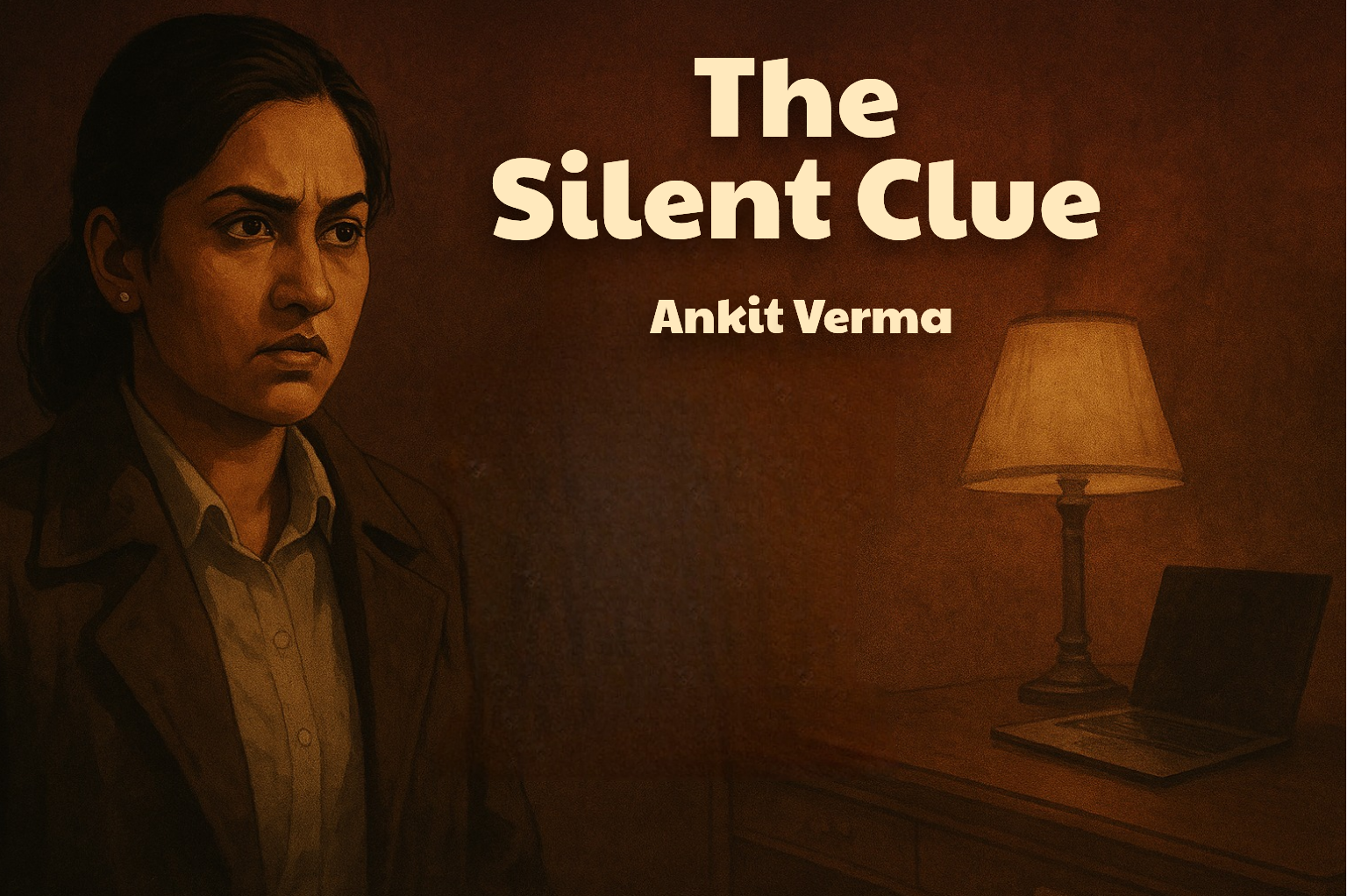

Ankit Verma
Detective Mira Roy had seen many crime scenes, but none that unsettled her as deeply as the one she faced now.
The small study was cluttered yet strangely untouched, as if the killer wanted to send a message rather than cover their tracks. Papers lay scattered across the mahogany desk, a half-empty glass of whiskey sat undisturbed, and the soft glow of a desk lamp illuminated the lifeless figure of Arjun Sen, one of the city’s most respected investigative journalists.
Arjun’s eyes stared blankly at the ceiling, mouth slightly agape, frozen in a moment of terror. No visible wounds. No weapon. No signs of struggle.
But on the polished surface of the desk, neatly placed as if to mock the scene, was a small folded note. Mira’s gloved fingers trembled slightly as she unfolded it. Written in shaky cursive was a single word:
“Truth.”
Mira’s mind raced. Arjun had been working on a groundbreaking story, one that threatened to topple powerful people. She knew the killer wanted to silence him—and to warn anyone else who might come too close.
“Secure the scene. No one leaves,” Mira ordered her team. She pulled out her phone and called the police headquarters.
“Get me the list of Arjun Sen’s contacts for the past 72 hours. And cross-check all his calls and messages.”
Her eyes drifted to Arjun’s open laptop. The screen was locked, but she could tell the last document he had been working on was titled Project Nightfall.
Outside the apartment, the rain began to fall heavily, casting a somber mood over the city. The streets glittered with the reflections of neon signs and flashing police lights.
Mira lit a cigarette, her thoughts heavy with questions.
Who wanted Arjun dead? Was the note a clue or a taunt?
And most important—what was Project Nightfall?
Over the next days, the investigation led Mira through the shadowy underbelly of the city’s elite. Arjun had been digging into Raghav Malhotra, a charismatic businessman with a spotless public image but a dark reputation whispered about in hushed tones.
Interviews revealed that Arjun had received threats.
“Stay away from Malhotra,” a message on his phone had warned.
But Arjun had refused to back down.
Mira confronted Raghav in his sleek office tower, the city sprawling behind him like a glittering kingdom.
“Why threaten a man who just wanted to expose the truth?” she asked, watching his face carefully.
Raghav smiled coldly. “Truth is subjective, Detective. Sometimes, it’s safer to keep it buried.”
The scar on his right hand caught Mira’s attention — a thin, jagged line matching the description from a witness who saw someone fleeing Arjun’s apartment the night he was killed.
Back at the forensic lab, the evidence was damning.
Raghav’s fingerprints were on the note left at the crime scene.
Mira’s gut told her there was more to this story. She knew from experience that criminals rarely leave such obvious clues unless they wanted to be caught—or wanted something else entirely.
Detective Mira Roy stood by the rain-speckled window of her office, watching the city pulse with life despite the storm. The dossier on her desk had grown thick overnight: interview transcripts, phone records, surveillance footage.
But something about Raghav Malhotra still didn’t sit right.
His confession, extracted after hours of questioning, was chillingly cold and rehearsed. He admitted to confronting Arjun at his apartment that night, but denied delivering the fatal blow. Instead, he claimed to have left the scene before Arjun collapsed.
“Then who killed him?” Mira had asked, eyes locked on his indifferent gaze.
Raghav’s smirk was unsettling. “Ask yourself—who benefits the most from Arjun’s death?”
Back at the crime lab, the forensic team delivered their latest findings.
The cause of death was poisoning. A rare neurotoxin, fast-acting and nearly impossible to detect without sophisticated tests. It had been administered through the whiskey glass found on the desk.
This detail explained the lack of visible wounds or signs of struggle.
But the poison’s origin was a puzzle.
Mira turned to Arjun’s laptop again, finally convincing the IT experts to bypass the password lock. Inside, Project Nightfall was more than a document — it was a digital treasure trove of secrets: encrypted files, recorded interviews, and a map of complex financial transactions linked to shell companies.
The data implicated not just Raghav, but a network of powerful individuals—politicians, businessmen, and law enforcement officers. The corruption was deep-rooted.
A sudden knock at Mira’s door startled her.
It was Nisha, Arjun’s closest friend and colleague.
“I found something,” Nisha said breathlessly, holding a USB drive. “Arjun sent me this last night, but I never had the chance to look.”
Mira plugged in the drive. It contained a video file — a shaky recording of a late-night meeting in a dimly lit parking garage.
The camera’s grainy footage revealed a hushed conversation between Raghav and a shadowy figure whose face was obscured.
“Tonight’s the night,” the figure said, voice distorted.
Raghav’s reply was cold: “Make sure it’s done clean.”
Mira’s heart pounded.
She realized this was bigger than she had imagined — Arjun’s murder was only the surface of a vast conspiracy.
That night, Mira received an anonymous text:
“Stop digging, or you’ll be next.”
But Mira was no stranger to danger.
She lit a cigarette and whispered to herself, “Truth always finds a way.”
The night air outside Mira’s apartment was thick with the scent of rain-soaked earth and exhaust fumes. A fog had rolled in, shrouding the city in an eerie silence. Mira sat at her desk, the anonymous text still fresh on her phone screen:
“Stop digging, or you’ll be next.”
She wasn’t afraid, but the weight of the case pressed on her chest like a stone. Every step closer to the truth was a step deeper into danger.
She glanced at the video on the USB drive again — Raghav’s meeting with the shadowy figure. She replayed it, this time focusing on the voice: raspy, low, with a faint Bengali accent. She recognized it, but couldn’t place it.
Her phone buzzed. It was Nisha.
“Detective, I think I found something,” she said, her voice urgent. “I checked Arjun’s encrypted emails. There’s one marked ‘urgent’ — sent to a lawyer named Ritu Kapoor. She’s been Arjun’s legal counsel for years.”
Mira made her way to Ritu’s office — a modest suite on the third floor of an aging building downtown. The place smelled of old books and stale coffee.
Ritu, a petite woman with steely eyes, greeted Mira cautiously. “Detective Roy, I was expecting you.”
“You were? Why?”
Ritu gestured to the stack of papers on her desk. “Arjun left these with me. He said if anything happened to him, I was to give them to you.”
Mira opened the folder. Inside were dozens of documents — financial statements, offshore accounts, photographs of clandestine meetings, all pointing to a massive criminal network.
At the center of it all: Raghav’s name appeared repeatedly, but so did someone else’s — Commissioner Devendra Suri, the head of the city’s police force.
Mira felt her stomach drop.
She’d always respected Suri. He was a father figure to many young officers. But Arjun’s notes and financial records didn’t lie. Suri had been shielding Raghav’s operations for years, using his authority to bury evidence and silence whistleblowers.
No wonder Raghav had smirked so confidently in that interview room — he knew he was protected.
Mira’s phone buzzed again. This time it was a call.
“Detective Roy,” a trembling voice said. “I saw you leave Ritu’s office. You’re in danger. They know.”
“Who is this?”
No answer.
Then: “They’re coming for you tonight.”
The line went dead.
Mira’s mind raced. She gathered the folder from Ritu’s office and tucked it into her coat.
“Ritu, lock your doors and stay put,” she said. “Don’t open the door for anyone but me.”
Ritu’s eyes widened with fear but she nodded.
Mira left, scanning the street carefully as she stepped into the fog.
Halfway down the block, a black SUV roared to life and began tailing her.
She ducked into an alley, her boots splashing in puddles.
The SUV screeched to a halt, and two men in dark clothes jumped out.
“Detective Roy, you’ve seen too much,” one of them sneered, brandishing a knife.
Mira’s hand instinctively reached for her service weapon. She fired a warning shot into the air, the sound echoing down the alley.
The men hesitated just long enough for Mira to slip behind a dumpster. Another shot — this one aimed. The first man went down, clutching his leg.
The second man lunged, but Mira was faster. She swung the butt of her pistol, connecting with his jaw. He collapsed in a heap.
Breathing heavily, Mira leaned against the wall. The fog felt thicker now, almost alive.
She had no choice. She needed backup, and she needed it now.
But could she trust anyone in the force with Suri’s name tied to the conspiracy?
She picked up her phone and called the only person she knew wasn’t on the take — Inspector Rohit Basu, her former partner.
“Rohit,” she whispered. “It’s Mira. I need your help. Meet me at the old warehouse by the docks in one hour. Bring everything you’ve got.”
Rohit’s voice was tense but steady. “I’m on my way. Be careful.”
Mira hung up.
She looked at the folder, at the name Suri written in Arjun’s neat handwriting.
“Truth always finds a way,” she muttered.
The fog at the old warehouse by the docks hung like a curtain, thick and impenetrable. Mira checked her watch—1:15 a.m. Rohit should have arrived by now.
She felt the cold metal of her pistol, a reassuring weight in her hand. Every step echoed on the cracked concrete floor as she moved cautiously through the shadows.
In the distance, a single overhead bulb swung gently, casting flickering light over a stack of wooden crates.
Then she heard it: footsteps, deliberate and slow.
“Rohit?” she called, her voice low but steady.
No response.
She raised her gun, finger on the trigger.
A shadow shifted near the crates. Mira approached, eyes scanning every corner.
Suddenly, a figure lunged from the darkness—Rohit, clutching his shoulder, blood seeping through his jacket.
“Mira,” he gasped, “it was a trap. Suri—he knew we’d come here.”
Mira’s heart pounded. She gripped Rohit’s arm, helping him lean against the wall.
“Stay with me,” she whispered.
From the shadows, a slow, mocking clap echoed.
“Well done, Mira,” a cold voice said. “But it’s too late now.”
Commissioner Suri stepped into the light, his uniform crisp and gleaming, a smug smile on his lips.
“You always were too idealistic,” he sneered. “Arjun thought he could expose me—he was wrong. Now you’ll join him.”
Mira’s eyes narrowed. “You killed Arjun. You orchestrated this entire mess.”
Suri’s smile faded. “It wasn’t supposed to go this far. But Arjun got too close, started digging into things better left buried. And now you have the folder.”
He gestured at the documents Mira still clutched.
“Hand it over, and maybe I’ll let you and your friend walk away.”
Mira’s grip tightened on her pistol. “You’re done, Suri. Arjun’s notes, his files, everything points to you. Even the poison—your contacts overseas. I know it all.”
Suri’s eyes flickered, a moment of doubt crossing his face.
Then he pulled his own weapon, aiming at Mira.
“It’s over, Detective.”
A shot rang out, echoing in the warehouse.
For a moment, time froze.
Suri’s eyes widened in shock. He looked down, saw the spreading red stain on his chest. He staggered, his weapon clattering to the floor.
Behind him, Rohit stood with his own smoking gun.
Suri collapsed to the ground, his final breath a gurgle of rage.
Mira rushed to Rohit. “You saved my life,” she whispered.
Rohit gave a weak smile. “Guess I still make a good partner, huh?”
Later, as the sun began to rise over the docks, Mira stood outside the warehouse, watching the fog lift.
The folder—Arjun’s legacy—would bring justice. Suri’s network would crumble.
She knew the road ahead would be long and dangerous. But Arjun’s death would not be in vain.
She lit a cigarette, exhaled a slow stream of smoke, and whispered to the dawn:
“Truth always finds a way.”
THE END