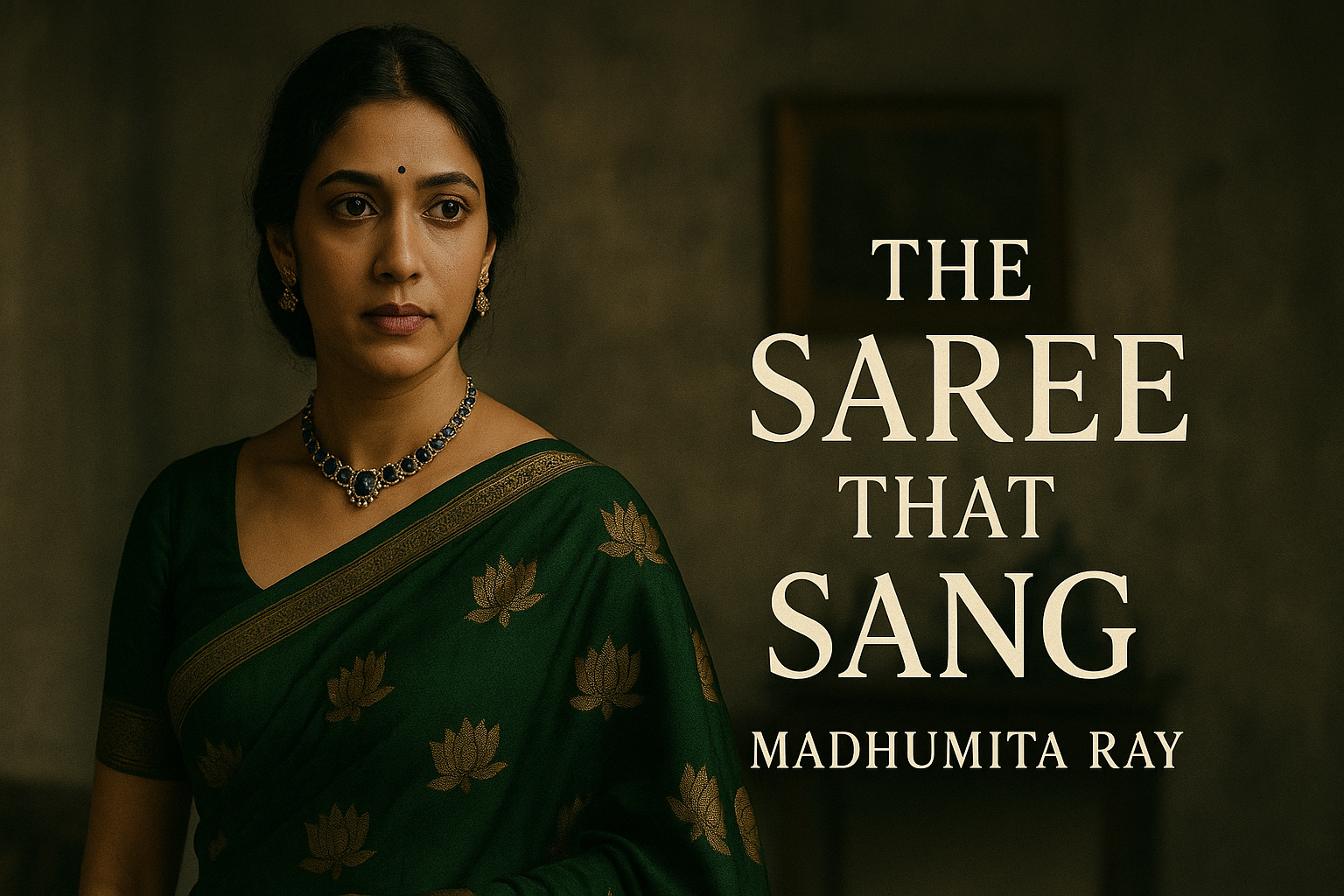

Madhumita Ray
Chapter 1: The Trunk in the Attic
The late March sun hung lazily over Shobhabazar, its amber glow falling across the shuttered windows of Anwesha’s ancestral home. The house, with its high ceilings, red oxide floors, and fading portraits, had been silent for years—like a tabla with loosened skin, still noble but mute. It had belonged to her grandfather, a man she barely remembered except through his letters—always inked in blue, always signed “Dadu.”
Anwesha had returned from Mumbai after almost a decade, driven by equal parts nostalgia and necessity. Her mother’s sudden passing left the Shobhabazar house in her name, and with the lease of her Andheri flat ending, she decided to come back for a few months. “Only till I sort my next project,” she told herself. She was a freelance music archivist, a profession as scattered as it sounded.
It was on the third morning, with the house thick in dust and memory, that she ventured into the attic.
The wooden stairs creaked like old knees. The attic door took effort, jammed with time and spiders. Inside, the air was dry and sharp, heavy with mildew. It smelled of forgotten summers and old books. A single light bulb hung from the ceiling, its filament still alive. Anwesha pulled the cord. A dim, yellow halo lit the cramped room.
She saw piles of moth-eaten shawls, broken dolls, a harmonium with one key sunken in, and a large, low trunk made of dark teakwood. It was banded with rusting brass and secured by a thick iron latch. Her fingers traced the grooves of the wood, and she felt the sudden urge to open it—as if the house had been waiting.
The trunk was locked. But near the corner of the attic, nestled beneath a cracked porcelain vase, lay a bunch of antique keys on a hook. She picked one, almost at random, and it clicked into place as though the lock remembered her.
When the lid opened, a gust of musty air escaped like an exhale from another time.
Inside was a saree. Deep forest green, almost black in the dim light, with golden lotuses embroidered along the border. It was folded carefully, too perfectly for something forgotten. Beneath it lay a white envelope sealed with red wax, but it was the saree that caught her attention.
As her hand brushed the fabric, soft and impossibly fine, she heard something strange—a sound, very faint.
A hum.
Three notes, like the beginning of a song. Her heart froze. She bent closer, unsure if the attic had tricked her. Again—ni sa ga. And then, unmistakably, the first line of a Rabindrasangeet:
“Esho shyamolo shundoro…”
It was not played, not sung, but hummed—delicately, hauntingly, like someone remembering rather than performing.
Anwesha pulled her hand back. The music stopped.
She looked around the attic, suddenly cold despite the warmth outside. No radio. No Bluetooth speaker. Nothing. She touched the saree again—this time, more deliberately. The humming returned, soft but certain.
She folded the saree back into the trunk and closed the lid. The music stopped again.
Back downstairs, Anwesha made herself tea, hands trembling slightly. She turned on her recorder app and went back up. This time, when she opened the trunk and touched the saree, she placed the phone close, praying it would pick something up. It did. The waveform trembled with a ghostly pitch—nothing too distinct, but not silence either.
Later that night, Anwesha couldn’t sleep. The saree sat in her mind like a question mark. Why had it been kept so carefully? Who had worn it? And why was it humming Tagore?
She opened the white envelope from the trunk. Inside was a letter, aged and fragile. The handwriting was elegant, slanted slightly to the left. Bengali script, written with care.
“Ei shari ta jodi keu hridoyer gaan niye pore, ami abar gaibo. — Bela.”
Anwesha read it twice. Then again.
“If someone wears this saree with a song in her heart, I will sing again. — Bela.”
Who was Bela?
The next morning, she rummaged through the trunk once more and found what she hadn’t seen before: a piece of folded cloth hidden under the saree—a sepia-toned photograph wrapped in muslin. In it, a young woman stood poised in front of a grand building Anwesha immediately recognized—Jorasanko Thakurbari. The woman wore the same saree, her long hair braided with jasmine, eyes proud yet gentle. On the back, in the same neat handwriting:
“Bela, Jorasanko, 1932.”
Anwesha stared at the photograph as if the woman might speak. Something about her seemed familiar—an echo, a presence. Like the song.
Back in her room, she placed the photograph on her desk, beside her laptop. She searched the web for singers named Bela associated with Rabindrasangeet. There were dozens—some recent, some older. But a few rare archives held references to a Bela Chattopadhyay, a promising singer trained under Dinendranath Tagore in the 1930s.
The articles were sparse, often footnotes in academic essays. One mentioned a planned performance in Tagore’s presence that was cancelled at the last moment. No further details. No obituary. No mention of her again.
It was as though Bela had vanished.
Anwesha closed her laptop. She looked at the photograph, then at the saree folded on her bed.
The house in Shobhabazar had offered her something—a puzzle, a presence, a voice locked in silk.
And the saree… it wanted to sing.
Chapter 2: A Saree Wrapped in Time
The morning sun filtered through the lace curtains of Anwesha’s room, casting soft dappled patterns on the floor. She hadn’t slept much. The hum of the saree, Bela’s letter, the photo from Jorasanko—all of it had occupied her thoughts like a silent orchestra tuning before a forgotten concert. For a brief moment, Anwesha wondered if she had imagined it all. Maybe the attic’s mildew had gotten to her, maybe the past week of cleaning, packing, sorting had played tricks on her senses. But when she looked at the saree draped gently on the armchair across the room, something in her stilled.
It looked different now—not just a piece of fabric but something more alive. Its forest-green silk shimmered slightly in the morning light, and the golden lotus motifs glinted like notes of a raga. She walked up to it, careful not to disturb the folds, and sat in front of it. Slowly, she reached out and placed her palm on the pallu.
The sound was immediate.
Not a hum this time, but a soft burst of wind, like a sigh through bamboo leaves. And then it came again—ni, sa, ga—a musical phrase curling into the air, incomplete, searching. She sat still, her breath shallow, afraid to break the spell. The melody faded, but a fragrance lingered—faintly of jasmine and old sandalwood. She wasn’t imagining it. The saree remembered. It wanted to be remembered.
Determined to understand more, Anwesha laid the saree on the bed and began to examine it. It was made of fine muslin silk, the kind that was nearly transparent and impossibly soft, with the intricate zari work hand-stitched into patterns that were neither entirely classical nor modern. The golden lotuses were not uniform—each had a slightly different petal arrangement, like hand-drawn illustrations. The border held minute calligraphic embroidery in faded gold thread, almost unreadable. She fetched a magnifying glass from her father’s old study drawer and leaned in.
There were words.
Woven into the border, as delicate as breath: “Ei gaan tomar jonyo—amar jibon diye royechhi ekhane.”
“This song is for you—I have left it here, with my life.”
Anwesha’s hand trembled. This wasn’t just a costume. It was a vessel.
She pulled out her notebook, the one she used for her field projects. Pages began filling quickly—descriptions, musical phrases she could recall from the hum, keywords like “Bela Chattopadhyay,” “1932,” “Tagore performance.” She noted the scent. The embroidery. The tonal pitch of the humming.
She didn’t notice when the door creaked open.
It was Manorama, the elderly housekeeper who had looked after Anwesha’s mother in her final years. Thin, soft-spoken, and always wrapped in a faded white cotton saree, Manorama rarely interfered unless asked.
“Ma’am,” she said gently, “I saw your light was on last night.”
Anwesha smiled tiredly. “Couldn’t sleep. Cleaning the attic brought up… memories.”
Manorama hesitated, her eyes falling on the green saree on the bed.
“That belonged to Bela-di,” she said suddenly.
Anwesha’s heart skipped.
“You knew her?” she asked, standing up.
“Not really,” Manorama said. “I was a child. But my mother was a maid in this house then. She would talk about Bela-di like she was a goddess. Beautiful, graceful, always singing. Everyone in Shobhabazar knew her voice.”
“What happened to her?”
Manorama frowned. “That’s the strange part. She was supposed to perform at a big event at Jorasanko. Everyone was talking about it. Then one day, she just… vanished. No one saw her after that. They said she ran away. But my mother never believed it. She said Bela-di had too much dignity to run. That the house swallowed her.”
“The house?” Anwesha asked, her throat dry.
“This very house. She never came out. No one saw her leave. Some said she went to Santiniketan. Some said… something happened that night.” Manorama looked around and then added softly, “There were whispers. But in those days, no one asked questions about women. They just disappeared into silence.”
The room suddenly felt heavier.
After Manorama left, Anwesha knew she had to know more. She took out her voice recorder, turned it on, and began speaking into it like she would for any archival project.
“This is Anwesha Ghosh. Location: Shobhabazar. Subject: ‘The Saree That Sang.’ Preliminary findings suggest the saree belonged to Bela Chattopadhyay, a Rabindra Sangeet singer from the early 1930s. Saree exhibits unexplainable sound phenomena—musical fragments consistent with Tagore’s composition ‘Esho Shyamolo Shundoro’. Saree also contains handwritten embroidery, suggesting it was created or gifted with personal intent. Interview with domestic staff indicates Bela disappeared mysteriously before a major public performance. Next step: search local archives, Tagore Society records, and any surviving letters or event announcements from 1932.”
She paused, then whispered, “And maybe… wear it.”
The idea terrified her. The humming, the scent, the letter—it all pointed toward an unfinished moment. A performance that was meant to happen but didn’t. Could wearing it unlock more? Would the saree show her something?
She couldn’t decide yet.
That evening, Anwesha walked down to Shyambazar library. The Tagore section was surprisingly well stocked. She sifted through old issues of Probashi, Sahitya, and Bharati. One article, dated July 1932, caught her attention:
“A promising young singer, Miss Bela Chattopadhyay, trained under Dinendranath Tagore, was to perform a special rendition of Rabindra Sangeet at the Thakurbari cultural evening next month. Her voice, described as ‘full of devotion and earth’, has captivated many rehearsals. The event is expected to draw luminaries of Bengal’s musical circle.”
But there was no follow-up article. No review. No mention of whether she performed.
Nothing.
The trail, like Bela, vanished.
Anwesha returned home, the saree heavy in her mind. She placed it on her lap that night, her fingers tracing its golden vines. The song didn’t come this time. But the silence was no longer empty. It waited—like an old raga waiting for the right taal, the right voice, the right moment.
And Anwesha was beginning to suspect… that voice might be hers.
Chapter 3: The Song at Midnight
The walls of the Shobhabazar house were thick with memory. Evenings stretched long here, especially after the sun dipped behind the crumbling terrace balustrade. Anwesha sat by the window, her recorder in hand, watching the day slip into night like an old melody fading into silence. The saree lay folded on the armchair, now a part of the room as much as the dusty bookshelf or the framed portrait of her mother with a half-smile.
She didn’t play music that night. She wanted to listen—to the room, to the silence, to the space between things. Around eleven-thirty, she switched off all the lights except the small table lamp, made herself a cup of tulsi tea, and settled into bed with Bela’s diary—if she could call it that. It was more a collection of torn pages, some barely legible, ink smudged at the edges, the paper yellowed to a deep ivory.
She turned a page at random.
“27 Asharh, 1339 — The saree is nearly ready. Ma says I should wear something brighter, but this green feels right. Like the pond after rain. Like the monsoon sky just before dusk. I want him to hear me in it. Even if he doesn’t look at me, even if he only hears the song.”
Who was he? Anwesha underlined the line. A forgotten love? A patron? Someone from Tagore’s circle? The entries were not linear, nor consistent. Days were skipped. Thoughts trailed off. But every now and then, there was a clear, crystalline line that cut through time.
“I sang it again today—Esho Shyamolo Shundoro. Dinu-da says my voice suits the low notes best. But I want the high note to tremble, to ache. I want it to carry something no one expects.”
Anwesha read that line aloud. Her voice cracked slightly. There was something raw in Bela’s words, not just ambition but a desperation to be heard—not as a woman singing, but as a soul echoing through sound.
She didn’t realize when she fell asleep. The diary slipped from her fingers onto the bed. The lamp remained on.
And then it began.
At exactly 12:03 a.m., the air in the room shifted. Anwesha stirred in her sleep, half-dreaming, half-aware. A note rose in the stillness—soft, tentative. A familiar three-note hum. But this time, it didn’t stop.
It blossomed.
The melody unfolded into a slow, aching rendition of Esho Shyamolo Shundoro, not sung, not played, but breathed—like the house itself had become an instrument. The notes hovered in the air, resonating in the glass panes, in the wooden floor, in the curve of the stair railing outside her door. Anwesha sat up, startled, her heartbeat loud in her ears.
The saree lay exactly where it was—but it glowed faintly, the gold embroidery shimmering as if kissed by moonlight. The air around it pulsed with song, each note trembling on the edge of the unsung. Anwesha stared, too stunned to move.
And then, almost imperceptibly, a second sound joined the melody—a voice.
Not from outside. Not from the walls. But inside her.
It was not her own.
A woman’s voice, low and velvety, full of pain and longing, began singing the line:
“Esho shyamolo shundoro, abar esho prane…”
The words were barely above a whisper, yet they filled the room like incense. Anwesha blinked, unsure if she was awake. But the sensation was unmistakable—someone was singing through her. Her lips were still. Her body still. But the song flowed.
The lamp flickered.
She stood up, slow and unsure, the melody guiding her. The air felt charged, like the moments before a storm. She walked to the saree, reached out, and as soon as her fingers touched the pallu, the voice grew louder.
“Alo chhaya’r bhelaye bheshe, tumi je ele moner ghare…”
Tears welled up in Anwesha’s eyes. She knew this part of the song, but never had it sounded like this—like a prayer and a farewell woven into one.
The clock struck twelve-fifteen.
The music ceased.
Just like that, the room returned to silence. The lamp returned to its steady glow. Anwesha’s breathing was shallow. She sank to the floor, still holding the edge of the saree. Her recorder, forgotten beside her, blinked red—still recording.
When she played it back minutes later, her hands trembling, the audio was mostly static. But just before the fifteen-minute mark, she heard it—the faint beginning of the hum, followed by something softer, like a breath or a sigh.
It was real.
The next morning, she played the recording again, this time with headphones. There it was. At full volume, she could hear five seconds of sung melody. Faint, but present.
Anwesha copied the clip to her laptop, ran it through sound editing software, amplified the waveform, cleaned out the static. The melody emerged clearer than she expected.
She wept.
Not out of fear—but out of recognition. There was grief in the voice, yes, but also… love. Deep, wordless love.
She emailed the clip to her old professor at the Sangeet Archives Institute with a short note:
“Possible archival anomaly. Attached is a 15-second voice clip recorded during midnight at my ancestral home. Subject: Possible Rabindrasangeet variant.”
She knew she couldn’t explain it in an email. Who would believe her?
That night, as she folded the saree and placed it in her cupboard, she whispered, “I’m listening, Bela.”
And she meant it.
Because whatever Bela had left behind—unfinished, unsung, unloved—it had found its way back. Through fabric. Through silence. Through Anwesha.
And the saree was only beginning to sing.
Chapter 4: The Woman in Sepia
The morning after the midnight song felt oddly calm, as if the house itself had settled into silence after sharing a secret. Anwesha woke late, the memory of the melody still curled inside her like steam in a clay cup. She sat at the edge of the bed, her mind tracing the words Bela had sung—not with her mouth, but with Anwesha’s soul. It felt like possession, but not of horror—of history, of art, of ache.
By ten, Anwesha had already brewed a strong cup of Darjeeling and spread out everything she had: Bela’s torn diary pages, the saree—now wrapped in fine muslin to preserve it—and, most importantly, the photograph. The woman in sepia. Bela.
The photo fascinated her endlessly. It wasn’t just the saree that stood out, though that was arresting—the same forest green silk, the golden lotuses catching the light. It was Bela’s face. She was beautiful in a way that didn’t shout. Wide eyes with a gaze slightly off-camera, lips not smiling but not unsmiling either, as if caught mid-thought. The kind of face that belonged in paintings, not because it was flawless, but because it was felt.
Behind her stood the unmistakable pillars of Jorasanko Thakurbari. A moment in time, a memory pressed into silver nitrate and paper. Anwesha flipped it again. The words in ink remained unchanged:
“Bela, Jorasanko, 1932.”
She wondered who had taken the photo. A fellow artist? A friend? A lover?
With a careful scan on her phone, Anwesha enlarged the image digitally, zooming in on the background. The pillars were chipped, the plaster faded, a corner of a harmonium visible on the right—perhaps it was taken during rehearsal. Her fingers hovered over Bela’s face. It felt surreal, seeing a woman so clearly and yet knowing so little about her.
Anwesha opened her laptop and began to dig.
This time she turned her attention to archived newspapers from 1932 to 1935. A few articles still existed in digital scans—concert announcements, obituaries, community gossip columns. A notice in The Statesman dated August 2, 1932, caught her eye.
“Cultural programme held at Thakurbari postponed due to unforeseen illness of one of the principal performers. Event to be rescheduled.”
No names. No mentions. But the date matched.
She jotted it down, then returned to a Rabindrasangeet blog she trusted. A post buried in the comments of a 2015 article about “The Lost Women of Tagore’s Music” mentioned a “Bela-di” who once sang like a koel, but disappeared just before her big break.
Anwesha replied to the comment with her own note and email, hoping against hope the commenter might still check after all these years.
By afternoon, she knew she had to leave the house. Shobhabazar had always been a neighborhood where the present tiptoed around the past—rickshaws still ruled the narrow lanes, the old ghats still held the river’s scent, and the paan-stalls knew more stories than any newspaper ever printed.
She made her way to Jorasanko.
The house-museum stood quiet, wrapped in brick-red colonial elegance. As a student, she had visited it for its archives and ambiance. But this time she walked in not as a tourist, but as someone seeking something personal. Something left unfinished.
Inside the museum’s small reading room, she requested access to the visitors’ registry and any photographic archives from 1930 to 1935. The clerk, a middle-aged man with kind eyes and an eternal film of dust on his glasses, agreed after she showed him her research credentials.
Anwesha scanned through brittle, handwritten ledgers. Most names were predictable—Basu, Mukhopadhyay, Lahiri. But there it was, in the August 1932 logbook.
“Bela Chattopadhyay — performer (pending rehearsal).”
And then, just four pages later: a note in the margin.
“Performance cancelled. No further contact.”
It was chilling, how easily a person’s name could vanish into parentheses.
She asked if any photographs from those rehearsals existed.
“There are boxes,” the clerk said. “Donated years ago. Not all catalogued.”
Hours later, inside a cardboard box marked 1932–Misc., she found a contact sheet of candid rehearsal photos.
There, on the second strip—grainy and slightly faded—was Bela.
In one, she was seated on a wooden bench, head tilted back, clearly mid-song. In another, she was laughing with a tall young man wearing round glasses and holding a notebook. Anwesha froze.
Who was he?
He had the air of someone important—not for his clothes, but for the way others turned toward him in the background. One image showed him adjusting the harmonium for her. In the last photo of the strip, Bela was alone, looking directly at the camera—no smile, but eyes full of something unsaid.
Anwesha carefully noted the file number and requested a digital scan.
On the tram ride home, her head spun with theories. Could the young man be the person she referred to in the diary? The “him”? A fellow musician? A composer?
The moment she got home, she placed the contact sheet beside the original photograph. It was clear now—the portrait had been taken on the same day. The saree was identical. Her hair was styled the same way.
But there was one difference.
In the original photo, Bela wore a necklace—an antique choker with a single sapphire drop. In the rehearsal photo, she didn’t.
Anwesha rushed to the trunk again, heart thudding. She had left everything untouched since she wrapped the saree. Carefully unfolding the muslin, she examined the base.
There it was.
Tucked into the farthest corner of the trunk, nearly invisible beneath the lining—a velvet pouch.
Inside it: the same sapphire choker.
She held it to the light, and in that instant, the air around her shifted again.
A faint, distant note rang out—shuddha ni—clear, echoing. Anwesha closed her eyes.
The saree had a voice.
The necklace had a name.
And the woman in sepia—she had a story still waiting to be told.
Chapter 5: Bela’s Diary
The sky over Shobhabazar darkened slowly, drawing a gentle curtain over the day as Anwesha sat by her writing desk, the soft glow of her table lamp illuminating the worn pages of Bela’s diary. With each entry, the voice of a woman nearly erased by time began to bloom—timid at first, then resolute. Anwesha handled the pages with reverence, like sheet music from a lost symphony.
She had now read the first dozen entries several times. Some were mundane—descriptions of vocal practice, of her mother’s fish curry, of afternoons spent reading Gitanjali in the courtyard. But others held emotional turbulence, stitched between everyday moments like torn seams barely concealed.
“6 Ashwin, 1338 — I sang for Dinu-da today. He smiled after the third verse. Said I was beginning to understand the difference between sur and bhab. I didn’t dare ask if Gurudev heard me from the other room. I just want to be good enough for one moment in his presence. Just one.”
Anwesha smiled faintly. There was something so achingly human about that longing—for recognition, for acknowledgment from someone who had shaped the very air you breathed. She knew that feeling. Bela had not been just a performer-in-waiting. She was a woman craving resonance—with music, with herself, with someone unnamed who lingered at the edges of each page.
“27 Poush, 1338 — He didn’t speak to me today. Only nodded when I sang. But I could feel him listening. His silence is louder than applause. I wore the green saree again during practice. Ma says it’s unlucky to wear performance sarees before the event. But I feel powerful in it. Like the saree has its own song tucked inside.”
Anwesha glanced toward her wardrobe. The saree was folded neatly inside, wrapped in a fresh white cotton sheet. The necklace lay beside it, nestled in a jewelry box lined with velvet. She hadn’t heard the midnight song again since that one night, but the air felt different now—like the house had adjusted to her presence, recognizing her not as a visitor but a collaborator in remembering.
She turned another page and her heart stopped.
A loose sheet had slipped between the diary pages. On it, scrawled in a hurried hand, were musical notations—sargam for a composition. At the top, in bold strokes:
“Esho Shyamolo Shundoro – Bela’s variation.”
It wasn’t just a traditional rendition. Bela had altered parts of the composition—moving the antara into a different rhythm, adding pauses after the sanchari. It was daring. Creative. Personal.
Anwesha, trained in Rabindrasangeet herself, realized what this meant. Bela had taken the liberty to interpret one of Tagore’s most spiritual pieces in her own voice. At the time, that would have been considered almost irreverent—unless, of course, the poet himself had approved.
The question burned in her chest—Did he?
Back to the diary.
“10 Falgun, 1338 — I showed him the variation. Dinu-da was horrified. Said it’s not how it’s meant to be sung. But he… he only looked at me and said, ‘You’ve understood the ache, Bela. That is enough.’ I could cry.”
Anwesha read the line again, this time aloud. The ache. That was it. Bela had not just sung Tagore—she had felt him, challenged him, embraced him, made him weep through her own wounds.
“18 Chaitra, 1338 — They’ve announced the performance. I’m one of three lead singers. The saree is ready. Ma added a golden border with lotuses. She says it brings out my skin. I don’t care. All I care is that when I sing, I remember what it’s like to long. Truly long.”
A chill ran down Anwesha’s spine.
This was the saree. That performance.
The concert that never happened.
She turned the page.
Nothing.
The next few pages were blank.
Not blank from age—but unused. Like words had failed her. Or something had happened.
She reached the final entry, just a few lines scratched in haste.
“I saw him today with her. She wore red. She laughed too easily. He touched her arm in a way I’ve never known. It broke something I didn’t know I had in me. I can’t sing tomorrow. Not with this voice. Not with this heart.”
Anwesha’s eyes blurred. Bela had not disappeared because of failure. She had disappeared because her song had broken before it could begin. Her voice, once tuned to divine sorrow, had cracked under personal grief.
And then came the last sentence—barely legible:
“If one day someone sings in this saree with a healed heart, maybe the song will be free.”
Anwesha closed the diary, her hands trembling. This wasn’t a ghost story. This wasn’t magic. This was history—raw, bruised, honest.
That evening, she placed the notations on her harmonium, sat before it, and began to hum.
It was shaky at first. Her fingers stumbled, voice unsure.
But when she reached the antara, something strange happened. Her breath settled. Her pitch aligned. And for a single moment, Anwesha felt she wasn’t singing alone.
The voice came again—faint but present. As if Bela sat beside her, one hand on the saree, the other on the keys.
Together, they sang.
And the house listened.
Chapter 6: The Concert That Never Was
The sound of the harmonium still lingered in the air when Anwesha awoke the next morning, her fingers aching slightly from the long practice the night before. A strange clarity had settled in her chest, as if Bela’s song had cleared some old cobweb not just from memory, but from within her. The saree lay folded on the bed again, and the diary rested beside it like two old friends in quiet conversation.
She knew now that the moment had been real.
Bela hadn’t simply been another forgotten artist. She had tried to say something—about heartbreak, about identity, about claiming space in a world that applauded softly and judged loudly. But the moment that was meant to be hers had been lost. Broken.
And Anwesha, somehow, was being asked to finish it.
Her inbox pinged.
She opened her laptop. The subject line read:
“Re: Bela Chattopadhyay – Lost Voice?”
It was from a music historian, Aroop Dey, a former student of her professor, who now worked at the Rabindrasangeet Heritage Trust.
Dear Ms. Ghosh,
I received your forwarded query and audio clip. I must admit—it caught my breath. The tonality is eerily consistent with old Tagore-era performances, especially the faltering vibrato at the phrase “alo chhaya’r bhelaye.” I’ve compared it with some 78 rpm recordings from 1931–32, and while we cannot confirm identity through voice alone, I believe your hunch is worth pursuing.
Interestingly, I came across a letter in the archives last year written by Dinendranath Tagore to his cousin Abanindranath. In it, he mentions a certain “Bela,” calling her “the girl who dares to sing grief before it becomes fashionable.” The letter goes on to say: “Her rendition of ‘Esho Shyamolo Shundoro’ stilled the courtyard. Even Rabi Thakur asked who she was. She may yet become someone worth remembering.”
But here’s the tragedy—the following month’s correspondence stops mentioning her altogether.
Please keep me updated. I sense you’re on the brink of something rare.
Anwesha exhaled. This was not in her head. Bela had been seen. Heard. Perhaps even praised by the poet himself. But something had silenced her before the final act. And now, the saree hummed with the weight of that unfinished note.
She called Manorama.
“Did Bela-di ever perform in public after the Thakurbari incident?” she asked, her voice steady.
Manorama hesitated. “My mother used to say Bela-di was never the same after that night. There was a lot of talk… not all of it kind.”
“What kind of talk?”
“They said she fell in love with a married man. A zamindar’s son. Very powerful. She thought he’d stand by her. But he came with his wife to that concert night… and Bela-di never left the house after.”
Anwesha’s fingers clutched the edge of the table.
“She lived here?” she asked. “All this time?”
“She stayed in the back room upstairs. After a while, no one saw her. Not even the servants. Food was left outside her door. When my mother came to clean, Bela-di would hum from inside. Never opened the door. And then one day… the humming stopped.”
Anwesha felt her throat tighten. Bela had chosen silence. Not out of fear, but heartbreak.
And now her voice was returning—through notes, cloth, breath, blood.
That night, Anwesha opened the wardrobe and took out the saree. Her fingers lingered on its soft silk, now fragrant with something indefinably sweet—like the first drop of rain on dry earth. She draped it carefully, not as a costume but as a second skin. The golden lotuses shimmered as she moved toward the mirror.
In the reflection, she didn’t just see herself. She saw echoes.
Of Bela.
Of the girl in the sepia photograph. Of a performer robbed of her debut.
She set up her camera and harmonium. This time, she would record it. Not just the voice—but the moment.
She began softly, humming the initial phrase, her voice blending with the same spectral hum she had heard that night. Slowly, the melody of Esho Shyamolo Shundoro unfolded—this time, not with precision, but with feeling.
Each verse, each phrase, felt like stepping deeper into a forest of memory.
And then it happened.
The air shifted. The candle on her desk flickered.
And the second voice came.
It wasn’t hers. It wasn’t a playback. It was within.
A duet. Anwesha and Bela. Across time. Across silence. One voice made of two hearts.
The recording continued for four minutes and twenty-six seconds.
When it ended, she sat frozen, the tears spilling silently. Not from fear, but from completion.
Something had been healed.
Later that week, she sent the video to Aroop Dey with the title:
“The Concert That Never Was.”
He wrote back within the hour.
This is not just a performance. This is resurrection. I will present it at the next Archive Symposium. But more than that, it must be performed live. Preferably… at Jorasanko.
And so it was decided.
Bela would sing again.
Through Anwesha.
On the stage she was denied.
Ninety-three years later, a saree would be worn again—not for sorrow, but for justice.
And when the last note would rise into the air, it would carry with it a story—of a woman silenced, and a woman who listened.
Chapter 7: A Voice Left Behind
The corridors of Jorasanko had never felt so alive.
It was the day of the performance. Anwesha arrived early, hours before the audience would trickle in, before the murmurs and microphones and introductions. The hall was still empty, save for a few staff members preparing the stage, dusting old wooden chairs, arranging tabla stands and floral garlands. But Anwesha stood in silence at the center of the hall, her eyes closed, listening not to the present, but to the past.
This was where Bela had stood—ninety-three years ago. Not as a performer, but as a promise. A voice almost heard. A saree unworn. A life paused at the edge of something beautiful.
Now, Anwesha was that bridge between a silenced soul and a stage waiting for redemption.
She wore the saree again.
The forest green clung to her like memory itself. The golden lotuses glowed in the afternoon light. The sapphire choker rested at her throat, catching flecks of sun as if it remembered the day it was first clasped. Aroop Dey arrived with the archival committee, offering her a nod of encouragement.
“Are you ready?” he asked, handing her the program leaflet. At the top:
“Bela’s Voice: A Tribute After Ninety-Three Years.”
She nodded. “As ready as a ghost.”
He smiled. “Then may she haunt us all.”
She stepped into the greenroom to wait, surrounded by mirrors that had seen decades of faces and nervous fingers. Anwesha ran hers gently across the harmonium keys, not pressing down—just feeling. The humming had started again—gentle, present. Not external anymore. It now lived inside her.
She remembered something Bela had once written:
“I do not wish to be remembered as a woman who waited. I wish to be remembered as a voice that almost broke the sky.”
The crowd was larger than she expected—over a hundred people seated in the hall, along with musicians, students, critics, and even a few elderly women in white sarees who said they’d heard of Bela through the whispers of their mothers. No one knew exactly what they were about to hear. The story had not yet been shared. The song would tell it first.
The lights dimmed. The soft resonance of the tanpura filled the space.
Anwesha walked onto the stage, not with drama, but with stillness. She bowed once to the audience, once to the harmonium, and once—slightly upward, as if Bela was somewhere in the rafters, waiting.
She began.
Not with the main melody, but with a humming—a low, familiar hum that grew steadily, confidently. And then, when the tala settled in, she began singing Esho Shyamolo Shundoro in Bela’s variation.
The audience stilled.
The song swelled.
Each verse carried more than music—it carried memory. Grief and glory. Silence and return. Anwesha didn’t just perform; she offered something. With every line, she gave back what Bela had been denied—space. Stage. Sound.
And halfway through the second antara, it happened again.
The second voice returned.
Not over the sound system. Not imagined. But felt. The harmonics shifted subtly, the room’s air vibrating with a presence not visible. Some in the audience closed their eyes. Some gasped softly. An elderly woman whispered, “She’s here.”
And Anwesha knew—it wasn’t just performance. It was release.
The final lines rose gently.
“Je gaan tomar jonyo, se gaan ami abar gaibo…”
And the voice—both Anwesha’s and Bela’s—held the note, a single, trembling thread of sound that seemed to shimmer in the very bones of the building.
Then silence.
But not emptiness.
A stillness so full it made the room ache.
The applause didn’t come immediately. No one wanted to break the spell. When it did rise, it was thunderous—not out of excitement, but out of reverence. Some cried. Some stood. Some simply folded their hands in quiet thanks.
Backstage, Aroop’s eyes were red.
“You brought her back,” he said, his voice thick.
“She never left,” Anwesha replied softly. “We just stopped listening.”
Later that night, alone in the Shobhabazar house, Anwesha placed the saree back in the trunk. The silk was no longer restless. The embroidery no longer pulsed. It had sung. It had been heard.
She placed a fresh sheet of muslin over it and added a note inside:
“Performed on 14th April, 2025, Jorasanko — in memory of Bela Chattopadhyay. Her song lives.”
As she closed the lid, the house exhaled.
No hum.
No whisper.
Just peace.
She turned off the light, whispering, “Goodnight, Bela.”
And for the first time since her return to Kolkata, Anwesha slept without dreams.
Chapter 8: Echoes in the Courtyard
The next morning, Shobhabazar woke under a blanket of soft spring sunlight, and Anwesha stepped into the central courtyard of the old house as if seeing it for the first time. The moss-covered bricks glowed emerald, the tulsi plant in the stone basin swayed gently in the breeze, and the air smelled faintly of incense and hibiscus from someone’s distant puja. It felt, impossibly, like the house had breathed again.
She carried her tea to the bench beneath the mango tree and sat there, letting the quiet wrap around her. For so long, the courtyard had felt haunted—not by ghosts, but by something unfinished. Now, it felt full. A kind of calm had settled over the place, not the silence of abandonment, but of resolution. The silence after the last note of a song has landed perfectly.
The night before, after the performance, she’d received messages from strangers and scholars alike. One read, “You gave back what time tried to take.” Another, “I felt as if I wasn’t watching a concert, but attending a remembrance.”
But it was the message from the elderly woman in the third row that moved her most:
“I don’t know who Bela was, but I know what it means to be silenced. Today, we all heard her.”
Anwesha traced the rim of her cup thoughtfully. The performance had been the end of one journey—but perhaps the beginning of another. She remembered what Bela had written:
“If ever someone wears this saree with a song in her heart, I will sing again.”
She had sung. Not just through Anwesha, but into the very walls of Jorasanko, into the minds of every person present. Her voice had returned not as nostalgia, but as something living.
Still, Anwesha couldn’t stop thinking about the final photo she had found—the one of Bela sitting quietly at the edge of a courtyard, not performing, not singing, just looking. The same courtyard.
This courtyard.
Suddenly, Anwesha stood up and looked around. The square layout, the arching mango branches, the basin with the tulsi—all of it matched. She ran inside, fetched the photo, and brought it back out.
Yes. It was unmistakable.
Bela had once sat right here. Decades ago. Alone.
Maybe the saree had always wanted to return here—to the courtyard, where Bela once dreamed. Maybe the song had waited for a loop to close, not just a note to resolve.
She placed the photo on the bench, next to her, and whispered, “I found you.”
As if in answer, a single mango leaf drifted down and landed on the edge of her tea.
Later that day, she explored the upper rooms of the house, trying to locate the one Manorama had once referred to—the room Bela had locked herself into. It wasn’t hard to find. On the southern side, behind a corridor that curved past the prayer room, there was a door different from the rest—older, heavier, its handle rusted and tight.
She tried the knob. To her surprise, it opened.
Dust clouded the air. The room was small, with a single wooden bed, a desk under the shuttered window, and a cracked mirror leaning against the wall. But what startled Anwesha was the shelf above the desk—lined with empty clay ink pots, calligraphy pens, and an old copy of Gitanjali, its pages annotated with tiny musical notations in the margins.
And then, on the desk, a brittle page pinned under a small stone.
It was a letter.
To whomever finds this,
This room holds no ghost, only a woman who once dreamed too loudly.
I leave behind not regret, but a hope—that someone will remember me not for how I ended, but for how I once began, with song.
The saree is my skin. The melody, my soul.
Let the song go on.
—Bela.
Anwesha folded the letter with care. She didn’t cry. She simply stood there, the silence of the room surrounding her like a warm shawl. The past had spoken, but it had not begged. It had trusted her.
That evening, she stood again in the courtyard, this time with a small framed photograph of Bela, which she placed on the old tulsi platform. Beside it, she lit a single oil lamp and placed a garland of jasmine.
She didn’t say anything.
The lamp flickered once, then steadied.
Inside the house, the wind moved through the old rooms. Doors creaked, not eerily, but like breath. The courtyard echoed—not with sound, but with story.
Later, as the moon rose over Shobhabazar, Anwesha played back the final performance video. She watched herself sing, eyes closed, body still—but she could see it now, what others might have missed: the faint shimmer in the air beside her, like the flicker of silk in motion. The second voice, rising.
Bela.
A voice left behind had finally found its way home.
Chapter 9: The Last Note
Summer had begun to curl at the edges of the Shobhabazar house. The jasmine creepers along the courtyard wall had started to bloom, and the air was thick with that sweet, heady fragrance that made evenings feel stretched, like ragas played just a little slower, a little longer. Anwesha sat in the old study, notebook open, voice recorder on, but she wasn’t researching anymore. She was writing something she hadn’t written in years—a personal piece.
A eulogy. A story. A closing act.
She titled the page: The Last Note.
Bela’s journey had begun with silence—not by choice, but by circumstance. She had loved, been betrayed, created beauty, and been locked away in a room above her own courtyard. Her song had waited—not out of vengeance, but hope. Anwesha now understood that it wasn’t just the performance at Jorasanko that had gone unfulfilled; it was the very idea that a woman’s voice, when broken, could still be beautiful.
She paused in her writing, stood up, and went to the trunk.
The saree lay inside, calm now, still. Not dead—never dead—but no longer restless. She ran her hand over the silk. It no longer sang. It no longer had to.
She carefully took it out for one final task.
The heritage committee had contacted her two days ago with a proposal. They wanted to preserve the saree, the choker, the diary, and Bela’s last letter in the new section of the Tagore museum dedicated to “Forgotten Voices of Bengal.” Anwesha had hesitated. Could she let it go?
But then she remembered Bela’s last line: “Let the song go on.”
Preservation was not loss. It was passage.
That afternoon, she wrapped the saree in archival cotton, slid it into a protective case, and prepared her donation letter. She included a note:
This saree was not just worn. It was sung into history.
With this, a silence ends. And a story begins.
She closed the envelope and placed it beside the case. The choker, cleaned and polished gently, sparkled in the sunlight streaming through the arched windows. For the first time, it looked less like jewellery and more like punctuation—an exclamation at the end of a long sentence.
That evening, Anwesha hosted a small gathering in the courtyard. Just friends, a few music scholars, and a pair of young girls from a local music school. She hadn’t told them everything—only enough. Enough to understand that they weren’t just drinking tea and listening to Rabindrasangeet under a mango tree. They were witnessing a farewell. And a beginning.
She played the recording of the Jorasanko performance on a small speaker.
As the final notes faded into the dusky air, one of the young girls whispered, “Who is the other singer?”
Anwesha smiled. “Someone who waited a long time to be heard.”
There were no questions after that.
Only music.
Only sky.
Only jasmine petals falling soundlessly into the courtyard basin.
Later that night, when everyone had left, Anwesha walked back to the old upstairs room. The one Bela had once locked herself into. The air there had changed too—it no longer pressed against her chest. It had let go.
She sat at the desk and wrote one final letter, addressed not to the committee or the press or the historians—but to Bela.
Dear Bela,
You are no longer a whisper in someone else’s song.
You are the note that stayed.
You are the saree. You are the voice.
You are the pause, and the breath that breaks it.
And I… I am simply the one who listened.
Yours,
Anwesha
She placed the letter inside the copy of Gitanjali she had found in Bela’s room and left it on the desk, beneath the cracked mirror.
Then she turned off the light.
The house slept.
And the voice—finally, finally—rested.
Chapter 10: A Saree Reborn
The sun was high over Kolkata when Anwesha stood once more at the gates of Jorasanko Thakurbari, but this time not as a performer, not even as a researcher—she had come to say goodbye. In her hands she held the case: the forest-green saree, the sapphire choker, the brittle diary pages, and the letter written in a trembling script by a woman long gone but never truly lost.
Inside the museum’s eastern wing, a new exhibit had opened.
“Unsung: The Forgotten Voices of Bengal’s Women Artists.”
Bela was its heart.
The curators had framed her photograph—the sepia one where she stood in the same saree, eyes full of something unfinished—and placed it beneath a soft spotlight. Beside it, in a glass case, lay the saree, folded perfectly, its golden lotuses seeming to shimmer in gratitude. The choker was displayed like an heirloom relic, though Anwesha knew it was something far more intimate than ornament—it was the last thing Bela wore before she disappeared from history.
The diary was digitized, its pages now scrolling slowly across a small screen for visitors to read. And next to it played the recording: Anwesha’s voice and Bela’s, woven together in their midnight duet of Esho Shyamolo Shundoro.
People stopped and listened.
Some stayed longer than others. One woman held her palm over her chest. A teenager with headphones closed his eyes, head swaying to the melody. An elderly man mouthed the words, as if remembering something he never lived.
And Anwesha?
She stood quietly in a corner, watching them, letting the weight of it all settle.
Bela had sung again.
And the saree—once wrapped in time and longing—had become something new.
Not a relic.
A witness.
The museum director approached her, soft-spoken and kind. “Would you like to say a few words at the opening event next week?” he asked.
Anwesha hesitated. “No,” she said with a smile. “She’s already said everything.”
Later that evening, Anwesha returned to Shobhabazar one last time. The house, no longer ghostly, felt like an old friend who had finally exhaled. She packed lightly. Her work in Kolkata was complete, for now. She had other places to go, other stories to listen for. But as she locked the door behind her, she paused.
The courtyard shimmered in golden twilight. A few jasmine petals floated down from the mango tree.
She whispered, “Thank you.”
And for the first time in weeks, she didn’t expect a response.
Back in Mumbai, months passed. Then a year. The performance at Jorasanko became part of a university course on female voices in colonial Bengal. The saree exhibit traveled briefly to Santiniketan. And one day, out of the blue, Anwesha received a letter in neat Bengali script:
Dear Anwesha-di,
I’m a student of Rabindrasangeet at Rabindra Bharati. I saw the Bela exhibit. I didn’t know voices could live in silence. I didn’t know sarees could sing. I want you to know—I wear my mother’s saree when I sing now. I think of Bela every time.
Yours in song,
Priyanka.
Anwesha folded the letter carefully and placed it in her own notebook. Not Bela’s. Hers.
Because stories do not end. They ripple.
And sometimes, a saree hums for decades just to be heard once—truly heard.
One spring evening, sitting alone in her Mumbai apartment, Anwesha opened her harmonium again. She began to sing—not Bela’s song this time, but her own. The window was open, and a breeze drifted in, smelling faintly of some faraway mango flower.
No hum came.
But she didn’t need it.
The saree had been reborn.
And the silence had learned to sing.
End