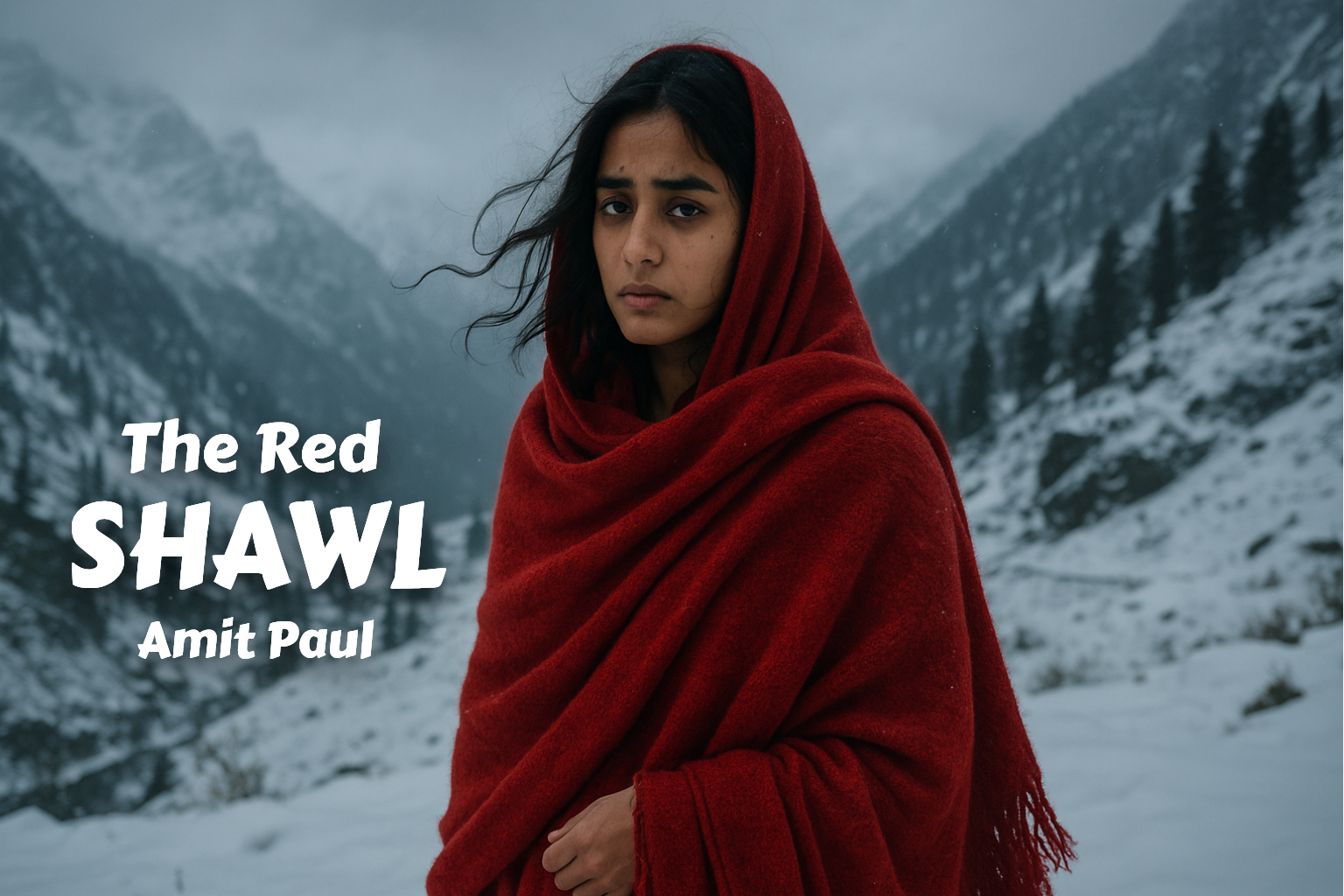

Amit Paul
Chapter 1: The Snowlight Frame
The sky above Spiti was a cruel, beautiful thing—too blue to trust. Arjun Rawat had been walking for hours, boots crunching softly over a thin crust of ice, camera slung across his chest like a talisman. He wasn’t just another tourist in search of selfies on mountain ridges; he was chasing something quieter, something lost. Delhi had drained him—clients who wanted glamour edits, weddings that looked like Bollywood trailers, and a personal life reduced to text message apologies. So when his friend mentioned a forgotten shepherd’s trail between Kaza and Chandratal that locals avoided in winter, Arjun had packed his gear and boarded the first bus. There was talk of frostbite and ghosts, sure, but it didn’t bother him. What scared him more was the emptiness he felt in the city. The higher he climbed, the more alive he felt—until the forest thinned and the world turned white. That morning, while the sun filtered through slits in the clouds, he found himself standing before a narrow ridge lined with prayer flags, swaying like whispers. And that’s when he saw her.
She stood a little ahead, just where the path curved into a narrow ledge above the ravine. A red shawl wrapped around her slim frame, her hair loose, catching flecks of snow. She didn’t wave or speak. She only looked at him—no smile, no fear—just a gaze that felt like an invitation. Arjun, startled but mesmerized, raised his camera instinctively. Through the lens, she seemed almost unreal—bathed in soft light, like a dream too carefully lit. But when he lowered the camera, she was still there. She gestured gently with her hand, urging him to follow. He did, without questioning why. Her walk was quiet, confident, her bare ankles visible just above the snow, adorned with tiny silver anklets that jingled softly. She led him down a side trail he hadn’t noticed before, past boulders marked with ancient inscriptions and thorny shrubs heavy with ice. She paused occasionally, allowing him to catch up, always a few steps ahead, never speaking. Arjun clicked photos feverishly—of the valley below, of the strange half-frozen stream that glowed turquoise, of the way her red shawl stood like fire against the grey-white landscape. Time began to blur; he forgot to check his phone, didn’t care about losing signal. It wasn’t until they reached a ridge with three prayer towers and a single old bench that she finally turned around and looked at him—not past him, but at him. Then she was gone.
Panting slightly, Arjun spun around. “Hello?” he called, his voice muffled by the wind. Nothing. Just the whisper of trees and distant snow groaning on rock. No footprints ahead. Only his own behind him. It was as if she had dissolved into the snow. He sat on the bench, heart thudding, not quite afraid but disoriented. Had he imagined her? Was it altitude sickness? No, he could still smell the faint trace of wildflowers, and his camera was full of shots that shouldn’t exist. When he returned to the village by dusk, the old caretaker at the homestay handed him a cup of butter tea and stared at the frost in his hair. “You went too far for one day,” he muttered. “People don’t walk that ridge alone.” Arjun told him about the girl, the red shawl, the photos. The man’s eyes narrowed slowly, and he looked away toward the window, where night had begun to bury the mountains. “That girl,” he said after a pause. “She died fifteen years ago in a snowstorm. Same red shawl. Her name was Chandrika.” Arjun’s stomach turned. “She was my niece,” the man added quietly. “And every winter, someone sees her. Some follow. Some… don’t come back.”
Chapter 2: The Ridge of Echoes
That night, sleep slipped past Arjun like the mist curling under closed doors. He lay on the creaking wooden bed of the homestay, the thick quilt pulled up to his chin, staring at the shadows cast by the fireplace. Every time he closed his eyes, the red shawl returned—floating just ahead, vanishing around corners, the jingling of silver anklets echoing faintly through his skull. The old man’s words circled him like vultures: “She died… she was my niece… she still waits.” Arjun wanted to believe it was a misunderstanding, a cruel coincidence. Maybe a local woman had dressed like her, maybe the grief had made the uncle see ghosts where none existed. But the photos on his camera told another story. At dawn, when the world outside still wore a blanket of frost, Arjun stepped into the biting air and flipped through the images. The red shawl was there, vivid as blood against snow, but the girl’s face—every single shot—was blurred, as if the lens had refused to capture her fully. Her eyes, her features, her mouth—always turned just enough, always hidden by motion or fog. Only one photo stood out: her shadow, cast perfectly on a snowbank beside his own. And that chilled him more than anything else.
Later that morning, Arjun wandered through the village, trying to ask questions without sounding mad. Most of the locals avoided his gaze or changed the subject. A few elderly women muttered old folk sayings under their breath: jin ke liye pahadi hawa rukti hai, unka waqt poora hota hai. (“For those whom the mountain wind pauses, their time is near.”) Only a little girl, no more than seven, tugged at his sleeve as he rested near a prayer wheel and whispered, “You saw Didi, didn’t you? She sings sometimes near the lake.” Before he could ask more, her mother whisked her away with frightened eyes. That afternoon, determined to know the truth—or at least face it—Arjun followed the trail again. The same way as before. The prayer flags. The sharp ridge. The cold air thinning into silence. But this time, she didn’t appear. Hours passed. Light faded. The snow thickened underfoot. And just when he turned to head back, disheartened, he heard it: a faint hum, a tune soft as a lullaby, carried on the wind like breath through conifers. He froze. Then followed.
She was sitting this time—on the same bench by the prayer towers, facing the horizon where the mountains kissed the clouds. Chandrika. The red shawl billowed gently as if caught in a breeze he couldn’t feel. Arjun approached slowly, reverently. She didn’t turn, but somehow, she knew he was there. “You came back,” she said, her voice lilting, as though it had been stitched together from memory and snowfall. “Why?” Arjun knelt beside her, unsure what to say. “I don’t know,” he admitted. “I think I was… drawn.” She smiled faintly, her fingers toying with the edge of her shawl. “Most are,” she said. “Some for beauty, some for sorrow. Few for truth.” He wanted to ask her everything: who she really was, why she waited, if she remembered dying. But she turned to him and asked instead, “Will you come home with me?” The words struck him like a heartbeat skipping. Before he could answer, she was already rising, gliding across the snow as if her feet didn’t quite belong to earth. And he—whether bewitched or brave—followed her once more, toward a path no map had ever marked.
Chapter 3: Where Footprints End
The trail Chandrika led him on was different this time—narrower, older, half-swallowed by snowdrifts and time. Arjun felt the weight of each step as the sun began to dip behind jagged peaks, casting a cold blue shadow across the world. The forest thinned until only crooked birch trunks stood like pale bones against the slopes, and the silence grew denser, almost physical. Chandrika walked ahead with effortless grace, her red shawl the only splash of color in a world that had forgotten light. Occasionally, she would glance back to ensure he was following, and each time her eyes held a depth that seemed bottomless—not frightening, but ancient, sorrowful. Arjun’s breath steamed in bursts, and his fingers grew numb on the camera he still gripped, though he hadn’t taken a photo since she reappeared. When he finally spoke, his voice was hoarse. “Where are we going?” She didn’t stop. “Home,” she said softly. “Where snow remembers.” He didn’t understand, not fully, but something in his chest pulled him forward—something like yearning, like destiny unspooling.
They came upon a clearing that looked untouched by man or time. A half-collapsed wooden cottage stood at its center, its roof caved in, windows frosted over from the inside. Nearby, a prayer wheel lay fallen in the snow, its base charred, as though once struck by lightning. Chandrika walked up to the door but did not enter. Instead, she turned toward Arjun. “This is where I waited,” she whispered. “Where I died waiting.” She lifted her shawl slightly, revealing a scar on her wrist, pale and delicate like a crack in porcelain. “There was a boy. A promise. He never came.” Her voice trembled—not with pain, but with the kind of stillness that follows years of waiting. Arjun stepped closer, heart pounding. “Why me?” he asked. “Why are you showing me this?” She looked at him then, with eyes full of something almost human—almost. “Because you saw me. Not just with your lens. You saw me.” The wind picked up, circling them with a wail like distant crying. Chandrika raised her arm and pointed to the horizon, where twilight had begun to consume the trail. “It’s time,” she said.
Arjun hesitated, staring at the ruined cottage and the red shawl that seemed brighter now, like a flame defying the dusk. His instincts screamed to leave, but something deeper urged him to stay. Chandrika took a slow step toward him and extended her hand. He reached for it—and for the briefest moment, their fingers met. Her touch was cold, softer than snowfall, and then—he blinked—and she vanished. The wind dropped. The clearing grew darker. And Arjun realized he was alone. No trail behind. No footprints in the snow but his own. Panic rose like a tide, but he turned back to the door of the cottage. It was open now. Inside, everything was layered with frost, untouched for years. On a table sat a rusted tin box with initials etched in the lid: C + R. He opened it slowly. Inside were dried wildflowers, a broken silver anklet, and a photograph—old, faded, but unmistakable. It was her. Smiling. Alive. Beside a man whose face had been scratched out. A shiver danced down Arjun’s spine. He backed away, the wind growing again, and from somewhere behind the hills came the echo of a familiar voice, almost playful, almost sad: “Will you follow me again, Arjun?” And the red shawl fluttered once more from the trees.
Chapter 4: The Photograph That Shouldn’t Exist
Back at the village, Arjun sat hunched over his camera, his hands trembling more from memory than cold. The images he had captured that evening refused to make sense. In one photo, the red shawl trailed across the snow—without a body. In another, Chandrika’s outline stood before the collapsed cottage, yet her feet did not touch the ground, her shadow missing entirely. The final image, taken when he accidentally pressed the shutter as he turned, showed something that made his breath hitch: himself, standing alone at the clearing’s edge—yet the angle suggested it had been taken by someone else. Arjun’s thoughts spiraled. He hadn’t imagined her. And the ghost hadn’t just appeared—she had interacted with him, touched him. That night, he couldn’t sleep. He replayed the strange encounter again and again, trying to decipher her words, the meaning behind her scars, and the buried memory etched into the air of that forgotten home. Who was the man whose face had been scratched from the photograph? Why was she leading him deeper, like a whisper pulling him closer to something unspeakable?
In the morning, he went to the old caretaker again, unable to keep the questions in. This time, the man didn’t flinch when Arjun showed him the tin box and the photo. He simply stared at it, then sighed. “You’ve gone farther than the others,” he said quietly. “She doesn’t let many see her home.” He poured a cup of butter tea and handed it over, his hand shaking slightly. “The man in that photo… he was an outsider. A geologist from Delhi. Promised Chandrika he’d return after the snows. But he never came. Some say he died in an avalanche. Others… believe he left her. When the first storm came that year, she walked to that cottage and never came back.” The old man looked out the window, where soft flurries had begun to fall again. “For years, no one would go near that path. Then one day, a tourist claimed a woman in a red shawl guided him to a perfect photograph. But when he showed the image, there was only snow. Ever since, she returns—every winter—always to those who wander alone, always to those who carry a lens or a longing.” Arjun felt the cold sink deeper into his chest. “Why me?” he whispered. The caretaker didn’t answer. Instead, he asked, “Did you follow her all the way?” Arjun hesitated. “Almost.” The old man nodded solemnly. “Then she’s not done with you yet.”
That evening, as snow thickened and lamps flickered in the dark, Arjun stared long at the mountains beyond. He wasn’t afraid anymore—not of her, at least. The fear that curled in his gut was stranger, softer—an ache for something he didn’t fully understand. Chandrika had chosen him. Whether for love or for something else, he couldn’t yet tell. But she was reaching out across time, through snow and silence, and he couldn’t look away. He opened his notebook and began writing—her name, the fragments of her story, the images that refused to leave his mind. He wanted to document her, to honor her, or maybe just to prove to himself that she was real. Outside, the snow continued to fall, and in its hush, he thought he heard the faintest sound of anklets jingling again. That night, in the mirror across from his bed, he saw a flicker of red near the window. And when he turned—nothing. But the glass had fogged over with five delicate words traced in breath: “Will you stay this time?”
Chapter 5: Her Voice in the Wind
The next morning, Arjun awoke to a strange stillness. No sounds from the kitchen, no echo of village dogs barking in the distance, not even the groaning of wooden beams above him. Everything was blanketed in an almost unnatural silence, as if the mountains had inhaled and forgotten how to exhale. He rose, pulled on his jacket, and stepped outside. The world had turned white—an overnight snowfall had buried the village in thick powder, and the trail leading up to the ridge was invisible. But something in him stirred with a restless urgency. He could feel her again. It wasn’t a voice exactly—it was a tug, a pull in his chest, like an unfinished sentence vibrating in the cold. He packed his camera, a flask of tea, and slipped out before anyone noticed. The old caretaker’s door was ajar, but Arjun didn’t knock. He feared the answer he’d hear. As he climbed, the landscape blurred. Trees bowed under ice, the sky hung low like slate, and the wind began to sing—not howling, not screaming, but singing—a soft tune, the one he’d heard that first day by the prayer towers.
The trail was harder now, obscured and dangerous, but Arjun trusted his memory—and her. When he reached the clearing near the ruined cottage, he was breathless. Snow had filled the roof’s holes. The doorway stood like a mouth, waiting. And then she stepped into view. Chandrika. The red shawl danced in the wind around her shoulders, but her hair was braided now, woven with frozen wildflowers. She didn’t look like a ghost this time. She looked present, heartbreakingly human. Her eyes met his. “You came,” she said, and her voice was clearer than ever, no longer part of the wind. “You came back.” He nodded, unable to speak. He wanted to ask her everything. But she simply held out her hand. “Walk with me.” And so they walked—past the cottage, down a path so narrow it seemed impossible, through thickets of blackened trees and ice-crusted stones. Time seemed to stretch, folding in on itself like light in fog. She told him stories: of her village, her mother’s lullabies, of the boy with a crooked smile who promised to return. “I waited,” she said. “Even after they told me he was gone. I kept waiting. I thought love would hold him to his word.” Her voice cracked, not with bitterness, but with a grief so patient it had turned to devotion. “But winter was stronger than hope.”
They came to a lake—small, half-frozen, still as a secret. Chandrika knelt and touched its surface. The ice did not crack. She looked up at Arjun. “You are the first who stayed long enough to listen.” Her eyes shimmered—not with ghostlight, but with memory. “Will you help me leave?” she asked softly. “Or will you stay here… with me?” Arjun’s heart pounded. The air around them shifted. The mountains seemed to lean in. The lake reflected nothing. “What do you want from me?” he asked, his voice trembling. “To remember me,” she said. “To let others remember. And if you can’t… then to not forget me alone.” Her fingers brushed his cheek—featherlight, cold, real. The wind stopped. Silence returned, heavy and eternal. When Arjun opened his eyes again, he was alone beside the lake. Her footprints vanished as snow began to fall again, gently, endlessly. But in the hollow where she’d knelt, the ice never formed again. It stayed as water—clear, reflective, waiting. And in his hand, Arjun found a single wildflower, its petals untouched by the storm.
Chapter 6: The Ones Who Stayed
Back in the village, the caretaker was waiting at the threshold, a shawl draped over his shoulder and an expression Arjun couldn’t name—somewhere between relief and dread. “You’re lucky,” he muttered as Arjun crossed the threshold. “Or cursed. Hard to tell the difference anymore.” Arjun sat near the hearth, unzipping his jacket with stiff fingers. The flower he had brought from the lake lay in his pocket, still bright, uncrushed. He placed it on the table between them. The old man froze. “Where did you find that?” Arjun looked him in the eye. “By the lake. Where the ice doesn’t form.” For a long moment, the caretaker said nothing. Then he rose and walked to a small tin trunk in the corner. From it, he took a faded book, bound in wool cloth, and set it beside the flower. “You’re not the first, you know,” he said. “Over the years, a few others followed her. Not all returned. But those who did… they left notes. Drawings. Dreams.” Arjun opened the book. Inside were trembling sketches of a girl in a red shawl, of ridges that didn’t appear on maps, of a half-frozen lake that reflected no sky. At the center was a page that made his throat tighten—a charcoal drawing of Chandrika, staring directly at the viewer, hand outstretched as if inviting the artist beyond the page.
For days after that, Arjun did not leave the village. Snowstorms boxed them in, trapping the world in a white hush. He spent his time photographing the ordinary—children playing with wooden sleds, women boiling lentils in smoky kitchens, dogs sleeping beside prayer wheels. Yet even in those simple frames, she lingered. A blur in the background. A red shadow at the edge of light. When he developed one of his photos in the caretaker’s darkroom—a black-and-white image of a shepherd walking past a stupa—he noticed something peculiar. A reflection in the stupa’s polished base. Her. Smiling faintly. Watching. He showed it to the caretaker, who merely nodded. “She doesn’t haunt in malice,” he said. “She lingers in longing.” That night, Arjun sat by the fire, flipping through the sketches again, and felt it—an idea stirring inside him, urgent and quiet. Chandrika had never asked to be remembered as a ghost. She had only wanted not to be forgotten. What if he could tell her story? Not in passing, not as a rumor, but as a truth—stitched with snow and silence and sorrow. Maybe that was the way to let her go. Or maybe it was the only way to stay with her.
On the final day before he was to leave for Kaza, the sky opened. The snow stopped. The trails cleared. Arjun packed his gear slowly, almost reluctantly. The caretaker walked him to the village edge. “She’ll know if you lie,” the old man said, handing him the wool-bound sketchbook. Arjun nodded. “I’m not going to forget.” As he turned to leave, the wind picked up once more, carrying with it the scent of pine and something sweeter. He looked up at the ridgeline. And there she was. Chandrika. Watching from a distance. The red shawl vivid even against the sky. She didn’t wave. She didn’t follow. She only stood, her presence woven into the wind. Arjun raised his camera slowly, reverently. This time, when he clicked the shutter, he saw her clearly—smiling, at peace, the weight of years lifted from her eyes. And as he lowered the lens, she faded gently into the morning light, like mist retreating before sun.
Chapter 7: When Snow Remembers
Arjun returned to Delhi with a silence inside him that the city could not crack. The horns, the hurried footsteps, the blinking neon—all of it felt like noise layered over an aching stillness. He moved through his apartment like a ghost, his hands hovering over objects as if unsure they were real. But each evening, he would sit at his desk, the sketchbook before him, and write. Slowly at first—scraps of her voice, the shape of her shawl in the wind, the feel of that half-frozen lake beneath grey sky. Then came the structure, the bones of a book: a story not about death, but about waiting; not about a haunting, but a love that time could not unmake. He named it The Red Shawl. Friends called it poetic fiction, beautifully strange. Publishers were hesitant—too quiet, too lyrical, not marketable enough. But one boutique imprint took the chance, drawn in by the stark photographs Arjun had captured—especially the final one: a young woman, barely visible, wrapped in red, standing beside an impossible lake. They didn’t ask how he got it. They only asked what it meant. And Arjun had answered, “Some stories are more real than memory.”
The book gained a small but devoted following. Readers sent letters—some said they cried for days, others asked if Chandrika had been real. One woman swore she’d seen a girl in a red shawl while trekking in Lahaul. Another mailed Arjun a silver anklet she’d found tied around a pine branch in Keylong. The mountain whispered through pages and screens, traveling farther than her spirit ever had. And then, one snowy evening, Arjun received a package with no return address. Inside was an old photograph—cracked, sepia-toned. It was the original version of the image he’d found in Chandrika’s box: her, smiling beside the geologist. But this time, the man’s face was intact. Arjun stared at it for a long time. The man looked like someone he had seen before—perhaps in a dream, or in the mirror when he was too tired to recognize himself. On the back was a line in looping Hindi script: “He never came back… but you did.” Arjun’s breath caught. He turned to the window. Outside, Delhi’s skyline blurred in winter haze. But for a moment, he swore he saw snow falling—and in its haze, the faint shimmer of a red shawl drifting past.
That night, he dreamt of the ridge. The same trail, the same sky. Chandrika stood by the prayer flags, but she looked different—lighter, as if unburdened. She didn’t speak. She only placed something in his hand—a roll of undeveloped film. When he woke, he found the old camera in his pack, untouched for months. He opened the film compartment. Inside—impossibly—was a roll. He didn’t remember placing it. Didn’t remember using it. But he developed it. Frame by frame, the story emerged. Images of her that he had never taken: Chandrika laughing, twirling in the snow, standing by the lake with her hands clasped. And in the last photo, she was facing him, close—eyes clear, mouth parted in a half-smile. She looked alive. Real. Free. Arjun pressed the print against the window. Outside, city lights flickered. But the reflection showed something else: the mountains behind him, and beside him—a girl in red, her head resting lightly on his shoulder. Not haunting. Not waiting. Just there. Remembered. And finally, at peace.
Three years later, Arjun returned to Spiti. The village looked unchanged, as if frozen in a snow globe—rooftops heavy with white, prayer flags faded but fluttering, and children still chasing each other with mittened hands. But the old caretaker was no longer there. He had passed the previous winter, a neighbor told him, quietly in his sleep, the sketchbook beside his bed and a single flower pressed between its pages. Arjun stood for a long time outside the caretaker’s house, the wind cold on his face, before making his way back to the trail—the same one where it had all begun. He didn’t bring a camera this time. No lens, no notebook, no distractions. Only memory. As he climbed the ridge, the air grew thinner, but his heart felt lighter, as if the mountains remembered him too. The lake, when he reached it, was just as he had left it—half-frozen, ringed with silence. Yet something was different. There were no footsteps leading to it. No red flicker between the trees. Just stillness. And the water in the hollow where she had once knelt—still unfrozen, still untouched by time.
He knelt by the lake and placed the photograph—the final one, the one that had never existed—beside a stone. For a moment, it fluttered in the wind, then lay still, the image catching a single ray of light. Chandrika, smiling. He whispered her name once, not as a plea or a summons, but as a goodbye. And the wind shifted. A soft exhale, as if the valley had finally released something long held. As he turned to leave, a whisper trailed behind him—no words, just the faintest sound, like anklets swaying on distant snow. But he didn’t turn back. He didn’t need to. In his heart, she no longer stood waiting. She had walked ahead, far beyond the last bend in the trail, where stories end and silence begins. When he reached the village again, dusk was falling, and he was smiling—a quiet smile, tinged with grief and grace. The villagers nodded as he passed. They knew. He was no longer a guest. He had become part of the mountains, part of the wind, part of her unfinished song.
Months later, The Red Shawl was adapted into a short film by an independent filmmaker who had once hiked in Himachal and claimed to have dreamt of a girl standing by a frozen lake. It screened at a small European film festival where audience members cried not from fear, but from the strange ache of love remembered too late. Arjun attended silently, seated in the back, watching shadows flicker on the screen. When the final scene played—the red shawl floating across snow—someone in the crowd gasped softly. Afterward, a little girl approached him, holding a program in one hand. “Did that really happen?” she asked. Arjun looked down, smiled, and replied, “Some stories are too true to be proven.” The girl thought for a moment, then nodded, satisfied. As she turned to leave, Arjun looked beyond her, through the glass doors of the theater. Outside, it had started to snow. And just for a moment, against the blur of falling white, he saw a streak of red vanish into the wind—no longer waiting, but dancing. Free.
***