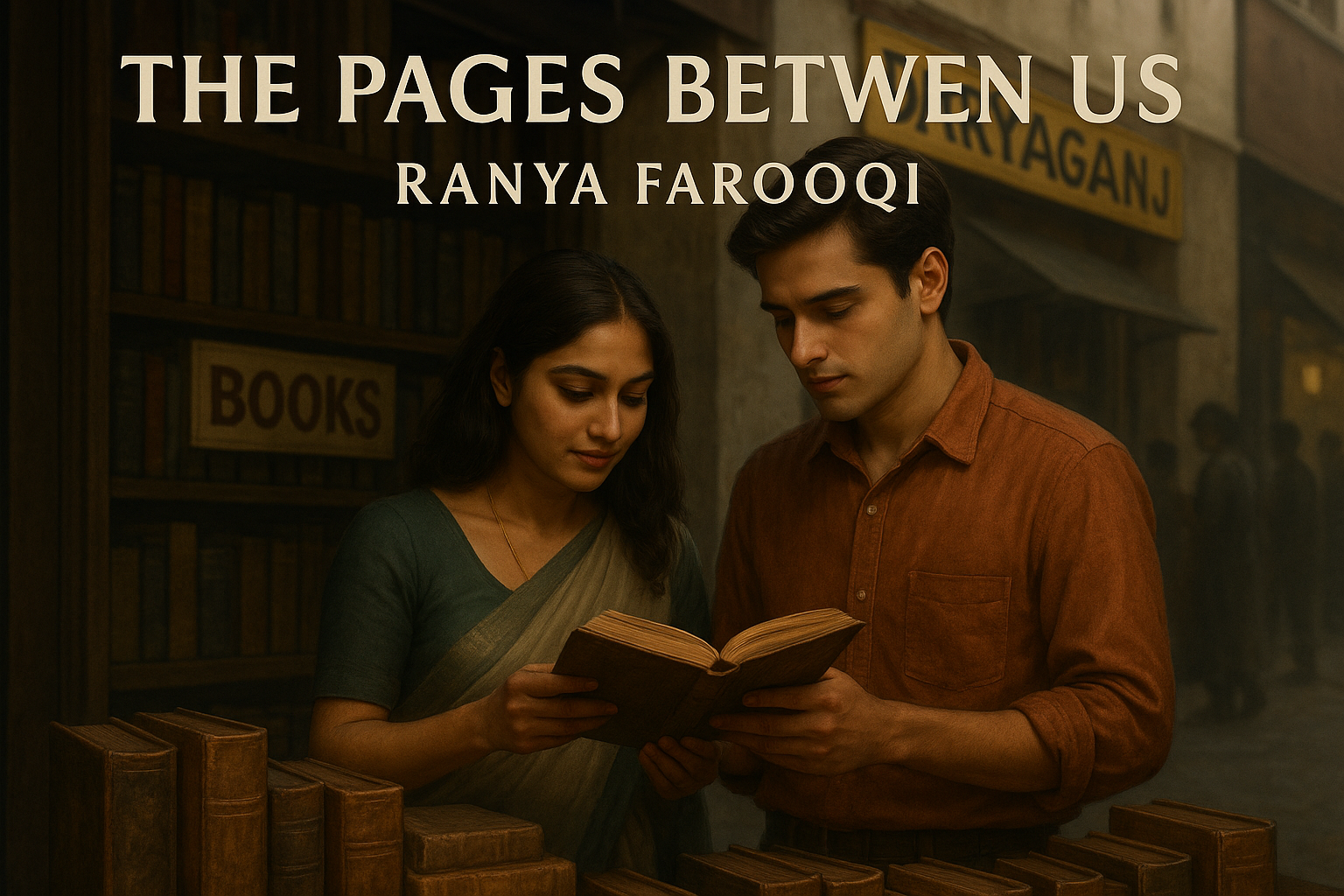

Ranya Farooqi
Whispers Among Books
The Sunday air in Daryaganj always carried the scent of ink and rust. Mixed with dust, sweat, and chai, it was a perfume uniquely Delhi — heady, stubborn, and lingering. Arjun knew this scent like an old lover. It had clung to his college years, to mornings spent flipping through yellowing books and the poetry of forgotten names.
He was here again, like every other Sunday, weaving through the chaos of the book market. His fingers brushed spines like skin — soft leather, brittle paper, some creased with life. Thirty-eight and teaching literature at a small college in North Campus, Arjun found more truth in these crumbling pages than he ever did in the carefully curated lives around him.
Then he saw her.
She stood by a stall near the corner where Urdu poetry collections were always half-buried under engineering manuals and cookbooks. She wore a pale blue cotton kurta, her hair in a loose braid that fell over her shoulder like a line from a ghazal. She wasn’t looking at anyone, only at a book in her hand — a Gulzar anthology, its cover torn, spine split.
Arjun watched her for a moment too long. Then, pretending to scan a copy of Panchatantra, he moved closer.
“Beautiful choice,” he said, nodding toward her book.
She looked up, and for a second, the world blurred like heat rising off pavement. Her eyes were kohl-lined, her lips bare. A pause. A half-smile.
“You mean the book or the price I bargained it for?” she asked.
He smiled. “Both.”
She tucked a strand of hair behind her ear. “You don’t look like the kind who bargains.”
“I don’t,” Arjun said. “But I am the kind who appreciates poetry.”
She raised the book slightly, like a toast. “Then you know this isn’t for beginners.”
“I was hoping you’re not either.”
Her smile deepened, and something unspoken passed between them — not flirtation exactly, not yet. But recognition. The kind that bypasses logic and goes straight to the skin.
“I’m Meher,” she said finally, extending her hand. Her bangles chimed.
“Arjun.”
Their hands touched. Warm. Brief. Real.
They walked together, the way strangers sometimes do when books and curiosity are stronger than caution. They talked of poets like old friends — Faiz, Amrita, Vikram Seth. She told him she was from Saket, worked part-time with a publishing house.
“And you?” she asked, stopping by a stall selling tattered journals.
“Professor. Literature. North Campus.”
“Ah, that explains the Neruda aura.”
He laughed, genuinely. “Is that a compliment or a warning?”
“Both,” she said again. It was becoming their word.
They didn’t exchange numbers. It didn’t feel necessary. Yet as he walked away that afternoon, clutching a copy of Ariel he didn’t need, Arjun felt something electric under his skin. A question left suspended.
The next Sunday, she was there again.
This time, in a maroon saree with silver motifs. His heart betrayed him a little when he spotted her.
“I was hoping the Gulzar wouldn’t be your last find here,” he said.
Meher turned, unsurprised. “And I was hoping you’d find that Sylvia Plath too intense for your bookshelf.”
“Never too intense. Only too honest.”
They walked again. Bought chai in clay cups. Sat on a concrete step near Golcha cinema. She spoke of her childhood in Jaipur, how she fell in love with Delhi’s bruised beauty. How she married at twenty-four, not because of pressure, but because it was easier than fighting.
“And now?” he asked.
She looked at him for a long second. “Now I read poems that say the things I never could.”
The sentence hovered, wrapped in silence. A bus passed. A dog barked in the distance.
Arjun leaned back, fingers stained from the old ink of a Kafka novella. “You always come alone?”
“Yes,” she said. “And no.”
He understood. The ring on her finger was subtle, gold and thin. A symbol not of love, but of duty. It hadn’t glinted in the sun. It had dulled with time, like most truths.
“I come for the books,” she added. “But also for the feeling of being someone else. Someone I could’ve been.”
“And who is that?”
“I don’t know,” she said. “Someone who buys poetry without worrying if it’ll be found in her handbag.”
That night, Arjun lay awake. He hadn’t touched her, hadn’t even asked to. But he remembered every word, every glance. She hadn’t flirted — not overtly. But her presence had undone something inside him. A quiet hunger.
Over the next few Sundays, they met again. Always at the market. Always pretending it was chance. They laughed over dog-eared erotica, argued about Bukowski’s misogyny, shared secrets through literary metaphors. Their fingers brushed over the same book too often to be accidental.
One Sunday, he found a folded paper tucked inside a copy of The Prophet. A Neruda verse, handwritten.
“I want to do with you what spring does with the cherry trees.”
There was no name, but her handwriting was unmistakable.
Arjun folded the note, placed it in his wallet.
He didn’t text her — didn’t have her number. He didn’t ask for it either.
Some books, he thought, must be read slowly. Savored. Like desire. Like rain before it touches earth.
But even then, beneath all the poetry and pauses, Arjun knew. This wasn’t a story about books.
This was the preface to a fire.
Second-Hand Touches
The next Sunday, Delhi was soaked in a sleepy drizzle. The kind of rain that didn’t drench but whispered — soft, persistent, almost secretive. Daryaganj was quieter than usual. Fewer stalls. Fewer voices. But Arjun came, like always, driven not just by the books, but the possibility of finding her again.
He didn’t have her number. He didn’t even know her last name. But in some ways, that made her more real, not less. Meher was a chapter that refused to be cataloged. Every meeting with her was an unread page. And he was beginning to crave the unfolding.
She appeared beside him, like a phrase in the margins.
“I thought you wouldn’t come today,” he said, half-smiling, surprised by his own relief.
“I almost didn’t,” she said, shaking the water from her dupatta. “But you know how it is — some books don’t wait.”
He offered her a cup of chai without asking. She took it.
They walked in silence for a while. The market looked like a memory — damp pages, smeared ink, voices muffled under umbrellas. They found shelter under the faded tarpaulin of a bookseller who sold nothing but romances — cheap pulp, Mills & Boon, and Bengali paperbacks with lurid covers.
Meher picked up a title and laughed. “Forbidden Nights in Shimla. Sounds like something we shouldn’t read but will anyway.”
“Sounds like our lives,” Arjun replied before he could stop himself.
Her eyes flicked up. A pause. A smile, restrained.
She didn’t deny it.
Instead, she said, “There’s a place I want to show you.”
They crossed the road, walked past the barricades, and into a lane that smelled of wet bricks and fried samosas. She led him to a small second-hand bookstore — almost invisible from the street, down a narrow staircase.
He had never been here before.
“Basement?” he asked.
“Treasure chest,” she corrected.
The shop was dim, warm, and stacked floor-to-ceiling. Old carpets on the floor. A single yellow bulb above. The air was thick with the scent of mold, old dreams, and untouched sentences.
As they browsed, something shifted. The proximity. The hush. The privacy.
She reached above her head to pull out a hardbound Collected Works of Rumi. Her arm brushed his. He didn’t move.
“You’ll like this one,” she said, handing it to him, her fingers lingering.
Their hands met over the book. Her thumb grazed his knuckle.
That was the first touch. Soft. Uncertain. Charged.
Neither pulled away.
He looked at her — truly looked — and for the first time, saw the edges of longing in her. It wasn’t just flirtation anymore. It was a crack in the wall.
“You smell like rain,” she said quietly.
“And you… like someone who remembers too much,” he replied.
There, in the quiet cocoon of books and distance, something broke open.
He leaned closer, just enough for her breath to find his skin.
“Meher,” he said.
She didn’t move.
His hand brushed a strand of hair behind her ear. His fingers trailed down her cheek. Her eyes fluttered shut.
It wasn’t a kiss, not yet. But it was everything that came before one — the held breath, the trembling, the hush.
“I should go,” she whispered.
He nodded.
But neither of them moved.
“I’m married,” she said, more to the air than to him.
“I know.”
“You haven’t asked me anything.”
“Do I need to?”
She finally pulled away, just a step.
“No,” she said. “That’s what scares me.”
They walked back without touching. The city pulsed around them — honks, footsteps, stories spilling from open windows. But between them was a silence so loud it made the rest of the world dim.
At the intersection, where the roads forked, she stopped.
“Next week?” he asked.
She hesitated. Then nodded. “Same place. Same time.”
And then she was gone — absorbed into the Delhi haze.
Arjun stood there for a while, letting the drizzle soak into his shirt, into his bones. Inside his pocket was the copy of Rumi she had given him.
He opened it when he got home. On the inside of the back cover, in the margin of a poem, he saw her handwriting again:
“Somewhere between right and wrong, there is a garden. I’ll meet you there.”
He read it twice. Then again.
For the first time in years, Arjun felt seventeen — the age when love didn’t ask for permission, and desire didn’t wear shame like a mask.
He didn’t know what he was stepping into.
He only knew he was already inside it.
And there was no going back.
Underlines and Margins
Delhi turned golden in the last weeks of October. The city was still warm, but the air carried a softness, like a poem beginning to close its stanza. The Daryaganj market breathed easier now, with fewer crowds and longer shadows. Arjun arrived early that Sunday, his eyes scanning the stall corners before his heart caught up.
She wasn’t there.
He lingered, pretending to browse through a stack of Salman Rushdie novels, but his mind was elsewhere—on a smile, a voice, the warm hush of a basement filled with books and breathlessness.
And then he saw it.
A Gulzar collection sat on top of an Urdu translation of The Unbearable Lightness of Being. Slipped inside the cover was a folded square of kraft paper. He opened it carefully, as if opening her palm.
Inside, written in long, slanting ink, were the words:
“Meet me at the Café near the Jain Book Depot at noon. Order the second chai before I arrive.
— Meher”
No hearts. No punctuation flourish. Just clean lines. Direct. Secretive. Seductive.
He folded the note and tucked it into his wallet, next to the Neruda verse from weeks ago.
At the café, he chose a corner seat. It was small, functional, nothing romantic about it. But she had chosen it, and that gave it gravity. He ordered two cups of chai as instructed and sat, fingers drumming against the Formica tabletop.
She arrived fifteen minutes later, wearing a plain white kurta with blue detailing. No lipstick. No jewelry today. She looked both sharper and softer — like a dream trying to forget it was once a life.
“Is this too cliché?” she asked, sitting down.
“Only if the chai’s cold.”
She smiled. “You waited.”
“Have I ever not?”
They sipped quietly. Their knees touched under the table, neither pulling away. The touch was faint but insistent, like the page corners of a well-read book.
Meher took out a small notebook from her cloth tote. It was leather-bound and worn, with frayed edges and corner stains.
“I’ve started writing again,” she said, flipping through it.
“You write?”
“I used to. Before marriage. Before life became logistics.”
“What kind of writing?”
“Mostly poetry. A little longing. Some lies disguised as metaphors.”
She handed him the notebook. He flipped through slowly, reverently.
One poem caught his attention. It was scribbled in a rush:
“The hunger isn’t for the body,
but for the place the body escapes to
when it forgets it’s being watched.”
His eyes lifted to hers. “This is about me.”
“It was about me,” she said. “You just walked into it.”
They stared at each other for a beat too long. The air thickened. She reached across and took the notebook back.
“Do you ever think we’re characters in someone else’s story?” she asked.
“I hope not,” he said. “I like writing mine.”
“But are we writing or underlining what someone else already wrote?”
He reached into his satchel and pulled out a book — an old translation of Letters to a Young Poet.
He opened it to a marked page and read aloud:
“Love consists in this: that two solitudes protect and touch and greet each other.”
Silence followed. This was how they flirted now — through borrowed words, between sips of spiced tea and stolen glances.
“You’re dangerous, Arjun,” she said finally.
“I haven’t done anything.”
“Exactly.”
They walked out together, shoulders almost brushing. The city moved around them, uncaring and unaware. But to Arjun, every honk, every passing rickshaw felt like punctuation interrupting a sentence he never wanted to end.
They didn’t go home immediately.
Instead, they walked aimlessly through the winding alleys near Jama Masjid, past kebab stalls and narrow stairs, past noise and children playing cricket in courtyards too small for dreams.
At a blind corner, she stopped.
“Do you want to come up?” she asked.
Her voice was calm, but her eyes were oceans.
“Where?”
“My friend’s place. She’s out. I sometimes use it to read or just… be.”
He nodded.
The apartment was on the second floor, with old iron railings and peeling paint. Inside, it smelled like sandalwood and loneliness. A single mattress lay on the floor, surrounded by cushions and a cracked window that overlooked the city’s broken skyline.
She poured two glasses of water. The air felt loaded, but she made no move. Neither did he.
Instead, she sat cross-legged on the mattress and gestured for him to sit.
They talked.
Really talked.
About disappointments. About the way marriage reduced her to a sequence of roles — daughter-in-law, wife, hostess — never Meher. About how Arjun had stopped dating after one woman told him he was “too much in love with language and not enough with real life.”
“I didn’t want to settle,” he admitted. “Then I realized no one was waiting for me anyway.”
She looked at him. Really looked.
“You’re not what I expected,” she said.
“And you’re everything I didn’t know I needed.”
The words hung like rainclouds, full and heavy.
Still, they didn’t kiss.
But when she walked him to the door, her fingers caught his, lightly, deliberately, and she placed something in his palm — a pressed flower, folded in paper, smelling faintly of rose.
“No poetry tomorrow,” she said. “Only silence.”
Arjun walked down the stairs with a storm in his chest and a whisper in his hand.
He didn’t know where this was headed.
But he knew now what longing felt like when it was dressed in cotton and smelled of secrets.
He also knew this: some people walk into your life like bookmarks — holding a place, marking a pause, never quite belonging to the story but changing it forever.
Between Chapters
There is a point in every story when the turning of a page no longer feels like progress. It feels like surrender. Arjun felt that now — suspended, weightless, somewhere between the choice to leap and the fear of landing.
The next week came slowly, like a hand brushing over bare skin.
Meher didn’t call. There was no message. No folded note tucked into a book. No casual whisper of a plan. And yet, Arjun found himself back at the Daryaganj market on Sunday, waiting. A man surrounded by stories, but aching for just one.
She didn’t come.
The market moved around him — bartering, laughing, shouting, selling — but he was elsewhere. His hands flipped through old books but his eyes kept catching emptiness.
It felt absurd — like trying to write a poem with no verbs.
He bought nothing that day. Walked home with hands in pockets and a familiar ache under his ribs.
That night, he opened The Prophet again. The Neruda verse. The Rumi line. The pressed flower.
He wanted to text her, but he still didn’t have her number.
She had never given it.
A choice. A barrier. A warning.
He understood now that they had been living in parentheses — moments that didn’t belong to the rest of their lives. Safe because they were temporary. Beautiful because they were stolen.
But what happens when stolen things demand permanence?
The next day, she messaged him — from a new number, no name.
“Tomorrow. 4 pm. Café Kabir, near Hauz Khas Village. Come if you want to read the next chapter.”
He stared at the message.
No emojis. No exclamation marks. Just intent.
He went.
The café was small, quiet, and tucked behind a boutique store selling overpriced scarves. Inside, the air was filled with soft jazz and the smell of cinnamon. She was already there, wearing a black kurta with small silver dots — modest, unassuming, disarming.
He sat opposite her. Said nothing. Neither did she. Not at first.
Then: “I needed a pause.”
“I know.”
“But the story didn’t stop. It kept writing itself in my head.”
He smiled, softly. “And what did it say?”
“That I’m not who I pretend to be, not anymore. And neither are you.”
They sipped coffee in silence for a while. This was no longer flirting. No longer safe.
“What are we doing, Meher?” he asked finally, his voice low.
“We’re not having an affair,” she said. “Not yet.”
“Would that be worse than what we’re already in?”
She looked at him, eyes unblinking. “This… is more dangerous than sex. Because it’s tender. Because it knows how to wait.”
He reached across the table and touched her wrist. Just once. She didn’t flinch. Didn’t pull away.
“There’s a hotel near Green Park,” she said, not looking at him. “They rent rooms by the hour. It’s discreet.”
He felt the weight of her sentence settle over him like dust.
He should have said no. Should have reminded her of the chaos waiting to unfold. But instead, he asked:
“Now?”
She nodded.
They left together. No words. No justifications.
The auto ride was silent except for the rustling of her dupatta and the occasional screech of a turning scooter. His hands were steady, but his heart was not.
The hotel was nondescript — the kind of place that held a thousand secrets in its walls. At the reception, she signed the ledger. “Mr. and Mrs. A.”
When they entered the room, it was dimly lit. Beige curtains. A large mirror. A bed that smelled faintly of bleach and cigarettes.
For a moment, they just stood there. Facing each other. Fully clothed. Not touching.
Then she walked to him and placed her palm on his chest.
“I don’t want to be undone by guilt,” she whispered.
“You won’t be,” he said. “Not today.”
Clothes came off slowly — not with urgency, but reverence. They undressed like they were unwrapping memories. Her skin was warm, alive, trembling in places she didn’t know could still tremble. His breath found the curve of her shoulder, the dip of her spine, the soft place behind her knee.
There was no music. Only the symphony of breath and heartbeat and whispered names.
No wild cries, no hurried thrusts.
Only time, taken.
Only silence, filled.
When it was over, they lay side by side, not speaking. Her head rested on his chest. His fingers played with the loose strands of her hair.
“Are we bad people?” she asked after a long pause.
“We’re people,” he replied. “That’s worse.”
She laughed. It broke the tension. A sweet, almost adolescent laugh. The kind that doesn’t belong in hotel rooms by the hour.
“We’ll have to stop,” she said eventually. “We can’t keep meeting like this.”
“I know.”
But neither meant it.
When they dressed, she kissed his wrist, the inside of it, just above the veins. It felt more intimate than anything else.
They left separately.
Outside, Delhi went on. Horns, smoke, life.
He walked home that evening carrying her scent under his collar and the taste of her name behind his teeth.
He didn’t call. Didn’t message.
But that night, in his notebook, he wrote:
“We were never in love.
We were in between —
the margins, the ellipses,
the aching space
between one story and the next.”
The Hours We Borrowed
There is a kind of intimacy that isn’t built on the body. It grows between glances, in silences shared without discomfort, in the knowledge of what can’t be said aloud — because the unsaid always carries more truth.
For a while, Arjun and Meher lived inside that silence.
They didn’t meet the week after.
Or the one after that.
But something between them had already been written, sealed like the pages of an old novel only they knew how to open. The affair — though still unnamed — now had weight. Memory. Muscle. And above all, danger.
Then, on a pale November evening, she called.
Not a text. Not a folded note. Her voice — real, warm, hesitant — trembled in his ear.
“He’s going on a business trip. Mumbai. Two nights. You’re the only thing I thought of when he told me.”
That was all she said.
And that was all he needed.
They met again at the same discreet hotel in Green Park. No pretenses this time. No performances. She opened the door, barefoot, hair still damp from a shower. There was poetry in how casually she let him in — like he belonged to that space, that stillness, that scent.
“I didn’t bring flowers this time,” he said, dropping his bag.
“I didn’t wear perfume,” she replied.
She touched his face like it was familiar now. As if his jawline was a sentence she’d underlined once, and then again. They kissed — slowly, deeply — not because they were desperate, but because they had time. Borrowed time, sure. Stolen, maybe. But still theirs.
The sex was different this time.
Not exploratory, not electric.
But warm. Slow. Like an unfolding. Their bodies moved like lines in a verse — rhythmic, patient, unashamed. She rested her mouth on his chest after, listening to a heartbeat that didn’t know how to lie.
Later, they sat naked beneath the bedsheet, backs against the headboard, her fingers tracing shapes on his forearm.
“Does your wife suspect?” she asked, not looking at him.
“She doesn’t notice enough to suspect.”
“Same,” she said. “We talk. We eat. We laugh. But it’s like acting out a script written ten years ago. No rewrites allowed.”
He nodded.
“This feels more real,” she whispered. “Even if it’s not forever.”
“Maybe real things aren’t meant to last. That’s why they’re real.”
They spent the night like that — not just wrapped in each other’s skin, but in words, and unfinished dreams. They ordered food. They shared secrets. They even laughed. She told him about the first boy she ever kissed, behind the school library. He told her about the story he wrote at twenty that no one ever read.
But morning always comes.
And with it, the rustle of consequence.
She woke first. Showered. Dressed in silence. He watched her from the bed, feeling like a comma in a sentence that refused to end.
At the door, she turned.
“I know what this is now.”
“What is it?”
“A chapter.”
He nodded.
“And you?”
“A bookmark,” he said. “I hold the place, but I’m not the story.”
She stared at him — eyes a little too wet, voice a little too calm.
“That’s the saddest thing I’ve ever heard.”
“Or the truest.”
Then she left.
Alone again, Arjun stayed a few minutes longer. He touched the pillow she’d slept on. He could still smell her — a mix of sandalwood and memory. He opened his notebook and wrote:
“There are nights you don’t return from.
Not because of sex.
Not because of love.
But because someone finally made you feel seen.
And now the mirror is gone.”
Back home, he avoided the mirror. Sat in the kitchen. Drank tea. Watched the shadow of a bird move across his wall like a message from nowhere.
He didn’t hear from her for four days.
On the fifth day, a courier envelope arrived at his door.
Inside: a book of Sylvia Plath poems.
No note.
But on page 37, beneath the line “I am inhabited by a cry,” she had underlined one word in pencil:
You.
That night, he didn’t write. He didn’t read. He just lay in bed, fully clothed, with the book on his chest and her name echoing between his ribs.
The next morning, he replied with a book of his own.
Letters to a Young Poet.
He sent it with a single note, handwritten:
“We are more than what we’ve done.
But sometimes, the doing is the only truth we have.”
He didn’t know if she’d read it.
He didn’t know if they’d meet again.
But he had given her a piece of himself — not the flesh, not the body — but something rarer. A truth without expectation.
The Body Remembers
The body, like a book, remembers everything.
Where the hand trembled.
Where the lips paused.
Where the skin learned a name it should never say out loud.
Days passed. Delhi wore its usual indifference like a coat. People moved. Rickshaws clattered. The city kept forgetting. But Arjun didn’t.
His body remembered Meher — not in grand ways, but in echoes. In the way his hand reached toward the side of the bed without meaning to. In how his eyes lingered too long on a woman’s wrist in the metro, seeking the familiar slope of Meher’s veins. In how tea no longer tasted like tea, but like the hotel room in Green Park where her laughter softened the silence.
He told himself he wouldn’t reach out. That if she wanted him, she’d come back.
She didn’t.
Until a Sunday evening.
He was browsing through the shelves at Bahrisons in Khan Market when he heard her voice behind him.
“Still trying to read your way out of your feelings?”
He turned.
There she stood — black jeans, loose white kurta, a yellow dupatta tossed lazily over her shoulder. Her hair was pulled back in a low bun. The only difference: her eyes were harder now. Not unkind. Just more guarded.
“I don’t have many tools,” he said. “Books are what I know.”
She stepped closer, careful not to touch him. “Did you read the line I underlined?”
“I did. A dozen times.”
“And?”
“And I think it was a confession. Maybe a goodbye.”
“It was both.”
There was silence. The kind only people with unfinished intimacy know.
Then she added, almost too quietly: “But I couldn’t stop remembering. Not the sex. That fades. But the space you made around me.”
He swallowed hard.
“You said once that we weren’t having an affair,” he said. “Were we?”
“I think we’re still deciding,” she replied. “Or maybe we already did.”
She asked if he wanted to walk.
They did — through the quieter lanes of Khan Market, away from the lights and overpriced cafés. The world blurred. It always did when they were together.
“I’ve told him I want a break,” she said after a few minutes.
He stopped walking.
She looked straight ahead. “I didn’t mention you. He doesn’t know. But I think… I just needed to say it. Aloud. To someone.”
Arjun didn’t ask why. He didn’t ask what would happen next. He knew better than to force timelines onto truths that were still unfolding.
“I’m not asking for a future,” she said. “I’m asking for presence. Yours. While I figure mine out.”
He took her hand. This time, in public. She didn’t pull away.
They sat on a low stone wall near the Lodhi Gardens entrance, watching the sky bleed from orange to ash.
She leaned her head on his shoulder. “Do you think we’re doing something awful?”
“I think we’re doing something honest. That’s always messier.”
He could feel her breathing settle. Their bodies, despite everything, knew each other now. Not as lovers, but as homes discovered in a storm.
Then she whispered, “Do you know why I remember you?”
“Why?”
“Because you never asked me to leave anything behind. Not my guilt. Not my marriage. Not my lies. You just… held space.”
“And do you know why I remember you?”
“Tell me.”
“Because I finally met someone who read me. Not just my words.”
They didn’t go home together that night. No hotel. No kiss.
Just hands held a little too long. A goodbye that didn’t end with a door closing, but with eyes saying, we’re still here.
That night, Arjun returned home and lay on the bed in the dark. He stared at the ceiling and let the silence throb.
His phone buzzed at midnight.
A photo.
Her hand, holding a cup of tea.
The message beneath it read:
“I’m still here too.”
He didn’t reply.
Instead, he opened his notebook and wrote:
“It’s not the sex.
Not the touches.
It’s the way the body
aches for a voice.
The way loneliness
can smell like her perfume
days after she’s gone.”
He closed the notebook.
Held it to his chest.
And fell asleep to the memory of her shoulder against his, like a poem whose final line hadn’t yet arrived.
In Rooms Without Clocks
Some moments don’t belong to time.
They don’t tick forward. They don’t expire. They just stretch—thin, warm, dangerous—like honey dripping off a spoon, or a lie left too long in the throat.
That’s how it felt the next time Meher and Arjun met.
No plan. No signal. Just a message:
“Room 206. You know where.”
No “hi,” no “when,” no punctuation.
Only the geography of longing.
He didn’t reply.
He didn’t need to.
By 5:15 p.m., he stood in front of Room 206, the familiar chipped paint, the dull brass handle, the weight of breath caught between guilt and desire.
She opened the door wearing a faded cotton saree. Not silk. Not lace. Just soft, wrinkled cotton—the kind that felt more like skin than fabric. Her hair was tied back but loose enough to say she hadn’t tried too hard. Her kajal was smudged.
Not because of artifice. Because she had lived a day.
“I wasn’t sure you’d come,” she said, voice steady.
“I wasn’t sure I wouldn’t.”
They didn’t rush this time. They moved like dancers returning to a stage they knew in the dark. The foreplay wasn’t hands. It was eyes. Breaths. The slow undressing of emotion before any button was touched.
“I missed this room,” she said, standing before him bare from the waist up, unashamed.
“I missed you in it.”
“You didn’t reply to my last message.”
“I didn’t want to put words where silence belonged.”
They made love without urgency, the kind of rhythm you find when the body stops pretending. She wept once—quietly—while on top of him, her eyes closed, lips parted, hips moving in a pace that wasn’t for climax but for remembering. He held her face and didn’t ask why.
After, she curled into him, a leg slung over his, her breath steady against his neck.
“This isn’t lust,” she said.
“No,” he whispered. “It’s geography.”
She smiled, half-asleep. “What do you mean?”
“Our bodies… found a place. Not just each other. But something between.”
He didn’t say more. Words would have felt greedy.
They stayed in the room longer than usual. Didn’t check the time. Didn’t ask if anyone would notice.
At one point, the curtain fluttered with a breeze from the faulty AC vent. She stood and watched the world through the foggy glass.
“Do you think he knows?” she asked.
“No.”
“Would he care?”
Arjun hesitated. “Not like I do.”
She turned. “Then this isn’t betrayal.”
He smiled, sad and slow. “Not until someone gets hurt.”
They didn’t talk about their spouses that day. They didn’t talk about ending or beginning. Only here. Only now. That was the spell the room cast.
No clocks. No calendars. No consequences.
After she left, Arjun stayed back again.
He lay on the bed, shirtless, replaying the details.
The way she laughed when he tripped over his jeans.
The shape her mouth made when she whispered his name.
The imprint of her elbow on the pillow.
He didn’t cry. But something inside him unclenched—a part of him that had been wound tight with loneliness for years.
He thought about writing, but couldn’t.
Not tonight.
Instead, he closed his eyes and let his body do the remembering.
At home, she sent him a single word message at midnight.
“Safe?”
He replied:
“Full.”
She wrote:
“You remembered me well.”
He didn’t reply this time. Not because he didn’t want to. But because the silence between them had become a kind of trust.
The next morning, he found a note in his coat pocket.
Folded three times. Smelled faintly of rosewater.
“One day, we will return to this room and laugh at our fear.
One day, the world will forgive us for wanting more than duty.
But until then, I’ll keep finding you in places we never touched.”
He didn’t recognize the handwriting at first.
It wasn’t hers.
It was his.
She had taken his notebook. Written it while he slept. Left him a reminder of himself.
Of them.
The Lie That Felt Like Truth
There are lies you tell to protect others.
And then there are lies you tell because they feel more real than the truth.
The next time Arjun met Meher, it wasn’t in a hotel room.
It was in a bookstore.
Not Daryaganj. Not Khan Market.
But a quiet, tucked-away corner of South Extension—one of those nameless little book cafés where the shelves leaned, and no one really came to buy, only to browse and vanish.
She had texted him the day before.
“I want to meet. No skin. Just breath.”
He didn’t ask what she meant.
Because he already knew.
When he entered, she was seated by the window, a half-finished cup of filter coffee in front of her, her hair braided neatly down one shoulder, a simple rust-colored kurta hugging her frame.
Her face lit up, but not with excitement.
With relief.
Like seeing someone after war.
“Sit,” she said.
He did.
She handed him a dog-eared copy of The Unbearable Lightness of Being.
“I read this in college,” she said. “Didn’t understand a word. Now I do. All of it.”
He flipped through the pages slowly. Some underlined. Some corners folded. And one page marked with a note in the margin:
What if all love is exile from the self?
He looked up at her. “Are you feeling exiled?”
“No,” she said. “I’m feeling rewritten.”
They didn’t touch. Not once. Not even accidentally.
But something between them pulsed—an invisible thread tying their words together like verses from an old song.
She told him she hadn’t gone back to her husband. Not entirely.
“I sleep on the couch now,” she said. “He hasn’t asked why.”
“And you?”
“I make tea for both of us. Pretend it’s enough.”
Arjun said nothing.
He didn’t want to be the man who dragged her toward chaos.
But he also didn’t want to be the man she forgot when the chaos settled.
“You know what scares me?” she asked, watching the world blur past the café window.
“That you’ll have to choose?”
“No. That I already have.”
He looked at her.
“I keep thinking I’ll end it. Us,” she said. “But then I picture you reading alone in some room, wearing that old grey shirt with ink on the sleeves, and I… I come back.”
He smiled, softly. “Maybe this is the end. We’re just circling it gently.”
They sipped coffee.
Talked of other things.
Childhood. Favorite authors. Her father’s silence. His mother’s bitterness.
They didn’t mention sex. Not once.
And yet—he felt her with him in every word, as if each syllable she spoke touched his skin.
When it was time to leave, she looked at him for a long time. Eyes heavy. Hands still.
“I lied to him,” she said. “Told him I was seeing a therapist. That’s how I get the hours with you.”
“Does it feel wrong?”
“No,” she said. “It feels like the first honest thing I’ve done in years.”
He nodded.
And then she added, more quietly:
“You’re my lie, Arjun. The one that feels like truth.”
He touched her knuckles. Briefly. Just once.
Then turned and left before she could say goodbye.
Back in his apartment, Arjun didn’t write that night.
Instead, he unpacked a shoebox he hadn’t opened in years.
Old photographs. Letters. Receipts from dinners he no longer remembered. A postcard from Manali.
And at the bottom, a picture of his wife.
They looked young. Too young.
Smiling, barefoot, standing outside a café that probably no longer existed.
He stared at it for a long time.
Then tore it in half.
Not in anger.
But in quiet acceptance.
Later, in the dark, he picked up his notebook.
“Some lies are love letters we never had the courage to write.
And some truths are knives we keep sheathed in silence,
because the cut would be too clean.”
He closed the notebook.
Messaged Meher.
“Next time—no bookstore. No hotel. Just you. Me. A street. And a walk that doesn’t need to end.”
Her reply came in a minute.
“Tomorrow. 6 p.m. Near Lodhi Art District. Wear something old.”
He didn’t ask why.
He would show up.
Because some truths you live.
Even when they’re dressed as lies.
The City That Watched Us
Delhi watched them that evening.
Not with the indifference of crowds, but with the quiet curiosity of an old friend who suspects something sacred is being unraveled.
Arjun reached the Lodhi Art District ten minutes early. He wore a faded blue kurta with a fraying collar. The same one he had worn the first time he read poetry aloud in college—when he still believed words could save him.
Meher arrived exactly on time. She wore a plain salwar suit in bottle green. No jewelry. Just kohl-lined eyes and that impossible calm she wore like perfume.
“You came,” she said.
“I always do.”
They didn’t hug. Didn’t kiss. Just began walking—slowly, in rhythm, as if the city itself had handed them a pace.
Murals rose around them. Gods in neon colors. Protest art. A woman with her eyes closed and her mouth open in mid-scream. They walked past it all in silence.
“What are we doing?” Meher asked finally, not looking at him.
“We’re walking.”
“That’s not what I meant.”
“I know.”
She stopped in front of a wall painted with two figures—one holding a match, the other a candle.
“I feel like both,” she said. “The flame and the burn.”
He stood beside her, hands in his pockets. “And I feel like a room you lit up just to see if it was still worth staying in.”
A quiet laugh escaped her lips. “Poetic.”
“It’s a sickness,” he smiled.
They sat on a low step beneath a mural of floating eyes.
A group of teenagers walked past, laughing loudly. One of them glanced at the couple, then looked away quickly. As if embarrassed to witness something too private for the street.
“I keep thinking about your wife,” Meher said suddenly.
Arjun didn’t respond.
“I think about what she’d say. If she saw us.”
“She’d probably ask me why I never looked at her the way I look at you.”
“And what would you say?”
“That I didn’t know it was possible.”
Meher looked away. Bit her lower lip.
“You make me want to be selfish,” she said.
“You make me forget I ever wasn’t.”
They watched the sky turn violet above the trees.
A dog barked in the distance. A couple kissed behind a pillar.
Then, as if the night had been waiting for it, Meher said, “I don’t want to lie anymore.”
“To him?”
“To myself.”
Arjun turned to her. “What truth do you want?”
“That this is real. Not fantasy. That you’re not just my escape.”
He nodded slowly. “And what if I am?”
“Then I want to escape with you. Not from him. From everything I thought love was supposed to be.”
He took her hand. This time, fully. Fingers interlocked. No hesitation.
“This city knows,” he said. “Every street we’ve walked. Every room we’ve touched. Delhi has watched us become what we weren’t allowed to be.”
She leaned her head on his shoulder.
“Do you ever think about the end?” she asked.
“Every day.”
“And?”
“I want to write it myself. Not let guilt do it for us.”
They walked again. Past the murals. Past the trees. Past the chai seller who didn’t look up. Through streets that didn’t ask questions.
They stopped at a bookstore café nearby.
He ordered coffee. She ordered ginger tea.
Inside, two children played with alphabet blocks. A sign on the wall read: “Some stories are not for everyone.”
Meher stared at it for a long time.
When the tea arrived, she took a sip and said, “I’m going to tell him.”
Arjun didn’t blink.
“Not about you,” she added. “About me. About who I’ve become. About the things I can’t undo.”
He exhaled. “And what about us?”
She smiled softly. “You’re the part I won’t apologize for.”
Outside, the city kept moving. Fast cars. Slow hearts. Flickering streetlamps.
Inside, two people dared to exist without shame, for a few stolen hours more.
Later, when she dropped him near his apartment, she didn’t lean in for a kiss.
Instead, she said, “You’ve ruined me for small talk.”
“And you,” he whispered, “have ruined me for all kinds of silence.”
She left without a word.
But the city heard everything.
That night, Arjun wrote:
“We walked streets not meant for lovers,
and still found hands to hold.
We whispered truths into a city
that already knew our names.”
The First Goodbye
Some goodbyes aren’t loud.
They don’t come with screaming matches, broken plates, or door slams.
Some slip in like a sigh in the middle of a kiss—almost gentle. Almost merciful. Almost pretend.
That’s how Meher left the first time.
Not forever. Just long enough to make Arjun forget what her skin smelled like when she fell asleep.
It started with silence.
No messages. No missed calls. Just a sudden blank space where her presence used to hum softly in the background of his life—like an old fan that had always been on, unnoticed, until the electricity went out.
He waited.
He told himself she was busy.
That maybe her husband had begun noticing.
That maybe her courage had finally lost the battle to her shame.
But when a week passed, and then another, Arjun knew.
It wasn’t a break.
It was a retreat.
The kind of vanishing people do when they’re not yet ready to be honest, but can’t keep pretending either.
So he did what writers do best—he suffered beautifully.
He walked past their usual café and stared too long at the table in the corner.
He wandered into bookstores and opened pages randomly, hoping to find a sentence that would remind him of her laugh.
He even returned to Room 206 once—alone.
Just to sit on the edge of the bed and remember the weight of her decisions against his chest.
There was a new stain on the curtain.
The room smelt different—cheap disinfectant instead of rosewater.
Even the silence felt changed.
Colder. Less forgiving.
He didn’t cry.
But he left the room with a hole he couldn’t name.
Two weeks later, she called.
Not messaged.
Not emailed.
Called.
And when he picked up, her voice was barely a whisper.
“I had to go,” she said. “I thought if I stayed, I’d fall completely.”
“You already had,” he replied, quietly.
“I know. That’s what scared me.”
There was a long pause.
A car horn blared somewhere on her end of the line.
Then she said, “I’m sitting at the Yamuna ghat. Alone. Watching the water pretend to be still.”
“I’m at Khan Market. Standing outside that little place where you bought blueberry cheesecake and called it overrated.”
Another pause.
Then they laughed.
Not because anything was funny.
But because it hurt too much not to.
“I tried to erase you,” she said.
“How far did you get?”
“Up to your elbows.”
Arjun smiled. “What about you?”
“I didn’t try,” he said. “You stayed like a fever. I just stopped fighting it.”
“Tell me the truth,” she said. “Did you hate me for disappearing?”
“No.”
“Why not?”
“Because I do the same thing in my stories. I disappear characters when they start telling the truth too loudly.”
She was quiet.
Then: “I miss you.”
He closed his eyes.
“Where do we go from here?” she asked.
“Wherever your heart stops being scared.”
“And if it never does?”
“Then I’ll keep finding you in fiction.”
The line disconnected before he could say goodbye.
He stared at the phone for a long time, wondering if the ache in his chest was just loneliness wearing her perfume.
That night, he wrote her a letter.
He didn’t send it.
He folded it into an old poetry book and left it on the bench at Lodhi Garden—the same one where she had once told him he made her forget time.
Dear Meher,
I’ve stopped looking for signs now.
I know you. And that’s enough to believe in the unsaid.
You are not a sin I regret.
You are the ache I carry with grace.
Yours,
In every word you once undressed with your voice,
—Arjun
Three days later, the book was gone.
He didn’t mind.
Maybe someone else would read it and feel less alone.
Maybe that’s what they were now.
A comfort in someone else’s loneliness.
Return Without Warning
She came back on a Thursday.
Unannounced. Unexpected. Unapologetic.
It was early evening, and Delhi was soaked in pre-monsoon heat—heavy clouds without rain, the kind of sky that felt swollen with unwept tears.
Arjun was in the middle of editing a story that wasn’t working. The protagonist sounded fake. The plot felt borrowed. And every line reminded him of what he hadn’t written about Meher yet.
The knock on the door startled him.
He opened it half-ready to argue with a delivery guy about a book he didn’t remember ordering.
But there she was.
Meher.
Wearing a white cotton kurta, her hair damp, cheeks flushed, breathing like she had run from something only she could name.
“I didn’t know where else to go,” she said.
He stepped aside without speaking.
She walked in like she used to—carefully, like someone stepping into a room full of old ghosts.
Only this time, the ghosts didn’t flinch.
She stood in the middle of his living room.
Nothing had changed.
Not the unwashed mugs. Not the stack of unread books.
Not the faint trace of her scent on the cushion she used to curl into.
“You still use the same coffee beans,” she said.
“I still wait for you to make it.”
That made her laugh. A soft, wounded sound.
Then silence.
She walked to the window, looked out at the darkening skyline.
“I told him,” she said.
Arjun’s breath caught.
“Told him what?”
“Everything except your name. I told him I wasn’t in love with him anymore. That I was in love with someone else. And that leaving wasn’t a betrayal—it was survival.”
“And?”
“He said he always knew. That I’d been distant for years, but I’d finally found a place I could disappear to.”
“And he let you go?”
“He didn’t say yes. He just didn’t stop me.”
Arjun leaned against the wall. “So why are you here?”
She turned to him, eyes blazing with quiet exhaustion.
“Because I needed to see if you still felt like home.”
A pause.
“Do I?”
She didn’t reply.
She walked across the room. Stood in front of him. Close. Closer than she’d ever stood without touching.
Then she kissed him.
No warning. No prelude. No buildup.
A kiss full of answers.
Of unfinished poems and sleepless nights and questions never asked because the answers might have broken them.
When they pulled apart, she whispered, “I couldn’t keep pretending that comfort is the same as love.”
He nodded, forehead resting against hers. “And I couldn’t keep pretending that your absence was just a phase.”
They didn’t make love that night.
They simply lay beside each other on his bed—fully clothed, fingers interlaced, like survivors in a story that had nearly swallowed them whole.
Later, in the dark, she said, “Do you think we’ll last?”
Arjun didn’t pretend to have faith in permanence.
“I think we’ll love each other until it breaks us,” he said. “And maybe even after.”
She sighed. “That’s not very comforting.”
“It’s not supposed to be. It’s just true.”
A silence settled between them.
Then, she said:
“I kept your letter. The one in the poetry book. I found it.”
He looked at her, surprised.
“You read it?”
“I memorized it.”
A pause.
“Especially the part where you said I wasn’t a sin.”
“You never were,” he said. “You were the reason I started writing honestly again.”
She reached out and touched his cheek.
“You were the first man who looked at me like I was a poem, not a problem.”
That night, the storm finally came.
The sky cracked open. Rain pelted the city like confessions too long withheld.
And inside a rented apartment in South Delhi, two people—bruised but breathing—held on to each other, not like lovers, but like lifeboats.
In the morning, the air smelled of wet leaves and second chances.
She made coffee. He watched her, like it was the first time all over again.
When she handed him the mug, she said, “Don’t ask what happens next.”
“Why not?”
“Because I don’t know. And I don’t want to ruin this by pretending I do.”
He nodded.
Drank.
And said, “This—right now—is enough.”
The Shape of Us
By the third morning, it felt normal.
Waking up to Meher brushing her teeth in his bathroom. Her wet hair dripping on his floor. Her lipstick tubes alongside his dull razor. The quiet orchestration of two people folding into each other’s habits without warning.
She stayed.
Not as a guest. Not as a secret. Not even as a lover with an escape plan.
She simply… stayed.
She folded her clothes into half of his drawer, began taking her chai with a little cinnamon, started marking pages in his books with torn receipts. She left behind strands of hair in his comb and little notes in his notebooks—“Buy fruit” on a haiku, “Too romantic” scribbled beside a line of longing.
She claimed space. Softly. Without apology.
And he let her.
Because for the first time in months, the apartment didn’t feel like a room he was renting from loneliness.
It felt like a story still being written.
They created a rhythm.
Mornings began with silence and coffee.
Days blurred into reading, writing, and Meher pacing the living room during long client calls.
Nights were slower—sometimes sex, sometimes just curled bodies, sometimes rain, sometimes soft music playing like background to the unsaid.
Once, while brushing his teeth, Arjun turned and found her watching him.
“What?” he asked, foam around his lips.
She tilted her head.
“I think we’re becoming a routine.”
“Is that bad?”
“No,” she said, walking up to him. “It’s dangerous.”
“How so?”
“Because routines make you forget what you risked to get here.”
That evening, they made love on the floor—half-undressed, tangled in discarded pillows and poetry books.
It wasn’t hurried or perfect. It was raw.
She cried after.
Not loudly. Just tears leaking from the corner of her eyes as he kissed her shoulder.
He didn’t ask why.
He just held her tighter, his breath syncing with hers, until the ache in the room quieted.
On a Tuesday, they took a short trip to Neemrana.
She wanted space. He wanted to pretend they were tourists in someone else’s life.
The old fort welcomed them with faded walls and wide skies. They walked barefoot, fed peacocks, and touched each other under the wide gaze of ancient windows.
That night, Meher said, “I’ve never told anyone this, but when I was younger, I wanted to disappear.”
“Disappear where?”
“Anywhere people couldn’t expect things from me.”
“And now?”
“Now I only want to disappear into someone who expects nothing… but sees everything.”
He kissed her collarbone.
“You’re already there.”
Back in Delhi, things shifted.
Not drastically.
But the weight of reality—of bills, of calls from her husband asking for signatures on divorce papers, of whispers from neighbors, of clients asking awkward questions—began seeping in.
She became quieter.
He became more watchful.
They argued over little things.
Like how long she stayed in the shower.
Or the way he always left half-empty glasses on the table.
Nothing that could undo them, but enough to suggest the cracks beneath the euphoria.
One night, she sat on the balcony, smoking a cigarette she’d stolen from his drawer.
He joined her, leaning on the railing.
“Do you ever wonder what we’re doing?” she asked.
“All the time.”
“And?”
“I think we’re trying to find a shape we both fit into.”
“And failing?”
“No,” he said. “Just trying to sculpt in midair.”
She smiled. “Always the poet.”
He took the cigarette from her fingers, crushed it underfoot, then whispered, “Tell me where it hurts.”
She looked at him. Really looked.
And then said, “Everywhere I thought love was supposed to be safe.”
They held each other after that. Not like lovers. Not like survivors.
But like two people who finally understood:
They weren’t trying to escape their pasts.
They were building a new one, right in the ruins.
Friction and Fire
They say the most dangerous thing about fire isn’t the heat—it’s how quietly it spreads before you even realize you’re burning.
That’s what started happening between Arjun and Meher.
Not a collapse. Not a betrayal.
Just friction.
Tiny sparks between the spaces they once called sacred.
It began with words left unsaid.
A sigh here. A tensed jaw there.
Conversations that ended with “It’s fine” when it clearly wasn’t.
Then came the questions.
“Why didn’t you tell me you were meeting him for the paperwork?”
“It was just signatures, Arjun.”
“I’m not accusing you. I’m asking.”
“You sound like you don’t trust me.”
“And you sound like you’re hiding.”
Each line, a scratch on the skin of something beautiful.
Meher started sleeping on the edge of the bed.
Arjun stopped writing for days.
The room filled with noise: the fan’s hum, the news on low volume, her anklets clinking when she walked to the bathroom at night.
But none of it drowned out the silence that was growing between them.
One night, over dinner, Meher said, “Do you ever regret it?”
Arjun looked up from his plate.
“Regret what?”
“Us. This. Everything we broke to be here.”
He put his fork down, wiped his hands on a napkin.
“No,” he said. “But I’m starting to regret how hard we’re trying to pretend this doesn’t scare us.”
She looked at him, her eyes tired. “It does. Terrifies me.”
“Then say it. Don’t swallow it.”
“I’m afraid if I say it out loud, it’ll become real.”
He reached across the table. Took her hand.
“It already is real, Meher. But that doesn’t mean it’s over.”
The next morning, she left early. No note. No call.
He waited. Again.
By evening, his mind began constructing stories—none of them kind.
Was she with her husband again?
Was this her retreat, again?
Did love always come with this flavor of suspicion?
She returned at 11 PM.
Wet from the rain, her eyeliner smudged, her expression unreadable.
“I went to see my mother,” she said, as she peeled off her wet dupatta.
Arjun nodded.
“She asked if I’m happy,” Meher added. “And I said yes. And I meant it. But then she asked, ‘For how long?’ and I had no answer.”
He walked to her, held her face in his hands.
“Then let’s not aim for forever. Let’s just try for tomorrow. And if that works, we try for the day after.”
She closed her eyes. “It’s not that simple.”
“It never is. But we’ve come too far to start fearing the slope.”
They made love that night. Not as a fix, but as a fire.
As two people trying to burn through the walls they’d accidentally built between them.
She bit his shoulder to keep from screaming.
He whispered her name like a prayer and a promise.
And for a while, there were no questions. No regrets. No what-ifs.
Just skin and breath and friction.
Afterward, as she lay beside him, her fingers tracing shapes on his chest, she asked, “Do you think we’ll survive this phase?”
He didn’t answer right away.
Then he said, “I think we’ve already survived worse.”
In the coming days, the tension didn’t vanish.
But it shifted.
They began talking more.
She cried once, while brushing her hair, whispering, “I don’t know how to be this honest all the time.”
He hugged her from behind and said, “Then lie. But lie next to me.”
They laughed.
Laughed like people who knew laughter couldn’t fix everything, but still chose it over silence.
On a humid Thursday, they visited Daryaganj again.
Back where it had started.
She held his hand as they wandered through old shelves, past stacks of forgotten novels and political pamphlets, walking over loose pages that had once carried someone’s heart.
They paused outside the same stall where they first met.
“This is where you asked me if I liked Eliot,” she said.
“And you said you hated ‘Prufrock.’”
“And you said that made you want me more.”
He smiled. “Still do.”
She leaned in and kissed him. Not out of impulse. Not out of nostalgia.
But because she knew:
They were no longer just a love story.
They were a choice.
Every single day.
The Edge of Decision
There are moments that don’t look like turning points while you’re in them.
They come wrapped in silence. Or tea. Or routine.
Meher was chopping okra in the kitchen when it came.
“Arjun,” she said, not looking up, “what do we do when love is no longer enough?”
The blade in his hand paused mid-apple.
He looked at her—sunlight on her cheekbones, a faint line of sweat on her temple, her mouth slightly open like she’d just realized she was breathing out a truth she hadn’t prepared to.
He placed the apple down, walked over, leaned on the counter.
“Is it not enough now?”
She didn’t answer.
Instead, she wiped her hands on a kitchen towel, turned to him, and said, “I got offered a job. Mumbai. Six months. Maybe more.”
And there it was.
The shape of the future folding inward.
Not with betrayal. But with possibilities.
He tried to keep his voice steady.
“Do you want to go?”
“Yes.”
A pause.
“And you didn’t think to talk to me before deciding?”
“I’m not deciding. I’m sharing. But I won’t lie—this came at a time when I was beginning to feel like I needed… air.”
That word again. Air.
The thing he gave her. The thing she kept craving.
He sat down. She remained standing.
“Then go,” he said softly.
Her eyes widened, as if surprised by his surrender.
“I didn’t say I will.”
“But you want to.”
“Yes,” she said, and then added, more quietly, “but I also want us.”
“You can’t have both, Meher.”
“And why not?”
“Because sometimes, love isn’t elastic. It doesn’t stretch across cities and careers and old wounds. Sometimes it just breaks.”
She shook her head, frustrated.
“So what do you want? That I stay and slowly grow to resent you?”
“No,” he said, rising. “I want you to stay because you want to. Not because you’re afraid of what leaving might do to us.”
She laughed bitterly.
“Do you even hear yourself? You say that like we’re a glass waiting to be dropped.”
“Maybe we are,” he said. “But we made this glass together. We poured everything into it. And I don’t want to watch it shatter from 1400 kilometers away.”
That night, they didn’t touch.
Not out of anger, but fragility.
As if their skin had become paper, and one wrong brush would rip everything.
Meher sat by the window long after Arjun had gone to bed.
She watched Delhi breathe. Heard a train whistle in the distance. Smelled the last of the summer in the air.
She lit a cigarette. Exhaled like an apology.
In the morning, she made tea.
He didn’t say much. Just watched her pour it into the cup he once told her was “too big for sorrow.”
She placed it on the table and sat across from him.
“I’m not going,” she said.
Arjun blinked. “You’re not?”
She shook her head.
“I can’t leave in the middle of something that’s still becoming.”
“But I don’t want to hold you back.”
“You’re not,” she said, voice steady now. “You’ve never been the weight. You’ve always been the wind.”
He reached across, touched her hand.
“What about your work?”
“I’ll figure something out. Remote. Or I’ll go later. But not now. Not like this.”
A pause.
Then she added, “I want to stay until this stops feeling like a decision.”
Later, as they lay in bed, she curled into him and said, “I’m terrified.”
“Of what?”
“Of one day waking up and realizing I picked the wrong life.”
He stroked her hair.
“You didn’t pick the wrong life, Meher. You just picked the honest one.”
And for the first time in weeks, they slept without dreams that carried the taste of endings.
Where We End, We Begin
Every story ends. But some endings don’t feel like doors closing.
They feel like windows cracking open, letting in a little more air than before.
Meher and Arjun didn’t become something perfect.
They became something real.
It happened slowly, like tea brewing under a lazy sun.
The big gestures faded.
There were no candlelit confessions.
No urgent love notes on mirrors.
Just mornings where she made him toast without asking,
and evenings where he wrapped her cold feet in a blanket without a word.
Love settled.
Not like dust. But like roots.
They stopped needing to talk all the time.
Not out of distance—but comfort.
She read books again—alone.
He started writing again—not about her, but from her.
Their days stretched into routines with room for solitude.
Once, while folding laundry, Arjun looked at Meher and asked,
“Do you miss the chaos?”
She smiled. “No. I miss the fear.”
“The fear?”
“That everything would end. That you’d leave. That I’d ruin it.”
He kissed her shoulder.
“You didn’t. We didn’t. We changed the shape of the ending.”
One Sunday, they returned to Daryaganj.
Again.
Bookseller Bhushan still wore his cricket cap.
Old pages still smelled like ink and time.
Meher picked up a faded copy of Love in the Time of Cholera and whispered,
“This is how it started.”
Arjun took the book from her hand and tucked it into their bag.
“No,” he said. “It started before that. It started the moment I looked at you and forgot what I came here for.”
She turned, her eyes laughing.
“And what did you come here for?”
“Solitude.”
“Liar,” she said, grinning.
That night, they hosted friends at home.
Wine, soft jazz, laughter.
No secrets. No shadows.
Someone asked, “So how did you two meet?”
Meher looked at Arjun. He raised an eyebrow.
She answered, “In a place where love wasn’t supposed to bloom. But it did anyway.”
Later, after the guests had left and the glasses were washed, Meher stepped out to the balcony.
Arjun joined her.
They stood quietly, watching the lights blink in distant windows.
“Have you thought about the future?” she asked.
“Which one?”
“The one where we don’t need to explain ourselves anymore.”
He nodded. “I think we’re already there.”
She leaned into him.
“Do you think we’ll last?”
“I don’t care if we last,” he said.
She looked up, startled.
He smiled gently. “I care that we live. Every day. Inside this love. Outside judgment. Beyond regret.”
She closed her eyes.
“Then let’s live. Not like heroes. Just like people who stopped apologizing for wanting.”
Somewhere far away, a train whistled.
Somewhere closer, a neighbor’s baby cried.
The world didn’t pause for them.
But something inside them had.
A peace. A decision. A truth without performance.
That this story didn’t need an ending.
It had already begun again.
Where they broke, they also mended.
Where they feared, they also trusted.
Where they touched, they left behind no bruises—only warmth.
The book market of Daryaganj faded behind them.
Not as a beginning.
Not as an ending.
But as a bookmark.
In the story they would write,
again and again,
with the pages between them.
THE END