
Rohini Joshi
Chapter 1: Roots and Promises
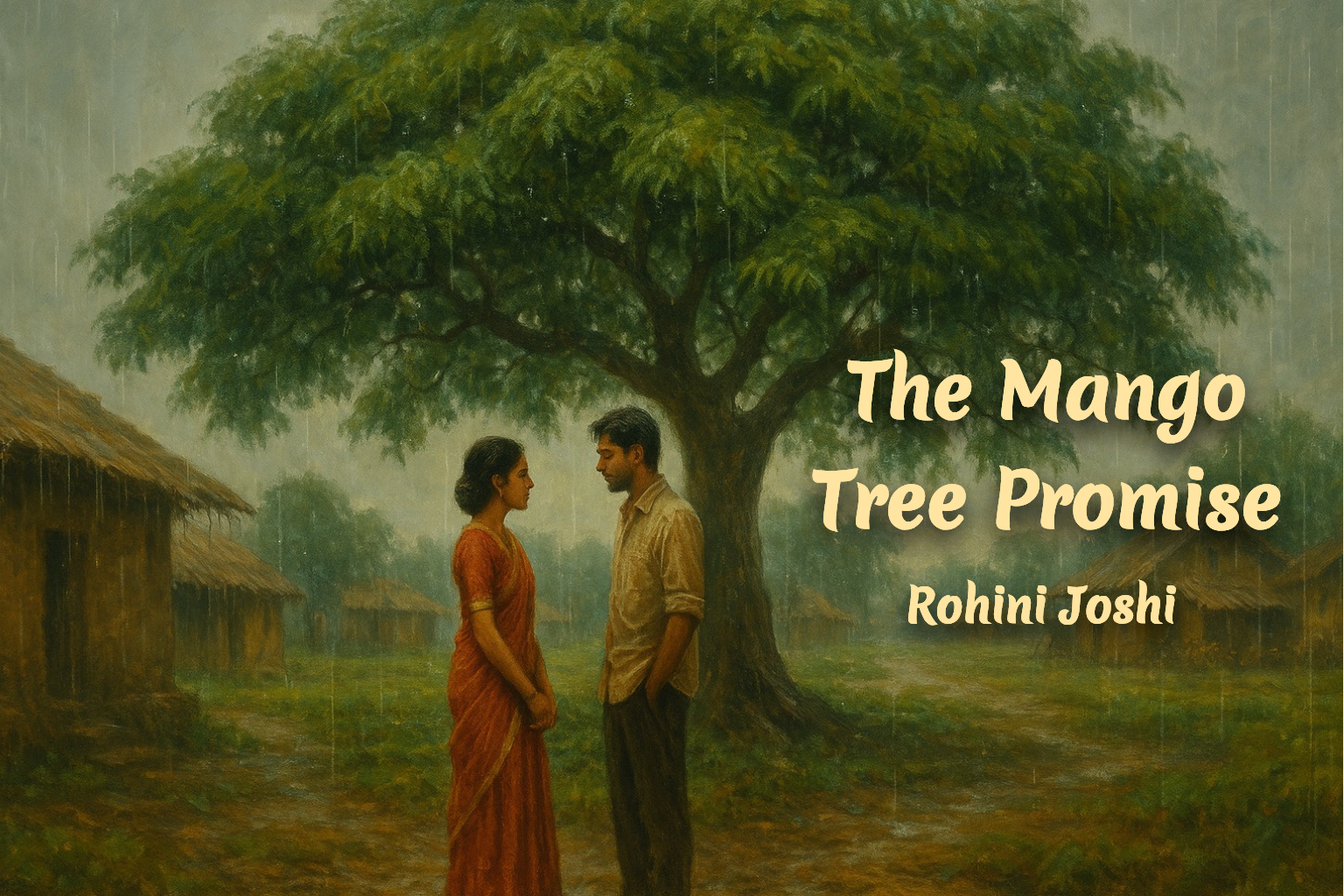
The sun dipped low over the village of Devgaon, painting the fields in shades of gold and rust. A warm breeze rustled through the sugarcane, carrying with it the scent of ripe earth and distant cooking fires. Birds chirped their way home, and somewhere near the temple pond, a cow mooed lazily. Life here was as steady and grounded as the banyan trees that marked the village borders. It was in this quiet, timeless corner of Maharashtra that Aanya and Kabir’s story began—beneath the sheltering branches of an old mango tree.
The tree stood on the edge of Kabir’s family farm, its trunk thick with age, roots breaking through the cracked earth like veins. It had seen many monsoons, many summers, and countless childhoods spent climbing its branches and stealing its fruit. For Aanya and Kabir, it was their castle, their spaceship, their secret meeting place.
Aanya was eight when she first met Kabir. She had just moved to Devgaon to live with her grandfather, a retired postmaster, after her parents took teaching jobs in the nearby town. Kabir was ten, already tanned from long days in the sun, his hands calloused from helping on the farm. He was the village rascal with a smile that disarmed even the strictest elders.
They met one hot afternoon when Aanya wandered past the fields, chasing a butterfly. Kabir, perched on a low mango branch with a slingshot in hand, called out, “You’re going to scare it away!”
Startled, she looked up. “I wasn’t trying to catch it.”
“Then what are you doing?”
“Just watching,” she said, frowning.
“Want a mango?” he asked, offering one he had picked.
She hesitated but nodded. From that moment, a silent understanding formed—an alliance of two lonely children who saw the world a little differently from those around them.
Their days quickly became entwined. Mornings were for school, afternoons for chores, and evenings for play. But weekends—they belonged to the mango tree. They’d climb its branches and share stories. Aanya would bring her grandfather’s old storybooks, and Kabir would bring raw mangoes dipped in salt and chili.
“Someday,” Aanya said one summer, swinging her legs from a high branch, “I’m going to be a doctor.”
Kabir looked at her, impressed. “What does a doctor do?”
“They help people. Fix them when they’re sick.”
He considered this, nodding slowly. “Then I’ll be a farmer, like my baba. And I’ll grow food for everyone, including you.”
“Deal,” she grinned.
It was during one such afternoon that the promise was made.
They sat in the crook of the tree where the branches formed a kind of natural bench. The sun filtered through the leaves in dapples, making Aanya’s dark hair shimmer.
Kabir had just finished telling her about a wedding he attended—how the bride wore flowers in her hair and the groom rode a horse.
“Will you get married someday?” Aanya asked.
“Of course. Won’t you?”
She nodded. “But only if it’s someone I like.”
“Like who?” he teased.
“Like you,” she said seriously.
He blinked, caught off guard.
“I mean it,” she said. “We should marry each other. Then we can always be together.”
He looked thoughtful, then slowly extended his pinky. “Promise?”
She linked her pinky with his. “Promise.”
Neither of them knew the weight of that moment. They didn’t understand love or destiny. But they knew they were safe with each other, that the world felt kinder under the mango tree.
Years passed like pages in a diary. Seasons changed, bringing with them the rhythm of rural life—harvests, festivals, school terms, and family gatherings. But through it all, the bond between Aanya and Kabir remained unchanged.
By the time Aanya was twelve, she was the top student in her class, known for her sharp mind and quiet confidence. Her grandfather beamed with pride whenever the schoolmaster praised her.
Kabir, at fourteen, had begun taking on more responsibilities at the farm. His father, though gruff, relied on him more each day. Still, he made time for Aanya—for their walks, their talks, their mango tree.
One day, during a particularly heavy monsoon, the tree was struck by lightning. It didn’t fall, but one of its thickest branches split.
Aanya cried when she saw it the next morning.
“It’s still standing,” Kabir said gently, placing a hand on the bark. “Like us.”
They patched it with rope and cloth, convinced their care would heal it. And, miraculously, the tree survived.
But time, unlike trees, cannot be patched so easily. Change was coming, slow but certain, like the tide.
Aanya’s father returned one weekend with news. She had been accepted into a prestigious school in Pune. She would stay with an aunt and prepare for the entrance exams to medical college.
She told Kabir under the mango tree, the summer before she turned fifteen.
“I’m leaving next month.”
Kabir’s face was unreadable. “For how long?”
“Years, maybe. But I’ll come back. I have to study.”
He nodded, kicking at the dirt.
“You’re not angry?”
He looked up. “No. Just… don’t forget me.”
She reached out, gently taking his hand. “Never. And when I’m a doctor and you’re a big farmer, we’ll marry. Like we promised.”
He smiled then, the boyish grin she had known for so long. “Then go. Become the best doctor. I’ll be here, waiting.”
They didn’t say goodbye. Not really. Just a hug under the mango tree as the sun set.
As she walked away, she turned back once. He stood there, hand on the tree, watching her with eyes too old for his age.
That tree had seen many things—but that day, it witnessed a childhood end and a promise take root deeper than any of its branches.
Chapter 2: Growing Pains
The dusty lanes of Devgaon seemed quieter without Aanya. The mango tree, though still strong and tall, looked lonelier to Kabir, who often sat beneath its shade after a long day’s work. He still brought raw mango slices dipped in salt and chili, though now he ate them in silence. Every evening, as the sun dipped behind the sugarcane fields, he would stare at the road that led to the bus stop, hoping to see a familiar figure return.
Aanya had been gone only a few weeks, but for Kabir, the days already felt longer. His father, Raghunath, had taken ill during the last harvest season, and Kabir, barely fifteen, now bore much of the farm’s burden. School had become a luxury, and though the headmaster protested, Raghunath insisted the boy learn the ways of the land.
“Books won’t till the soil,” he would mutter between coughs.
So Kabir learned about irrigation schedules and seed rotations, about dealing with merchants who tried to cheat them, and about the ache that settled in his back after a day of labor. But no matter how tired he was, he always made time for the mango tree—for memories, for hope.
Letters came occasionally. Aanya’s handwriting was neat and precise, like her. She wrote about life in Pune—about her aunt’s apartment, about the English-medium school with its marble floors and science labs. She missed the village food, the dusty games of langdi, and most of all, Kabir.
Kabir kept every letter in a tin box beneath his cot. He read them under a lantern’s light, his calloused fingers tracing the words slowly. He never wrote back—not because he didn’t want to, but because he didn’t know what to say. What could he write about? The broken tractor? The rising fertilizer costs? The loneliness?
Instead, he poured himself into the farm, growing sugarcane, tomatoes, even trying a patch of sunflowers because Aanya once said she liked them. The village boys teased him—”Doctor girl’s still got you dreaming, eh?”—but Kabir only smiled. Let them talk. They hadn’t seen the look in her eyes when she made the promise.
Years slipped by. Aanya thrived in Pune. Her sharp mind, coupled with fierce determination, earned her a scholarship to one of the best pre-med colleges. By the time she was seventeen, she was giving tuitions to younger students, managing her studies, and acing competitive exams. Yet at night, when the city lights flickered outside her window, she thought of Devgaon. Of the tree. Of Kabir.
She tried calling once, through her aunt’s landline. But the village number rarely worked. She tried writing more, but the letters came back unopened after Kabir’s family changed homes temporarily when Raghunath fell seriously ill. Eventually, the distance wasn’t just physical—it was emotional. What had once been a bond started to feel like a memory.
At eighteen, Aanya was admitted to Government Medical College. It was a dream she had nurtured since childhood. Her parents were proud, her professors in awe. But even in her white coat and stethoscope, she felt a hole inside her—one shaped like a mango leaf, like a boy with muddy feet and mango-stained fingers.
Meanwhile, Kabir had become a man. At twenty, he had taken over the farm completely. Raghunath had passed away during a dry season, and the weight of the land now sat entirely on Kabir’s shoulders. He worked from dawn till nightfall, rarely laughing, rarely resting. His mother worried.
“You’re too young to carry the world, beta.”
But Kabir had made a promise. And he was nothing if not loyal.
He rebuilt the tree bench where he and Aanya used to sit. He cleared the weeds around it, hung a swing from one of the branches. When the blossoms came in early spring, he smiled for the first time in weeks. He imagined her there, books in hand, swinging her legs like old times.
But she didn’t come.
One day, a marriage proposal arrived. The girl was from a nearby village—educated, polite, with a family that owned adjoining farmland. It made sense. Kabir’s mother was delighted.
“Think about it,” she said gently. “You need someone.”
He nodded but said nothing.
A few weeks later, the village held a small fair. Kabir went reluctantly, dragged by his cousin. He walked past the game stalls and sugar candy stands, but nothing caught his interest—until he heard a familiar laugh.
His heart stopped.
But it wasn’t her. Just someone with a laugh like hers.
That night, he climbed the mango tree one last time and whispered into the leaves, “Did she forget? Or did I just imagine it all?”
In Pune, Aanya faced her own doubts. Her world was textbooks and patients, diagnoses and deadlines. She had friends—some even romantic interests—but no one felt like home. She dated briefly in her second year but ended it when she realized she kept comparing him to someone who never left her heart.
During her internship, she once treated a farmer who reminded her of Kabir. She stitched a wound on his palm and asked, “Do you have children?”
“Two sons,” he said proudly. “One of them wants to leave the village, become an engineer. The other—he wants to stay. Farm the land. I’m proud of both.”
That night, Aanya opened an old box of letters—her own, the ones she had written Kabir. All returned, unread. Her eyes welled up.
Had he forgotten her? Had he moved on?
Time had created a silence neither of them knew how to break. Each thought the other had forgotten. Each still carried the promise like a scar.
Back in Devgaon, the mango tree flowered every spring. Kabir didn’t visit it as often. It hurt too much. Instead, he poured his energy into the land, expanding the fields, building new irrigation channels. He became known as one of the most dependable young farmers in the taluka.
But beneath the strength, he was tired.
Aanya graduated with honors. She was now Dr. Aanya Deshmukh. The village girl with dreams had made it. Her parents beamed at the ceremony. Her aunt cried.
But Aanya’s eyes searched the crowd for someone who wasn’t there.
After the convocation, she sat under a tree on campus. It wasn’t a mango tree, but it offered shade.
She opened her notebook and wrote one more letter:
Dear Kabir,
I don’t know if this will reach you. Maybe you’ve moved on. Maybe you’ve forgotten the promise we made.
But I haven’t.
I’m a doctor now. You were right—I became what I dreamed. And I think about you every day. About us. About that tree.
If you ever think of me, if you still remember, come meet me under the mango tree this Ganesh Chaturthi. I’ll be home.
She sealed the letter and mailed it the next morning. Whether it would reach or not, she didn’t know.
But some promises, she believed, still found their way home.
Chapter 3: The Return
The air in Devgaon was thick with the scent of marigolds and damp earth as the monsoon clouds hovered low. It had been seven years since Aanya had last walked these village roads. Now, at twenty-two, with a stethoscope in her bag and sorrow clinging to her heart, she returned—not as a curious child, but as a grieving granddaughter.
Her grandfather had passed quietly in his sleep, the villagers said. A peaceful end for a peaceful man. Aanya had received the call two nights ago and had packed her bags with trembling hands. The journey from Pune had felt surreal—fields blurring past her window, memories pressing at the edges of her mind.
The village hadn’t changed much. The same winding roads, the same faded shop signs, the same temple bell echoing through the air. And yet, it felt different. Or perhaps she had changed.
The family home stood solemn, draped in white cloth and silence. Neighbors came by with condolences and offerings—platters of rice, candles, murmured prayers. Aanya moved through the rituals with practiced grace, her doctor’s composure masking the storm within.
But even in mourning, her eyes searched.
On the third evening, after the lamps had been lit and the crowd had thinned, she slipped away. Her feet found the path instinctively—the narrow trail behind the house, past the well, past the broken stone wall. The same path that led to the mango tree.
The tree stood tall, older, but familiar. Its branches had thickened, and a wooden swing hung from one limb. The rope was frayed, the seat worn. She smiled.
He hadn’t forgotten.
She sat on the swing, letting it sway gently. Fireflies blinked around her, and for a moment, time rewound. She was fifteen again, waiting to tell Kabir about her acceptance letter. But now, it was silence that answered.
“I’m back,” she whispered.
The next morning, she walked to the village square. The fair was being set up for Ganesh Chaturthi—colorful stalls, music systems being tested, children chasing each other barefoot. Her eyes wandered across the crowds.
Then she saw him.
Kabir stood near a cart stacked with sacks of grain, speaking with the vendor. He was broader now, his frame solid, his skin darker from years under the sun. He wore a simple cotton kurta, the sleeves rolled up, and when he turned, her breath caught.
He looked up, as if sensing her gaze.
Their eyes met.
Neither moved for a heartbeat. Then she took a step forward.
“Kabir.”
His name on her lips stirred something in him. He blinked, the ghost of a smile appearing before vanishing.
“Aanya,” he said, voice softer than she remembered.
She nodded. “It’s been a long time.”
He nodded too, but the space between them felt thick with things unsaid.
“I heard about your grandfather,” he said. “I’m sorry.”
“Thank you.” She hesitated. “I wanted to tell you I was coming, but I didn’t know how to reach you.”
He looked away. “I got your letter. A week ago.”
Hope flared. “And?”
“I didn’t know if I should reply.”
Her stomach sank. “Why?”
Kabir’s gaze was steady. “Because I’m engaged.”
The world tilted. The fair sounds faded.
“Engaged?” she echoed.
“Her name is Meera. She’s from the next village. We’ve known each other for a while.”
Aanya swallowed. “And you… love her?”
He didn’t answer.
She forced a smile. “Well, congratulations.”
Kabir stepped closer. “It’s not that simple.”
“It never is.”
They stood in silence, surrounded by laughter and music they no longer heard.
“I wasn’t sure if you’d come,” he said finally.
“I wasn’t sure either,” she admitted.
He looked down. “A lot’s changed.”
“I can see that.”
Then, a child tugged at Kabir’s hand, asking about sugarcane juice. He turned away briefly, and the moment shattered.
Aanya walked back slowly, her chest heavy. She had come home hoping for answers, perhaps even a rekindled flame. Instead, she found an engagement ring and a man who no longer belonged to her.
Back at the house, she sat by the window, watching the rain. Her aunt came in quietly.
“Did you see him?”
“Yes.”
“And?”
“He’s engaged.”
Her aunt sighed, placing a hand on her shoulder. “People move on, Aanya.”
“Do they?” she asked, more to herself than anyone else.
That night, she couldn’t sleep. She wandered the house, memories clinging to every corner. Finally, she stepped outside and walked to the mango tree again.
Kabir was there.
He stood with his hands in his pockets, his eyes on the swing.
“I thought you might come,” he said.
“So did I.”
He turned to her. “I didn’t want to hurt you.”
“Then why did you stop writing? Why did you never try?”
“I did. But the letters returned. And time… time made it harder.”
She crossed her arms. “And Meera?”
“She’s kind. She understands the land. My mother likes her. It made sense.”
“But do you love her?”
Kabir looked at her, and for a second, the years melted. “No.”
Silence fell between them.
“Then why?” she whispered.
“Because I thought you had forgotten me. And I was tired of waiting.”
Aanya stepped closer. “I never forgot. Not once.”
Kabir looked torn, the weight of his choices heavy on his face.
“I don’t know what to do anymore,” he confessed.
Aanya reached for his hand, hesitating before she touched it. “Then start with this. One step. One truth.”
He looked down at their hands, then at the swing.
“It’s still here,” he murmured.
“So are we.”
Above them, the mango leaves rustled gently, as if echoing the sentiment.
Chapter 4: Harvest of the Heart
The sun rose over Devgaon with golden insistence, casting long shadows across the wet fields. The festival of Ganesh Chaturthi had begun, and with it, the village burst into color and celebration. But beneath the vibrant sounds of dhol-tasha and the wafting aroma of modaks, two hearts beat out of sync—tied to each other, yet pulled apart by years of silence and choices.
Kabir hadn’t slept. After his meeting with Aanya under the mango tree, he had walked home with a whirlwind in his chest. He sat through dinner mechanically, nodding through his mother’s cheerful remarks about the upcoming wedding. Meera had come by, her smile patient, her voice gentle. Kabir barely noticed.
He kept seeing Aanya’s eyes—the pain she tried to hide, the hurt in her voice. And the way her hand had trembled slightly when she touched his. Something inside him cracked.
The next morning, he rose before dawn. Without a word, he walked to the fields, his feet treading paths worn with memory. He stood by the edge of the sugarcane patch, looking at the horizon. He remembered a younger version of himself standing there, dreaming of a girl in a white dress and pigtails who’d promised to marry him.
What had become of that promise?
Meanwhile, Aanya sat at her grandfather’s writing desk, the very place where she used to scribble poems and letters as a child. The scent of old paper and sandalwood calmed her, but her mind was anything but calm. Her conversation with Kabir replayed endlessly.
She opened her notebook and began to write—not a letter this time, but a memory:
“We promised under the mango tree—two foolish children with hearts too big for their chests. But was it really foolish? Or did we know something then that we’ve forgotten now?”
Her pen hovered. The words spilled faster than her thoughts. She wrote for an hour, capturing moments, longings, regrets. When she stopped, tears dotted the page.
That evening, the village celebrated with a grand aarti at the temple. Aanya attended with her aunt, draped in a green silk saree her grandfather had gifted her years ago. The villagers whispered and smiled—Dr. Aanya had returned, and she looked like a goddess.
Kabir was there too, dressed in crisp white kurta-pajama. Meera stood beside him, offering flowers into the deity’s lap. Aanya watched them, her heart squeezed tight.
As the aarti ended and the crowd dispersed, Kabir stepped away. Their eyes met across the courtyard. She looked away.
Later that night, a knock came at her door.
Kabir stood there, his eyes dark and stormy.
“Walk with me,” he said.
She hesitated, then followed.
They walked in silence, down the moonlit path to the mango tree.
“I wanted to tell you something,” he said. “I ended the engagement.”
Aanya stopped short. “What?”
“I told Meera I couldn’t marry her. That I was living a lie.”
She stared at him. “And she was okay with that?”
“She knew. Maybe not all of it. But she knew I was never really hers.”
Aanya took a shaky breath. “Why now?”
“Because you’re here. Because I finally had the courage to stop hiding behind the past.”
She looked up at the tree. “What about the village? Your mother?”
“I’ll face them. With you, if you’ll stand by me.”
Her heart beat wildly. “I came back not just for Dadaji’s funeral. I came because I needed to see if the boy I loved still lived here. If the promise still mattered.”
Kabir stepped closer. “It always mattered. I just didn’t know how to reach you.”
“I’m here now,” she whispered.
He touched her cheek gently. “And I’m not letting you go again.”
They stood beneath the mango tree, older now, wiser. The promise made in childhood, shaped by years of distance and doubt, had weathered the storm.
Above them, a mango dropped, thudding softly on the ground. They laughed.
“I guess the tree approves,” she said.
Kabir took her hand. “Next Ganesh Chaturthi, we’ll get married. Right here. Beneath this tree.”
She smiled through tears. “It’s a promise.”
Chapter 5: The Mango Tree Promise
A year had passed since Aanya and Kabir had stood beneath the mango tree, hearts laid bare. The promise made under childhood branches had blossomed again—not in innocence this time, but in understanding.
The village of Devgaon hummed with anticipation. It was Ganesh Chaturthi once more, and the temple bells echoed through the fields, calling everyone to celebrate. But this year, there was more than just a festival to prepare for. There was a wedding.
The mango tree had been decorated with strings of marigolds and white jasmine. Lanterns hung from its broad limbs, swaying gently in the monsoon breeze. Beneath its shade, chairs were arranged in a semicircle, and a mandap had been built with bamboo and banana leaves, simple yet elegant.
Aanya stood before a mirror in her grandfather’s house, now hers. She wore a traditional Paithani saree of deep red with gold motifs, her hair woven with mogra flowers. Her aunt fussed over the last touches, wiping a smudge from her cheek.
“Dadaji would’ve been so proud,” her aunt said, eyes moist.
Aanya smiled. “I think he’s here. In the wind. In the mango leaves.”
Outside, the village gathered in anticipation. Children wore new clothes, running between stalls of sweets and bangles. Elders sat on charpoys, fanning themselves. The DJ booth near the square played folk songs mixed with Bollywood, much to everyone’s delight.
Kabir waited under the tree, dressed in a cream-colored sherwani with a saffron turban. His friends teased him, but he barely heard them. His eyes were fixed on the house down the lane, where she would soon appear.
And then, she did.
Aanya walked slowly, each step measured. As she reached the gathering, silence fell like magic. She locked eyes with Kabir, and nothing else existed.
The ceremony began. The priest chanted mantras, and the fire crackled. As they circled the sacred flames, their past—separation, longing, misunderstandings—burned away, leaving only now.
With each phera, they made new promises:
To never let silence come between them again.
To hold on, even when the world pulls apart.
To honor the love that grew under the mango tree.
When it was done, and the garlands had been exchanged, the villagers erupted in cheers. Flowers rained from above. Someone released a pair of white pigeons that flew toward the horizon.
That night, as the last of the guests drifted away and the moon rose high, Aanya and Kabir sat beneath the mango tree. The swing creaked gently between them.
She leaned against his shoulder. “Do you remember the day we made the promise?”
He smiled. “You were bossy. You made me swear twice.”
“I had to be sure.”
“You always were.”
She took his hand, lacing her fingers with his. “We made it, Kabir. Through everything.”
“And now we start again.”
The tree rustled above them, leaves whispering in the night.
Aanya looked up. “I want to build a clinic here. For the village. For Dadaji.”
Kabir kissed her forehead. “And I’ll plant more trees. One for every promise we keep.”
They sat in silence, two souls who had grown apart and found their way back. The mango tree stood tall above them—no longer just a witness to childhood oaths, but now a guardian of a lifelong vow.
The promise had endured.
And in the heart of Devgaon, love had come home.
—