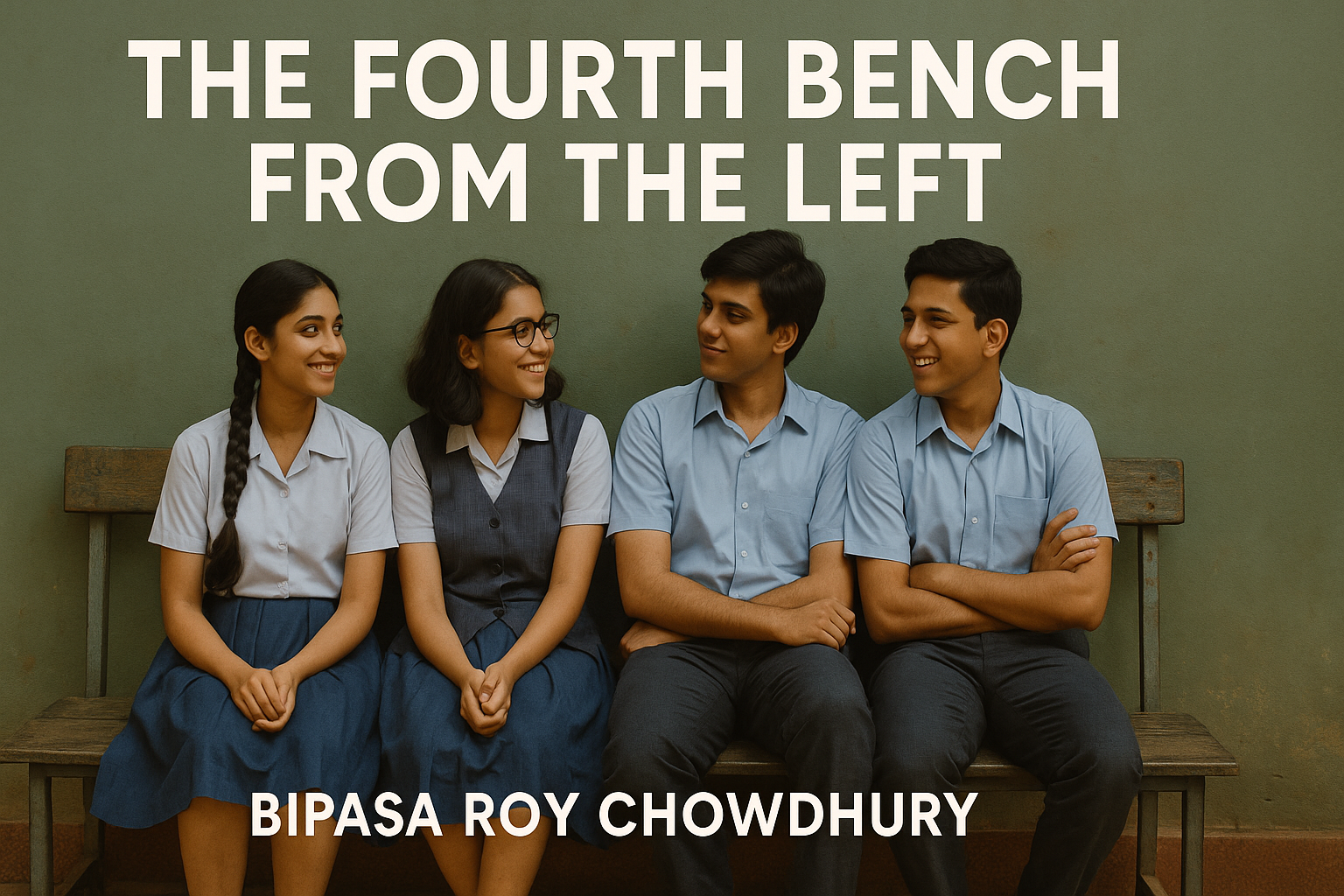

Bipasa Roy Chowdhury
Chapter 1: Assigned Seats and Accidental Fates
On the first day of the new academic year, Oakridge High buzzed with the scent of freshly bound notebooks, sharp pencils, and the distinct nervous energy that only teenagers in half-creased uniforms could produce. In Class 10-B, the fans creaked overhead like tired old men, and sunlight streamed through dusty glass, illuminating years of chalk smudges and scraped graffiti. A printed seating chart stuck hastily on the blackboard, like a bureaucratic lottery ticket, dictated the year’s fate for every student. And it was here, in faded Arial font and alphabetical tyranny, that four lives were forced to collide: Naina Bhattacharya, Mili Fernandes, Kabir Khan, and Soumya Roy—destined, as per school records, to occupy the fourth bench from the left. It was a bench no one loved—too close to the front to be invisible, too far back to be free. Soumya, slouched with a permanent smirk and headphones poking from his collar, arrived first and claimed the corner with casual disdain. Naina followed timidly, hugging her sketchpad like a talisman. Kabir entered next, clad in black and judgment, giving everyone the vibe of a tortured indie songwriter, and took the edge farthest from humanity. Mili came in precisely on time, badge polished, hair braided, and horror etched on her face when she realized she’d be sandwiched between what looked like a walking detention slip and a girl lost in clouds. Within the first five minutes, Naina had spilled her water, Soumya had made two sarcastic jokes at Mili’s expense, and Kabir had glared at them all with a sigh deep enough to create emotional tremors. That bench was chaos. That bench was uncomfortable. That bench, by sheer accident, was about to change all of them.
Homeroom began with announcements, new timetable confusion, and a science teacher who looked like she’d rather be anywhere else. As the day rolled on, it became painfully clear that the fourth bench wasn’t just a seat—it was a sentence. The four were paired together for every possible activity: group discussions, biology partners, even the rotating blackboard duty. They stumbled through introductions like an unbalanced table with mismatched legs. Soumya, always quick with his tongue, mocked Kabir’s brooding silence until Kabir recited a line of brutal poetry about ignorance. Mili tried mediating but ended up getting caught in the crossfire of two massive egos. Naina, true to form, said very little, but she sketched all three of them on her notebook margin, giving them exaggerated anime heads and tiny speech bubbles. Tension hung like damp clothes on a monsoon morning—everything soggy and unpleasant. And yet, between mispronounced roll calls and shared glances of mutual suffering during surprise quizzes, something began to shift. When the math teacher announced a pop test and Mili instinctively offered to pass her notes to Naina, when Soumya let Kabir borrow his extra calculator with a wink instead of a wisecrack, and when all four of them silently protested the teacher’s attempt to move Soumya for “talking too much,” the seed of solidarity was planted. They didn’t like each other. Not yet. But they disliked the rest of the class just enough to tolerate being together.
Lunch that day was a turning point—not in an epic, firework way, but in the small, quiet way friendships often begin. Mili took out her mother-packed tiffin with military precision—perfectly cut sandwiches and grapes in individual foils. Soumya, in contrast, had chips and an oily samosa stuffed in a crumpled napkin. Kabir didn’t eat, claiming food was a capitalist distraction, and Naina pulled out a banana and began drawing it instead of peeling it. A teacher spotted Soumya’s forbidden food and threatened to confiscate it, prompting a spontaneous cover-up mission led by Mili, of all people, who coughed loudly while Naina distracted the teacher with a question about test syllabi. The samosa was saved. They looked at one another, surprised—perhaps even impressed. It was in that accidental alliance, in the blurry lines between rules and rebellion, that something clicked. No grand speeches were made. No promises exchanged. But that bench—dusty, squeaky, often wobbly—had begun to become something else. A shared territory. A safe corner. A front-row seat to drama, disaster, and maybe even, eventually, friendship.
Chapter 2: Chemistry, Literally
The first full week of classes brought with it a swift descent into academic chaos. Timetables shifted like tectonic plates, teachers threw surprise quizzes like ninja stars, and no one, not even Mili with her color-coded planner, could predict when a subject would suddenly be replaced by an unexpected lecture or a power cut. But one thing remained depressingly consistent: the dreaded double period of chemistry with Mrs. Nambiar, known throughout Oakridge as “Acid Aunty.” A lean, hawk-eyed woman with a voice like vinegar and a weakness for exact decimals, she terrorized even the toppers. Soumya, who had a knack for science but no patience for authority, saw her as a personal challenge. Kabir, allergic to conformity and lab coats, considered chemistry a capitalist scam. Mili took notes with robotic speed, underlining every word Nambiar uttered. Naina doodled Bunsen burners with faces, imagining them running away from the syllabus. Their lab bench, predictably, became ground zero for chaos. On Tuesday, while measuring sulfuric acid for a routine experiment, Soumya—distracted by trying to balance a pencil on his upper lip—accidentally poured a little too much into the beaker, which fizzed and overflowed onto the burner. Flames shot up like an angry dragon, and while the reaction was harmless in the end, the class erupted in panic. Naina dropped her pipette in terror, Kabir muttered something that might have been a poem about combustion and capitalism, and Mili screamed so loudly that two junior teachers came running. The fire was doused in seconds, but the incident earned them a week’s detention and a lecture about the “danger of adolescent arrogance mixed with chemicals.”
Detention in Oakridge wasn’t cruel—it was just boring. Held in a dusty side-room beside the library, the punishment sessions were quiet pockets of shared misery. For an hour after school, the Fourth Benchers sat under the watchful eyes of Mr. Gulati, the history teacher who napped through most of his surveillance. At first, they suffered in silence. Mili would work on her assignments, Naina would pretend to revise while actually sketching birds from the courtyard, Soumya would pass sarcastic notes to no one in particular, and Kabir would sit with his headphones in, writing lyrics about rust and silence. But as the days passed, something unusual began to bloom in the dullness. Soumya tried teaching Naina how to make a paper missile that could land on the fan. Mili discovered that Kabir’s poetry wasn’t all angry, and even laughed—out loud—when he compared the school bell to a goat’s dying scream. When Naina finally showed them a sketch of Mrs. Nambiar drawn as a chemical formula with devil horns, the entire group broke into muffled laughter. Their detention room began to feel less like a punishment and more like an exclusive club—a refuge from the overachievers and gossip-mongers of the rest of the class. They began to whisper inside jokes during class, eye-roll in unison at bad PowerPoints, and even start passing around Naina’s sketchpad as if it were a sacred text. The Fourth Bench wasn’t just a seat anymore. It was a territory with its own language, its own rituals. And though they still rolled their eyes at each other and groaned every time Mili took attendance too seriously or Kabir quoted existentialist philosophy in math class, they now did it with something dangerously close to affection.
The chemistry incident also brought unexpected ripple effects. Mrs. Nambiar, though furious, was slightly impressed by Soumya’s impromptu reaction time during the fire—he had thrown a lab coat over the beaker before anyone else had moved. She started calling on him more in class, often to challenge or trap him, which only made him study harder out of spite. Mili began sitting with Naina after school to help with science homework, discovering that beneath the dreamy drawings was a brain that simply processed information differently—visually, associatively, almost like stories. Kabir, while pretending to hate everyone, started walking halfway to school with Soumya, exchanging arguments about whether physics was poetry in disguise. They were still misfits. They still fought. But like four jagged puzzle pieces accidentally forced together, they began to find where they fit. When the second monthly test arrived, they sat in a row, sharpened pencils ready, hearts pounding. After the paper, instead of discussing the questions, they all simultaneously turned to Naina’s notebook, where she had drawn the four of them as superheroes: “Captain Chemistry,” “Miss Method,” “Brooding Blastman,” and “The Scribbler.” For the first time, they didn’t dread the rest of the school year. Because they had the Fourth Bench. And it was starting to feel like home.
Chapter 3: Operation Break the Rules
It started, as most legendary things do, with boredom—and one tragic lunchbox inspection. That Thursday, just before the last period, the Vice Principal, Mrs. D’Mello, a woman who walked like she was perpetually chasing a misbehaving student, barged into 10-B with a clipboard and her trademark frown. “Random tiffin check,” she announced, to which several kids groaned in despair, and one even tried to swallow an entire pastry at once. Soumya, of course, was caught red-handed with a contraband packet of fried momos. Mili had warned him not to bring outside food; she even quoted the handbook rule—Section 3B, Clause ii, Subpoint 4. He had winked and called her the “Minister of Mundane,” which didn’t help. The confiscation wasn’t just embarrassing—it was personal. Mrs. D’Mello not only took the momos but also gave a long sermon in front of the class about discipline, cleanliness, and the dangers of unregulated dumplings. When the four of them sat sulking at the bench afterward, Soumya proposed it with a grin that could only spell disaster: “Let’s prank the system.” Mili’s first response was a scandalized “No.” Naina’s was a slow blink of curiosity. Kabir simply folded his arms and said, “What did you have in mind?” That’s how “Operation Break the Rules” was born—equal parts vengeance, boredom, and creative chaos. The plan was to fool the school with a lifesize cardboard cutout of the principal that would be strategically placed during morning assembly, while a pre-recorded message played from the AV room. It was, on paper, brilliant. In execution? Less so.
Preparation was everything. Naina designed the cutout from an old school photo and mounted it with help from the art room’s unattended supplies. Mili, surprisingly, offered to distract the lab assistant to steal cardboard. “For the record,” she said while slipping out the door, “I’m morally opposed to this. But D’Mello insulted my handwriting, so consider this a social correction.” Kabir wrote the fake speech—a masterpiece full of generic wisdom and random inspirational quotes from people who didn’t exist. Soumya managed to convince a junior to lend them the AV room key in exchange for a shoutout on their secret school blog, Under the Desk. On the day of the prank, everything was in place. The morning bell rang, students assembled in neat lines under the blazing sun, and just before Principal Iyer arrived, the cardboard clone was rolled into place. The pre-recorded speech echoed from the loudspeaker: “Good morning, future leaders of tomorrow. Let us begin today’s assembly with a meditation on excellence…” No one noticed at first. In fact, some teachers nodded along. But midway through the third quote—“As Napoleon Gandhi once said, discipline is the price of mangoes”—a ripple of confusion spread. Someone finally shouted, “Why isn’t he blinking?” Chaos erupted. The cutout was discovered, the AV room traced, and within an hour, all four members of the Fourth Bench were sitting outside the Principal’s office, facing what Soumya called “certain death or, worse, suspension.”
But the punishment never came. Instead, something stranger happened. Principal Iyer, a wiry man with a perpetually amused expression, called them in one by one. When Soumya entered, expecting a lecture or a notice to bring his parents, Iyer simply asked, “Why’d you do it?” And when Soumya replied, “Because school was becoming a spreadsheet,” the Principal smiled faintly and said, “Don’t do it again. But also… not bad.” Naina was asked if she was the artist. She nodded shyly. Iyer told her she should consider joining the inter-school art festival. Kabir expected sarcasm, but Iyer said, “Your speech had better structure than the actual one I gave last month.” Even Mili, who confessed everything and handed over a list of her own infractions for good measure, was let off with a warning and an invitation to join the student council as “someone with a moral compass but also imagination.” The prank, unintended as it was, made them legends. Other students looked at them differently—some with admiration, some with envy, and one particularly irritating kid tried to copy their idea using a mop dressed as a teacher. But for the Fourth Benchers, the success wasn’t in the applause. It was in the adrenaline, the chaos, the shared glances in class when teachers mentioned “morality” or “rules,” and they fought laughter. They hadn’t planned on becoming friends. But now, there were memories stitched between them—flammable chemistry labs, detention doodles, and one epic prank that didn’t just break the rules. It bent the school around their story.
Chapter 4: The Diaries of Naina
Every school has its whisper zones—unwritten corners where secrets are born, where glances speak more than voices, and where silences mean everything. For the Fourth Benchers, that whisper zone had quietly become the fourth bench itself. It had seen spilled ink, mid-lecture doodles, coded insults, accidental confessions, and now, unknowingly, it was about to bear witness to one of the most vulnerable moments of the year. It happened on a wet Friday afternoon, when thunder rolled lazily across the sky and the class was buried in the sleepy haze of a post-lunch civics lecture. Naina’s sketchpad, dog-eared and thick with days of illustrations, slipped unnoticed from her lap and fell under the bench. When the bell rang and the students scattered, she didn’t notice it was missing. But Mili did. She had seen the cover before—the hand-drawn swirl of vines with four tiny caricatures of herself, Soumya, Kabir, and Naina at the corners. Thinking nothing more than to return it later, Mili opened the first page—and froze. It wasn’t just drawings. It was Naina’s world. Sketches of Mrs. D’Mello turning into a dragon, of Soumya building robotic wings, of Kabir’s face melting into a storm, of herself with a crown too heavy to lift. On the margins, small lines of text curled around the figures—whispers of thought, hidden confessions, and raw, unfiltered feeling. “I can’t speak in class without imagining I’ll break,” one note read. Another: “Soumya jokes when he’s sad. I see it in the way he blinks.” And then a particularly poignant line under a sketch of the four of them sitting on the fourth bench: “I didn’t know belonging could feel this… accidental.” Mili snapped the book shut, hands trembling. She felt like she had peeked through a door never meant to be opened. But more than guilt, she felt awe. And something else—recognition.
Later that day, Mili waited until the classroom was empty before approaching Naina. She held out the sketchbook gently, like it was a baby bird. Naina looked at it, eyes widening in horror. “You read it?” she whispered. Mili hesitated—then did something she’d never done before. She pulled out her own notebook, one she usually reserved for speeches, goal charts, and council prep. From its folds she extracted a small crumpled page and handed it to Naina without a word. It was a poem—rough, unpolished, oddly shaped. It read:
She wears perfection like a badge,
But it cuts her skin, inch by inch.
She smiles when she’s supposed to,
And drowns where no one blinks.
It wasn’t brilliant. It wasn’t even neat. But it was true. Naina’s expression softened. A bridge was being built, quiet and slow. They didn’t speak for a while after that. But in the following days, Mili began sitting a little closer, and Naina started letting her peek at new sketches. They even began exchanging notes, not about class, but about the world—things they noticed, things they feared. One lunchtime, Kabir passed by, saw the two girls giggling over a page and frowned dramatically. “Should I be concerned about the emotional collusion on this bench?” Soumya, munching loudly beside him, replied, “Only if they start planning your personality makeover.” But even he smiled. The air around the bench shifted—less chaotic now, more layered. They were beginning to hold each other’s truths, not just their jokes. There was still teasing, of course—Soumya couldn’t help mocking Kabir’s new poem about “existential lunchboxes,” and Kabir retaliated by comparing Soumya’s logic to a leaky faucet. But underneath it all, an unspoken trust was forming. The kind that didn’t need declarations. The kind built through shared glances, confessions folded into notebooks, and the quiet agreement that they were, strangely, becoming each other’s people.
Still, no bond forms without tremors. One afternoon, during an especially intense physics test, Kabir caught Mili glancing at Naina’s paper and misread it completely. After class, he accused Mili of helping Naina cheat, throwing words like “favorites” and “dishonest perfection” into the air like darts. Mili, who had simply been passing a calculator, turned pale with fury. The argument that followed was quiet but brutal—hissing whispers at the back of the library, the kind that sound louder than screams. Soumya, upon hearing of it, uncharacteristically took Mili’s side, which only made Kabir storm off, muttering about hypocrisy. Naina stood between them, arms crossed, trying not to cry. For two days, the fourth bench was a landmine. No one looked at anyone. Teachers noticed. So did the rest of the class. The silence was louder than any prank they’d pulled. Then, on the third day, someone found a folded piece of paper taped under the bench. It had four stick figures drawn with exaggerated noses, all holding up a fifth sign that read, “We argue. We mess up. But this bench is Switzerland. Leave your weapons outside.” No one claimed it, but all four knew who had drawn it. At lunch, Kabir sat down first. Mili followed. Then Naina. Then Soumya, holding out a pack of momos like a peace offering. The war was over. Not because anyone had won—but because they chose the bench again. Every school has its sacred place. For these four misfits, it wasn’t the library or the field or the auditorium stage. It was a piece of wood, worn and scratched, fourth from the left, where stories were being written not on the blackboard—but between hearts that had no reason to find each other, and every reason to stay.
Chapter 5: Midterms and Mayhem
By the time October rolled around, the buzzword on every teacher’s lips was “Midterms.” Worksheets flooded in like biblical punishment, tuition schedules bloated, and every blackboard groaned under weighty formulas and timelines. Oakridge High shifted into war mode, and so did the students—everyone except the Fourth Benchers, who were still straddling the line between mild rebellion and accidental achievement. Mili, unsurprisingly, was fully geared up: her revision notes were laminated, her planner color-coded into neon blocks, and she’d already solved last year’s papers twice. Naina, on the other hand, approached the exams like she approached a blank sketch page—staring, sighing, and hoping inspiration would save her at the last minute. Kabir refused to acknowledge the exams until he realized his literature teacher was using his poem in a mock test to illustrate “vague abstraction.” Soumya claimed he worked best under pressure but was mostly just tinkering with a physics project that looked suspiciously like a slingshot. As the days ticked down, the cracks in their casual camaraderie began to show. The school was no longer just a backdrop for their antics—it had become a test of their identities. Tension brewed during classes. Even their bench, once echoing with whispered jokes and elbow-nudges, now simmered with unspoken worries. When Mili offered to quiz Naina on trigonometry, Naina snapped, “I’m not your project.” Soumya chuckled, trying to diffuse the awkwardness, but Kabir muttered, “She’s not wrong,” sparking a half-hearted spat that fizzled into a moody silence. The bench felt colder. The bell louder. And suddenly, exams weren’t just about marks. They were about proving something—individually, painfully, alone.
Then came the storm. It started with whispers—a rumored question paper leak in the science department. No one took it seriously until the night before the physics exam, when a WhatsApp screenshot began circulating through the batch like wildfire. It was a blurry photo of a familiar question sheet, marked “CONFIDENTIAL.” Mili saw it and panicked. Kabir called it a hoax. Soumya, oddly quiet, said nothing at all. The next day, the exam went ahead, but the air in the hall was thick with unease. Mili recognized every question. She stared at the sheet, pen poised, torn between guilt and obligation. Naina, sitting behind her, noticed the tremble in her hand. After the paper, chaos erupted. Teachers stormed into classrooms, confiscating phones. An emergency assembly was called. Someone had leaked the paper. Suspicion swept through like a gust of poison. And at the center of it, unexpectedly, was Soumya. A junior anonymously told the Vice Principal he’d seen Soumya near the chemistry staffroom late in the evening—the same staffroom where copies of the question paper were stored. It didn’t matter that he was probably there returning a lost calculator, or that he had a reputation for snooping around. Perception did its damage. He was summoned. Questioned. And the moment his name was said aloud, even their bench felt it—something heavy and cruel pressing down. Mili defended him immediately, too quickly perhaps. Kabir stayed silent. Naina looked heartbroken. And Soumya, usually full of comebacks, just said, “I didn’t do it. But I get why you’d think I could.”
The next forty-eight hours stretched forever. Rumors ran wild—some claimed Soumya had cracked the school’s Wi-Fi, others that he had a teacher’s login. He didn’t deny or confirm anything. He just stopped coming to school. The bench felt amputated without him. Mili sat rigidly upright, trying to keep order. Kabir scribbled darker poems. Naina stopped sketching altogether. It was only when Mili, overcome with guilt and confusion, confessed to the Vice Principal that she’d seen the screenshot the night before and hadn’t reported it, that things began to unravel. That act of honesty brought things to light—others stepped forward, confirming that the screenshot had been circulating long before Soumya had entered the scene. His name was cleared quietly, without apology. He returned the following Monday, backpack slung over one shoulder, face unreadable. No grand welcome, no confetti. But when he slid into his usual spot on the bench and muttered, “Missed the smell of over-sharpened pencils and silent judgment,” the bench exhaled. Kabir passed him a folded paper titled “Ode to the Unnamed Culprit.” Mili shoved a samosa toward him and said nothing. Naina finally handed him a torn sheet from her sketchbook. It was the four of them, drawn with angry faces and exaggerated frowns, holding a banner that read: “Midterms may break us, but the bench bends us back.” And they all laughed—not because anything was funny, but because laughter was the only glue that worked when everything else cracked. That bench had once been an accident. Now, it was an anchor.
Chapter 6: Kabir’s Vanishing Act
It happened with no drama, no forewarning. One Monday morning, the bell rang and Kabir wasn’t there. The fourth bench sat lop-sided, not just in form but in energy, its rightmost edge colder somehow, waiting for a slouching shoulder that didn’t arrive. At first, no one thought much of it. Kabir wasn’t exactly known for punctuality or consistency—he often walked in five minutes late, quoting Sylvia Plath or claiming that buses were “manifestations of bureaucratic failure.” But by the second day, when the seat remained empty and his desk was still littered with a scrawled list of metaphors and one of Naina’s origami doodles, something felt wrong. Rumors trickled in. A classmate mentioned his house had been locked. Another said they saw him arguing with a man outside the municipal office. No teachers gave answers. Even Mrs. D’Mello, when asked, simply said, “Personal family reasons.” Soumya, surprisingly silent, began pulling at the threads. He found a newspaper clipping about Kabir’s father, a mid-level contractor who’d been arrested for bribery and fraud. The story was buried deep, but the implications were clear. Kabir hadn’t just vanished—he’d been pulled out of school, pulled out of orbit, sucked into the kind of scandal that makes people lower their voices when they say your name. And in his absence, the bench became strangely uneven. Naina stopped folding tiny paper birds. Mili became stricter about rules, trying to hold something—anything—together. And Soumya started doodling on his own, angry scribbles on his palms and margins, never admitting what it meant to lose someone he’d once mocked daily but now realized he missed in ways he couldn’t name.
It was during the school debate competition that Kabir returned, unannounced and dressed in a faded kurta instead of the uniform, standing at the back of the auditorium like a ghost no one believed in anymore. The debate had reached its dull midpoint—another student was quoting Gandhi out of context—and Naina, fidgeting in her seat, happened to glance back. She froze. Her elbow nudged Mili. Mili turned, blinked, then whispered to Soumya, who swiveled and let out a short breathless laugh that sounded like something breaking. Kabir didn’t wave. He didn’t smile. He just watched. After the debate, they rushed outside, half-scolding, half-relieved. He looked thinner, like he’d been hollowed out. “We thought you died,” Soumya said, jabbing him in the arm. Kabir shrugged. “I did. For a bit.” No one knew what to say after that. They ended up on the school terrace, skipping the rest of the event, sharing one packet of orange candy and stories in uneven pieces. Kabir told them about the police showing up at home, about his mother’s silence, about shifting to a relative’s house in Salt Lake where the windows never opened properly. “I wanted to call,” he said. “But I didn’t know if the bench had room for a ghost.” Mili, eyes glassy, replied, “The bench has room for the broken, the messy, and the weird. So yeah, you fit.” Naina said nothing, but she handed him a page from her sketchbook—the bench drawn like a boat, drifting on a stormy sea, with one empty corner and a flag that said, “Still waiting.” Kabir didn’t speak for a long time. Then he whispered, “I saved every poem I wrote about you idiots.” And just like that, something fragile and essential was sewn back together—not because the pain had passed, but because they allowed it to stay and still sat beside it.
After that, the group became different—not in the way a crack becomes a flaw, but in the way a scar becomes part of the map. Kabir didn’t come every day, but when he did, his spot was always waiting, and no one else dared sit there. The bench regained its symmetry, but its rhythm had matured. They talked less nonsense and more real. Mili admitted she was applying for scholarships to get out of the city. Naina confessed her parents didn’t believe in art school, so she’d been secretly emailing portfolios. Soumya let it slip that his parents were probably divorcing, and he didn’t know which home would still be home. Even Kabir, still dressed in greys and silence, let his poems open wider. One lunch break, he read one aloud, shaky but proud. It ended with the line: “I didn’t know how to be a friend until I vanished. Now I return with a bench-shaped heart.” No one clapped. No one needed to. That day, they didn’t go back to class after the bell. They stayed on the bench, watched the clouds turn pink over the water tanks, and for the first time in weeks, laughed—real laughter, the kind that comes from being seen, from being missed, from knowing that even if everything else was unpredictable, the bench, the stories, and the people sitting on it… were still there. Together.
Chapter 7: The Great Fourth Bench Prank
The final term arrived like a storm cloud barely holding back its thunder. With board exams looming, school authorities clamped down on every ounce of laughter, noise, and unauthorized paper airplanes. Morning assemblies began to feel like state addresses. Smiles were met with suspicion. Even the fourth bench, once a symbol of controlled rebellion, began to feel like a caged corner. But if there’s one truth universally acknowledged in the history of teenage friendship, it’s this: pressure breeds chaos. And from that pressure emerged an idea—born from Soumya’s boredom, sharpened by Naina’s sketches, justified by Kabir’s disdain for “manufactured seriousness,” and reluctantly greenlit by Mili, who whispered “One last time” like someone lighting a fire in secret. The plan was ambitious: create and distribute an anonymous school newsletter titled The Real Report Card—a comedic, no-holds-barred satire poking fun at teachers, school rules, the mysterious mold growing in the washroom tiles, and even the canteen’s infamous rubbery idlis. They worked in late-night WhatsApp threads, library corners, and under the desk during history class. Kabir wrote the fake “teacher performance reviews” with poetic sarcasm. Soumya handled design and distribution logistics—decoding the school’s printer password system like a codebreaker. Naina created the illustrations: caricatures of teachers in superhero costumes (or villain masks), and even Mili, who designed the disclaimer: “This publication does not endorse rebellion. Unless it’s funny.” It was, in their minds, their farewell—loud, irreverent, unforgettable. Their final defiant love letter to the place that had both stifled and shaped them.
The night before launch, they met on a park bench three blocks from school, hearts pounding under the illusion of chill. They went over their plan like operatives: Soumya would slip copies into lockers before the bell, Kabir would distract the peon near the photocopy room, Naina would drop a few in the teacher’s lounge “by accident,” and Mili—bracing herself for moral whiplash—would alert them if anyone caught wind of the scheme. That night, no one slept properly. And by morning, as the first whispers spread across corridors, the air changed. Laughter erupted in places usually ruled by sighs. Students huddled over pages, giggling at hand-drawn charts like “The Evolution of the Math Teacher’s Mood Swings” or “Top 5 Times the Chemistry Lab Almost Killed Us.” For an hour, it felt like the school was theirs. But joy doesn’t go unnoticed. Mrs. D’Mello stormed into 10-B with fire in her eyes and confiscated three crumpled copies. An emergency meeting followed. The principal summoned all student council members—including Mili. The group knew the walls were closing in, and for a brief moment, their bench felt like a sinking ship. But what they hadn’t expected was this: the Principal wasn’t angry. In fact, he smiled. “You kids,” he said, holding the illustrated newsletter in his hand, “have done what we fail to do: made them listen.” Then, almost dramatically, he asked who was responsible. Silence. Naina’s hand twitched. Kabir’s pen clicked. Mili opened her mouth, then shut it. But it was Soumya who spoke first. “It was us. The Fourth Bench.” No excuses. No fear. Just four words spoken like a creed.
The aftermath wasn’t as dramatic as they feared. No suspensions. No lectures. Instead, they were given something even stranger—an opportunity. The principal invited them to turn the newsletter into a monthly student publication, supervised, of course, but with full creative freedom. The team said yes. Not because they wanted the spotlight, but because, somewhere deep down, they realized that this—this creation, this chaos, this shared act of rebellion—wasn’t just about breaking rules. It was about claiming space. The fourth bench became their newsroom, their war room, their confession booth. Other students began to smile at them in hallways, not with the awe of fans, but with the knowing grin of comrades. And slowly, the prank that began as a finale became a beginning. Their bond—once an accident of seating charts—was now bound by choice. That week, during one of the rare quiet lunches, Kabir read a line from his notebook aloud: “Rebellion isn’t fire. It’s friction. What burns you close enough to feel, but bright enough to remember.” No one clapped. But Mili reached out and tore off a corner of the latest newsletter, scribbled something, and slid it to Soumya. He read it, grinned, and passed it on. The note simply said: “We may not be in the syllabus, but we’ll be in the footnotes.” That day, as the bell rang and they returned to their classes, the fourth bench stood not as wood and metal, but as proof—of memory, mischief, and the kind of friendship that doesn’t need permission to matter.
Chapter 8: Cracks in the Chalkline
It started with a whisper—so soft, so seemingly harmless that no one saw the crack forming until it was too late. It began with Naina, who, one chilly morning before the final pre-boards, overheard two classmates in the corridor snickering about her. They were flipping through a spiral-bound portfolio she’d submitted for the interschool art competition—the one she’d toiled over silently for months, the one she hadn’t even shown the boys yet. “Looks like cartoon therapy,” one boy said. “No wonder she never speaks properly. All her talking is in crayon.” That would have been bad enough. But what broke her wasn’t just the taunt. It was the signature on the application form—neat, proud, written in Mili’s handwriting. Mili had helped submit the form because Naina’s nerves got the best of her. But the form had included a section titled “Type of Speech Support Received (if any)”, and it had been ticked. Naina hadn’t noticed it at the time. But now it was out, her stammer labeled like a footnote on every page. She didn’t speak about it—not right away. She withdrew instead. Her sketches grew darker, her words fewer. At first, the others thought it was exam stress. But when Naina stopped replying to even Soumya’s worst puns and flinched when Mili touched her shoulder, they knew something deeper had shifted. One afternoon, Soumya confronted Mili outside the library. “Did you break her?” he asked, no jokes, no winks. Mili looked genuinely crushed. “I ticked the box because I thought it might help her get selected. I never imagined—” But damage doesn’t wait for intentions to catch up. By the time Kabir found out, it was too late. Naina was skipping lunch, sketching behind the water tank. And the bench? The bench sat imbalanced again—not because someone was missing, but because presence didn’t always mean peace.
The tension soon spilled into the classroom. What once was a synchronized rhythm of snark and solidarity became awkwardly timed silences. Mili, guilt bleeding from her every movement, tried to make it right—offering Naina a new sketchbook, a quiet “sorry” folded into her textbook, even showing up at her house with cupcakes and a scribbled apology. But Naina, quiet and dignified, simply said, “It’s not that you told the world. It’s that you told them before I was ready to tell you.” That line stayed with Mili like a bruise. Kabir, torn between his growing admiration for Naina’s vulnerability and his old loyalty to Mili, did what he always did when overwhelmed—he wrote. But this time, the poems weren’t for anyone. They stayed locked in his drawer, unfinished. Soumya tried to balance the storm, but even he found himself snapping at teachers, skipping school once just to walk aimlessly through the city, wondering how something that had once felt unbreakable was now paper-thin. It didn’t help that mock results came out that week. Mili had topped. Soumya had barely passed. Kabir was average, and Naina… Naina had improved, but no one cheered. When they sat for the board photo, all four were there, dressed in clean uniforms, but they didn’t stand next to each other. The photographer called out, “The Fourth Benchers!” as a joke. No one laughed. It was a moment frozen in pixels—a portrait of four kids pretending not to grieve the thing they had built together. The bench remained in the room, solid, wooden, waiting. But without the heartbeats that had made it alive, it was just a seat again. A number in a classroom. A location, not a story.
Then came the day everything nearly ended. It was Sports Day—usually the one day Soumya claimed immunity from “forced joy through track events.” But this year, Kabir had signed them up as a team for the Creative Relay: a ridiculous new event involving one member painting, another writing a caption, one building a structure from cardboard, and the fourth delivering a speech about teamwork. “It’s symbolic,” Kabir had said weeks ago. “We’re chaos. Let’s make it art.” Mili had protested. Naina hadn’t responded. But somehow, they all ended up on the list. The day was hot, the air sticky with tension, and as their turn came, it became obvious how far they had drifted. Naina painted quietly in one corner, refusing eye contact. Kabir wrote something cryptic. Mili built a shaky tower. Soumya was supposed to speak—but when he stood up, he didn’t say a word. He looked at the three of them—his broken bench—and then sat back down. “We’re not ready,” he muttered. “We’re not a team.” The silence that followed was heavier than defeat. The judges politely ushered them off the field. They didn’t win. No applause followed. But maybe that was the moment they all needed. Later that day, back in the empty classroom, they sat quietly at the bench, all four of them. No one spoke for a long time. Then Naina whispered, “You didn’t speak today. Why?” Soumya smiled sadly. “Because it didn’t feel like our bench anymore.” And then Mili, barely audible, said, “I’m still here. If you’ll have me.” Kabir didn’t look up, but slid a folded page across the table: a single poem titled ‘Cracked, but Not Collapsed.’ And finally, slowly, a soft sigh left Naina’s lips. “Then maybe,” she said, “we rebuild.” The bell rang. Not a soul moved. The fourth bench, still scratched and crooked, exhaled with them. The story wasn’t over. Just paused. And now, finally, ready to turn a page.
Chapter 9: Things We Never Said
There’s something about final months that makes every bell sound louder, every goodbye feel like it’s arriving too early. February arrived with breezy mornings and a slow panic that had less to do with textbooks and more with time itself—time that was slipping through fingers ink-stained with notes and half-written farewells. The board exams hovered like vultures, but the real weight was the realization that things would change. Not might. Would. Even if they didn’t say it aloud, all four of them could feel the edges of their friendship fraying and reforming, tender and unspoken. The fourth bench became a quieter place—not dead, just deeper. Mili brought extra pens for everyone without mentioning it. Kabir began writing poems in the margins of Naina’s sketchbooks, now less cryptic and more open. Soumya, who used to scoff at seriousness, started actually studying with headphones on, mouthing formulas like lyrics. Naina started smiling more, still shy but stronger. She had submitted her final portfolio to the art institute she dreamed of—and this time, she signed it herself. One afternoon, when the others were mock-arguing over a physics problem, she slipped a note into the middle of the desk. It simply read: “You made me braver than silence.” No one said anything, but they all touched it, one after the other, like it was a contract. Even the sun seemed to fall differently over the bench now—softer, more golden, like it knew.
But no teenage friendship ends in a neat bow, and theirs was no exception. With just two weeks left before study leave, a letter came for Kabir—an offer from a creative writing residency in Delhi, meant for “emerging voices under 18.” It was prestigious, full scholarship, and completely unexpected. He didn’t tell anyone for two days. When he did, Soumya laughed and slapped his back, calling him “Mini-Gulzar.” Mili gasped, genuinely thrilled, and Naina said, “I knew it,” even though her eyes flickered with something like fear. But the truth hit them during lunch, when Kabir quietly added, “I’ll have to leave next week. Before boards.” That sentence silenced them more than any exam schedule ever could. Mili started listing practicalities—“You’ll miss our physics final. Is that okay?”—but Kabir just nodded. “They’ll let me reschedule. They said it’s worth it.” That night, the others couldn’t sleep. Soumya lay awake, wondering who he would argue with now that his most sarcastic mirror was leaving. Naina stared at the ceiling, imagining a classroom where that familiar brooding presence didn’t sit beside her. Mili opened her old planner and wrote Kabir Leaves = Heartbreak / But Proud in tiny script. On his last day, Kabir handed each of them a sealed envelope. No names on the outside. Just the phrase “For when it gets quiet.” Then he hugged Mili, tousled Naina’s hair, and said to Soumya, “Keep the bench warm, idiot.” And just like that, he was gone—leaving behind only the smell of ink and the hollow silence of something irreplaceable.
They didn’t open the envelopes until the first board exam. That morning, in a classroom filled with nerves and sweat, the three of them sat together for one last time. Mili opened her letter first. It read:
“You taught me structure, even in chaos. If I ever become someone worth quoting, it’ll be because you made me believe in drafts—of writing, of people.”
Soumya’s letter said:
“You were my noise, my friction. You made space for me to be angry and still be loved. Stay wild, but aim it. You’re better than you pretend to be.”
Naina’s was the longest. A sketch of the bench, drawn in quick charcoal. Underneath, just one line:
“You didn’t need to speak for me to hear you. Thank you for giving me silence that healed instead of hurt.”
They didn’t cry—not in the way people expect teenagers to. But when the invigilator handed out the papers, and their fingers brushed over that familiar old wood of the fourth bench, something inside them settled. They were no longer misfits forced together by a seating chart. They were fragments that had learned to form a whole. Even with Kabir gone, even with change looming like a second sun, they knew: the bench didn’t just belong to four kids. It belonged to their courage, their flaws, their stories. And wherever they went from here—into exams, cities, heartbreaks, or poems—they would always carry the weight of that crooked slab of wood that once held them up, even when they didn’t know they needed holding.
Chapter 10: The Last Bell
It wasn’t the final exam or the farewell speech or the official group photograph that made it real. It was the moment the classroom emptied out for the last time, and the fourth bench—scratched, chewed at the corners, graffitied with hearts and nonsense—stood bare under the fluorescent lights. The fan above still hummed that same slow, dusty rhythm, as if nothing had changed, but everything had. Mili stood at the back, arms folded across her sari, watching as Soumya pulled out a small screwdriver to loosen the metal plate on the bench’s side—the one with the number 14C-4 engraved on it. “A souvenir,” he said. “Not theft. Sentimental relocation.” Naina laughed softly, the sound warmer now, fuller, as if her voice had finally grown into its own space. “We should all leave something behind,” she whispered. One by one, they did. Mili slid her favorite blue pen into the hollow underneath the desk. Naina folded a tiny origami swan and tucked it inside Kabir’s old ink-stained pencil box, which none of them had the heart to take. Soumya took out a sharpie and wrote along the wooden edge: “If you sit here, be kind to yourself. Misfits once lived here.” No music played. No teachers hovered. It was just the three of them, holding a moment they knew would never come back. The sun was soft through the windows. Dust floated lazily in the stillness. And for once, no one wanted to rush out.
The farewell that followed was a blur of colors and awkward hugs. Students in borrowed saris and stiff suits stumbled through dance routines and goodbye songs, parents clapped, teachers smiled, and cameras flashed every five seconds. Mili gave a speech so moving the chemistry teacher actually teared up. Soumya danced badly and unapologetically, pulling Naina on stage for a two-step that nearly ended in a collision. Kabir wasn’t there in person, but he sent a letter that the principal read aloud: a half-poem, half-confession titled “Ten Things I Learned From a Bench”. It ended with the line: “You can’t choose the people beside you, but you can choose to stay.” The audience clapped politely. But for the Fourth Benchers, it was thunder. After the ceremony, Mili hugged Naina so tightly her glasses fogged. “You’ll write to me?” she asked. “No,” Naina said. “I’ll sketch you weekly, scan it, and mail it. With captions.” They laughed. Soumya stood awkwardly nearby, then said, “I’ve been thinking of studying psychology.” “Because you’re crazy?” Mili smirked. “No. Because I want to understand why people break… and how they heal.” Naina touched his arm gently. “Start with us.” And just like that, it was time to leave—not the school, but the version of themselves they had built in it. Outside the gates, rickshaws waited. Parents waved. Futures beckoned. But none of them moved right away. They stood there—three kids who had once been strangers forced to share a bench—now family stitched together by secrets, by loyalty, by mistakes and repairs. And behind them, the classroom stood still. Quiet. Full of echoes.
Years later, long after jobs and heartbreaks and homes in new cities, the fourth bench still lived in their messages, their meetups, their jokes. Every birthday someone mentioned “rubbery idlis.” Every group chat began with a poem, a pun, or a drawing. Kabir’s first book was dedicated “To the misfits who gave me structure.” Mili, now a policy analyst, still color-coded her emotions and once mailed Naina a spreadsheet titled “Why I Miss You in Columns.” Naina became an illustrator, her first graphic novel titled “The Bench in Between”. Soumya eventually opened a counseling space for teenagers, and on one corner of his office wall hung a photograph—not of them, but of the old classroom bench, now installed in his waiting room. When a confused kid once asked, “Why that broken old seat?” Soumya smiled and said, “Because sometimes, broken seats hold whole hearts.” The fourth bench had never been about wood or screws or location. It had been a story. A space. A sanctuary. Where a boy who didn’t believe in rules met a girl who lived by them. Where a poet hiding in silence met a girl who used art to shout. Where four strangers, seated by accident, found the family they never knew they needed. Schools change. Buildings fall. But some benches remain—inside people, inside memories, inside the way we choose to hold onto others long after the bell has rung.
End