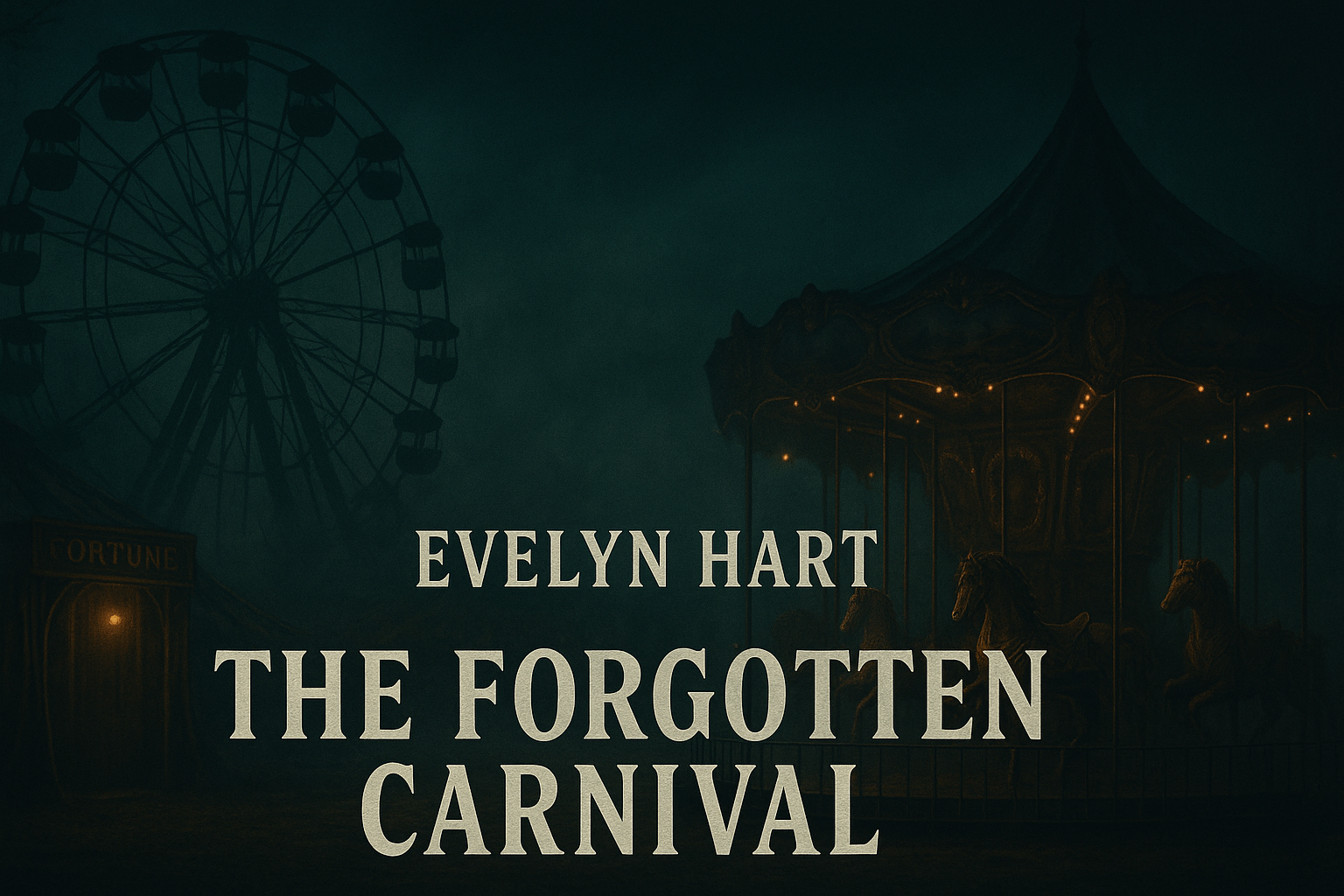

Evelyn Hart
Part 1 – The Road Into the Woods
The forest road narrowed like a throat as they drove deeper into it, the canopy closing overhead until sunlight became a dim green wash, a trickle of light spilling between branches that seemed too eager to entwine. The rental car rattled over roots breaking through the old asphalt, and every so often the trees opened to reveal brief glimpses of moss-slick boulders or dry creekbeds that wound like scars across the earth. In the backseat, Priya leaned forward between the front seats, her voice sharp with that mix of excitement and irritation she always carried on road trips.
“I told you,” she said, her dark braid falling over her shoulder, “Google Maps doesn’t even mark this road. It’s not on any GPS.”
Jack, at the wheel, shrugged, his knuckles pale on the steering wheel. He was the kind who pretended not to care but drove with the clenched concentration of someone expecting an accident. “Then maybe it’s just a shortcut. Look—we’ll reconnect with the highway.”
Beside him, Amelia pressed her palm against the window, her breath fogging the glass. She was quiet, always quiet, the sort who listened longer than anyone was comfortable with. “Doesn’t feel like a shortcut,” she murmured.
The fourth passenger, Lucas, slouched in the back beside Priya, scrolling through his phone even though the signal bars had vanished twenty minutes ago. “No service,” he muttered. “Figures. You drag me into a forest and now I can’t even check the game scores. What year is this?”
Priya snorted. “Maybe if you looked up from your phone once in a while you’d notice how creepy this place is.”
The argument was familiar, worn smooth by years of friendship, but beneath it there was a restlessness none of them wanted to name. They were supposed to be heading for a weekend lakehouse, rented cheap, a place to celebrate finishing their last college exams before scattering into jobs and cities. But Jack had taken a wrong turn, or maybe followed a sign that no longer existed, and now they were here: a narrowing road through trees that seemed older than memory.
The car jolted suddenly. They all lurched. Jack cursed under his breath, braking hard. Ahead the road was blocked by a fallen log, thick with moss.
“End of the line,” Lucas said with exaggerated cheer, pocketing his useless phone.
They climbed out. The air was cooler than expected, damp, as though the forest sweated even without rain. A hush hung around them—not silence, exactly, but the muffled hush of sound absorbed. No birdsong. No insects. Even their voices seemed dulled.
And then they heard it.
A faint sound at first, so soft Amelia thought she had imagined it: a distant music, carried thin as smoke. A carousel tune, the kind children once sang along to—bright, tinny notes that should have belonged to laughter and sugared air.
Priya’s head tilted. “Do you hear that?”
Jack frowned, his face paling though he tried to hide it. “Maybe it’s a radio. Some house nearby.”
“There are no houses here,” Amelia whispered.
The music floated again, clearer now, curling through the trees, pulling at them like invisible thread.
Lucas grinned, though uneasily. “Okay, that’s…weird. But kind of cool. Haunted carnival vibes. Let’s check it out.”
No one moved for a moment. The forest pressed close, the scent of damp earth and rotting leaves clinging to their lungs. Then, one by one, they began to follow the music.
The path they took was not a path at all—more a corridor of trees that bent aside as if inviting them. Branches arched overhead, forming a tunnel where the light dimmed to twilight. The music grew louder, sometimes fading, sometimes swelling, as though the forest itself inhaled and exhaled it.
Priya walked fast, her sneakers crunching dry leaves. “It’s probably some abandoned fairground. Think of the photos we’ll get. Creepy Instagram gold.”
“Or tetanus,” Lucas muttered. “Rusty nails, broken rides. Perfect.”
But when they emerged at last from the tunnel of trees, their words shrank into silence.
The clearing opened wide and sudden, a wound in the forest. There, sprawling across the moss and grass, stood a carnival.
Or what remained of one.
Rust-stained rides crouched like skeletons: the frame of a Ferris wheel, towering and skeletal, its seats dangling, swaying in a wind none of them felt. A carousel hunched in the shadows, its horses frozen mid-gallop, chipped paint flaking to reveal wood scarred like flesh. Game stalls lined one crooked row, their striped awnings faded to ghosts of red and white. A ticket booth leaned at the entrance, its glass shattered, but even so a faint bulb glowed within, pulsing with weak yellow light.
And the music—they saw now it came from nowhere and everywhere, an invisible orchestra piping that same carousel tune.
Amelia clutched Jack’s arm. “It shouldn’t be working,” she whispered. “There’s no power. Look—no wires, no generators.”
The Ferris wheel creaked. Slowly, impossibly, it turned.
One rotation. Another. The sound of grinding metal mingled with the music, a harmony of rust and song.
Lucas laughed, too loud. “Well. Congratulations, gang—we found a horror movie set. Who wants popcorn?” But his voice shook, and when he shoved his hands into his jacket pockets, they trembled.
The ticket booth light flickered. For an instant, they thought they saw movement inside—just a shape, hunched and waiting. Then the glow dimmed, leaving only their reflection in the cracked glass.
Jack exhaled. “We should go back. This is—this is not safe.”
Priya shot him a look, half defiance, half fear. “Don’t tell me you’re scared. It’s just abandoned rides.”
“It’s not abandoned,” Amelia said, her voice almost breaking. “It’s waiting.”
The others looked at her, uneasy, but she only hugged herself tighter.
The music shifted, a ripple through the tune, almost like laughter. And with a groan, the carnival gates—iron bars bent into shapes of grinning clowns—swung open as if on cue.
No one had touched them.
Priya’s eyes gleamed. “See? An invitation.”
Lucas forced a grin. “Ladies and gentlemen, step right up.”
But Jack lingered, staring at the dark curve of the Ferris wheel against the trees, the impossible way it moved without wind, without power. He felt, with a certainty he could not explain, that something had been watching their arrival, and now, at last, it smiled.
The music swelled, louder, more insistent. The carnival breathed. And the four of them stepped forward, past the open gates, into the forgotten carnival.
Part 2 – The Gates Open
The gates closed behind them with a clang that echoed longer than any sound should, the metal shriek rolling out into the trees like the scream of something alive. All four froze, turning in unison. The iron bars loomed, locked, though none of them had touched them.
“Okay, that’s…” Lucas swallowed, running a hand through his hair. “That’s new.”
Priya pressed at the gate. It didn’t budge. The bars were cold, colder than metal should be in spring air, so cold they burned her palms. “It’s rusted shut,” she lied, though in truth she knew the hinges had moved smoothly a moment ago.
Amelia backed away, her gaze darting around the fairground. “It wants us here.”
Jack put a hand on her shoulder. “Don’t start with that. It’s just…old iron. We’ll find another way out. Just—don’t panic.” His voice was steady, but his eyes never left the Ferris wheel. It turned, slow and groaning, each rotation deliberate, like a predator circling.
The music drifted through the grounds, no longer faint but sharp, piping and sweet, too sweet, the kind of melody that left an aftertaste. They walked, hesitant, past the ticket booth. Its glass window was cracked like a spiderweb, and for an instant Amelia thought she saw a face pressed against it—chalk-white, eyes hollow. But when she blinked, the booth was empty, the bulb flickering.
Then a voice rasped from the shadows within.
“Tickets, please.”
They jolted, every head turning. The booth window slid open with a screech. Behind the glass, a figure sat hunched, too still, its uniform striped red and white though the colors had long since faded. The head was tilted down, the brim of a cap shadowing the face.
Jack stepped forward despite every instinct screaming no. “We…we don’t have tickets.”
The figure’s head lifted slowly. Beneath the brim was not a face but a painted mask, a carnival smile frozen in cracked porcelain. The mouth moved, though the painted lips never shifted.
“Everyone must play.”
The words rasped like wind through dry leaves. A strip of paper slid out beneath the glass. Four tickets, yellowed, edges curled. One for each of them.
No one reached for them. The tickets fluttered anyway, lifting in an unseen draft, floating into their hands.
Amelia dropped hers instantly, but the ticket clung to her palm like static, burning cold. Priya laughed nervously. “Okay, that’s…that’s actually kind of cool. Some kind of trick.”
Lucas stared at his. Printed on the paper, in faded ink, was a single word: ENTRY. Beneath it, in smaller script, a phrase that made his throat close—No Exits. No Refunds.
“Okay,” he said tightly, shoving it in his pocket. “We’ve humored the creep in the booth. Can we leave now?”
But when they turned back, the gates were no longer gates. The iron arch still stood, the clown faces still grinning—but beyond was not the forest. Only more carnival stretched into darkness, rides and stalls looping into a horizon that made no sense.
Priya let out a low whistle. “Now that’s impossible.”
Jack’s jaw tightened. “It’s a trick. Has to be. An old fairground, mirrors, tunnels…” His words died as he realized how thin they sounded.
They followed the midway. The air smelled faintly of sugar, but under it was another stench—damp wood, something spoiled. Stalls lined either side: ring toss games with bottles that seemed to tremble, balloon darts where balloons pulsed faintly as if they were lungs.
Amelia kept her arms wrapped tight around herself, whispering under her breath. She didn’t realize the others heard: “It’s feeding on us. It knows we’re afraid.”
Priya forced a laugh, her defiance brittle. “Afraid? Please. It’s just a rundown amusement park. Look—no one’s even here.”
And then a carousel horse whinnied.
It was a dry, splintering sound, wood grinding on wood, but it carried the shape of a neigh. The horse’s head jerked, its painted eyes rolling. The carousel began to turn.
The friends stumbled back as lights flared to life above them, bulbs popping one by one along the ride’s crown. The horses, chipped and cracked, began to move, their frozen legs straining against the poles. The music shifted to match their rhythm—no longer the bright tune but something lower, warped.
“Don’t,” Amelia said sharply. Her voice was not a whisper now. “Don’t get closer.”
But Priya was already stepping forward, her ticket glowing faintly in her hand. “Maybe this is how we get out,” she said. “Maybe we’re supposed to ride. That’s what carnivals are for.”
Jack caught her arm. “No. This isn’t—”
The voice cut him off. It came from everywhere at once, low and guttural, the sound of a showman announcing from beneath the earth itself.
“Step right up. The carnival awaits. Everyone must play.”
The carousel spun faster. The Ferris wheel creaked. Stalls lit with sudden bursts of light, each one calling them, pulling them deeper.
Lucas’s ticket seared against his chest like a brand. He tore it out, tried to rip it. The paper didn’t tear. It pulsed instead, like flesh, and the words shimmered: Round One.
The carnival had chosen.
And none of them could turn back.
Part 3 – The Ferris Wheel of Shadows
The midway funneled them forward until the Ferris wheel rose above them like a rusting moon, its spokes groaning against the night sky. Though no stars were visible, the wheel itself gleamed faintly, as if the sky bent its dim light toward the ride. Its seats rocked gently, suspended, though no wind stirred.
Amelia stopped short, her breath catching. “It’s watching us.”
The others followed her gaze. The wheel had forty seats, each a metal cage flaked with paint, each empty. But as they stared, shadows rippled across the cabins, dark stains stretching like figures seated, waiting.
Jack cursed under his breath. “We’re not going near that thing.”
But Lucas’s ticket pulsed again, hotter now, and when he pulled it from his pocket, the words had changed. Round One: The Wheel. His face blanched, sweat beading at his temple. “It’s…calling me.”
The Ferris wheel groaned. One cabin descended slowly, stopping at ground level, its door swinging open with a squeal that echoed across the empty fair.
Priya tried to joke, but her voice cracked. “Congratulations, Lucas. You won the grand prize. A tetanus shot.”
Lucas’s laughter came out brittle. “Better than standing here while this thing breathes down my neck.” He forced himself forward, though his legs felt wooden. He stepped into the cabin. The metal slammed shut behind him.
The wheel shuddered and rose, carrying him upward.
From below, the others watched, helpless, as the ride jerked into motion, the cabins clattering. The music twisted into a slower tempo, a dirge masquerading as a carnival tune.
Inside the cabin, Lucas gripped the bars, his stomach lurching as the ground dropped away. He tried to call out, but his voice was swallowed by the grinding metal. Then the air shifted, thickening like smoke.
The seat across from him was no longer empty.
A figure sat there—himself. Same clothes, same face, but pale, hollow-eyed. The double leaned forward, its grin too wide.
“You think jokes will save you?” it hissed, though the lips barely moved. “You mock everything. Sports, friends, even yourself. But you know what you really are?”
Lucas shook his head violently, squeezing his eyes shut. “Not listening. Not real.”
The cabin jolted, rattling. He opened his eyes again. Now there were two doubles. One whispered, “Coward.” The other spat, “Parasite.” Their voices merged, growing louder until the sound drilled into his skull.
Below, Priya and Jack shouted his name, their voices muffled as though heard through water. Amelia only stared, her nails biting her palms. “It’s showing him himself,” she whispered. “That’s how it feeds.”
The wheel carried Lucas higher. With each turn, more figures filled the cabin—versions of him, distorted. One was childlike, sobbing into his hands. Another was older, gaunt, eyes bloodshot. Another laughed hysterically, banging his fists on the bars.
They crowded him, pressed against him, hissing his failures: the girlfriend he’d abandoned without explanation, the exams he’d cheated on, the brother he hadn’t spoken to in two years. Every voice was his own.
The cabin darkened, the only light coming from their glowing eyes.
Lucas screamed, clawing at the bars, desperate for air. “Make it stop! Please, make it stop!”
The Ferris wheel groaned, slowing. The cabin descended, jerking violently before thudding to the ground. The door swung open.
The others rushed forward. Lucas stumbled out, collapsing on the dirt. His eyes were bloodshot, his face wet with tears he didn’t remember shedding. He clutched his ticket. The word ENTRY had changed again: Survived.
Priya knelt, grabbing his shoulders. “What happened? What did you see?”
Lucas’s laugh was broken. “Me. Just me. Too much of me.”
Jack helped him to his feet, but his eyes kept flicking to the wheel. The shadows still sat in the other cabins, waiting, though now one seat was empty—the one Lucas had taken.
The wheel slowed to a stop. Silence settled, thick and heavy. Then, without warning, the ticket booth voice echoed again, deeper, crueler.
“Next.”
The midway lights flared. Beyond the Ferris wheel, the Hall of Mirrors glowed faintly, its glass mouths shimmering in the dark.
Amelia’s ticket pulsed in her hand.
She didn’t look at it. She already knew.
Part 4 – The Hall of Mirrors
The midway narrowed, drawing them toward the crooked tent at its end. Its sign swung overhead, the letters barely clinging to rusted hooks: Hall of Mirrors. The paint had long peeled, but the glass panels on either side gleamed unnaturally, catching what little light the carnival offered.
Amelia’s ticket glowed in her palm, each pulse tightening her chest. She wanted to drop it, fling it away into the dirt, but it clung to her skin as though it had grown there.
“No,” Jack muttered, gripping her wrist. “Not you. We’re not doing this again.”
The voice came instantly, the same showman’s rasp that had haunted them at the Ferris wheel.
“Everyone must play.”
The mirrors hummed, a vibration they could feel in their teeth.
Amelia’s lips trembled. She’d been silent most of the night, holding her dread close, but now words pushed through. “It knows me. It knows what I’m afraid of.”
Priya tried for levity, though her voice wavered. “What, mirrors? Please. You’re gorgeous, babe. Even your reflection is jealous.”
But Amelia shook her head, her eyes wide. “Not my reflection. The parts of me I don’t show anyone. The parts I can’t escape.”
The tent flap stirred, though no wind moved. The entrance yawned black.
Lucas touched her shoulder, still pale from his own trial. “If you don’t go in, it’ll only get worse. Trust me. The longer you wait, the louder it gets.”
She stepped forward. The others followed, but the instant Amelia crossed the threshold, the canvas walls rippled and closed behind her like water. She was alone.
Inside, silence reigned.
Rows of mirrors stretched into infinity, taller than any she’d seen before. They bent at odd angles, warped, catching her reflection in fragments—an arm here, a face there. With each step, more Amelias multiplied, their gazes turning toward her in perfect unison.
Her breath fogged the glass. She pressed her hand against one pane. The reflection pressed back, palm to palm. But then the reflected lips curved into a smile.
Amelia’s hand dropped. The reflection’s did not. It stayed, palm flat, grinning wider.
She spun. The mirrors behind her rippled. More versions of herself stared—some weeping silently, some bleeding from eyes that weren’t hers, some laughing with mouths stretched too wide.
Her throat constricted. “You’re not me.”
One stepped forward from the glass. The surface did not break. It simply allowed passage, like air made solid. The other Amelia stood there, identical but sharper somehow, her eyes crueler.
“Oh, but I am,” it said. The voice was hers, only lower, steadier, certain. “I am the you who doesn’t bite her tongue. The you who doesn’t cower behind silence.”
Amelia stumbled back. Another figure stepped through. This one’s smile was tender, too tender, pitying. “I am the you who forgives everything, even when you shouldn’t. Do you know how pathetic that makes you?”
More followed, spilling into the maze. They crowded her, circling, a chorus of selves she had never wanted to meet.
“You’re weak.”
“You’re useless.”
“You’re invisible.”
The words pounded against her skull, echoing in the chamber. She dropped to her knees, hands over her ears, but the voices were inside her head, seeping through bone.
One reflection knelt with her, tilting her chin up. Its eyes burned with fury. “Let me out. Let me live instead. You don’t deserve this body.”
The mirrors around them shimmered, the glass thinning. She saw herself multiplied a hundredfold, each face leaning forward, mouths opening. They all spoke at once.
“Trade places.”
Amelia’s chest tightened. She wanted nothing more than to vanish, to hand herself over, to let someone stronger take the burden. But deep beneath the terror, another voice rose—quieter, shakier, but hers.
“No.”
The reflection snarled. “You can’t fight us. We are you.”
Amelia’s hands shook, but she forced them flat against the cold earth. “You’re pieces of me. But I’m whole. I don’t need you to live for me.”
The reflections screamed in unison, the sound shattering glass. Mirrors cracked, splintering into spiderweb fractures. The doubles clawed at the air, faces twisting, but their edges blurred, their bodies dissolving into silver dust. One by one, they vanished into shards.
When silence returned, Amelia was alone. Only one mirror remained unbroken, showing her single reflection—pale, trembling, but hers.
Her ticket fell into her hand, glowing faintly. The word had changed: Survived.
She staggered out of the tent. The canvas parted and the others rushed to meet her, relief carved into their faces. Jack caught her, steadying her, though his own hand trembled.
Priya whispered, “What did you see?”
Amelia didn’t answer. She only stared at the broken mirrors behind her, hearing faint echoes of her own voice laughing in the dark.
The carnival lights dimmed, then flared again. The carousel horses stirred, their chipped mouths stretching open in silent neighs.
Lucas groaned, clutching his stomach. “Oh God. It’s not done, is it?”
The showman’s voice rolled across the fairground, smoother now, almost amused.
“Round Two. Step right up.”
And the carousel began to spin.
Part 5 – The Game Stalls
The carousel spun as if it had found a pulse, light stuttering along its crown, horses tossing their splintered heads. But the tickets in their hands burned with a different heat, tugging them sideways, drawing them not to the circle of painted horses but to the crooked line of midway games where striped awnings sagged like tired eyelids and prizes hung in rows—glass fishbowls, stuffed bears with split seams, tin soldiers with rust-bitten smiles. The air tasted of stale sugar and old breath.
“Round Two,” the showman intoned, everywhere and nowhere at once. “Win three prizes. Win back your way.”
Priya’s name smoked up from her ticket as if seared by an invisible brand. She tried to rub it away; the letters only sank deeper.
Jack stepped instinctively in front of her. “Pick me instead.”
The ring toss bottles rattled as though in laughter. The balloon-dart board burped a soft rubbery sigh. From the shooting gallery, a row of metal ducks clacked their beaks, and every beak said the same word in the same voice: “No.”
Amelia’s fingers slipped into Priya’s. “We’re here. Whatever it is, we’re here.”
Priya nodded, though the movement felt like a lie. She had always been the one who ran toward spectacle, toward the lens, toward the bright cut of a story that would earn her the most attention. But the carnival smelled the difference between wanting eyes and wanting escape. It swung its prizes like bait.
“Step right up.” The barker’s voice acquired a grin. “One chance at the ring. One at the dart. One at the shot. Hit your mark, darling. Hit what you love.”
Priya moved to the ring toss first because it looked the kindest: a plywood board studded with bottle necks in a grid, each ring a loop of polished wood. It was almost innocent. The attendant, if it could be called that, was a mannequin in a striped vest, its painted pupils set too close together. Its jaw clicked open and shut without sound, a metronome for dread.
“Best of three?” Priya tried to joke. Her voice came out thin.
“Best of one,” said the row of bottles, their mouths all whistling the words in a glassy hiss.
She picked up a ring. The wood felt warm—as if held recently in human hands—and heavier than it looked. On the far end of the board, one bottle glowed faintly. It wasn’t glass after all, she realized. It was a small, delicate bangle, the kind her grandmother had worn, the kind Priya had loved to slip over chubby wrists as a child, the kind that jingled like rain. The neck was a circle of gold, hairline crack down one side, like the one that had shattered in their kitchen the morning of her grandmother’s stroke. Priya’s breath snagged.
“No,” she whispered to nobody and to everything. “No, choose another.”
But the other necks dissolved into dull shapes. Only the gold bangle gleamed, waiting.
Lucas saw her go rigid. “What is it?”
“My nanu’s,” she said, and hated the way her voice shrank on the word. “It broke. I kept the pieces in a box for years. I—”
“Throw,” the bottles chimed.
She could miss on purpose, she thought. She could hurl the ring wild, let it clatter to the ground. The carnival would laugh, would punish her, would tilt the game so the others paid the price. That was how these things worked. Choose, or be chosen.
She closed her eyes. The weight of the ring in her hands became a memory: the weight of her phone the night she’d filmed a stranger crying in a subway car because the way the light carved the tears would make a perfect clip. The way she’d posted it with a caption that pretended empathy and watched the numbers climb. The next morning she’d deleted it, shame sick and sticky in her stomach, but the climb had been real. The game had always rewarded hits.
Priya opened her eyes and exhaled. “I’m not playing your way.”
She turned the ring in her fingers until the smooth edge found her skin. Then she pressed, hard, harder, until a thin line of blood lifted. She smeared the blood along the wood, a raw red seam. Jack started forward; Amelia caught his sleeve. Lucas’s mouth opened, then shut. Priya aimed—not at the bangle, but at the space just before it, a kiss of air, the tiniest refusal.
She threw.
The ring arced and slowed as if trying to decide who she was. When it reached the bangle’s neck it didn’t drop, and it didn’t catch. It hovered, trembling, then settled around the empty air beside the gold and hung there, impossibly suspended, a halo for something not quite here.
The mannequin’s jaw stopped clicking. For a second the midway held its breath. The barker’s voice thinned with annoyance. “A technicality is not a triumph.”
“My rules,” Priya said, surprising herself. “You said hit your mark. I did.”
Something like a sigh rippled through the row. The bangle darkened, tarnish spreading like night. It flaked into ash and drifted down in a glittering rain, and when it touched the dirt it rang—just once, a bell at a funeral. In its place, a small prize rattled down a chute: a cracked glass marble with a swirl of milk-white inside. Priya reached for it; the glass was warm. For an instant she saw her grandmother’s hand flick light across the floor with a dozen such marbles and call her by her pet name. Then the warmth faded. The marble went dull.
“Prize one,” the carnival said. “Next.”
The balloon-dart stand reeked of rubber and breath. Balloons crowded the board in swollen clusters—pearl, rose, smoke-gray. Each balloon contained a shape: a photograph curled within the latex, a paper toy boat, a pressed hibiscus petal, a child’s drawing of a house in trembling crayon. Overhead hung a sign: POP TO PROVE YOU REMEMBER.
Priya’s chest tightened. “I won’t break them.”
“Then they will break you.” The attendant at this stall was no mannequin; it was a boy about eight, hair slicked to a side part, eyes too steady. His skin had the waxy sheen of preserved fruit. He held out a dart. “You’re late,” he told her, not unkindly. “You always are.”
“What happens if I don’t throw?”
He considered. A balloon at the edge of the board—transparent, almost invisible—throbbed faster, and she saw within it a miniature of the four of them, cardboard cut-outs on a cardboard road into paper trees. A pinprick grew above their heads, the promise of a sudden pop.
Priya took the dart.
Between the balloons, a single one pulsed with soft gold. Inside, a tiny video played: her younger brother on an ancient phone screen, cheeks still round with baby fat, sleeping in the back seat of their father’s car. She’d snapped that clip the night of the accident, just hours before twisted metal and a hospital corridor and air that smelled like burnt sugar and bleach. Her brother had lived. Their father had not.
Priya felt the board lean toward her, offering up the past like a throat.
She raised the dart, then lowered it. “You want the little deaths. You never ask anyone to fix anything.”
The boy’s face made a small shape of curiosity. “Fix?”
Priya stepped to the side, into the negative space between clusters where no balloon had been placed because no memory had room to float there. She lifted her empty hand and pinched the air. “Here,” she said. “Hold this for me.”
Nothing answered. The game did not know what to do with a thing that was not a thing. She grinned, a fierce, exhausted baring of teeth, and drove the dart into her own thumb instead.
Pain lanced bright. A drop of blood swelled. She pressed her thumb against the gold balloon—not to pop but to mark. The latex drank the red and went still, as if a heart had decided to rest. The balloon released its video into her palm: a smooth, warm oval of plastic, cheap and precious, the exact shape of her old phone battery. It lay in her skin like a coin.
The boy blinked. “Prize two,” he said, puzzled into softness. He took a step back, and when he smiled his teeth were too many.
The shooting gallery waited last: a counter lined with pellet rifles, targets shaped like ducks, stars, wolves, hearts. The air jingled with tin. A row of prize shelves behind the targets sagged under the weight of giant plush animals, sequin pillows, a glass case of knives that winked with mean light. The attendant here was only a pair of gloves floating above the counter, fingers drumming.
“Three shots,” said the gloves. “But really only one matters.”
Priya lifted a rifle. Its barrel was slick, not with oil but with something that smelled like the underside of a bandage. Through the sights, the world sharpened to a ring. Targets wobbled into the circle, then out: a star. A wolf. A heart.
The heart drifted past again. In its tin face was stamped a single word: MOTHER.
“Don’t,” Jack whispered.
Priya’s hands steadied, and with the steadiness came fury that felt like grace. “You want me to pick you,” she told the carnival, not bothering to lower her voice. “You want me to choose the bright target and live with it forever. But I don’t choose this way any more.”
She shifted the sights until the heart receded, until the row of tin was no longer the only field. Beyond the targets, off to the left, a thin chain held the entire spinning row together, a cheap skeleton for an expensive illusion. The carnival hummed in warning. Priya exhaled. She squeezed the trigger.
The pellet snapped the chain. The targets stuttered, lurched, and clattered into stillness. Somewhere, deep inside the machinery, something coughed and died.
Silence rolled across the midway, astonished, almost childlike. Then the shelves behind the counter tipped and spilled a rain of prizes at her feet: a battered teddy missing an eye, a strand of faux pearls that felt like baby teeth, a paper crown with sweat stains, a snow globe cloudy with age. One object did not fall. It floated. It was a small brass key, simple, old, engraved with a whorl that matched the ridges of her thumb.
Priya reached for it. It fit her hand as if made there.
“Prize three,” the barker muttered at last, forced to witness a game misplayed into victory. “Round Two…concluded.”
Priya’s ticket cooled. The word Survived bled up through the paper. She turned, legs unsteady, and found Amelia’s arms, found Lucas’s tired grin, found Jack’s gaze trying to say everything at once—pride and fear and a question she could not yet answer.
The light along the midway guttered. The carousel, which had spun and spun, shuddered to a halt as if some invisible rider had finally dismounted. At the far end of the grounds a striped tent lifted its own lid of canvas and exhaled a swell of dust that glittered like ground-up bones. A figure’s silhouette moved behind the fabric, jerky, graceful, arms lifted as if to pull stars on strings.
“Round Three,” purred the voice, entertained again. “Ladies and gentlemen, the Puppet Master will see you now.”
From the mouth of the tent drifted thin cords of black silk, searching the air like feelers. One brushed Priya’s wrist. It recoiled from the brass key in her fist and hissed.
Jack stepped forward, jaw set. “Then we cut the strings,” he said.
Somewhere behind the canvas, as if in answer, the strings multiplied.
Part 6 – The Puppet Master’s Tent
The tent loomed like a hunched beast, stripes sagging, corners tethered with stakes sunk too deep into the earth. The midway lights sputtered as if afraid of what was inside. Black silk cords spilled from the entrance, dragging across dirt, twitching like veins searching for a pulse.
Jack felt his ticket hum before he even looked at it. When he finally unfolded the paper, his name curled up from the parchment in smoky letters. Round Three: The Puppet Master.
Priya gripped his arm, eyes still wide from her own ordeal. “Don’t go in there.”
“I have to,” Jack said quietly. His voice was the low steady sound they all trusted, but inside his chest something bucked against the bars. “If I don’t, it’ll just come for one of you.”
Amelia’s lips parted, but the cords lashed at the ground between them, hissing like whips. The carnival had made its choice.
Jack stepped through.
Inside the tent, the air was thick with dust and something sweeter—the smell of varnish, of wood that had been polished a hundred times by hands that no longer existed. A small stage rose at the center, curtains moth-eaten but drawn as if ready for performance.
Above the stage dangled a forest of marionettes. Hundreds of them, perhaps thousands, each suspended by strings that disappeared into blackness overhead. Some were carved like clowns, some like soldiers, some like children with too-wide eyes. Their painted faces turned as one toward Jack.
Then, slowly, they began to dance.
The music rose from nowhere, a thin piping waltz. The puppets jerked and swayed, their limbs clacking together. The sound filled the tent with hollow applause.
Jack’s throat tightened. He hated puppets. Always had. The way strings dictated every twitch, the way something unseen controlled what you thought you saw. He had told no one, not even Priya. Childhood fear, long buried. But the carnival had found it, dug it up like a bone.
A figure emerged from behind the curtain. Taller than any man, but crooked, its limbs jointed like wood, its face a blank oval mask. From its hands trailed a fan of strings, each one glistening as if wet.
The Puppet Master tilted its head, and Jack’s arms rose without his consent. Strings had already found him, slick cords sliding down his shoulders, wrists, ankles. He fought, but his own body betrayed him, knees locking, jaw clenching.
“Dance,” whispered the Puppet Master. Its voice was not sound but vibration through the strings.
Jack staggered forward. His legs lifted, jerked, moved to the rhythm not his own. The puppets on stage mirrored him, dozens of soldiers marching in sync.
“No,” he grunted, every muscle straining. He tried to lower his arms, to drop to the ground, but the strings tightened until his joints burned. His mouth opened against his will, words spilling: “I am nothing without orders. I am a hollow thing.”
The words sliced through him. They weren’t his. They were every command he had followed, every time he’d bowed to expectation instead of choosing. His father’s voice telling him to play safe. His professors’ demands to take the secure path. His friends’ reliance on him to drive, to decide, to protect. Strings, all of them.
The Puppet Master yanked, and Jack’s body convulsed into a bow.
On the stage, a marionette soldier cracked in half, spilling sawdust like blood. The others clattered, collapsing in a chain reaction. Their wooden heads turned toward Jack, painted eyes gleaming. “We are you,” they whispered.
Jack’s vision blurred. His ticket burned in his pocket, the word Plaything pulsing through the paper.
“No,” he gasped, teeth grinding. “Not anymore.”
The brass key in Priya’s hand flared outside the tent, and Jack felt its heat echo faintly. With the last of his strength, he reached for the pocket where his ticket smoldered. The strings fought, pulling his arms away, but he clenched his hand over the paper, crushing it.
The ticket didn’t tear. It ignited, blue flame licking up his wrist. The fire didn’t burn flesh—it burned strings. One by one, the cords shriveled, curling into ash.
The Puppet Master shrieked, the mask on its face cracking down the middle. It staggered back as marionettes dropped from above, their strings severed, bodies limp.
Jack dropped to his knees, free. His lungs heaved. His skin smoked where the cords had touched, faint lines like scars of choices made by someone else.
The Puppet Master collapsed, mask shattering into shards that clinked like glass. From its chest rolled a prize: a small wooden soldier, no taller than a finger, its limbs jointed but free of strings.
Jack picked it up. The tiny figure saluted once, then went still. His ticket cooled, the word shifting to Survived.
When he staggered back outside, the others caught him. Priya wrapped her arms around him; Lucas clapped his back hard, shaky with relief; Amelia’s eyes brimmed with a quiet pride she didn’t voice.
Overhead, the carnival’s lights blazed, brighter than ever. The Ferris wheel turned. The carousel shrieked. The stalls rattled.
The showman’s voice oozed through every crack of the fair.
“Three rounds. Three prizes. Three survivors.”
The ground shivered. The carnival trembled as if pleased. Then, slowly, a curtain at the far edge of the grounds parted. Behind it sat a small, crooked caravan painted black, its door glowing faint red.
From within came the scent of smoke and old incense.
“The Fortune Teller,” the voice crooned. “She is waiting. And she knows how this ends.”
Amelia shuddered. Her ticket pulsed again.
Part 7 – The Haunted Carousel
The carousel had been spinning in the distance ever since they’d entered the carnival, a slow, grinding loop of painted horses frozen mid-gallop. Now, as if it had been waiting, the music shifted into a shrill organ dirge, and the ride lurched to a stop. Its chipped bulbs flared awake. The horses turned their heads toward the four friends, wooden eyes gleaming, cracked mouths stretching into sneers.
Amelia’s ticket smoldered in her fist again, but when she unfolded it, the smoky lettering had changed. Round Four: The Carousel.
“No,” she whispered. “Not me again.”
The carnival answered with a rattling neigh that made every horse snap its teeth in unison.
Lucas shook his head violently. “Take me. She’s been through mirrors already—”
But the horses jerked against their poles, and one lowered itself to the ground, its saddle splitting open like a hungry jaw. The ride had chosen.
Amelia trembled, but she stepped forward anyway. “If I don’t go, it’ll drag us all.” She turned back to Jack, Priya, Lucas—her family more than friends. “Whatever happens, don’t follow me.”
The moment she swung her leg over the horse, the carousel shrieked into motion.
The world blurred into streaks of red and gold. Wind tore through her hair though she felt no breeze. The music warped faster, notes clawing at her ears. She clutched the reins—leather slick with something wet—and realized the horse’s mane was real hair, coarse and knotted.
As the carousel spun, the scenery around her twisted. The midway vanished. Instead, she galloped through a nightmare city where every window reflected her face. Each reflection showed her at different ages: a child crying behind a locked door, a teenager silenced during arguments, a young woman standing mute while others spoke for her.
“Get off!” she screamed, yanking the reins, but the horse only bolted faster.
From the mirrors in the windows, voices thundered back: “You never fight. You never speak. You let life ride you.”
Amelia tried to cover her ears, but her arms were locked around the reins. Tears streamed back against the wind. “I had no choice,” she cried.
The horse reared, and the carousel hurled her into another vision. She was in a hospital hallway, clutching her mother’s sweater while doctors muttered words she didn’t understand. She remembered standing silent, unable to demand answers, unable to scream at the injustice. Her reflection sneered at her from the glossy floor tiles.
“You let her die without a word.”
The carousel whirled again. Now she was back in her college dorm room, sitting mute while friends mocked another girl’s accent. She had stared at her shoes, too afraid to speak up. The shadows of those girls swirled around the carousel now, laughing, their voices high and cruel.
“You’re complicit. You’re nothing. You’re a ghost in your own life.”
Amelia’s chest heaved. Her hands bled where the reins cut into her skin. “Stop it!” she shouted. “Stop telling me what I already know!”
The horse’s painted head snapped back toward her. Its mouth opened wide enough to split its skull, and inside was not wood but a tunnel of black teeth. “Then prove it,” the horse hissed.
The reins flared red-hot. In that heat, Amelia realized: the only way off was not to cling. It was to let go.
Her fingers shook. The carousel bucked violently, trying to throw her before she was ready. Every instinct screamed to hold tighter. But she forced her grip to loosen. She peeled her hands from the reins.
The horse shrieked. The carousel spun so fast the world fractured. Then, abruptly, silence.
Amelia floated. She was no longer on the horse. She was standing on the dirt midway again, gasping, her palms seared but free. The carousel had frozen, every horse bowed low as if acknowledging her.
At her feet lay a prize: a cracked wooden whistle, carved like a bird. She picked it up, and for a moment it sang with her own breath, a sound clear and strong. Her ticket cooled: Survived.
The others rushed to her, relief breaking across their faces. Priya caught her hand; Lucas pulled her into a clumsy hug; Jack stood just behind, eyes bright, nodding as if to say: you spoke at last.
But their reunion was cut short. The ground trembled, heavier now, a pulse that shook every stall and ride. At the far end of the midway, the crooked black caravan yawned open wider. A curl of smoke drifted out, tinged with red firelight.
The showman’s voice lowered into something reverent.
“Four rounds complete. The Fortune Teller will see you now. She has your futures in her cards… and the price of your freedom.”
The music died. The carnival held its breath.
Amelia clutched the whistle to her chest. She already feared she knew what price it meant.
Part 8 – The Fortune Teller’s Warning
The caravan door gaped like a wound stitched in red firelight. Smoke curled out, smelling of scorched incense and something sweeter—burnt sugar mixed with copper. The four friends stood before it, reluctant to cross the threshold, but their tickets pulsed hot, dragging them closer with every heartbeat.
Lucas muttered, “I swear, if some creepy old lady tells me I’m tall, dark, and doomed, I’m walking out.” His laugh was brittle. No one joined him.
The voice of the showman rolled from within, softer now, reverent: “Step inside. The cards are waiting.”
Jack pushed open the door. Hinges groaned like bones grinding. Inside, the caravan was larger than it should have been—long, endless, walls lined with velvet curtains that shimmered as if alive. At the far end sat a woman draped in silks the color of midnight. Her face was hidden behind a veil, but her eyes burned through it, gold and unblinking.
On the table before her lay a deck of cards that shuffled themselves, flipping and cutting with insect precision. The air vibrated with each movement, as though reality bent around the shuffle.
“Sit,” she commanded. Her voice was cracked honey—sweet, brittle, dangerous.
They obeyed, four chairs creaking as they lowered themselves.
The Fortune Teller drew one card and laid it face-up. The Tower. A black spire split by lightning. She tilted her head. “Collapse is already written. You will fall, one by one.”
She drew again. The Lovers. A man and woman joined by strings. She tapped the card. “But not all of you will fall together.”
Priya swallowed hard. “We don’t want your readings. We just want to leave.”
The cards froze mid-air, every edge gleaming like knives. The Fortune Teller leaned closer. “There is no leaving without a bargain.”
Amelia clutched her whistle, her voice trembling but steady. “What kind of bargain?”
The woman’s eyes flickered to Lucas. “One must stay. A soul to keep the lights burning. Only then will the gates open.”
The silence in the caravan was suffocating. Even the smoke seemed to pause.
“No,” Jack said instantly. “We don’t trade each other. That’s not happening.”
The cards resumed their shuffle. The Fortune Teller ignored him, gaze locked on Lucas. “You’ve always feared being the weakest link. The clown. The joke. But here, you can be the savior. One choice, and your friends walk free.”
Lucas’s throat bobbed. “And if I say no?”
The deck fanned out before him, every card a mirror of his own face—smiling, crying, screaming. “Then the carnival eats all of you.”
Amelia’s eyes filled. “Lucas, don’t listen. It’s a trap.”
Priya leaned forward, her voice urgent. “We’ll find another way. We’ve survived every round together. That’s how we win.”
Jack’s jaw clenched. “Lucas. Look at me. You don’t have to prove anything.”
But Lucas’s ticket had already changed. The word Survived bled away, replaced with Chosen. His hands shook as he held it, torn between terror and the tiniest flicker of relief—the relief of finally being important, finally mattering.
The Fortune Teller smiled behind her veil. “One candle must burn for the others to see the road.”
Lucas’s eyes darted to each of them: Jack, steady and furious; Priya, desperate and pleading; Amelia, trembling but strong. And deep inside, where the carnival gnawed, a thought whispered: They’ll be fine without me. Better, even. I’m always the one slowing them down.
His lips parted. “Maybe—”
Amelia slammed her fist on the table, startling even the cards. “Don’t you dare.” Her voice broke but didn’t waver. “We need you. Not some sacrifice, not some excuse. You.”
Lucas’s hand froze on the ticket.
The deck of cards shivered violently, scattering across the table. Every card showed the same image now: the four of them standing at the carnival gates, but in each, one face was scratched out—sometimes Jack’s, sometimes Priya’s, sometimes Amelia’s, often his own.
The Fortune Teller swept them back into a pile with a hiss. “Decide quickly. Dawn approaches, and the carnival does not like to be cheated.”
The tent walls trembled. Outside, rides groaned, hungry.
Lucas sat frozen, sweat dripping down his neck, the weight of the choice crushing him. Betrayal hovered in the air like smoke, waiting for breath to make it real.
Part 9 – The Escape Route
The Fortune Teller let the silence swell until it scraped their throats. Then she gathered the cards with a dry whisper and tapped the table once. The caravan’s back wall sighed open to reveal a slit of night and the faint pulse of red far below the midway, as if the earth itself kept an ember.
“Dawn is for the honest,” she said. “Light the heart, if you can.” Her gaze flicked to Lucas. “Or pay the fare.”
Jack seized the opening. “We’ll earn it.” He stood so fast his chair toppled. Priya and Amelia followed. Lucas lingered half a breath longer, eyes fixed on the deck, where one card had not slid back—face down, small as a secret. When he rose, his hand brushed the table. The card vanished. No one saw where it went.
They stepped out. The door slammed behind them and became only canvas and shadow, as if the caravan were an idea that had already changed its mind.
The midway had shifted while they were inside. Booths had crept closer to the spine of the grounds; rides leaned in, sealing exits with metal ribs and painted teeth. The Ferris wheel’s spokes cut the dark like a clock that had forgotten numbers. Somewhere a calliope breathed in and out, like lungs deciding.
“Heart’s down there,” Priya said, pointing toward a service lane newly exposed, a grit-choked gutter of timber and wire running under the carousel. The brass key in her palm warmed as if agreeing.
They moved fast. Cotton-candy stands exhaled webs that gummed at their shoes. A row of tin ducks waddled from the shooting gallery and snapped at their ankles with clacking bills. Jack’s wooden soldier jolted awake in his pocket, saluted, and leapt to the ground; it charged the ducks with absurd courage, knocking them spinning. The soldier wedged itself under a gear and jammed the mechanism with a heroic, metallic cough. Jack stumbled, weirdly bereft, and then steadied—something loyal had chosen to break for him.
A mouth of a maintenance door yawned under the carousel. It had no lock—only a carved whorl matching the pattern on Priya’s key. She pressed it in; the wood softened like wax, drank the teeth of the key, and the door sagged open on hinges that felt like old bones.
Inside, the air went cold as cellars and tasted of coins. A passage sloped downward between pylons and bundled cable, the world above thrumming faintly like distant thunder. Amelia lifted the small bird-whistle; when she breathed, its note cut straight through the hum, and the flicker of false corridors peeled back. The path narrowed to one true line, thin as a promise.
“Stay close,” she said, and for once her voice carried.
They descended. On the walls, faded stencils showed old safety warnings: NO SMOKING NEAR FUEL, KEEP CLEAR OF DRIVE CHAIN, DO NOT FEED THE FIRE. Beneath the paint, someone had scratched smaller messages: TURN BACK, and below that, scratched over and over until the metal dented—PLEASE.
The tunnel opened into a cavern the size of a church nave, all iron arches and black tanks. In the center stood a dead brazier taller than Jack, a ring of soot tattooed around it on the floor. Pipes fed its mouth from every direction; gauges slept with needles flat in their faces. On the brazier’s lip, a brass plate had been bolted and rebolted so often it looked like scar tissue. In deep enamel letters: HEART OF THE CARNIVAL — NO EXITS. NO REFUNDS.
Amelia cupped the whistle. “We light it, gates open,” she said, making belief out of the way the words felt true.
Jack circled the brazier, hands on cold metal, scanning for ignition. “There should be a pilot line. A feed.” He ducked under, squinting. “Everything’s cut. Someone starved it on purpose.”
Priya slid the battery-coin she’d taken from the balloon board from her pocket. It had stayed warm ever since it left the rubber. She pressed it to a junction box: a spark jumped, mean and blue, and one needle on one gauge twitched, then held. A single artery woke and began a slow, reluctant pulse.
“Breath,” Amelia said, lifting the whistle to the brazier’s mouth. She blew; the note opened the space the way a key opens a throat. Dust shivered. The soot-ring rippled like something listening.
“Blood,” Priya whispered. She glanced at the thin line healed along her thumb from the ring toss. She pressed the cut against the brazier’s rim until the seam softened and drank another drop. The enamel letters steamed for an instant and bled, NO into NOW before the paint set again.
“Courage,” Jack said, softer, laying his empty palm where the wooden soldier would have stood. The metal warmed as if recognizing the shape of a thing that had chosen to break for love.
They had offered breath, blood, courage, spark. The brazier considered. A faint glow budded at its base, then guttered, then returned, stubborn as a coal in rain.
“Come on,” Jack urged. “Take it.”
Behind them, something shuffled. Lucas stood a little apart, head bent, thumb rubbing the edge of his ticket. The word Survived had faded. In its place, in delicate, insistent ink: Chosen. He didn’t remember when it had changed back. He didn’t remember when the extra card had lodged in his sleeve like a wicked splinter. He only knew that since the caravan he’d felt a pressure at the back of his tongue, a word building like a sneeze he didn’t want to sneeze, a naming so simple it would lance all this dread.
The Fortune Teller’s voice slid down the tunnel, sugar in smoke. One candle to light the road.
Lucas swallowed hard. He wanted it to end. He wanted them to be safe. He wanted, just once, to be the one who fixed it. A thought flickered, shameful and logical: Amelia had already survived twice. She was stronger than he was. She would bear it better. It would be—fair.
He didn’t speak the thought out loud. He didn’t have to. The card in his sleeve turned over, face up, without moving. THE CANDLE. The image burned through the cloth, and a wick of black light rose from its painted wax. The brazier’s coal brightened, answering. Thin paper ribbons blew up from the floor—tickets un-latching themselves from the shadows—and streamed toward Amelia’s wrists.
She jerked as the ribbons looped her, confused, then furious. “Lucas?”
He flinched. “I—I didn’t—”
Priya saw the card’s ember licking his sleeve. “What did you do?” Her voice knifed high.
“It said someone has to stay,” he blurted, the words falling wrong even to his own ears. “I thought—just for a while—if it was Amelia, she—she’s—”
“Stronger?” Amelia’s laugh tore itself out, wet and stunned. The ribbons cinched. The brazier’s glow fed on the choice, brightening by a shade that felt like guilt.
Jack moved, all the steadiness gone, anger a clean bolt. He seized Lucas by the front of his jacket and shoved him into a post. The entire room rang. “You don’t decide that,” he said, low and shaking. “You don’t decide us.”
Lucas didn’t fight. He sagged. “I’m sorry,” he said, meaning it so hard it felt like something breaking in his chest. It wasn’t enough. Sorry was a bandage on bone-deep rot.
The tickets tightened on Amelia’s skin, hot as wire. She pulled back, teeth bared. “Cut them,” she hissed through her breath. “Please.”
Priya fumbled the brass key. The whorl at its head had cooled when the Puppet Master fell; now, in her palm, it flared as if hearing a lock speak. She jammed it against the ribbons. They sizzled, recoiled, slithered to grip higher. Jack tore at them; they burned him. Amelia blew the whistle; the note carved a slit in the air through which some of the ribbons slipped and fell limp as snakeskins. Others held.
Above, the carnival felt the fire find its first appetite and roared approval. The Ferris wheel spun. The carousel stamped. In the maintenance tunnel, bolts shivered loose and slid like coins into dark cracks.
“Listen,” Priya said, sudden, urgent. She grabbed Jack’s scorched wrist, thrust the brass key into his palm, and pointed at the brazier’s plate. The enamel letters were no longer strict. With every offering they had given—breath, blood, courage—the slogan’s curls softened, as if language itself might be persuaded. She pressed her thumb, the battery-coin, the old pain of the ring, into the metal words. The O in NO dented. The R in REFUNDS wavered.
“Names are their wires,” she panted. “If it runs on what we call ourselves—coward, puppet, ghost—then we cut the names.”
Jack understood. He pressed the key’s whorl into the O until the circle smudged. Amelia blew again, hard enough to tremble the tanks. The O collapsed into a mouth. The whistle’s pitch changed. The brazier’s glow flexed, hungry, then—confused.
Lucas stared at the word Chosen burning his ticket and hated it, hated the part of him that had reached for it. He yanked the sleeve up and ripped the card free. It clung like a leech. He pressed it against the brazier’s lip, meaning to starve the bargain on the heat of his own shame. The painted wax on THE CANDLE melted; black fire licked his fingers and didn’t burn. For a heartbeat, the ribbons on Amelia slackened.
The carnival hissed—offended. The brazier guttered, then flared higher, greedier. The room shook. Above them, the rides chanted in metal: EVERYONE MUST PLAY.
A gauge needle leapt into the red. A vent snapped. From the pipes poured not fuel but tickets, thousands, a blizzard of paper that tried to mummify the four of them where they stood. Jack and Priya tore, coughed, choked on the taste of old ink. Amelia’s whistle carved them into confetti, but for every ribbon that fell, two more writhed up.
“Enough,” Lucas said. The word came out very small, lost in paper weather. He said it again, louder, to the brazier, to the Fortune Teller’s mouth in the pipes, to himself. “Enough. Take me. Not her.”
The tickets paused, listening. The fire tilted its head.
Lucas climbed the rim. The heat was a language against his skin. In its glow he saw nothing romantic—no saint’s halo, no cinema sacrifice. Only the correct weight of a thing that had to be done because he had already failed to be anything else. He looked at Jack. “Get her out.” He looked at Priya. “Cut the words.” He looked at Amelia. “I’m sorry I almost named you.” He choked on his own breath. “I won’t let that be true.”
“Lucas—don’t you—” Jack lunged. Priya grabbed him, eyes flooding, not with consent but with the understanding that force was a string too. Amelia’s whistle fell silent in her hand. The ribbons around her tensed, feeling the trade in the air.
Lucas held the Chosen ticket like a passport and lifted one leg over the rim. The brazier’s glow swelled, becoming a color that wasn’t a color at all but a hole where color went to die.
Somewhere above, the gates groaned as if remembering a hinge. The carnival shrieked, a thousand gears stripping.
Lucas met the fire’s gaze and stepped forward.
The room exploded into light.
Part 10 – The Carnival That Waits
Light slammed through the chamber, searing white, a furnace roar that sucked every shadow into its throat. Jack shielded his face, teeth gritted. Priya flung an arm across her eyes. Amelia, bound by half-burnt ribbons, could only turn her head and scream his name—“Lucas!”—but her voice was lost in the cyclone.
And then silence.
The brazier glowed steady now, a sun caged in iron. The ribbons that had coiled Amelia turned brittle and flaked away, dissolving to ash mid-air. The tickets that had poured like a blizzard shriveled in the heat, curling to black scraps before vanishing entirely.
Where Lucas had stood, there was nothing. Not a body, not a bone. Only his ticket, charred to lace, drifting down to land on the soot rim. One word remained unburnt. Paid.
Jack staggered forward, chest heaving, as if he could claw him back from the fire. Priya caught him, choking, “He chose it. He chose—” Her words failed; grief thickened her throat.
Amelia pressed the whistle to her lips. A broken note shivered out, thin as mourning. The brazier’s flames bowed as if listening. Then, somewhere above, the carnival itself moaned—a long, reluctant creak.
The ground shuddered. Bolts rained from the ceiling. Gears screamed. Through the tunnel walls came the sound of gates wrenching wide, iron teeth unclenching.
“The way’s open,” Amelia said, hollow. “We can leave.”
But leaving meant climbing past the glowing heart. Leaving meant walking away from where Lucas had stood. None of them wanted to be first.
Jack forced himself up the slope. Each step felt like treason, like abandoning his brother. But when they reached the midway, dawn was already clawing pale light into the trees beyond the gate. The forest was back, wet with mist, as if the carnival had always been a wound sealed over.
The three of them stumbled through. Behind, the gates clanged shut, the clang so final it rattled the marrow in their bones.
They collapsed in the dew-slick grass of the clearing. No music. No lights. Only birdsong tentative in the branches, as if the world itself was testing its voice again.
For a long while, none spoke.
Finally, Priya whispered, “We should tell someone. What happened here.”
Jack shook his head slowly. “Who’d believe us? And if they came looking…” His eyes flicked back toward the trees. “The carnival would wake again.”
Amelia uncurled her hand. In her palm lay the whistle, cracked now down the middle, its bird-shape broken. She closed her fingers around it. “Then we remember. We carry it.”
The sun climbed higher, burning mist to silver. They rose at last, three shadows where there had been four, and made their way back toward the road.
That night, long after they’d found help, long after paramedics and police and parents had wrapped them in blankets and questions, Amelia sat alone in her room. She reached into her jacket pocket for the whistle.
Instead, her fingers touched paper.
She pulled it out slowly.
A ticket. Edges crisp. Ink fresh. Printed across it in ornate script:
Admit One. The Forgotten Carnival.
Beneath, tomorrow’s date.
Her breath stilled.
Outside, across the sleeping neighborhood, faintly—so faintly she almost convinced herself it was imagination—the sound of a calliope drifted through the dark. A carousel tune, tinny and sweet.
And somewhere, a Ferris wheel creaked.