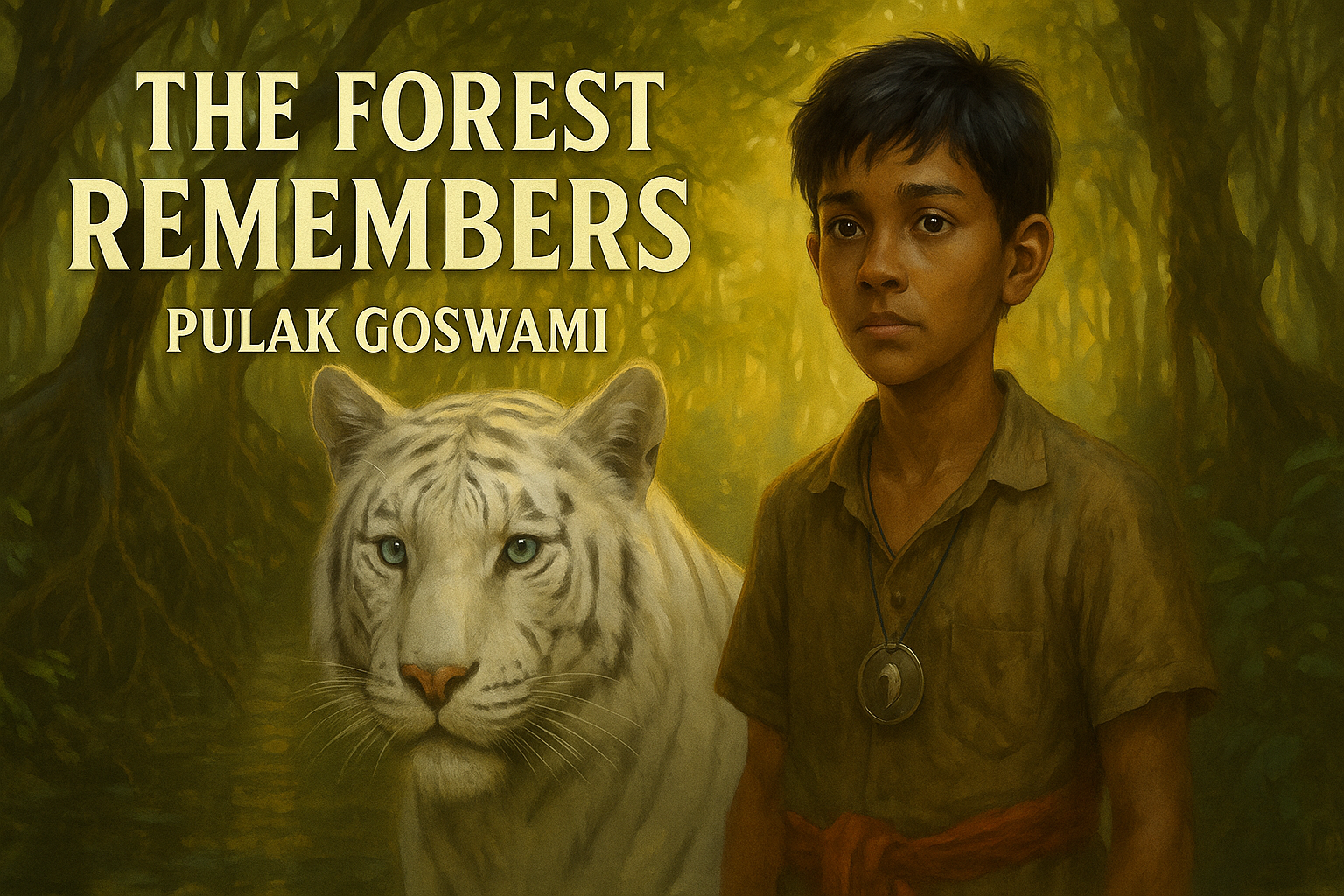

Pulak Goswami
Chapter 1: The Storm That Spoke
The day the storm came, the air in Pranoy’s village crackled with a kind of silence that wasn’t natural. Even the herons had stopped calling from the mangrove trees, and the fishermen had returned earlier than usual, hauling their nets as if fleeing from an unseen predator. Pranoy stood barefoot at the edge of the muddy path that led to the river, watching the clouds gather like ink spilled across the sky. The water in the canals had turned a darker green, and the mangrove leaves whispered secrets to one another in a tongue older than time. His grandmother, Dida, had already begun muttering prayers under her breath, crouching beside the earthen idol in the prayer alcove, oil lamp trembling in her hands. When Pranoy stepped inside, a gust of wind slammed the bamboo door shut behind him. That’s when it began—the thunder, not like the usual rolls across the sky, but like growls, low and echoing, as if some massive beast were pacing above the clouds. The storm came with a scream. Rain lashed the thatched roof like angry whips, and lightning cut the sky into ribbons. The trees bent low, some falling, the mud walls of the kitchen shivering with every blow. Huddled in a corner, Pranoy wrapped himself in his grandfather’s old shawl, eyes wide, heart thumping. It wasn’t the rain that scared him, nor the wind, but the sound he heard—deep, unmistakable. A growl. Long and deliberate. Not far, not even beyond the village, but right outside the door.
At first he thought he was hallucinating, like he had once during a fever. But this was no trick of the mind. There, framed in the flickering light of the single earthen lamp, stood a tiger. Not just any tiger, but a white one—its fur glistening even in the rain, as if lit from within. It didn’t blink. Its silver eyes locked onto his, ancient and calm, unmoving amidst the chaos. Time stopped. The walls of the house seemed to dissolve, and for a few seconds, there was nothing but the storm, the boy, and the tiger. Pranoy didn’t scream. He couldn’t. Something in the animal’s gaze silenced the fear inside him. His breath caught in his throat, and his skin tingled as if the air between them had turned electric. The tiger didn’t snarl or advance. It simply stood there, tail swishing gently, rain matting its fur, eyes burning like twin moons. Then, just as suddenly as it had appeared, the tiger turned and vanished into the dark, swallowed by the wind and rain. Pranoy fainted without a sound, collapsing into the cold mud floor, his hand outstretched toward the doorway, toward something even he couldn’t name. When he awoke, the storm had passed. The house was intact. Dida was asleep beside the idol. But the door was open, and on the earth just beyond the threshold were pawprints—clear, deep, and unmistakably those of a tiger. He touched one with shaking fingers. The mud was still damp.
No one believed him when he spoke of it the next morning. The villagers laughed gently, attributing it to fear, fever, or perhaps a ghostly vision stirred by the gods. Even Dida, though her eyes narrowed at the mention of a white tiger, simply said, “Storms play tricks on lonely hearts, Pranoy.” But he knew. He knew what he saw. That day, the jungle no longer felt like a distant, dangerous place—it felt alive, alert, and watching him. Even the wind that rustled through the Sundari trees seemed to carry whispers now, half-formed words on the edge of thought. Birds no longer startled him; the hoot of an owl felt like a greeting. The silence of the mangroves was no longer empty. Something had changed. That night, he sat by the edge of the canal under a sky studded with stars, listening to the quiet. He dipped his feet in the water and watched the ripples break the reflection of the moon. Somewhere deep in the forest, a tiger growled again—only this time, he wasn’t afraid. It was calling to him. And for the first time in his life, he realized he could almost understand what it said.
Chapter 2: The Claw Pendant
The morning after the storm, the village was cloaked in strange quiet—like the land itself was holding its breath. Mangrove leaves glistened with leftover raindrops, and the muddy paths were scarred with footprints, broken branches, and scattered prayer flags blown in from the temple on the eastern ridge. But none of this mattered to Pranoy, for he couldn’t shake the vision of the white tiger. It wasn’t a dream. He knew. The image burned into his memory like lightning into bark—its silver eyes, its stillness amid chaos, the growl that echoed not just in his ears but deep in his chest. He said nothing to the other boys who passed him on the way to the boatyard. Instead, he wandered aimlessly until the village disappeared behind him, his feet dragging him to the back shed where Dida kept old trunks and broken tools. Dust hung in the air like fog as he pushed open the rusted latch. Something tugged at him—more instinct than thought—and he reached for a faded wooden chest hidden beneath a cracked fishing net. It was one he had seen Dida praying over years ago, but had never dared to touch. With trembling fingers, he opened the lid. Inside were scraps of yellowing fabric, old photographs with ghost-smiles, and at the bottom, wrapped in red cloth—a pendant. It was a tiger’s claw, dark with age, strung on a thread of twisted copper. The moment his skin touched it, the pendant pulsed warm, like a heartbeat. The world tilted.
In a flash that was not quite a vision but not fully memory either, he saw a man in khaki—his father—kneeling beside a massive tiger in the twilight, placing a palm gently on the beast’s head. The image was silent but clear, like a photograph lit from inside. The pendant in the man’s hand shimmered just as it did now in Pranoy’s. Then the forest around the man grew dark, and the image snapped. Pranoy gasped, falling back against the trunk. When he staggered to his feet, the shed felt colder, the light dimmer. He slipped the pendant over his neck and stumbled outside. That evening, he sat silently at dinner while Dida stirred rice porridge and watched him from the corner of her eye. Finally, he whispered, “Baba wore this, didn’t he?” Dida’s hands paused mid-motion. For a long moment, she said nothing. Then, without looking up, she said, “He did. And he left it behind the night he disappeared.” She didn’t scold him for opening the trunk. She didn’t tell him to return the claw. Instead, she only added, “It chooses when to wake.” That night, Pranoy couldn’t sleep. The pendant felt heavier on his chest, as though it was anchoring him to something unseen. Outside, the jungle seemed louder—frogs croaking, insects chirping, and, far away, the unmistakable low rumble of a tiger’s growl. But there was no fear. Only recognition.
The next morning, the villagers gathered near the temple pond, murmuring about the tiger tracks found outside homes and fish markets. No goats or chickens were missing, no humans harmed, yet the prints were too large to ignore. Some wanted to send word to the Forest Office. Others said it was the spirit of the jungle, come to punish them for greed. Pranoy stood at the edge, his fingers clutching the pendant beneath his shirt, a secret warmth humming against his heart. He heard their words, but he wasn’t listening. His ears tuned instead to a distant rustle beyond the reeds. Later, while fetching water near the mangrove edge, he spotted something impossible: a clear tiger print in the shallow mud, and beside it—another, smaller one, just forming in the air as if pressed by an invisible paw. It held for a second before vanishing. Pranoy didn’t run. Instead, he knelt, touched the fading imprint, and whispered, “I see you.” The wind rustled the branches above, and he could swear it sounded like breath—not air, but breath. That evening, back home, he asked Dida, “Was Baba a tiger keeper?” This time, she looked directly at him. Her eyes were tired but fierce. “He was more than that. He was chosen. And now, so are you.” She placed her hand over his, and for the first time, Pranoy didn’t feel like a boy with questions. He felt like a story waking from its sleep, waiting to be told.
Chapter 3: Rakhta of the Deep Forest
The forest had always loomed like a legend beyond the village—too vast, too tangled, too unknowable. Children were warned never to venture beyond the worn trails. It was the land of crocodiles, snakes, mudholes that swallowed you whole, and tigers that watched from shadows. But something had changed in Pranoy. Ever since the storm, the pendant, and the strange half-visions, the Sundarbans no longer felt like a wall. It felt like a door. And something on the other side was calling him. One humid afternoon, while Dida slept after chanting from her old prayer book, Pranoy slipped away. He carried nothing but a small satchel with dry puffed rice and a water gourd. The path he took was not one he had ever seen before—it almost unfolded for him, branches swaying just enough, ground rising slightly to reveal steps only he seemed to notice. The air grew heavier as he moved deeper into the mangroves, the light dimming into a mossy twilight. Everything smelled of salt, mud, and old secrets. Then he felt it—not heard, but felt—a rumble through the earth, like a drumbeat beneath his feet. He froze. Slowly, he turned. There, no more than ten feet away, stood a tiger. Not white this time—this one was massive and gold with deep black stripes, its head broad, its body battle-worn with scars like old rivers across its fur. Its eyes locked onto his, and for a second, Pranoy felt every hair on his body stand on end. He could not move. He could not breathe. But he was not afraid. The tiger did not growl. Instead, it blinked once—slowly, deeply, as though thinking.
Something shifted in Pranoy’s mind then. It was not words that came, not exactly, but meaning—like wind finding shape. Emotions surged into him: curiosity, caution, a guarded nobility. The tiger was not wild. It was intelligent. It was listening. Pranoy clutched the pendant beneath his shirt, and the tiger’s gaze flicked down as if recognizing it. The moment stretched, deeper than any moment he had ever known. And then, in that unspoken space between them, he heard—not with ears, but inside him—”You are late.” It wasn’t a voice, not truly, but something older, more rooted, like the tone of thunder or the weight of stone. The tiger stepped forward, massive paws barely making a sound. Pranoy didn’t run. He dropped to his knees, eyes wide but calm. The tiger circled him once, pausing beside his shoulder. “You are his cub. His echo. His failure. His hope.” Pranoy didn’t understand the words completely, but they sank into him like seeds. “Who are you?” he whispered aloud, and the name came to him from nowhere, rising from some place buried in bone—Rakhta. As if in response, the tiger let out a low growl that vibrated through the trees. Then Rakhta turned, walking toward the deeper forest. Pranoy followed. He didn’t think. He simply moved, heart thrumming. They passed mangroves twisted like dancers, pools of water that reflected no sky, and trees carved with symbols—circular patterns, claws, suns swallowed by vines. After a long silence, Rakhta stopped near a massive banyan whose roots formed a natural dome. He looked back at Pranoy. “This is the edge. From here, your blood will either awaken—or be silenced.”
Pranoy stepped beneath the tree, and everything changed. It felt like walking into a memory not his own. Images flickered before his eyes—glimpses of men in tiger masks dancing before fire, of a young boy bowing to a tiger in a moonlit glade, of his own father whispering into the wind, his pendant glowing. Rakhta sat silently, his gaze fixed on the horizon, where distant crows circled. “What happened to him?” Pranoy asked. Rakhta did not answer directly, but the air grew heavier, sorrowful. “The keepers forgot their duty. Some tried to use the gift. Others feared it. One tried to sell it.” Pranoy shivered. He didn’t know what all this meant, but he could feel that none of it was myth. This was history. Living, breathing history. The tiger moved closer. “The White One watches. She waits. But not for long. A hunter walks again.” Pranoy looked up. “The poacher?” he asked. “He who smells of rust and rot. He killed balance. He returns to finish it.” A chill ran down Pranoy’s spine. Bhaskar Roy. Pranoy had only heard whispers of him—of how he vanished into the Sundarbans years ago and came back with tiger pelts and ruby eyes. He was more ghost than man. But if Rakhta feared him, then he was real. The tiger stood again. “Your path is not chosen. You must choose it.” Then, with one last look that held the weight of generations, Rakhta vanished into the forest shadows, silent as wind. Pranoy stood alone beneath the banyan, the pendant warm against his chest, the jungle breathing around him like a giant beast. He understood, finally, that this was no longer a story. It was a summons.
Chapter 4: The Poacher’s Shadow
The return from the forest felt like waking from a dream, but one that left a strange residue—mud on his soles, tremors in his heartbeat, and the scent of wildness still clinging to his skin. Pranoy stepped back into the village just as the orange dusk began to melt into night. No one noticed his absence. A few men chatted at the tea stall about a missing boat; an old woman sprinkled rice around her doorstep to keep away jackals. But something had shifted—he felt it in the air, the same way birds sense the tremor before an earthquake. Dida was waiting, seated on the porch, her back straight, her eyes tired but clear. “You went to the deep trail,” she said simply. Not a question. A statement wrapped in quiet grief. Pranoy nodded, pulling out the pendant from under his shirt. She looked at it but didn’t touch it. “Rakhta found you,” she added. “It means the forest still hopes.” Then her voice dropped lower. “And it means danger walks again.” Pranoy sat beside her, still unsure whether to speak of the words he’d felt from Rakhta, the warnings. But Dida already knew. She took a deep breath. “His name is Bhaskar Roy. Once a forest officer. He came to protect, but greed turned his heart black.” She paused, her voice now like dry leaves rubbing together. “He hunted not for meat, not even for trophies—but for something else. For power. He believed killing the White One would make him king of the jungle.” Her eyes glittered as she added, “Your father tried to stop him. That’s when everything changed.”
The name struck Pranoy like a stone. Bhaskar Roy—the Bagh Shikari. The poacher of stories, of late-night whispers. Children used to chant his name around fires, not knowing whether he was a man or ghost. He was said to shoot without a sound, to sell tiger parts to black-robed buyers from foreign cities. But now, suddenly, he was real. That night, Pranoy couldn’t sleep. The tiger claw pendant felt hot on his chest, and each time he closed his eyes, he saw Rakhta staring through flames. He rose quietly before dawn and walked to the eastern edge of the village, where honey collectors sometimes gathered. There he met Nila, the fierce-eyed girl with the sharp voice and faster hands, who was tying palm bark onto her sling-pouch. She looked up, one eyebrow raised. “You look like a boy who’s seen a ghost.” Pranoy told her everything. About the storm. The white tiger. Rakhta. Even the pendant. She didn’t laugh. She just stared. Then she said, “If that’s true, we don’t have much time.” She led him past the honey trails, beyond where most villagers dared tread, to an old watchtower half-eaten by vines. From the top, the world looked different—mangroves like seaweed carpeting the land, salt rivers weaving like silver snakes. And in the far distance, black smoke. “They’re back,” she said. “My father saw men with guns near Dhanir Khaal. They’re setting up camps again. Marking the jungle. Just like last time.” Her voice hardened. “They think no one’s watching.” Pranoy’s pulse quickened. “But the forest is watching,” he said. She nodded. “And now so are we.”
By nightfall, the village felt smaller, tighter, like its heart had skipped a beat. News had begun to trickle in—rumors of a forest boat stolen, dogs barking at shadows, a fisherman gone missing near the western bend. Pranoy sat with Dida again that night, and for the first time, she told him the full story. How his father, Subhro, had once worked with the forest department, but also carried a secret title—Rakshak, Keeper. How he had worn the pendant proudly, not as a weapon, but as a promise. How he had discovered Bhaskar’s secret network—traps hidden beneath prayer flags, poisons painted on fish bait, silent darts filled with chemicals to bring tigers down alive. And how one monsoon night, Subhro followed Bhaskar into the forest—and never returned. “The river gave back his cap,” Dida whispered. “But not his body. Not his spirit.” Her hands trembled, but she did not cry. “They never found Bhaskar either. He disappeared. Until now.” A silence hung between them, heavy and sacred. Then, far away, a shot rang out. Just one. Like the crack of a bone. Every bird in the canopy took flight at once. Pranoy stood, breath frozen. He looked east, where the forest loomed like a sleeping beast. “It’s begun,” he whispered. And somewhere, in the dark, something roared—not in pain, but in fury. Not a tiger. Not quite. Something older. And Pranoy knew, without question, that the shadow of the poacher had returned to finish what he started—and that the forest was not ready to forgive.
Chapter 5: Nila of the Honey Path
The Sundarbans had many secrets, but few were as bold as Nila. She wasn’t like the other village girls who tied their hair in tight braids and fetched water in neat rows while giggling about festivals. Nila wore her hair short, tucked under a cotton scarf, and moved through the forest as if it were a second home. She was the daughter of Moti Da, a honey collector whose name was whispered with a mix of awe and exasperation—he’d survived five tiger encounters, been stung half to death by bees, and once got stuck in quicksand for two days before being pulled out by his own daughter. It was from him that Nila learned to read clouds, listen to the hiss of mud, and smell a tiger from nearly a kilometre away. When Pranoy first told her about the white tiger, Rakhta, and the pendant, he expected mockery or disbelief. Instead, she squinted at him, tugged at his collar to see the pendant, then said flatly, “Well, looks like you’re in trouble.” And just like that, they became allies. Over the next few days, they met secretly—under the salt tree near the broken boat, behind the beehive rock, and once inside a hollowed-out log that had become their command post. Nila shared with him her carefully drawn maps, marking old poacher trails, fallen nests, snake holes, and flowering trees where bees nested. She called it “The Honey Path.” Pranoy began to realize how much she knew—not from books, but from years of walking where no one dared, listening, learning. He watched how she moved without fear, how she treated the forest not as a threat but a living, breathing elder. And for the first time since the storm, he didn’t feel so alone.
One afternoon, while tracking fresh tiger prints near the wetland’s edge, they stumbled upon a strange sight—a faded plastic packet tied to a tree root, inside which was a dart tipped with a bluish-black residue. Nila froze. “Sedatives,” she muttered, eyes narrowing. “They’re setting traps.” She knelt to examine the mud. “At least four men came this way. One was limping.” She sniffed the air, her brow furrowing. “Burnt metal. They’re camping nearby.” Pranoy felt a chill creep up his spine. He could hear the faint buzzing of bees, smell the decay of rotting leaves, but underneath it all was the unmistakable sense of being watched. They retreated quietly, marking the tree with Nila’s own symbol—a spiral sun drawn in sap, invisible unless you knew what to look for. Later that night, hidden inside her father’s unused shack near the edge of the forest, they plotted. Nila unrolled another hand-drawn map and began circling danger zones. “We can’t face them directly,” she said, “but we can learn their patterns. Smoke trails. Water sources. Dart collection sites. Bhaskar won’t move until he sees the White One. That’s when we act.” Pranoy stared at the claw pendant in his palm. “But what if it’s not enough?” he whispered. Nila looked up. Her eyes, sharp as a kingfisher’s, softened for the first time. “You’re not just a boy with a pendant,” she said. “You’re a bridge. The forest chose you. I’m just making sure you don’t fall off it.” In that moment, surrounded by maps, whispers, and candlelight, Pranoy realized she didn’t follow him because she believed in legends. She followed him because she believed in him.
Days passed in a rhythm only the forest understood. Mornings brought mist and soft footprints; afternoons brought dragonflies, rising tides, and hidden messages scratched into bark; nights brought whispers from the jungle, as if the trees themselves were leaning closer. Nila and Pranoy moved like shadows—mapping poacher traps, observing from treetops, once even stealing a bag of equipment from a sleeping scout. But the forest was growing restless. Tigers were shifting territory. Birds flew earlier. One night, Rakhta appeared again, this time at the river’s bend, his fur streaked with swamp mud, eyes glowing like silent lanterns. Pranoy knelt, pendant humming against his chest. Rakhta’s presence stirred the very wind. “The white one stirs. The balance weakens. The hunter’s blood is old—it remembers this land. You must break the chain.” Nila, hiding nearby, watched in awe. She saw nothing but heard everything—the low thrum in the air, the charged silence. When Pranoy returned, she simply said, “So it’s real.” He nodded. “And close.” That night, as frogs croaked and fireflies blinked along the mangrove walls, they made a vow—Nila, the forest-scout, and Pranoy, the tiger-whisperer, would protect the white tiger at all cost. Because this was no longer about stories. This was about the breath of the Sundarbans, the soul of the trees, and a bond written in claw and courage. And somewhere, beyond the tangled green, Bhaskar Roy loaded his final dart, his eyes already dreaming of silver fur and blood on his hands.
Chapter 6: The Trial of Mangroves
It began with a dream—not of tigers or poachers, but of water. Endless, shifting, green-black water, coiling through trees that groaned like ancient bones. Pranoy stood knee-deep in it, alone, the forest silent, the sky above him cracked with red lightning. Then came a voice—Rakhta’s voice—not spoken, not heard, but felt like thunder in the soul. “If you fear the deep, you cannot keep the wild.” When Pranoy woke, soaked in sweat, the pendant burned cold against his chest, as if dipped in river water. That morning, Nila noticed the change in his silence. “What is it now?” she asked, while sharpening a twig into an arrow. Pranoy explained the vision, and her lips pressed into a thin line. “I think you’re being summoned.” Rakhta appeared just before dusk, his massive body brushing silently past thorn thickets as if the forest moved aside for him. He led Pranoy into the dense part of the Sundarbans where maps turned meaningless and even birds forgot how to sing. Nila followed silently, keeping a respectful distance. At the edge of a mangrove channel where the mud glistened like oil, Rakhta stopped. His golden eyes turned to the boy. “Before the white one chooses, the forest must test.” Then he vanished into the thickets. Pranoy looked ahead—there, floating between twisted roots and mist, was a path of half-submerged logs leading to a grove in the middle of the channel. In the center of that grove, a single tree bloomed with ghost-white flowers—Bhoropushpa, the flower of old forest lore, said to bloom once every decade, sacred to tiger spirits and unseen gods. “That’s your trial,” Nila whispered behind him. “Fetch it. Alone.”
The mangrove path was unlike anything Pranoy had faced. Each step was a gamble—logs slick with moss, gaps filled with brackish water hiding crabs or worse. He moved slowly, balancing with arms outstretched, heart pounding like a war drum. Somewhere nearby, a crocodile’s tail flicked against the surface, sending ripples through the water. Sweat trickled down his neck. The mud beneath the logs bubbled ominously. At one point, a water snake glided past his ankle, and he nearly lost his footing. But something deeper than fear pushed him forward—a sense of being watched not with hunger, but with expectation. This was no ordinary task. It was a rite. By the time he reached the grove, the forest had gone utterly still. The tree stood before him, its flowers luminescent in the dusky light, petals like ivory flames. As he reached up, the pendant around his neck pulsed once—hard—and suddenly, the wind rushed in. Branches shook, and from the shadows, a shape emerged—a tiger cub, silver-striped, pale as mist, eyes wide and curious. Not Shwet. Not Rakhta. Something in between. It didn’t speak, but Pranoy felt its presence like a question. Are you ready? He took the flower, cradling it in both palms. The cub blinked once, then turned and melted into the trees. As Pranoy turned to leave, the water surged. A crocodile lunged—not at him, but at the log behind. He leapt forward instinctively, landing hard in wet silt, the flower crushed against his chest. But somehow, it remained intact. Breathing heavily, arms scraped, he crawled back to the start, where Nila waited wide-eyed. “You passed,” she said. “I saw the cub.” Pranoy looked at the flower. “I saw something else too,” he whispered. “The forest remembers.”
They returned in silence, the mangroves parting like curtains, the crickets beginning their song again as if acknowledging his survival. Dida stood at the threshold of their hut, and when she saw the flower, her eyes welled with something ancient—fear, pride, sorrow. She took it gently, placing it at the foot of her old clay idol. “This was your father’s path too,” she said. “He brought the same flower. On the same day. Before he vanished.” That night, Pranoy sat by the canal with Nila, neither speaking for a long time. Fireflies blinked like scattered stars across the reeds, and in the distance, an owl called once, low and mournful. “What does the trial mean?” he finally asked. Nila replied, “It means the forest recognizes you. It means you belong here—not as a visitor, but as something more.” Pranoy looked down at his muddy palms, the fading scent of the Bhoropushpa still on his fingers. “I’m not brave,” he murmured. “I was terrified.” Nila smiled faintly. “Bravery isn’t about not being afraid. It’s about walking through the fear because something bigger is calling.” She stood, brushing mud from her knees. “And right now, the Sundarbans is calling you louder than ever.” As she walked away, Pranoy looked up at the canopy, at the moonlight filtering through tangled branches. The forest was alive around him, not just in movement, but in memory. And he knew now—his journey had truly begun. The Trial of the Mangroves was not about strength. It was about listening, about humility, about proving you could walk softly through a world that had every reason to fear you. And in that soft step, the forest found its keeper again.
Chapter 7: The Return of Shwet
The moon that night was unlike any Pranoy had ever seen—full and golden, swollen like an ancient eye watching from the heavens. It cast long shadows across the mangrove forest, turning the tangled roots into serpentine shapes and the canals into rivers of melted glass. After the Trial of the Mangroves, something in the jungle had changed. It felt more awake, more aware. Birds no longer fled when Pranoy passed, and even the mud crabs paused, watching him with twitching antennae before slipping back into their hollows. He moved differently now—more careful, yet more certain. Nila noticed it too. “You walk like someone the forest speaks to,” she said quietly one evening, as they tracked fresh pawprints near the honey trail. They were not Rakhta’s—too delicate, too light, as if the tiger had barely touched the ground. For two days, they followed those tracks, winding through low canopies and mangrove arches, past sacred trees painted with vermillion and discarded charms. Then, just after twilight on the third day, they saw her. Shwet. The white tiger. She emerged from a wall of mist near the Ghoramara bend, her fur so pale it seemed to shimmer, her eyes vast and colorless, like snow reflecting the sky. She stood there, still and silent, a creature out of folklore and breath. And in that moment, the forest fell utterly quiet, as if the world had exhaled all at once. Pranoy couldn’t move. His breath caught in his throat. The pendant around his neck pulsed once, then again. Shwet’s gaze met his—not predator, not prey, but something sacred, eternal.
The world shifted around him. It was as if the trees bent closer, the ground faded, and suddenly Pranoy wasn’t standing in the Sundarbans anymore—he was in another place entirely. A dreamscape of deep blues and silvers stretched before him, where rivers moved backward and stars floated within reach. Shwet walked ahead of him, her paws leaving no marks, her form glowing softly like mist under moonlight. She turned her head once, and Pranoy followed without hesitation. They reached a clearing where visions danced in the air like fireflies—memories of those who came before. He saw a line of tiger keepers standing tall: men and women of different times, each bearing the pendant, each walking beside a tiger. He saw his father, Subhro, his hand on Rakhta’s mane, eyes full of sadness and fire. He saw the fall—the betrayal of a keeper who sold maps to poachers, the silent fury of the tigers, the breaking of the bond. And then he saw Bhaskar Roy, younger, ruthless, driven by a hunger that had nothing to do with survival. The visions faded into smoke, and Shwet stepped closer. Her voice entered his thoughts, not spoken but felt. “You are the last of the bloodline. The keeper born of fire and storm. If I fall, the forest falls. If you fall, the line ends.” Pranoy’s heart pounded. “How do I protect you?” he whispered. Shwet blinked slowly. “By remembering who you are. Not just a boy. Not just a speaker. But a bridge between tooth and root, river and roar.” As she turned, the dream-world began to unravel, and Pranoy was pulled gently back into the real jungle, where the mist still hovered and Shwet was already gone—leaving only glowing pawprints that slowly faded into the earth.
For a long time, he stood there in silence, Nila’s voice far behind him, calling softly. When she reached him, she didn’t ask what happened. She saw the look in his eyes—the tear tracks on his cheek, the way he held the pendant like a prayer. “She’s real,” he said. “She knows everything.” Nila only nodded. Together they walked back to their camp, and that night the fire burned low, and no one spoke. Far away, drums echoed from a neighboring village—wedding songs, maybe, or harvest rituals—but they sounded distant, misplaced, irrelevant. The next morning, the sky broke open with crows. Dark, chaotic, endless. Nila and Pranoy ran to the watchpoint they had built in the hollowed silk-cotton tree, and what they saw turned their blood cold. Smoke. Thick, black, angry smoke curling from the south ridge. Bhaskar had made his move. He had found a kill—possibly bait. The forest was screaming again, not in words, but in warnings. Tigers shifted paths. Deer fled into the salt flats. And in the middle of it all, the poacher’s shadow stretched wide. Pranoy turned to Nila. “We have to protect her.” Nila’s hands tightened into fists. “We will,” she said. But she didn’t smile. Because now, they were no longer just guardians. They were a line between myth and extinction. The last hope of the wild. And the storm that once brought awakening was now circling back—this time not with wind, but with fire and bullets. The final hunt had begun.
Chapter 8: The Hunt Begins
The Sundarbans, once a world of whispers and hidden breath, now crackled with the sharp scent of smoke and the noise of something foreign—footsteps too heavy, voices too harsh, and the metallic clatter of rifles brushing against mangrove trunks. Bhaskar Roy had arrived not as myth, but as flesh and vengeance. For three days, Pranoy and Nila watched from their hidden lookout post high in the branches of a baen tree, eyes scanning the intruders who moved through the forest like an infection. Bhaskar no longer worked alone. With him were four men—quiet, efficient, armed with dart guns, rifles, tranquilizers, radio tags, and bags of rotting meat. One of them carried a drone. Another wore forest ranger’s boots, stolen, no doubt, or once rightfully earned and now corrupted. Their voices were hushed, military. They spoke in signals and fragments, and yet, amidst it all, Bhaskar’s silence was loudest. His presence was leaden, like a hole in the jungle through which life could not pass. When Pranoy saw him, really saw him, crouching near a tree trap he’d set with bait, he didn’t see a man. He saw a void in human skin. Cold eyes, hair streaked with grey, mouth like a knife’s edge. This was the one who had hunted the tiger gods. This was the one who had broken the keepers’ line. That night, under a moon veiled in storm cloud, Pranoy turned to Nila. “He’s not after just any tiger,” he whispered. “He’s waiting for Shwet.” Nila nodded grimly. “And she’s coming. I can feel it too.” The forest itself seemed to shiver around them, waiting for something ancient to collide.
The trap Bhaskar set was unlike anything from common poachers. It was a ring—a silent snare of pressure-triggered darts, motion sensors buried beneath leaves, lures that reeked of fresh blood and musk. Around it, incense burned not like prayer, but like camouflage—dulling the sharpness of tiger senses. Pranoy knew the path he had chosen, and he knew the stakes now. Shwet could not walk into that circle. If she did, even her strength might not be enough. So he and Nila began their counterwork. They used the Honey Path, those invisible corridors that only she knew—paths through swamp and tangle, marked by bee nests and shifting tides. They laid false scents, scattered the remains of wild boar dung and old tiger fur taken from a forgotten shrine. At night, Nila crept close enough to the poachers’ camp to cut holes into their stored bait bags and replace them with rotten jackfruit. It wasn’t just sabotage. It was a message: the forest sees you. Bhaskar responded by doubling guards. But he didn’t get angry. He simply adjusted, cold and methodical, shifting the traps deeper into the forest’s throat. Then, on the fourth day, something changed. Rakhta reappeared, limping. A tranquilizer dart lodged in his left shoulder, blood matting his golden fur. He emerged near the mangrove altar where the forest once crowned its protectors, and collapsed before Pranoy. That night, while Nila fetched medicinal herbs, Pranoy sat beside the old tiger, wiping blood from his flank. Rakhta’s voice in his mind was faint, flickering like a dying flame. “He hunts not for profit now. He hunts for revenge. He knows she is near. You must guide her. Away from the trap. Or all will end.” Pranoy placed his hand on Rakhta’s neck. “I swear it. I won’t let her fall.”
And then came the night the sky went black without stars. The village lay quiet in uneasy sleep, but the forest was alive, electric. Shwet’s pawprints were spotted near the northern ridge, close to the first trap zone. Pranoy and Nila moved like shadows, their movements silent, their hearts pounding. They knew what they had to do—not just stop the poachers, but divert Shwet’s path. Nila climbed the old bell tree and began lighting signal fires—small flames with dried tiger grass and resin that sent up specific scents, messages meant for the tigers. Meanwhile, Pranoy moved to the trap zone. He saw the sensors blinking faintly under leaf cover. Every step he took was through remembered paths his father had once taken, dreams Rakhta had once shared. He stepped into the circle—not of darts, but of legacy. And then he heard it—the unmistakable rustle of fur against branch. Shwet was near. Too near. And behind her—Bhaskar, rifle raised, eyes gleaming with cold triumph. Time slowed. Pranoy didn’t think. He ran forward, leapt into the trap zone, triggering it all at once. Darts hissed into the air, sensors screamed, lights burst. Shwet halted in a flash of white. And in that chaos, Bhaskar shouted, fired—and missed. Nila’s fire roared behind her, illuminating her silhouette in gold. Shwet turned, leapt away into the dark. Pranoy stood shaking, darted but upright, his body resisting the tranquilizer through the sheer weight of purpose. Bhaskar stared at him across the burning grass. And for the first time, the poacher looked confused. “You,” he said hoarsely. “You’re his son.” Pranoy collapsed into Nila’s arms. The hunt had begun. But so had the reckoning.
Chapter 9: The Reckoning in Firelight
The forest was burning—not in wild tongues of destruction, but in scattered rings of flame, controlled, calculated, cruel. Bhaskar Roy’s strategy had shifted from stealth to siege. The failed ambush had enraged him, but he was too cold for rage to last long. Instead, he did what poachers rarely dared: he declared war. Fire in the Sundarbans is a sacrilege. The jungle is meant to smolder only by lightning or the sun’s tantrums. But now, men with torches crept like insects across the underbrush, setting dry patches, torching saplings, and herding wildlife with flame and noise toward the river edges—toward the kill zone. Pranoy and Nila, hidden on the far side of the Jhorra canal, watched with sinking hearts as their map—their forest—was being rewritten with ash. “He’s forcing her out,” Nila said, her voice raw. “He’s choking the wild into one path.” Pranoy’s eyes narrowed. The pendant on his chest had stopped pulsing; it felt cold, inert. Shwet had vanished since the ambush—no prints, no fur, not even a rustle. Rakhta hadn’t moved from his shaded resting ground in two days, his wound swelling. And the forest, usually their ally, now stood confused—birds circling, snakes slithering across open clearings, even the bees abandoning their hives. “We can’t stop the fire,” Pranoy whispered. “But we can change the river.” And then a plan came, wild and desperate. They would not fight Bhaskar’s flame with force. They would outsmart him—with the very nature he underestimated.
They worked without sleep, without pause. While Bhaskar’s men drove their flames forward, Nila and Pranoy raced through forgotten gullies and tide-fed streams, breaking beaver dams, opening floodlocks of tidewater into low channels that would rise and swell once the moon pulled the river. It was a game of minutes. They needed the fire to approach the southern bend by nightfall—and the tide to arrive just after. Meanwhile, they scattered scent markers—old tiger dung, a tuft of Rakhta’s fur, and even a dried blood trail from Pranoy’s own wounded palm—all pulling the predators’ natural instincts away from the trap zone. The hardest part came as dusk settled: getting Rakhta to move. The old tiger, stubborn and weary, growled when touched, eyes clouded with pain. But when Pranoy knelt before him and whispered, “If I fall, the line ends. Help me walk,” the tiger rose—slowly, like thunder building behind the sky. Together, they limped through the shallows, Nila clearing bramble ahead, until they reached the edge of Bhaskar’s flame-ring. The poacher was there, standing atop an overturned tree stump, watching his men push the fire with eerie calm. He held the same rifle that had killed many before, its barrel dark, its scope adjusted with predatory patience. But what he didn’t know—what none of them knew—was that the jungle had begun to flood. Quietly, deceptively, the tide Pranoy had redirected was arriving like a ghost army. Water pooled under the leaf beds, soaked fire lines, doused key flames, turned paths to sludge. Then, in the flicker of torchlight, came the roar. Not Rakhta. Not any tiger. But her—Shwet.
She did not pounce. She did not rush. She emerged like judgment—her white coat blazing against the black smoke, her stride elegant, slow, regal. Bhaskar lifted his rifle. But the water at his feet betrayed him. It surged up with sudden force, knocking his balance. The rifle fired—but the shot went wide, cracking through a palm tree. Shwet leapt then—not at Bhaskar, but above him, across him, landing between him and Rakhta, fangs bared, tail thrashing. Pranoy stepped forward, pendant in hand, his voice clear. “Stop.” Bhaskar turned, drenched, wild-eyed. “You don’t understand!” he screamed. “This forest betrayed us! Your father left me to die!” For a moment, time froze. Flames crackled in the background, the last few resisting the water’s rise. Shwet stared at the poacher, unmoving. Rakhta, battered, limped beside her. Pranoy stood between history and vengeance, the line between myth and man. “You chose greed over balance,” Pranoy said. “You hunted what you were meant to protect. And you broke the bond.” Bhaskar raised the rifle again—but this time, it didn’t fire. Nila had circled behind him, and with a firm kick, sent the rifle into the flooded roots. “It ends now,” she said. Bhaskar tried to run—but Shwet lunged—not to kill, but to block. He fell backward, breathless, eyes wide as the two tigers stood over him like guardians of judgment. Then came the forest sounds—the real forest, returning. Birds singing again. Leaves settling. Bees humming softly. The jungle exhaled. The fire died. And the poacher wept—not for guilt, but for defeat. Pranoy turned away. “Let the jungle decide,” he said. And it did. By morning, Bhaskar Roy had vanished. Whether into the river, or into the forest’s deeper judgment, no one ever knew.
Chapter 10: The Rise of the Last Keeper
Dawn came not with fanfare, but with quiet absolution. The flames had long since hissed into steam under the breath of the tides, and now, only curling smoke drifted like thin ghosts above the damp canopy. The Sundarbans had survived the fire—not unscarred, but unbeaten. Insects returned first, wings brushing through wet leaves. Then birdsong threaded through the trees like new lifeblood. The deer peeked from the salt thickets, and somewhere far beyond, a langur called, as if counting survivors. Bhaskar Roy had vanished without a trace—no body, no scream, no rifle. Whether the river took him, or the forest simply closed around him and never let him out, no one would ever know. But his shadow was gone, burned away not by flame, but by the reckoning of the wild. Pranoy sat beneath the same tree where Rakhta now lay resting, breathing deeply, the dart wound slowly healing, golden fur rising and falling like a living drumbeat. Shwet had disappeared after the confrontation, as silent as she had come, leaving no prints, no sound—only the echo of her presence in the very hush of the mangroves. Nila joined Pranoy with a bundle of smoked fish and water. “It’s done,” she said simply. But Pranoy shook his head. “No,” he replied, staring at the rising sun through the trees. “It’s just beginning.” And he was right. The jungle had shifted. The spirits had stirred. The bond had been mended—but only barely. It would take generations to heal the betrayal, to teach the next keepers. And now, that burden began with him.
The days that followed passed like threads of story being rewoven. Villagers who once feared the forest began to listen differently—respecting its silence, cleaning the paths where fire had licked, planting fresh saplings where smoke had kissed the earth. Dida, who had watched her son vanish and her grandson become legend, said nothing. She simply placed the flower of the Bhoropushpa before her clay idol each morning, and stared at the east wind as if it carried his spirit back each time. Nila, meanwhile, remained by Pranoy’s side—not as a follower, but as an equal. Together, they repaired old paths, marked sacred trees with protective spirals, and began etching a new map of the Honey Path—one that included the tigers’ migration, nesting zones, and the safe trails no poacher would ever discover. Forest officers arrived later, summoned by a village that had changed from prey to protector. But they found no evidence of Bhaskar, no signs of his men. Just flooded traps, scattered darts, and one blood-stained claw pendant strung over a tree with flowers at its base. They left quietly, nodding to Pranoy without understanding who he had become. But the forest knew. Rakhta watched from the shadows now—not as a guardian, but as witness. And sometimes, just before dusk, a flash of white could be seen far across the water—a flicker of Shwet, reminding all who remembered that some myths never sleep. And Pranoy? He no longer waited for visions or words from beasts. He began to speak for the forest not through whispers, but through action—teaching children the calls of birds, leading lost honey-gatherers through safe routes, and sitting with elders to learn the chants his ancestors once sang to the moonlit tide.
It was on the seventh day after the fire that the forest finally answered. Pranoy had wandered deep into the oldest grove, barefoot, the pendant warm against his skin, its bronze claw humming faintly like a tuning fork struck by spirit. There, he found an altar he had never seen—a half-buried circle of stones carved with tigers and rivers, faded from centuries. As he stepped into it, the winds stilled, and Rakhta emerged behind him—not limping, not growling, but proud, restored. Shwet stood on the opposite side, her eyes soft, the forest glowing faintly in her white fur. Between them was silence—not empty, but sacred. And then Pranoy felt it. Not words, not visions, but an understanding deeper than speech. You are not a keeper because you wear the claw. You are keeper because you listened. Because you walked in fear and still moved forward. Because you did not claim, but protected. The ground beneath his feet thrummed. The mangroves rustled in unison. And then, he felt something pass through him—a pulse, a light, a breath older than language. The mantle of Keeper was no longer a story. It was a truth. When he stepped out of the altar, he was not the same boy who had once hid from storms and tigers. He was Pranoy, last of the line, first of the new keepers. And as the sun broke through the branches, casting gold on water and white fur, the forest sighed in relief. A guardian had returned. Not to rule. But to walk beside. And the Sundarbans, scarred but living, roared in quiet joy.
End