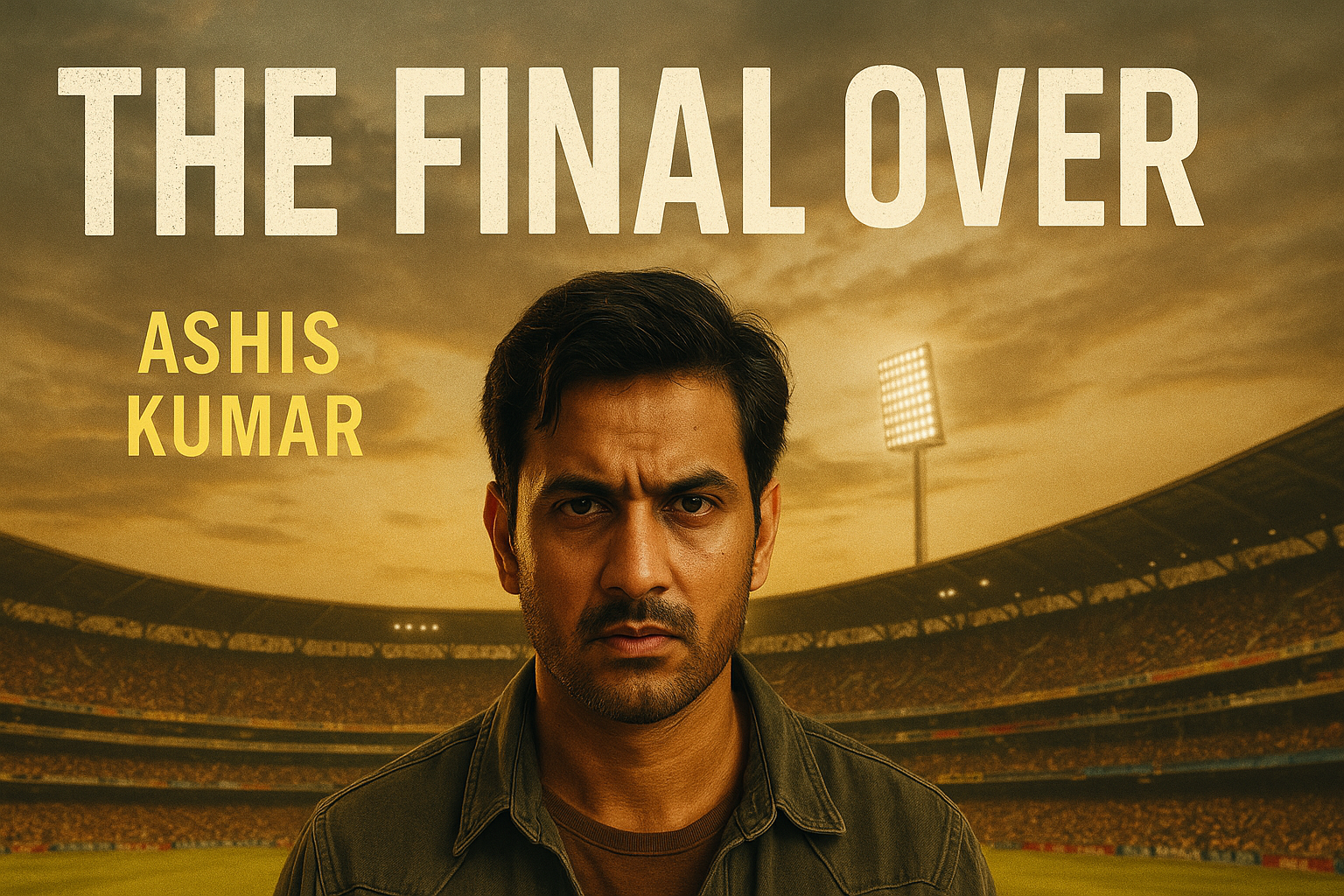

Asish Kumar
Chapter One: The Collapse
The roar of the crowd at Wankhede Stadium was deafening, a cyclone of noise and anticipation as the scoreboard blinked “19.5 overs – 164/7.” One ball left. Five runs needed. And standing at the crease, helmet tilted back slightly under the blistering floodlights, was Punit Shekhawat—the poster boy of modern Indian cricket, the heartthrob of the nation, the boy from Jodhpur who had become Mumbai Thunder’s talisman. Sweat shimmered off his brow as he took his stance. In the commentary box, voices trembled with energy. In the VIP box, team owner Vikrant Bajaj sipped champagne and exchanged smug glances with sponsors. And in a dingy apartment across town, Kabir Thakur stared at the screen, the flickering television painting his unshaven face in hues of blue and gold. Punit shuffled his feet. The bowler, a South African pacer known for death-over heroics, sprinted in. The ball pitched short, angling towards the ribs. Punit attempted a pull—but halfway through his motion, his limbs faltered. His bat clanged awkwardly against his pads, and then—he dropped. Flat. Lifeless. The ball rolled away, untouched, and so did the silence—spreading like ink through the stadium. The crowd’s cheer turned to shrill confusion. Umpires rushed. Players gestured frantically. Punit lay still, unmoving, his helmet slightly askew, eyes wide open.
The news rippled across India like an electric wave: “Cricket Star Punit Shekhawat Dies on Field.” The official statement came within the hour—”suspected cardiac arrest.” The post-match ceremony was cancelled. Celebrities tweeted tributes. The Prime Minister expressed condolences. By midnight, hashtags like #RIPPunit and #FinalOverTragedy trended nationwide. But somewhere, in the cracks of this national mourning, shadows began to stir. Kabir Thakur, once the most feared investigative sports journalist in the country, now reduced to scribbling unpublished columns in a smoky Byculla flat, sat frozen in his chair. Not because of grief—but because of unease. He had met Punit only twice, both times years ago, but he remembered the fire in the boy’s eyes—disciplined, sharp, impossibly aware. This collapse, so sudden and theatrically timed, gnawed at Kabir’s instincts. Something about the fall wasn’t natural. The timing. The angle. The lack of convulsion. The fact that Punit hadn’t shown a hint of fatigue all match. Kabir played the slow-motion replay again. And again. And on the sixth time, he caught it—just a flicker. A moment of hesitation. Punit’s left hand, instead of reacting reflexively as he fell, had twitched toward his thigh—like he was trying to reach something. Kabir paused the frame. Enlarged. The faint outline of a small patch under the jersey. Not medical tape. Not sweat. Something else.
By dawn, Kabir’s room was littered with scribbled notes and old press passes. He hadn’t felt this alive in years. Memories flooded back—of sting operations, of late-night calls with whistleblowers, of the time he’d exposed the infamous 2008 Ranji match-fixing scandal that cost him his career. He made two calls—one to an old friend at the BCCI medical team, the other to a data analyst he used to work with. Both offered nervous laughter and silence. No one wanted to talk. No one wanted to question the heart attack theory. But Kabir knew that silence wasn’t innocence—it was fear. The deeper he dug, the more resistance he felt. Security footage of the Thunder dressing room mysteriously glitched. The team doctor who initially spoke to reporters now refused to take calls. And most chillingly, Punit’s mentor from his academy days was reported missing from Jodhpur. The media was already moving on, shifting to upcoming IPL playoffs and who would replace Punit in the lineup. But Kabir couldn’t let go. He scribbled four words on a sticky note and pasted it on his screen: “This wasn’t an accident.” Somewhere in the flashing glamour of cricket, in the betting dens of Dubai, or the marble floors of franchise boardrooms—someone had scripted this final over. And Kabir Thakur, disgraced but not defeated, was going to find out who.
Chapter Two: Echoes in the Silence
Mumbai had a strange way of grieving—flashes of hysteria followed by collective amnesia. Two days after Punit Shekhawat’s on-field collapse, life in the city resumed its tempo: traffic snarled, billboards advertised energy drinks with new faces, and local TV stations had already pivoted to a celebrity divorce scandal. But Kabir Thakur hadn’t slept. He spent forty-eight hours combing through every available replay of the match, every post-game interview, and every medical bulletin. Something was being withheld. He could sense it. In his old drawer, beneath dog-eared notebooks and unpaid bills, he found the voice recorder that had once taken down cricketing giants. As he cleaned it, his phone vibrated—a message from a masked number: “Stop. This isn’t your story anymore.” That was all it said. No threat. No name. But it was enough to confirm Kabir’s suspicion—he was onto something. In that moment, he made a decision he hadn’t made in years. He shaved, packed his notebook, and stepped out into the chaos of Mumbai, heading toward the one person who would speak—the last person to see Punit alive in private: Rhea D’Souza.
Rhea was everything Kabir wasn’t—young, visible, and feared by the establishment. A prime-time crime reporter with a reputation for showing up uninvited in morgues, police press briefings, and corporate boardrooms. He found her outside Punit’s gated housing society in Lower Parel, notebook in hand, dictating notes into her smartwatch. She looked annoyed when Kabir introduced himself, her eyes scanning him like a bouncer judging a party crasher. “Weren’t you the guy who got blacklisted by the IPL for leaking audio tapes?” she asked bluntly. “The same,” Kabir smiled. “And you’re the one who accused the Mumbai police commissioner of shielding a drug cartel on live TV.” That broke the ice. They spoke in her car, the AC humming over the street noise. Rhea had been investigating Punit for months—not for corruption, but for fear. “He thought someone was following him,” she said, flipping through messages on her tablet. “He never told me why, but he mentioned he didn’t trust his own team. Said something was off in the dressing room.” She pulled up an audio file—Punit’s voice, weary and uncertain: “If anything happens, talk to someone who remembers Barmer.” Barmer—Kabir’s heart skipped. That was Punit’s hometown. And also the town where an illegal cricket betting syndicate had once run trials under the guise of youth leagues.
Kabir and Rhea made an uneasy alliance. She brought access and tech. He brought instinct and memory. Their first stop: the postmortem report. What they got wasn’t medical, it was mechanical—heart failure, collapsed lungs, no toxins, no anomalies. But Kabir spotted something odd: the report was timestamped six hours before the autopsy was officially conducted. It had been pre-written. Their second stop was the underbelly of the game—Kabir’s old acquaintance, Raghu Sikka, a small-time bookie turned information broker who now ran a paan shop as cover. In his backroom, with fans buzzing and CCTV monitors showing race scores, Raghu revealed the unspoken truth. Punit had been approached—twice—by syndicates wanting him to fix matches. Both times he’d refused. “You know what happens to those who say no?” Raghu asked. “They become memories.” That night, Rhea received another message: “Barmer is just the beginning. Look under the turf.” As Mumbai slept and the nation debated who would open in Punit’s absence, Kabir sat by his window, staring at the skyline. He wasn’t chasing a story anymore. He was chasing justice. And he knew now—Punit hadn’t died in the final over. He had been silenced long before it.
Chapter Three: Under the Turf
The train to Barmer left from Bandra Terminus just after dawn, rattling through the city’s drowsy skeleton and into the stillness of Rajasthan’s desert-stained outskirts. Kabir and Rhea sat in the second-class sleeper, blending into the tapestry of families, vendors, and lone travelers. Barmer wasn’t on the tourist map—it was dust and heat, memories and myths. As the train roared westward, Kabir filled Rhea in on a ghost from his past: ten years ago, an anonymous tip had led him to a so-called “cricket development camp” outside Barmer, where he had uncovered a rigged system feeding young talent into illegal betting networks. He’d published the story. The academy was shut down. But nothing stuck. No arrests, no bans. Just a relocation of rot. Now, with Punit’s death and that cryptic message—“Look under the turf”—Kabir feared that the same machinery had not only survived but evolved. When they reached Barmer station, it was already late evening. A dry wind whipped dust into their eyes. The town looked unchanged—shrubs swaying beside rusted water pumps, kids playing cricket with worn-out bats, and the same eerie silence around the skeletal remains of the old academy building. The locals still avoided it. “Haunted,” a chaiwala whispered. “Boys went in. Some didn’t come out the same.”
They broke in after midnight. The building had no locks—just a rusted chain hanging from a gate like a throat slit open. Inside, the floor was layered in sand, scattered with broken stumps and torn nets. But the turf—green, fake, and oddly preserved—still stretched across the indoor pitch like an untouched relic. Kabir knelt. It wasn’t turf—it was something newer, more advanced, and oddly warm beneath the surface. With effort, they peeled back a corner and found a sealed hatch. A ladder descended into darkness. No electricity. Just a torch and guts. What they discovered underground changed everything. A compact room with a rusted table, disused oxygen tanks, dozens of medical syringes, and biometric scanners. Rhea found a file folder with names, photographs, and match statistics—hundreds of players, most of them teenagers. Kabir flipped through and froze. Punit’s name was there. His photo dated five years before his debut, with a red stamp that read “Uncooperative – Level 2 Monitoring.” “They were tracking him,” Rhea whispered, her fingers trembling. “Even before he played for the state team.” A deeper folder showed contracts, all unsigned, and a list of recurring ‘sponsors’—many now senior executives in IPL franchises. This wasn’t just betting. It was grooming, manipulation, long-term investment in future stars to ensure control. Talent laundering.
By morning, the hatch was re-sealed. They left before sunrise, avoiding questions. Kabir didn’t speak much on the train ride back. His mind reeled with implications. Rhea, meanwhile, sent copies of the documents to three anonymous inboxes for safekeeping. But things moved fast after Barmer. Their hotel room in Mumbai was broken into—no valuables taken, just notes and hard drives erased. A journalist Rhea knew in Jodhpur was run off the road. And a former coach from the Barmer files was found dead in his home—heart attack, again. The message was loud now: stop digging. But Kabir couldn’t. Not now. He went back to Raghu Sikka, who confirmed their worst fear—Punit had secretly approached a lawyer last year, intending to expose a fake sponsorship scam tied to young players. The syndicate found out. And like others before him, he was warned. Only he didn’t fold. He played on, knowing they might come for him. “Under the turf,” he had said. And Kabir had found it. But the truth was heavier than the weight of any file. Because now, they weren’t chasing a scandal—they were unraveling a system. And the final over? That was just the beginning of the innings.
Chapter Four: The Fixer’s Shadow
Rain pattered against the windows of Rhea’s flat in Andheri, a rare monsoon downpour in early April that made the streets below glisten with oil and neon. The city looked deceptively cleansed, as though it hadn’t just buried one of its brightest stars under lies and media tributes. Rhea paced, watching Kabir replay the leaked Barmer footage frame by frame, his eyes sunken, his fingers trembling ever so slightly at each pause. He wasn’t just hunting down a scandal anymore—he was bleeding into it. “We need someone inside,” Rhea said. “Someone who still moves freely in the system.” Kabir looked up. “There’s one man. But he’s a fixer, not a friend.” His name was Manav Rathi, the invisible hand behind more than a dozen IPL team deals, a man who never appeared on camera, but whose whispers could build or break a career. Kabir had crossed paths with him once—at a closed-door BCCI mediation in 2013. Manav had offered him silence money. Kabir had laughed in his face. Now, years later, they would meet again—but this time, Kabir was no longer the fearless crusader of sports journalism. He was just a man with a memory, and nothing left to lose.
They tracked Manav to his new base of operations—an upscale wellness retreat in Alibaug, where the rich sent their children to “detox” from public scandal. Rhea booked an appointment under a fake name. Kabir, reluctantly, posed as her manager. Inside, everything smelled like lemongrass and hypocrisy. Manav arrived twenty minutes late, dressed in yoga whites and a Rolex, with the smile of a politician and the eyes of a hyena. The room chilled the moment Kabir spoke his name. “I don’t do cricket anymore,” Manav said, leaning back. “I’m into wellness.” Kabir slid a photo of the Barmer hatch across the table. “This look like yoga to you?” Silence. Then a chuckle. “Still chasing ghosts, Thakur?” But Kabir noticed the twitch—the flicker of fear behind that rehearsed smile. Rhea pushed a folder forward, the list of names, the doctored contracts. Manav didn’t open it. He didn’t need to. “Let it go,” he said softly, “or you’ll end up like Punit. Or worse, you’ll end up forgotten.” Before Kabir could respond, two security guards entered the room. Manav’s smile returned. “Enjoy the steam bath. On the house.” They were escorted out. But outside, as they reached the parking lot, a folded napkin fell from Kabir’s pocket—a note scribbled hastily: “Vikrant’s vault. Carter Road. Ask for S.R. Room 47.”
That night, back in Mumbai, Kabir sat by the sea at Carter Road, the skyline behind him throbbing like a pulse. The note was a gift—Manav’s way of pushing back without leaving fingerprints. Rhea hacked into the registry of the private complex near Carter Road known for discreet corporate apartments. Room 47 was leased under a shell company registered to Vikrant Bajaj’s cousin. They broke in just past midnight using a duplicate key card purchased from a disgruntled concierge. Inside was more than they imagined: encrypted hard drives, two dozen burner phones, and a filing cabinet filled with confidential contracts, many with Punit’s signature forged. But the most damning evidence was a series of video clips—hidden cameras inside the Thunder dressing room. Kabir watched as Punit argued with a team physio. Then with a masked man—voice scrambled—who handed him a vial. The date stamp? Three days before the final match. In one video, Punit stared straight at the hidden lens, as if he knew. As if he wanted someone to see it later. Kabir’s throat tightened. “He knew he was going to die,” he murmured. Rhea whispered, “He didn’t die in the final over. He delivered a final message.” And now, they were the only ones who’d heard it.
Chapter Five: The Franchise Lie
The morning after their break-in at the Carter Road vault, Kabir and Rhea sat in a roadside tea stall in Mahim, their eyes bloodshot, their voices low. Between them lay a borrowed laptop loaded with copied footage and files. Around them, life went on—rickshaws honked, children raced down lanes with plastic bats, and a nearby radio played the latest cricket commentary as if nothing had happened. Rhea sipped her chai, then murmured, “This isn’t just one team. It’s an industry.” The documents confirmed it—five franchises had quietly bought into a shadow network that “scouted” rural talent, pushed them through fake sponsorships, offered luxury and contracts—but ultimately controlled them with substances, silence, and surveillance. The organization behind it all was disguised as a performance analytics firm, “GameCore India Pvt Ltd.” On paper, it provided data science services to IPL teams. In reality, it was a front for player monitoring, manipulation, and if necessary—removal. Punit’s name appeared in a 2022 internal memo marked Category Red: Breach Risk. He had refused to promote a fake brand, resisted backdoor sponsors, and worst of all, threatened to go public. Vikrant Bajaj had flagged him personally. The final match? That wasn’t a game. It was an execution wrapped in spectacle.
Kabir knew they couldn’t go to the media—too risky. Rhea’s last two exposés had been scrubbed off the internet within hours by unknown forces. Instead, they turned to someone with less to lose and more to prove—Inspector Nikhil Rawat. Kabir had once written a scathing piece accusing him of shielding bookies. But now, Rawat had become a rogue element in the system: posted to minor narcotics cases, denied promotions, but still driven by guilt and a chip on his shoulder. They met him in a dusty back office behind a police chowki in Dharavi. Kabir laid out everything—Punit’s video, the Barmer facility, the forged signatures. Rawat listened silently, then said only two words: “Follow me.” He took them to the evidence vault of a case long buried—one that involved the same analytics firm, GameCore, and an under-19 player who had mysteriously “overdosed” in his hostel in 2019. The autopsy then had also mentioned cardiac failure. Rawat pulled out a matchbox-sized vial from the sealed evidence bag. “Same formula. Lab never figured it out. No trace post-absorption. Leaves no residue in the bloodstream.” Kabir stared at the vial. The delivery system. The perfect murder weapon in a sport where sweat and collapse were everyday events. “And they’ve been doing this for years,” Rhea whispered. “Building an empire on silence.”
Their next move had to be surgical. Kabir called a retired forensic chemist who had quietly helped him in the past, asking him to examine the vial in exchange for anonymity. Meanwhile, Rhea set up a secure channel with a foreign sports watchdog group—offshore, uncorrupted. She packaged a redacted version of the Punit footage, blurring faces and voices, and sent it as a teaser. But then, things spiraled. The old chemist never showed up. His house was ransacked, his phone disconnected. A burner number called Kabir with a digitized voice: “You’re dragging ghosts into the light. They will bury you too.” That night, Kabir found Rhea sitting on the floor of her flat, shaking, her phone smashed, her apartment turned upside down. “They were here,” she whispered. “They didn’t take anything. They just… looked at me.” Kabir helped her pack what little they had left—hard drives, notes, footage—and left the city behind. As they boarded a bus to Pune under fake names, he glanced at the skyline one last time. Somewhere, beneath the stadiums and sponsorships, the truth was gasping for air. And Kabir Thakur, battered but not broken, would make sure it breathed again—even if it cost him everything.
Chapter Six: The Whisper Game
Pune was quieter, older—more cautious in its rhythm than the roar of Mumbai—and it gave Kabir and Rhea space to breathe, think, hide. They rented a small room above a bakery near Deccan Gymkhana under false IDs. Every morning, the scent of bread and early lectures filled the air; at night, they pieced together the fragments of a story so big it no longer felt like journalism—it felt like war. With the chemist gone, Kabir reached out to his last card: Dr. Parul Deshpande, a pharmacologist-turned-whistleblower who had helped dismantle a pharmaceutical doping ring in 2017. She agreed to meet at a café off Fergusson College Road. Parul examined the stolen vial with a clinical eye and whispered after a long pause, “This isn’t a drug. It’s a designed enzyme suppressor. Short-circuits oxygen absorption in cardiac cells. Perfectly trace-free. And—this,” she held up the vial, “was developed under a private defense biotech grant. Not even on medical records yet.” Kabir and Rhea sat stunned. This was no longer just about cricket—it was a national-level weaponization of sport. “Where did you get this?” Parul asked sharply. Kabir only answered, “From the grave of a player who didn’t bow to the system.” Parul shook her head. “You need to disappear. Or you’ll both be next.”
But Kabir was done disappearing. That night, with Parul’s help, he wrote the beginning of the story. A real one. Names redacted, evidence summarized, footage still encrypted. He sent it through a secure tunnel to the foreign watchdog group Rhea had contacted—Athleaks, a pan-global sports transparency collective. Hours later, they responded: “We believe you. We’re watching the connections. Keep feeding.” Encouraged, Rhea opened a channel to someone unexpected—her estranged brother Neil D’Souza, a former junior player who had vanished from the sport a decade ago after refusing a strange medical regime during his training camp. He was now living anonymously in Gujarat, teaching schoolkids cricket. When Rhea and Kabir reached him, Neil was reluctant. “I buried that world,” he said. But when they showed him Punit’s forged medical documents, he sat down hard, lips trembling. “They approached me too,” he admitted. “Said it was for endurance, for performance. But one of the boys collapsed during a practice game and never came back. They buried it. Said he went home.” Neil gave them a notebook filled with names, sketches, team codes, schedules—a diary he had kept in fear for years. In the final page was a single phrase underlined three times: “The Whisper Game.”
Kabir finally understood. “The Whisper Game” wasn’t just a phrase—it was a method. The network used subtle pressure—rumors, injury threats, fake sponsorships—to corner players into submission. Once inside, they whispered instructions—fix an over, drop a catch, endorse a product. If a player resisted? The whispers grew louder. Leaked scandals. Legal threats. If that failed—well, the enzyme suppressor did the rest. Rhea compiled the diary entries with the Barmer files, overlaying them with IPL match data from the last five years. A disturbing pattern emerged: five unexplained collapses, all dismissed as accidents, all connected to franchises linked to GameCore. They had enough to burn the sport down. But the question loomed—how? The media wouldn’t run it. The government wouldn’t touch it. Even Athleaks warned that this level of exposure required “one undeniable signal”—something public, loud, undeniable. That signal came in the form of an anonymous video leaked online a week later—Punit Shekhawat, sitting in front of a camera, dated one day before his final match, saying: “If you’re watching this, I’m already gone. And if I am, know that it wasn’t a heart attack—it was silence.” The nation exploded. And now, the game had changed.
Chapter Seven: The Breaking Point
The video detonated like a bomb across India’s digital landscape. Punit’s trembling voice, those final words—“It wasn’t a heart attack. It was silence”—went viral within hours. News channels scrambled for statements, the BCCI called for a “review committee,” and hashtags flooded every social feed: #JusticeForPunit, #CricketKills, #FixTheGame. But amid the outrage, Kabir and Rhea knew what would come next: denial, distortion, and a hunt. Vikrant Bajaj issued a public statement expressing “shock” and “sadness,” claiming the video was “deep-fake propaganda.” Within a day, bots flooded the internet with theories discrediting Punit—saying he had mental health issues, drug dependencies, “performance anxiety.” Kabir watched it all unfold from a dusty cybercafé in Satara, his fists clenched. “They’re going to martyr him and then erase him,” he muttered. But the momentum couldn’t be fully contained now. With Athleaks backing them, the pair released Phase One of their report: redacted documents from GameCore, screenshots from the Barmer compound, a list of eight mysterious player deaths over ten years. The response was thunderous—and then, terrifying. Within twenty-four hours, Rhea’s parents received threats, her newsroom was raided under a tax evasion warrant, and a Mumbai news anchor was found unconscious in his car—one who had planned to host a debate on Punit’s video.
Kabir tried to keep them mobile, but nowhere felt safe. They moved through Maharashtra like ghosts—Ahmednagar, Kolhapur, then back to Pune—changing SIM cards and laptops, avoiding faces. Meanwhile, Inspector Rawat called with updates. The enzyme suppressor had vanished from the police vault. “Internal hands,” he said grimly. “They’re scrubbing everything.” Still, Rawat promised them protection for a final act—their endgame. They would need to crash the fortress from within. “You want justice?” he told Kabir. “Then bring it to the one place they can’t edit—the Wankhede final.” The IPL championship match was set for three weeks away. Kabir thought it was madness—how could they possibly infiltrate that kind of event? But Rhea had an idea: Athleaks had secured them media credentials under a European sports analytics firm. “We won’t be seen,” she said. “But we’ll be heard.” Their plan was audacious: a live broadcast intercept. A timed projection in the middle of the final. All the files. The footage. The names. The suppressed deaths. And Punit’s voice—booming over the roar of the crowd. It would only work once. If it failed, they’d be arrested or worse. But if it worked—if it worked—they’d light a fire no one could bury.
The days that followed felt like countdowns to a storm. Kabir wrote his final report, Rhea cut footage, and Neil prepared the trigger sequence from Gujarat with a VPN maze that would take half the world to trace. Kabir found himself dreaming of Punit every night—never with a bat, never on a field—just standing in silence, staring back at him, as if asking, “Are you ready to finish what I started?” The night before the final, they checked into a cheap hotel two kilometers from the stadium. Kabir looked in the mirror. His face was hollow, but his eyes clear. “You ever wonder what comes after this?” he asked Rhea. She didn’t answer. Instead, she handed him a folded piece of paper—Punit’s last diary entry, the one the world hadn’t seen. It read: “If even one voice rises from my silence, then it was worth it.” And so, as the stadium lights prepared to blaze and India readied to watch another pageant of cricketing glory, two fugitives armed with nothing but truth got ready to tear the veil apart. The final over of the tournament was coming—but this time, they would deliver it.
Chapter Eight: The Last Over
The Wankhede Stadium shimmered like a living giant under the floodlights, over sixty thousand voices rising in layered rhythm—cheers, chants, horns, the electric breath of a nation watching its religion unfold. It was the IPL final. And from the press box high above the sea of blue and gold, Kabir Thakur sat motionless, headphones on, eyes fixed on the monitor—not watching the match, but waiting for the timestamp. At his side, Rhea was silent, her fingers hovering over the modified broadcast switch. The final over was minutes away. Down below, cameras panned to star owners in their luxury boxes, commentators shouted over crowd noise, and on the field, a tight match neared its climax. But behind the glittering illusion, another reality was preparing to reveal itself. Athleaks had gone dark after receiving the final batch of files—no confirmation, no signal. The failsafe now lay entirely in Rhea’s hands. She had split the video into twelve encrypted fragments—if intercepted, they were useless. But if triggered live, they would stitch into a single, catastrophic truth: the footage of Punit’s confession, the hidden recordings from Barmer, the forged contracts, the list of deceased players marked “inconvenient.” Rhea looked at Kabir. “Are you ready?” Kabir’s answer came not in words, but a nod that felt centuries old.
At 19.1 overs, Rhea inserted the transmitter module into the studio console. The countdown began. On screen, the batsman lofted a shot for six, and the crowd erupted. 19.2—the audio feed flickered. A glitch. Kabir’s fingers hovered over the override. 19.3—the stadium screen blinked, just for a second, enough to be missed, enough to be remembered. And then, as the bowler ran up for the 19.4th ball, it hit. The feed froze—and was replaced. The scoreboard dissolved into black. The commentary was cut. And suddenly, over the entire stadium, over televisions in millions of homes, a voice spoke: “My name is Punit Shekhawat. If you’re hearing this, it means I didn’t survive my last match. But they cannot silence me anymore.” The video played—Punit’s final testimony, his eyes burning through the screen. Then the footage of the Barmer facility. Then the forged contracts. Then the locker room exchange. The stadium went deathly quiet. No one moved. Not the players. Not the fans. Not the owners. Vikrant Bajaj’s face appeared on screen for three seconds before the feed was cut by backup systems. But it was enough. The truth had been televised. And the myth of the clean game shattered.
What followed was chaos, but not confusion. Security swept the press box within minutes, but Kabir and Rhea were already gone, melting into the night with forged press badges and burner phones. But they didn’t run far. They didn’t need to. The avalanche had begun. By dawn, the footage was everywhere—mirrored across thousands of servers, translated into over thirty languages. Foreign media erupted. Sponsors pulled out. Two franchise owners issued panic statements. The BCCI called for an “extraordinary inquiry.” Vikrant Bajaj went off-grid. And amid the wildfire, Kabir and Rhea surfaced one last time—on an independent podcast, no visuals, just voices. “This isn’t about one player,” Kabir said. “It’s about the game behind the game. And we’re done letting it hide.” Rhea’s voice followed, steadier: “We didn’t break cricket. We broke the lie built around it.” They signed off, not as heroes, but as messengers. And in a quiet street in Jodhpur, a statue was erected outside a local academy—a bronze figure of a young batsman, helmet tucked under his arm, gaze steady. The plaque read: “He didn’t fall. He stood for the truth.” And the game, finally, was forced to reckon with its silence.
Chapter Nine: The Reckoning
The weeks that followed the Wankhede broadcast sent shockwaves across the country and far beyond the cricketing world. The IPL was suspended midway through its next season. Emergency sessions were called in Parliament. Sports sponsorships dipped by 37%, and global headlines screamed betrayal, corruption, and murder. The BCCI, after initial denials, was forced to launch an independent investigation headed by retired Justice S.P. Chaturvedi—a name Kabir respected from past court trials. But even as arrests were made—mid-level managers, agents, two GameCore directors—the architects of the rot remained elusive. Vikrant Bajaj vanished completely, his mansion raided, his assets frozen, yet not a trace of him found. Kabir and Rhea, now cult figures in the independent journalism space, remained hidden. Not underground—but quiet. They moved through the country with caution, changing towns, teaching workshops at rural schools, coaching girls’ cricket teams under aliases. Their names appeared in global exposés, documentaries, even foreign award nominations. Yet neither of them appeared in public. “Not until the work’s finished,” Kabir would say. But it was Neil—Rhea’s brother—who emerged into the spotlight, releasing a memoir titled The Whisper Game. In it, he recounted not just what had happened to Punit, but what had nearly happened to him. The book became a national bestseller. And for many, it was the first time they truly read between the lines of Indian cricket.
But truth comes at a price. Inspector Nikhil Rawat, the whistleblower in uniform, was found dead in his car two months later—reportedly suicide, though Kabir knew better. Parul Deshpande went into witness protection in Canada. Athleaks came under cyberattack, and one of their servers was permanently lost. The forces resisting the reckoning were vast, faceless, funded by old money and older silence. But the public was no longer docile. Protesters gathered outside franchise offices, stadiums, even cricket academy gates. Young players posted anonymous testimonies online—many of them detailing similar approaches, threats, and “performance enhancement offers” masked as nutrition. Kabir watched these messages from a lodge in Himachal, growing older, growing quieter. He kept a folder marked “Punit – Phase Two.” It was filled with evidence yet unreleased—more names, more facilities, a second compound in Bihar. Rhea asked him once, “Will there ever be an end to this?” And he had said, “Truth doesn’t end. It evolves.” She understood. Their bond, forged in fire and fear, had grown beyond alliance. They had become a rhythm of survival—alternating days of hiding with days of fire, moments of laughter with long silences by dusty roads. If Punit had been the martyr, they had become the wandering flames.
Then came the letter. Delivered by hand. No return address. Just a sentence: “Your file made it to Interpol.” Enclosed was a flash drive and a short note: “You’ve started a storm. Now give it direction.” The flash drive contained evidence tying Vikrant Bajaj to offshore arms trafficking, pharmaceutical shell firms, and private bio-labs—everything Punit had feared and more. It was the last piece. Rhea wanted to release it at once. Kabir hesitated. “If we go ahead with this,” he said, “they’ll hunt us till we vanish.” Rhea’s reply was simple: “Then let’s vanish with a roar.” And so, they prepared their final drop—not through Athleaks, but publicly, virally, in a dozen languages, mirrored across civil rights networks and whistleblower portals. The night it went live, the world paused again. And in that pause, millions heard Punit’s voice once more—this time not alone, but joined by thousands who whispered what they could never say before. The reckoning wasn’t clean. It wasn’t conclusive. But it was undeniable. And in the quiet that followed, somewhere between the broken stadium lights and the distant echo of applause, the game began to learn how to kneel—not to money, not to power—but to truth.
Chapter Ten: The Score That Matters
Two years later, the monsoons returned to Mumbai—not with the usual chaos but with a strange calm, as if the city had finally exhaled. The Wankhede still stood tall, but a rust had begun to form on the banners. Ticket sales never fully recovered. The IPL had returned, restructured, rebranded, and now regulated under international scrutiny. The GameCore empire had been dismantled. The names once whispered in dugouts were now etched in court documents. A few franchise heads were imprisoned, one died in exile, and Vikrant Bajaj—India’s most elusive ghost—was finally caught at an airstrip in Tbilisi under a forged identity. His arrest was live-streamed by Athleaks. It made headlines, yes, but the public’s relationship with cricket had shifted. The devotion remained, but so did the doubt. And amid this quiet transformation, Kabir Thakur and Rhea D’Souza walked into an abandoned community hall in Juhu, now transformed into the Punit Shekhawat Memorial Academy. No cameras, no journalists. Just twenty-three children with plastic bats, real hunger, and no illusions. “We’re not here to make cricketers,” Kabir told them softly, “We’re here to make people who ask questions.” And they listened, wide-eyed, as if cricket itself had whispered a new language through the voice of two survivors.
Kabir looked older now. His hair had grayed, his posture relaxed but heavy. He no longer wrote for headlines. He wrote for records. His notebooks were now archives—volumes of stories no one else would ever print. Rhea had become a ghostwriter, her articles published under rotating pseudonyms across various human rights journals. She refused awards. She declined TED talks. She preferred truth without applause. The two met once every few weeks—at tea stalls, on bus rides, by the coast. Their bond was not defined by love in the romantic sense, but by a shared wound that neither time nor distance could erase. “Do you regret it?” Rhea asked once, on a foggy evening in Nashik. Kabir smiled faintly. “Only that we didn’t begin sooner.” They lived quietly but fully. They taught at night schools. Ran journalism bootcamps. Funded unknown reporters anonymously. In every small act, they pulled weeds from the poisoned soil left behind. They knew they hadn’t changed the world. But they had cracked its mask. That was enough. And every year, on the day of the IPL finals, they would light a diya—not for celebration, but for remembrance. For a boy who once played the game with a heart too big for silence.
On the third anniversary of Punit’s death, the academy organized its first inter-district match. No sponsors. No logos. Just a simple scoreboard with one message printed beneath it: “Play Loud. Live Honest.” Rhea sat in the stands with Neil, watching the game unfold. A wiry left-handed batsman flicked a perfect cover drive and pointed skyward. The crowd—a handful of locals and passing cyclists—cheered like it was a World Cup. In that moment, Rhea felt something stir that she hadn’t in years. Hope. Behind her, Kabir sat with a tattered journal, noting the names of the boys. No stats. No endorsements. Just names. Because to him, names mattered more than scores. When the match ended, one of the younger boys ran up to him, sweaty and beaming. “Sir, did I play well?” Kabir looked him in the eye, smiled, and said, “You asked questions when the umpire gave a bad call. That’s the best game you can play.” And as the boy ran off laughing, Kabir leaned back, the clouds above parting just a little. The storm was over. The field was open. And though the scars would remain, the silence… finally, was gone.