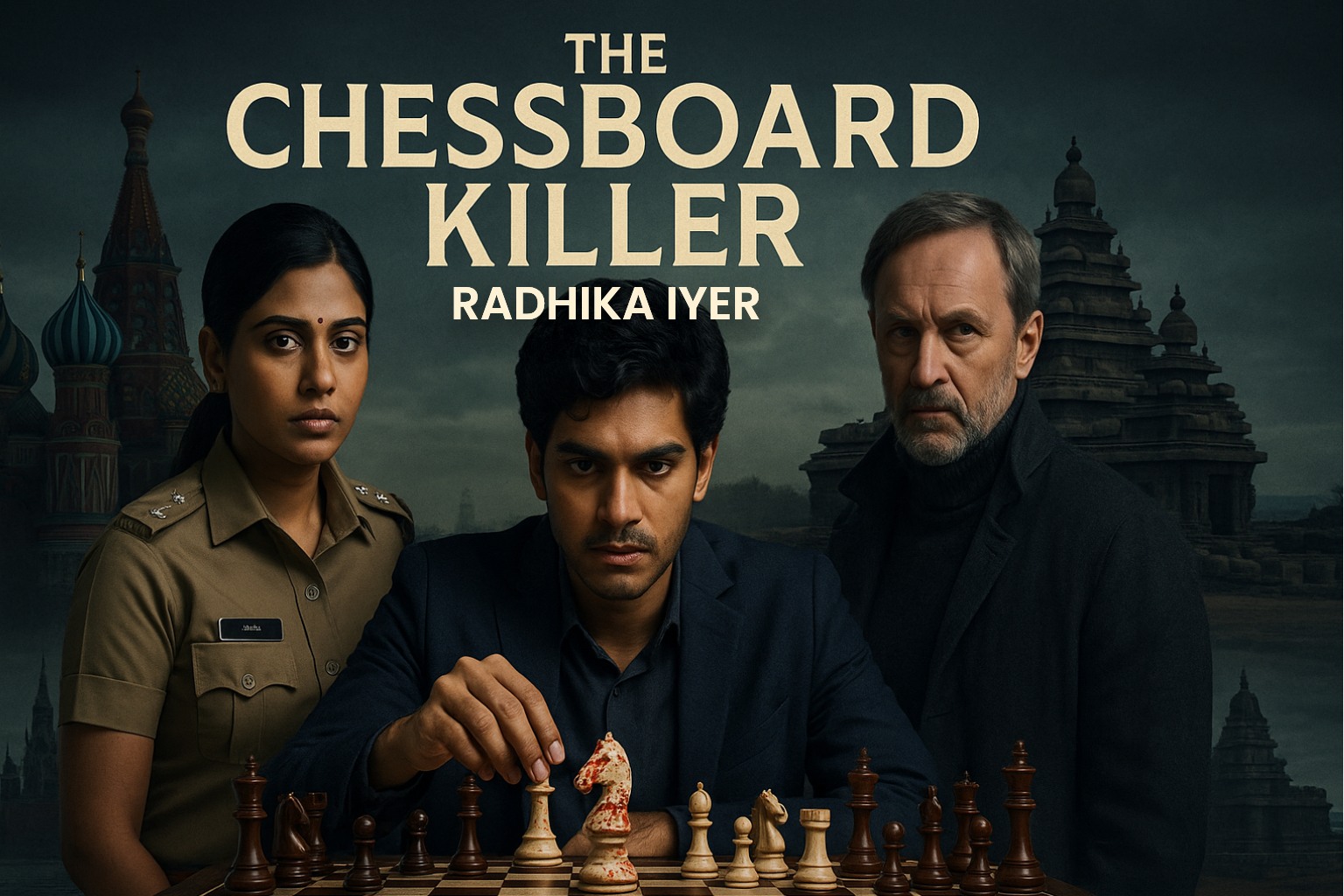

Radhika Iyer
One
The monsoon had just started whispering over Chennai when Rudra Iyer walked into the Madras Chess Club for his final pre-tournament practice. The marble floor of the hall was damp from the humid wind sneaking in through the old lattice windows, and the scent of wet books, sweat, and varnished wood gave the room an odd comfort he had always known. At twenty-four, Rudra was already a Grandmaster and the brightest Indian hope in the upcoming Tamil Nadu International Grandmasters Open. But today, something felt misaligned. On the board, he played a quiet e4, the most classic of openings—aggressive yet balanced. As he pressed the timer, his opponent across the table, a junior player from Kerala, hesitated slightly. Rudra barely noticed. His eyes were on the strange envelope that had been slid under the club door earlier, addressed in no handwriting he recognized. He hadn’t opened it yet, but something in its weight, or maybe its stillness, pulled at him.
He finally tore it open in the privacy of the club library, behind dusty Tamil periodicals and yellowed Soviet chess manuals. Inside was a single square of thick parchment. Written in a smeared red ink—e4. The same move he had just played. No sender, no message. Just the move. A coincidence? Rudra’s mind, trained in calculation and pattern, flickered with unease. He thought of discarding it but folded it carefully into his notebook instead. He didn’t realize then that this was not the first such note—only the first he had noticed. That night, rain lashed against his apartment balcony in Mylapore as he poured over old games and tried to dismiss the envelope as a strange prank. His thoughts drifted to his twin brother Rishi, gone for over a decade. The memory remained a blur: a championship, a fall, a scream in the corridor—and a death that no one could truly explain. Chess had saved him from that grief, given him structure. But tonight, it was beginning to feel like the enemy.
The next morning shattered everything. Grandmaster Suren Roy, Rudra’s longtime mentor and friend, was found murdered in his hotel suite near the venue. The crime scene was gruesome, cold, and surgical. But what chilled Rudra the most was the detail the press didn’t yet know: a black knight piece, drenched in blood, placed carefully on Suren’s bare chest. When Inspector Anjali Ramachandran arrived on the scene, she didn’t overlook the symbolism. She was known in the Crime Branch for her meticulous attention to ritualistic details, and this—this wasn’t random. Rudra, arriving at the hotel moments after the news broke, felt a chill as she stared at him longer than necessary. “You’re not just a player in this tournament anymore,” she told him quietly, her voice measured but grim. Rudra didn’t flinch, but deep inside, he already knew: someone was playing a game, and he had just been moved into it as a pawn.
Two
Rain still lingered in the air as the streets of Chennai sloshed with grey puddles and flashing sirens. At the Tamil Nadu Crime Branch headquarters, the lights buzzed faintly overhead as Inspector Anjali Ramachandran stared at the crime board pinned with photos of the murdered Grandmaster Suren Roy. The black knight piece recovered from the scene had no fingerprints. The coroner’s report confirmed precision: a single, fatal stab wound to the heart, no signs of struggle. What disturbed Anjali more was the placement of the chess piece—ritualistic, calculated, and deliberate. She had dealt with serial offenders before, but this felt different. This killer wasn’t just taking lives; they were sending a message. Rudra Iyer had been cooperative during questioning, but his silence felt less like hiding and more like calculation. His fingers tapped invisible rhythms on the table—openings, counterattacks, endgames. She had seen eyes like his before—in war veterans and homicide detectives. The eyes of someone who had lived too long in their own mind.
Back at Rudra’s apartment, the memory of the envelope gnawed at him. He opened his old tournament journals, flipping through annotated matches, strategy notes, and scattered pieces of childhood drawings. In the back of one, hidden behind a loose sheet, he found it—another envelope. He had dismissed it months ago as fan mail. This one had a move too: Nf6—a reply to e4. The Indian Game. The realization struck like a blow to the chest. Someone had been sending him these notes for months, and he had ignored them, mistaking them for odd fan gestures. Rudra sat back, his mind unraveling the pattern. These weren’t random. They were playing a game with him. And with Suren’s death, he was already one move behind. With trembling hands, he placed both moves on his personal travel board: 1. e4 Nf6. A classic defense—but in this game, someone else was on the offensive. He took a deep drag from the cigarette he hadn’t smoked in months and dialed Anjali’s number.
Anjali returned to Rudra’s flat within the hour, armed with a warrant and two constables. But Rudra was waiting alone, calm, composed, and ready. He handed her both envelopes and explained everything: the matching moves, the timing, the eerie symbolism. Her brows furrowed, her mind already mapping the psychological implications. “They’re building a real game, piece by piece,” Rudra said. “And every piece has a target.” Anjali’s instincts screamed that this was more than just a madman obsessed with chess. This was personal. She made the call to request international assistance. The pattern, the method—something about it reminded her of an old case file from Russia she had read in passing: a string of unsolved murders in Moscow, each victim left with a symbolic chess piece. The name on the file: Dr. Lev Orlov, profiler and former FSB analyst. She didn’t believe in coincidences, especially not ones involving black knights and genius minds. As the Chennai rain fell heavier against the panes, two thoughts filled her mind: the killer was only just beginning, and Rudra wasn’t just being hunted—he was being challenged.
Three
The cold air of St. Petersburg drifted through the half-open window of a dimly lit study, where Dr. Lev Orlov sat hunched over an ancient wooden chessboard. His fingers hovered over the black bishop, staring at a reconstructed crime layout from five years ago—a case that had never left his mind. The victim: a Russian Grandmaster. The killer’s calling card: a blood-marked bishop and an unfinished chess score written beside the body. The case had gone cold, but Lev had always suspected it was more than isolated madness. When the Indian police request arrived—mentioning chess-based killings and symbolic pieces—his pulse quickened for the first time in months. The names were different, but the pattern was almost identical. He didn’t hesitate. Packing only his field notebook, a bottle of sleeping pills, and a dusty Soviet-era psychology manual, Lev booked his flight to Chennai. Before leaving, he flipped the bishop over once more and whispered, “You’ve moved again, haven’t you?”
Meanwhile, back in Chennai, Rudra was restless. The tournament was officially postponed after Suren Roy’s murder, and the press had descended like vultures. Every outlet speculated wildly—from fan obsession to underworld betting scandals—but no one mentioned the chessboard. Rudra knew why. The police were hiding it. Inside his flat, the pieces from the mysterious notes sat replayed on his board: 1. e4 Nf6. Then, he noticed something he had missed—on the CCTV footage the club had sent him. At the corridor near Suren’s hotel room, a figure in disguise passed just ten minutes before the murder. Rudra paused the frame. The person wore what appeared to be a bishop costume—long black robes, a mitre-like hood, and gloves. It would’ve looked like cosplay to most, but not to him. Not after the bloodied knight. The killer wasn’t just leaving chess pieces—they were becoming them.
Anjali reviewed the footage with forensic analysts. “This is theatrical,” she murmured. “It’s more than murder—it’s performance.” The killer was using the visual language of chess to stage symbolic executions. She forwarded the footage to Orlov en route. Her hunch about the Russian connection was now growing into something much darker. When Orlov finally arrived at Chennai International Airport, he looked like a ghost of history—stoic, hollow-eyed, dressed in a threadbare coat. But when Rudra met him in person, something clicked: they were alike. Both men thought in moves and consequences, both haunted by a past that refused to vanish. Lev spoke slowly, deliberately, each word heavy like carved wood. “This is not a game of skill,” he said. “It is a game of memory… Someone is remembering something, and punishing everyone who forgot.” As the three of them sat in Anjali’s office, going over crime scene diagrams, match records, and psychological profiles, the conclusion became clear. The killer was building toward something—something personal, strategic, and far from over. And if the first three moves had already claimed a life, the fourth would not wait long to strike.
Four
The Tamil Nadu International Grandmasters Open resumed under the looming shadow of death, relocated to a high-security cultural hall in Egmore. Police officers in plainclothes milled around the tournament floor, metal detectors lined every entrance, and every game was streamed live under close surveillance. But even paranoia could not mask the atmosphere—tense, suffocating, a room full of minds overclocked by fear. Rudra Iyer sat at Board 1 again, trying to steady his breath. His opponent was Serbian Grandmaster Mladen Kostic, a veteran with sharp instincts and silent eyes. Rudra opened with 1.d4, a shift from the earlier e4, hoping to throw off whoever was watching. But as Kostic responded with d5, Rudra felt the same familiar sensation—the eyes on the back of his neck. This game wasn’t confined to sixty-four squares. Somewhere beyond this hall, another board was already in motion.
The match ended in a tense draw, but Kostic never stood up. He stared at Rudra for a moment too long, then leaned forward and whispered, “The bishop is not alone.” Before Rudra could respond, Kostic left abruptly, exiting through the southern gate. Within the hour, chaos erupted. The power went out in the players’ lounge, backup generators kicked in seconds later—but it was enough. In a dark corridor near the washrooms, another Grandmaster was found murdered—a young Italian prodigy named Elio Bernini. A rook piece, dipped in crimson, was placed at the scene beside the body. The hallway security footage revealed nothing—just a shadow flickering past during the outage. The scene had been staged with precision. But what made Rudra’s stomach turn was the small board found on the victim’s chest—an exact replica of the legendary “Immortal Game”, played in 1851 between Adolf Anderssen and Lionel Kieseritzky. The killer wasn’t improvising—he was recreating.
Anjali, Lev, and Rudra pored over the new evidence at the Crime Branch late into the night. Lev leaned over the miniature board from the crime scene, silently rearranging the pieces in exact moves from the Immortal Game: sacrificial bishop, advancing pawns, a final queen trap. “This is no longer symbolic,” he muttered. “It is structural. Every kill follows a move from a historic masterpiece. The murderer is reenacting the perfect games of chess… but with blood.” Rudra felt nausea rise in his throat. He had studied these games his whole life, worshipped them. Now they were being defiled, turned into scripts for death. Anjali scanned the tournament’s player history. One thing became clear—every victim, so far, had played against Rudra in the past five years. And every game had ended with Rudra’s victory. Lev looked at Rudra sharply. “He’s not just playing a game with you,” he said. “He’s punishing you… for winning.” As Rudra lit a cigarette by the window, rain beginning again to tap the glass, a chilling possibility emerged: the killer wasn’t targeting random Grandmasters. He was using their blood to send a message to Rudra himself.
Five
The air in Rudra Iyer’s flat had grown heavier, as if the very walls were absorbing the dread that had seeped into his life. He sat in silence, staring at a blank chessboard. All standard openings now felt like invitations to death. The killer had followed the King’s Gambit, then the Indian Defense, and now the Immortal Game—a legacy being rewritten in blood. That evening, in a sudden surge of defiance, Rudra decided to break the expected flow. “He wants classics? I’ll give him chaos,” he muttered, lighting a cigarette with trembling fingers. In the next match, he would abandon the classical lines and choose something unpredictable, something explosive—The Sicilian Defense. If the killer was mirroring his moves, this would force them off-script. Rudra wasn’t sure what he feared more: the killer keeping up or falling behind. When he informed Inspector Anjali of his decision, she nodded solemnly. “Do it,” she said. “Let’s see if the predator can adapt when the board flips.”
The following day, tension crackled through the tournament hall like static. Rudra’s opponent was a Polish tactician, aggressive and unpredictable—perfect for the experiment. Rudra opened with 1. e4, and the opponent responded with c5—Sicilian Defense. The game quickly turned into a brutal positional war, with sacrifices on both sides, but Rudra managed a narrow win. He didn’t celebrate. Instead, he walked straight out of the hall and found Anjali waiting. “Check the beaches,” he said cryptically. “If he’s following this game, he’ll leave the next piece near open territory—like white’s pawn structure.” Anjali was puzzled, but Lev Orlov, who had just arrived from a late meeting with the embassy, understood instantly. “Mahabalipuram,” he said, eyes gleaming darkly. “The ancient open-air boards. Coastal. Symbolic.” The trio rushed out of Chennai, headlights slicing through the mist as monsoon winds began to howl.
By evening, they reached Mahabalipuram—a coastal town steeped in history and stone carvings. Amid the sea-facing rocks and abandoned chess tables used by tourists, they found it. On the third table from the shore, drenched in saltwater and wind, was a rook—not plastic, not wood, but carved from ash and bone. Below it, etched into the surface of the stone board, was a message in Tamil: “The castle falls at dawn.” Anjali’s blood ran cold. Lev ran his fingers over the script, murmuring, “The rook represents protection, defense, home. Whoever is next… is personal to the killer.” Rudra stared into the gray waves, his mind racing. The castle wasn’t just a symbol—it was a place. Back in the city, his thoughts leaped: His old academy—where he learned chess as a child, where he and his brother played side by side until the accident. “We need to go there,” he whispered. “Now.” But even as they turned back, something told Rudra it was already too late. The killer was always one move ahead—or worse, playing a game no one else fully understood.
Six
The gates of the Mylapore Chess Academy groaned open after years of disuse. Rainwater dripped from broken tiles, and dust coated the boards where dreams were once built move by move. Rudra stepped inside slowly, each creaking floorboard beneath his feet echoing old memories—his first tournament, the metallic smell of trophies, and his brother Rishi’s laughter echoing from sunlit classrooms. But now, silence ruled. In the main hall, under a flickering ceiling fan, lay a single board with an unfinished position: Rook to e1, with the white castle toppled onto its side, stained with red. No blood, just paint—but the message was chillingly precise. “The castle has fallen,” Lev muttered, stepping behind him. Anjali scanned the area with her torch, eyes sharp. The killer had been here. Recently. There were faint footprints near the rear exit, leading toward the alleyway that used to serve as the academy’s old emergency exit. Rudra didn’t speak. His fingers hovered over the pieces on the board, placing them in motion mentally. He recognized the pattern. It was from a match he’d played at age 12—against his twin.
Back at the Crime Branch headquarters, Anjali dug into tournament archives. Something had been gnawing at her—every victim of the killer had played one particular private invitational tournament in St. Petersburg six years ago. She found the list. Six Grandmasters had played. Two were now dead, one had mysteriously died by suicide a year later in Prague, another had gone off-grid and hadn’t been seen since 2022. And the last two? Rudra Iyer and Suren Roy. Rudra had been invited but declined due to academic commitments. But Rishi—his twin—had shown interest, despite being presumed dead by then. A cold shiver ran down Anjali’s spine. “What if…” she whispered, staring at an old passport application half-submitted in Rishi’s name. “What if he didn’t die at all?” She shared the theory with Lev, who sat silently in the interrogation room, scribbling patterns onto a notepad. After a long pause, he said, “If Rishi survived and disappeared, he may have developed a split strategy—two players, two minds. One planning, one executing. One watches from afar; the other gets blood on his hands.”
Outside, the rain thickened. Lev continued his psychological reconstruction. “The killer—or killers—are working in a mirrored formation. Like two halves of a chessboard, each side advancing toward the same goal: to dethrone the king.” Anjali added, “And Rudra is the king.” At that moment, a third murder rocked Chennai. Rudra’s former coach, Bharat Krishnan, was found dead in his gated home in T. Nagar. The scene was horrifying—no forced entry, but the place was cold and clinical. On his desk, a queen piece dipped in mercury sat atop a match record from a junior championship. It was the very game Rudra had won to become state champion as a teen. Mercury, Lev explained, symbolized madness and alchemical transformation. “They’re reaching the final act,” he said grimly. “The queen’s sacrifice always comes before the checkmate.” Rudra, shaken but composed, stared out into the monsoon-darkened streets. He knew the killer wasn’t just targeting his present. They were erasing his past, piece by piece, until he stood alone on the board—exposed, surrounded, and unable to move. Zugzwang.
Seven
The bitter wind of St. Petersburg hit Rudra’s face like a slap the moment he stepped off the plane. The ancient Russian city, cloaked in a gray fog, looked like a chessboard soaked in ice and blood. Accompanying him were Anjali and Lev Orlov, each carrying their own burdens into the city’s depths. They had come searching for the root of the pattern, the origin of the killer’s game—a forgotten tournament played behind closed doors, a sealed memory that now threatened to destroy Rudra’s life piece by piece. Lev led them through the backstreets of the city, past broken-down Soviet-era chess schools and worn-out theaters where grandmasters had once played for glory and rubles. Finally, they reached an old, abandoned chess club near the Neva River—the supposed location of the unofficial invitational match held six years ago. The tournament that tied all the victims together. Its doors were chained shut, its windows broken. But inside, a dusty board still sat undisturbed beneath a cracked dome skylight—frozen in mid-game. The pieces hadn’t moved in years. Or had they?
In the club’s basement archive, they discovered a series of notebooks—match logs, psychological notes, and something more disturbing: a cult ledger belonging to a secretive group once known as Zver, meaning “The Beast”. The group was obsessed with the concept that chess reflected divine balance, and only by sacrificing the losing pieces could the balance of intellect and soul be restored. Rudra flipped through one notebook, and his blood ran cold. Scrawled across a page in block letters: “THE PRODIGY WITH MIRRORED EYES KNOWS THE TRUTH.” Underneath it, a sketch—two identical boys facing each other on a chessboard. Lev took the book from him and confirmed the author: Yevgeny Chekov, a Russian trainer with a reputation for brutal psychological methods. He had mentored prodigies into madness. “Chekov vanished after the invitational,” Lev whispered. “Some say he took one of the players with him… a child who never appeared in the match records.” Anjali suddenly saw the shape of the truth. “Rudra, are you certain Rishi died? Is it possible he was taken?” Rudra didn’t answer. His hands trembled over the pages. He remembered a face watching from behind the crowd during one of his tournaments. A face identical to his own.
Their next visit was to the Moscow Institute of Cognitive Studies, where they accessed private medical files Chekov had submitted before disappearing. Inside, a patient’s record appeared—name withheld, but birth date, height, blood group, and chess ELO rating matched Rishi Iyer. The file described split personality symptoms, obsession with mirrored strategies, and a tendency to mimic the games of famous masters. Rudra felt the walls close in. “He’s alive,” he whispered. “And he’s trying to finish something we started as children.” Lev nodded gravely. “This isn’t just murder. It’s a message sent across the board, across years. A challenge you unknowingly declined long ago.” On the return flight to Chennai, Rudra couldn’t close his eyes. His memories twisted into shadows—Rishi’s stare across their childhood chessboard, the unfinished final game they never completed, and his whispered last words before the “accident”: “You win today. But the real game starts tomorrow.” That tomorrow had arrived. And the knight—the twisted, wayward piece—was returning to complete its path.
Eight
The sky over Chennai was bruised purple as the city awoke to the news of another murder—this time, a returning blow while Rudra, Anjali, and Lev had been across continents. The body of GM Sourabh Mehta, a flamboyant, Mumbai-born player and Rudra’s longtime rival, was found on the rooftop of his luxury apartment in Alwarpet. The crime scene was starkly theatrical: white curtains billowing in the wind, a blood-red bishop piece clutched in the victim’s hand, and a folded photograph of a 12-year-old Rudra and Rishi placed beside the body. It was no longer just symbolic—it was personal, a knife stabbed straight into Rudra’s past. The killer had moved while they were in Moscow, proving two things: he had a local accomplice, and Rudra was never out of sight. Inspector Anjali scanned the rooftop with growing dread. This wasn’t improvisation. This was execution. Lev stood silently by the parapet, whispering to himself, “Check. Not checkmate. He’s cornering the king slowly… perfectly.”
The three returned to the Crime Branch office with mounting urgency. Anjali reassembled her investigation board—faces of the dead, the board of the Immortal Game, cryptic notes, the Zver cult symbols, the recovered pieces—all pointing inward to one name: Rishi Iyer. Rudra, still silent, finally broke down his last memory of that day. “He didn’t fall,” he said. “He ran.” It had been during their final match at the academy—twin versus twin. Rishi had lost, violently pushed the board, and stormed out. Moments later, a broken window, blood on the ledge, and the body supposedly found near the lake. But the face had never been shown to Rudra. He had been told to accept. To forget. “What if they lied?” he whispered. “What if someone took him?” Lev nodded. “Chekov. He would have seen potential in Rishi’s rage.” As Lev and Anjali built a profile of the unknown accomplice, they noticed inconsistencies—access to tournament schedules, knowledge of Chennai’s terrain, and psychological familiarity with Rudra’s thinking. “He’s not just mirroring your past games,” Lev said. “He’s mirroring you.”
Anjali requested access to tournament staff and volunteers from the current GM Open. One name stood out—a psychology student and chess blogger named Ashwin Rao, who had followed Rudra’s career obsessively for years and had worked security clearance at the tournament. They brought him in for questioning. Nervous, stammering, Ashwin confessed to nothing at first—until Rudra asked a single question: “Do you know the term zugzwang?” The boy flinched. Ashwin finally broke under pressure, revealing he had been receiving encrypted move instructions through a secure chess forum from a user named “MirrorMate.” He had followed every order—delivering pieces, leaving photos, controlling small but important actions. He had never met the person behind the messages. “He said he was Rudra’s brother. That he wanted to finish a game they’d started long ago,” Ashwin said, eyes wide with panic. “He said it was about truth, not murder.” Lev sat back, his hands folded. “It’s time,” he murmured. “The final moves are coming. And he’ll make them on a board everyone will see.”
Within hours, the Crime Branch received an anonymous tip—coordinates and a message: “Let the king fall at 12.” The location? The stage of the upcoming Chennai Chess Festival Grand Finale, to be broadcast live across India, with Rudra playing a ceremonial charity match against rising juniors. The police scrambled into preparation. The symbolism was too perfect—a king sacrificed in public, the final act of a game that had been secretly building for years. Rudra stared at the chessboard in front of him, the pieces set and waiting. It wasn’t about winning anymore. It was about understanding what the killer wanted him to remember—the game, the mirror, the unfinished match. “He’s not killing me,” Rudra said softly. “He’s trying to make me finish the game… and lose.”
Nine
The Chennai Chess Festival had never witnessed a crowd like this. Thousands of spectators filled the grand auditorium in Anna Nagar, while millions more tuned in via livestream. The finale match—meant to be a symbolic celebration of India’s rising chess dominance—was now a ticking time bomb. Rudra Iyer sat at the ornate central table, dressed in black, staring at the board with more intensity than he had ever brought to a game. The move list had not been announced. His opponent was a last-minute change: a masked junior prodigy, identity hidden under the guise of a “thematic surprise.” Anjali Ramachandran paced the wings, earpiece buzzing with updates from security teams stationed throughout the hall. Every row had been scanned, every bag checked. Yet, something felt wrong. It was too quiet. As Rudra opened with 1. e4, the lights flickered ever so slightly—almost imperceptibly. Anjali’s phone lit up: a fresh message had been posted to the anonymous forum linked to Rishi. It read, simply:
“Match 33. Queen’s sacrifice will end the game. Watch the stream. 12:00.”
Lev Orlov sat in the broadcast control room above the stage, eyes locked on the board and the crowd. He saw it now—not the opponent across from Rudra, but the board itself. Each move Rudra made was being mirrored in strange ways across the city. At 12:03 p.m., when Rudra pushed his queen to h5, a report came in: a bomb threat had been called into the central metro station at exactly that minute. Earlier, when a rook was captured, a car exploded in a junkyard on GST Road—no casualties, but perfectly timed. The killer was orchestrating crimes in real-time, using the board as a trigger. Every piece moved here caused something violent elsewhere. Ashwin Rao, now under protective custody, revealed the final layer: he had been told the real execution—the king’s fall—would occur if Rudra resigned or lost. The killer had recreated a full match from their childhood, and the final trap was coming. It was not meant to be won. It was meant to end in forced surrender.
Rudra’s hands shook as he stared at the queen on h5. He had no doubt now. His brother was out there, watching—guiding everything, maybe even hidden in the hall itself. A move echoed in his head from years ago: the game they never finished, the one where Rishi had walked away after losing a single pawn. And then he remembered something else—something only the two of them had known. A line from a poem their grandfather had repeated when teaching them chess:
“If you cannot win, break the board.”
Suddenly, everything became clear. Rishi hadn’t returned to win. He wanted Rudra to validate their final game—to admit guilt, weakness, vulnerability. This entire blood-soaked opera had been a performance staged to make Rudra fold, to finally give his brother the checkmate he had once denied him.
At 12:14 p.m., Rudra stood up in the middle of the match. The cameras zoomed in. He turned toward the live broadcast feed, looked straight into the lens, and said:
“Rishi, I’m still your brother. But I will never be your opponent again. The board is broken.”
And with that, he toppled the king, not in surrender—but rejection. Immediately, chaos erupted. Anjali’s team arrested a stagehand—Rishi in disguise, watching from behind the curtains. His fingerprints matched. His mind did not. He screamed about moves, destiny, justice. But it was over.
Lev looked down at the board and whispered, “Checkmate was never the goal. It was recognition.”
Rudra walked out of the auditorium into the monsoon-washed street, soaked but lighter. For the first time in years, he felt the silence not as a threat, but a relief. The game had ended—unfinished, yes—but not lost.
Ten
The rain had stopped, but Chennai still wore the smell of gunpowder, sweat, and old wounds. Rudra Iyer stood in the echoing corridors of the Mylapore Mental Health Institute, watching through a one-way mirror. Inside the observation room, a man sat slumped in a straitjacket, staring blankly at a wooden chess piece—a white king, scorched at its base. Rishi Iyer—his twin, his shadow, his ghost—was alive. And broken. No longer the genius child who had once whispered opening lines in secret matches at their childhood academy, but something far more tragic: a mind consumed by strategy, betrayal, and unhealed resentment. The doctors said he spoke rarely, but when he did, it was always in moves. “Knight to f3. Sacrifice bishop. Castle kingside,” he mumbled, over and over. Rudra turned away, heart heavy but steady. “Checkmate,” he whispered—not in triumph, but in finality. The game was done. For the first time, he felt the board between them dissolve.
At the press conference the next morning, Inspector Anjali Ramachandran stood beside Lev Orlov, now clean-shaven and oddly calm. “The case of the Chessboard Killer,” she announced, “was not a serial murder. It was a personal vendetta masquerading as genius. A psychotic reflection of childhood trauma, played out on a national stage.” Reporters hurled questions: How did Rishi survive? How did he vanish? Why didn’t Rudra speak earlier? Lev cut through the noise with a single sentence: “The most brilliant minds often bleed in silence.” Rishi had been taken under the wing of a rogue Russian trainer, brainwashed into believing he was the “corrected” version of Rudra. For years, he followed tournaments in the shadows, practicing his final revenge through symbolism, manipulation, and murder. The cult of Zver had long since dissolved, but its philosophy—purging through defeat—lived in Rishi’s mind.
Days later, Rudra visited the abandoned Mylapore Chess Academy one last time. The walls were crumbling, and the roof leaked. But the smell of varnished boards and chalk dust still lingered. He sat where he and Rishi had played their final match as children. Placing the pieces gently, he began the game again—1. e4. And then, smiling faintly, he removed the black pieces. “You don’t have to answer anymore,” he said softly. Outside, the rain began again, soft and healing. As he walked away from the broken boards and stained memories, Rudra knew he would never play competitively again. Chess had given him discipline, fame, and survival. But it had also taken too much. Now, it was time to let the silence remain uninterrupted.
Lev Orlov returned to Moscow, leaving behind a sealed file titled “The Iyer Gambit”. Anjali, promoted to DCP, visited the institute once every month—never to question, only to observe. Rishi never acknowledged her. Yet once, as she turned to leave, he whispered: “Pawn becomes queen only by suffering.” Rudra, meanwhile, disappeared from the public eye. Rumors swirled: that he was writing a book, teaching underprivileged children, or living quietly near the mountains of Uttarakhand. No one knew for sure. But those who remembered his matches said one thing: every move had meaning. And every game had a shadow.
The Chessboard Killer was over.
But the memory of the moves would echo forever.
Because in chess, like in life,
some kings fall not by checkmate—
but by letting go of the board.
THE END