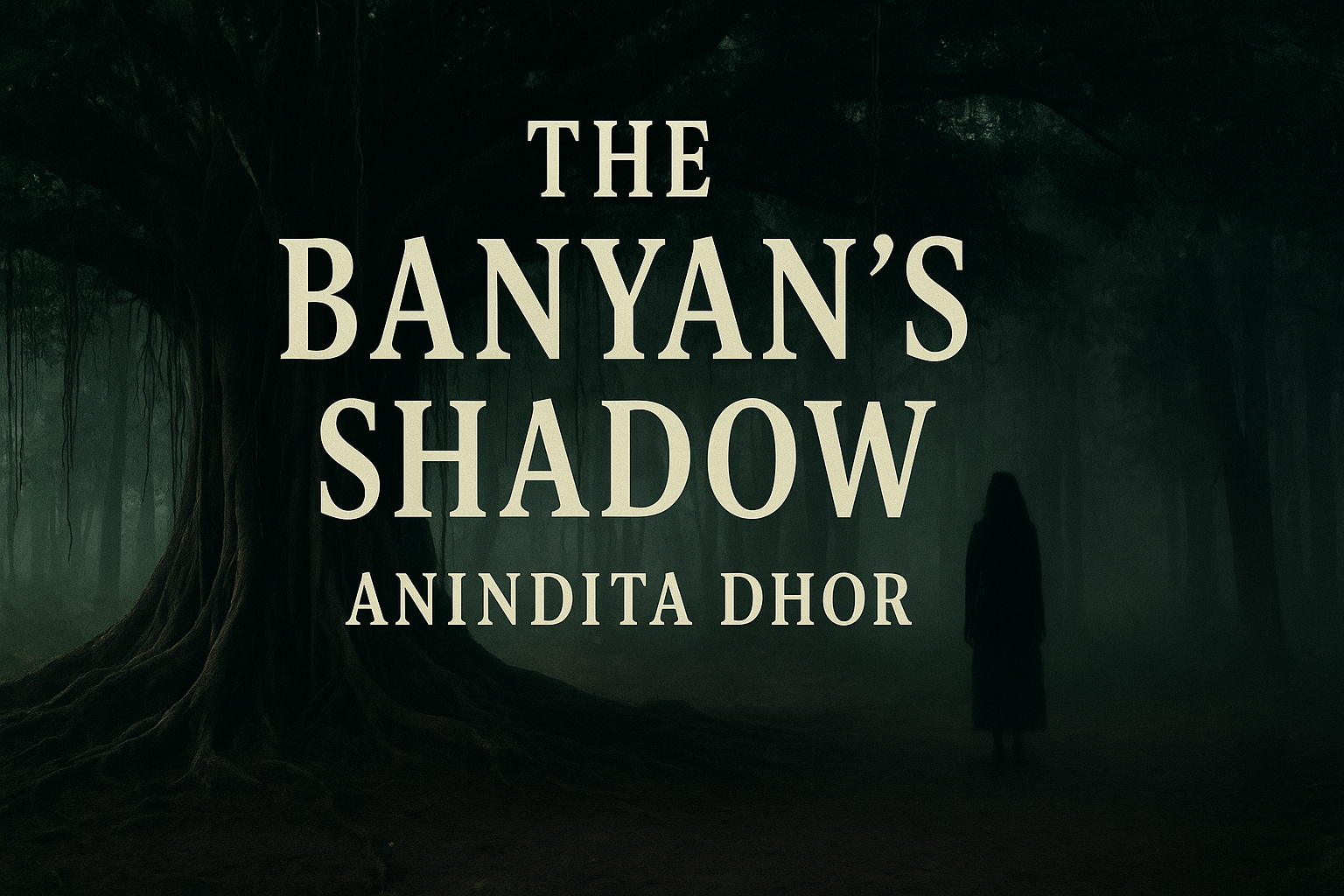

Anindita Dhor
Arrival at Chandipur
Aarohi Sen leaned back against the worn leather seat of the old Kolkata-to-Chandipur bus, trying to shake off the fatigue of the journey. The bus had rumbled through endless paddy fields, the green stretching to the horizon under a heavy monsoon sky. Rain pelted the metal roof, drumming a restless rhythm that seemed to seep into her bones. She could feel the chill in her fingers despite the thick woolen sweater she had thrown over her shoulders.
The village of Chandipur appeared suddenly, as if emerging from a fog. Mud-streaked paths wound between tightly clustered huts, and the smell of wet earth mixed with incense from small shrines scattered around. Children ran past, laughing, their bare feet splashing in puddles. But despite the liveliness, a strange hush seemed to hang over the outskirts, especially near the ancient banyan tree at the village’s edge.
Aarohi had heard the stories before she arrived—tales of villagers disappearing without a trace, of whispers beneath the sprawling roots of the banyan. But as a journalist, skepticism was her shield. Ghost stories were fine for folklore columns; she was here for something more tangible.
She stepped off the bus, her suitcase sinking slightly into the mud. A thin mist hovered over the fields, curling around the huts like ghostly fingers. A few villagers watched her silently, their expressions unreadable, eyes shadowed beneath wet, clumped hair. One old man muttered something under his breath, clutching a walking stick like a lifeline.
“Are you Aarohi Sen?” a voice called. She turned to see a young man, probably in his early twenties, approaching hesitantly. He introduced himself as Rohit, the local shopkeeper’s son. He had a nervous smile and kept glancing toward the banyan tree in the distance.
“The tree…” he said, his voice almost breaking. “It’s… you shouldn’t be wandering too close. People have… gone missing.”
Aarohi nodded politely, but curiosity pricked at her. “I’m here to see it for myself. To report. That’s why I came.”
Rohit’s gaze flitted to the dark mass of the banyan. Its thick roots twisted like serpents across the ground, disappearing into shadows that seemed darker than the overcast sky. “They say the tree… listens,” he murmured. “And it remembers.”
A shiver ran down Aarohi’s spine, but she chalked it up to the wind and rain. She checked into the small guesthouse Rohit recommended, a humble structure with creaking doors and wooden floors damp from the monsoon. Her room overlooked the village path leading to the banyan tree.
As night fell, the wind picked up, rattling shutters and sending rainwater streaming down the walls. Aarohi sat by the window, notebook in hand, recording her first impressions of Chandipur. The villagers’ hesitant warnings, the uneasy glances toward the banyan, the inexplicable weight in the air—it all felt like material for a compelling story.
And then she heard it.
A faint whisper, almost like a sigh, drifted from the direction of the tree. Aarohi froze, her pen hovering over the page. The sound was so soft she could have imagined it, yet it carried a cadence, a rhythm that felt disturbingly human.
“Hello?” she called out, her voice barely audible over the storm. The only answer was the patter of rain and the occasional rustle of leaves.
Shaking off the chill, she convinced herself it was the wind playing tricks. But deep in her gut, Aarohi felt the first stirring of a truth she couldn’t yet name: Chandipur was not a place where the dead and forgotten stayed buried quietly.
And the banyan… it was waiting.
The First Night
Aarohi didn’t sleep well that night. The rain had slowed to a steady drizzle, but the wind still moaned through the gaps in the guesthouse’s wooden shutters. Each creak of the old building sounded amplified in the darkness. She lay under the thin blanket, notebook and pen resting on her chest, thinking about the banyan tree.
By dawn, she had made a decision: she would visit it. Equipped with her camera, a flashlight, and a small umbrella, she stepped out into the misty morning. The village seemed quieter than the night before, almost expectant, as though it, too, were holding its breath.
The path to the banyan tree wound through wet fields, the mud sucking at her boots with every step. When she arrived, the tree loomed over her like a sleeping giant. Its massive aerial roots curled around the earth, creating hollowed-out spaces where the soil had eroded. The trunk was wide, gnarled, and darkened by years of rain. Even in daylight, it exuded a sense of ancient presence, and Aarohi felt a shiver crawl up her spine.
She circled the tree, snapping photos of its roots and the offerings scattered at its base—old coins, clay figurines, and incense sticks, long extinguished. She noticed talismans tied to some of the aerial roots, faded red threads knotted around small pieces of metal. Something in the air felt heavy, charged, as though she had stepped into another time.
A sudden movement made her turn sharply. A shadow flitted between the roots, quick and silent. Her heart pounded, and she raised the camera, but by the time she focused, there was nothing. Just a rustle of leaves.
“I must be imagining things,” she muttered, but the uneasy feeling lingered.
By evening, she decided to camp near the tree to observe it through the night. She set up a small tent at a safe distance, keeping her flashlight and camera close. The sky darkened quickly, swollen with storm clouds, and the first rumbles of thunder echoed across the fields.
Around midnight, the whispers began. Faint at first, almost imperceptible, like the sighing of a far-off wind. Aarohi froze. She strained her ears. The whispers seemed to grow closer, curling around the roots, rising in rhythm with the rustling branches.
Her flashlight flickered. She swung it across the roots—and froze. A figure, pale and indistinct, moved within the shadows of the tree. It wasn’t entirely human. It appeared to shimmer, like smoke caught in the wind.
“Who’s there?” she called, her voice trembling. The figure disappeared, leaving only the wet, earthy scent of the soil and the faint trace of incense.
Aarohi’s mind raced. Rational explanations tumbled over each other—mist, trick of the light, exhaustion—but nothing calmed her growing dread. The tree seemed alive, aware of her presence, watching silently.
Then came the voice, unmistakable this time: soft, melodic, yet filled with an impossible sorrow.
“Aarohi… Aarohi…”
Her breath caught. The voice was calling her name. It was coming from the tree itself—or from the hollow spaces beneath its roots. Every instinct screamed at her to flee, but her journalistic curiosity anchored her to the spot. She whispered back:
“I’m here… who are you?”
The wind swirled violently, the branches overhead groaning as if in protest. Shadows danced across the tent. And then, as abruptly as it had begun, silence fell.
Aarohi sat frozen, notebook on her lap, pen trembling in her hand. She realized with a sinking certainty: this was no ordinary haunting. Something ancient and restless lived within the banyan, and it had recognized her presence.
As the rain continued to drum against the tent, Aarohi understood that her investigation had crossed a threshold. She was no longer an observer. She had become part of Chandipur’s story.
And the banyan… was waiting.
Hidden Talismans
The morning after her unnerving night, Aarohi woke to a damp chill seeping through her bones. She hadn’t slept well, the whispers from the banyan tree still echoing in her ears. Determined to get answers, she packed her camera and notebook and headed back to the tree, ignoring the uneasy looks of the villagers she passed.
The sun was weak behind heavy clouds, casting everything in a gray, muted light. The banyan tree seemed larger in daylight, its roots twisting into grotesque shapes, some forming natural alcoves that looked like hollowed-out doors. Aarohi crouched near the base, brushing away fallen leaves to reveal a small collection of talismans she hadn’t noticed before.
They were crude objects: tiny figurines carved from clay, tied with red and yellow threads, some smeared with dried ash. A few had coins or miniature bells attached. Each one seemed meticulously placed, as if someone—or something—had left them to appease the tree. Aarohi snapped photographs, fascinated despite a creeping sense of dread.
Her fingers brushed over one particularly old charm. The clay was cool and damp under her touch, and suddenly she felt a sharp prickle down her spine, like the tree itself had shivered. She recoiled instinctively, only to notice something odd: a faint, almost imperceptible pattern etched into the soil around the tree. Circles, spirals, symbols she didn’t recognize—ancient markings designed with purpose.
A voice called out from the path.
“You shouldn’t be touching those.”
Aarohi looked up to see Rohit, the shopkeeper’s son, standing stiffly. His eyes darted nervously to the roots. “They’re not just decorations. They… they’re for keeping it calm.”
Aarohi raised an eyebrow. “Keeping it calm?”
Rohit swallowed hard, stepping closer. “The banyan… it’s not just a tree. It’s… alive. People believe it listens, watches, punishes. Those talismans… they’re meant to protect us. Or at least delay what comes.”
Aarohi felt a chill creep over her. She had encountered superstition before, but something in Rohit’s tone—the tight line of his lips, the fear in his eyes—made it impossible to dismiss. “Delay what?” she asked.
He shook his head. “Disappearances. The tree… it doesn’t let go of anyone it notices. Not entirely. Not unless…” He trailed off, unwilling to say more.
A sudden gust of wind rustled the roots. Aarohi felt the air shift, heavier somehow, as though the tree itself were leaning closer. Her camera clicked instinctively, capturing shadows that seemed to move against the flow of light. She could almost hear it whispering, faint and sibilant, like the rustle of dry leaves—her name again.
Rohit backed away, muttering prayers under his breath. “Some things in Chandipur are better left alone,” he said. “The tree remembers every wrong, every secret… every lie.”
Aarohi’s journalistic curiosity battled with instinctive fear. The markings, the talismans, the villagers’ warnings—they pointed to something far older and darker than she had imagined. And as she studied the tree, she noticed a hollow space beneath the roots, shaped almost like a doorway. A strange, almost imperceptible light flickered from within.
She knelt closer, peering inside. The air smelled of damp earth and something else, something metallic, like dried blood. For a brief moment, she thought she saw a face, pale and twisted in anguish, staring back at her from the shadows. Then it was gone, leaving only silence—and the oppressive weight of the banyan.
Aarohi straightened, heart pounding. The tree was no longer just a subject for her story. It was a living enigma, guarding centuries of secrets, demanding attention—and now, she felt certain, it had taken notice of her.
That night, she returned to the guesthouse, notebook filled with observations, photographs, and sketches. She couldn’t shake the feeling that someone—or something—was following her. Every rustle of leaves outside her window made her flinch. Even in her room, the air felt heavier, charged, waiting.
And from the corner of her vision, she could swear she saw shadows move like roots reaching out, stretching closer, eager to entangle her in the banyan’s dark embrace.
Visions in the Monsoon
The monsoon had fully arrived in Chandipur, and the village was drenched in endless sheets of rain. Aarohi woke to the sound of raindrops hammering against the guesthouse roof, their relentless rhythm like a heartbeat syncing with her own anxiety. The air smelled of wet earth, decaying leaves, and something faintly metallic. She knew the banyan tree awaited her, and she could no longer ignore the pull.
With her camera, notebook, and flashlight in hand, Aarohi ventured out. Rainwater pooled in the narrow paths, and each step made a squelching sound that echoed strangely against the quiet village. Even the children were nowhere to be seen, and the adults kept their doors shut, peering through small windows with wary eyes.
By mid-afternoon, she stood again before the banyan. Its massive roots were slick with rain, and the hollow spaces beneath it seemed darker than the shadowed clouds above. Aarohi approached cautiously, her fingers brushing against talismans and offerings. Then she noticed a faint glow emanating from the hollow beneath the roots—a soft, almost ethereal light, as if something inside was breathing.
She crouched closer. The moment she looked directly into the hollow, the world shifted. The rain around her seemed to blur, the sounds of the village fading. She was no longer in 2025, no longer in Chandipur as she knew it.
The banyan’s hollow had become a window to the past.
She saw women in faded cotton saris, their faces etched with sorrow and fear, kneeling beneath the tree, tying talismans around its roots. Men she didn’t recognize shouted, their voices angry, desperate. The villagers of long ago were performing some ritual, and the tree seemed alive, its roots curling like snakes, reaching toward the kneeling women.
Aarohi stumbled back, heart racing. The visions continued, unrelenting. She saw a young girl, no older than ten, standing beneath the tree. Her eyes met Aarohi’s across time, filled with a terror so raw that it made Aarohi’s blood run cold. The girl whispered something she couldn’t quite hear, but the emotion was unmistakable: plea, warning, despair.
Then, flashes of violence: shadows dragging villagers into the tree’s roots, the faintest hint of faces trapped in the bark, screaming silently. The hollow pulsed with a dark, living rhythm, and the whispers grew louder—Aarohi… Aarohi…
Aarohi pressed her hands to her ears, but the sound penetrated her skull. She had crossed some threshold. The banyan wasn’t just a tree—it was a guardian of memory, a collector of guilt and suffering. Every wrong committed in its shadow was etched into its roots, trapped forever.
When the vision faded, Aarohi was alone again, the monsoon drenching her, the hollow silent. But the weight of what she had seen pressed against her chest. She knew the banyan had revealed a fraction of its story, and that story was tied to the sins of the village, the villagers’ ancestors, and—somehow—her own family.
She backed away slowly, taking photos, though she feared the camera would fail to capture what her eyes had witnessed. The village itself seemed unchanged, yet she felt their silent judgment in every shadow, in every ripple of rainwater along the mud paths.
By nightfall, she returned to the guesthouse, soaked to the bone, shivering. Her notebook was filled with frantic sketches of the talismans, symbols, and the visions she had seen. She could barely eat, her mind replaying the images, the faces, the whispers.
And somewhere, in the hollow of the banyan, she could still feel it: the tree watching, waiting, remembering her presence.
That night, as she tried to sleep, the whispers returned—soft, insistent, like the brush of dry leaves across her skin: “Aarohi… see me… remember… release us…”
For the first time, she understood the terrifying truth: the banyan’s power was far older, far darker, than anyone had warned her. And it had chosen her as its witness.
The Goddess of Vengeance
The next morning, Aarohi awoke to a damp chill that seemed heavier than the previous days. She could still feel the weight of the banyan pressing against her mind, a lingering memory of whispers and shadowy faces. Determined to understand, she resolved to seek answers from the village elders.
She found Rohit near his father’s shop, nervously dusting off clay figurines that had fallen during the night’s rain. His eyes widened when he saw her approach.
“You’re going back to the tree?” he asked, voice tight.
“Yes,” Aarohi said firmly. “I need to know what’s happening. I need the story.”
Rohit hesitated, then lowered his gaze. “Then you should speak to Dadi Shanti. She knows the oldest tales, from when the banyan first became… cursed.”
Dadi Shanti lived in a small mud-brick hut on the outskirts, decorated with marigold garlands and incense smoke that curled lazily into the morning sky. She was frail but sharp-eyed, her skin etched with decades of sun and storm. Aarohi introduced herself, showing her notebook and photographs.
The old woman’s eyes darkened as she peered at the images. “The tree,” she said softly, “is no ordinary banyan. Long ago, there was a temple here, dedicated to Kali Maa, the Goddess of Vengeance. The villagers—your ancestors included—wronged her. They tried to trap her anger, to use her power for their own gain.”
Aarohi’s pen trembled as she wrote. “What do you mean, trap her anger?”
Dadi Shanti’s voice lowered. “The priests cast a binding ritual. They imprisoned the goddess’s spirit in the tree’s roots, chaining her to the earth. But she is alive still. She remembers every injustice. Every secret. Every lie. Those who come near the tree, those who awaken her memories… she judges them. Some are spared. Some… vanish.”
Aarohi felt a chill run down her spine. She thought of the visions, the shadows, the whispers calling her name. “And the talismans?” she asked.
“They are meant to calm her,” Dadi Shanti explained. “Not to defeat her. Not to reason with her. Only to delay her wrath. Every thread, every clay figure, every coin, it is a plea. A promise. And yet, it is not enough for those who carry guilt in their hearts.”
Aarohi’s mind raced. Guilt. Could it mean… her family? Her own presence in Chandipur?
“Many years ago,” Dadi Shanti continued, “the goddess’s spirit became restless. Children disappeared, villagers were swallowed by shadows beneath the roots. Those who saw her, the angry, vengeful form of Kali Maa, never spoke again. Some went mad. Some were never found. And now, she stirs again, because you have returned.”
The journalist in Aarohi fought to remain skeptical, but she could no longer deny the evidence. Every vision, every whisper, every talisman pointed to a force ancient, living, and merciless.
Dadi Shanti leaned closer, her eyes narrowing. “If you seek the truth, remember this: the goddess is patient. She waits. She watches. And she will test your heart before she lets you leave. You cannot fight her. You can only face what is in your soul—and hope it is not found wanting.”
Aarohi left Dadi Shanti’s hut with her notebook heavy in her hands, the words burning into her memory. The banyan was not simply a haunted tree—it was a vessel, a prison, a judge.
As she walked back, the sky darkened with the coming evening storm. The banyan loomed ahead, its roots twisting like the arms of a giant waiting to embrace—or to punish. And from somewhere deep within, a voice whispered her name again, low and mournful, carrying the weight of centuries:
“Aarohi… you see me… you remember…”
She quickened her pace, knowing that the next encounter with the banyan would not be merely observation. It would be a confrontation with the spirit itself, and with the truths she had long ignored.
Shadows of the Past
The monsoon had grown heavier over Chandipur, washing the village in a relentless gray. Aarohi walked through the puddle-laden paths, her notebook clutched to her chest. Dadi Shanti’s words haunted her: the banyan, the goddess, and now… the weight of her own family’s connection.
Back in her guesthouse room, she spread out her notes and photographs on the damp wooden table. The talismans, the symbols, the whispers—they were all part of a story that reached far beyond what she had imagined. She began to dig into the village records, census notes, and local genealogies that Rohit had helped her access.
Her heart skipped a beat as she found her family name, Sen, woven into the history of Chandipur. Generations ago, her ancestors had owned land near the banyan, and historical notes hinted at a dispute with the local priests, a betrayal that angered the goddess and led to the original binding ritual. Her great-grandfather had been listed among those who “tried to defy her wrath,” a phrase repeated ominously in the old documents.
Aarohi leaned back, mind spinning. The visions, the whispers—it was all tied to her bloodline. The banyan hadn’t simply noticed her presence; it recognized her heritage, the sins of her ancestors now echoing through her.
That evening, she returned to the banyan, compelled by a mixture of fear and journalistic obsession. The rain had slowed to a drizzle, but the roots still shimmered with dark wetness, and shadows seemed to shift unnaturally. She approached the hollow beneath the largest root, her flashlight illuminating shapes that almost looked like faces trapped within the bark.
“Aarohi…”
The whisper came again, soft and deliberate. Her breath caught. This time, she spoke aloud: “I know. I know about my family.”
The air seemed to shiver. Leaves rustled even without wind. A pale shape emerged from the hollow, flickering like smoke. It was a woman in tattered saris, eyes dark pits of sorrow, and yet, there was anger radiating from her. The figure drifted closer, and Aarohi realized with growing horror that this was not just a ghost—but the embodiment of the Goddess of Vengeance herself, in some fragmentary, tethered form.
“You carry their blood,” the spirit whispered, voice like rustling leaves. “The deceit, the betrayal… it courses through you as it did through them. Will you flee, as they fled? Or will you face what your heart has inherited?”
Aarohi’s knees trembled, but she squared her shoulders. “I don’t want to flee. I want to understand. I want to help.”
The spirit wavered, almost like a ripple in water, then spoke again. “Understanding does not spare you. Seeing does not absolve you. You must face the truth within yourself, or the banyan will claim what you carry.”
Aarohi felt the weight of the banyan press in on her from all sides. The roots seemed to move subtly, curling toward her as if testing her resolve. In that moment, she understood the terrifying power of the tree: it was not only alive, it was sentient, judging those who approached, measuring guilt, fear, and courage.
Shaking, Aarohi whispered, “I… will face it. I will not run.”
The figure faded into the shadows of the tree, leaving only the sound of dripping water and the faint rustle of leaves. Yet the voice lingered, echoing in her mind long after she returned to the guesthouse:
“Remember, Aarohi… the banyan sees all. The banyan waits.”
That night, she barely slept. Every shadow in her room seemed alive, every creak in the floorboards a potential movement from the banyan itself. The first undeniable truth had set in: she was no longer a visitor. She was part of Chandipur’s story. She was part of the banyan’s memory.
And with that realization came a cold certainty—what awaited her next would not only test her courage, but her very identity.
The Disappearances
The village of Chandipur had grown quieter over the past week, and not in the usual monsoon hush. There was an uneasy tension among the villagers, an undercurrent of fear that Aarohi could feel in every glance, every hushed conversation. Doors were shut earlier, children no longer ran freely through puddled paths, and the elders avoided her, their eyes clouded with worry.
Rohit met her at the guesthouse that morning, his face pale. “It’s happening again,” he whispered, glancing over his shoulder. “People… they’re disappearing.”
“Disappearing?” Aarohi asked, gripping her notebook.
He nodded. “First it was old Manik, the fisherman. Then Rekha, the girl who works at the shop. Last night… two men from the fields. Gone. No footprints in the mud, no cries. Nothing.”
Aarohi’s heart thudded painfully. She had known the banyan’s power was dangerous, but now she could see its effect manifesting in the real world. The disappearances were not stories—they were happening.
Determined to witness the truth, Aarohi returned to the banyan that evening, rain still dripping in persistent sheets. She approached the hollow beneath the largest root, the same place where she had first seen the spectral figure of the goddess. Shadows clung to the roots like living things, and the whispers had returned, low and sibilant.
“Aarohi… Aarohi…”
This time, the voice carried urgency, almost frustration. The hollow pulsed with a faint light, and she felt the unmistakable pull of something unseen, beckoning her closer. As she crouched to look in, she glimpsed figures moving within the shadows—vague, blurred, human shapes. They twisted and flailed, silent screams etched onto their faces.
Aarohi stumbled back, breath caught in her throat. The banyan was collecting them, she realized. These were the missing villagers, drawn into the roots, trapped within the tree’s ancient power. Each talisman she had seen before was not enough to save them. The banyan did not discriminate—it was a force beyond mercy.
A rustling behind her made her spin. Rohit stood there, drenched, his eyes wide. “You can’t stay here!” he shouted. “The banyan… it wants you now! It recognizes you!”
Aarohi nodded grimly, her journalist instincts battling with raw fear. “I know. That’s why I have to see it. I have to understand it.”
The roots seemed to respond, writhing subtly, curling toward her like living fingers. A faint, metallic scent filled the air, thick and heavy. The whispers intensified, overlapping voices now, calling names—her name repeated, interwoven with the pleas of the missing villagers.
“Release us… release us… Aarohi…”
Her mind reeled. The banyan was not just a tree. It was a prison and a judge, a vessel for the goddess’s vengeance, holding centuries of captured souls. And it had recognized her, not just as a witness, but as a participant, bound by the guilt of her ancestors.
Rohit grabbed her arm. “You have to leave! Tonight! If you don’t… you’ll be next.”
Aarohi shook his hand off gently. “I can’t run. I have to see this through. If I can understand her… maybe I can help them.”
The wind whipped violently, rain striking her face like shards of ice. From the hollow, a low, resonant growl emanated, a sound that was neither human nor animal. Shadows leapt and shifted, forming grotesque shapes that seemed to reach for her. She stepped closer, notebook and camera in hand, heart hammering.
The banyan was alive. It was aware. And it was hungry for the reckoning.
As the night deepened, Aarohi felt the first true brush of terror—the undeniable realization that the banyan’s power was far greater than she had imagined, and that the disappearances were only the beginning. If she failed to confront what lay within, she herself would vanish, another soul trapped in its dark embrace.
And somewhere deep in the roots, the whispers continued, patient, eternal:
“Aarohi… face me… or join them…”
Ritual of Confrontation
The night air in Chandipur was heavy, saturated with the scent of rain and wet earth. Aarohi knew she could no longer face the banyan alone. With Rohit’s hesitant guidance, she sought out Maa Bhavani, the local priestess reputed to possess knowledge of the old rituals, passed down through generations. Her small hut, hidden behind a tangle of banana plants and marigolds, glowed faintly from the flicker of oil lamps.
Maa Bhavani was an imposing figure despite her age. Her eyes, dark and penetrating, seemed to see through Aarohi’s very soul. Without a word, she motioned for Aarohi to sit.
“You have stirred what should have remained at rest,” Maa Bhavani said, her voice calm but firm. “The banyan sees the blood in your veins. The goddess waits. You must prepare, or you will be consumed like the others.”
Aarohi swallowed hard. “I want to help. I want to free them—the missing villagers, the souls trapped in the tree.”
The priestess nodded slowly. “Then you must face the tree and the goddess directly. It is a dangerous path. You will need protection, and you will need courage beyond fear.” She produced a bundle of red threads, dried herbs, and a small bowl of sacred ash. “These are the tools. The threads bind, the ash purifies, the herbs shield. Together, they may give you a chance. But understand this—the banyan is alive. It judges, it punishes, and it remembers every lie.”
As night fell, Aarohi followed Maa Bhavani and Rohit to the banyan. The storm had subsided, leaving only a drizzle that soaked the twisted roots and darkened soil. Aarohi placed the sacred ash in a circle around the tree’s base, tying red threads to the roots in careful patterns instructed by Maa Bhavani. She held the herbs close, feeling their pungent, protective scent mingle with the earthy aroma of the rain-soaked tree.
“Focus on what you know,” Maa Bhavani instructed. “Call the goddess. Acknowledge your lineage. Ask for mercy, not challenge. But be ready for the test.”
Aarohi knelt before the hollow beneath the largest root, whispering her name aloud and acknowledging her ancestors’ wrongs. The air thickened. The ground trembled beneath her knees. Shadows emerged from the hollow, forming a dense, twisting mass. The whispers returned—urgent, overlapping, haunting.
“Aarohi… blood of Sen… you remember… you will atone…”
Aarohi’s heart pounded. She forced herself to breathe steadily, chanting the prayers Maa Bhavani had taught her. The shadows swirled violently, forming the ghostly image of the goddess: a figure with eyes like dark pools of fury and sorrow, her hair wild, hands stretched as if reaching for justice.
“You carry their guilt,” the goddess’s voice thundered. “Will you acknowledge it, or flee?”
“I acknowledge it,” Aarohi shouted, voice trembling but resolute. “I see it. I see the wrongs of my ancestors, and I will not let their sins condemn the innocent!”
For a moment, the shadows paused, the storm seeming to hold its breath. Then a low, resonant hum filled the air, vibrating through Aarohi’s chest. The banyan’s roots writhed, curling toward her in an almost sentient rhythm, but the protective threads and ash seemed to form a barrier.
Slowly, the twisted shadows began to dissipate, revealing the faint silhouettes of the missing villagers, trapped in the hollow, pale and silent. Aarohi stepped forward, whispering their names. One by one, the figures moved through the roots, emerging into the rain-soaked clearing. They were weak, dazed, but alive.
The goddess’s image hovered above them, still immense, still terrifying, yet there was a flicker of acknowledgment in her eyes—a recognition that the atonement had begun. Then, almost imperceptibly, she receded back into the hollow, leaving only the whispers:
“Remember… remember… the banyan watches…”
Aarohi sank to her knees, soaked to the bone, exhaustion overtaking her. Rohit helped her to her feet, and the rescued villagers stumbled toward the safety of the village. Maa Bhavani approached, placing a hand on Aarohi’s shoulder.
“You have faced her,” she said quietly. “But the banyan never forgets. It waits for those who carry bloodlines like yours. You have survived this night, but the path is far from over. The goddess watches still.”
Aarohi nodded, drenched and trembling, realizing that she had won a temporary reprieve—but not victory. The banyan had judged, and she had survived. For now.
As the villagers returned to their homes, Aarohi glanced back at the massive, gnarled roots. In the faint flicker of lightning, she thought she saw shadows moving within the tree—waiting, patient, eternal.
And somewhere in the depths of the hollow, she could still hear the whispers:
“Aarohi… we remember…”
Escape from Chandipur
The village of Chandipur was quiet that morning, almost unnaturally so. Aarohi packed her few belongings into her backpack, her heart heavy with the knowledge that the banyan’s power still lingered, even after the ritual. The rescued villagers moved about in muted relief, but fear still glimmered in their eyes. The banyan had judged and spared them—for now—but its presence was not confined to its roots.
Rohit accompanied her to the edge of the village. “You must leave quickly,” he urged, glancing back at the distant shadow of the banyan. “Even now, it watches. It recognizes your bloodline. You can’t linger.”
Aarohi nodded, a knot of apprehension tightening in her stomach. She had thought survival meant she could return to her normal life, but the banyan had marked her. Its whispers had followed her every step, sometimes faint, sometimes nearly audible over the sound of the monsoon wind.
As she walked along the muddy path toward the main road, she felt the unmistakable shift in the air—a subtle tightening, as if unseen fingers were brushing against her spine. The shadows under the trees seemed to stretch unnaturally, reaching toward her. She quickened her pace, clutching her notebook and camera tightly.
Suddenly, she heard it: a whisper, unmistakable and clear:
“Aarohi… remember…”
Her heart leapt. She spun around, but the path behind her was empty, obscured by mist and rain. The banyan’s presence seemed to stretch far beyond its physical location, as though it had extended its roots into the very air around her.
Rohit grabbed her arm. “Do you feel it?” he asked, voice strained. “It’s not just the tree anymore. It follows those it chooses.”
Aarohi swallowed, nodding. “I know. I felt it the moment I left the clearing.” She looked back toward Chandipur one last time. The massive banyan loomed like a dark sentinel at the village’s edge. Its roots twisted impossibly, and the hollow beneath the largest root seemed darker, almost pulsating with anticipation.
The bus that would take her back to Kolkata arrived, rattling along the mud-slick road. Aarohi climbed aboard, heart pounding, and as the vehicle pulled away, she glimpsed shadows moving under the banyan, more defined than before—shapes of villagers, specters of the past, and something else: a faint flicker of a figure resembling herself, staring from the hollow, watching her leave.
She exhaled shakily, trying to calm the tremor in her hands. The city and its familiar chaos felt distant, yet the whispers had begun to echo in her mind, faint but persistent.
By the time she reached Kolkata, she felt the first tendrils of unease settle into her bones. The banyan had not been confined to Chandipur; its influence followed her, threading through her thoughts, lingering in reflections, in the shadows of her apartment. Every creak of the floorboards and flicker of light seemed to carry the faint echo of the whispers:
“Aarohi… we remember…”
That night, she could no longer sleep. Every mirror, every dark corner of her apartment seemed to breathe, pulse, and shift. She realized with a chilling certainty that the banyan had followed her, its roots invisible but present, stretching into the city, into her life, into her very mind.
Aarohi understood the terrifying truth: survival had not meant freedom. She had escaped Chandipur physically, but the banyan’s shadow now loomed over her everywhere, patient and eternal, a silent guardian of vengeance that would not be ignored.
The story she had come to write was no longer about folklore—it was about a living, breathing horror that had chosen her, bound to her bloodline, and would not rest until its reckoning was complete.
The Banyan in the City
The streets of Kolkata were drenched in the muted glow of streetlights, puddles reflecting neon signs and the blur of passing rickshaws. Aarohi Sen walked quickly through the monsoon-soaked sidewalks, backpack slung over one shoulder, her mind restless. The city should have felt like a refuge, a place of anonymity, yet she couldn’t shake the sense of being watched.
It began subtly. A flicker in her apartment mirror, the shadow of a branch moving against the flow of light. At first, she dismissed it as exhaustion, a trick of reflection. But soon, the whispers returned. Soft, sibilant, carrying the weight of centuries:
“Aarohi… remember… we are here…”
The voice made her blood run cold. She spun around, heart hammering, but her apartment was empty. The familiar walls now seemed strange, their corners too dark, their shadows stretching unnaturally. She realized with a shudder that the banyan’s reach had extended beyond Chandipur; it had followed her, threading its presence into her life.
Aarohi’s thoughts raced back to the ritual, the freed villagers, the goddess’s figure flickering in the hollow. She had survived the night, but the banyan had not finished its reckoning. The whispers were patient, eternal, reminding her that it judged not only her ancestors but her own choices.
She moved to the living room, camera and notebook in hand, scanning every reflection, every shadow. The air felt thick, heavy with an unnameable presence. Then she saw it: in the corner of the room, where the wall met the ceiling, a faint outline—a root-like shadow, twisting impossibly, pulsing as if alive.
Aarohi’s breath caught. The banyan’s essence had found a way into her city apartment, invisible yet palpable. Every instinct screamed to run, yet she stood frozen, knowing there was no fleeing this. This was the nature of the curse: it followed, it lingered, it remembered.
A rustle came from the hallway, and then, unmistakable, a whisper:
“Aarohi… see me… remember…”
Her reflection in the mirror shivered independently of her movement. Within it, she saw not just herself, but faces—dozens of them—twisted in sorrow and fear, trapped in the banyan’s roots, all staring directly at her. They were silent, yet their presence pressed on her mind like a weight.
Aarohi’s hands trembled. She realized the horrifying truth: the banyan had chosen her as both witness and custodian. Its power was beyond containment, beyond understanding. She could not escape. The whispers and shadows would always follow, a reminder of the sins of the past, of the debts she now bore.
Shaking, she sank to the floor, pressing her palms to her ears, trying to block the voices. Yet the whisper persisted, patient, eternal:
“Aarohi… we remember… we wait…”
Outside, rain pattered against the window. Inside, the shadows stretched and writhed, tendrils creeping along the floorboards and walls, pulsing with a life of their own. The banyan’s presence filled every corner, every reflection, a silent testament to centuries of vengeance and memory.
Aarohi knew she would never be free. The city, with all its chaos and familiarity, was no refuge. The banyan’s shadow had followed her into her life, and its patient, eternal gaze would never waver.
The story she had sought to write—an exploration of folklore, of a haunted tree—had become something far darker: a living, breathing horror, bound to her, inseparable from her reality.
As she stared into the mirror, the shadows twisting behind her, she whispered to herself, trembling but resolute:
“I remember. I will not forget.”
And from the corners of the room, almost imperceptible, came the faintest sigh, the lingering whisper of a presence that was no longer bound to a village, but bound to her:
“Aarohi… we are here… always…”
The apartment fell silent, yet the sense of watching, of waiting, lingered like a pulse in the walls. The banyan had followed, and it would never leave.
***