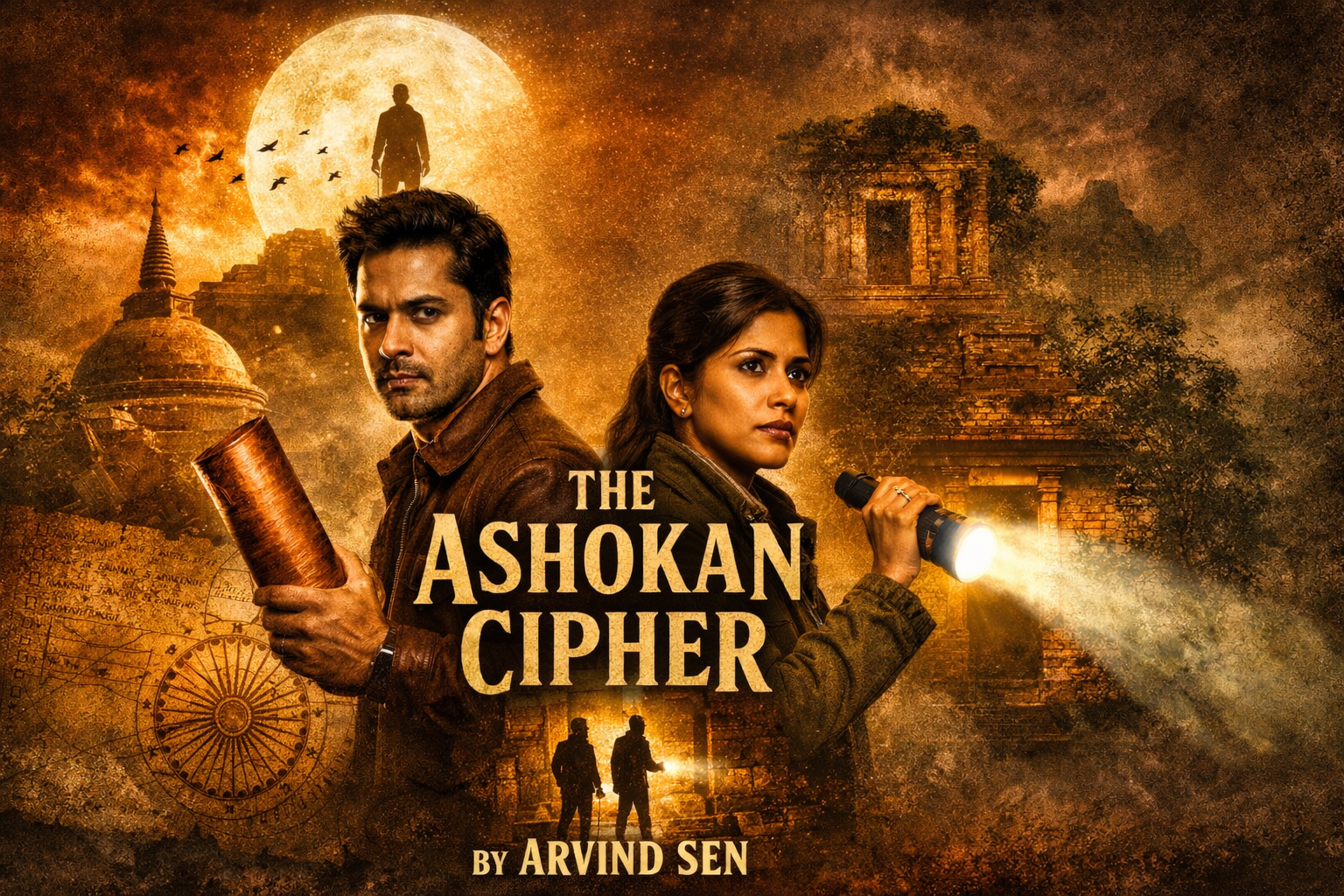

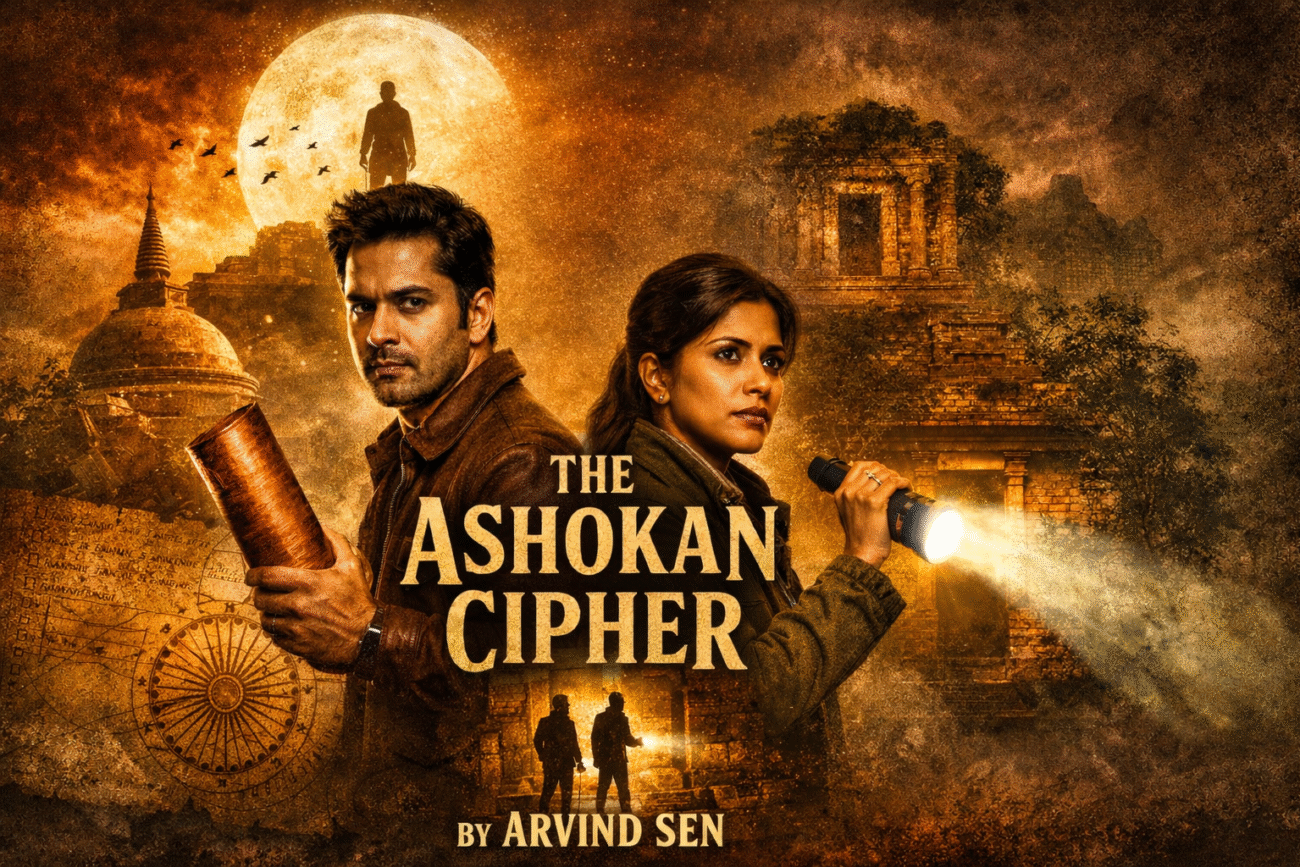
Arvind Sen
The Broken Stone
The rain had started just before dusk, the kind of quiet Kolkata rain that seemed less like weather and more like a memory returning to the city. The narrow lanes around College Street glistened under dim streetlights, and the smell of wet paper drifted from the old bookshops like a faint ghost of history. Inside the archive room of the Asiatic Society, Dr. Arnab Mukherjee sat alone at a wooden table scattered with manuscripts, notebooks, and a half-finished cup of tea that had long gone cold. Arnab had spent most of his life surrounded by history—dusty scrolls, forgotten inscriptions, broken statues whose silence carried stories older than empires. For him, history was never dead. It was simply waiting to be noticed.
The discovery had begun as an accident.
Three weeks earlier, a small excavation team from the Archaeological Survey had been digging near the outskirts of Bodh Gaya, where a new road expansion project had exposed fragments of an ancient mound. Most such finds turned out to be nothing more than pottery shards or weathered bricks. But this time, the workers uncovered a rectangular slab of stone half buried in mud. It was cracked diagonally across its surface, as though struck violently long ago. At first glance, it looked like any other fragment of a Mauryan inscription. But when photographs of the slab reached Arnab, something about the letters unsettled him.
Now the photographs lay spread before him.
The script was unmistakably Brahmi, the ancient writing system used during the reign of Emperor Ashoka in the third century BCE. Arnab had studied Brahmi for years, enough to read its curved characters almost instinctively. Yet the lines on this stone refused to behave like ordinary Ashokan edicts. The grammar was unusual, the spacing irregular. Some symbols appeared slightly altered, as if the stonecutter had intentionally modified the script.
Arnab leaned closer to the photograph, tracing a line with his finger.
“Impossible,” he murmured.
Ashokan edicts were well documented. The emperor had left dozens of inscriptions across the subcontinent—messages about moral conduct, compassion, and the principles of dharma. They were written clearly, meant to be read by common people. But this fragment did not read like a proclamation. It felt coded.
A knock on the archive door interrupted his thoughts.
Arnab looked up to see Professor Devika Rao entering the room, shaking raindrops from her umbrella. Devika was one of the most respected epigraphists in India and Arnab’s former mentor. Her sharp eyes quickly scanned the table.
“You’re still here,” she said, smiling faintly. “I thought the guard would have thrown you out by now.”
Arnab slid the photograph toward her. “Look at line three.”
Devika adjusted her glasses and bent over the image. For a moment the room fell silent except for the distant tapping of rain against the windows. Arnab watched her expression carefully. Devika rarely showed surprise.
But now her eyebrows tightened.
“This isn’t right,” she said quietly.
“That’s what I thought.”
She pointed at a cluster of symbols near the middle. “These characters… they’re Brahmi, but slightly altered. Almost like substitutions.”
“Exactly.”
Devika leaned back slowly. “You think it’s a cipher.”
Arnab nodded.
Neither of them spoke for a moment.
If the inscription truly belonged to Ashoka’s era, a coded message would be extraordinary. The emperor’s edicts had always been public declarations, not secret communications.
“Where did this come from?” Devika asked.
“Bodh Gaya excavation site. Found last month.”
She frowned. “That region already has several Ashokan pillars. But none like this.”
Arnab flipped open his notebook and turned it toward her. Across several pages he had copied the characters and attempted preliminary translations. Most lines made little sense. But one fragment had begun to form a strange sentence.
Devika read it aloud slowly.
“‘When the wheel turns toward silence… the truth must remain buried beneath the lion’s shadow.’”
She looked up.
“That doesn’t sound like Ashoka.”
“No,” Arnab said softly. “It sounds like someone hiding something.”
Outside, thunder rolled faintly over the city.
Devika studied the photograph again, then lowered her voice.
“Arnab, you know what this could mean.”
“A lost edict?”
“Or something that was never meant to be public.”
Arnab felt a familiar thrill rising inside him—the dangerous excitement of a mystery unfolding in the quiet corners of history.
“Look at the bottom edge,” he said.
Devika leaned closer again.
There, beneath the final line of text, was a faint carving almost invisible in the photograph. It was not a letter. It was a symbol.
A circle.
Inside the circle was a small figure of a lion.
Devika inhaled sharply.
“That’s not Mauryan iconography,” she said. “At least not officially.”
Arnab turned another page of his notebook. On it he had drawn the symbol again, enlarging the details. Around the lion’s mane were tiny marks—almost like numbers or stars.
“I’ve seen this somewhere,” Devika murmured.
“Where?”
She hesitated.
“In a manuscript that was never published.”
Arnab looked at her.
“What manuscript?”
Devika’s expression darkened.
“Something I read years ago in the archives at Nalanda University. A damaged Buddhist chronicle from the 12th century. It mentioned a secret council that existed during Ashoka’s reign.”
Arnab felt a sudden chill.
“A council?”
Devika nodded slowly.
“They were called the Nine Shadows of the Empire.”
The rain outside grew heavier, drumming against the windows like distant footsteps.
Arnab’s mind raced. Secret councils, coded inscriptions, hidden edicts—these sounded less like academic history and more like myth. Yet the stone fragment lay before them as undeniable evidence.
“If this symbol is connected to that story,” Arnab said, “then the inscription might be pointing somewhere.”
Devika’s voice dropped almost to a whisper.
“Or warning us.”
At that moment Arnab’s phone vibrated on the table.
He glanced at the screen.
An unknown number.
He answered cautiously. “Hello?”
For a few seconds there was only static.
Then a calm male voice spoke.
“Dr. Mukherjee.”
Arnab froze. “Yes?”
“You found the stone.”
The words sent a jolt through him.
“Who is this?”
The voice ignored the question.
“What you discovered should remain unread.”
Arnab’s grip tightened around the phone.
“Excuse me?”
“The emperor’s secret was buried for a reason.”
Arnab exchanged a quick glance with Devika.
“Who are you?” he repeated.
The voice paused.
Then it said quietly, “Stop translating the inscription.”
A faint click followed.
The call ended.
The room fell silent again.
Arnab slowly lowered the phone.
Devika looked at him.
“What happened?”
He swallowed.
“Someone knows about the stone.”
Outside the rain continued to fall over Kolkata, washing the streets of College Street while thousands of books slept behind locked shop shutters. Somewhere in the darkness of the city, a secret that had survived for more than two thousand years had begun to stir again.
And Arnab Mukherjee had just stepped into its path.
The Brahmi Code
The call ended, but its echo seemed to linger in the quiet archive room like a shadow refusing to leave.
Arnab stared at the dark screen of his phone for several seconds, as though the voice might suddenly return. The rain outside had grown steadier now, filling the night with a constant whisper. Devika watched him carefully from across the table.
“What did he say?” she asked.
Arnab placed the phone down slowly. “He told me to stop translating the inscription.”
Devika’s expression hardened.
“Did he identify himself?”
“No.”
“But he knew about the stone.”
Arnab nodded.
For a moment neither of them spoke. In the dim yellow light of the archive room, the photograph of the broken slab seemed to glow faintly on the table.
Devika leaned back in her chair. “That means one thing.”
“They’re watching,” Arnab said quietly.
Devika’s voice dropped to a whisper. “Or someone in the excavation team leaked information.”
Arnab shook his head. “Even then, how would they know I’m working on it?”
The question hung between them like a heavy weight.
Arnab looked again at the photograph. The cracked slab, the strange Brahmi characters, and the mysterious lion symbol now felt less like academic puzzles and more like the opening move of something larger.
“Let’s assume the warning wasn’t a prank,” he said finally.
Devika folded her arms. “Agreed.”
“Then someone believes this inscription hides something important.”
Devika leaned forward again, studying the copied characters in Arnab’s notebook.
“You said the grammar doesn’t match Ashokan edicts?”
“Not even close.”
Arnab flipped through several pages of notes. Over the past three days he had written dozens of variations of possible translations, trying to force the lines into recognizable structure.
But every time the text resisted.
Until this evening.
He turned to a page filled with carefully drawn Brahmi symbols arranged in two columns.
“I think the letters are substitutions.”
Devika raised an eyebrow. “Like a cipher alphabet?”
“Yes.”
Arnab pointed to the first line of the inscription.
“If we read it normally, it becomes nonsense. But if certain letters are shifted…”
He wrote a sequence quickly beside it.
Devika leaned closer as the symbols began to rearrange themselves into recognizable patterns.
After a minute she whispered, “Wait…”
Arnab nodded.
Now the line formed a sentence.
Devika read it slowly.
“‘When the wheel of dharma turns west… the guardians must conceal the ninth truth.’”
She looked up sharply.
“Ninth truth?”
Arnab tapped the page.
“That’s the second time the number appears.”
He flipped to another sheet of paper.
Across it he had written the partially translated lines from the slab.
Some were incomplete. Some still made little sense. But three fragments stood out clearly.
Devika read them aloud one by one.
“‘When the wheel of dharma turns west… the guardians must conceal the ninth truth.’”
“‘The lion watches the door of silence.’”
“‘Let the knowledge sleep beneath stone and fire.’”
The words felt ancient, heavy with intention.
“This doesn’t sound like philosophy,” Devika said slowly.
“It sounds like instructions.”
Arnab nodded.
“And the ‘ninth truth’?”
He hesitated.
“That might connect to the story you mentioned.”
Devika looked uneasy.
“The Nine Shadows of the Empire.”
Arnab had read countless legends during his research career—lost kingdoms, cursed manuscripts, forgotten sects. Most turned out to be historical exaggerations.
But this felt different.
“Tell me everything you remember about that manuscript,” he said.
Devika stood and walked slowly toward the tall window overlooking the rain-soaked courtyard.
“The chronicle was written by a Buddhist monk in the twelfth century,” she said quietly. “It described several secret traditions that survived the fall of ancient empires.”
Arnab listened carefully.
“One passage mentioned Emperor Ashoka forming a hidden council after the Kalinga war.”
“A council of scholars?” Arnab asked.
Devika shook her head.
“Not scholars.”
She turned to face him.
“Guardians.”
Arnab felt a chill creep across his spine.
“The text claimed Ashoka feared that certain knowledge could destroy civilization if it fell into the wrong hands.”
“What kind of knowledge?”
Devika spread her hands.
“The manuscript didn’t explain clearly. It only said that the emperor divided the knowledge into nine parts and entrusted each part to a member of a secret order.”
Arnab stared at the pages in front of him.
“Nine guardians.”
“Yes.”
“The Nine Shadows.”
Devika nodded.
The rain continued to fall outside, but now the archive room felt strangely smaller, as if history itself had leaned closer to listen.
Arnab flipped back to the photograph of the slab.
“What if this inscription is connected to that order?”
Devika didn’t answer immediately.
Then she said quietly, “That would mean the legend might be real.”
Arnab traced the symbol of the lion inside the circle again.
“And the ‘ninth truth’ might be one of those secrets.”
Before Devika could respond, the archive lights flickered.
Both of them looked up.
The electricity steadied again, but the moment left a faint tension in the air.
Arnab stood.
“I’m going to run a digital reconstruction of the inscription tonight.”
Devika frowned. “Here?”
“No. At my lab.”
He began packing his notebook and laptop into his bag.
“If the cipher works across the entire text, we might get a full translation.”
Devika hesitated.
“Arnab… maybe we should inform the Archaeological Survey.”
He paused.
“And tell them what?”
“That we might have found a coded message from a secret council of Ashoka?”
She sighed.
“You’re right.”
Arnab zipped his bag.
“Let’s finish the translation first.”
Devika nodded reluctantly.
“Fine. But be careful.”
Arnab smiled faintly. “When has history ever been dangerous?”
Devika did not return the smile.
“You’d be surprised.”
They left the archive room together and walked down the quiet hallway toward the exit. The building was almost empty now, its long corridors echoing with the sound of their footsteps.
Outside, College Street shimmered under the rain.
Bookshops stood closed behind metal shutters. A few tea stalls still glowed faintly beneath plastic tarps as the last customers hurried through the wet streets.
Arnab opened his umbrella.
“See you tomorrow,” he said.
Devika nodded.
“Call me if the translation reveals anything strange.”
Arnab laughed softly.
“I think we passed ‘strange’ a while ago.”
He turned and began walking toward the tram stop.
Devika watched him disappear into the rain.
Something about the evening felt wrong.
As she stood there thinking, a black car parked across the street slowly started its engine.
Inside the car, a man in a dark coat lowered a pair of binoculars.
“Confirmed,” he said quietly into a small radio device.
“The historian has the text.”
A faint voice answered through the static.
“Then the process begins.”
The man looked once more toward the direction where Arnab had gone.
“Should we stop him now?”
The voice replied calmly.
“No.”
A brief pause followed.
“Let him translate it.”
The man frowned slightly.
“And then?”
The voice spoke its final instruction.
“Then we take the stone.”
The radio went silent.
Rain continued to fall over Kolkata as the car’s headlights flickered on.
Far away, Arnab Mukherjee walked through the dim streets carrying his bag of notes, unaware that the ancient mystery he had begun to unlock had already awakened forces that had guarded its secret for more than two thousand years.
And somewhere deep inside the coded lines of the broken stone, the hidden message of the emperor waited patiently to be read.
The Nalanda Manuscript
Arnab Mukherjee’s apartment overlooked a narrow lane near Southern Avenue, where rainwater gathered in shallow puddles beneath the dim glow of streetlights. By the time he reached home that night, the rain had softened into a thin mist, but the city still carried the damp heaviness of the storm. Inside his study, books covered almost every wall. Histories of ancient India, epigraphic studies, Buddhist chronicles, archaeological reports—decades of scholarship pressed into silent rows.
Arnab placed his bag on the table and immediately opened his laptop.
The photograph of the stone slab appeared on the screen, its cracked surface magnified under digital light. The Brahmi characters looked sharper now, each curve and stroke etched like a whisper from the third century BCE.
He adjusted the image and opened the transcription file he had begun earlier.
If his theory about the cipher was correct, the inscription was not written in plain Brahmi. The characters had been shifted according to a pattern—possibly numerical or phonetic. Ancient India had used coded communication before, though rarely in stone inscriptions.
Arnab leaned closer.
“Let’s see what you’re hiding,” he murmured.
He began replacing characters according to the substitution table he had constructed earlier in the archive. Slowly, the broken lines started forming recognizable words.
At first, the translation seemed fragmented.
But then something extraordinary appeared.
Arnab stopped typing.
The line on the screen read:
“The ninth truth must remain sealed where the fire once consumed knowledge.”
Arnab frowned.
“Fire… consumed knowledge?”
He leaned back in his chair, thinking.
There was only one place in Indian history that fit that description.
Nalanda.
The ancient university of Nalanda had once been the greatest center of learning in the Buddhist world. Thousands of monks and scholars had studied there. Its libraries were legendary, said to contain countless manuscripts on philosophy, science, medicine, and mathematics.
Until the year 1193.
When invading armies burned the university.
Historical accounts claimed the library fires lasted for months.
Arnab stared at the translation again.
“…where the fire once consumed knowledge.”
Nalanda.
He quickly typed the next translated line.
The result made his pulse quicken.
“The lion marks the door.”
Arnab immediately grabbed his notebook and turned to the drawing of the mysterious symbol beneath the inscription—the lion inside a circle.
If the translation was correct, the symbol might not represent an organization.
It might represent a location.
Arnab stood up and walked toward his bookshelf, scanning the spines until he found a thick archaeological survey volume on Nalanda.
He opened it quickly and flipped through several pages of site maps and excavation diagrams.
Nalanda’s ruins were vast—temples, monasteries, courtyards, lecture halls. The complex had expanded over centuries, leaving layers of structures buried beneath one another.
Arnab studied the diagrams carefully.
Then he froze.
Near the eastern edge of the complex stood a lesser-known structure called Monastery Nine.
The building was partially destroyed during the medieval invasion, but one of its gateways still stood.
And carved above that gateway…
Arnab flipped to a photograph in the book.
A stone lion.
Not the famous Ashokan lions seen on pillars across India—but a simpler carving, weathered and almost forgotten.
Arnab felt a cold thrill.
“Nalanda,” he whispered.
At that moment his phone buzzed again.
This time the screen displayed a familiar name.
Devika Rao.
He answered immediately.
“I think I found something.”
Devika’s voice sounded tired but alert. “You translated more of the inscription?”
“Yes.”
“Tell me.”
Arnab paced slowly across the room while explaining the new lines.
“The inscription mentions fire destroying knowledge,” he said. “And the lion marking a door.”
Devika was silent for several seconds.
“You’re thinking Nalanda.”
“Yes.”
Her voice lowered. “That’s exactly where I read about the Nine Shadows.”
Arnab stopped walking.
“In the manuscript?”
“Yes.”
“Do you still have access to it?”
“Technically… yes.”
Arnab sensed hesitation.
“But?” he asked.
“The manuscript isn’t part of the public collection.”
“What do you mean?”
“It’s stored in the restricted archive of Nalanda University.”
Arnab smiled slightly.
“Well, that’s convenient.”
Devika did not sound amused.
“Arnab, that archive requires special clearance.”
“So we request it.”
Devika sighed softly.
“You’re moving very fast.”
He glanced again at the translated text glowing on his laptop screen.
“I don’t think we have much time.”
Devika immediately understood.
“The call.”
“Yes.”
If someone had already discovered that Arnab was translating the inscription, it meant the mystery surrounding the stone was not purely academic.
Someone else wanted the secret to remain hidden.
Or perhaps…
Someone else was searching for it too.
Devika spoke again.
“I’ll contact an old colleague at Nalanda tomorrow.”
Arnab nodded.
“If the manuscript still exists, it might explain the symbol.”
“And the Nine Shadows,” she added.
They ended the call.
Arnab returned to the laptop and began translating the remaining fragments of the inscription.
Most of the text was still incomplete because the slab had been broken. But one final line appeared near the bottom.
It took several attempts before the characters aligned correctly.
When they finally did, Arnab felt a shiver run through him.
The line read:
“When the lion awakens, the ninth truth will return to the world.”
Arnab stared at the sentence for a long time.
Return to the world.
Whatever this “ninth truth” was, it had been hidden deliberately.
Protected.
Guarded.
He saved the translation file and closed the laptop.
Outside his window the misty rain had stopped, leaving the city quiet and still.
Arnab turned off the study light and went to bed, though sleep did not come easily.
Across Kolkata, the night stretched slowly toward dawn.
But Arnab did not know that while he slept, someone else was already moving.
In a dimly lit room somewhere in the city, the man from the black car stood before a table covered with photographs.
Among them was the same image of the broken stone slab.
Another man sat across from him, his face half hidden in shadow.
“The historian is making progress,” the first man said.
The second man nodded slowly.
“That was expected.”
“He’s translating the cipher.”
“Good.”
The man frowned.
“You still want him alive?”
“For now.”
He tapped one of the photographs on the table.
It showed the ruins of Nalanda University.
“The inscription points there.”
“Yes.”
The shadowed man leaned forward.
“And when he reaches Nalanda…”
He paused.
“…the guardians will be waiting.”
The room fell silent.
Outside, somewhere in the sleeping city, dawn began to rise over Kolkata.
And far away in Bihar, the ancient ruins of Nalanda stood quietly beneath the pale morning sky, guarding secrets that had survived centuries of fire, invasion, and silence.
Secrets that were about to be disturbed again.
The Road to Nalanda
Morning arrived in Kolkata with the soft grey light that follows a night of rain. The streets were still wet, reflecting the slow movement of buses and trams beginning their daily routes. Arnab Mukherjee had barely slept. The translated lines of the inscription kept replaying in his mind like fragments of an unfinished puzzle.
Where the fire once consumed knowledge.
The lion marks the door.
Every path of reasoning led to the same destination—Nalanda.
By eight o’clock he was already in his study, drinking strong tea while rereading the translation on his laptop. The sentence about the “ninth truth” felt heavier the more he examined it. Ancient inscriptions rarely used language so cryptic unless they were meant to hide meaning.
His phone rang.
Devika.
“Good news,” she said as soon as he answered.
“You got access?”
“Not exactly,” she replied. “But I spoke to Professor Sandeep Sharma. He currently supervises the restricted manuscripts at Nalanda.”
“And?”
“He remembers the chronicle I mentioned.”
Arnab leaned forward.
“Does it still exist?”
“Yes. It’s catalogued as an incomplete Tibetan-Buddhist manuscript from the twelfth century.”
Arnab felt his pulse quicken.
“That’s it.”
Devika continued, “Professor Sharma agreed to let us examine it… unofficially.”
Arnab smiled.
“Unofficial is my favorite kind of permission.”
“We need to reach Nalanda tomorrow morning.”
“I’ll book the train.”
“No,” Devika said quickly. “We’re driving.”
Arnab frowned slightly.
“That’s six hours.”
“Exactly.”
“Why not take the train?”
Devika paused.
“Because if someone really is watching us, trains are easier to track.”
Arnab could not argue with that.
“Alright,” he said. “When do we leave?”
“Tonight.”
Arnab looked out the window at the waking city.
“Tonight it is.”
By evening, the sky over Kolkata had cleared. The humid air carried the smell of wet earth as Devika’s dark blue SUV rolled out of the city and onto the highway leading toward Bihar.
The traffic thinned quickly once they crossed the outskirts.
For a while neither of them spoke. The rhythmic hum of the engine filled the silence as long rows of trucks crawled along the highway.
Finally Devika glanced at Arnab.
“You look exhausted.”
“I’m thinking.”
“About the inscription?”
“Yes.”
Arnab opened his notebook again and pointed to the translated fragments.
“Look at this sentence,” he said.
Devika read it aloud softly.
“‘When the lion awakens, the ninth truth will return to the world.’”
She frowned.
“That sounds almost prophetic.”
“Exactly.”
Arnab tapped the page.
“What if the inscription wasn’t just hiding information?”
“Then what?”
“What if it was meant as a safeguard?”
Devika considered the idea.
“You mean instructions for protecting something?”
“Or releasing it.”
They drove in silence for another few minutes.
Outside the window, the landscape slowly changed from dense suburbs to wide stretches of farmland. The night sky above the highway was unusually clear.
Devika finally spoke again.
“The Nine Shadows story always bothered me.”
“Why?”
“Because if Ashoka really believed certain knowledge was dangerous, hiding it in stone inscriptions would be strange.”
Arnab nodded.
“Unless the inscription wasn’t meant to be found easily.”
Devika glanced at him.
“You think the cipher itself is a test.”
“Possibly.”
Arnab leaned back in his seat.
“Imagine it. A message designed so only someone trained in ancient scripts could read it.”
“And that person would be guided to Nalanda.”
“Yes.”
Devika’s fingers tightened slightly on the steering wheel.
“And what happens when they get there?”
Arnab gave a small smile.
“That’s the part we’re about to find out.”
Several kilometers behind them, another vehicle moved quietly through the night.
The black car.
Inside, the same two men from earlier sat in silence.
The driver watched the distant headlights of Devika’s SUV.
“They’ve left the city,” he said.
The man beside him nodded.
“Maintain distance.”
“Yes.”
The driver hesitated.
“Should we stop them before Nalanda?”
The other man looked out into the dark highway.
“No.”
“Why not?”
“Because the historian is useful.”
The driver frowned.
“Useful how?”
The man’s voice remained calm.
“He will lead us to the ninth truth.”
The driver said nothing more.
The black car continued following the distant SUV through the darkness.
Near midnight, Arnab and Devika stopped at a roadside dhaba somewhere near Dhanbad.
The small restaurant glowed under bright fluorescent lights. Truck drivers sat at metal tables drinking tea and eating late dinners while a radio played old Hindi songs in the background.
Arnab stretched his stiff legs.
“Long drive.”
Devika ordered tea for both of them.
They sat quietly for a moment while steam rose from the cups.
Arnab suddenly noticed something.
Across the road, a black sedan sat parked beneath a dim streetlamp.
Its engine was running.
The driver inside seemed to be watching the highway.
Arnab looked away quickly.
“Devika,” he said softly.
“Yes?”
“Don’t turn around.”
Her eyes narrowed slightly.
“Why?”
“I think we’re being followed.”
She remained perfectly still.
“The black car across the road?”
“Yes.”
Devika took a slow sip of tea.
“Did you see it earlier?”
“Not clearly.”
“Hmm.”
She placed the cup down calmly.
“Well,” she said quietly, “that confirms it.”
Arnab looked at her.
“You suspected something?”
Devika nodded.
“The warning call. The manuscript. Someone clearly doesn’t want us digging into this.”
Arnab glanced again toward the car.
“What do we do?”
Devika smiled faintly.
“We keep driving.”
“And if they follow?”
“Then they’ll reach Nalanda with us.”
Arnab laughed softly.
“That’s comforting.”
Devika stood and walked toward the SUV.
“Finish your tea,” she said. “We leave in five minutes.”
Across the road, the man in the black car watched them carefully.
He picked up the radio again.
“They noticed us.”
A faint voice responded through static.
“That’s acceptable.”
“What are your instructions?”
The answer came calmly.
“Let them reach Nalanda.”
The man lowered the radio.
His eyes followed Arnab and Devika as they returned to their vehicle.
Somewhere ahead in the darkness lay the ancient ruins of Nalanda.
And beneath those ruins—if the inscription was telling the truth—slept a secret buried since the time of Emperor Ashoka.
A secret that powerful people were still willing to kill for.
The Lion Gate
Dawn spread slowly across the plains of Bihar as Devika’s SUV rolled through the quiet road leading toward Nalanda. The eastern sky glowed pale orange, and a thin mist floated above the fields like a lingering dream. After hours of driving through the night, both Arnab and Devika were silent, watching the early light settle over the countryside.
Nalanda appeared gradually.
First the signboards along the road. Then the scattered ruins of ancient brick structures rising from the earth like red shadows of a forgotten city. Finally, the wide archaeological complex itself—sprawling across the land, its ancient monasteries and temples still standing after nearly fifteen centuries.
Devika slowed the car as they approached the entrance.
“Welcome,” Arnab said softly, “to the world’s oldest university.”
Nalanda had once been the intellectual heart of Asia. Thousands of monks, scholars, and students had lived here, studying philosophy, astronomy, medicine, mathematics, and Buddhist theology. Travelers from China, Tibet, Korea, and Persia had journeyed across continents to learn within its walls.
Until the fires came.
Arnab stepped out of the car and breathed in the cool morning air. The ruins were quiet at this hour, with only a few guards walking along the pathways.
Devika stretched her arms.
“Professor Sharma should arrive soon,” she said.
Arnab’s eyes wandered across the vast site.
Rows of red brick monasteries lined the ancient courtyards. Tall stupas rose like silent sentinels above the ruins. Despite centuries of decay, the place still carried a strange sense of dignity.
History had survived here.
Arnab pulled out his notebook and flipped to the drawing of the lion symbol from the inscription.
“If the translation is correct,” he said, “the lion marks the door.”
Devika nodded.
“There’s only one lion carving here that matches the description.”
“Monastery Nine.”
“Yes.”
Arnab pointed toward the eastern section of the complex.
“Then that’s where we start.”
Monastery Nine stood slightly apart from the rest of the ruins.
Its walls were partially collapsed, but the central gateway still stood upright, framed by weathered brick pillars. As Arnab and Devika approached, the carving above the entrance became visible.
A lion.
Not large or elaborate like the famous Ashokan lions—but unmistakable.
The stone lion sat within a circular frame carved into the gateway arch.
Arnab stopped walking.
“That’s the symbol.”
Devika looked at the carving carefully.
“The same lion from the inscription.”
Arnab opened his notebook and compared the drawing.
Even after two thousand years, the resemblance was clear.
“This can’t be coincidence,” he said.
Devika stepped closer to the gateway.
“The inscription said the lion marks the door.”
Arnab glanced around the courtyard.
A few tourists were wandering through the nearby ruins, but Monastery Nine remained mostly empty.
“Let’s go inside,” he said.
They stepped through the ancient gateway.
The courtyard beyond was quiet, surrounded by small monk cells built into the walls. In the center stood the foundation of what had once been a meditation hall.
Devika walked slowly across the courtyard, examining the brickwork.
“If something was hidden here,” she said, “it wouldn’t be obvious.”
Arnab nodded.
Ancient Buddhist monasteries often contained underground chambers used for storing manuscripts or relics.
He began examining the stone floor near the base of the gateway.
The translation of the inscription replayed in his mind.
The lion marks the door.
Where the fire once consumed knowledge.
Nalanda had burned.
Entire libraries had turned to ash.
But perhaps something had survived.
Arnab crouched near a cracked stone slab embedded in the ground.
“Devika,” he said.
She walked over.
“What did you find?”
Arnab pointed.
The slab had a faint circular carving near its edge.
Inside the circle…
Another lion.
Devika’s eyes widened.
“That’s it.”
Arnab ran his fingers along the edge of the stone.
“It’s not decorative.”
“No.”
He pressed lightly.
Nothing happened.
Devika knelt beside him.
“Maybe it’s a locking mechanism.”
Arnab looked closer at the carving.
Around the lion’s mane were small indentations—tiny marks arranged like a pattern.
Suddenly Arnab remembered something.
“The inscription mentioned the wheel of dharma.”
Devika looked at him.
“Yes.”
Arnab placed his fingers on the carved circle and turned it slightly.
For a moment nothing happened.
Then a faint grinding sound echoed beneath the stone.
Both of them froze.
The slab shifted.
Slowly, the circular stone rotated a few inches.
Dust fell from the edges as something ancient moved after centuries of stillness.
Devika whispered, “You just opened something.”
Arnab carefully pushed again.
The slab slid sideways, revealing a narrow dark opening beneath it.
Cold air rose from the darkness below.
Devika leaned forward.
“An underground chamber.”
Arnab felt his heartbeat quicken.
Two thousand years.
Whatever lay beneath this monastery had been hidden since the age of Ashoka.
“Flashlight,” Devika said.
Arnab pulled one from his bag and switched it on.
The beam of light cut through the darkness below the opening.
Stone steps descended into a narrow underground passage.
Arnab looked at Devika.
“Well…”
She smiled slightly.
“History first.”
They climbed down the steps.
From across the courtyard, hidden behind a collapsed wall, a man watched them disappear underground.
He picked up his radio.
“They found it.”
A faint voice answered.
“Excellent.”
“They’re inside the chamber.”
The voice remained calm.
“Wait until they retrieve the object.”
The man frowned.
“And then?”
The reply came quietly.
“Then remove them.”
He lowered the radio and looked again at the stone opening.
Below the ruins of Nalanda, the hidden chamber had finally been opened.
And deep beneath the ancient monastery, something that had remained sealed for centuries was about to see the light again.
The Chamber of Ashes
The air inside the passage was cold and dry, carrying the faint smell of dust and ancient stone. Arnab’s flashlight beam moved slowly along the narrow stairway as he and Devika descended beneath the ruins of Monastery Nine.
The steps were worn but stable.
Whoever had built this chamber had intended it to survive time.
“Careful,” Devika said quietly behind him. “The stones might be loose.”
Arnab nodded but kept moving downward.
The silence felt strange. Above them, Nalanda’s ruins stood under the open sky, visited by tourists and archaeologists every day. But beneath the monastery, this hidden passage had remained untouched for centuries.
Finally the staircase ended.
They stepped into a small underground chamber.
Arnab lifted the flashlight higher.
The room was built entirely from stone blocks, its walls blackened in places as though smoke had once passed through the chamber. The ceiling was low and curved like the inside of an ancient vault.
Devika slowly turned in a circle.
“This place was sealed deliberately,” she whispered.
Arnab nodded.
“There’s no sign of collapse. Someone closed it from above.”
The light fell across the floor.
Ash.
Thin layers of grey ash still covered parts of the stone ground.
Devika knelt beside it.
“Fire,” she said quietly.
Arnab remembered the translated line again.
Where the fire once consumed knowledge.
“After Nalanda burned,” he said, “someone must have hidden something here.”
Devika stood up.
“But what?”
Arnab moved the flashlight across the chamber again.
At the far end of the room stood a stone pedestal.
And on top of the pedestal—
A small rectangular box.
Both of them froze.
Even from several meters away, the object looked ancient.
The box appeared to be made of dark metal, possibly bronze, with intricate carvings along its edges.
Arnab walked toward it slowly.
Devika followed.
The carvings became clearer as the flashlight beam illuminated them.
They were not decorative patterns.
They were symbols.
Circles.
Wheels.
And lions.
Arnab felt his heart beating faster.
“This must be it.”
Devika looked around the chamber again.
“No other objects. No manuscripts. Nothing else.”
“Which means,” Arnab said, “whatever was hidden here… is inside that box.”
They stopped before the pedestal.
For a moment neither of them touched it.
Two thousand years of silence rested in that small metal container.
Devika finally spoke.
“Open it.”
Arnab carefully placed the flashlight on the pedestal so the beam shone directly onto the box.
He examined the lid.
There was no lock.
Only another carved symbol in the center—a wheel with eight spokes.
“The dharma wheel,” Devika said.
Arnab placed his fingers on the lid.
“Ready?”
Devika nodded.
He lifted it slowly.
The metal creaked softly as the seal broke.
Inside the box lay a bundle wrapped in faded cloth.
Arnab gently unfolded the cloth.
Something cylindrical rolled slightly onto the pedestal.
A scroll.
Not paper.
Metal.
A thin sheet of copper rolled into a scroll-like shape.
Devika inhaled sharply.
“A copper manuscript.”
Arnab carefully unrolled it.
The metal sheet revealed rows of engraved characters.
Brahmi.
But unlike the inscription on the broken slab, these characters were clear and complete.
Devika leaned closer.
“It’s another message.”
Arnab began reading the first line silently.
Then he whispered the translation.
“‘By the command of Devanampriya Ashoka…’”
Devika looked at him.
“That’s the emperor’s title.”
Arnab continued reading.
His voice grew slower as the meaning unfolded.
“‘…this knowledge shall remain hidden until the world is ready to bear its weight.’”
Devika frowned.
“What knowledge?”
Arnab read further.
The words seemed almost unbelievable.
“‘Within these teachings lies the science of destruction beyond armies and kings…’”
He stopped.
Devika stared at him.
“Destruction?”
Arnab read the next line again, making sure he had translated it correctly.
“‘The power of invisible fire that consumes cities and poisons the air.’”
Devika’s face turned pale.
“That sounds like…”
Arnab finished the sentence quietly.
“Chemical warfare.”
Silence filled the underground chamber.
Two thousand years ago.
A warning about invisible fire and poisoned air.
Devika shook her head slowly.
“That can’t be right.”
Arnab looked down at the copper scroll again.
“Maybe it’s metaphorical.”
But even as he said the words, he knew the translation felt disturbingly literal.
The scroll continued.
“‘Nine guardians shall protect this knowledge so that it may never be misused by rulers of ambition.’”
Devika whispered, “The Nine Shadows.”
Arnab nodded.
The ancient legend suddenly felt less like myth.
“These guardians,” Devika said slowly, “weren’t protecting religious secrets.”
Arnab looked at the engraved lines again.
“They were protecting dangerous knowledge.”
He continued reading.
“‘If the seal is broken, the guardian order must awaken again.’”
Devika’s eyes widened.
“Awaken?”
Arnab lowered the scroll.
“Maybe the inscription wasn’t just hiding this chamber.”
“What do you mean?”
Arnab looked toward the staircase leading back to the surface.
“Maybe it was also… a signal.”
At that moment a sound echoed faintly from above.
Footsteps.
Devika heard it too.
Someone was moving near the opening of the chamber.
Arnab switched off the flashlight instinctively.
The room fell into darkness.
They listened carefully.
Another sound.
A stone sliding.
Devika whispered, “We’re not alone.”
A faint beam of light appeared at the top of the staircase.
Voices.
One of them said calmly:
“Thank you, Dr. Mukherjee.”
Arnab felt his stomach tighten.
The voice continued.
“You have just completed a task that took us many years.”
Devika whispered, “The men from the highway.”
Arnab gripped the copper scroll tightly.
The voice from above spoke again.
“Please bring the scroll with you when you come up.”
A brief pause followed.
“Or we will come down.”
The beam of light grew brighter as footsteps began descending the stone staircase.
Arnab and Devika stood silently in the darkness of the ancient chamber, holding the secret that Emperor Ashoka had hidden from the world.
And now others had come to claim it.
The Guardians
The beam of light from the staircase cut through the darkness of the underground chamber like a blade. Arnab and Devika stood beside the stone pedestal, the copper scroll still in Arnab’s hands.
Footsteps echoed slowly down the stone steps.
Two men emerged from the passage.
Arnab recognized one of them immediately.
The man from the black car.
Tall, calm, dressed in a dark coat despite the humid heat of Bihar. The second man remained slightly behind him, holding a flashlight and something else in his hand.
A gun.
Devika inhaled quietly.
The first man spoke in a polite tone.
“Good morning, Dr. Mukherjee.”
Arnab did not respond.
The man’s eyes moved to the copper scroll.
“I see you found the object.”
Arnab tightened his grip.
“Who are you?”
The man smiled faintly.
“A student of history.”
Devika said sharply, “People who point guns at historians rarely are.”
The man seemed amused.
“Fair point.”
He stepped closer to the pedestal.
“We have been searching for this chamber for many years.”
Arnab said nothing.
“But the cipher,” the man continued, “required someone with your expertise.”
Arnab finally spoke.
“So you followed us.”
“Yes.”
“And let us open the chamber.”
“Of course.”
Arnab felt anger rising.
“You used us.”
The man nodded calmly.
“That was unavoidable.”
Devika looked at the copper scroll.
“You already knew about the Nine Shadows.”
The man’s expression changed slightly.
“Not everything.”
He gestured toward the scroll.
“But now we will.”
Arnab shook his head.
“You’re not getting it.”
The second man raised the gun slightly.
“Hand it over.”
Devika whispered to Arnab, “Don’t.”
Arnab looked again at the engraved copper sheet.
The words of Ashoka’s message echoed in his mind.
The power of invisible fire that consumes cities.
If the scroll truly described ancient chemical knowledge, it was not something that should fall into the wrong hands.
The first man seemed to read Arnab’s hesitation.
“You believe you’re protecting the world,” he said calmly.
“Yes.”
The man sighed.
“Dr. Mukherjee, the world you imagine already exists.”
Arnab frowned.
“What do you mean?”
The man spoke quietly.
“Chemical weapons. Biological warfare. Nuclear fire.”
He gestured toward the scroll.
“Whatever knowledge Ashoka feared… humanity has already rediscovered it.”
Devika said, “Then why are you here?”
The man’s eyes hardened slightly.
“Because knowledge is power.”
Arnab replied coldly, “That’s exactly why Ashoka hid it.”
The man smiled again.
“You still think this story is about morality.”
He stepped closer.
“But history is written by those who possess power.”
The second man moved forward.
“Enough talking.”
The gun pointed directly at Arnab now.
“Give us the scroll.”
The chamber felt smaller suddenly.
Devika’s voice was steady.
“Arnab.”
He understood.
Without warning, Arnab blew out the flashlight.
The chamber plunged into darkness again.
A shout echoed.
The gun fired once.
The shot struck stone, sending sparks across the chamber wall.
Arnab grabbed Devika’s hand.
“Run!”
They rushed toward the staircase.
Behind them the men shouted.
Another shot rang out, the bullet hitting the stone steps.
Arnab and Devika climbed quickly toward the surface, the narrow passage amplifying every sound.
By the time they reached the opening above, sunlight was flooding the courtyard.
They climbed out and pushed the stone slab back over the entrance.
Devika rolled a heavy brick across it.
“Move!”
They ran across the courtyard of Monastery Nine.
Tourists nearby turned in confusion as the two historians sprinted past them.
“Car,” Arnab said.
They rushed toward the parking area where Devika’s SUV waited.
Behind them, the stone slab at the monastery entrance shifted again.
The men were coming out.
Devika jumped into the driver’s seat.
Arnab slammed the door shut.
“Go!”
The engine roared to life as the SUV sped across the dirt path toward the main road.
In the rearview mirror Arnab saw the two men emerging from the ruins.
The man in the dark coat watched the SUV disappear down the road.
He did not look angry.
Only thoughtful.
The second man asked, “Should we pursue?”
The man shook his head slowly.
“No.”
“But they still have the scroll.”
“Yes.”
He looked back toward the ancient monastery.
“That was only the first chamber.”
The second man frowned.
“What do you mean?”
The man smiled faintly.
“Ashoka divided the knowledge into nine parts.”
He turned toward the ruins of Nalanda.
“We have just found one.”
The man’s voice lowered.
“And now we know the guardians were real.”
The second man looked confused.
“Guardians?”
The man glanced toward the road where Arnab and Devika had vanished.
“Yes.”
He said quietly.
“And they are already running.”
Inside the SUV, Arnab finally exhaled.
His hands were still shaking.
Devika drove fast along the narrow road leaving Nalanda.
“Are you alright?” she asked.
“Yes.”
He looked down at the copper scroll resting on his lap.
“Do you realize what this is?”
Devika nodded.
“A piece of history the world was never meant to see.”
Arnab looked out the window at the passing countryside.
“Or a warning.”
Devika said quietly, “What do we do now?”
Arnab thought for a long moment.
Then he said:
“We finish the translation.”
Devika glanced at him.
“And then?”
Arnab looked back at the scroll.
“Then we decide whether Ashoka was right to hide the ninth truth.”
The road stretched ahead into the afternoon sunlight as the SUV disappeared into the distance.
But somewhere behind them, the search for the remaining secrets had already begun.
And the ancient order of the Nine Shadows might not have disappeared after all.
The Ninth Truth
The road from Nalanda stretched endlessly through the plains of Bihar, cutting across quiet villages and fields of mustard that shimmered under the afternoon sun. Devika drove steadily while Arnab sat beside her, the copper scroll resting carefully across his lap.
Neither of them spoke for several minutes.
The events in the underground chamber had left a strange silence between them—a silence filled with realization.
Arnab finally broke it.
“They knew about the chamber.”
Devika nodded.
“Yes.”
“They knew about the inscription too.”
“Probably.”
Arnab looked at the scroll again.
“Which means someone has been searching for this for a long time.”
Devika glanced at him.
“The question is… why?”
Arnab slowly unrolled the copper sheet again.
The engraved Brahmi letters gleamed faintly in the daylight filtering through the car windows.
He began reading the lines once more, translating quietly.
“‘The ninth truth must never belong to kings…’”
Devika raised an eyebrow.
“That sounds like Ashoka speaking after the Kalinga war.”
Arnab nodded.
After the devastating battle of Kalinga, Emperor Ashoka had famously renounced violence and embraced Buddhist philosophy.
But the scroll suggested something deeper.
Arnab continued reading.
“‘Knowledge that destroys cities will destroy the soul of the world if wielded by ambition.’”
Devika’s voice softened.
“That sounds frighteningly modern.”
Arnab gave a small, uneasy laugh.
“History has a way of repeating itself.”
The scroll contained several paragraphs of engraved text.
Some lines described a secret order formed by Ashoka himself.
Nine individuals chosen for their intellect and loyalty.
Each guardian responsible for protecting a specific branch of dangerous knowledge.
Science that could transform civilization—or destroy it.
Medicine.
Psychology.
Propaganda.
Energy.
Biology.
Chemistry.
Mathematics.
Communication.
And finally…
Arnab traced the last section of the scroll carefully.
“The ninth truth.”
Devika said quietly, “What does it say?”
Arnab translated slowly.
“‘The ninth truth is the science of influence over the human mind.’”
Devika frowned.
“Influence?”
Arnab nodded.
“The ability to control the beliefs of entire populations.”
Devika looked stunned.
“You mean… propaganda?”
“More than propaganda.”
Arnab pointed to the engraved lines.
“This describes techniques for shaping collective thought. Manipulating fear. Creating obedience.”
Devika whispered, “Mass psychology.”
Arnab continued reading.
“‘Whoever controls the mind of the people controls the fate of nations.’”
The words felt chilling.
Two thousand years ago.
Ashoka had already understood something that modern governments and corporations still struggled to grasp—the power of controlling narratives.
Devika looked out the windshield.
“That’s the most dangerous knowledge of all.”
Arnab nodded slowly.
“A weapon without armies.”
The scroll ended with a final message from the emperor.
Arnab read it aloud quietly.
“‘If this knowledge is ever rediscovered, the guardians must ensure it is never used to enslave humanity.’”
Devika asked, “Guardians?”
Arnab folded the scroll carefully.
“The Nine Shadows.”
Devika frowned.
“But that order disappeared centuries ago.”
Arnab looked out at the long road ahead.
“Did it?”
Devika glanced at him.
“You think they might still exist?”
Arnab didn’t answer immediately.
Instead he reached into his pocket and pulled out his phone.
There was a new message.
Unknown number.
He opened it.
Three words appeared on the screen.
WELCOME, GUARDIAN.
Arnab felt a cold shiver.
Devika noticed his expression.
“What happened?”
He handed her the phone.
She read the message slowly.
“Guardian?”
Arnab said quietly, “Someone knows we have the scroll.”
Devika looked back at the road.
“So what now?”
Arnab leaned back in his seat.
“For two thousand years this knowledge stayed hidden.”
“Yes.”
“And people were willing to kill for it.”
Devika nodded.
“So what do we do with it?”
Arnab looked down at the copper scroll again.
He thought of the underground chamber, the ashes of Nalanda, and the warning carved by a king who had witnessed the horrors of war.
Then he said softly:
“We protect it.”
Devika smiled faintly.
“Like the Nine Shadows.”
Arnab nodded.
“Maybe that order never truly disappeared.”
Outside the car window, the fields of Bihar passed slowly under the fading afternoon light.
Far away, the ruins of Nalanda stood silent once more.
The chamber beneath Monastery Nine had been opened for the first time in centuries.
But the secret it contained had not been lost.
It had simply found new guardians.
Several hundred kilometers away, in a quiet office in Delhi, the man in the dark coat sat at a desk reviewing several photographs.
One of them showed Arnab Mukherjee leaving Nalanda with the scroll.
Another showed the lion symbol carved above Monastery Nine.
A third photograph showed something else.
Another ancient inscription.
This one located in Sri Lanka.
The man smiled slightly.
“So the first secret has been found,” he murmured.
The door behind him opened.
A woman entered the room.
“Did they escape?”
“Yes.”
“And the scroll?”
“With them.”
She frowned.
“You’re letting them keep it?”
The man leaned back in his chair.
“For now.”
“Why?”
He placed the photograph of the Sri Lankan inscription on the table.
“Because Ashoka divided the knowledge into nine parts.”
The woman looked at the image.
“And this?”
“Another location.”
He smiled again.
“The search has only begun.”
Outside the window, the evening lights of Delhi flickered on as the city prepared for night.
Somewhere on the long road between Bihar and Bengal, two historians carried a secret older than empires.
A secret that had shaped history in silence.
And across the world, the forgotten trail of the Nine Shadows was beginning to awaken again.
***