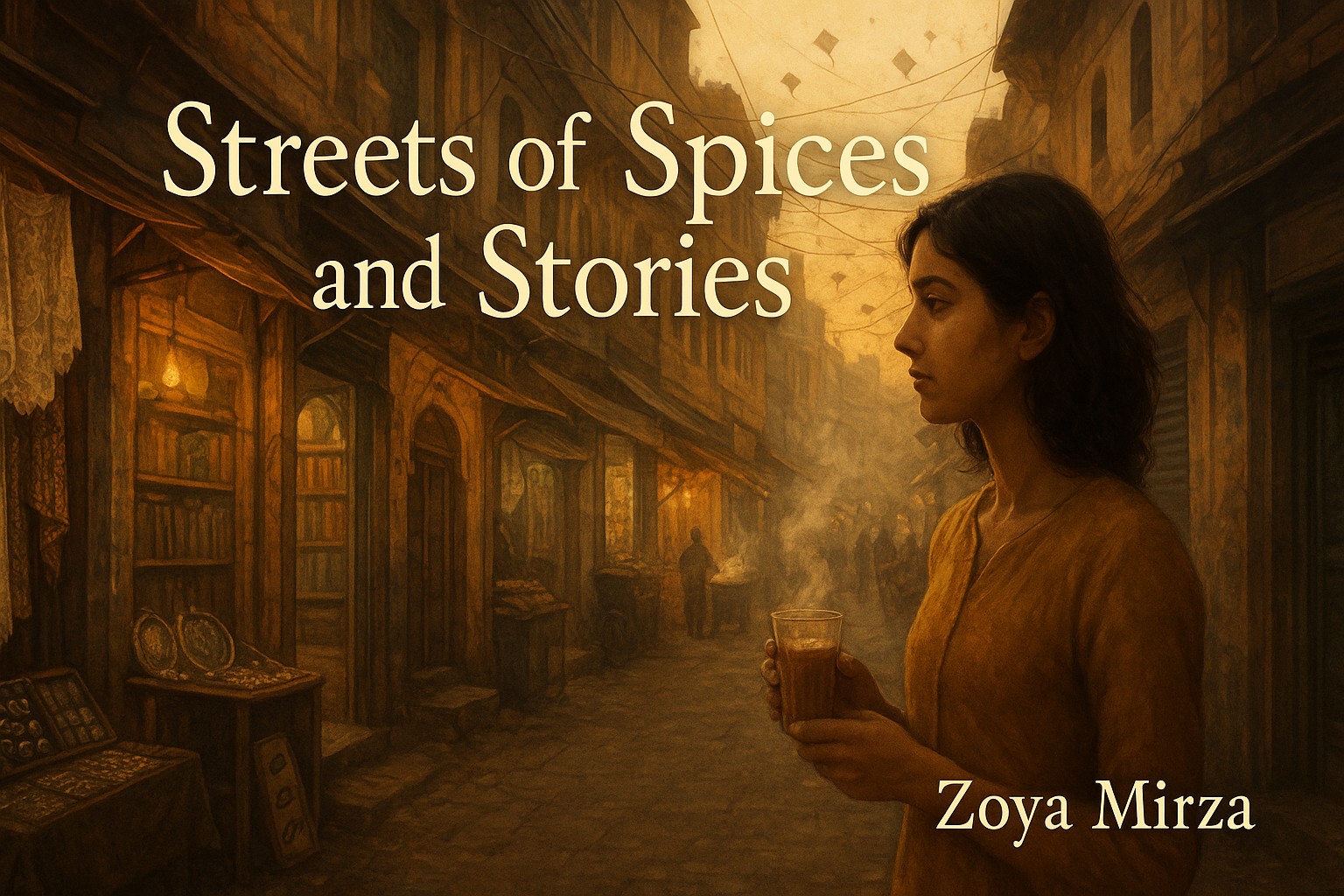

Zoya Mirza
Chapter 1: The Clocktower and the Chaos
The air in Old Delhi is not something you breathe—it’s something you step into, like a dense fog of memory, spice, and relentless sound. I surfaced from the depths of the Chawri Bazar metro station like a diver breaching the past. The escalator groaned under the weight of a hundred lives and then spat me out into a world that felt more alive than anything I had known in years.
The street outside buzzed like an old radio dialed between frequencies. Rickshaws honked as if they were in competition. Men with tea-stained shirts shouted the names of places I couldn’t yet pronounce. Overhead, a lattice of tangled wires drooped like vines from invisible trees, swaying with pigeons, dust, and possibly divine secrets. And there, rising above it all, stood the old Ghantaghar—the Clocktower—its face cracked, its hands stuck at a time no one seemed to mind.
I stood for a while, just staring. The tower, though no longer functional, commanded a presence like an old storyteller who no longer speaks but still makes you lean in. I wondered how many lovers had kissed under its indifferent gaze, how many rebels had dreamed, how many vendors had bartered for survival at its feet.
I was here alone, for no reason that made sense to anyone back home. Not for a wedding or a job or a photoshoot. I had taken a week off from a job I barely liked and left behind a flat filled with unopened bills and untouched cereal boxes. I had told no one—except a postcard I had written to myself the night before, which now lay in the bottom of my tote bag.
Just a line: “Find yourself somewhere older than your questions.”
So here I was.
A boy no older than ten pushed past me with a basket of guavas on his head, the fruit polished and glistening like jewels. I turned down a lane without thinking. That’s how you move through Old Delhi—not by plan, but by instinct, like following the sound of a flute in the dark.
The alley opened into a broader street—though calling it a street was generous. It was a theatre, and everyone in it played a part. A man roasted papad over open flame on one side, while across from him, a woman with tattooed arms arranged bangles on a red cloth like she was setting out weapons for battle. Old men squatted on newspaper-covered crates, gossiping about cricket and politics. Somewhere, someone was playing a harmonium off-key, the notes tumbling through the air like spilled sugar.
I passed a wall plastered with fading posters. One read “Jashn-e-Rekhta,” another bore the half-torn face of a forgotten politician. Over them all was the imprint of the past, like dust that refused to settle.
I stopped near a juice stall. The man behind the cart had a face that belonged in black-and-white photos. “Mosambi?” he asked, lifting a fruit toward the sun as if to prove its worth. I nodded, and he began his work, slicing, squeezing, humming a tune I didn’t recognize. The machine squealed. Juice spilled into a glass that was rinsed with two drops of water and a prayer.
“Taste this,” he said, handing it over with a proud smile. “No sugar. Just Delhi.”
It was cold and tart and earthy—like drinking a monsoon cloud. I thanked him with a note and a smile and kept walking.
Further down, I saw a dog asleep in the middle of the road, unbothered by the rickshaw that swerved at the last second. Above him, a faded sign read “Gali Qasim Jan”. I’d read somewhere that Mirza Ghalib had once lived down this lane. The idea that the poet’s footsteps might still echo in the dust made my skin tingle.
I didn’t enter the house that day, though I could have. I just stood by the gate, listening. Not to anything in particular. Just… listening.
Because that’s what Old Delhi does. It teaches you to listen. Not with your ears, but with your skin, your breath, your forgotten aches.
It was getting close to noon. The light had changed—harsher now, casting sharp shadows that danced between bicycles and barefoot children. I slipped into the shade of a bookshop, its door half-open, as if unsure whether to welcome or warn. Inside, the air was cool and dusty. Stacks of Urdu poetry books leaned against paperbacks about Mughal history and biryani recipes.
The shopkeeper was asleep, his chair tilted against the wall, a newspaper draped over his face like a second skin. I didn’t wake him. I didn’t need help. I wasn’t here to buy a book. I was here to remember how it felt to be surrounded by them.
I picked up a copy of Faiz and turned to a random page.
“Mujh se pehli si mohabbat mere mehboob na maang…”
My Urdu wasn’t perfect, but my heart understood. Don’t ask me for the love I once had. Don’t ask me to be who I once was.
That line sat with me for the rest of the day.
As I walked back toward the Clocktower, the sun beginning its slow descent, I felt something strange. Not happiness. Not sadness either. A kind of full emptiness. Like when you leave a movie theatre after watching something that changed you, but you don’t yet know how.
Tomorrow, I’d explore the kitchens and courtyards, the bazaars and baolis. But for now, I just stood there, under the indifferent hands of a frozen clock, letting Old Delhi seep into the cracks I didn’t know I had.
Chapter 2: The Food Building
They don’t mark it on maps, this place I found. But you’ll know it when you smell it—just beyond the southern gate of Jama Masjid, past the man selling rainbow bangles and the boy with the basket of second-hand phone covers. There, between a cracked blue wall and a kebab stall burning with smoky pride, is a staircase that leads to nowhere. Unless you believe in food that remembers your name before you tell it.
I had followed no guidebook. Just hunger. Not the kind that growls from an empty stomach—but the kind that whispers from an empty heart.
The staircase was narrow and uneven. I gripped a rusted railing and climbed into a corridor that seemed suspended between centuries. The ceiling was low. The light flickered. The paint peeled like old secrets. And then, at the end, a wooden door with no name, only a faint smell of garlic and crushed cloves leaking through the crack.
I pushed it open. What greeted me was not a restaurant. Not even a proper dining room. It was more like a temple of appetite, held together by devotion and smoke.
The walls were soot-stained and yellowed by turmeric. Old calendars hung beside clippings from newspapers I couldn’t date. A fan buzzed overhead like it had given up trying to cool the room years ago. On one side stood a tandoor, its mouth glowing red, and beside it, a bearded man in a kurta folded a paratha with the focus of a sculptor.
No menus. No counter. Just a handful of wooden tables and long benches. The kind that made you sit elbow-to-elbow with strangers and become less of a stranger by the third bite.
“Baitiye,” the cook said, motioning to an empty table. I sat.
A teenage boy came over with a steel tumbler of water and a question in his eyes. Before I could speak, he smiled. “You want nihari.”
It wasn’t a question. It was a reading. A divination. I nodded.
As I waited, I looked around. A family of six was sharing shami kebabs from a single plate. A couple sat in silence, the woman feeding the man pieces of naan like he was too tired to lift his hands. At the corner, an old man with milky eyes was sipping curry from a spoon as if each drop was a verse from his youth.
When the food arrived, it came not on a plate but in a deep, shallow-bottomed bowl placed reverently in front of me. The nihari shimmered. Slow-cooked meat, buried under thick, saffron-colored gravy, steamed with secrets. A fresh rumali roti, thin as breath, lay folded on the side like a love letter.
I tore a piece of the bread and dipped it in. The first bite melted into my tongue, the second made my eyes close. By the third, I had forgotten I was alone.
The boy returned and placed a side of pickled onions. “You’re not from here,” he said.
“No,” I replied.
“But something brought you here,” he smiled. “It always does.”
“What is this place?”
He looked around, then leaned in. “It used to be a house. A haveli. My great-grandfather cooked for the Mughals—at least that’s what we say at weddings. Then came the partition. Then the riots. And then… this.” He gestured at the tandoor, the walls, the oil-slick floor.
“So now you feed the city?”
He laughed. “No. We feed its hunger.”
I ate slowly, each bite like peeling back a memory. The nihari wasn’t spicy in the showy way of restaurants. It was warm and deep, like something you once tasted in your childhood but forgot how to name. The meat fell apart with a sigh. The gravy clung to the bread like an old friend who didn’t want to let go.
In the corner, a young boy was writing something on a napkin. A poem, maybe. A prayer. Or a recipe.
Just before I finished, the cook came over. He had flour on his sleeves and turmeric on his brow. He looked at my nearly empty plate, nodded once, and said, “Your eyes smiled. That’s how I know it was good.”
He brought over a piece of sheermal—soft, sweet bread brushed with saffron and rosewater. “No charge,” he said. “You came on a hungry day.”
It was the kind of sweetness that didn’t just end a meal—it blessed it.
I lingered a little after. The boy showed me an old family photo—black and white, five men in chef’s hats and sherwanis, holding ladles like swords. “This place never closes,” he said. “Even on curfew nights, we cooked.”
I left a generous tip and more importantly, a promise: that I’d return, with someone I loved, someday. Because some meals are too full for one.
As I stepped back onto the street, the sun was setting. The air outside felt heavier. But I felt light.
Down below, the world had returned to its usual chaos—horns, hawkers, hurried feet. But inside me, something had slowed. Something had stayed.
Because in Old Delhi, food is not just something you eat. It’s something you remember. Long after the plate is clean. Long after the city has forgotten your name.
Chapter 3: Dariba’s Forgotten Jewels
The next morning, I woke with a strange ache in my legs and a strange peace in my chest. My window, overlooking a tangle of rooftops, let in the sounds of honking scooters, early azaan, and pigeons flapping like old newspapers come to life. I poured myself a cup of cheap hostel chai and circled a place I’d only ever seen in footnotes: Dariba Kalan.
Once famed for its silver and gems, Dariba had lived through the Mughals, the Company Raj, Independence, and internet cafes. They say Shah Jahan’s daughters once shopped here, bartering for anklets and rose oil. Now, it was a crooked lane of shuttered shops, saffron marigolds, and time’s leftover shimmer.
The arch at the entrance bore a cracked sign: “Dariba Kalan – Street of Incomparable Pearls.” There were no pearls in sight, only glinting eyes of shopkeepers waiting like cats behind counters.
I turned into a lane of silver—literally. Every few feet, someone held up an earring, a bangle, a delicate chain that caught the sun and threw it back. But the real treasure waited further in.
His name was Faheem bhai, and he owned the tiniest store on the strip. The board said: “Faheem & Sons – Since 1890.” There were no sons in sight.
Inside, the shop smelled like velvet, polish, and nostalgia. Faheem sat on a low stool, legs folded, polishing a tiny jhumka with a piece of faded muslin.
“You don’t look like someone shopping for a wedding,” he said without looking up.
“I’m not,” I smiled. “I’m looking for a story.”
That made him pause. He put the jhumka down and gestured for me to sit on a wooden box covered with old newspapers.
“My grandfather made anklets for the Begum of Rampur,” he began, as though I had asked for proof of his credentials. “My father once repaired a brooch worn by Meena Kumari on a film set. Now people ask me for silver nose rings with emojis.”
I laughed, and he allowed himself the faintest grin.
“What keeps you here?” I asked.
Faheem looked out toward the street, where a boy on a bicycle yelled about lassi.
“Everything else left,” he said. “The filigree shops, the stonecutters, the pearl-polishers. But me? I stayed. Because someone has to remember how things used to shine.”
He showed me a drawer filled with unfinished pieces: half-etched rings, lone clasps, odd earrings missing their twin. “This,” he said, “is a box of waiting. Waiting to be whole again.”
I ran my fingers across a cuff bracelet shaped like a curling serpent. It was too ornate, too delicate to wear, but beautiful. “What’s this one’s story?”
“That?” he sighed. “That was ordered by a woman who never came back. Said she was getting married in Canada. Gave me a deposit and a smile. Haven’t seen her in ten years.”
“Do you ever think of selling online?”
He looked scandalized. “And who would write the story with it? Who would see the hands that made it?” His voice dropped. “Silver doesn’t like being posted.”
Just then, a young couple entered. She wanted something “cool and light.” He brought out a pair of minimalist earrings with geometric design. They admired, clicked photos, and left without buying.
“Instagram,” he muttered, shaking his head.
I bought a small silver pen-shaped pendant. It reminded me of poetry and bullets—both things I had grown up fearing and needing. He wrapped it in soft cloth, tied it with red thread.
“No plastic,” he said proudly. “Only memory.”
As I stood to leave, he added, “Next time, bring me a story. I’ll make you something in return.”
Outside, the sun was unforgiving. But Dariba still glinted in parts—on a shop mirror, in a nose ring worn by a bride, in the rhythm of a craftsman’s hand.
I turned once to see Faheem through the glass. He was polishing again. Not silver this time. But something older. Something rarer.
Maybe in another century, someone will walk down this lane and find a piece he made, worn by a woman who didn’t believe in disposable things.
And maybe they’ll say, “This isn’t jewelry. This is a sentence someone forgot to finish.”
Chapter 4: Kinari Bazaar and the Thread of Time
You don’t walk into Kinari Bazaar. You slip into it, like a thread into a needle. One moment you’re in a semi-quiet lane near the western edge of Chandni Chowk, and the next, you’re swallowed whole by a kaleidoscope of lace, zari, sequins, silk, and the perfume of wedding dreams.
It was mid-afternoon when I wandered in. The sun, no longer merciful, poured heat like syrup over the tin roofs. But the bazaar had its own weather. Shadowy. Glittering. Fevered. Like the backstage of a never-ending play.
The walls leaned inwards, the shops overflowed. Garlands of synthetic flowers hung like tangled chandeliers. Every inch shimmered with the ambition of a bride or the pressure of her family. There were borders of gota patti stacked like currency. There were tiny mirrors stitched into cloth as if light itself had been sewn in. A boy with nimble fingers threaded beads into an anklet while his father shouted into a phone about a late shipment from Surat.
I paused at a stall selling laces—rows of golden thread coiled into circles like edible jewelry. The vendor saw me, saw my bare wrists, and asked, “Shaadi kab hai?” When’s the wedding?
“No wedding,” I replied. “Just wandering.”
He laughed and muttered something to his assistant about “ajeeb tourists with empty suitcases and full eyes.”
I moved on.
Past a shop that specialized in turbans. Past another that sold bells for ghungroos. Past a mirror where I caught my reflection and barely recognized the woman staring back. Dust on her forehead. A smudge of turmeric on her sleeve. A tired face, but wide-eyed, alive.
It hit me then—how much this bazaar reminded me of my grandmother. Not her house or her clothes, but her stories. She used to tell me tales of her wedding. Of her mother hemming borders by lantern light. Of a lace that took three weeks to stitch and lasted through two marriages and one widowhood. Kinari Bazaar felt like the physical echo of that memory.
I entered a shop lit only by tube lights and time. No music, no chaos. Just silence and soft cloth. The shopkeeper, a woman in her sixties with oil-slick hair and a steel bangle on each wrist, was folding dupattas like she was folding history.
“Looking for something?” she asked.
“Maybe,” I said. “Maybe not.”
She studied me the way tailors study shoulders. Not rudely, but precisely. Then she opened a drawer and pulled out a piece of lace so delicate, it could’ve been breath frozen into gold.
“This was part of a trousseau in 1975,” she said. “The bride never used it. Said she wanted something modern. So it stayed.”
It was beautiful—aged just enough, like a poem yellowed by sunlight.
I ran my fingers over it. “Why keep it this long?”
She shrugged. “Some things aren’t meant to be sold. Just shown. Like old photographs. Or unspoken love.”
We sat in silence for a few moments. Somewhere outside, a boy was yelling the price of lehenga borders. A woman was bargaining with the ferocity of revolution. A child was crying over a lost sequin.
“I almost got married once,” I heard myself say.
The shopkeeper didn’t flinch. She just folded the lace back with more care than necessary.
“Almosts are sacred,” she whispered. “They stay whole. Perfect. Untouched by time.”
I bought nothing. She asked for nothing. I left with something far more precious—a fragment of peace stitched in silk.
As I stepped out, the bazaar pressed in again. But it no longer felt suffocating. It felt alive. Like it was made of the thousand choices women never spoke of—what to wear, what to lose, what to become.
I walked until the glitter began to blur. My hands were empty. But I carried the weight of a lace that had never been worn, and a life I had almost lived.
Chapter 5: The Evening Chai at Nai Sarak
It was almost evening when I turned into Nai Sarak, the street of books. The sun was lower now, casting amber shadows across tarpaulin roofs and fluttering paperbacks. Nai Sarak wasn’t quiet—Old Delhi never is—but it had a certain hush, the kind that only streets full of printed words can hold.
The first shop I passed had college guides piled to the ceiling. The second offered second-hand novels, bound in scotch tape and memory. The third… the third pulled me in.
It had no signboard, only a torn sticker on the shutter that said “Urdu Classics. Chai Free with Words.”
The inside smelled of dust, nostalgia, and a hint of cinnamon. Not cinnamon from a jar, but the kind boiled slowly in milk by someone who adds it without measuring. There were shelves of poetry—Faiz, Ghalib, Amrita, Sahir—and a tiny counter where a kettle hissed like a secret being kept warm.
An old man sat there, pouring tea into tiny glass cups. His kurta was the color of old parchment. A pair of round glasses sat low on his nose, as if they’d grown tired of responsibility. He looked up when I entered.
“You’re late,” he said.
“Late for what?”
“For the silence.”
I smiled. “Is it still available?”
He gestured to a stool. “Only until the city wakes again.”
I sat.
He poured me a cup of chai—dark, spiced, and so hot I had to hold it by the rim. The first sip was a sigh. The second was a song.
“You like Faiz?” he asked, pointing at the copy in my hand.
“I’m learning to,” I said.
He chuckled. “Faiz isn’t learned. He’s endured.”
Then he reached under the counter and pulled out a slim diary, wrapped in cloth. “Let me show you something.”
Inside were handwritten letters. Not photocopies. Not scans. Actual ink bleeding into actual paper.
“They wrote to him,” he said. “Young poets. Struggling lovers. Angry dreamers. And sometimes, he wrote back.”
He showed me one: a young woman from Lucknow asking Faiz if love was still possible after silence. Below, in elegant Urdu, Faiz had written back:
“Even silence, when held long enough, becomes a form of music.”
“Do people still write like that?” I asked.
“No,” he said. “They tweet.”
We both laughed.
The old man—he said his name was Professor Akhtar—used to teach Urdu literature at Zakir Husain College. Now, he ran this “bookroom,” as he called it, for chai, talk, and the occasional reader.
“Most come for the chai,” he said. “Few stay for the books.”
I stayed. We spoke of poetry and politics, of Ghazals and Gulzar, of how cities forget their own stories until someone walks in and remembers.
“I used to love someone once,” I admitted, surprising myself.
“Only once?”
I paused. “Only properly once.”
He nodded. “Then you understand Urdu.”
Before I left, he gave me a book of poems. On the flyleaf, he wrote in delicate ink:
“For the girl who arrived late, but not too late.”
The street outside had darkened. The shops were closing, the books being tucked in like children before sleep. A boy ran past carrying a basket of samosas. A woman bargained for a schoolbook.
And yet, the silence stayed with me.
Not the absence of sound. But the presence of meaning.
As I walked back, chai warming my veins, Faiz in my bag, and a faint smile on my lips, I realized I had fallen in love again—not with a person, but with a language, a city, and the quiet between two verses.
Chapter 6: A Walk Through Memory Gate
On my last evening in Old Delhi, I walked toward Turkman Gate. Not because it was famous, or particularly scenic, but because someone at the hostel had once said, “If you want to see how Delhi remembers, go to the Gate.”
So I did.
The road was uneven, lined with houses that leaned into one another like old companions. Streetlights blinked slowly to life. Children flew kites from rooftops, shouting in languages that overlapped like threads in a loom. An old man sold peanuts under a lamp. A woman in a green dupatta watered her tulsi plant and watched the world with eyes that had probably seen enough.
Turkman Gate loomed ahead—not majestic like the Red Fort, not ornate like Humayun’s Tomb, but solid. Tired. Honest. Built in the 1600s, the gate had survived more than just empires. It had seen curfews, fires, protests, prayers. Now it stood quietly, as if holding up the sky for a part of the city that had forgotten how to ask for help.
I leaned against a nearby wall. The stones were warm from the day’s sun, and somewhere inside me, something exhaled.
Behind me, laughter echoed.
A group of boys were gathered near a broken staircase, flying kites into the orange sky. One of them had eyes like crushed coal and a voice loud enough to carry across rooftops.
“Didi, want to try?” he asked, holding out the spool.
I shook my head. “I’ll lose it.”
“You only lose it if you’re afraid,” he said wisely.
I smiled and stepped forward. The spool was rough in my hands. He guided me—“Hold it like this… tighter… now pull.” The kite jerked upward, stumbled, then found its rhythm. The wind caught it. It soared.
And in that moment, so did I.
I thought of Faheem polishing silver no one wore. Of the old lace folded like a sigh. Of chai that smelled like music and poems written in pencil. I thought of streets without signboards, meals without menus, silences without regret.
Old Delhi hadn’t shown me just food or architecture. It had shown me inheritance—of culture, of grief, of beauty passed down in whispers and smells and stone.
The boy tugged the string. The kite dipped, then danced again.
“You’re good at this,” he said.
“No,” I replied. “Delhi is.”
He grinned and ran off, disappearing into a blur of motion and dust. The kite stayed.
As twilight thickened into night, I sat on the steps near the gate. Around me, the city hummed its lullaby—vendors closing stalls, radios playing old Hindi songs, the clatter of steel plates in homes too small for silence.
Before I left, I wrote myself another postcard:
“You found a place that didn’t need you to be extraordinary. Just present.”
I tucked it between the pages of Faiz, beside Professor Akhtar’s note.
Then I stood up, dusted off my jeans, and walked away—not like a tourist ending a trip, but like someone leaving a house where they once lived.
Old Delhi didn’t wave goodbye. It doesn’t do that. It just watches you leave, and waits for the next story to arrive.
[End of Story]