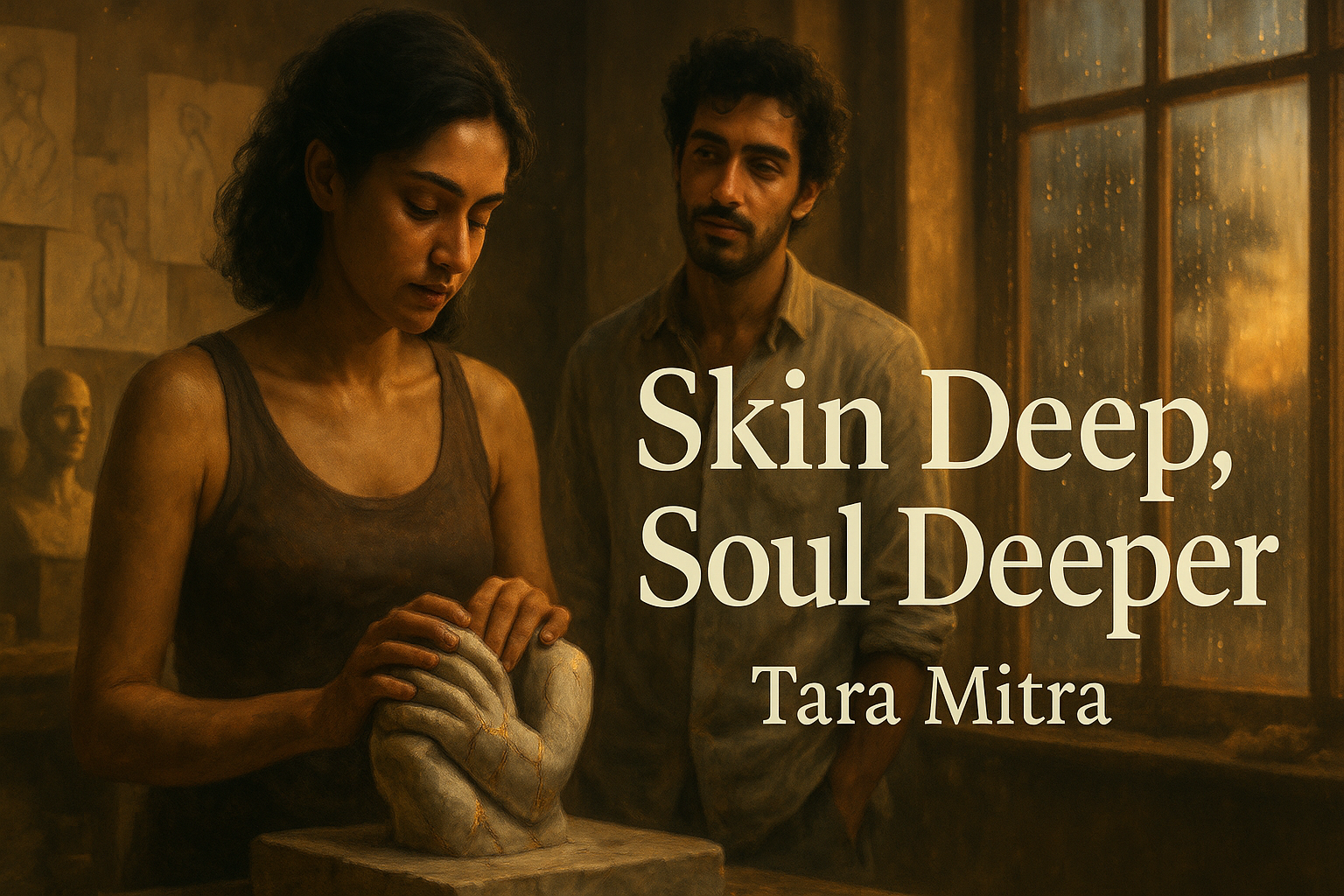

Tara Mitra
Part 1 — The First Gaze
The sky over Goa wasn’t just blue—it was bold, like a canvas splashed with reckless abandon. Rhea stepped into the quiet artist residency nestled between palms and silence, her duffel slung over one shoulder and her thoughts as heavy as clay. She had come here to escape, to disconnect, to breathe. After fifteen years in Mumbai’s blistering art scene, she wanted to sculpt something not for a client or a gallery, but for herself. Something raw. Something honest. She wasn’t prepared to meet Ayan.
He was leaning against the porch railing when she arrived—barefoot, loose white shirt unbuttoned at the top, curls unkempt like he hadn’t bothered to tame them for weeks. A notebook rested in his lap, a pen held lazily between his fingers. He looked up as her cab kicked up dust. Their eyes met. Just for a second. Just long enough.
He didn’t smile. Neither did she.
Later, when she was unpacking in her room—a whitewashed space with French windows that opened to bougainvillea—she found herself distracted by the scent of sandalwood and something sharper, muskier, coming in from the open window. She shook her head. It wasn’t like her to notice such things anymore.
Dinner was communal. The residency encouraged bonding, but Rhea wasn’t in the mood. Still, she joined the others at the long wooden table under the open-air shed, surrounded by oil lamps and salt-kissed air. Artists of all kinds—painters, photographers, dancers—introduced themselves. Ayan spoke last.
“I’m Ayan,” he said simply. “I write poetry I rarely share. I burn most of it. Sometimes I keep the ashes.”
The table laughed softly. Rhea didn’t. She was watching his hands. Long fingers. Ink-stained. She hated how easily her mind wandered to the way those fingers might feel tracing the line of her spine.
That night, sleep came in fits. She lay in bed, sheets tangled around her bare legs, the fan clicking above in steady rhythm. Every creak in the hallway pulled her attention. Around midnight, she heard soft footsteps pause outside her door. She held her breath. Then they walked on. Her heartbeat didn’t settle for minutes after.
The next morning, she found him on the beach. Not sketching or writing. Just standing ankle-deep in the tide, shirtless, his jeans rolled up, staring at the horizon like it had wronged him. She wanted to turn away, but her feet betrayed her. She walked to him without thinking.
“You always this intense before breakfast?” she asked, shielding her eyes from the glare.
He turned, and for the first time, smiled. It was crooked, like he hadn’t used it in a while. “Only when the sea pretends to listen.”
“I’m Rhea,” she said, realizing she hadn’t introduced herself last night.
“I know,” he replied. “You make sculptures that look like they’re still becoming.”
It was a strange compliment. But it landed. Somewhere below her ribcage.
They started meeting unintentionally—then intentionally. She found herself lingering in the kitchen when he came in for coffee. He lingered longer in the communal lounge when she was reading there. They didn’t speak much. But when they did, it always felt like a dare. Like they were walking a tightrope suspended between too much and not enough.
One night, a week in, she invited him to her studio. Not for company. Just to show him a bust she was carving out of grey marble—a woman’s face, half-formed, lips parted as if mid-sentence.
He stared at it for a long time.
“It’s not her mouth,” he said. “It’s her silence that speaks.”
She looked at him, really looked at him, and in that moment something fragile cracked open inside her.
“Do you always talk like that?” she asked, but her voice was softer now.
“Only when I want to be touched without being touched.”
She didn’t answer. But her breath hitched.
A week passed. They didn’t kiss. They didn’t touch. But the air between them pulsed like a second skin.
Then came the rain.
It was sudden and violent, hammering the tin roofs and splashing against the veranda where Rhea sat sketching. The lights flickered. The wind pulled the pages off her table. She ran outside to collect them, and in the downpour, she saw Ayan, drenched, laughing—laughing like a man who’d just remembered joy. She watched him from the steps, every inch of him soaked, shirt clinging to muscle, hair plastered to his face.
“You look ridiculous,” she shouted over the thunder.
“So do you,” he shouted back, stepping closer.
And then he was right there. Inches away. Water dripping from his lashes.
She didn’t stop herself. Neither did he.
The first kiss wasn’t soft. It was desperate. It tasted like salt and rain and held breath. His hands were at her waist, sliding up under her wet kurta, and hers tangled in his hair. They stumbled back inside, clothes clinging, kisses biting.
In her studio, he lifted her onto the worktable. Clay dust coated her thighs. His fingers left smudges on her skin. They didn’t speak. There were no declarations. Only the kind of silence that comes when bodies speak louder.
After, she lay against him, heart still racing. Her hand on his chest, tracing lazy circles over his skin.
“Are we just… this?” she asked quietly.
He tilted her chin up. “I don’t do ‘just.’ Not with you.”
Rhea wanted to believe him. But years of leaving and being left had taught her caution.
Still, as the storm outside softened into a hush, she let her head rest on his shoulder.
For now, it was enough.
But beneath the skin, something deeper had already begun.
Part 2 — The Aftertouch
The morning after smelled of turpentine, wet earth, and secrets. Rhea woke up before the sun cracked open the horizon, tangled in a coarse cotton sheet that still carried the scent of rain and skin. Ayan lay beside her, one arm curled possessively around her waist, his breath warm against the nape of her neck. She could feel the steady rhythm of his chest rise and fall, a tempo that her body had unknowingly tuned itself to.
She didn’t move. Didn’t want to wake him. And yet, part of her wanted to turn around, look at him in the light, trace the soft line of his jaw and commit every curve of his collarbone to memory. But she didn’t. Instead, she closed her eyes and let the weight of him press into her like a promise she wasn’t ready to ask for.
When he finally stirred, he didn’t say anything at first. Just kissed the small of her back, so lightly she almost thought she imagined it. Then he whispered, “You sleep like someone trying not to dream.”
Rhea smiled into the pillow. “Maybe I don’t like where dreams take me.”
“Then stay awake,” he murmured, pressing another kiss between her shoulder blades. “With me.”
The day began as if nothing had changed, but everything had. At breakfast, they didn’t sit next to each other, but their eyes found each other across the table. Rhea dipped her toast into black coffee and felt his gaze tracing the line of her wrist. Ayan scribbled something furiously into his notebook, then tore the page and tucked it into his pocket when he caught her watching.
Outside, the sea was louder than usual. Waves crashed with the kind of reckless abandon she’d always envied. Rhea took her sketchbook and wandered down to the beach, hoping to lose herself in the rhythm of lines and shadows. But every curve she drew reminded her of his body. His hands. His breath in her ear.
She tried not to let it get to her. Tried to treat it like a moment—beautiful, fleeting, like a shooting star you’re grateful for but don’t expect to see again.
But it wasn’t fleeting.
That night, he came to her again. No words. No knock. Just presence. Like his body belonged there in her doorway, in her space, in her silence. She let him in, and this time, it was slower. Not urgent, not frenzied. His mouth found hers with aching gentleness. They undressed each other with reverence, like sculptors unveiling something sacred. He kissed the scar just below her left breast without asking how she got it. She ran her fingers across the faded tattoo on his spine without needing to know why.
In the stillness afterward, he read to her. His voice low, rasping, as if the words tasted of her. She didn’t understand half the metaphors, but the way he said them made her body stir all over again.
They didn’t talk about what they were. They didn’t define or dissect it. But over the next days, the lines blurred.
They still worked alone. She spent hours in the studio, chiseling away at stone and clay, trying to find truth in form. He disappeared into the palm groves with his notebook, returning with eyes a shade darker than before. But the nights—they were never alone anymore.
One evening, as the sun dipped low and painted the walls of her studio golden, he sat behind her while she sculpted. Not saying anything. Just watching. Her hands moved with muscle memory, smoothing the ridges of a torso she hadn’t realized she was shaping in his likeness. She could feel his breath against her neck, but he didn’t touch her.
Then, suddenly, he stood and walked over. Took the chisel from her hand and without asking, began carving the shape of a shoulder. She froze, half in irritation, half in awe. No one touched her work. No one dared. But he did. And his hand moved like he belonged there.
“You’re ruining it,” she whispered, not quite meaning it.
“No,” he said. “I’m finishing it.”
That night, she cried. Not because she was sad. Not because anything was wrong. But because something had cracked inside her—something she had kept sealed off for years. The ability to let someone in. To be seen.
Ayan didn’t ask why. He just held her. Fingers curled in her hair. Lips at her temple. His heartbeat steady against hers.
But nothing stays untouched forever.
The residency director, an older woman named Nalini with eyes that missed nothing, cornered Rhea in the library the next afternoon. “You’re glowing,” she said casually, flipping through a stack of catalogues.
Rhea pretended to laugh. “Must be the coastal air.”
“It’s not the air,” Nalini said, without looking up. “It’s him.”
Rhea’s silence gave her away.
“Careful,” Nalini added. “Artists burn bright. But some fires consume more than they warm.”
Rhea wanted to snap back. Wanted to say she was too old for warnings. But instead, she just nodded and walked out, her chest hollow.
That night, when Ayan kissed her, she kissed back with desperation. As if afraid that the world would take him from her. That he would disappear like the morning tide. She scratched at his back, moaned into his mouth, wrapped her legs around him like she could hold him in place with want alone. And he met her intensity. Matched it. Matched her in ways that went deeper than thrusts or sighs.
When they collapsed afterward, sweaty and silent, Ayan whispered, “You’re sculpting something inside me, Rhea.”
She didn’t respond. She didn’t know how.
But she reached for his hand and laced their fingers together.
As the moon rose over the sea and spilled silver across the sheets, Rhea finally allowed herself to believe that this wasn’t just a moment. That maybe—just maybe—it was the beginning of something neither of them could name.
Part 3 — The Curve Between Words
The day stretched like a ribbon pulled taut, the sun casting soft gold on the terracotta roofs of the residency. Rhea stood in front of her mirror, brushing clay from her elbows, noticing the way her collarbone stood out, how her lips were slightly bruised from the night before. It wasn’t vanity that made her linger. It was curiosity. She looked… different. Not younger. Not more beautiful. Just—less armored.
When she stepped out into the corridor, Ayan was leaning against her doorframe, holding a cup of black tea in one hand, a folded page in the other. He didn’t speak. Just handed her the paper. His eyes said the rest.
She unfolded it. A poem. No title. No punctuation. Just breath and ache shaped into syllables.
you walk like unfinished music
like commas pressed against skin
i forget how to breathe
between the sound of your silence
She held the paper like it was fragile, like it might burn her fingers. “Is this about me?” she asked, though the answer was obvious.
“No,” he said, his mouth tugging into a smile. “It’s you.”
They didn’t kiss then. Didn’t touch. But in that still moment, something passed between them—weightless and heavy all at once. It was the kind of moment that didn’t need skin to feel naked.
The days blurred. Their lives intertwined in small, almost invisible ways. She started keeping black coffee in the studio for him. He began bringing her mangoes from the tree near the back gate. When they weren’t in the same room, she found herself listening for his footsteps. He stopped burning his poems.
But beneath the softness, an undercurrent of tension brewed—unspoken and sharp. One evening, while working on a new bust, Rhea noticed him watching her again, too quiet, too still.
“What is it?” she asked.
“You don’t talk about your past,” he said, not accusing, just observing.
She shrugged. “It’s past. Isn’t that the point?”
“No,” he said. “Not when it still shapes how you breathe.”
She turned away, hands tightening around the sculpting tool. “Don’t psychoanalyze me, Ayan. You’re not one of your poems.”
He stood slowly, the chair creaking behind him. “And you’re not just your work.”
His voice was quiet. But it hit her like a slap.
Later that night, she didn’t come to his room. He didn’t come to hers. The silence felt cold, like the sea had withdrawn its warmth.
She tried to sleep. Failed. Tried to work. Failed again.
Finally, at midnight, she walked barefoot across the courtyard and knocked on his door. He opened it instantly, as if he’d been waiting behind it.
“I don’t talk about it,” she said. “Because if I start, I won’t stop. And not everything should be remembered.”
He didn’t reach for her. Just nodded. “Then don’t speak it. Show me. Let me feel it.”
So she did.
She undressed in front of him slowly, deliberately, letting her clothes fall like barriers. She stood bare before him, not seductive but defiant. Her body bore the map of her years—faint stretch marks at her hips, a scar above her knee, the softness at her belly. She waited for him to look away.
He didn’t.
Instead, he stepped forward, and with the gentlest touch, traced the curve of her waist with the back of his knuckles. Then he leaned down and kissed her hipbone, like a vow.
They didn’t rush. That night, their bodies moved like they’d known each other for lifetimes. He kissed every inch of her like he was trying to unwrite the hurt. She let him. Let his lips do what words could not. They made love not like people falling into lust, but like two broken things trying to find wholeness in each other.
After, she curled into his chest, her hand resting just above his heart.
“I was married once,” she whispered. “Briefly. He left when I stopped being his idea of perfect.”
Ayan didn’t respond with pity or platitudes. He simply said, “Then he never deserved to know your flaws.”
She blinked back the sudden burn behind her eyes. “You’re too young to understand.”
He smiled, lips against her forehead. “Maybe. But not too young to care.”
The days that followed felt lighter. Like something had been exhaled. They made love in shadows and sunlight. They argued about art and music. She hated the mess he left in her studio, he teased her obsession with symmetry. But they kept returning to each other, night after night, like the tide to shore.
One evening, under a sky smeared with violet, Rhea took Ayan to the old Portuguese ruins a few kilometers from the residency. They sat on the crumbling wall, legs swinging, watching the sun bleed into the horizon.
“You know this won’t last, right?” she said, voice calm but trembling.
“Why not?”
“Because I’m a decade older. Because you’ll leave. Because all beautiful things are brief.”
He turned to her, brushing a strand of hair from her cheek. “Rhea, don’t you see? That’s why it matters. Because it’s brief. Because it burns.”
She wanted to believe him. Wanted to hold on. But she’d lived long enough to know that desire doesn’t always mean staying. That love, sometimes, is a tide that recedes without warning.
Still, she leaned into him. Let his kiss quiet the ache. Let the moment be real, even if it couldn’t be permanent.
Back in her studio that night, she started sculpting a new piece. Not of a face. Not of a body.
Just two hands—intertwined, carved in marble.
Not holding tight.
Just holding.
Part 4 — Between the Sculptures and the Silences
The monsoon sky hung low over the residency like a secret no one dared speak aloud. Thunderclouds gathered at the edge of the sea, but no rain came. The air was thick with waiting. Rhea stood before her half-finished sculpture of the interlaced hands, her fingers hovering just above the stone, afraid to touch, afraid to break the illusion. She hadn’t worked on it in two days. Something about it unsettled her. It was too honest.
Behind her, Ayan walked in barefoot, hair still damp from his bath, a thin cotton kurta clinging slightly to his chest. He didn’t speak. Just stood there, the silence between them stretching like thread, waiting to be pulled.
She broke it. “I think I’m too close to this one.”
“Or maybe,” he said softly, “you’re finally close enough.”
She turned, eyes meeting his. “What happens when I finish it? What happens to us then?”
He stepped closer. “Are we only real in process? In half-light?”
“I don’t know what we are,” she admitted. “Sometimes I think I just imagined all of this. That you’re something I sculpted with need.”
He reached for her hand. “Then need me. As long as it’s real.”
That night, they made love on the studio floor, between discarded sketches and splashes of clay, their bodies dusted in the fine film of creation. Rhea felt something inside her give way—not collapse, but soften. For the first time, she let herself cry while he moved inside her, not from sadness, but from the sheer unfamiliarity of being held so wholly, so gently. Ayan kissed the tear off her cheek and whispered a line of poetry she would remember long after the residency was over.
Some nights, they didn’t touch at all. They just lay side by side, naked under thin sheets, speaking in half-sentences and unsaid truths. He told her about his mother—how she never read his poetry but kept all his rejection letters. She told him about her first solo show and how it felt like standing naked in front of strangers. They didn’t always understand each other, but they always listened.
One morning, they argued.
It began with something stupid—she’d moved his notebook off the kitchen table, and he couldn’t find it. But underneath, the real fight rippled like an undertow.
“You treat everything like it’ll break,” he snapped. “Maybe not everything needs to be handled like marble.”
“And you treat everything like it’s disposable,” she retorted. “Like you can just write it, burn it, forget it.”
They stood apart, both breathing hard, the weight of every difference between them suddenly visible.
“I’m not your redemption story,” she said coldly.
“I never asked you to be,” he replied.
He left the studio without another word. She didn’t follow.
That evening, she ate dinner alone. He didn’t show up. She stared at the empty chair next to hers, pushing food around her plate, wondering if this was it. If this was how it always ended—with too many truths and not enough tenderness.
The next day, he was gone.
No note. No message. Just absence.
Rhea found his poetry journal on the table. The pages were dog-eared, some torn, some crossed out so violently the paper had ripped. She opened to the last entry.
i touched you like a storm
hoping you’d hold
but i forgot
even marble cracks in rain
She didn’t cry. Not right away. She just stood there, the sea roaring outside her window, the sculpture of the hands behind her, unfinished, brittle in its waiting.
Hours passed. She didn’t move. Didn’t sleep.
Then, just before dawn, he returned.
Wet from the sea. Shirt torn. Sand clinging to his arms like salt stains.
“I walked till my feet bled,” he said simply. “I thought leaving would make it easier.”
She stared at him, hollow and furious and aching.
“You don’t get to disappear, Ayan. Not like that. Not after everything.”
He stepped forward, one cautious breath at a time. “I’m scared,” he admitted. “Of how much I feel. Of how real this is. I thought I could handle it. But I’ve never needed someone like this.”
She didn’t speak. Just looked at him. Really looked. At the boy beneath the poet. At the man trying to grow inside the skin of both.
Then she reached up and touched his face, not gently, but firmly. “Then stay. And learn how to need without running.”
He leaned into her palm. Closed his eyes. Nodded.
And that night, for the first time, they made love not like people chasing an escape, but like people choosing to stay.
She took him into her bed not with urgency, but with intention. Every kiss mapped out like cartography. Every sigh drawn from the deepest part of the body. He whispered her name like a prayer. She moaned his like a confession.
And after, as he lay curled against her, one hand resting on the curve of her belly, he murmured, “I want to be more than a poem to you.”
She smiled into the darkness. “Then stop vanishing like one.”
Outside, the sea finally calmed. The air cleared.
And inside the studio, the hands waited.
Still unfinished.
But no longer afraid.
Part 5 — The Shape of Staying
The morning after his return, Rhea found Ayan asleep in her bed, limbs tangled in the sheet like he was trying to hold on to something even in dreams. She watched him quietly, tracing the slope of his shoulder with her eyes, not daring to touch. Love, she had learned, didn’t announce itself in grand gestures. It seeped in through ordinary mornings. Through the way someone breathed beside you, the way their absence rearranged your air.
She got up without waking him, stepping into the courtyard barefoot. The earth was wet, finally washed clean by the night’s rain. The scent of jasmine clung to the breeze, soft and ghostly. She made coffee, black and strong, and by the time he appeared at the door, yawning and shirtless, she had two cups ready.
He took one wordlessly, sat across from her, and for a while, they just drank in silence. No apologies. No need. His presence was enough.
“You ever think about what comes after this?” he asked suddenly, eyes fixed on the rim of his cup.
“You mean after the residency?”
He nodded. “After us.”
She exhaled. Slowly. “Every day.”
He looked at her. “And?”
“And I don’t have an answer. I never came here expecting this.”
“I did,” he said quietly.
She blinked. “You came here looking for… me?”
He smiled. “No. But I came looking for something that would shake me. Something that wouldn’t just pass.”
Rhea didn’t respond. She didn’t know how. The idea that someone could arrive in her life not as an accident but as a turning—terrified her.
Later that day, she returned to the sculpture of the intertwined hands. She touched the marble with new intention, letting her fingers trace the groove between fingers, wrists, the suggestion of veins. Ayan watched from the door, saying nothing, just letting her work. He had begun to understand that her silences weren’t distance—they were intimacy carved in stillness.
In the evening, they walked to the sea. The tide was high, waves crashing with a violence that felt cleansing. They held hands without thinking, their fingers instinctively finding one another, like roots seeking soil.
“Tell me something I don’t know about you,” Rhea said, glancing at him.
He thought for a second. “I’m afraid of mediocrity.”
She laughed softly. “You write like a man who’s already beaten it.”
“No. I write like a man running from it.”
She nodded. That, she understood. She too had sculpted through fear, through the hunger to be seen as more than just competent. To matter.
“My turn,” she said. “I once smashed an entire sculpture because someone called it ‘pretty.’”
He laughed. “You hate pretty?”
“I hate safe.”
He stopped walking. “So what are we, Rhea? Are we dangerous?”
She looked at him, really looked. “We’re not safe. But I’m not afraid anymore.”
That night, they made love with the windows open, the breeze licking their skin, the moon spilling across the bed like a witness. He kissed her slowly, thoroughly, like someone memorizing a language. She arched into him, not just for pleasure but for clarity. Every breath between them was an answer to a question neither had dared to ask.
When they finished, they lay tangled together, hearts pounding in sync.
“I want to live in your city,” he said suddenly, eyes fixed on the ceiling.
She turned to him, startled. “Ayan…”
“I’m serious,” he said. “I don’t want to go back to Calcutta. Not without you.”
Rhea sat up, the sheet falling from her chest. “You don’t even like Mumbai.”
“I don’t like cities,” he said, propping himself up on his elbow. “But I like you.”
Her throat tightened. “We don’t know how this works beyond here. We’ve only known each other in this bubble.”
“Then let’s burst it,” he said. “Let’s see what happens outside it.”
It scared her how much she wanted to say yes.
But reality had weight. She had a studio, a schedule, shows to prepare for. He was a poet with no fixed address. Could two people from such different orbits really hold?
She reached for his hand. Held it tightly.
“I want to try,” she whispered. “But I won’t follow blindly.”
He kissed the inside of her wrist. “I’m not asking you to follow. I’m asking you to let me walk beside you.”
And in that moment, it felt possible.
The next week passed in a blur of half-packed suitcases and long, tangled nights. The residency was winding down. Artists began exchanging social handles, promising to visit, to stay in touch—lies dressed as kindness.
Rhea and Ayan didn’t talk about goodbye.
But it hung between them, heavy and inevitable.
On the final day, she finished the sculpture of the hands. It was quiet and unassuming. Not dramatic. But intimate. The kind of piece that whispered, rather than shouted.
When she unveiled it during the farewell exhibition, there was a pause in the room—a hush that meant something had landed deep. People clapped. Some looked away, almost embarrassed by how seen they felt.
Ayan stood beside her, eyes damp.
“It’s us,” he said.
“No,” she whispered. “It’s how we held.”
He nodded, and then, without asking, took her hand in front of everyone.
That night, they didn’t sleep. They lay in bed, holding each other like anchors.
“Whatever happens,” she said, voice hoarse, “don’t write me into the past.”
“I won’t,” he said. “You’re not a chapter. You’re the reason I started writing.”
Outside, the sky broke into rain.
Inside, they held.
Still unfinished.
Still becoming.
Part 6 — The Spaces Between
The residency ended not with applause or fanfare, but with a series of silent nods, reluctant hugs, and the sound of suitcases being zipped up. The rain hadn’t let up, a constant drizzle painting the world in muted shades. Rhea stood at the edge of the courtyard, watching Ayan load his single duffel into a waiting cab. Her hands were shoved deep into her pockets, fingernails digging into her palms just to keep herself grounded.
“You could still come,” he said, standing beside her, his face unreadable.
She shook her head. “My studio. My show. My life—it’s all back in Mumbai.”
He nodded, jaw clenched. “And mine is… nowhere.”
She looked at him then, the ache pooling behind her eyes. “Not nowhere. Just not here. Not now.”
They kissed like people who knew time was no longer their ally. His mouth was urgent, hands trembling slightly as they held her face. She memorized the taste of him, the press of his chest, the faint scent of salt and sandalwood. He didn’t promise anything. Neither did she. They were both too old, or perhaps too broken, to believe in promises.
“I’ll write,” he whispered against her lips.
“I’ll read,” she whispered back.
And just like that, he was gone.
The studio felt cavernous without him. Too many shadows. Too many echoes. Rhea returned to Mumbai like a woman trying to slip back into a skin she had already outgrown. She threw herself into work, into marble, into the muscle of routine. She sculpted long hours, fingers blistered, spine sore, until exhaustion dulled the ache of his absence.
Ayan did write. Letters, not emails. Poems scrawled on the back of bus tickets. A photograph of his writing table in a dusty book café in Pondicherry. A pressed bougainvillea petal. A boarding pass with a scribble—“Still chasing wind. Still holding you.”
She kept them in a box beside her bed. She didn’t respond often. When she did, it was brief. A sketch. A torn piece of canvas with a charcoal kiss. A one-line message—“I still finish sentences with your name.”
But distance has a way of turning intimacy into memory. And memory, no matter how warm, is not the same as touch.
Weeks turned into months.
One afternoon, while sculpting the curve of a woman’s back, her phone rang. Ayan’s name lit up the screen. Her hands froze, clay-streaked and trembling.
“Hello?”
“You sound like thunder,” he said.
She laughed. It felt strange in her mouth. “And you sound like absence.”
There was a pause. Then: “I’m coming.”
She didn’t ask what that meant. She didn’t need to. Two days later, he was at her door—tired, tanned, leaner than before, eyes still fire-lit.
They didn’t kiss immediately. They just stood there, seeing what had changed. What had remained.
“I missed you,” he said finally, voice breaking.
She pulled him inside, shut the door, and locked the world out.
They undressed slowly, reverently, as if relearning each other’s bodies. His hands were more calloused. Her skin more pale from studio light. But when their bodies met, it was the same language, spoken more fluently.
They made love on the studio floor, her back arched against his chest, his hands guiding her with the kind of memory only longing can create. There was no music, only the sound of breath and skin and soft moans swallowed in half-light. After, she traced the line of his jaw with her thumb.
“Why now?” she asked.
“Because I couldn’t write about anyone else,” he said. “And I’m tired of missing someone who’s alive.”
They sat in silence, wrapped in the same sheet, a half-sculpted torso watching them from the corner like a witness.
“What happens now?” she asked.
“We try,” he said. “We fuck. We fight. We make art. We leave sometimes. But we come back.”
She stared at him, heart thudding. “Do you think love is enough?”
“No,” he said. “But I think it’s the only thing worth failing at over and over.”
She kissed him then—not like a woman hungry, but like one hungry for staying.
In the days that followed, they tried to live like more than an affair of summer and clay. He stayed in her flat. Cooked badly. Read her poetry while she sculpted. Left his books everywhere. Argued about everything. Made love in the shower, on the balcony, against the kitchen counter. And at night, they held each other like the only truth left in the world was the skin they shared.
But life wasn’t a residency. There were deadlines. Commutes. Bills. Ego.
One night, he came home drunk from a poetry reading, reeking of whiskey and attention.
“You flirted with that girl,” she said flatly.
“I was reading a poem, not proposing,” he snapped.
“You touched her hand.”
“I touch hands all the time. It’s how I talk.”
“No,” she said coldly. “It’s how you escape.”
The fight exploded like dry leaves catching flame. Words sharpened. Accusations thrown like knives. He left. Slept at a friend’s place. She didn’t text. Didn’t call.
Two nights passed. Then three.
On the fourth night, she returned to the sculpture of the intertwined hands.
And broke it.
She didn’t mean to.
Her chisel slipped. Or maybe her anger found its target.
The marble cracked down the center, splitting one hand from the other.
She sank to the floor, surrounded by shards of what was once unity. Her own hands stained in dust. Her breath came in gasps.
Then came the knock.
Slow. Hesitant.
She opened the door, not knowing what she’d find.
Ayan stood there, drenched in rain again, like the first time.
“I can’t be perfect,” he said, his voice hoarse. “But I can be here.”
She didn’t answer.
She just pulled him inside.
And as they stood amidst the ruin of their sculpture, he reached for her hand.
Still unfinished.
But reaching.
Part 7 — The Art of Repair
They stood in silence, surrounded by fragments. The cracked sculpture lay in pieces across the floor, a single marble hand split at the wrist, the grain torn open like skin. Rhea stared at it with a blank expression, but her fingers twitched slightly, the way they always did when something inside her was louder than her voice.
Ayan crouched beside the ruins. He touched the marble gently, not like a lover, but like a mourner. “Did it break,” he asked, “or did you break it?”
“Does it matter?” she replied. “It’s broken.”
He didn’t answer. Instead, he reached for a brush and began clearing the dust, sweeping the debris into a neat pile. His movements were careful, respectful. Like he wasn’t afraid to be near what had shattered.
“I hurt you,” he said finally.
“You left,” she said. “Again.”
He nodded. “But I came back. Again.”
She folded her arms across her chest, suddenly exhausted. “That’s not enough, Ayan. Coming back isn’t enough. I need you to stay. Even when it’s hard. Especially then.”
He stood. Stepped closer. “Then let me stay. Let’s stop sculpting some perfect version of us. Let’s just… be.”
She looked at him, really looked. His eyes were red from the rain, from regret. His hair dripped onto the floor. But his hands were steady, open.
She exhaled. Walked past him. Picked up the largest piece of the sculpture. “Do you know what kintsugi is?”
He shook his head.
“It’s a Japanese method of mending broken pottery with gold. They don’t hide the cracks. They highlight them. Make them part of the story.”
Ayan smiled. “Sounds like us.”
“No,” she said. “Not yet. But maybe.”
The next few days were quiet. Careful. They moved around each other like dancers relearning rhythm. He made breakfast. She accepted it without commenting on the burnt toast. She sculpted. He didn’t interrupt. But every so often, their hands brushed. A kiss landed on a shoulder. A note slipped into a coat pocket.
The sculpture remained broken.
One evening, Rhea returned home to find gold leaf sheets and resin on her studio table. Ayan stood behind her, a sheepish look on his face.
“I googled it,” he said. “Kintsugi.”
She smiled. “You want to fix it?”
“No,” he said. “I want to make it beautiful again. With you.”
So together, they began the slow process of restoration. Piece by piece. They aligned the fragments. Mixed resin with gold dust. Pressed them back together with care and silence and breath.
It took days.
But the final piece gleamed under the light—scarred, yes, but luminous. The cracks shimmered like lightning frozen in stone.
They didn’t display it.
They kept it in the studio, just for themselves. A reminder.
Love wasn’t preservation.
It was repair.
One night, curled up in bed, Rhea ran her fingers along his chest, tracing lazy circles. “I still don’t know how this ends,” she said.
“I don’t want it to end,” Ayan replied.
“But we’re different. I have shows, clients, a life rooted in place. You chase wind and metaphors and vanish when it gets heavy.”
“I’ll learn to carry weight,” he said. “And maybe you’ll learn to let go sometimes.”
She looked at him. “You think we can meet in the middle?”
“I think the middle is messy,” he said. “But I think it’s where all the beauty lives.”
Their mouths met, slow and deep, and this time, the love-making felt like a vow. Not loud. Not hungry. But certain. His hands cupped her like clay, molding her with care. Her legs wrapped around him like a sculpture finding its base. They moved in rhythm, not for climax, but for closeness.
After, she whispered, “You still write about me?”
“Every day,” he said. “Even when I don’t pick up a pen.”
She didn’t cry.
But she felt something settle inside her. A quiet knowing.
A few weeks later, they visited a gallery together. It was Rhea’s show—portraits of incomplete bodies, torsos with missing limbs, faces turned away. Critics called it “brave” and “raw.” Ayan stood in the back, hands in his pockets, watching her talk to patrons, pride gleaming in his eyes.
Someone asked him, “Are you one of the models?”
He smiled. “I’m the gold in the cracks.”
That night, as they walked home, she said, “I don’t want to lose this.”
He replied, “Then let’s stop trying to make it permanent. Let’s just keep choosing it. Every damn day.”
She kissed him in the middle of the road, uncaring of honking cabs or stares. And for the first time, she didn’t feel like she was falling.
She felt like she was landing.
The next morning, she signed up for a poetry workshop.
He began building shelves in the studio—for her tools, for his notebooks.
The sculpture stayed just where it was.
Still broken.
Still whole.
Still theirs.
Part 8 — What Holds, What Heals
The studio began to change. Slowly, imperceptibly, but undeniably. Ayan’s books now occupied the lower shelves, spine up, some scribbled on, others swollen from dog-eared pages. A chipped mug with his tea stains sat beside Rhea’s set of chisels. His sweaters—too soft, too loose—began appearing draped over chairs, and more than once, she found poetry scrawled across the backs of her canvas receipts.
They hadn’t spoken of the future again. Not concretely. But something had shifted from dream into routine. Ayan cooked breakfast most mornings, terribly. Rhea sculpted. He edited his lines. They argued over whose playlist played in the evening. They held hands without needing to.
And sometimes, at night, when the city outside hummed its restless tune and the ceiling fan spun like a whisper, they touched each other in reverence rather than urgency. Their sex became less a ritual of need, more of trust. Fewer words, deeper breaths. The curve of her shoulder became home for his lips. His collarbone became her compass.
But even in peace, there are ripples.
One afternoon, Ayan received an invitation to perform at a major poetry festival in Berlin.
He read the email twice, then once more aloud.
Rhea looked up from her sculpture, sweat clinging to her neck. “You should go.”
He hesitated. “It’s in October. That’s—”
“Three months away,” she said, smiling. “You’ll need a visa.”
He studied her expression. “You’re not going to say don’t?”
“I’d never be the reason you clipped your wings.”
He came over, crouched beside her stool. “But I only learned to fly because of you.”
She leaned down and kissed his forehead. “Then take me with you. In your poems. I’ll still be here. Covered in dust and deadlines.”
They laughed, but beneath it, both knew the unease that distance brought.
Over the next few weeks, preparations began. He applied, got accepted, booked his tickets. She helped him pack, folding his shirts, tucking notes into his socks. One read: “Don’t fall in love with a city that forgets my name.”
The night before he left, they didn’t talk much. They walked through the city’s narrow lanes, fingers brushing, silence dense. He took her to a tiny rooftop bar where fairy lights flickered and the air smelled of old gin and rain.
They danced, slowly, offbeat, to music neither of them recognized.
And later, back at the studio, they made love like memory. Every kiss was archival. Every thrust, a lingering punctuation. She ran her tongue along his spine like she was signing his body. He whispered poems into her hair like they were prayers.
After, as they lay tangled, sweat-slick and aching, she said, “Promise me something.”
He turned. “Anything.”
“Promise me that you’ll come back not just to me—but to us.”
He nodded, tracing the length of her thigh. “Only if you promise to keep making that terrible filter coffee.”
She laughed softly, then said nothing else. The laughter was enough. The promise was enough.
The morning was harder than either of them expected. At the airport, Rhea kept her arms tightly crossed, like if she didn’t unfold them, nothing could fall apart.
He hugged her. Once. Twice.
Then said, “When I land, I’ll write.”
“I know.”
“You’ll answer?”
“Eventually.”
He smiled. “Still scared of needing too much?”
She leaned forward, pressed her lips to his. “Still learning how to let someone stay, even when they go.”
And then he walked away.
Not with a flourish.
Not with a final glance.
Just with faith.
Back home, the studio felt quieter. Not empty, but quieter. Rhea rearranged her tools. Played his playlist just loud enough to annoy herself. She sculpted less for galleries now, more for herself. Messier things. Hands that reached without touching. Mouths that almost spoke.
Every few days, his letters arrived.
Postcards with half-lines. Voice notes full of wind and tram bells. A video of him reading at the festival, her name buried in a stanza he never explained.
She didn’t answer often.
But she kept listening.
Then, one day, a box arrived. No return address.
Inside: a small sculpture. Two marble figures—neither male nor female, both featureless, embracing. The bodies bore cracks, painted gold.
At the bottom of the box, a single line:
“Not perfect. Just ours.”
She held the sculpture to her chest, breathing him in.
And for the first time since he left, she cried.
Not from loneliness.
But from knowing she wasn’t alone in it.
Part 9 — Almost Home
Autumn crept into Mumbai without drama—no falling leaves or golden horizons, just a slightly cooler breeze and fewer beads of sweat down Rhea’s spine. She walked the streets with her scarf loose and the memory of Ayan folded in her chest like a letter read too often. It had been six weeks. Six weeks since he left. Six weeks of postcards and voice notes and poetry on recycled paper. And now, the city hummed with a quiet kind of anticipation.
He hadn’t said when he’d return.
He just wrote, “You’ll know when the wind changes.”
Rhea had laughed at that, but still, she listened to the air now as if it had something to say.
Her studio had changed. It always did, depending on her moods. The sculpture he sent her—the cracked figures holding each other in a silence louder than screams—sat beside the repaired piece they’d made together. The twin works spoke to each other like lovers across time. She often stared at them when she didn’t feel like sculpting, as if they could speak truths her chisel couldn’t.
One night, after another long day shaping a life-sized torso that wouldn’t hold its weight, she walked out to the balcony, chai in hand, dusk pressing against the horizon. The air smelled different. Crisp. Alive. Like the first breath after holding too much in.
Then her phone buzzed.
A message. Just a photo.
Ayan. On a train. A cup of tea in his hand.
Caption: “Home tastes like this.”
She didn’t reply.
But she cleaned the studio. Bought jasmine for the bedside. And made two cups of coffee that next morning, just in case.
He arrived the following night. No poetry. No flourish. Just Ayan. Hair longer, skin darker, smile tired but true.
She opened the door before he knocked.
And for a moment, neither moved.
Then he whispered, “Rhea.”
She didn’t cry. She stepped aside.
He walked in.
And in that quiet moment, the space between them collapsed like breath released.
They didn’t speak much that night. They didn’t need to. He dropped his bag in the corner. She handed him coffee. They sat on the studio floor, surrounded by the dust of something not quite finished, not quite broken.
“Did you miss me?” he asked.
She gave him a look.
“Okay, stupid question.”
She smirked. “Did you fall in love with a German poet with better hair?”
“I tried,” he said. “But no one moaned my name the way you do.”
She laughed, reached for his hand, and kissed his knuckles.
They didn’t make love that night. They slept—tangled limbs, shared breath, the soft hum of ceiling fan and city traffic outside their window. Sometimes, that’s all two people need to remember who they are.
The next morning, she watched him unpack. Slowly. Carefully. He placed his books on the same shelf. Slipped his toothbrush beside hers. Hung a poem on the wall without asking.
He was staying.
Not just visiting.
Staying.
She returned to work with a new clarity. Her art shifted again—full torsos now, unbroken, faces turned forward. Joy wasn’t loud in her hands, but it was steady. Honest.
Ayan, too, changed. He taught workshops. Performed less, wrote more. Sat in cafés editing Rhea’s artist statements. Made peace with stillness. Slowly. Not perfectly.
They still fought.
About nothing. About everything.
But the leaving stopped.
One night, they sat in bed, limbs bare, skin warm, the fan spinning above like an old lullaby. Rhea traced the tattoo on his back—a small crescent moon below his left shoulder blade.
“I want one,” she said.
“A tattoo?”
“No,” she smiled. “A story I can wear.”
He kissed her shoulder. “Then let’s carve it. Together.”
And they did.
Not in ink. Not in marble.
But in mornings shared. In burnt breakfasts. In poems left on pillows. In sculptures that held their cracks with pride.
Their bodies still reached for each other like prayers, still touched with wonder, still discovered corners they’d missed before. But it wasn’t just lust anymore.
It was language.
It was home.
And one evening, as they sat sipping tea beside their twin sculptures, she said, “Maybe we don’t need to finish the story.”
He looked at her, eyes gentle. “Maybe we just need to keep telling it.”
She leaned into him, the jasmine blooming behind them, the past folded into gold-lined scars, the future unwritten.
And for once, the present was enough.
Part 10 — Still Becoming
The rain came back like a lover who remembered. Not the kind that roared and flooded, but the kind that draped itself over the city gently, insisting that things grow. It tapped against the studio windows while Rhea worked in clay, her hands slick and steady. She was shaping a new series—figures without arms, yet embracing, faceless but full of ache. They weren’t sculptures of people. They were feelings made flesh.
Ayan sat behind her on the floor, scribbling onto the back of an old envelope, his thumb stained with ink. He read aloud without warning:
“She touches time like clay,
shapes it with her breath,
leaves fingerprints in the hours
where no one else dared to stay.”
Rhea didn’t look up. “Is that me?”
He smiled. “It’s always you.”
They still lived with mess—forgotten laundry, unwashed mugs, arguments that came out of nowhere and left the air tender. But their mess was a lived-in one. It was life. Their bed remained unmade most days. Their bodies still found each other in the early hours, sleep-heavy and urgent. They didn’t call it making love anymore. It had become something more ordinary. More holy.
Sometimes, he read her poetry while she fell asleep. Sometimes, she woke in the middle of the night just to watch him breathe. Sometimes, they forgot to touch for days and then did so with a hunger that nearly broke them.
But what endured wasn’t the fire.
It was the embers.
Months passed. She finished her new collection. He published a chapbook titled Still Becoming. In the dedication, he wrote: “To Rhea, who taught me that permanence is overrated, but presence is everything.”
They began hosting open studio nights together. She displayed her sculptures. He read beneath warm yellow light. Strangers came. Strangers stayed. And slowly, their love became something that existed not just between their skin, but in walls, in rituals, in how they showed up for others.
One night, after everyone had left, Rhea stood at the studio sink, washing clay off her forearms. Ayan came up behind her, kissed the back of her neck.
“I’ve been thinking,” he said. “Maybe we should leave the city for a while. Travel. Work from the road.”
She turned, drying her hands. “And what happens to this?” She gestured to the room—the sculptures, the dust, the gold-threaded cracks.
“We take the story with us,” he said. “Wherever we go.”
She looked at him. The man who once fled silence, who once kissed like he was disappearing. Now he stood before her barefoot and open, asking her to begin again—not out of fear, but out of faith.
“I’ll go,” she said, “but only if you still let me come back here. This is where we began.”
“No,” he said, pulling her close. “We began long before this.”
They didn’t pack right away. Life continued. Rain dried. Sun returned. But the idea was planted.
And one day, without fanfare, they left.
A suitcase full of notebooks. A crate with two sculptures. Two toothbrushes. One shared intention.
They stayed in small towns, slept in borrowed rooms, created art in community halls and temple courtyards. He read under banyan trees. She taught local kids to shape clay with their palms. They didn’t make a spectacle of their love—but it clung to them like perfume, subtle, undeniable.
In a quiet village near the hills, they built something temporary. A space with a roof and a workbench and a bed that creaked when they made love.
And one evening, while the moon hung low and the wind smelled of night jasmine, Rhea stood at her wheel, clay slipping through her fingers, while Ayan sat nearby writing her into another page.
She turned to him, breathless from work, from joy, from the simple act of being.
“Do you ever miss the old us?”
He shook his head. “No. Because we’re always becoming.”
She crossed the room and kissed him then, deeply, slowly, the way people kiss not for answers, but for arrival.
Outside, the wind stirred.
Inside, their hands met.
Still imperfect. Still soft.
Still becoming.
Still home.
END