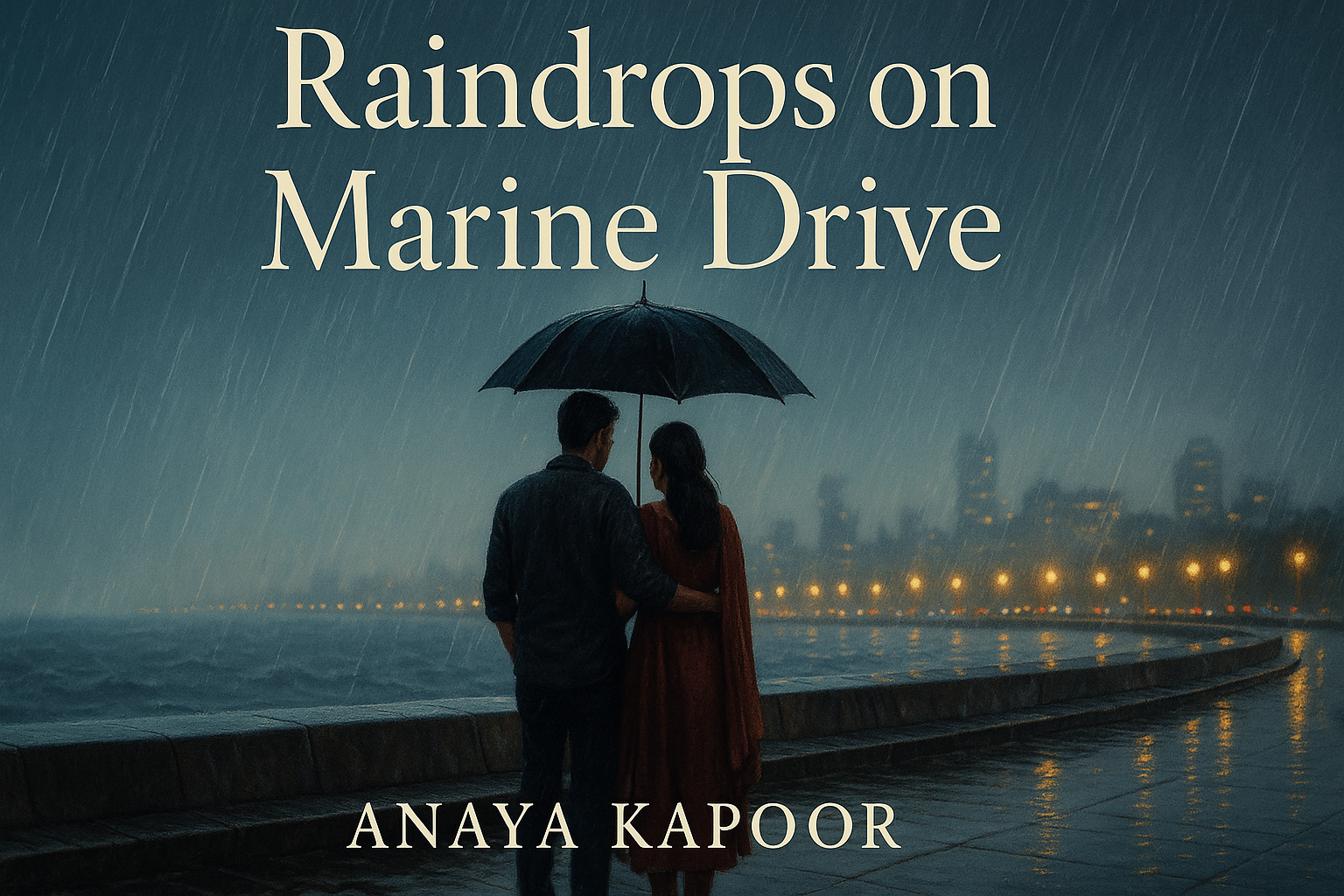

Anaya Kapoor
Part 1: Return in the Rain
The plane touched down in Mumbai just as the first spell of the monsoon had begun to break across the city, the tarmac glistening with that familiar shimmer of water and oil mixing into tiny rainbow puddles. Aditi pressed her forehead against the cool oval window, watching the drizzle streak across the glass, and for a moment she was sixteen again, rushing home from school in a wet uniform, her shoes squelching, her mother scolding her to change quickly before she caught a cold. Ten years had passed since she had left the city for New York, chasing a scholarship, chasing the dream of filmmaking, and yet here it was—the smell, the sound, the feel of Mumbai rain—waiting like an old friend that had never stopped lingering at the gate. The immigration line felt endless, the ceiling fans still as slow and dusty as ever, and when she finally wheeled her suitcase into the arrivals hall the familiar dampness wrapped around her like a second skin. Outside, chaos reigned: drivers holding up placards, families screaming names, rain bouncing off tin sheds, horns blaring through sheets of drizzle. She paused, took a breath, and felt the city seep back into her pores. Aditi had returned for her father’s 60th birthday, a gathering her mother had planned with the precision of a festival. But she also knew, beneath the polite explanations, she had come back to measure herself against the city she once called hers, to see if it still claimed her or if she had outgrown its madness.
The taxi ride from the airport was a baptism of rain and noise. The driver, a man with tired eyes, cursed the traffic as the water rose knee-deep near Andheri. The wipers screeched across the windshield, barely clearing the torrent. She opened the window for a second and let the damp breeze slap her face, the smell of wet earth, diesel, frying pakoras from some roadside stall blending into an intoxicating perfume of homecoming. She remembered evenings when she and Rohan had cycled down lanes in Juhu, racing against sudden showers, their laughter mixing with thunder. She hadn’t thought of him in months, perhaps years, but the rain had its own memory and it whispered names she had buried.
By the time she reached her parents’ apartment in Dadar, the city was on the verge of a standstill. The watchman recognized her instantly, exclaiming in Marathi how grown up she looked, how foreign, how much like her father’s face she had become. Upstairs, her mother embraced her with a mixture of joy and complaint—“At last you remembered we exist, madam New York!”—and her father’s eyes glistened though he pretended it was just the onions his wife was cutting. Aditi sank into the sofa, sipping steaming adrak chai, listening to the familiar hum of ceiling fans, the whir of pressure cookers, and it was as if no time had passed, as if she had only stepped out for a week, not a decade.
That night she could not sleep. The rain drummed on the balcony railings, a relentless tattoo that called her name. She slid open the glass door and stepped out, the city sprawled before her, yellow streetlights reflected in pools of water, cars stranded, people huddled beneath plastic sheets. Somewhere beyond the mist and storm lay Marine Drive, the necklace of lights she had always loved, the curve of the city’s heart. She longed to see it again, to feel the spray of the sea mixing with the rain.
The next morning, umbrella in hand, she set out alone. Local trains were late, platforms overflowing with wet bodies pressed together, and yet she felt alive in the chaos. She boarded one, her shoes slipping on the wet floor, and smiled at the women who made space for her in the ladies’ compartment. The train rattled through the city, and with every station—Matunga, Byculla, Charni Road—her heartbeat quickened. When she finally stepped out at Churchgate, the rain was heavier, the sky a low bruise of gray, and the air smelled of salt. She walked fast, dodging puddles, the umbrella barely holding against the wind, until she reached the promenade.
Marine Drive stretched before her like a drenched dream. The waves crashed furiously, spraying foam over the parapet, the necklace of streetlights blurred in the storm. Lovers huddled under shared umbrellas, joggers tried to keep pace with the downpour, a balloon seller fought to hold on to his sagging wares. Aditi closed her umbrella and let the rain soak her entirely, her clothes clinging, her hair plastered to her cheeks. She felt both foreigner and native, someone who belonged and didn’t, someone who had left and returned, uncertain what awaited her.
And then, as she stood there letting the sea and sky swallow her in water, she heard a voice.
“Aditi?”
She turned, and through the curtain of rain she saw him. Rohan. Older, broader, his hair shorter, his shirt wet and sticking to his frame. His eyes widened in disbelief before a smile spread across his face, the same smile she had carried in memory but aged now, deeper, touched by years.
For a second she could not move. The rain thundered, the sea roared, the city blurred around them, and all she saw was the boy she had once loved, standing before her again as if the monsoon itself had conspired to bring him here.
Part 2: The First Encounter
For a moment she wondered if the rain had played a trick on her, if the years away had made her conjure a familiar face from a stranger’s, but then Rohan’s voice carried through the wind again, steady, unmistakable, calling her name with that half-laugh that had once been the soundtrack of their long summer evenings. She managed to smile, though her throat felt dry despite the downpour, and said his name back, softly at first, then louder, letting it roll into the storm. They walked towards each other, the sea spray stinging their faces, and when they finally stood only a foot apart the silence between them was louder than the traffic on Marine Drive. Rohan’s eyes scanned her face, pausing at her wet hair, her tired smile, as if he was trying to fit the girl he once knew into the woman who stood before him now.
“You’re back,” he said simply, and the words hit her with more force than any declaration could have, because in that moment the rain, the city, the years all seemed to collapse into those two syllables. She nodded, unsure how to explain ten years of distance, ten years of choices, in a single sentence. “Just for a while,” she answered, but even that sounded too small for what it meant.
They began to walk without deciding to, moving along the wet parapet, the sea raging at their side, the city pressing in behind them. The rain had soaked them beyond caring, so they let their umbrellas hang at their sides, laughing at how futile it felt to resist the monsoon. The old rhythm between them returned, awkward at first, then flowing as if time had bent to accommodate them. She asked about his work and he told her he was now a marine architect, working on harbor projects that tried, futilely perhaps, to keep the city safe from the same waters that gave it life. She laughed at the irony, that the boy who once skipped school to sketch boats in the sand had grown into the man designing the future of the sea. He teased her back, asking if the girl who once scribbled poems on the backs of bus tickets had finally made her film, and she admitted she had, though not the one she had dreamed. A documentary about immigrant lives in New York, shown in a small festival, a modest success, yet enough to keep her afloat.
They stopped at a chaiwala’s cart, steam rising from kettles fogged with rain, the man pouring thick, sweet tea into plastic cups. She remembered how they used to stand exactly like this after classes, warming their hands against cups that cost five rupees then, joking that one day they’d be drinking coffee in Paris or New York. Now she had, and yet the tea on Marine Drive tasted richer than anything she’d sipped abroad. Rohan raised his cup in a mock toast and said, “To the return of ghosts.” She clinked her cup against his, smiling at the phrase.
As they drank, a silence settled between them, comfortable and uncomfortable at once. Aditi felt the urge to ask about his life beyond work, whether he had married, whether he had children, but the words caught in her throat. She wasn’t sure she wanted the answers just yet. Rohan seemed to sense it, for he spoke instead about smaller things—the new traffic flyovers, the worsening floods, how the city’s skyline was unrecognizable from some angles but remained stubbornly the same from others. They laughed about the old college gang, about teachers who must have retired by now, about a boy who once declared he would leave Mumbai forever and yet was spotted running a bookstore in Bandra last month. The rain softened to a drizzle, and for a moment the city felt suspended, as if waiting for their story to continue.
When they resumed walking, Marine Drive gleamed with the glow of headlights reflecting off wet asphalt, the Arabian Sea calmer now, the tide retreating like a sigh. Aditi felt her pulse quicken, a mixture of nostalgia and a quiet ache she had not allowed herself to feel in years. She realized she was walking a little too close to him, their shoulders brushing now and then, and every accidental touch felt deliberate, electric. She caught him glancing at her once, then quickly looking away, and it made her smile though she didn’t let him see.
At the far end of the promenade, where the stone wall curved towards Chowpatty, Rohan paused. “Strange, isn’t it?” he said. “How you can walk the same stretch of road a hundred times and then one day it feels completely new.” She wanted to answer that it felt new because they were together again, but she bit her tongue, afraid of laying too much weight on fragile ground. Instead she nodded and said, “Maybe the city remembers things we forget.”
They stood in silence, watching the rain blur the horizon where sea met sky, and in that silence Aditi felt the tug of all the years lost, all the conversations never had, all the choices that had pushed them onto parallel tracks. She wondered if the rain was trying to bend those tracks together again, even if only for this fleeting evening. Finally, Rohan checked his watch, reluctantly, as if the act itself broke the spell. “I should go,” he said. “Early meeting tomorrow.” She nodded, pretending it didn’t sting, pretending she hadn’t wanted to keep walking until dawn.
As he hailed a cab, he turned back and asked, “Still have the same number?” She shook her head and laughed. “Too many SIM cards in too many countries. I’ll give you my new one.” They exchanged phones, typing digits into contact lists, their fingers brushing once more. When she handed his phone back, her own name glowed on the screen: Aditi—Marine Drive. She looked up at him, confused, and he shrugged, smiling sheepishly. “That’s how I’ll remember today,” he said.
She watched his taxi disappear into the night, taillights blurring in the drizzle, and felt a strange hollowness, like the sea had pulled something out of her with the tide. She walked back slowly, the rain returning in heavy sheets, her mind replaying his smile, his voice, the simple weight of his presence beside her. By the time she reached Churchgate station she was soaked to the bone again, but her chest felt lit with a warmth she hadn’t carried in years. The rain, she realized, had not just welcomed her back to the city—it had brought her face to face with the unfinished chapter she had thought she had left behind.
Part 3: Old Haunts
The days after their first meeting blurred into a rhythm Aditi had not expected. Mumbai was a city that rarely allowed time to stretch; it ran on deadlines, horns, and floods, and yet somehow in that monsoon haze she and Rohan found stolen hours. It began with a message—simple, casual, a “Want to grab chai after work?”—and before she could even think, she had typed back “Yes.” That evening they met near the same corner of Marine Drive, where the chaiwala now recognized them and handed over cups with a knowing grin. It was the first of many reunions, each one stitched together by the rain that refused to relent.
One Sunday, when the sky was a gray ceiling and the streets shimmered with puddles, Rohan suggested they take a walk through the neighborhoods of their childhood. Aditi agreed without hesitation, curious to see what had changed and what the city had preserved like a secret photograph. They began at Dadar, winding through narrow lanes where old Irani cafés stood shoulder to shoulder with shiny new bakeries, where the smell of bun maska still wafted out from chipped blue doors. She stopped in front of one café, its walls peeling but its counters still lined with glass jars of biscuits, and laughed. “Remember how we used to sit here and share one plate of keema pav because we couldn’t afford two?” Rohan grinned, the memory lighting up his face. “And you always stole the bigger piece when you thought I wasn’t looking.” She punched his arm, and the laughter spilled into the rain, easy and unforced, the kind that belonged to younger versions of themselves.
They took a bus towards Bandra, climbing the rickety stairs of a double-decker, sitting in the front seat of the upper deck just as they had done as teenagers. The city rolled past, blurred by droplets streaking the glass. She pointed at old movie posters plastered on walls, at graffiti blooming under bridges, at bookstores stubbornly alive in lanes of boutiques. He told her stories of the years she had missed: a flood that had stranded him overnight in a stranger’s shop, a college reunion that turned into a brawl, the first paycheck he had spent on buying his father a wristwatch. She listened with the hunger of someone who had missed a decade of his life, every story another reminder of the distance between them.
At Bandra, they walked by the sea, the rocky shore slippery with moss, waves crashing violently. Aditi remembered how they used to sit on those very rocks during college festivals, sketching plans of futures they half-believed in. She had wanted to leave, to see the world, to escape the heaviness of expectations. He had wanted to stay, to build something lasting in the city that raised them. She realized now how true those choices had been, how much they had defined the people they had become.
Later, they wandered into a bookstore tucked between cafés, its musty air instantly familiar. The owner, an old man with glasses slipping down his nose, squinted at them before breaking into recognition. “You two,” he said, “always sitting on that carpet corner, reading books you never bought!” They laughed, embarrassed but warmed by the memory. Rohan picked up a book of poems, flipping through pages, and without meaning to Aditi whispered a line she remembered by heart. He looked at her in surprise, smiling at the fact that some things hadn’t changed, that she still carried words the way he carried maps.
The rain grew heavier as evening approached, and they ducked into a roadside stall for vada pav, standing shoulder to shoulder under a leaking tarpaulin. The vendor handed them plates dripping with chutney, and as they ate, the years seemed to vanish. For a moment they were just two college kids again, escaping lectures, counting coins, watching the rain flood their shoes. Yet beneath the surface laughter, Aditi felt the ache of awareness—this was no longer youth, no longer infinite time. This was borrowed space, a return to a world that had moved on without her.
When the rain softened to drizzle, they walked towards Carter Road, the promenade alive with couples huddling under umbrellas, joggers splashing through puddles, children sailing paper boats in the drains. Rohan slowed, looking at her carefully. “It feels strange,” he said. “Like we never left these places, like they were waiting for us.” Aditi nodded, but inside she wondered whether the places had waited or whether they had simply carried the memory of them, fragile but intact, across the years.
As dusk fell, they sat on a bench overlooking the sea, the horizon a blurred line of silver and shadow. Aditi watched the tide rising, swallowing rocks inch by inch, and thought about the tides inside her—how memory pulled her back, how regret washed against her, how longing rose without permission. Rohan was quiet beside her, his elbows on his knees, his gaze fixed on the restless waves. She wanted to ask him everything—whether he had been happy without her, whether he had missed her, whether he had ever looked at the rain and thought of her name. But she stayed silent, afraid of breaking the fragile glass of this reunion.
Finally, he turned to her, a faint smile tugging at his lips. “Next time,” he said, “we should go to our school. See if the classrooms still smell of chalk and wet shoes.” She laughed, though her throat tightened. “And see if the blackboard still has our names carved in the corner.” He raised his eyebrows. “I thought we swore never to tell anyone it was us.” She met his gaze, and for a moment the years dissolved, leaving only two conspirators under the monsoon sky.
When they parted that night, Aditi walked home with her heart heavier than the rainclouds above. Old haunts had brought back laughter, but they had also unstitched wounds she had kept neatly hidden. She realized that the city had not simply preserved their memories—it had sharpened them, waiting for the day they would both return to feel their weight again.
Part 4: The Engagement
The week after their tour of old haunts, the city’s rain grew angrier, swelling drains, swallowing roads, and yet Aditi found herself stepping out every evening as if the monsoon had given her a private path to Rohan. They met at cafés, sometimes at the edge of the sea, sometimes under leaky awnings where the world blurred in sheets of water. Each time she told herself she was only revisiting friendship, reclaiming a piece of youth she had misplaced. But she knew it was more. The quiet rhythm between them had shifted, heavier with the weight of things unsaid. She caught herself watching his hands when he stirred sugar into his tea, the way his eyes crinkled when he laughed, the way his silences seemed filled with words he chose not to speak.
One evening, after a day of near-flooding that stranded buses and pushed crowds into chaos, they ducked into a new café in Bandra. The place was small, walls painted with splashes of yellow and green, fairy lights dangling across damp ceilings. They found a corner table, shaking rain from their hair, ordering coffee they didn’t need just to sit and wait out the storm. Aditi watched Rohan speak to the waiter with ease, his voice firm but kind, and she wondered how many storms he had weathered without her.
It was in that café that the truth slipped into the room, casual and brutal. He was talking about his office, how the new project demanded long hours, how his weekends vanished into site visits. Then, almost as an afterthought, he added, “I keep telling Mira she deserves better than cancelled plans.” Aditi blinked, the name sliding past her ears before landing heavy in her chest. “Mira?” she asked lightly, as if it were just a colleague. Rohan paused, looked at her, and said the words that cracked the rhythm they had rebuilt. “My fiancée.”
The world did not stop for her revelation. Outside, rickshaws splashed through water, couples laughed under umbrellas, the café hummed with low music. But inside Aditi something collapsed quietly, a wall she had not even realized she was leaning against. She forced a smile, nodding, saying something polite she could barely hear herself say. Fiancée. The word echoed like a drum, drowning out the rain.
Rohan kept talking, unaware of the storm he had unleashed in her. He told her about Mira—how they had met through mutual friends, how she worked in advertising, how she loved reading travel books and hated the smell of wet socks. Aditi laughed at that detail, though it sounded like glass breaking in her throat. She sipped her coffee slowly, nodding, inserting questions where needed, but inside she was somewhere else, replaying every moment of the past weeks. Had she misread everything? The smiles, the silences, the closeness—had it all been just nostalgia, nothing more?
When he excused himself to take a call, she sat back, staring at the rain sliding down the glass window. She remembered the nights in New York when she had longed for home, for someone to share the silence with, and realized she had kept Rohan alive in those longings, without even admitting it to herself. She had carried him across oceans, hidden in the fold of memory, and now here he was, flesh and bone, already promised to someone else. The cruelness of it almost made her laugh.
When he returned, they changed the subject, talking about films, politics, traffic. She smiled when required, even teased him about his over-seriousness. But beneath the mask her thoughts spun in circles. Mira. Aditi wondered what she looked like, how she spoke, whether she loved the rain or cursed it. She wondered if Mira knew that her fiancé still walked in the storm with another woman, retracing old haunts, laughing like the boy he once was. The thought stung, not because it was betrayal—Rohan had given her no promise—but because it meant she was late, hopelessly late, and the story she had imagined in the rain had already been written without her.
Later, as they walked out, the rain fell harder, hammering the pavement. Rohan pulled his umbrella open and held it over both of them, the gesture automatic, natural. She walked beside him, her shoulder brushing his, and for a dangerous moment she let herself imagine what it would feel like if this was theirs, if the city belonged to them together again. But the word fiancée clanged against her ribs, dragging her back.
At the station he asked, “Can I drop you home? The roads are a mess.” She shook her head. “No, I’ll be fine. You should go.” He hesitated, perhaps sensing something in her tone, then nodded and let her go. She stood on the crowded platform, watching the train lights blur through the rain, her heart a heavier monsoon than the one drowning the city.
That night, lying on the bed she had grown up in, listening to the ceiling fan groan and the rain hammer the window, she pulled out an old box from her suitcase. It was filled with letters she had written as a teenager, letters she had never sent. Each one began with his name. She unfolded one, yellowed with time, reading the shaky scrawl of her sixteen-year-old self: “I think the rain is trying to tell me something, but I don’t know if I can tell you yet.” She laughed bitterly, pressing the paper against her chest. Some storms, she realized, never really passed.
Part 5: Letters Never Sent
The rain had not stopped for three days, the city gasping under its weight, and Aditi felt as if the clouds above were simply a mirror of the storm inside her. She stayed home through the morning, listening to the familiar chorus of pressure cookers hissing, neighbors arguing about leaking ceilings, the watchman swearing about clogged drains, yet she was far away, her mind fixed on the word fiancée like a nail hammered into her chest. She kept replaying that café evening, the moment Rohan had spoken the name Mira, the easy way he had said it, as if it belonged naturally in his life, as if she had no place there anymore. She tried to distract herself with helping her mother in the kitchen, chopping vegetables, arranging plates, even agreeing to run small errands in the waterlogged market, but each time she caught her reflection in rain-smeared windows she saw a girl who had once left Mumbai full of dreams and returned only to discover she had been dreaming the wrong story all along.
That night, unable to sleep, she reached for the old box of letters again, the one she had kept hidden in the corner of her suitcase as if afraid her parents would discover her teenage ghosts. She had written them during those last school years, long before she left for New York, back when love was something raw and unformed, a feeling she could not name but could only pour onto paper. The first was clumsy, written in uneven blue ink, full of half-poems about rain and the sea. The second was sharper, more urgent, a confession wrapped in metaphors of waves crashing against walls. By the tenth, she had written without hesitation: “Rohan, I think I love you. I think I always have.” But she had never sent it, folding it carefully, placing it at the bottom of the stack, too afraid of rejection, too afraid of altering the friendship that had been her anchor.
Now, holding those pages years later, she felt the absurdity of it—words that had waited patiently in paper silence while life moved on without them. She pressed them against her chest, wondering what might have been if she had slipped one of those notes into his hand during a lecture, if she had left one inside a book at the Bandra bookstore, if she had whispered the truth instead of laughing it away. Perhaps the story would have been different, perhaps not, but at least it would have been hers to claim.
The next day the rains eased enough for the city to breathe again, and Rohan called, his voice casual, asking if she wanted to meet for a drive along Worli Seaface. She almost refused, afraid of the ache that now accompanied his presence, but the word yes slipped out before she could stop it. They drove through puddled streets, his car smelling faintly of damp upholstery and aftershave, the windows fogging with their breath. He talked about his projects, about how the sea walls were failing against the rising tides, about how sometimes he felt like Sisyphus pushing a rock that the sea always rolled back. She listened, nodding, but her mind was elsewhere, the unsent letters burning in her bag like contraband.
When they stopped near the promenade, watching the waves crash in violent spray, she almost told him. The words reached her lips, hovering like a tide about to break. She wanted to say, “I wrote you letters once. I wrote I loved you. I still might.” But she swallowed them, afraid of shattering what fragile bond remained. Instead, she asked about Mira, her voice steady though her nails dug into her palm. He spoke softly then, describing her kindness, her fierce ambition, her ability to calm him when work drowned him. Aditi smiled, but inside she felt the weight of years pressing harder.
That night she returned home soaked and restless. She spread the letters across her bed, the ink faded, some pages smudged from earlier tears, and she began to copy lines into her notebook, as if rewriting them could rewrite her fate. She scribbled furiously, half in English, half in Hindi, the words tumbling without form: “What do you do when the person you loved becomes a stranger you still know better than yourself? What do you do when the rain brings him back only to remind you he is gone?” Her handwriting was messy, but for the first time in years she felt the pulse of creation again, as if the unsent confessions were not wasted but waiting to transform into something else—a film, perhaps, or a story about love that arrives too late.
Days passed like this, each one soaked in rain and memory. She met Rohan twice more, each meeting laced with laughter and silence, each parting heavier than the last. She told herself she could accept his engagement, that friendship was enough, but each time she caught the way his eyes lingered on her a fraction longer than necessary she wondered if the storm inside him mirrored hers.
One evening, sitting on the balcony while the city thundered, her mother came to sit beside her. “You look the way you did before you left,” she said softly. “Like you’re holding a secret that’s eating you alive.” Aditi laughed, brushing it off, but the truth hung between them, unsaid but visible.
When she went to bed, she placed the box of letters back into her suitcase, zipping it shut. Perhaps they would never reach him. Perhaps they were only meant for her. But she knew now that love, even unsent, left traces that refused to vanish. The rain could wash the streets clean, could drown entire neighborhoods, but it could not erase the words she had written long ago. They were hers, even if they were never his.
As she drifted into uneasy sleep, the storm outside gathered again, and she realized that the city, like her heart, would always live between flood and drought, never still, never safe, always waiting for the next downpour to decide what would survive.
Part 6: Storm Inside, Storm Outside
The monsoon struck with a violence the city had not seen in years, a deluge that drowned roads, stranded trains, and forced offices to shut early. Aditi had spent the morning editing a short documentary reel for a client, her laptop perched on the dining table while the rain hammered the glass doors of the balcony. By afternoon the power flickered, the lights dimming in protest, and the Wi-Fi sputtered out. She cursed softly, staring at the spinning icon on her screen, but deep down she knew the rain wanted her attention. It had been calling her all week, and today it had no intention of being ignored. When her phone buzzed, she wasn’t surprised. Rohan’s name lit the screen, his voice breaking through static. “Are you stuck? The streets are chaos. Don’t try to take a cab. I’m nearby. I’ll pick you up.” She wanted to argue, to say she was fine, but another crack of thunder silenced her. “Okay,” she said, and within half an hour his car pulled up, wipers battling sheets of water, his face lit with the strained concentration of driving through floodwater.
She climbed in, drenched even from the short run to the gate, her kurta plastered to her skin. He glanced at her, handed over a towel from the backseat, and smiled despite the storm. “Always forgetting umbrellas, aren’t you?” She laughed, though her throat was tight, remembering all the times he had teased her as a teenager, pulling her under his own umbrella when she insisted she didn’t need one. They drove through waterlogged streets, the car jerking as it pushed against rising currents. Outside, people waded waist-deep, clutching bags over their heads, some forming human chains to cross. The city was a drowning island, and yet inside the car Aditi felt suspended, as if the rain had built a cocoon around them.
After nearly an hour of inching forward, Rohan swore under his breath. The road ahead was blocked, a bus half-submerged across the lane. He tried another route, only to find it flooded too. “We’ll have to wait it out,” he muttered, parking the car under a half-sheltered flyover where dozens of other vehicles had given up. The rain roared against the roof, drowning every other sound, and the air inside thickened with silence. They sat side by side, windows fogged, water dripping from their clothes onto the mats. Aditi shivered, rubbing her arms, and without thinking he reached across, adjusting the air conditioning, then digging out a spare jacket from the back. She slipped it on, the fabric warm from his touch, and for a moment she closed her eyes, inhaling the faint scent of him—salt, rain, a trace of cologne.
Conversation started haltingly, about the storm, about how the city never learned, about how every year the monsoon brought the same disaster. But soon the words deepened, pushed by the intimacy of being trapped. He told her about the nights he stayed up working, the pressure of deadlines, the fear that no matter how hard he built, the sea would always win. She listened, then confessed how she often wondered if she had chosen right by leaving India, how success in New York felt hollow when it was built on loneliness, how she sometimes longed for the chaos of Mumbai more than the quiet streets of Manhattan. He laughed softly, shaking his head. “You always wanted to escape,” he said. “And I always wanted to stay. Maybe that was our difference.” She looked at him then, his profile lit faintly by a passing car’s headlights, and the weight of what was unspoken between them pressed heavier than the storm.
The minutes stretched into an hour, rain unrelenting, the city outside sinking deeper. Inside, time folded strangely. Their shoulders brushed now and then, a small contact magnified by the stillness. She wanted to tell him about the letters, about the years of silence she had carried, but fear stopped her. Instead, she asked quietly, “Are you happy?” The question surprised even her. He didn’t answer immediately, his eyes fixed on the curtain of water outside. Finally he said, “I think so. Mira is…she’s good. She’s steady. She makes sense.” He paused, then added almost inaudibly, “But sometimes I wonder about the things we leave behind to make sense of our lives.” His words hung in the air, fragile, dangerous. Aditi’s pulse quickened, but she stayed silent, afraid that even a breath would break the spell.
Another hour passed. They shared a packet of biscuits he found in the glovebox, laughed at how soggy they were, then fell into another silence. The rain drummed harder, but inside the car it felt like the world had narrowed to just them. Aditi’s hand rested near the gearshift, and once, when he reached for the biscuits, his fingers brushed hers. Neither of them moved immediately. The contact lingered, soft, almost deliberate, and when their eyes met, the air thickened with a charge that felt older than words. She looked away quickly, heart hammering, the word fiancée ringing in her head like an alarm.
By the time the rain eased enough to move, night had fallen. The roads were still messy, but manageable. He drove her home slowly, carefully, both of them quieter now, as if the storm had stripped them raw. At her building, she hesitated before opening the door. “Thank you,” she said, the words inadequate for what the day had been. He nodded, his eyes lingering. For a second she thought he might say more, but he only said, “Get some rest. Tomorrow the city will pretend this never happened.” She smiled faintly, stepping out into the wet night, watching his taillights vanish into the distance.
Upstairs, peeling off her damp clothes, she felt the storm replaying inside her chest. She thought of his words, the hesitation in his voice, the almost-touch of his hand. The rain might have ended for now, but its echoes were louder than ever. She lay awake long into the night, listening to the dripping balcony, and realized that some storms don’t pass—they simply move inside you, where no city can drain them away.
Part 7: Between Then and Now
The city crawled back to motion after the storm, trains limping on soaked tracks, buses sputtering past potholes that had grown into ponds, and people shrugging off the chaos as if it were nothing new. But inside Aditi, the storm had not receded; it lived in her chest, restless, humming with questions she had no answers for. She tried to busy herself with family duties, helping her mother finalize details for her father’s sixtieth birthday, meeting cousins who laughed too loudly, listening to uncles debate politics over endless cups of chai. Yet every time her phone buzzed her pulse quickened, every time rain tapped the windows she saw Rohan’s face through the blur. She told herself she was foolish, that she had no right to feel this way, but longing is rarely obedient.
They met again a few days later, at his suggestion, at a book fair near Bandra where stalls sprouted like mushrooms under leaky tarpaulin sheets, the air thick with the scent of wet paper and fried snacks. The place was crowded, umbrellas colliding, feet slipping in mud, yet amidst the chaos they found a strange calm walking side by side, browsing second-hand novels stacked in uneven piles. Aditi picked up a copy of Neruda, the same edition she remembered borrowing from the college library years ago, and without thinking she whispered a line under her breath. Rohan heard it, finished the verse softly, and for a moment they were no longer two adults with separate lives but the same boy and girl who once sat on classroom steps reciting poetry while rain bled across the courtyard.
Later they sat under a canvas roof eating samosas wrapped in old newspaper, the oil staining their fingers, and Aditi felt laughter rise in her chest like a tide she could not resist. He joined in, and the sound of their laughter was almost painful in its familiarity, like an old song returned after years of silence. When the laughter faded, a silence followed, heavier, as if both knew they were circling something dangerous.
“You’ve changed,” he said suddenly, his eyes on the rain rather than her. “But also…you haven’t. You still tilt your head when you laugh. You still forget umbrellas. You still carry poems in your mouth.” She smiled, swallowing the ache in her throat. “And you,” she said, “you still pretend you’re not tired when you are. You still chew your lip when you’re thinking. You still look at the sea like it’s the only thing that can answer you.” Their eyes met, and in that meeting all the years collapsed, the lost decade dissolving into nothing.
She wanted to tell him about the letters, about how she had once loved him with a fierceness that terrified her, about how she still carried that love folded into the corners of her life. But before she could, he said quietly, “Sometimes I wonder what would have happened if you hadn’t left.” The words were almost drowned by the rain, but she heard them clearly, as if the storm itself wanted her to. Her heart lurched, the confession she had been holding back suddenly mirrored in his. She looked at him, searching for more, but he turned away, biting his lip, retreating into silence.
They walked afterwards through lanes where the rainwater had begun to recede, children splashing barefoot, streetlights flickering weakly. Aditi felt suspended between two worlds: the one where she was simply visiting, bound to return to New York and her solitary life, and the one where she could imagine staying, where the rain wasn’t just nostalgia but a language she could still speak with him. Yet the shadow of Mira hung between them, her absence louder than presence, reminding Aditi with every heartbeat that he was already promised elsewhere.
At one point he stopped, leaning against the wall of a closed shop, rain dripping from the tin awning above. “You know,” he said, “I used to think I’d forgotten you. That I’d buried all that long ago.” His voice was steady but his eyes betrayed him, shining with something unguarded. Aditi swallowed, her pulse roaring in her ears. “And now?” she asked, her voice trembling. He shook his head, exhaling. “Now I’m not sure.”
The silence that followed was unbearable. She wanted to reach for his hand, to bridge the distance that words could not, but fear pinned her still. Instead she stepped back, forcing a smile. “The rain confuses us,” she said lightly. “It makes the city dream strange dreams.” He nodded, though his gaze lingered on her a moment longer, as if unwilling to let go.
When they finally parted that night, Aditi walked home through streets littered with fallen branches, puddles reflecting broken neon signs. Every step felt heavy, weighed down by the knowledge that what lived between them had never truly died. It had only been waiting, buried under years and oceans, for the monsoon to dig it out again. But what use was it now? She lay awake in bed, listening to the rain soften, and realized she stood between then and now, torn between the girl who had written letters she never sent and the woman who must learn how to survive the silence of loving someone who belonged to another.
Part 8: The Unspoken Goodbye
The first time Aditi saw Mira was not by design but by accident, a collision orchestrated by the rain itself. She had gone to a gallery opening in Colaba, invited by an old college friend who insisted she needed to meet more people in the city’s creative circle. The place was crowded, bodies damp from the drizzle outside, the smell of wet clothes mixing with wine and acrylic paint. She wandered between canvases, polite smiles exchanged with strangers, when she heard Rohan’s laugh across the room. Her heart leapt before her reason could catch it, and when she turned she saw him standing near a large abstract painting, Mira at his side.
Mira was striking without effort, her presence quiet yet undeniable, dressed in a simple black kurta that accentuated her grace. She was speaking to a group of people, animated but calm, the kind of composure Aditi had always envied. Rohan spotted her, surprise flickering across his face, followed quickly by warmth. He gestured her over, and suddenly she was in front of them, smiling through the ache in her chest. “This is Aditi,” he said, his voice carrying a note of pride that confused her. “We went to school together.” Mira extended her hand, her grip firm, her eyes kind. “I’ve heard about you,” she said. “Rohan mentioned your documentaries. It must be wonderful, living in New York.”
Aditi nodded, her rehearsed answers tumbling out automatically—yes, it was exciting, yes, it was challenging, yes, she sometimes missed home. But all the while she watched the way Rohan’s hand rested lightly at the small of Mira’s back, the ease of it, the intimacy of habit. She realized then that Mira was not a shadow or a distant name; she was flesh and presence, woven into Rohan’s life in ways Aditi could never undo.
The evening stretched unbearably. She moved through conversations half-present, the hum of voices muffled by the storm inside her. Every so often she glimpsed them together, their heads bent in quiet exchange, their laughter syncing in the way of people who had built a rhythm of years. It was then she understood the cruel truth: she was not just late—she was an intruder in a life that had already taken shape without her.
After the event ended, Rohan offered to drive her home. Mira excused herself with a smile, saying she had to meet a colleague, and Aditi found herself once again in his car, the city outside blurred by rain. For a long while neither spoke. The silence was heavy, weighted with the presence of someone not there. Finally Aditi said softly, “She’s lovely.” Rohan nodded, eyes on the road. “She is.” There was no hesitation in his voice, only certainty. That certainty pierced her sharper than any rejection.
At her building he parked, neither making a move to end the moment. She wanted to tell him about the letters, about the storm she carried, about how the rain had brought him back only to show her what she had lost. Instead she smiled faintly, her voice steady in its betrayal. “You’re lucky.” He turned to her then, his expression unreadable, as if he wanted to say something but the words drowned before they reached his mouth. At last he only said, “Take care, Aditi.” She stepped out, closing the door slowly, the sound of it final.
That night she opened her suitcase, pulled out the old letters, and spread them across the bed. She read them one by one, her younger self’s handwriting blurring through tears. Each word was a reminder of the girl who had loved without fear but acted with too much of it. She considered burning them, letting the smoke carry away what remained, but instead she folded them carefully, placed them back, and zipped the suitcase shut. They were hers to keep, not his to know.
In the days that followed she avoided him, replying to messages late, inventing excuses when he asked to meet. Her family kept her busy with birthday preparations, the house buzzing with relatives, decorations, the smell of sweets frying in ghee. She laughed when required, posed for photos, but inside she felt like glass, fragile, ready to shatter. On the night of her father’s celebration, as relatives clapped and music blared, she slipped out to the balcony, staring at the city washed in silver rain. Her phone buzzed with a message from Rohan: “Leaving for a site visit tomorrow. Out of town a few days. Wanted to see you once before.” She stared at the words until they blurred, then typed back: “Safe travels.” Nothing more.
It was her unspoken goodbye. She knew she could not trust herself to see him again, not with Mira’s smile etched into her memory, not with the storm inside her demanding more than the world would allow. The rain fell harder, streaking down the glass, and she whispered the words she had never dared send: “I loved you.” The city, as always, said nothing back.
Part 9: The Breaking Point
Ganesh Chaturthi arrived in the city with its usual frenzy, drums echoing through lanes, processions winding like serpents of color and sound, idols carried on shoulders gleaming with sweat and rain. Aditi watched from her parents’ balcony as crowds surged past, chanting, singing, the smell of incense fighting the stench of clogged drains. The monsoon had not relented; the sky was still swollen, clouds hanging low like a curtain ready to burst. Her father insisted the family join the immersion later that evening, a tradition they had always kept, and though she longed to avoid the throng, she agreed, knowing refusal would invite questions she had no energy to answer.
The streets were chaos—children splashing barefoot, women in bright saris balancing umbrellas, men dancing with abandon despite the water pooling around their ankles. The air vibrated with a fevered devotion, each chant of “Ganpati Bappa Morya” rising into the sky as if to shake the clouds themselves. Aditi felt both part of it and outside it, her mind elsewhere, circling around the one name she could not let go of. She had not seen Rohan since the gallery night, their messages reduced to polite fragments. Yet she felt him in every beat of the drums, in every wave of the crowd, as if the city itself carried his echo.
As evening deepened, the family joined a procession towards Girgaon Chowpatty, where thousands gathered for the immersion. The rain poured harder, but the crowd only grew louder, umbrellas discarded, bodies pressed together, the air electric with devotion. Aditi moved with her cousins, but her eyes kept searching the faces around her, irrationally hoping, fearing, that she might glimpse him. And then, as if the city wanted to test her, she did.
Rohan was there, a few rows ahead, his kurta soaked, his face lit by the glow of streetlights reflecting off wet skin. He was with friends, Mira at his side, her hand wrapped around his wrist to keep from losing him in the surge. Aditi froze, her breath catching, the world narrowing to that single tableau—the man she loved and the woman who held him. For a moment she thought she could disappear into the crowd, vanish before he noticed, but as if pulled by the invisible thread that had always tied them, he turned. Their eyes met across the rain-smeared chaos, and in that instant the noise of drums and chants fell away, replaced by the deafening silence of recognition.
He moved towards her, pushing through bodies, Mira following uncertainly. When he reached her, his expression was raw, as if stripped of all the careful composure he usually carried. “Aditi,” he said, voice almost swallowed by the roar around them. She opened her mouth, but no words came. Mira looked between them, confusion flashing across her face, but the crowd surged then, pushing them apart. Aditi stumbled, her cousins pulling at her arm, and by the time she regained her footing he was a few paces away, caught in the tide of bodies carrying the idol towards the sea.
The immersion began, the giant Ganesh lowered into the waves as fireworks split the sky, thunder rolling in competition. The sea swallowed the chants, the rain turned heavier, and Aditi felt herself breaking, as if the god’s departure was mirrored by the departure of her own illusions. She pushed away from her family, stepping closer to the water’s edge, her clothes plastered to her, her hair dripping into her eyes. She needed air, space, something to contain the storm inside.
And then he was beside her again, breathless, Mira nowhere in sight, his eyes fixed only on her. “We can’t keep pretending,” he said, his voice hoarse, urgent. “Not after everything.” She shook her head, rain streaking her cheeks, unsure if it was water or tears. “You’re engaged,” she whispered, the word cracking in her throat. He closed his eyes for a moment, exhaling as if the truth itself was too heavy. “I know. But you—” He stopped, as if afraid of finishing, afraid of the consequence of naming what hung between them.
The drums thundered louder, the idol vanished beneath the waves, and the crowd roared. Around them the city celebrated devotion, but inside her chest Aditi felt only the ache of betrayal and desire colliding. “Don’t,” she said sharply, cutting through the rain. “Don’t say it. It’s too late.” He stared at her, his face anguished, the boy she had loved still flickering in the man he had become. For a second she thought he might reach for her, pull her into the confession they had both carried too long. But then Mira appeared, pushing through the crowd, her hand finding his again. He flinched, as if caught, and Aditi stepped back, her breath ragged.
She turned before either of them could speak, forcing her way into the crowd, letting the bodies and the rain swallow her whole. Each step away from him felt like tearing skin from bone, but she kept moving, chanting with strangers, drowning her heart in the rhythm of the drums. By the time she reached the streetlights again, soaked and trembling, she knew something had broken beyond repair. The storm had forced the truth out, but the truth offered no solace. Love had come too late, and now it was only a wound the rain could not heal.
That night she lay awake, the noise of drums still echoing in her skull, the image of his face in the rain refusing to fade. She realized she had reached the breaking point—the place where memory, longing, and reality collided and left nothing standing. Tomorrow she would have to choose: to stay and bleed, or to leave again before the city swallowed her whole.
Part 10: Raindrops on Marine Drive
The morning after the immersion the city was eerily quiet, as if exhausted from its own frenzy. The sea lay swollen but still, the streets littered with flower petals, broken clay, and abandoned banners. Aditi stood by the window, sipping lukewarm tea, her suitcase open on the bed behind her. She had started packing without admitting to herself that she was leaving, folding clothes with the precision of someone trying to convince herself that order meant control. Her mother had asked why she was in such a hurry, reminding her she had weeks before her flight, but Aditi had only smiled, unwilling to explain that sometimes leaving was the only way to stop bleeding.
By late afternoon the sky darkened again, the monsoon unwilling to rest, and she found herself drawn to Marine Drive one last time. She took the local train to Churchgate, the compartment half-empty, the windows streaked with drizzle. Every sound, every smell, every jolt of the carriage felt like farewell. When she stepped onto the promenade, the air was thick with salt and rain, the Arabian Sea restless, the necklace of lights hazy in the gloom. She walked slowly, umbrella forgotten in her hand, letting the drizzle soak her until she felt transparent.
She thought of the first day she had seen him again, standing exactly here, his smile breaking through the rain like sunlight. She thought of the nights in the car, the laughter in bookstalls, the storm that had trapped them and the storm that had freed their words. And she thought of Mira, whose presence had closed the door before Aditi could even knock. It should have been enough to leave it all as memory, but the heart is stubborn; it refuses tidy endings.
When she reached the curve near Chowpatty she stopped, staring at the waves rising and collapsing, and whispered to herself, “Goodbye.” The word barely left her lips before another voice cut through the rain. “Aditi.” She turned sharply, her chest tightening, and there he was. Rohan. Soaked, breathless, as if he had run through the storm to find her. For a moment neither moved, the rain stitching a curtain between them. Then he stepped closer, his eyes raw, stripped of the careful composure he always carried.
“I thought you’d left,” he said, his voice hoarse. She shook her head, managing a smile that trembled. “Almost. I was saying goodbye.” The words hung heavy between them, final and fragile. He swallowed hard, his hands clenching at his sides. “I can’t do this,” he admitted. “I can’t stand here and pretend these weeks meant nothing. I can’t walk back to Mira and act like you never came back into my life.” His voice cracked, and she felt the world tilt.
Tears stung her eyes, mixing with the rain. “Don’t,” she whispered. “Don’t make it harder than it already is. You’re engaged, Rohan. You’ve built a life. She loves you.” He closed his eyes, rain dripping from his lashes. “I know. And maybe I should choose what’s steady, what’s safe. But when I’m with her, I feel calm. When I’m with you—” He stopped, looking at her with desperation. “When I’m with you, I feel alive. And I don’t know which one I can live without.”
Her heart surged with every word, but she forced herself to breathe, to think beyond the storm of the moment. “You can’t build a life on borrowed time,” she said softly. “I learned that the hard way. Leaving you all those years ago…I thought I was choosing freedom, but I was just running from the truth. Now you’re the one standing at that crossroad. Don’t run, Rohan. Choose.”
The rain poured harder, the sea rising against the parapet, waves crashing like a warning. He reached for her hand, and when his fingers touched hers it was everything she had wanted for ten years. She let herself feel it—the warmth, the familiarity, the rush of recognition—but she also knew it could not last. With a trembling smile she pulled her hand back. “Some things come too late,” she whispered. His face crumpled, but she held his gaze, steady, refusing to let the storm decide for them. “I will always love you. But this isn’t our story anymore. It’s a chapter we’ll carry, not one we can finish.”
For a long moment he said nothing, only staring at her as if memorizing her face, as if carving it into memory where no tide could wash it away. Finally he nodded, slowly, painfully. “Goodbye, Aditi.” She smiled through tears. “Goodbye, Rohan.”
She turned then, walking away, the rain blurring her vision, her footsteps merging with the rhythm of the sea. She did not look back, though every cell in her body wanted to. At the station she boarded the train, the wet wind rushing in through open doors, carrying with it the smell of the city she loved and hated in equal measure.
As the train pulled out, she watched Marine Drive recede, the streetlights shimmering like raindrops strung across the dark. She pressed her forehead against the window, whispering to herself, “Once upon a time, and always.”
The rain answered, steady, eternal, carrying her goodbye into the restless sea.