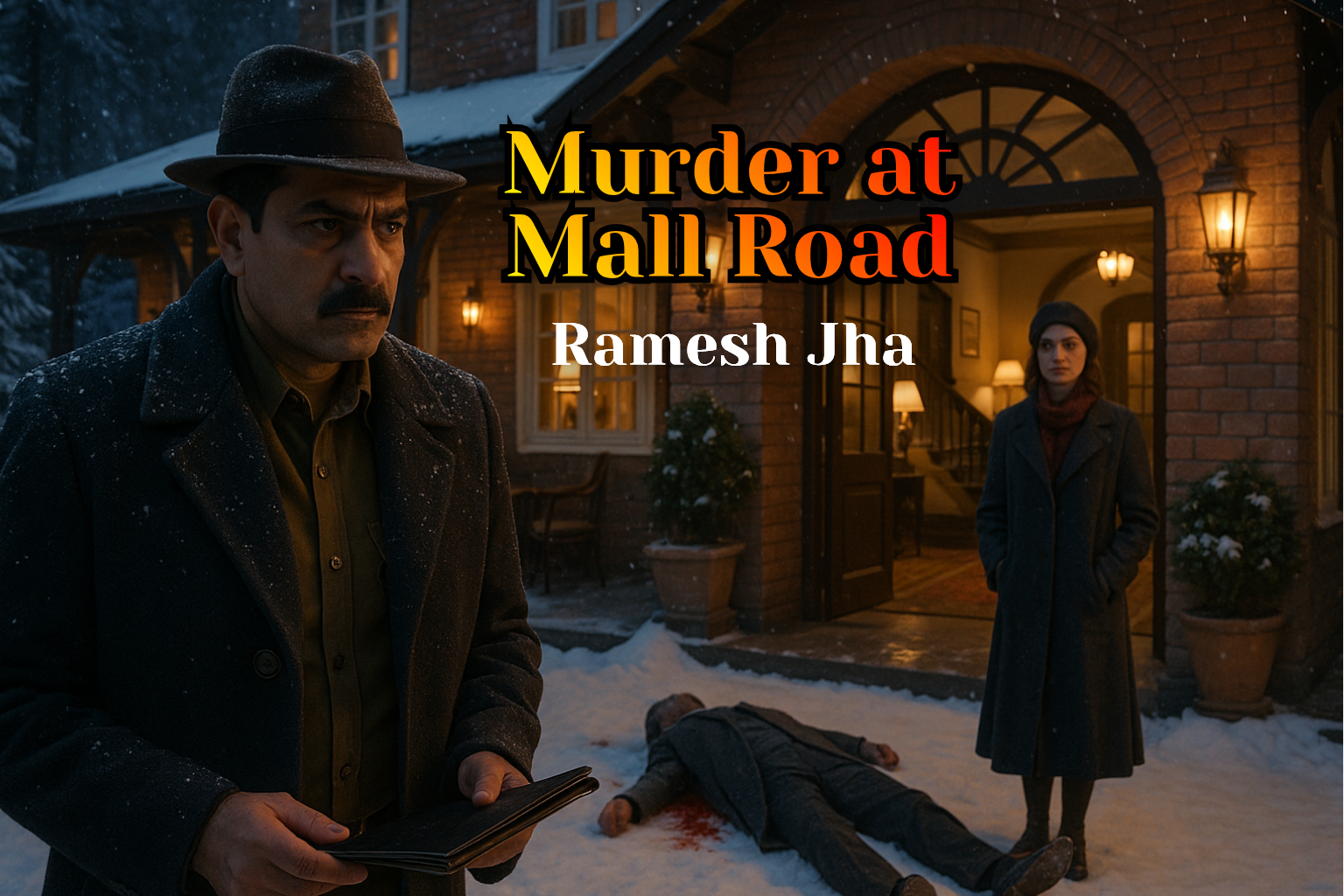

Ramesh Jha
Chapter 1: The Arrival
Snow fell in lazy spirals over Shimla’s Mall Road, blanketing the colonial rooftops and iron lamp posts in white. Tourists had thinned out by evening, and the narrow lanes echoed with the crunch of boots on icy gravel. Nestled between the aging Tudor-style library and a forgotten clock tower stood The Elgin Crest Hotel—a heritage property with oak-paneled halls, a grand staircase, and fireplaces that still burned real wood. Ayesha Mirza stepped out of her taxi, wrapped in a crimson shawl, boots sinking slightly into the slush. She had chosen this destination to escape the noise of Delhi, to finish her next novel in peace. But there was also something charmingly eerie about colonial hotels in the hills—the way they remembered things long after people forgot. As the concierge led her up the stairs to Room 203, Ayesha’s eyes briefly met those of a stern older man descending from the third floor—Justice Pratap Mehra. She recognized him immediately from the newspapers, but they exchanged no words. A short moment, a glance, and he was gone, disappearing into the fireplace lounge where the rest of the hotel’s small winter guest list gathered, unaware that within the next twenty-four hours, one of them would be dead.
That evening, the guests assembled for dinner in the oak-walled dining room, with its flickering candlelight and windowpanes slowly frosting from the outside. The air smelled of roasted lamb, old books, and polish. Ayesha noticed the variety around the table: Major Rana, who spoke with a growl and carried a cane he didn’t seem to need; the young tech entrepreneur Tanvi, who barely looked up from her notepad; Father Dominic, who blessed the food softly before eating; Nina Singh, who wore perfume strong enough to overpower the mutton; Rhea, the sprightly girl who was live-vlogging her “Snow Retreat”; and Dr. Sethi, calm and distant, who answered questions with precise disinterest. Justice Mehra presided at the head like a colonial ghost himself, sipping wine and making sharp observations about the Supreme Court’s latest verdicts. Conversation was brittle and brittlely polite, until an offhand comment by Rana about “people getting away with murder these days” caused a moment of silence. Ayesha, ever the observer, watched as glances were exchanged—between Nina and the judge, between Tanvi and her notebook, between the priest and the untouched wine glass. Something thick and unsaid hung in the air. That night, as snow built up on the windowsills, Ayesha couldn’t sleep. Something about the judge’s manner troubled her. He wasn’t resting, she thought. He was waiting for something.
By morning, the hotel’s maid screamed loud enough to wake everyone. Justice Mehra was found dead in his room, slumped in the armchair near the fireplace. His door had been locked from inside, windows latched, no sign of forced entry. Dr. Sethi confirmed he had died sometime around midnight—peacefully, it seemed—no signs of struggle, no blood, just a toppled glass on the floor and a faint smell of burnt almonds that Ayesha was the first to recognize. Cyanide. The local authorities arrived, but it was young Constable Rakesh Thakur, thin and serious in his brown uniform, who noticed a curious thing: a torn piece of paper in the fireplace, only half burned. It read: “He who escapes judgment once must eventually face it again.” Ayesha stepped forward then, breaking her usual silence, and said clearly, “This wasn’t suicide.” The constable turned to her, surprised. “And how would you know?” he asked. She smiled faintly, already flipping open the notebook she always carried. “Because I’ve written this murder before. But this time, I didn’t write the ending.”
Chapter 2: Snowprints and Shadows
The hotel had transformed overnight from a holiday haven into a hushed mausoleum. Snow clung heavily to the pine branches outside, muting all sound, as though nature herself were complicit in the silence of murder. Constable Rakesh Thakur had cordoned off the judge’s room, placing a makeshift sign on the door with “UNDER INQUIRY – DO NOT ENTER” scribbled in rushed Devanagari. Inside the room, the details were both chilling and precise. Justice Mehra sat as if asleep, head slightly turned, one hand resting on the armrest, the other curled near his chest. The fireplace had gone out sometime during the night, leaving behind charred logs and grey ash. The wine glass lay shattered in a radial spray, the wine soaking into the wool rug like an old bruise. Rakesh crouched near the embers, sifting through the half-burned paper that had caught his eye earlier. The handwriting was angular, precise—the kind of writing born of years of official rulings and legal notes. The edges of the note were seared, but its intent was unmistakable: this was not the voice of someone preparing to die, but of someone issuing judgment. Ayesha stood silently in the doorway, arms folded, watching the young constable work. He wasn’t sloppy, she noticed. His eyes missed little, though his hands trembled slightly when he reached for evidence. “Any signs of poison in the glass?” she asked softly. “The smell—almonds—suggests cyanide.” Rakesh nodded. “Doctor Sethi’s confirmed. No bottle, no syringe, nothing left behind. And no one entered this room between 11 p.m. and 7 a.m. The night porter swears he saw the judge lock his door from inside.” Ayesha’s eyes moved to the brass key still in the inner lock. Locked-room mystery. The kind she adored in fiction—but in real life, the stakes had teeth.
Downstairs, the hotel lobby buzzed with restrained hysteria. The guests had gathered again, this time around the fireplace lounge, but the mood was no longer one of leisure. It was interrogation in slow motion. Major Rana was pacing near the window, muttering curses at the police’s delay. Nina Singh sat with a trembling teacup, her fingers twitching, though her face remained composed. Rhea, looking younger than ever, had abandoned her phone and sat silently in a corner, hugging her knees. Tanvi continued writing—this time, not code or strategy, but lines that looked like timelines and deductions. Father Dominic clutched a rosary in his coat pocket, whispering prayers under his breath. And Dr. Sethi stood apart, near a shelf of colonial law books, seemingly absorbed in one of them, but his eyes flickered to the others every few seconds. Ayesha entered, and the air shifted. People noticed her now—not as a fellow guest, but as something more observant, perhaps more dangerous. Rakesh joined her, and with quiet authority, began his first round of informal questions. Where were you last night? What time did you last see the judge? Did you hear anything unusual? The answers were expected, rehearsed, wrapped in politeness. Rana claimed he slept like a rock after three whiskeys. Nina said she read till past midnight—alone. Rhea said she had headphones on. Tanvi said she couldn’t sleep but never left her room. Father Dominic said he was praying in bed. Dr. Sethi said he retired early and locked his door, as always. But Ayesha, standing behind Rakesh, noticed how some answers overlapped too neatly. A flush of the cheek here. A slight pause before answering there. She took quiet notes—body language, lies of omission, guilt wearing masks. This was not a hotel anymore; it was a theater, and everyone was playing a role.
By late afternoon, the snow had stopped, but a blanket of fog had descended like a curtain over the hills. Rakesh and Ayesha went through the judge’s personal belongings, searching for motive or messages. There were no suicide notes. But there was a leather-bound journal hidden behind a loose wooden panel in the wardrobe. Inside, the pages were filled with clipped news articles, court verdicts, and hand-written reflections. Some were circled with red ink, others underlined with the word: “UNFINISHED.” The names leapt out—Bansal, Rana, D’Souza. Ayesha felt her pulse quicken. This wasn’t a guest list—it was a ledger of regret, or revenge. Justice Mehra had brought all of them here, not by coincidence, but deliberately. He wanted something. Perhaps confession. Perhaps confrontation. Perhaps closure. Or perhaps… punishment. Ayesha turned to Rakesh, her voice low. “He invited them all. One by one. Each with a hidden past connected to him. He was orchestrating something.” Rakesh looked stunned. “You think he expected to die?” Ayesha’s eyes narrowed. “I think he expected justice to finally arrive. He just didn’t expect it would come wearing poison.” And somewhere in the snowy silence outside, a murderer sat quietly, knowing they had turned judgment into execution—and gotten away with it. For now.
Chapter 3: The Judge’s Ledger
Evening had thickened into a heavy grey fog that swallowed the view beyond the hotel’s veranda, turning Mall Road into a ghostly corridor where headlights glowed like floating orbs. Inside the Elgin Crest, the fireplace was once again lit, casting flickers of warmth that did little to ease the growing unease within the old walls. Ayesha and Constable Rakesh sat alone in the judge’s room, poring over the leather journal they had recovered. Page after page revealed a mind weighed down by contradiction—harsh judgments paired with secret remorse, public pride shadowed by private doubts. Each entry mentioned a case, a date, a verdict, and a final line marked in red ink—some said “Correct,” others “Too harsh,” and some simply read “Unfinished.” Seven of those entries matched the surnames of the guests staying in the hotel. The implication was chilling: the judge had summoned them here, perhaps to confront them, or himself. One passage caught Ayesha’s attention: “December 2022 – the sins of the bench are not washed by time. I must look them in the eye before someone else does.” It wasn’t just guilt. It was foresight. He knew danger was coming. Perhaps he even welcomed it. The fireplace hissed softly as the logs shifted, and Ayesha felt the room closing in—this was no longer a mystery to be admired from afar; it was a tightening noose around seven very real lives, one of which had decided to turn silent judgment into a final act.
While Rakesh ordered phone records and requested the judge’s call logs from Delhi headquarters, Ayesha chose a different path—confrontation. She met each guest again, not as a fellow vacationer, but with the cool authority of someone now in possession of uncomfortable knowledge. Her first stop was Major Rana, who sat in the library staring at a black-and-white photograph of a military unit. “Tell me about Operation Bhadra,” she said without preamble. He stiffened. “That’s classified,” he muttered. “Not to the judge, apparently,” she replied, opening the journal to the entry marked with his name. His face darkened. “He let the bastard go. A known arms dealer, caught red-handed. Said the evidence was ‘circumstantial.’ A month later, one of my boys was killed in the northeast. Shot with weapons we could have seized.” Ayesha watched him with measured eyes. “Did you come here for revenge?” He looked up sharply. “No. But I came hoping he’d finally admit he was wrong. Instead, he acted like I didn’t exist.” She moved on to Nina Singh, who was in her room adjusting pearl earrings in the mirror. Ayesha didn’t speak; she merely laid down a photograph of Nina’s brother—a news clipping of his sentencing by Justice Mehra. Nina’s hand trembled slightly. “He died in that prison,” she whispered. “The judge had no sympathy, no understanding. My brother was guilty, yes, but he wasn’t a monster.” Ayesha asked, “Did you tell the judge that when he invited you here?” Nina looked at her, unblinking. “He didn’t invite me. I checked in under another name. He saw me in the lobby the first night—and recognized me. His face went pale. He knew.”
Later that night, as the fog thickened into a silvery wall outside and the mountains became little more than shadows in the snow, Ayesha reviewed the rest of the journal. Tanvi Bansal’s startup had been strangled by a stay order issued by the judge—an act that cost her crores and left her father bankrupt. Father Dominic’s parish had suffered when one of their boys died in custody after being denied bail in a petty theft case overseen by Mehra. Dr. Sethi’s daughter had spiraled into depression after her stalker walked free under the judge’s signature, and her eventual suicide was marked as “accidental trauma” in the records. Even young Rhea Kapoor—who had claimed she was a travel blogger—had her name scratched onto the back of one of the entries. A footnote read: “Kapoor v. State – untraced witness. Lied under oath? Or protected?” Ayesha stared at it for a long time. Was Rhea not who she claimed to be? Was she the missing piece that turned guilt into murder? She descended to the dining hall, where Rakesh was examining the room service logs. “Two glasses of wine ordered to Room 207 at 10:45 p.m.,” he said. “Judge Mehra’s room. But there’s no record of who brought it.” Ayesha looked around, eyes sharp. “And no record of who drank the second glass.” Silence pressed in again, but this time it wasn’t just the building holding its breath—it was the knowledge that everyone here had blood under their fingernails, past or present. Ayesha whispered to herself, “The room was locked from the inside. The killer didn’t enter after. They never left.” And in that moment, the fire cracked again, and behind the sound, she could almost hear someone laughing—softly, mockingly—from just beyond the veil of fog.
Chapter 4: Footsteps in the Fog
The following morning arrived with a strange hush—no wind, no birds, only the dull creak of floorboards and the echo of boots in long hallways. The snow had not melted; instead, it had deepened, burying paths and blanketing the veranda in white silence. From the upper corridor window, Ayesha watched as the fog slithered like a slow river over the pine-covered ridge. Somewhere within that cold quiet was a secret that had survived the night. She walked the corridor toward Room 207 once more, passing the other doors—each now heavy with implication. The air smelled faintly of pine resin and old varnish, but beneath it was something else: unease. Rakesh had been up all night reviewing the guest registry and CCTV tapes, which were limited and unreliable due to snow-induced power fluctuations. No one had entered or exited the judge’s floor past 10 p.m., not through the main hallway nor the creaky fire escape that overlooked the service lane. And yet, Ayesha kept circling one idea—the room was locked from the inside, yet someone had poisoned the judge. It didn’t make sense unless the killer was someone the judge had willingly let in, or worse, someone who had been in the room all along. Her thoughts were interrupted by a faint knock—Rhea Kapoor at the door, holding a notebook. “I think you should read this,” she said softly. Ayesha invited her in, and as she flipped through the notebook, her eyebrows rose. It was filled not with travel blogs or reviews but handwritten notes—on the judge, on his cases, on every guest. “You’re not a blogger,” Ayesha said. Rhea’s face tightened. “No. I’m a researcher. My mother was a clerk at the Delhi High Court. The judge knew her. He ruined her—professionally and privately. I came here because I wanted answers. Not death.”
Rakesh joined them shortly after, holding a stained room service tray. “This is from last night. One of the waiters found it behind the linen closet on the second floor. Someone tried to hide it.” On the tray were two wine glasses—one clean, the other faintly clouded. Ayesha sniffed the rim. The sharp, bitter scent still clung faintly. Cyanide. “This was the second glass,” she said. “The judge’s drink was laced—but whose was this?” They gathered all the guests once again in the fireplace lounge. The fire snapped and sparked, throwing dancing shadows on wary faces. Everyone was tired now, the mask of politeness slipping. Accusations flickered between eyes—Nina’s glare at Tanvi, Rana’s disdain for Dominic, Dr. Sethi’s glances toward Rhea. Ayesha stood in front of the hearth, holding the judge’s journal in one hand, the hidden tray in the other. “Justice Mehra invited most of you here deliberately,” she said. “You all share one thing—he ruled in cases that harmed you or those you loved. But only one of you turned that grudge into murder.” She paused, letting the tension thicken. “This was never about revenge. It was about correction. The judge wanted to confront his past. Someone else decided to erase it instead.” Rakesh stepped forward, reading from a sheet. “We also found a partially deleted email on the judge’s laptop—sent to one of the guests here—suggesting he wanted to meet privately to discuss an ‘error in judgment.’ He offered a name, a time, and an apology.” The guests exchanged tense looks. Ayesha watched their reactions like a hawk. Some feigned ignorance. Some looked down. But one person—just one—stared directly at her, unflinching, eyes unreadable.
Later that night, after the lounge had emptied and the fire had died down to coals, Ayesha remained seated, notebook in hand, flipping back through her notes. She circled two words repeatedly: untraced witness. That name had come up in a case five years ago involving a minor who had died under unclear circumstances. Justice Mehra had dismissed the key witness as unreliable. That witness had used a pseudonym—R. Kapoor. Ayesha felt the weight of realization settling like frost in her bones. She rose and made her way quietly to the lower floor, to the hotel archives and old record room, where guest logs dating back a decade were stored. There, with a flashlight and a wool scarf pulled tight around her neck, she leafed through brittle pages. In December 2020, there was a guest listed as “R. Kapoor – Legal Advisor.” And next to that name, a handwritten note: “Met with P.M. Room 207. Left alone. Key not returned.” She turned off the flashlight and stood in the darkness, mind racing. If the killer had been here before, if they knew the room, the judge, and the staff—it meant this wasn’t spontaneous. It was planned. Carefully, patiently. A long-held grudge sculpted into a perfect crime. When she turned to leave, a sudden sound echoed in the corridor—soft footsteps, slow and deliberate. Someone was behind her. She turned quickly, but the hallway was empty, only the fog pressing against the glass windows, and her own reflection staring back at her like a ghost trapped inside a mirror.
Chapter 5: The Face Behind the Curtain
Ayesha’s breath formed soft clouds in the cold corridor air as she backed away from the glass, every instinct sharpened to a razor’s edge. The footsteps she had heard could’ve belonged to anyone—or no one at all. But she had learned long ago that fear was rarely irrational; it often carried truth in disguise. She returned to her room, bolting the door, and began compiling everything she now knew. The judge’s journal was not only a confessional but a countdown—a reckoning he had orchestrated but not survived. Someone among the guests had planned this murder for longer than the snowfall outside had existed. And the locked-room puzzle still clung to her like a riddle she couldn’t quite unfold. She laid the facts bare: the judge drank poisoned wine, alone in his room, which was locked from the inside. No sign of force. No syringe. The wineglass laced and cleaned. A service tray hidden. Rhea’s research notebook revealed knowledge far beyond casual curiosity. Tanvi’s timeline obsession and coded notes showed premeditation. Rana’s military precision meant access and discipline. Nina’s false identity revealed forethought. Father Dominic’s prayers could not erase his past threat letters. And Dr. Sethi—the calmest among them—had every reason to seek vengeance in silence. But one clue haunted her most: the second wineglass. Someone had shared a drink with the judge, face to face. Someone he trusted—or someone he had hoped to forgive.
The next morning, Rakesh brought in a crucial breakthrough. “I pulled the intercom records,” he said, setting down the page. “At 10:43 p.m., a call was placed from the judge’s room to Room 209. That’s Dr. Sethi’s.” Ayesha felt the threads begin to tangle. “What was said?” she asked. Rakesh shook his head. “No recording. Just duration—ninety seconds. Then, ten minutes later, the wine is delivered.” Ayesha’s eyes narrowed. She headed straight to Room 209. Dr. Sethi answered the door in his pressed sweater and polished demeanor. “You had a call with Justice Mehra,” she said. “Care to explain?” He didn’t blink. “He asked me to come up. Said he wasn’t feeling well. Wanted to discuss something… private.” Ayesha stepped inside. “Did you go?” Sethi nodded. “I did. We spoke. He offered me wine. I declined. We argued about… the past. He accused me of blaming him for my daughter’s death. I told him he was right.” Ayesha leaned closer. “Did you pour him the drink?” He met her gaze evenly. “No. When I left, he was alive.” Rakesh entered with a printout. “Hotel staff confirmed Sethi returned to his room at 11:15. But here’s the thing: the waiter says two people were in the judge’s room when the tray was delivered. One at the window, one seated.” Ayesha froze. “And who signed for the tray?” Rakesh grimaced. “No signature. Verbal acknowledgment only. But the waiter said the second person… was female.” They stared at each other. Dr. Sethi’s story began to unravel. “You weren’t alone with him,” Ayesha said. “Who else was there?” Dr. Sethi’s lips parted, then closed again. “I don’t know,” he finally said. But Ayesha saw something flicker in his eyes—not fear, but sorrow.
The revelation shifted the focus entirely. If a woman had been with the judge that night, she had not left by the front door or the hallway. The only other exit was the narrow back window, which overlooked the service stairs—but it had been latched from inside. Ayesha walked back to Room 207 with Rakesh, examining the layout again. The latch could be reached, yes, and locked from inside—but only if someone exited and closed the window with a string or hook. A trick. A stage illusion. Someone had practiced. Back in her own room, she reviewed Rhea Kapoor’s notebook again, flipping to the final page. Scribbled in the margin was a line: “Every locked room has a window—sometimes in the mind.” Ayesha froze. That wasn’t a research note. It was a quote. Her quote—from her third novel. Rhea had read her books. All of them. She had followed her writing. She knew the tricks. And if she had read the third novel, she would also know that the locked-room trick used there involved a window latch and a thin length of fishing wire. Ayesha raced down to Rhea’s room and knocked. No answer. Rakesh broke the lock. The room was empty. Her backpack gone. But in the bin was a pair of gloves, and inside one—thin nylon thread, coiled and cut. Ayesha turned to Rakesh, heart pounding. “She’s not the witness. She’s the executioner. She studied all of us. Even me. She planned it like a story—and now she’s vanished into the snow.” Rakesh looked out the window. The fog had lifted. In the far distance, just past the ridge trail, a single figure walked through the white, her red scarf fluttering like a flame against the cold.
Chapter 6: The Red Scarf Trail
The chase began not with sirens but with silence—a silence so thick it seemed stitched into the fog that cloaked the mountainside. Ayesha and Rakesh followed the red scarf like it was a wound cutting across the snow, the only color in a world gone white. Rhea’s footprints were erratic, switching between the main trail and side ridges that skirted the edge of the forest. The constable called for backup through his crackling radio, but the signal dropped into static as they climbed higher, the hotel receding into a toy-like shadow below. Wind whipped across their faces, biting and sharp, and Ayesha’s boots slipped more than once on the icy gravel path. “She’s headed toward the old Church Ridge,” Rakesh said, pointing to the silhouette of a crumbling steeple barely visible through the trees. “That trail’s been abandoned for years.” Ayesha nodded grimly, breathing hard. “She chose it on purpose. She wants to disappear the way she wrote it.” The deeper they went, the more the forest seemed to close in—gnarled oaks heavy with snow, branches creaking under their burden. Each step became a question: did they want to catch her to punish her, or to understand her? Somewhere along the trail, the footprints vanished, swallowed by wind or trickery. Ayesha crouched, scanning the slope, and spotted a faint crimson smear on a snow-covered rock—fabric snagged. “She went off-trail,” she whispered. “She knew we’d follow her story. Now she’s rewriting the ending.”
They found her standing on the edge of a frozen ledge behind the church ruins, staring into the mist-filled valley like she was waiting for it to speak. Her red scarf had unraveled in the wind, the thread of it tangled in a bare shrub nearby. Rakesh raised his voice. “Rhea Kapoor, step away from the edge!” But she didn’t flinch. “That’s not my name,” she replied softly. “That was the name I borrowed to get inside his world.” Ayesha stepped forward, slowly, hands visible. “Then tell us who you are.” The young woman turned, her eyes hollow but clear. “My name is Diya Vashisht. My sister, Meenal, was the girl who was supposed to testify in the Kapoor v. State case five years ago. She wasn’t a liar. She wasn’t unstable. But the judge ruled her ‘unreliable,’ and the man who hurt her walked away. Two months later, she swallowed a bottle of drain cleaner.” Rakesh’s expression hardened, but Ayesha stayed quiet. “He knew he was wrong,” Diya continued. “He wrote me a letter last month—said he remembered her eyes, said he wanted to ‘make peace.’ He invited me to Shimla. Said he would apologize. Do you know what he said when I met him?” She laughed, brittle. “He said he never forgot, but that it was ‘complicated.’ He poured us both wine, but only drank his. Said he’d ‘earned’ this.” Ayesha’s voice was barely above a whisper. “So you let him drink it. And left the room.” Diya nodded. “No rage. No fight. I just watched him sleep. Then I left through the window. The rest… the lock, the tray, the thread… all just technique.”
The wind howled across the ridge, whipping Diya’s hair into her face as she stared at Ayesha. “You write about justice,” she said. “But justice isn’t poetic. It doesn’t come with applause. It comes late, cold, and quiet.” Rakesh stepped forward. “Diya, you need to come back with us. We’ll talk about the case, the pain, all of it—but you can’t vanish like this.” Diya looked down at the abyss below. “I didn’t plan to run,” she said. “But when I saw how quickly the rest of them forgot… how they each had blood on their hands and walked away with their tea and blankets… I knew I didn’t belong there anymore.” Ayesha’s voice cracked slightly. “You’re not wrong, Diya. But you’re not alone either. You pulled off a murder that fooled everyone—including me. That takes control. If you give it up now, you’re handing the story back to the ones who buried your sister.” The words hung in the frozen air. Diya’s fingers loosened from her scarf. Slowly, she stepped back from the ledge. No applause. No drama. Just three figures standing quietly in the snow, the truth between them like a final breath. Later, as they walked her down the trail, Diya turned to Ayesha and asked, “Will you write this?” Ayesha met her gaze, steady. “No. But I’ll never stop thinking about it.” And behind them, the scarf caught in the wind once more, fluttering like a bookmark left in a story no one would ever read aloud.
Chapter 7: Echoes in the Fireplace
The hotel had returned to its stillness, but it was no longer the quiet of leisure—it was the hush after revelation, where every hallway remembered the tread of truth. Diya Vashisht had been taken into custody without handcuffs, without spectacle, only the silent nod of understanding between her and the world she had quietly judged. Rakesh filed the preliminary report with uncommon care, choosing his words not just as an officer but as a man who had glimpsed the thin line between justice and vengeance. Ayesha sat alone in the judge’s room again, staring into the ashes of the fireplace, where remnants of his final note still clung to the grate. The journal had been sealed as evidence, but its final pages haunted her. She remembered one line above all: “Perhaps it takes a thief of breath to return stolen voices.” The judge had foreseen his fate, not as a martyr, but as a flawed man offering his silence in payment for years of spoken authority. Around the hotel, the guests had resumed their performative routines—Major Rana checked out early, Nina Singh avoided eye contact and vanished into a waiting car, Tanvi muttered about corporate meetings and left without a backward glance. Father Dominic remained the only one who lingered, kneeling in the chapel before dawn, whispering prayers not for the dead judge but for the sins of silence. Dr. Sethi, who had watched the news of Diya’s arrest without blinking, had nothing to say. In a sense, the murder had not shocked them—it had merely peeled back the lacquer of civility that had always hidden a hundred smaller deaths.
Ayesha didn’t sleep that night. The storm had passed, but something colder had settled over her—something unspoken. She sat on the hotel’s upper veranda, wrapped in a shawl, watching the lights of Shimla blink through the rising mist. Her thoughts circled not around the cleverness of the locked-room trick or the psychological elegance of Diya’s revenge—but around her own role in the story. She had walked into this place seeking peace from her past, but instead, the mountain had handed her a mirror. Rakesh joined her quietly, handing her a cup of steaming tea. “The department’s divided,” he said. “Some say Diya should be tried for murder. Others say… maybe justice needed a thief.” Ayesha looked at him, weary. “Justice isn’t a statue. It moves. It bleeds.” Rakesh nodded. “What will you do next?” She sighed. “Write? Maybe. But not about this. Some stories are sacred not because they’re secret, but because they’re already complete.” The wind picked up then, swirling a small drift of snow across the balcony. From somewhere inside the hotel, a piano note echoed—one of the guests practicing perhaps, or maybe just the old piano shifting with temperature. But to Ayesha, it sounded like an echo from the fireplace—the crack of wood and the sigh of ash that had ended the life of a man who had written judgments all his life but finally found himself judged by a girl with grief in her spine and silence in her step.
As dawn finally broke over the white rooftops of Mall Road, light spilled across the hill town in fragile gold, touching rooftops and iron railings with warmth that had been missing for days. The Elgin Crest looked unchanged from the outside, its colonial grace still intact—but within its walls, a story had been carved so deeply it could never quite be scrubbed away. Ayesha stood at the gate, her suitcase beside her, ready to leave. Rakesh came to see her off, not as a constable, but as something more enduring—a fellow traveler through moral fog. “Do you think she’d do it again?” he asked. Ayesha looked toward the white mountains. “No,” she said softly. “She needed to do it once. That was enough.” As the car pulled away down the winding road, Ayesha glanced at the rearview mirror. The hotel stood like a relic, holding secrets behind shuttered windows and creaking wood. But she no longer feared its shadows. She understood them now—not as threats, but as truths too long denied. And somewhere, she imagined Diya—not in a cell, not in shame, but walking alone through snow-laced pines, carrying with her the final chapter of a story only she was meant to end.
Chapter 8: A Question of Justice
The train wound its way down the narrow tracks through the Shivalik hills, each turn revealing valleys dipped in morning mist and ridges that still clutched at the last snow of winter. Ayesha sat by the window of the Kalka-bound coach, her journal open on her lap, though her pen had not moved in over an hour. Her mind returned again and again to the moment Diya had stood on the edge of that frozen ledge, not with fear but with finality—as if she had already left the world once and what remained was only an echo. In all her years of writing fictional detectives and constructing precise mysteries, Ayesha had never imagined a case where the “culprit” would be someone she understood so completely. It wasn’t sympathy; it was recognition. Diya hadn’t killed out of impulse or malice. She had killed with silence, with planning, with the resolve of a wound that had never closed. And in doing so, she had illuminated the limits of law—how some pains were too complex to be weighed on a judge’s scale, and some voices could only be heard after they had taken something away. Outside, the train passed through pine forests, their branches glinting with frost. A group of children waved from a village platform, and for a moment, Ayesha felt the pull of simpler times. But inside her chest, a truth still rattled: sometimes justice was a closed room, and sometimes it was an open wound no court could dress.
Back in Shimla, the local press had caught wind of the judge’s death, spinning it into a column of speculation and half-truths. Some said it was a natural heart attack. Others whispered about revenge. Only Rakesh and a few higher officials knew the full story, and even then, not all of it. The official report classified it as an “unconfirmed poisoning under investigation.” Diya Vashisht had been moved to judicial custody in Chandigarh, awaiting psychiatric evaluation. But the whispers followed. Ayesha had declined all media requests and refused to give interviews, despite offers from national dailies hungry to publish the “crime novelist who solved a real murder.” She found the irony bitter. The real solving hadn’t come from deduction, or clues, or locked-room logic—it had come from listening to pain. A kind of listening the law rarely practiced. Rakesh had written her one last message before she boarded the train: “You were right. It wasn’t a murder mystery. It was a reckoning.” She had replied with only one word: “Yes.” Now, as the hills gave way to the plains, Ayesha felt her characters—those fictional sleuths she had created—grow small and pale in comparison to the woman who had turned her grief into judgment. Perhaps Diya would vanish into history, forgotten behind legal headlines. But Ayesha would not forget. And in that memory lived a more dangerous truth: that justice, when denied for too long, does not fade. It learns to wait.
A few weeks later, in her Delhi apartment filled with books and silence, Ayesha finally returned to her writing desk. But this time, the story that emerged was not fiction. It was a letter—addressed to no one, perhaps to herself, perhaps to Diya. In it, she wrote of snow and silence, of a red scarf tangled in wind, of a man who ruled from a bench but crumbled in a chair, and of a woman who refused to stay voiceless in a world that had stolen everything. She did not frame Diya as a killer. She did not absolve her either. She simply told the story as it had happened: not to judge, but to remember. As she sealed the letter and tucked it into the drawer beside her desk, she realized something had shifted. She no longer wrote to escape the world. She wrote to understand it. And maybe, someday, when someone else felt voiceless, they would find in that forgotten drawer a story not of murder, but of reclamation. Outside, Delhi’s air carried no snow, no pine-scented winds. But Ayesha closed her eyes and heard the crackle of that fireplace once more, and in it, the whisper of the only question that mattered in the end: Who decides when justice has truly been served?
Chapter 9: The Unfinished Verdict
Spring had come late to Shimla that year. The last of the snow melted into narrow gutters along Mall Road, carrying with it not just water but whispers—of that winter storm, of the judge’s death, of a girl with a red scarf who vanished and returned as a question the town couldn’t quite answer. The Elgin Crest Hotel reopened its doors quietly, without advertisement or ceremony. Guests returned, though fewer than before, and the staff spoke little of the night when Room 207 went silent forever. Some said the judge’s ghost still lingered in the hall, that the fireplace lit itself on windless nights. But Ayesha Mirza, now back in Shimla for a literary talk, didn’t believe in ghosts. She believed in stories that refused to die. The bookstore where her session was scheduled had changed its display to showcase her novels, but tucked between them was something else—a printed pamphlet titled The Girl Who Judged the Judge, author unknown. Ayesha picked it up, hands suddenly cold. Inside were lines she had read before. Lines from Diya’s journal. Diya had written her truth. And someone—perhaps Rakesh, perhaps someone inside the legal system—had made sure it was found. It wasn’t public yet, but it was growing. An underground testament not to a murder, but to a voice long denied its echo. Ayesha felt something loosen inside her. The story hadn’t ended. It had just shifted hands.
Later that evening, she walked the Ridge alone, passing by benches still damp from the melting snow. The same wind that once carried silence now stirred with a murmur of resilience. Shimla felt changed—older, maybe, but more awake. She paused outside the church ruins near the ridge, where Diya had once stood with her back to the edge of the world. Nothing remained of that moment now. No scarf, no footprints. But Ayesha saw it clearly—Diya’s eyes, steady and unsentimental, asking not for forgiveness, but for acknowledgement. She sat on the stone steps, watching the sun melt into gold behind the mountains, and thought about the others—Major Rana had since given an anonymous interview about the “moral confusion in modern service,” Nina Singh had quietly funded a scholarship in her brother’s name, Tanvi had started a legal startup focused on transparency in corporate litigation, and even Father Dominic had written an op-ed titled When Silence Fails the Faithful. The ripples had spread. The judge’s death had not silenced pain. It had stirred it into motion. And perhaps that was the final irony: in dying, he had achieved what he could not in life—a conversation. As the bells from the old church tower rang once for the hour, Ayesha whispered into the breeze, “She rewrote the ending.” The wind carried it down into the pines, where no verdict could reach, but memory could.
Back at the hotel, Ayesha checked once more into Room 203—the room she had stayed in that fateful week. The curtains were new, the linens crisp, but the shadows still remembered. She poured herself a cup of tea, opened her journal, and began to write—not a story, not a novel, just lines. Observations. A record. A warning. A hymn. Her fingers trembled only once, when she wrote the name “Diya,” and then continued. Outside, fog began to settle again over the hills. A knock came at her door—room service, she assumed—but when she opened it, no one stood there. Only a folded piece of paper lay on the floor. She picked it up. No signature. Just a single line: “The verdicts we leave unwritten are the ones that live the longest.” Ayesha looked down the hallway, empty and echoing. She smiled, not with fear, but with knowing. The story hadn’t ended at all. It had only left the room.
Chapter 10: The Final Footnote
Ayesha stood before the full-length window of Room 203, her breath forming a ghost on the glass, her reflection fractured by the frost creeping along the edges. Below, Mall Road shimmered faintly in the pale light, its cobbled path now familiar, as if it had known her longer than the few weeks she’d spent entangled in its cold silence. The note—the final note—lay on her desk, its simple sentence burning deeper than any courtroom judgment. “The verdicts we leave unwritten are the ones that live the longest.” It wasn’t a threat. It wasn’t closure either. It was… continuity. The voice she had heard in that final line—she knew it now. It wasn’t Diya’s. It was the judge’s. Left behind not as forgiveness, but as confession, a final acknowledgment that even the dead knew their hands were never clean. The paper bore the faint scent of burnt wood, as if it had been placed into the fireplace and rescued at the last moment. She didn’t need to know who had left it. It could’ve been Rakesh, perhaps emboldened after all his quiet observation, or one of the guests—finally ready to stop pretending. But part of her believed it had come from the walls themselves, from the hotel that had become not a setting but a witness. The Elgin Crest was no longer a hotel in her memory. It was a courtroom without a judge, a confession booth without a priest, a novel without an ending. Until now.
The literary talk the next morning was a modest affair, tucked inside an old reading room that smelled of lemon polish and tobacco ghosts. The topic was “Truth in Fiction,” a phrase Ayesha now found almost laughable. The audience listened with polite curiosity as she spoke of narrative control, of emotional architecture, of how truth hid inside character arcs. But her voice faltered when she began discussing “justice.” Not in the legal sense, she clarified, but in the emotional one—the justice that readers demand in endings, in symmetry, in the punishment of villains and the reward of virtue. “But in life,” she said quietly, her hands folded before her like they were holding something invisible, “justice rarely arrives at the right chapter. Sometimes it doesn’t arrive at all. And sometimes, it arrives looking nothing like what we expected.” There was a pause in the room. An old woman in the front row nodded slowly. A student scribbled something furiously. Ayesha let her eyes wander to the window behind them. Snow had started again—light, uncertain. “I once believed in endings,” she said. “Now I believe in echoes.” After the session, a man she hadn’t seen before approached her. Young, maybe late twenties. Sharp features, hesitant smile. “You wrote Crimson Verdict?” he asked. “Yes,” she replied cautiously. “My sister loved that book. Said it taught her to believe victims could speak.” Ayesha smiled, aching. “And what do you believe?” The man hesitated, then said, “That sometimes, silence says more than we expect.” He walked away without another word, and Ayesha stood frozen in the middle of the aisle, the edges of memory folding inward.
That evening, before her departure, she returned one final time to the fireplace lounge. No guests occupied the chairs now. No glasses clinked. Only the slow burn of orange embers and the murmur of pine wind outside the window. She sat in the chair the judge had once favored, ran her fingers along the armrest polished smooth by time, and allowed herself to close her eyes. Diya’s face rose behind her lids—not the moment on the ledge, but earlier, in the judge’s room, in the silent war between guilt and justice. Diya had not wanted sympathy. She had wanted presence. A recognition that what was taken could never be returned, but at least should be acknowledged. Ayesha had written murder mysteries all her life, weaving poison and shadows into elegant puzzles. But now she knew: the neatest puzzles often hid the ugliest truths. Justice was not always about the killer. Sometimes, it was about the question they left behind. She took out her pen one last time and scribbled on a napkin from the side table. “Some endings do not resolve. They echo.” She left it in the judge’s chair, rose without another glance, and walked toward the door. Behind her, the fire sighed and settled, swallowing the light in a final, soundless verdict.
End