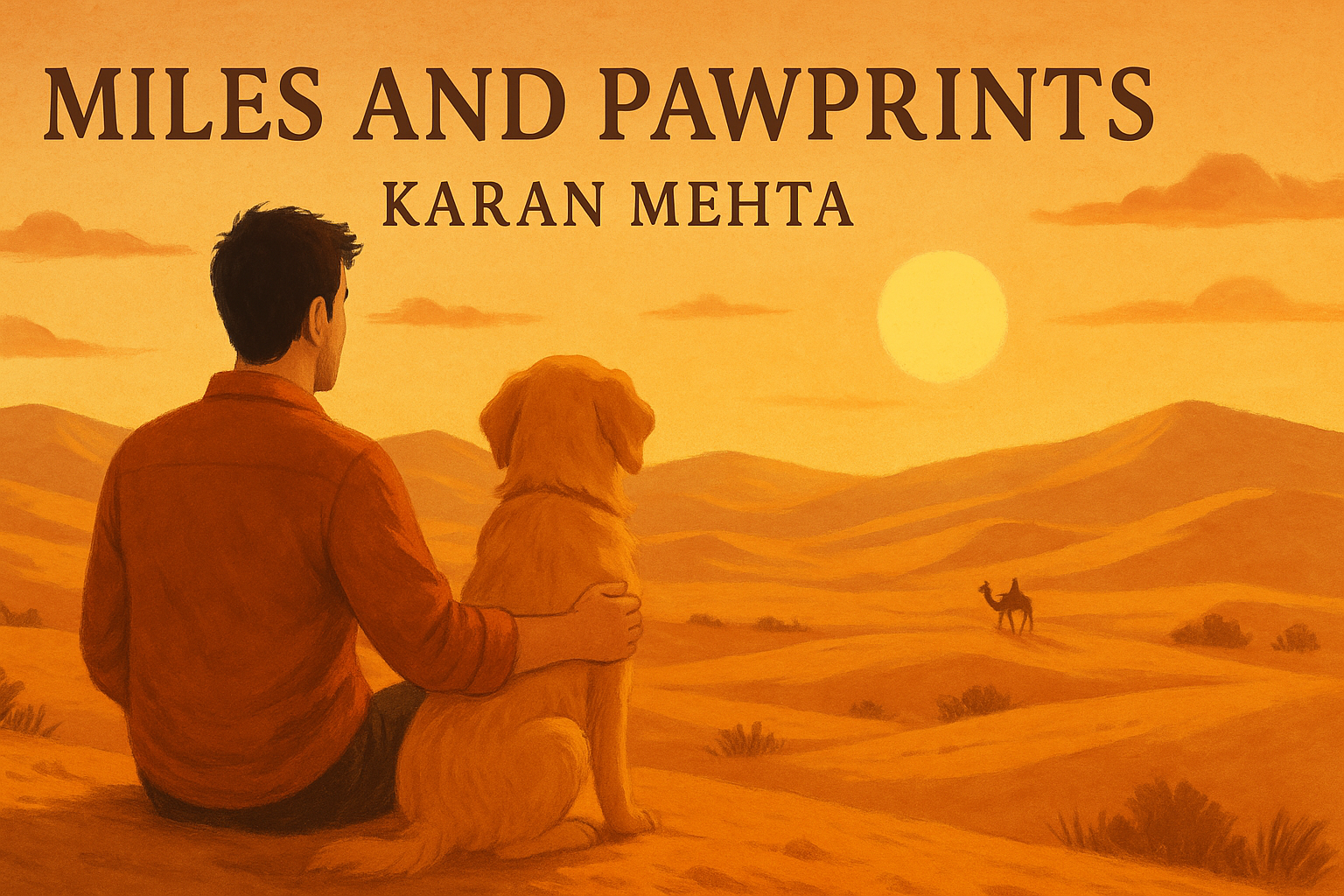

Karan Mehta
The Road Begins in Mumbai
The smell of old books and rain hung in the air of Arjun’s flat as he sealed the last cardboard box. It was strange how quickly a life could pack itself away—eight years of a job, two failed relationships, a pile of unread journals, and a dog who never left his side.
Simba watched quietly from his corner, tail swishing slowly across the tile. The golden retriever was almost six, with a slight limp in his left leg from a puppyhood injury. Arjun liked to think that limp made Simba more human, more relatable. Less perfect. Like him.
“You sure about this?” Aniket’s voice broke the silence as he leaned against the doorframe, sipping chai.
Arjun gave a half-smile. “Nope. But I’m done waiting for something to happen.”
The publishing house had let him go with a polite handshake and a half-hearted email template. ‘Restructuring,’ they’d said. He didn’t hate them for it. In a way, it felt like permission—to stop pretending the daily grind still meant something.
Aniket looked down at Simba. “And he’s in?”
“He’s in before I am,” Arjun chuckled, running a hand through Simba’s fur. “We’ve both been staring at walls for too long.”
By afternoon, the old Mahindra Thar was loaded—sleeping bags, a dented steel flask, some poetry books, Simba’s favorite ball, and a creased map of India that Arjun insisted on keeping despite having GPS.
As they pulled out of the narrow Bandra lane, Arjun rolled down the windows. The smell of fried samosas and diesel drifted in. Mumbai’s monsoon had just begun, turning the city into a mosaic of umbrellas, muddy puddles, and restless dreams.
They crossed the Sea Link as the sky turned silver. Arjun glanced at Simba, ears perked, tongue out, loving the wind. His chest felt lighter. It wasn’t joy—not yet. But it was the absence of heaviness, and that was a start.
Their first goal was Malshej Ghat—close enough to feel like a beginning, far enough to believe in escape. The road wound through green hills, mist curling like whispered secrets around the tires.
Night fell by the time they reached the edge of the ghats. Arjun stopped at a tiny roadside dhaba, more a shack with flickering bulbs than a proper eatery. He ordered dal-chawal, two boiled eggs for Simba, and sat cross-legged on a wooden bench.
“You from the city?” the dhaba owner asked, wiping his hands on his kurta.
“Was,” Arjun replied.
The man chuckled. “People who leave the city say that. Then they come back thinner and wiser.”
“Or not at all,” Arjun said, staring at the dark hills.
Simba finished his meal in five gulps and curled up by Arjun’s feet. A little boy came by and patted his head, unafraid. Simba licked the boy’s hand gently. Arjun didn’t say anything, but smiled inwardly. His dog was his softest part.
They camped near a lookout point that night. The tent zipped against the cold, Simba a warm presence beside him. Wind howled through the cliffs, and somewhere far below, a waterfall roared in the dark.
Lying on his back, eyes wide open, Arjun whispered, “What are we doing, Simba?”
The dog stirred, placed his head on Arjun’s chest, and sighed.
Maybe that was the answer.
In the morning, they hiked. It wasn’t planned. A trail began behind the camp and Arjun followed it, boots slipping in wet mud, Simba bounding ahead, tail high. The rain was gentle, more mist than downpour, but the view it revealed was staggering.
The valley below was wrapped in green velvet, the fog like torn silk drifting through it. Waterfalls traced silver threads along the cliffs. Birds called from unseen branches. Simba barked once, then stopped, ears alert.
“What is it?” Arjun asked, crouching.
A rustle in the bushes. Then a flash of grey fur. A monkey. Two. Then five.
Arjun laughed. “No chasing, soldier.”
Simba looked tempted, but sat down dutifully, tongue lolling.
They stayed on that trail till noon, stopping at a broken milestone that someone had painted with the words: Here, the air remembers.
That night, Arjun wrote in a worn notebook he had carried since college.
“We are not running away. We are running into. The noise is behind us now. The silence knows our names.”
Simba snored beside him.
Monsoon in Malshej
The rains came heavy on the second morning.
Thick sheets of monsoon water lashed against the canvas of Arjun’s tent, drumming loud and wild. He blinked awake to find Simba already sitting upright, ears twitching, nose sniffing the dampness that hung like perfume in the air. The tent’s flap fluttered violently until Arjun zipped it shut.
“Well,” he muttered, rubbing sleep from his eyes, “guess you’re not getting your morning stroll today.”
Simba sneezed as if in protest.
They stayed huddled for an hour, waiting. Arjun made instant coffee with water boiled over a travel stove. It tasted like damp socks, but warmth was warmth. Simba got a few bites of dry toast from Arjun’s stash—he licked the crumbs off Arjun’s fingers as though it were gourmet fare.
By late morning, the rain softened to a dull drizzle.
They ventured out, boots and paws squelching in red earth. A thin fog coiled between the trees, and the wind carried the scent of wet leaves and distant flowers. Arjun slung his backpack over one shoulder and let Simba lead the way down a mossy trail, unmarked and half-eaten by time.
An hour in, they stumbled upon a forgotten British-era bungalow—roof caved, vines clawing up the walls, windows shattered. Arjun whistled low.
“Looks like something out of a Ruskin Bond story,” he said.
Simba padded inside fearlessly, tail wagging. Arjun followed, his steps careful. The floor groaned underfoot. Birds scattered from the rafters. There was something about old houses, the way silence settles in the bones of wood.
They paused in what must’ve once been a living room. A fireplace still stood, blackened and cracked. Simba sat near it, eyes watchful. Arjun imagined a time when fire warmed this room, laughter bounced off these walls, and someone’s dog curled up on that very same spot.
History isn’t just in books, he thought. It’s in smell. In echo. In what’s left behind.
As they explored the ruins, thunder rumbled overhead. A downpour began again, thick as a curtain. Arjun decided they’d stay put for a while. He rolled out his mat and leaned back against a wall. Simba lay beside him, chin on paws, gazing into the rain like it held secrets.
Later, an old man appeared on the steps—barefoot, with a bamboo stick and a bundle of wildflowers.
Arjun stood up, startled. “Namaste.”
The man nodded. “You shouldn’t be here when it gets dark.”
“There’s a storm,” Arjun explained. “We’ll leave once it slows.”
The man sat on a fallen pillar, looking out. “This place is not just stone. It remembers things. Some of them not so kind.”
Simba walked up to him, sniffed, and licked his fingers.
The man chuckled. “He has a good heart. But even animals feel what we forget.”
He didn’t stay long. As quickly as he came, he vanished into the rain.
Arjun wasn’t superstitious. But he couldn’t deny the strange chill that lingered after the man left. That night, they didn’t sleep inside the bungalow. Instead, they pitched their tent just outside, under a banyan tree that seemed more welcoming.
In the middle of the night, Simba barked once. Loud, sharp.
Arjun sat up. “What is it?”
But the dog had already quieted, ears low, staring into the dark.
“Just wind,” Arjun whispered. He wasn’t sure who he was convincing.
They left the next morning. The rain had paused, the sky heavy but quiet. On their way down, they met a tea-seller named Madhav who ran a small shack near the edge of the cliff. His tea was strong, his smile stronger.
“You came down from that bungalow?” he asked, surprised.
“Yes. Took shelter there in the rain.”
Madhav shook his head. “People don’t go up there anymore. The forest grew over it like it was never meant to be found again.”
“Do you believe it’s haunted?”
Madhav shrugged. “I believe memory is heavier than ghosts.”
Arjun nodded. “Fair.”
Simba nosed at Madhav’s tin biscuit box, earning a laugh and two Parle-Gs.
They sat there for a long while, watching the clouds climb and collapse into the valley. Arjun scribbled in his notebook again:
“Even in ruins, life lingers. The wind tells stories if you’re quiet enough to listen. And sometimes, the only map you need is a dog who walks beside you without question.”
By late afternoon, they were back on the road. The Thar splashed through puddles, past waterfalls that gushed with fury, and past rice fields gleaming in green serenity. Simba leaned against Arjun’s arm as if to say, Where next, Captain?
Arjun smiled. “Goa, I think. Let’s chase some sun for a change.”
Simba woofed once, short and satisfied.
The monsoon receded slowly behind them, like a curtain drawing back after the first act.
Sands of Solitude in Goa
The Goa air smelled like old salt and freedom.
After the cold and mystery of Malshej, the coastline felt like a wide-open sigh. Coconut trees bent lazily in the sun, and the sea stretched out in all directions, sparkling like spilled sequins. Arjun’s Thar rolled into a sleepy part of South Goa—no shacks, no parties, just silence punctuated by waves and birdsong.
He had no booking, just a tip from Madhav the tea-seller: “There’s a guesthouse near Palolem run by an old couple. They take in travelers. And dogs too, if they’re polite.”
Simba, as always, sat like a gentleman in the front seat, tongue hanging out with approval.
They reached the guesthouse by late afternoon. The signboard read Casa de Vento—House of Wind. Fitting.
A woman in a cotton saree and silver hair greeted them on the porch. “We don’t get many walk-ins anymore,” she said.
“I don’t walk. I wander,” Arjun replied with a grin. “But only if you have space.”
She squinted at Simba. “And him?”
“He’s the gentler one.”
She laughed and called into the house. “Ashok! Get the red room ready—we’ve got a man, a mutt, and maybe a story.”
The red room was simple: whitewashed walls, faded curtains, and a bed that creaked like it had its own memories. Simba sniffed every corner, then settled on the cool tile floor.
Over dinner—vegetable stew, rice, and roasted cashews—Arjun learned their story. Meera and Ashok had once been backpackers themselves. They’d met in Manali in the ’70s, eloped to Goa, and never quite left. The guesthouse was their way of staying part of the road even after they’d stopped moving.
“You look like someone who’s recently let go of something,” Meera said, pouring him a second glass of coconut feni.
“More like something let go of me.”
“That’s the same thing,” Ashok said, puffing on a hand-rolled cigarette.
For the first time in weeks, Arjun slept without waking in the middle of the night. He dreamed of floating in water while Simba paddled beside him, both weightless and unafraid.
The next morning, he walked down to the beach with Simba trotting ahead. The shore was almost empty, save for two fishermen pulling in their nets and a child making sand castles that didn’t last more than a wave.
Simba ran to the edge of the surf, barked once at the sea, and then sprinted in circles like a madman. Arjun laughed, shoes in hand, letting the water lick at his ankles.
Days passed in a sunlit rhythm.
Arjun wrote in the mornings on the porch, longhand in a fresh notebook Meera had gifted him. Simba dozed at his feet, occasionally chasing away a crow or two. By noon, they’d walk into town, eat at a tiny café that served prawn curry and mango lassi, and then return for a nap in the garden.
In the evenings, Meera played old Hindi songs on a dusty radio while Ashok shared wine with fellow guests—most of them artists, yoga teachers, or people who had forgotten what they were running from.
One evening, a group of local kids came to visit Simba. Word had spread about the “travelling dog.” They called him “Yatra Wala Bhaloo”—the traveling bear.
Simba didn’t seem to mind the name. He posed with them, tolerated endless hugs, and even learned a new trick: fetching marbles from the sand.
Arjun watched the scene with a strange fullness in his chest. He had always been restless—always planning, always comparing, always moving without moving. But here, in this corner of the world, there was nothing to do and nowhere to be. And it felt… enough.
He wrote in his journal that night:
“We keep looking for cities and jobs and people to complete us. But sometimes, all you need is salt in your beard, sand in your shoes, and a dog who believes you’re already whole.”
The next morning, a young woman named Tara checked into the guesthouse. She was from Pune, taking a break from her PhD in marine biology. She spoke little, but smiled often. She seemed to speak Simba’s language—within a day, he was following her like a disciple.
“You’ve been replaced,” Meera teased.
“Maybe I needed to be,” Arjun smiled.
They shared breakfast over papaya slices and masala omelets. Tara spoke about coral reefs and seabirds and the loneliness of academic deadlines. Arjun spoke about quitting, about the unexpected freedom in failure. They didn’t flirt—it wasn’t like that. It was just the kind of closeness that didn’t need labels.
On the fifth day, Arjun knew it was time to leave. Not because he was bored—but because he was full. Of stories. Of smiles. Of space.
He hugged Meera, shook Ashok’s hand, and promised to write.
“You’ll never write,” Ashok smirked, “but you’ll remember.”
Tara waved from the porch, hair damp from a morning swim. Simba licked her hand one last time, then jumped into the Thar like he was done vacationing.
They drove off just as the tide came in.
Arjun didn’t look back. He didn’t need to.
Simba rested his chin on the window frame, eyes half-closed, the wind in his ears.
The road ahead curled like a secret. And they were ready.
Ruins of Hampi, Echoes of the Past
The rocks rose like forgotten gods from the earth.
As Arjun and Simba rolled into Hampi, the landscape shifted into something ancient and reverent. Boulders the size of buses balanced on hillsides with impossible ease, and the horizon was painted with crumbling temples and sunburnt stone. The past didn’t just live here—it breathed.
Simba sniffed the air, ears flicking back and forth. The heat was dry and heavy, pressing against their skin like invisible palms. Arjun parked the Thar under a neem tree and stepped out, shading his eyes.
“I think we just entered a poem,” he murmured.
They had no booking—again. But that didn’t matter here. In Hampi, everything slowed. A man with a bicycle and no shoes offered them a homestay with a smile and no questions. Arjun accepted. The room was plain, the bed sunken in the middle, and the fan worked only when it felt like it. But the view—ah, the view opened to the Virupaksha Temple standing like a sentinel in the distance, and the Tungabhadra river curling like a silver ribbon below.
On their first evening, Arjun took Simba walking through the ruins. The sun turned the granite pink, and monkeys watched them from the treetops like curious scholars. A narrow path led them to the old elephant stables—majestic domes that echoed with footsteps and something older than memory.
Simba barked once, not in alarm, but wonder.
“I know, buddy,” Arjun whispered. “It’s like walking through someone else’s dream.”
A group of backpackers sat cross-legged near the stables, strumming guitars, smoking clove cigarettes, and talking about time. One of them, a lanky man with dreadlocks and a Welsh accent, waved Arjun over.
“You look like someone who carries a story,” he said.
“I’m just passing through.”
“That’s what stories always say.”
They shared peanuts and stories of far-off cities—Barcelona, Kolkata, Cape Town, Shillong. Simba slept beside Arjun as they spoke about loss, love, and the strange ache that came with not knowing where home was anymore.
Later, a woman named Maitreyi joined them. She was Indian, a historian researching ancient trade routes. Her eyes were sharp, her voice low. She spoke of Vijayanagara like it had never fallen.
“Hampi isn’t just ruins,” she said. “It’s a language carved in stone. It remembers everything.”
She pointed to a nearby carving—an elephant, a dancer, a lion. “This one? It’s not just art. It’s a warning. The lion faces the dancer—power faces joy. Guess who wins?”
“Joy?” Arjun guessed.
“No,” she smiled. “Neither. They collapse into silence.”
Something about her stuck in Arjun’s head. That night, he dreamed of a marketplace—full of color, laughter, drums, and coins—and woke with the faint scent of incense in his nose.
The next morning, he and Simba hiked up Matanga Hill before sunrise. It was a steep climb, rough on Simba’s old leg, but the dog didn’t stop. By the time they reached the top, the sky was opening in slow golds and reds. Below them, the ruins stretched like a memory frozen mid-breath.
Arjun sat, pulled out his journal, and began to write:
“The earth here doesn’t speak in words. It hums in ruins. It sighs in wind. And when you listen—really listen—you can hear every story ever told.”
He didn’t know how long he sat there. When he finally stood, he found Simba sniffing near a pile of stones. Something shimmered faintly beneath them—a coin? A pendant?
He crouched and brushed away the dust. It was an old copper talisman, shaped like a fish with inscriptions along its body. Ancient. Forgotten. Waiting.
Later, he showed it to Maitreyi.
Her eyes widened. “This is from the Vijayanagara period. Traders carried these for luck.”
“Simba found it.”
“Then maybe you’re luckier than you think.”
They walked by the river that evening. She asked nothing about his past, and he offered nothing. But the silence between them felt like a choice.
“Do you ever feel like you were meant to be someone else?” Arjun asked.
“No,” she replied. “But I do feel like I’m always chasing the version of me I left behind.”
Simba splashed in the water ahead of them, barking at a heron.
“You’re chasing history,” Arjun said.
“And you’re escaping it.”
He smiled. “Maybe we’ll meet in the middle.”
They parted at the stone steps near the bazaar. No phone numbers, no promises. Just a shared nod, as if acknowledging they were both exactly where they needed to be—for now.
That night, Arjun wrote one last note before leaving:
“Every ruin is a memory. Every crack a whisper. Hampi doesn’t ask you to understand—it just asks you to feel.”
They left the next morning. The talisman hung from the rear-view mirror now, gently tapping the windshield with every bump on the road.
Simba curled in the passenger seat, tired but content.
Arjun didn’t know their next stop. But for once, not knowing didn’t feel like being lost.
It felt like being free.
The River Knows in Rishikesh
By the time they reached Rishikesh, Arjun was quieter than usual, and so was Simba.
The drive from Hampi had taken several days, filled with tea-stall conversations, truck-stop meals, and sunsets that bled into each other. They’d passed through Maharashtra’s dusty edges, skimmed Madhya Pradesh, then followed the winding arms of Uttarakhand until the mountains rose around them like guardians. But Arjun barely spoke. Something had shifted after Hampi. A stillness. Not heavy, but deep.
Rishikesh greeted them with the smell of incense, the clang of temple bells, and the steady hum of the Ganga. The town felt both sacred and chaotic—sadhu and selfie-taker sharing the same sidewalk, cafes named after gods serving shakshuka, silence sold by the hour in meditation huts.
Arjun found a small ashram on the quieter side of town. Dogs weren’t usually allowed, but the swami at the gate looked at Simba for a long moment before smiling. “He’s calmer than most people. Let him in.”
They were given a single bed in a whitewashed room, a window opening to the river, and meals of warm khichdi and ginger water. There was a daily schedule: yoga at dawn, meditation at noon, satsang in the evening. Arjun participated with hesitation at first, but Simba took to the rhythm immediately, napping during chanting and sitting patiently during discourses.
On the third morning, Arjun woke early and walked down to the river. The Ganga was pale green and glassy in the morning light, curling around smooth rocks like a breath. He sat on the ghats, toes dipped in water, Simba beside him.
An old man with a copper pot approached them. “Do you know why the river is a goddess?” he asked without preamble.
Arjun shook his head.
“Because she carries your sins without complaint. You give her what you can’t carry.”
“I’m not sure I believe in sin,” Arjun said.
“Then call it memory. Regret. Hurt. Give her that.”
He walked away, leaving Arjun staring at the ripples.
That day, Arjun signed up for a three-day silent retreat.
The ashram provided a corner of the garden for Simba, a bowl of water, and instructions: no talking, no writing, no phones.
Just breath.
It was harder than he thought. The silence wasn’t peaceful at first—it was loud, filled with echoes. Past failures played like broken records. Memories of people he’d let down. Conversations he should’ve had. Words left unsaid. Questions that still ached.
On the second day, during a walking meditation by the river, he saw Simba sitting by a group of local children who were drawing in the sand with sticks. One of them handed Simba a red flower. He didn’t eat it. Just held it between his teeth and looked at Arjun.
That night, Arjun wept. Quietly. Freely.
It wasn’t about anything in particular. Just everything.
On the final morning, the silence became softer. Not absence, but space. A place to rest.
He walked down to the river again, knelt, and cupped water in his hands.
“This isn’t an ending,” he whispered, breaking the vow gently. “It’s a release.”
Simba rested his chin on Arjun’s knee, eyes steady. No bark. No movement. Just presence.
After the retreat, the swami called him to the veranda.
“You’ve lost weight,” he said. “And something else.”
“Fear, maybe.”
The swami smiled. “The best kind of weight.”
They stayed another day. Arjun visited the suspension bridge—Lakshman Jhula—where he watched monkeys steal prasad and tourists stare at their phones instead of the river. He didn’t judge. He just noticed.
That evening, a musician performed on the banks—a flute player with eyes closed, letting the notes fall like petals. Arjun sat among a small crowd, Simba curled at his feet. For the first time, he didn’t feel like a traveler. He felt like a witness.
Later that night, he wrote in his notebook:
“The river doesn’t erase. She accepts. The way a dog does. Without needing to fix, just to flow beside you.”
The next morning, Arjun tied the copper talisman—found in Hampi—to a string and left it hanging from a tree by the river. Not as an offering. Not as closure.
As a mark that he’d passed through.
When he turned, Simba was already sitting in the Thar, ready.
“Alright,” Arjun said, settling into the driver’s seat. “Where to next, old man?”
Simba let out a soft woof.
They drove off before the city awoke fully, the sun still yawning behind the mountains.
The road climbed higher. The air grew thinner. And somewhere beyond the bends, something awaited.
Something cold.
Something real.
Snow and Silence in Spiti
Spiti was not a place. It was a hush.
Even before they reached the valley, Arjun felt it—like the world itself had leaned in and whispered: Only bring what matters. The road coiled like a ribbon of stone, rising higher, narrowing with each turn. The air thinned. Breath shortened. Even Simba, ever alert, grew solemn, curling up on the passenger seat with an almost monk-like stillness.
They arrived in Kaza at dusk. It wasn’t snowing yet, but the cold clung to everything—doors, tires, fingers. Arjun’s beard bristled with ice crystals. Their homestay was a two-room house with walls painted sky blue and a stove that wheezed like an old harmonium. The woman who ran it, Tsering, barely spoke. She gave Arjun a thick yak wool shawl and poured butter tea into small metal cups.
Simba sniffed at the warmth and settled by the stove. The heat made his nose twitch in his sleep.
That night, Arjun couldn’t sleep. The silence was so complete it made his ears ring. No distant horns. No barking. Just the creaking of wood, the occasional sigh of wind, and the faint rustle of snowfall beginning outside.
He pulled out his journal but didn’t write. Words felt too heavy here.
In the morning, the world had turned white.
Snow blanketed the rooftops, the paths, even the prayer flags that fluttered across the nearby monastery. Arjun stepped outside with Simba, boots crunching with each step. The cold bit hard. Even the sun, now gleaming on the snow, felt distant.
They climbed toward the monastery together, taking it slow. At over 12,000 feet, every breath felt like sipping air through a straw. But Simba didn’t complain. He simply stayed close, pressing his body into Arjun’s thigh every now and then, as if to remind him—I’m here. Keep going.
Inside the monastery, a young monk served them salty tea and said little else. Arjun sat cross-legged on the wooden floor, letting the incense wrap around him like fog.
“Why do people come here?” he finally asked.
The monk shrugged. “To forget. Or to remember.”
Arjun looked at Simba, who was now watching a moth dance near the butter lamps. “I’m still figuring out which one I came for.”
The monk smiled. “The mountains don’t give answers. They just take away your questions.”
That afternoon, the snow thickened.
By nightfall, they were snowed in.
The wind howled like a beast outside, rattling windows, snapping at the corners of the house. Tsering lit more candles. The power flickered and died. The stove struggled to stay lit. Simba curled tightly against Arjun’s legs, his body warm, but trembling.
And then, it happened.
A loud cracking sound. Then silence. Then another sound—something falling.
Arjun grabbed his flashlight and stepped outside into the storm. The shed near the house had collapsed under the weight of snow. A section of the roof was buried. They were stranded.
Tsering looked worried. “No road. No phone. Two days, maybe three.”
Arjun nodded, heart racing.
That night, they burned yak dung for heat. Simba refused to eat. His body was warm but sluggish. Arjun checked his paws—red and cracked.
“We’re not built for this,” he whispered, cradling his head against Simba’s. “We’re just visitors here.”
The cold got into his thoughts. Made them slower, fogged. He lay under blankets, holding Simba, humming to keep them both alert. Outside, the wind howled on.
By morning, Tsering had cooked a rice broth. Simba licked a few spoonfuls from Arjun’s hand. That was enough hope.
They stayed indoors for two days. Arjun read from an old poetry book someone had left behind: verses by Wang Wei, Basho, Milarepa. Lines about snow and silence and surrender.
He began to understand.
On the third day, the sky cleared. A caravan of mountain villagers arrived from a lower village, helping clear the path. One of them looked at Simba and said, “He’s strong. Most don’t last this cold.”
“He’s more than strong,” Arjun replied. “He’s my compass.”
They left the valley the next morning. Slowly. Carefully. Simba rode with a blanket over his back and a steady gleam in his eyes.
As they descended, Arjun finally wrote in his journal:
“There are places that ask you to speak. And there are places that make you listen. Spiti listens for you, to the echoes inside your chest. And when it answers, it’s only with snow.”
Simba licked his fingers as he closed the notebook.
Arjun smiled. “Alright, soldier. Let’s find some sun.”
The engine groaned to life. The mountains stood behind them—unmoving, unbothered, unchanged.
And the road stretched forward again.
The Woman with Chai in Uttarakhand
It was supposed to be a brief detour.
Just a couple of days of slower driving through the Kumaon hills, on their way down from Spiti toward the warmth of the plains. Arjun had planned no stops—just winding roads, chai breaks, and crisp air. But life, like the road, always had curves he hadn’t accounted for.
It was late afternoon when he spotted the sign: “Naini Village – 2 km →”. Not marked on Google Maps. No phone signal. But something about it tugged at him. The Thar turned almost on its own.
The road turned gravel, then dirt. Trees closed in. The sun filtered through pine branches like melted gold. Simba, now regaining his energy after Spiti, perked up in the front seat, head out the window, sniffing like a detective on a promising case.
The village was no more than ten houses scattered across a sloping hill. Stone walls, blue-painted doors, clothes fluttering like prayer flags. Chickens ran underfoot. And at the center of it all stood a small tea stall—with a wooden bench, an iron kettle, and an old woman stirring chai with a rhythm that seemed older than the hills.
She looked up and smiled. “Lost?”
“No,” Arjun replied. “Just… found something I didn’t know I was looking for.”
She gestured to the bench. “Sit. Chai will explain.”
Arjun laughed, sat, and Simba lay at his feet as though he’d been here before.
The chai was earthy, laced with ginger and some unfamiliar herb that reminded Arjun of childhood winters. The woman didn’t ask questions—not about where he’d come from, nor where he was headed. She just sat beside him, letting the silence settle, as natural as the breeze.
After a few minutes, she spoke.
“My husband built this bench in 1972. Said it was for tired travelers. We’ve had monks, politicians, honeymooners, and one Bengali who claimed he was a time traveler.”
“And now a man with a dog.”
“He might be the wisest of them all,” she smiled, tossing Simba a biscuit. He caught it mid-air.
She looked at Arjun closely. “Your eyes are clearer than your shoulders.”
“What does that mean?”
“Means you’ve seen something worth keeping. But you haven’t yet let go of what’s heavy.”
Arjun was quiet.
She poured another cup. “Most people carry things long after they’re done serving them.”
“What if you don’t know what you’re still carrying?”
“Then listen to your silences. They’ll tell you.”
A light wind rustled the trees. Bells tinkled from a goat’s collar somewhere up the hill. Simba lifted his head but didn’t move. He was at peace.
Later, she showed him a small hut nearby. “Stay the night. No charge. But you’ll have to take care of the firewood yourself.”
Arjun didn’t refuse. Something about this place—its stillness, its unimportance on any map—made it feel sacred. That night, he built a small fire, boiled rice, shared it with Simba, and sat outside the hut staring up at stars he hadn’t seen in years.
There was no traffic. No cell signal. No ambition.
Only breath.
Only presence.
Simba lay across his feet, tail gently thudding every few minutes, as if to say—You’re still here. Good.
In the darkness, Arjun whispered, “Do you think I’ll ever stop running?”
Simba blinked once, as if in agreement.
The next morning, the woman gave him warm roti, smeared with ghee and wrapped in a banana leaf. “Eat before the sun burns your hunger.”
Before leaving, Arjun asked, “Do you have a name?”
“Once. Now I’m just the woman with chai.”
He offered money. She waved it off.
“Then let me give something.”
She nodded. “Write me something. Not now. Later. Something I can read in winter.”
He promised he would.
As he drove down the mountain, the sun climbed above the pines, flooding the road ahead with honeyed light. The rear-view mirror held a shrinking image of the village, the bench, the woman waving gently with her steel ladle.
He wrote later, in his notebook:
“There are places not on maps, and people not in stories, who change you anyway. They don’t ask you who you were or want to know who you’ll become. They just give you a place to pause. And remind you that stillness, too, is movement.”
That evening, they camped near a riverbank where the water sang over stones. Simba chased a cricket. Arjun read poetry aloud to the trees. No audience. No performance. Just rhythm.
And for the first time, Arjun no longer felt like a man escaping his life.
He felt like a man returning to it.
The Journey Never Ends
They reached the edge of the desert just as the year began to turn.
Winter was easing its grip, and the plains of Rajasthan stretched wide and bare under a soft sun. Arjun parked the Thar near a dune that rose like a sleeping whale in the sand. Simba hopped out slowly—his steps measured now, a little more careful, a little less eager. He was aging. And so was the journey.
They weren’t heading anywhere in particular. Not anymore. Arjun had stopped planning routes two weeks ago. He let the road decide. If it curved toward the hills, they followed. If it vanished into dirt and wind, they turned. If the sun looked warmer in one direction, they drove that way.
They pitched the tent near the base of the dune. The sand was cool to the touch, peppered with dry grass and tiny beetles. Simba lay flat and watched the sky turn from gold to blood orange, then melt into violet.
Arjun opened his notebook, now worn and almost full, its pages bent and smudged from months of use. He flipped through them—fragments of places, sketches of people, scribbled dialogues, poems that didn’t rhyme but felt true.
He found a blank page and began to write.
“There’s no finish line. No arrival. The road just folds into itself. Sometimes you move to escape. Sometimes you move to remember. And sometimes… you move because you love the way your dog looks at the world.”
He paused and looked at Simba, who was now snoring gently, nose twitching at a dream only he could see.
In the distance, a camel bell rang. A boy on a cycle waved. The desert was vast, but never empty.
That night, they built a small fire with dried twigs and watched sparks drift upward like fireflies. Arjun warmed his hands. Simba curled beside him. They shared a packet of Parle-G biscuits and boiled sweet potatoes. A feast for kings.
“I think we’ve been everywhere and nowhere,” Arjun murmured, gazing at the flames. “And I think I’m okay with that.”
Simba looked up, ears flicking once, then rested his head again.
The next morning, Arjun did something he hadn’t done in years.
He called his mother.
From a pay phone near a chai stall, voice cracked by static and memory, he spoke for a long time. About nothing. About everything. He said he was writing again. Said he was okay. She asked if he was coming home.
“I’m already home,” he said. “But I’ll visit soon.”
Back at the tent, he sat for hours, typing on his old laptop, fueled by dusty wind and too many cups of chai. The travel essays he’d once promised to editors were now growing into something else. A book. A memoir. A map of moments. Not of places visited—but of the man who had visited them.
He titled it Miles and Pawprints.
One evening, weeks later, he returned to Meera and Ashok’s guesthouse in Goa. They were surprised, delighted. Simba ran straight to the garden as if he’d left a part of himself there.
“You’re glowing,” Meera said, hugging him.
“I’m writing.”
“You’re healing,” she corrected.
They gave him the red room again. Arjun spent a month there. He edited his manuscript. Read it aloud to Ashok in the evenings. Let Simba nap beside his desk. Sent the draft to a publisher in Delhi, half-expecting nothing.
But the reply came.
“We love it. It’s gentle. Human. Needed. We’d be proud to publish it.”
He didn’t cry. But something in him softened like wax.
On the last day at the guesthouse, Meera handed him a package. Inside was a leather-bound journal. On the first page, she had written:
“To new pages. And the dog who helped you turn them.”
They left the next morning, before sunrise.
Simba rode in the front seat, chin on the window, fur silvering around the muzzle now.
They passed a village, a lake, a lonely temple, and then nothing but sky for miles.
As they drove, Arjun didn’t feel like he was finishing a story. He was beginning one. Again and again. Every day.
And somewhere between two towns without names, he whispered,
“We’re not done yet, are we?”
Simba didn’t bark.
He just looked at Arjun with eyes that said—No, friend. The road is still calling.
And together, they drove on.
THE END