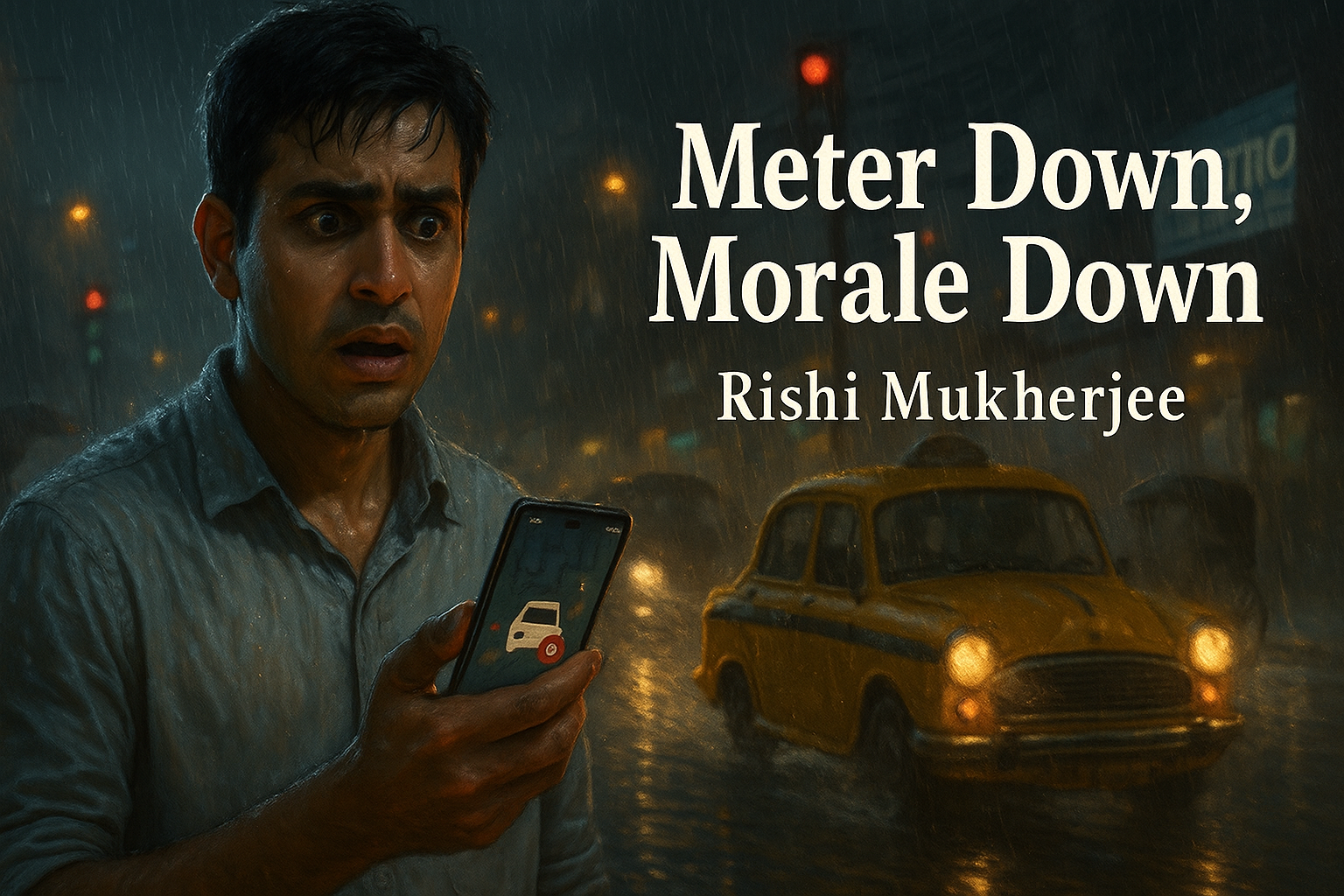

Rishi Mukherjee
Part 1: The Booking Blunder
Sayan Roy was many things—a decent copywriter, a loyal consumer of roadside egg rolls, and a devoted user of cab apps. What he was not, however, was punctual. This particular Tuesday morning in Kolkata was no different. The clock on his wall blinked a smug 8:42 AM as he fumbled with his half-burnt toast, a tangled earphone, and a sock that had somehow disappeared from the pair. He had precisely eighteen minutes to get from his modest flat in Behala to his office in Salt Lake Sector V—a journey that even astronauts would consider ambitious during morning rush hour.
“Today,” he mumbled, juggling his phone and his bag, “I’ll beat time.” He opened his Uber app with the intensity of a man unlocking a treasure chest. One swipe, one tap—Boom! A white WagonR appeared on the screen. ETA: 3 mins. Driver: Laltu Mondal. Rating: 4.6 stars. Car plate: WB20AG2541.
“Laltu da, I trust you,” Sayan whispered as he ran out of the flat, not realising his fly was wide open. He managed to zip it up just as he reached the gate. There stood the car, clean-ish, the driver leaning against the bonnet like he’d just wrapped up a photoshoot for ‘Auto Driver Digest.’
“Sayan babu?” Laltu asked with the confidence of a man who had seen 27 Salt Lake routes and survived them all.
“Yes, yes, Sector V. Let’s go!” Sayan replied, climbing in and nearly tripping over a packet of muri and a stray slipper on the backseat.
“Meter e jabo toh?” he asked cautiously, remembering past wounds inflicted by rogue cabbies.
“Meter e jachhi, kintu ektu bypass diye jete hobe. Shortcut,” Laltu replied with a wide grin that made Sayan nervous. He had been fooled by ‘shortcuts’ before. The last time someone took him via a shortcut, he had ended up in a wedding baraat in Sonarpur and eaten two pieces of mutton to feel less awkward.
But time was not on his side. The cab started moving. Sayan opened his office group chat and typed: “On my way. Some traffic. Will be there in 20.” It was a hopeful lie. The map on his app was already turning orange. The fare meter showed ₹212, which was normal, but his gut told him it wouldn’t stay that way.
Ten minutes later, the ‘shortcut’ took a hard left into a colony full of under-construction buildings and loose cows. Sayan looked up, puzzled. “Laltu da, this doesn’t seem like the EM Bypass…”
“Arrey EM Bypass a jam. Eta new route. Google bollo.”
Google, apparently, had gone insane.
Within five more minutes, they were passing through a fish market where hilsa was being auctioned like black-market organs. A man waved a giant fish next to Sayan’s window, yelling, “Ei taxi ta holo lucky, kaal je ilish uthlo seta exactly etar samne!” Sayan ducked instinctively, as if the fish might jump through the window.
He looked at his phone again. The fare now read ₹347. “Wait, what! How?”
“Surge pricing, babu. Tohkal toh hoyei.”
“It’s 9 in the morning! Who’s taking Ubers to attend fish auctions at this hour?”
“Kolkata people. Versatile.”
Sayan stared into the rearview mirror, wondering if he could jump out and roll safely onto the road without injury. But before he could attempt cab-escape parkour, Laltu declared, “Aar ekta toll ache samne. Chhoto ekta.”
Sayan leaned forward. “Toll? There’s no toll booth on this road!”
“Emotion-er toll,” said Laltu gravely. “Shortcut e heartbreak hoy.”
“Are you serious?”
“Na. Joke korlam.”
Sayan gave him a death stare but said nothing.
They reached EM Bypass eventually, merging into a line of cars so long it could be seen from space. Sayan had officially entered the land of doom. His Creative Head, known as the Lord Voldemort of Corporate Branding, had called for an urgent team meeting. No one knew why, but everyone suspected it had something to do with the jingle they had written for a hair removal cream that accidentally sounded like the national anthem.
Sayan’s phone buzzed again. “Where are you?” the account manager texted.
“In transit,” he replied, hiding the fact that the ‘transit’ currently included a goat staring at the cab from a divider and a man brushing his teeth in public.
The fare now blinked: ₹472.
He was stunned.
“Laltu da, are you trying to reach the moon with this meter?”
“This meter honest. Government certified,” said Laltu proudly.
“Are you sure the certification didn’t come from Hogwarts?”
Laltu didn’t respond. Instead, he offered Sayan a boiled candy from the glovebox. “Mango flavour. Cholbe?”
“No. I want my ₹472 back.”
“That I can’t do. But mango candy ektu mon halka kore.”
Sayan took it. He didn’t know why. Perhaps because when you’re trapped in a moving financial disaster disguised as a vehicle, mango-flavoured sugar is your only friend.
At 10:03 AM, the cab finally turned into the Salt Lake service road. The building was in sight. Sayan’s hair looked like he had been electrocuted, and his shirt had more creases than a senior citizen’s elbow.
When the car stopped, the final fare was ₹542.
Sayan stared at the number like it was the code to launch a nuclear missile.
“I booked this ride for ₹210,” he whispered.
“Yes,” said Laltu, smiling as he handed over the candy again, “but today God wanted to test your patience and your wallet.”
Sayan paid the amount with trembling fingers and exited the car like a man walking away from a battlefield.
As he entered the elevator of his office, he took a vow: no more cab rides for the rest of the week. From tomorrow, it would be the bus, no matter how many armpits surrounded him or how many coins he had to dig out from the depths of his sofa.
What he didn’t know was that destiny had other plans—and they all involved cab rides, surge pricing, and increasingly ridiculous misadventures.
Part 2: Surge of the Century
Sayan Roy’s vow to never take a cab again lasted exactly one and a half days. On Wednesday, he boarded a minibus that reeked of old sweat and government inefficiency. An elderly woman kept swinging her plastic shopping bag into his ribs every four seconds like a pendulum of passive aggression, and a man with a dense, curly moustache stood so close behind him that Sayan could practically hear his breakfast digesting. By the time he stumbled out near his office in Sector V, he was nauseous, missing one earphone, and convinced he had briefly gone blind from the combined force of cheap perfume and armpit musk.
On Thursday morning, defeated and desperate, he reached for his phone with the shameful resignation of a man returning to a toxic ex. He opened the Uber app with trembling fingers, whispering, “Just this once. No drama. No shortcuts. Point A to Point B. We ride, we pay, we move on.”
The app took a suspiciously long time to load, as if it was judging him. Then came the result: UberGo, White Swift Dzire, ETA: 4 mins. Driver: Pintu Chatterjee. Rating: 4.8 stars. Price: ₹189. Surge multiplier: 2.1x.
Sayan froze. “Two point one? For what? Is the city under attack? Has someone declared free rasgullas in New Market? What is this madness?”
He refreshed. Surge remained. He waited two minutes, staring at the phone like a gambler waiting for the jackpot to hit. The multiplier dropped to 1.9x. “Okay! Progress,” he muttered. Another refresh. It went back to 2.2x.
“Are you… are you playing with me?” he asked aloud, as if the app had grown a conscience and a cruel sense of humour.
He opened Google Maps. No roadblocks. No rain. No festival. No reason for this economic betrayal. And yet, the surge held strong, standing its ground like a corrupt MLA before elections.
He considered taking the bus again, but then remembered that yesterday, during an abrupt brake, his face had been squashed into someone’s back pocket. Metro? Too far. Auto? The last time he’d asked for a ride to Salt Lake, the driver quoted him ₹300 and said, “Discount deke ₹270 nibi?”
No. It had to be Uber. Defeated, he tapped “Book.” The app chirped with cruel cheeriness: “Your ride has been confirmed! Pintu is 3 minutes away.” Pintu’s face on the app looked oddly serene, like a yoga instructor who had seen life, death, and Dum Dum traffic, and decided none of it mattered.
Sayan packed his bag, triple-checked his fly, and marched downstairs. The Swift Dzire pulled up with the aggression of a car being chased by creditors. Pintu Chatterjee leaned out and flashed a grin.
“Sayan da?”
“Yes,” Sayan replied cautiously. “Sector V, Salt Lake?”
“Haan, haan! Ei bhorer taara aagey uthle, jam avoid kora jaay,” Pintu said, even though it was already 9:15 AM.
They pulled out into traffic. Everything was going surprisingly well. The AC worked. Pintu didn’t chew paan. The seats smelled faintly of Dettol. Sayan relaxed a little.
Five minutes into the journey, they reached a signal where a massive wedding procession was blocking the road. A brass band played “Tumse Milke Dil Ka Hai Jo Haal,” while relatives in glittering clothes danced as if they were being electrocuted gently. Pintu groaned.
“Shaadi rasta rokiye rakhlo. Eta toh regular hoye gechhe,” he said. “Ektu goli diye ghuriye nebo, thik ache?”
Sayan panicked. The word “goli” in cab driver language was code for “prepare to double your fare.”
“Is it really shorter?”
“Of course! Ekdom shortcut.”
Sayan sighed and nodded. The car turned right and entered a narrow bylane that appeared to be part of an abandoned film set. Goats grazed lazily. A man bathed with a pipe next to a Maruti 800 covered in vines. The cab swerved past puddles, potholes, and a boy flying a kite in the middle of the road.
Ten minutes in, Sayan noticed the fare had already crossed ₹300. He glanced up.
“Pintu da, this fare is… growing. Like, aggressively.”
“Surge pricing. What to do?” Pintu shrugged. “Bhalo rating thakle Uber more charge kore. That means I’m good driver.”
Sayan couldn’t argue with that flawed logic. But he was silently seething. The surge was worse than interest on a shady loan. Every red light added ₹15. Every speed bump, ₹7. By the time they reached the EM Bypass, the fare had reached ₹417.
Sayan was sweating. “It said ₹189 when I booked it!”
“Haan toh,” Pintu replied calmly, “that was estimated fare. Uber gives hope, not promise.”
Sayan bit his tongue. He was too tired to fight. Maybe the app had conspired with his stars. Maybe Mercury was retrograde. Maybe he was cursed.
At a traffic signal, a beggar child tapped on the window. Sayan handed him a ten-rupee coin, and the boy immediately turned to Pintu and said, “Ektu kom chalao dada, dada r chokh jol jome gechhe.”
Pintu laughed loudly. “Dekhchen toh, even beggar is traffic expert now!”
They crawled forward. A man selling inflatable hammers tried to sell one to Sayan. “Eita diye boss ke mere chhuti nite parben,” he said helpfully. Sayan almost bought one.
At long last, they reached Salt Lake. As they turned into the office lane, Sayan noticed a biker scratching his back mid-ride with a long spoon. He decided not to question it. Kolkata had its own ecosystem of absurdity.
The car halted. Final fare: ₹471.
Sayan stared at the number like it had personally insulted his ancestors. “Four seventy-one?” he croaked.
“Haan. But see, no jam on this route. I saved time!”
“I could have flown to Delhi in that much,” Sayan muttered, opening his wallet and watching a lone ₹500 note weep silently.
He paid, stepped out, and the heat hit him like a slap. His shirt was now sticking to his back, his mood was fried, and he still had to present the “Monsoon Chyawanprash” campaign idea to the Creative Head, who once described his last slogan as “emotionally constipated.”
As he entered the elevator, a message from Uber popped up: “How was your ride with Pintu?”
Sayan clicked “⭐️⭐️” and typed: “Fare reached Mt. Everest. Driver was nice but took route through Narnia. Please refund emotional damage.”
He closed the app, vowing again to quit cabs forever.
Of course, tomorrow was Friday. And Friday traffic was a beast of its own.
Part 3: The Wallet Trap
By the time Friday arrived, Sayan Roy had completely lost touch with the concept of budgeting. On Monday, he had ₹1,500 in his wallet. By Thursday evening, he had ₹57, two Metro tokens, and a loyalty card from a momo shop that promised a free plate after eleven purchases—he had eight stamps. His Uber account, meanwhile, looked like it had been through a recession. With three rides totaling nearly ₹1,500 over three days, Sayan was now a walking example of financial mismanagement in urban transport.
Friday mornings at his office were deceptively calm. Clients rarely called before noon, and the Creative Head usually strolled in around 11:30 AM smelling of aftershave, existential dread, and passive-aggression. It should have been a peaceful morning. But at 8:49 AM, Sayan received a text from Rini, the HR executive: “Sayan, remember the 9:30 pitch meeting with Bina Chyawanprash team. You’re presenting the jingle. Don’t be late or I’ll kill you with my eyes.”
Sayan screamed internally. He hadn’t written the jingle. Not even a word. He had spent the previous evening binge-watching conspiracy videos about how surge pricing was secretly linked to the lunar cycle.
He scrambled. No time for breakfast. No time for socks. He shoved his laptop into his bag, jammed a packet of Bourbon biscuits in his pocket, and sprinted out of the building like he was escaping a fire.
Bus? Too slow. Metro? Too far. Auto? Ha! He didn’t even glance at the stop this time. It was Uber again. His toxic partner in crime.
He opened the app. This time, it was different. No surge. Base fare: ₹213. Driver: Jatin Ghosh. ETA: 2 minutes. Vehicle: Silver Honda Amaze. 4.9 stars.
He blinked. “Is this… a sign? A blessing from the cab gods?”
The car arrived right on time. Clean, sleek, with the faint smell of camphor and mint. Jatin was an elderly gentleman in a crisp white shirt, hair neatly parted, humming an old Hemanta song under his breath.
Sayan got in, surprised. “Sector V please. I’m in a bit of a hurry.”
“No problem, babu. I drive smooth,” Jatin said. He spoke with a calmness that felt like chamomile tea in human form.
The ride started. Traffic was thin, and the route was direct. No suspicious shortcuts. No hilsa markets. No goats. Just pure, uninterrupted motion.
Sayan allowed himself to relax. He even pulled out his phone and typed the jingle lyrics in Notes:
“Bina Chyawanprash, sweet and bold,
Keeps you young though you’re growing old!”
“Ugh, cheesy,” he mumbled, editing it mid-ride.
About fifteen minutes in, they reached Park Circus. Sayan felt light. Maybe he’d finally broken the curse. He sipped water from his bottle and looked at the fare—₹229. Reasonable. He smiled.
And then, disaster.
The car suddenly slowed to a halt. Jatin looked through the rearview mirror, troubled. “Babu, sorry. Please check your wallet. I think I have a problem.”
Sayan frowned. “Why? What happened?”
“I just remembered. My PayTM is not working. Kaal theke technical issue. And I don’t have change for ₹500.”
Sayan froze. He checked his own wallet. Inside: ₹57. And three chocolate wrappers.
“No card reader?” he asked hopefully.
“No. Only cash or PayTM. And cash must be exact change,” Jatin replied politely but firmly.
Sayan panicked. He opened Google Pay. But the driver wasn’t listed. He asked, “Can’t you just accept online payment through Uber directly?”
Jatin smiled sadly. “My son opened this Uber account for me. It doesn’t connect. I do manual rides only.”
Sayan considered jumping out of the car and running the last four kilometers. But he’d never make it in time for the pitch. So he asked, “Can we stop at an ATM?”
“Sure, but I know only one nearby. Ballygunge More.”
They turned and headed toward the ATM. Sayan’s anxiety doubled every second. He finally saw the SBI sign like a beacon of salvation.
But fate had more jokes lined up.
The ATM was out of cash. A paper sign on the door said: “No money. Come back after lunch. Or next week.”
Sayan wanted to scream.
Jatin sighed. “Another ATM nearby. Purnadas Road. We try.”
They reached the second ATM. The line outside looked like ration queue from the 1960s. A man in a lungi explained helpfully, “Note bar hoychhe. Shob withdraw korche.”
The cab meter kept ticking.
Sayan tried the HDFC next to it. The guard said, “Machine is working. But server down.”
At this point, Sayan had lost all connection with hope. He was sweating through his shirt, jittery from anxiety, and late for a pitch that could potentially decide the company’s next quarter.
In desperation, he called his roommate Ankit.
“Bro, come to Ballygunge with ₹200. Fast. I’ll give you kidneys later.”
“I’m in Dum Dum.”
Sayan looked at the sky.
He turned to Jatin. “I’m very sorry. I don’t have money. And I can’t pay online. What can I do?”
Jatin looked at him calmly. “Babu, I believe in people. You are decent boy. Just promise me you will pay later. Come find me.”
Sayan was stunned. “Really?”
“Yes. My karma is strong. But your karma… hmm, slightly confused.”
Sayan gave him a folded ₹50 note from his wallet. “This is all I have now. Please take it. I’ll find you and pay the rest.”
Jatin nodded with a gentle smile. “Okay. But next time, carry change. City runs on coins more than currency.”
Sayan thanked him a hundred times and ran into the office like his life depended on it.
He reached just as the meeting started. His Creative Head looked up, annoyed. “Where’s the jingle?”
Sayan opened his laptop, heart still racing, and said, “Here. It’s called ‘Sweet and Bold’.”
Everyone stared.
“…What’s it about?” asked the client.
Sayan swallowed hard. “It’s about growing older without getting boring.”
Silence.
Then the marketing head smiled. “Interesting. Refreshing angle.”
Sayan nearly passed out.
He had survived the Wallet Trap. Barely.
But fate wasn’t done with him yet.
Part 4: Stranger in the Front Seat
Sayan Roy had seen things. He had seen traffic move slower than tectonic plates. He had seen surge pricing rise like blood pressure. He had seen cows overtake his cab on VIP Road. But nothing—absolutely nothing—prepared him for the horror of Saturday morning.
It all began innocently. Sayan had made plans to meet his friend Ritika for brunch at a café in Hindustan Park. They hadn’t met in months, and Ritika had recently gone through what she described as a “soul-cleanse breakup.” Sayan had no idea what that meant but suspected it involved deleting playlists and stalking someone’s wedding photos with inner peace.
By 10:30 AM, he was ready—ironed shirt, hair mostly in place, face washed, and wallet replenished with cash. He opened the Uber app. Base fare ₹179. No surge. Driver: Murari Das. Car: Blue WagonR. ETA: 5 mins. He felt a surge of hope. Maybe the curse had passed.
He stepped outside just as the WagonR rolled up. The car looked… ordinary. That was the first red flag. Every other Uber he’d taken had something odd—loud music, angry gods on the dashboard, or upholstery that smelt like forgotten pickles. But this car was eerily normal.
Murari Das leaned out and smiled. “Sayan Roy?”
“Yes, Hindustan Park, please,” Sayan confirmed, climbing into the backseat.
The car pulled away silently. Too silently.
After five minutes, Sayan realized something strange. There was someone sitting in the front passenger seat.
A man.
Wearing sunglasses.
Holding a tiffin carrier.
Sayan sat upright. Was this a carpool? Had he accidentally clicked “Uber Share”? He checked the app again. No, it was a regular ride.
The man in the front said nothing. He didn’t even glance back. Just sat there, like a monument to mystery.
Sayan cleared his throat and leaned forward. “Uh, dada… who is this?”
Murari looked at the rearview mirror. “Oh! My cousin brother. Anukul.”
Anukul gave a stiff nod, still looking ahead like he was guarding state secrets.
Sayan wasn’t sure what to say. “Is… is he coming to Hindustan Park too?”
“No, no,” Murari said cheerfully. “I’m dropping him off near Park Circus. Very close. Hardly ten minutes. Won’t affect your route.”
Sayan blinked. “But I booked a private ride.”
“Yes, yes! Private! But he’s not paying. So it’s private for you only,” Murari explained, as if that solved everything.
“But…”
“Don’t worry, babu. He doesn’t talk. Silent boy.”
Sayan looked at Anukul. Anukul looked like he hadn’t blinked in ten minutes.
“Great,” Sayan muttered. He tried to focus on his phone. Ritika had sent a message: “Don’t be late! I’m bringing the banana bread I made. Need your honest review. And don’t lie like last time!”
Sayan typed back: “On the way. With a mystery man and tiffin box. Will explain later.”
They cruised past Park Circus. Anukul showed no sign of leaving. In fact, Murari hadn’t taken the turn toward his alleged drop point.
“Uh… didn’t you say Park Circus?” Sayan asked.
“Haan, but I thought maybe I’ll drop you first. That’s better, right?” Murari replied, suddenly switching lanes with such speed that Sayan hit his head on the window.
“How is that better?!”
“Emotionally better. You looked stressed,” Murari smiled.
“I’m stressed now!”
Anukul finally spoke. “Chill, bhai. Life e stress korle liver damage hoy.”
Sayan’s eyes widened. “You can talk!”
Anukul nodded slowly. “I talk only when useful.”
“Can you talk Murari into following the route then?”
Murari laughed. “Don’t worry. I know shortcut.”
“No, no shortcut, please. Go the route Uber shows.”
“Uber doesn’t know Kolkata like I do.”
Sayan was trapped. Again. This was becoming a pattern—trust a cabbie, question your life choices.
Suddenly, the car turned into a narrow lane behind Ballygunge AC Market. A woman in a nightie and curlers was shouting at a vegetable vendor. A cat jumped over the bonnet. A man carrying ten gas cylinders on a cycle blocked their way.
Sayan sighed. “Is this part of the shortcut?”
“No, this is the obstacle course part,” Anukul said calmly.
Murari honked politely—three short, hopeful beeps. The gas cylinder man didn’t flinch.
Sayan opened the app again. The fare had gone up to ₹261.
“How? I haven’t moved!”
“You moved emotionally,” Anukul said, eyes still ahead. “Uber knows.”
After a tense five minutes, they finally exited the maze of domestic chaos and reached the main road.
Murari announced, “Now straight route!”
“Wonderful,” Sayan muttered. “We’ve only added twelve extra minutes and two spiritual crises.”
They finally neared Hindustan Park. Sayan spotted Ritika standing in front of the café in a floral dress, holding a box with deadly confidence. She waved.
“I’ll get down here!” Sayan said urgently.
The car stopped. The fare blinked: ₹283.
Sayan groaned but paid. He stepped out, stretched like he’d just exited a coffin, and said to Murari, “Next time, please don’t bring cousins. Or detour through parallel dimensions.”
Murari saluted. “Bless you, babu. May your route always be straight!”
Anukul leaned out and handed Sayan a boiled egg.
“For liver,” he said.
Sayan took it without thinking, then watched the car drive away like a surreal dream he wasn’t sure happened.
Ritika walked up, smirking. “Boiled egg and cab trauma again?”
Sayan nodded. “Don’t ask.”
“Good,” she said. “Let’s eat banana bread and complain about life.”
Sayan smiled. He might be cursed with weird rides, but at least the bread was real.
For now.
Part 5: The Cancelled Chronicles
By Sunday, Sayan Roy had developed a mild twitch in his left eye that activated every time he heard the Uber app’s notification tone. It wasn’t even his fault anymore. He had simply wanted to go to his aunt’s place in Lake Gardens for lunch—a simple, peaceful Bengali meal involving at least three types of fish and an argument about politics. No meetings. No deadlines. No surge pricing. Just food and emotional blackmail.
He showered early, put on his most non-offensive kurta, sprayed a little perfume he’d found in a gift box from last Diwali, and opened the app with the optimism of a man who hadn’t yet been betrayed by technology, time, and tiffin-carrying cousins.
Base fare: ₹149. No surge. Driver: Subhasis Malakar. Silver Indica. 4.7 stars. ETA: 4 minutes.
Sayan felt a flutter of hope. “Today is going to be simple,” he said aloud, then instantly regretted it, because he remembered the cardinal rule of urban commuting—never jinx yourself.
Subhasis was nearby, circling from the next lane. Sayan waited at his gate, phone in hand, eyes alert. One minute passed. Then another. Then four. Then seven. The car’s little blue dot on the map remained stationary.
Sayan called. “Hello, Subhasis da?”
“Haaan, Sayan babu?”
“Where are you? App’s showing you’re stuck.”
“Actually, I’m… ektu tea khete boshechhi. Just five minutes. You want tea? I can bring you one.”
Sayan paused. “You’re drinking tea instead of picking me up?”
“I didn’t think you’d be ready so fast! Most people take time, bathroom and all.”
“I am ready. I’m standing on the road.”
“Oh. In that case… okay, okay, I’ll come.”
Five minutes later, no car. Sayan refreshed the app. Subhasis had moved exactly two feet. Possibly to adjust his chair.
Then came the ping.
Your ride has been cancelled by the driver.
Sayan stood there, blinking at his phone like it had just slapped him.
He booked again.
This time, Driver: Abhirup Ghosh. WagonR. ETA: 6 mins.
Three minutes later, Sayan’s phone rang.
“Sir, where to?”
“Lake Gardens.”
“Ohh… no sir, too far. Can you cancel?”
“You accepted the ride.”
“Yes, but now I have to go pick up my niece from tuition. Urgent.”
“Then you cancel.”
“No, you cancel. If I cancel, rating e asar kore.”
“No sir, if I cancel, Uber will scold me.”
“So we wait here till your niece becomes an adult and you’re free?”
Click.
Your ride has been cancelled by the driver.
Sayan was fuming. He tried again.
Driver: Mintu Sardar. Rating: 4.2. That alone should have warned him.
The moment the booking went through, Sayan got a call.
“Sir, are you Bengali?”
“Yes…”
“Then you will understand. I have gas.”
Sayan was silent. “Excuse me?”
“Gas. Pet e. Flatulence. Very risky to drive. You understand?”
Before Sayan could reply, Ride cancelled.
He stared at his phone, lips twitching. “God is watching me. And laughing.”
By now, his aunt had called three times.
“Kothay? Lunch thanda hoye jacche!”
“I’m trying. But the cab drivers of Kolkata have united in protest against my existence.”
“Just take a yellow taxi,” she said.
Sayan looked down the road. Not a single yellow taxi in sight. Only one app remained untried—Ola. The underdog of his transport history. Desperate, he opened it.
Car confirmed. Driver: Ramesh Roy. Rating: 4.0. Vehicle: Hyundai Santro. ETA: 7 minutes.
It felt dangerous. But at this point, Sayan would’ve taken a camel with Bluetooth if it guaranteed arrival.
The car arrived. Ramesh looked like he had just woken up from a nap and was still processing the laws of gravity.
“Lake Gardens,” Sayan said.
“Okay,” Ramesh mumbled, starting the car like it was a personal favor.
The ride began normally. Quiet roads. No detours. Sayan dared to hope.
Then, five minutes in, the car stopped.
“Sir, petrol sesh hoye gechhe.”
“What?!”
“Fuel finished. Sorry. I thought I could manage.”
“Do you not check the fuel gauge before driving?”
“I believe in faith. Sometimes petrol lasts.”
Sayan got out of the car slowly, with the silence of a man who was about to walk into traffic voluntarily.
He stood on the sidewalk, hair ruffled, kurta creased, mentally drafting a resignation letter from society.
Then he saw a miracle.
A yellow taxi. Approaching. Empty.
He flailed his arms. The taxi stopped. The driver leaned out.
“Lake Gardens?”
“Haan, cholen.”
“No argument?”
“Na. Straight ride. Meter e cholo.”
Sayan couldn’t believe it. He got in and sat back like a war hero returning home.
The driver didn’t talk. The road was clear. The meter worked. No cousins. No tiffin boxes. No detours through fish markets or spiritual tolls.
By 1:10 PM, he reached his aunt’s house. The fare: ₹146. He paid ₹150 with trembling joy and stepped out.
His aunt opened the door. “You look tired.”
“I just survived The Cancelled Chronicles,” he muttered.
“What?”
“Nothing. Give me fish. I’ve earned it.”
He sat at the table. There was ilish. There was chingri. There was rice so fluffy it deserved a poem.
And for the first time in a week, Sayan was at peace.
But somewhere in the depths of the Uber server, a new ride was loading. A new driver was warming up. A new twist awaited.
And Sayan’s phone was already buzzing.
Part 6: The Rain, the Rickshaw, and the Rage
Monday morning in Kolkata had one agenda: chaos. The city woke up to a sky that looked like a giant steel plate had slammed down over the sun. Dark clouds loomed like gossiping aunties preparing for a monsoon intervention. Sayan Roy stared out of his window with the exhausted soul of a man who had been through a week of vehicular trauma and still couldn’t predict whether he would reach work or just emotionally disintegrate halfway through.
He put on his most monsoon-friendly outfit—rolled-up jeans, waterproof sandals, and a T-shirt with the faded slogan “Sarcasm Loading…” He packed his essentials: wallet, umbrella, resignation letter (just in case), and a plastic pouch containing two Marie biscuits and paracetamol.
It was 8:42 AM. He opened the Uber app. No surge. Miraculous. Driver: Ganesh Halder. Vehicle: Indigo CS. ETA: 5 minutes.
Sayan allowed himself a hopeful exhale. He stepped outside and was immediately ambushed by rain. Not drizzle. Not polite water sprinkles. But full-blown horizontal droplets launched at Mach 3. His umbrella did what all Kolkata umbrellas eventually do—it flipped backward like a dying jellyfish.
He fumbled with it under a tree, trying to stay dry while keeping one eye on the Uber map. Ganesh Halder’s car appeared stuck near Parnashree. The car icon was spinning in place, as if confused about its existence.
Then came the call.
“Sir, heavy rain hoye gechhe. Eta route e ekta jhiri jhiri chhoto flood. Apni onno ride book korun, please.”
“What do you mean, jhiri jhiri flood?”
“Matlab waist-deep water. But it flows nicely.”
Before Sayan could protest, Ganesh ended the call.
Your ride has been cancelled by the driver.
Of course it had.
Sayan opened the app again. Surge: 1.8x. He stared at it. “You’re charging me for being emotionally unstable, aren’t you?”
He tried Ola. App didn’t load. It simply showed a raindrop emoji and crashed.
Meanwhile, the rain turned cruel. The sky thundered. A coconut fell from a nearby tree and almost killed a parked scooty. Sayan knew he had two options: wait and rot, or brave the road.
He chose bravery.
He spotted a hand-pulled rickshaw across the street. The rickshaw-puller, an old man in a red gamchha and a plastic sheet over his head, looked more mythological than real.
Sayan dashed through the puddles and approached him.
“Dada, Rashbehari More jaben?”
The man nodded, adjusting his gamchha like a cloak. Sayan got in, careful not to sit on the soggy mat. The rickshaw creaked forward, squeaking like an old cassette tape.
Rain pelted down like rejection emails. Water splashed at every turn. But they moved—slowly, steadily, with the dignity of a tired snail.
At Hazra crossing, disaster struck. A speeding car swerved too close and sent a tsunami of brown water straight into Sayan’s lap. He yelped. The rickshaw-wallah turned and said, “Kichu holo?”
“Only my will to live.”
They carried on. It was oddly poetic—Sayan sitting like a drenched cat, pulled through monsoon madness by a silent hero who had probably never downloaded an app in his life.
Eventually, the rickshaw reached Rashbehari. Sayan got down, paid ₹60, tipped ₹20, and bowed slightly. The man nodded like a rain-soaked samurai and disappeared into the fog of falling water.
Sayan walked toward the main road and tried Uber again. This time he got one: Blue Ertiga. Driver: Partha Majumder. ETA: 8 minutes.
He waited under a dripping shop awning, watching the water level rise and traffic drown slowly in philosophical regret. Partha’s car was visible on the map—then disappeared.
The app updated.
Your ride has been cancelled.
Sayan laughed out loud. A shopkeeper nearby looked at him with mild concern, as if wondering whether to offer tea or call someone.
Then, a miracle. A cab—yellow Ambassador—pulled up, old-school and majestic.
“Free?” Sayan asked.
The driver, moustache perfectly waxed, said, “Where?”
“Sector V.”
“Meter e cholbo.”
“Really?”
“Hain, kono golmal nei.”
Sayan jumped in. It was the smoothest moment of the entire day. The cab moved like a tank, crushing potholes under its tires, wipers working like lazy crabs.
They reached Park Street when the driver looked in the rearview mirror and said, “Babu, ekta kotha bolbo?”
Sayan braced himself.
“Actually, fuel kom ache. Ektu petrol nebo.”
“Okay,” Sayan said cautiously.
They turned into a fuel station.
And then came the real twist.
The driver rolled down his window and yelled to the attendant, “Ei, full tank. Ar ekta cigarette dao.”
Sayan blinked. “Full tank? But I’m only going to Salt Lake.”
“I know. But this is part of my routine.”
The attendant, a teenage boy with earbuds in both ears, pointed at Sayan. “Client payment niben?”
“Na na,” the driver replied, “etate boro ride ashchhe. Ekhanei jachchhi.”
Sayan was stunned. “Wait… you’re using my ride to refuel for the day?”
“Why not? You’re paying for half the route anyway.”
“But this isn’t part of the ride!”
The driver lit the cigarette, exhaled, and said, “Babu, shob kichu toh app e thake na. Life e kichu offline o cholte dey.”
Sayan wanted to scream.
They finally left the petrol pump. The cab made two more stops. Once, to drop off a tiffin box to the driver’s sister. Another time, to pick up a friend who “just needed a lift till the crossing.”
When Sayan reached office, the meter read ₹341.
He paid. He didn’t even argue. He just handed over the notes and walked into his office like a man who had seen war and returned with PTSD, biscuits, and a fungal infection.
His manager looked up from the desk. “You’re soaked. What happened?”
“Uber cancelled. Rickshaw soaked me. Taxi refueled. Life happened.”
“Okay. Just upload the client deck before lunch.”
Sayan opened his laptop, rainwater dripping from his sleeve, and whispered to himself, “Next time, I’m walking.”
But he wouldn’t.
Not yet.
Because there were still two days left in the week. And fate had two more rides to ruin.
Part 7: Surgezilla Strikes Back
By Tuesday, Sayan Roy had begun experiencing what psychologists might clinically describe as “transport-induced existential unraveling.” He would wake up, stare at his phone, open the Uber app, and flinch instinctively—as if the fare itself might leap out and slap him across the face. His office colleagues had started noticing changes. He flinched at notification sounds. He twitched every time someone said “meter.” Once, during lunch, someone mentioned “pool” (as in swimming), and he hissed, “NEVER AGAIN,” and stormed out, mistaking it for “UberPool.”
But Tuesday was different. Sayan had a date.
Yes, a real date. With someone not connected to HR, not asking about the Bina Chyawanprash jingle, and not sharing the cab ride uninvited while holding a tiffin box.
Her name was Rhea. They had met at a book event where Sayan was hiding behind a stack of unsold poetry anthologies and she had dropped her phone near his shoe. Their conversation had been brief, awkward, and full of references to Pablo Neruda and biryani. It had been perfect.
They had planned dinner at a rooftop café in Southern Avenue. Sayan wore his best shirt (creased but clean), dabbed a suspicious amount of cologne, and mentally rehearsed lines that sounded casual but not desperate. He opened the Uber app at 6:10 PM, hoping to arrive fashionably on time at 7.
Surge: 2.9x.
He dropped the phone. Picked it up. Refreshed.
Surge: 3.1x.
He screamed internally. “Why? What is this? Are people trying to evacuate Kolkata? Has the government declared free momo at every metro station? WHY THIS FARE?”
He tried Ola.
“No rides available.”
He tried Rapido.
“Too far.”
He considered walking, then remembered that his shirt was thin enough to show sweat patterns like abstract art.
Defeated, he booked the ride. ₹487 for a 9-kilometer journey. Driver: Debabrata Naskar. Car: Maroon Honda City. 4.9 stars. ETA: 5 minutes.
Sayan whispered to himself, “She better be my future wife.”
The car arrived promptly, sleek and suspiciously clean. Debabrata wore sunglasses and a Bluetooth earpiece that gave him the vibe of an undercover agent pretending to be a cabbie.
“Southern Avenue,” Sayan said. “And please no shortcuts through Jadavpur jungles or cousin pickups.”
Debabrata nodded, no nonsense. “We go straight.”
Sayan leaned back. Maybe it wouldn’t be so bad.
They were five minutes into the ride when Debabrata asked, “Sir, you love someone?”
Sayan blinked. “What?”
“You wearing perfume. Good shirt. You nervous. It’s love date?”
“Uh… yes?”
“Then I drive special. Love mode.”
Sayan didn’t know what that meant. But he regretted knowing soon enough.
Debabrata turned on music. Not romantic music. Not even instrumental. No, he played Kishore Kumar’s “Pal Pal Dil Ke Paas” at full volume—on loop.
Sayan tried to smile. “Can we maybe… lower the volume a bit?”
“Sir, this is love anthem. It increases chances.”
“What chances?”
“Romantic success. Eight out of ten riders thank me later.”
“I’ll take my chances silently.”
Debabrata sighed and reduced the volume—slightly. The music now felt like it was humming directly in Sayan’s earlobe.
Halfway through, they hit traffic. Thick, unmoving traffic where cars had turned off their engines and one man had started selling boiled corn between windows.
Sayan glanced at the meter. ₹513.
“How?! We’re not even there yet!”
“Surge increased mid-ride,” Debabrata said calmly.
“Mid-ride?!”
“Yes. It’s dynamic economy. Like stock market. But emotionally worse.”
Sayan contemplated asking to be dropped off right there. But Rhea had just texted:
“Here! Let me know when you’re nearby :)”
He sighed. “Please take the fastest route. Even if it’s through Mars.”
Debabrata nodded like a man taking on a military mission.
They swerved left. Then right. Then into a lane so narrow that Sayan wondered if they had entered someone’s living room. At one point, a cow licked the side mirror.
They finally reached the café at 7:23 PM.
Sayan stepped out, sweaty, disoriented, and ₹541 poorer. Debabrata handed him a mint.
“For good breath. For love.”
Sayan accepted it with a shaky smile. “Thanks.”
He walked in. Rhea was seated at the far corner, sipping iced tea, wearing a blue kurti and the calm expression of someone who hadn’t fought traffic demons for ninety minutes.
“Hey!” she smiled. “Rough ride?”
“You don’t even want to know.”
“Uber?”
“Yes. Debabrata Naskar. Very passionate about love.”
She laughed. “You survived the Surgezilla?”
Sayan looked up. “You too?”
“I once paid ₹600 to get from Gariahat to Golpark.”
They stared at each other. United in trauma. Bonded by surge.
The evening went well. Laughter. Food. No awkward pauses. Just the kind of first date you hope to remember and not regret. They walked out into the cool night air, and Rhea smiled.
“You want to share a cab?”
Sayan froze.
He looked at the street. The app. Surge: 2.8x.
He looked at her.
“I have a better idea,” he said.
They found a cycle rickshaw nearby, the driver asleep but willing. They got on. The pace was slow, but peaceful. No music. No meter ticking like a doomsday clock.
As they rolled through the quiet lanes of Southern Avenue under fairy lights and rustling trees, Rhea looked at him and said, “This is nice.”
Sayan nodded. “No surge. No cousins. No heartbreak toll.”
She laughed. “You’re funny.”
“I’ve been through things.”
They reached her place. She waved goodbye and said, “Let’s do this again.”
Sayan sat in the rickshaw for a second longer, smiling like a man who had just defeated the final boss level of a very wet, loud, unpredictable game.
He gave the rickshaw puller ₹50 and said, “You, my friend, are better than all the apps combined.”
The man nodded. “Tomorrow I take leave. My daughter’s wedding.”
Sayan grinned. “Wise man.”
But deep inside, he knew—there was still one more ride left. One final chapter in this saga of meters, mistakes, and mental breakdowns.
And it was coming.
Part 8: The Last Ride Home
It was Friday night, and Kolkata sparkled in its usual schizophrenic way—half the city gridlocked in traffic, the other half dancing to remixed Rabindra Sangeet at someone’s rooftop party. Office buildings yawned their final sighs, and food stalls sizzled as if to say, “You survived another week, now eat.”
Sayan Roy was standing outside his office building in Salt Lake Sector V, holding a polythene bag with leftover biryani, a dying power bank, and a mood that was somewhere between relief and trauma. The week had been a saga of unpredictable cab fares, mystery passengers, philosophical drivers, and emotional detours. All he wanted now was to get home, take off his shoes, and sink into the worn-out embrace of his bed.
He opened the Uber app, bracing himself.
Base fare: ₹199.
He exhaled. No surge.
Driver: Tapan Bauri. Rating: 4.5. Vehicle: White Dzire. ETA: 4 minutes.
“I believe in second chances,” he whispered, booking the ride like a man forgiving his worst enemy.
The car pulled up precisely on time. Tapan wore a neon green shirt, gold-rimmed sunglasses (at night), and a necklace that jingled with every gear change.
“Behala, right?” he confirmed.
“Yes, please. Just straight route. No temple visits. No cousin drops. No motivational speeches. I’ve had enough.”
Tapan grinned. “Boss, I only drive. You sleep if you want.”
Sayan smiled. “I might.”
The car began moving. The ride was smooth. The city lights flickered past. Salt Lake melted into Park Circus, Park Circus into Ballygunge. The stereo played soft flute music, and Sayan, exhausted, began to doze off.
He woke up fifteen minutes later to the car slowing down near New Alipore. Something felt… off.
Tapan was talking.
Not to him.
He was on the phone. Loudly.
“Haan bolchhi. Ami ekhon passenger niye jachhi. Na na, ekdom bhalo customer. Kichu jiggesh korena. Nijer duniya te thake. Soft.”
Sayan blinked. “Soft?”
Tapan turned, startled. “Oh! You woke up. Sorry, just telling my wife what a peaceful rider you are.”
“Thanks… I guess.”
Just then, the car slowed abruptly.
“What happened?” Sayan asked.
“Short cut.”
Sayan sat up. “No. No shortcut. Please. We’re so close.”
“This one is real shortcut. Save five minutes.”
Sayan didn’t trust that line anymore. “Where does it go?”
“Through Alipore zoo back lane. Very nice. No animals roam these days.”
Sayan groaned. “Fine.”
The car turned into the lane. It was dark. Narrow. But empty.
Then—thud. The car jolted.
Sayan’s heart jumped.
“What was that?”
“Speed breaker. Didn’t see.”
Another thunk. The suspension squealed like a goat giving birth.
Suddenly, a figure appeared on the road. A security guard waved a stick, shouting, “One-way! Turn back! This is restricted at night.”
Tapan stopped. “Sir, you have any ID?”
“Why do I need ID?!”
“Sometimes it helps in tricky situation.”
Sayan got out and explained to the guard that he was not a zoo escapee, just a desperate man trying to reach Behala. The guard sighed and pointed to a U-turn.
Back on the main road, Tapan was sheepish. “Okay, okay. My fault. But now full speed.”
The car sped up. The fare now showed ₹289.
Sayan stared. “It was ₹199 when we started!”
“Sir, app added delay time and route correction.”
“Route correction?! YOU were the error!”
Tapan shrugged. “Technology sees everything.”
They finally entered Behala at 10:52 PM. The roads were empty. A single dog barked somewhere in the distance, perhaps protesting the surge-less fare.
As the car turned into Sayan’s street, a new sound emerged—whup whup whup.
“What is that?”
Tapan’s expression changed. “Sir… I think… flat tyre.”
The car slowed. Wobbled. Then stopped.
Sayan stepped out. The rear tyre was indeed flatter than his bank balance.
“I’m sorry,” Tapan said, embarrassed. “You want help walking?”
Sayan looked at the fare. ₹309.
He sighed. Paid it. “No problem. It’s just a flat tyre. Could’ve been a bear attack. Or a driver with a tiffin again.”
He walked the last fifty metres home, shoes squelching slightly, plastic bag of biryani swinging gently like a tired pendulum. He reached his building, climbed the stairs, and unlocked his door.
Peace.
He threw his phone onto the bed, collapsed next to it, and let the city fade into silence.
His phone buzzed.
Uber notification: “Rate your ride with Tapan!”
Sayan laughed.
He typed: ⭐️⭐️⭐️
“Driver wore sunglasses at night, took me into zoo territory, popped a tyre, but didn’t ask me to cancel the ride. Three stars for effort. Would not ride again unless spiritually forced.”
Then, another notification popped up.
“You’ve earned a badge: Uber Warrior – 10 Rides in a Week!”
Sayan stared at it.
He deserved more than a badge. He deserved therapy.
But he smiled.
Somehow, across the detours, the floods, the cousins, the boiled eggs, the heartbreak tolls, and the fluctuating laws of physics and fares—he had survived.
And he had stories.
Lots of stories.
The End.