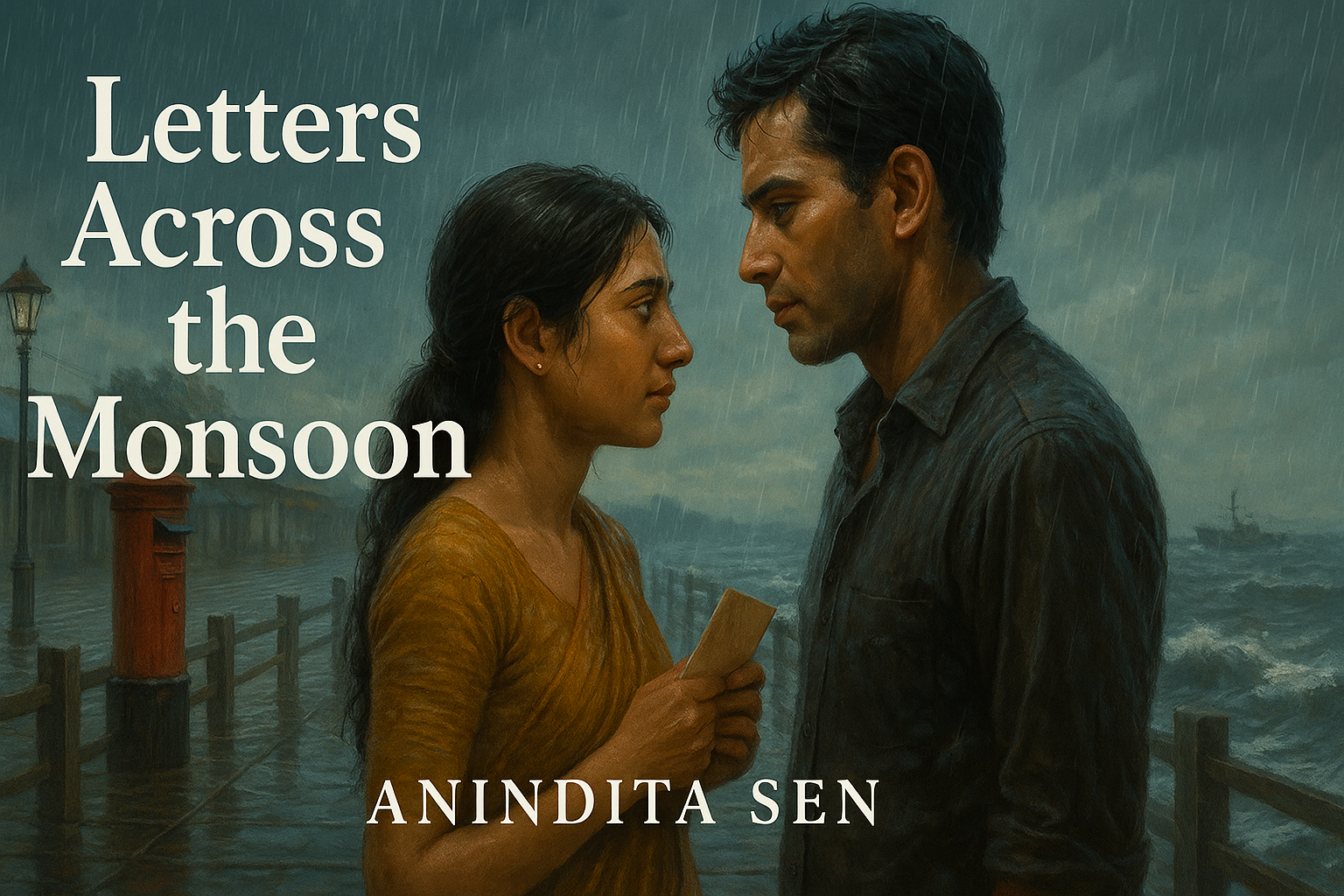

Anindita Sen
Part 1 – The Postbox by the Pier
The sea had been restless all week, its surface shifting in colours that belonged more to a mood than to the sky—dull pewter in the mornings, then a bruised green by afternoon, then turning almost black by evening when the horizon swallowed the sun whole. Mira Basu walked along the narrow pier each day after school, not because she had errands to run there but because the smell of salt and the sound of waves striking the wooden posts felt like a private conversation she could not hear anywhere else. The small port town lived by this pier—the fishermen hauled their nets, the dockworkers shifted crates of tea and jute, the vendors called out over the wind—and yet, just past the last shop selling fried hilsa and tea in chipped glasses, there stood an old red postbox half-eaten by rust, its paint peeling like tired skin. Nobody used it anymore; the new post office on Station Road had metal boxes with shinier locks, and letters travelled by buses that never came near the pier. Still, the postbox remained, fixed to a cement pillar with its mouth open like a patient creature waiting for someone to remember it. Mira first noticed it on a Monday afternoon when the wind carried a faint drizzle. She stood there longer than she should have, staring at the crooked slot, wondering if anything inside it had turned to pulp over the years. She had no letter to post, not really, but when she reached home that evening and found her small desk under the window, the thought would not leave her. She took out a piece of cream-coloured paper from her school ledger, hesitated, then began to write—not to anyone in particular, just to the sea perhaps, or to some imagined reader who might stumble upon her words. She wrote about the mango tree in her courtyard that had shed all its leaves before summer had truly ended, about the smell of rain when it first touched the clay roof tiles, about the tiredness in her bones that had nothing to do with teaching arithmetic to children. When she signed it simply as “M,” she felt both foolish and relieved. The next day, between the last bell and the evening train whistle, she slipped the folded paper into her handbag and walked back to the pier. The tide was coming in; the wooden planks beneath her feet trembled faintly as if the sea was knocking from underneath. A group of dockworkers were unloading crates stamped with faded English letters. Mira kept her head down, the way she always did when walking past strangers. When she reached the postbox, her fingers hovered over the slot. It was almost absurd, posting a letter to no one, but she slid it in quickly before her own sense of reason could catch her wrist. The sound it made when it fell—soft, final—echoed in her chest. That night, lying on her narrow bed under the mosquito net, she thought about her letter lying in the dark belly of that box. Maybe it would dissolve in the damp air. Maybe a curious boy would pry it out with a stick and laugh at its contents. Or maybe it would just stay there, unseen, unread, a secret the pier would keep. She told herself she wouldn’t think about it again. But two days later, on her walk, she noticed something different. The slot of the postbox was closed—not jammed, but latched from the side with a thin strip of jute rope. On impulse, she tugged at it. Inside, her fingers brushed against paper. She pulled it out. It was a folded sheet, thicker than the one she had used. The handwriting on the outside was unfamiliar, a little uneven as though written on a surface that kept moving. “To the Lady Who Wrote First,” it said in blue ink. Mira’s heart beat so quickly she had to step aside, leaning against the pier’s railing. She unfolded it carefully.
I do not know who you are. I only know the words you left in this box made me stop in the middle of my work and read them twice. I work at the docks. My hands are more used to ropes than to pens. But I think the sea wanted me to answer you. The mango tree will grow leaves again. Tiredness also comes and goes like tides. I will be here by the water most days, if you choose to write again.
It was signed, simply, “A Friend by the Sea.” She folded the letter back, tucking it into her bag as if it might crumble in the open air. Her first thought was disbelief. Her second was a quiet, unexpected warmth, like the first sip of tea after hours in the rain. That evening she did not go straight home. She found herself stopping at a stationery shop near the bazaar, buying a small bundle of pale blue writing paper. Back at her desk, the rain began tapping against the shutters. She took up her pen, and for the first time in years, she wrote without thinking of exams, reports, or the neat columns of numbers she marked in red ink. She wrote to the friend she had never seen.
Part 2 – A Stranger Replies
The rain had not stopped since dawn, and by afternoon the lanes of the town had turned into thin brown rivers that carried away fallen hibiscus flowers and stray matchsticks. Mira Basu sat at her classroom desk long after the children had run out into the downpour, their shouts fading into the watery air. She had been waiting for this moment all day—not the empty classroom, but the walk that would take her back to the pier. The blue paper she had bought last night was folded neatly in her bag, its edges already soft from the way she had held it and refolded it, reading and rereading her own sentences before deciding they were enough. She had told him—her friend by the sea—about the colour of the sky over the school at four o’clock, about the old bell in the temple that rang whenever the wind changed direction, and about the strange comfort of writing to someone whose face she did not know. She signed again with just “M.” It was nearly five when she reached the pier. The air smelled of salt and wet rope. The tide was high, slapping against the wooden pillars with the patience of something that knew it had nowhere else to go. She checked to make sure no one was watching, then slipped the letter into the slot of the rusted postbox. The soft thud as it landed was almost identical to the first time, yet it seemed to carry more weight now, as if it knew it would be answered. For three days, she walked past without checking. It was partly a game, partly an act of self-preservation; she did not want to seem like someone who waited too eagerly. But on the fourth day, the sky cleared a little, and the pier was bathed in a watery gold that made everything look like it belonged to another season. The postbox waited as it always had, unassuming, patient. She opened the slot. The jute rope was there again. She pulled, and once more her fingers brushed paper. This time, the letter was longer. The handwriting slanted differently, as though written more quickly.
Dear M,
I did not think you would write again. People often begin things they do not finish. Your letter made me read it slowly, as if the paper would dissolve if I turned it too quickly. I imagined the school you wrote about, the bell, the way the wind must carry children’s voices into the alley behind the pier. I want to tell you something. My work is not only ropes and crates. I sometimes travel on the small cargo boats when they go up the river. The journeys are long and the nights are colder than the sea, but I like how the stars look when the engine goes quiet. If you listen carefully, the water speaks. Not always, and not to everyone. But if you stand still enough, it might say your name.
Your friend by the sea.
Mira read the letter twice on the pier, then again at home under her lamp. She found herself looking out of her window, though there was nothing to see except the neighbour’s wall and the shadow of her mango tree. The thought of him—this man with calloused hands who travelled upriver and listened to water—stayed with her as she corrected her students’ notebooks. She began to imagine his face, though she kept it blurred in her mind, as if focusing too sharply might break the spell. The next letter came sooner. She found it in the postbox after just two days, as if he could not wait either.
M,
I saw a kingfisher today, bright as fire, sitting on a rope between two mooring poles. I thought you might like to know. The rains have swollen the river. Yesterday a boy fell in and was pulled out by one of the older men before he could be carried away. There are things I do not write here, because paper is fragile. But I hope one day I can tell you when the wind is stronger and we are standing by the water, not writing about it.
She read those lines again and again—the part about things he did not write, the part about one day. It stirred something in her that was not just curiosity, but a quiet ache she could not name. That night she dreamed of standing on the pier with the rain falling so hard it blurred the outlines of the world, and a man’s voice saying her name as if it belonged to him. When she woke, the sound of rain was still there, but it was only the monsoon on her roof.
Part 3 – The Tides Wash Over Ink
The third week of August came with a rain so heavy that the entire town seemed to vanish behind a veil of water. The pier was no longer a place to linger; the waves slapped against its sides with a violence that sent spray over the planks, and the wind pushed sideways as if trying to sweep away anyone foolish enough to be there. Mira still went, her umbrella turning inside out twice before she reached the shelter of the tea stall near the beginning of the pier. From there she could see the red postbox, hunched against the storm like an old fisherman in a frayed shawl. She had a letter with her, one she had written in the quiet between thunderclaps the night before. It spoke of a dream she had—sitting on the bow of a boat as it slipped along a river the colour of slate, with someone she could not quite see beside her, humming a tune she almost knew. She signed it with “M,” as always. When she reached the postbox, she found the rope latch missing; the slot was open, rainwater dripping in. She hesitated, thinking of her paper inside that dark metal stomach already slick with damp. But she posted it anyway, telling herself the ink would hold. For days after that, she found no reply. The wind tore at her sari when she walked to the pier; the water near the dock turned brown with silt and debris. She began to imagine the postbox filling with sodden paper, their words dissolving into each other until no one could tell which was hers and which was his. On the sixth day, the rain slowed. The air was thick and salt-heavy. She went to the pier again, and this time, when she reached into the postbox, her fingers met a handful of crumpled, wet scraps. She pulled them out in clumps, the ink running into blue and black stains, letters bleeding into each other. Among them she recognised her own handwriting, the loop of her “M,” blurred into a blue cloud. And in another corner of paper, she saw his—lines she could not read, except for one word near the edge that had survived the storm: “tide.” Standing there, with the scraps in her palm, she felt an unexpected grief—as though something fragile and secret between them had been swept away. That night she lit the hurricane lamp in her small room and laid the pieces out on her desk to dry. Some were so thin they tore when she tried to separate them. She pressed them under her school ledger, hoping that by morning they might flatten enough to read. But when she lifted the ledger at dawn, they remained nothing more than patterns of blurred ink, like the shadows of birds seen through rain. She took out a fresh sheet of blue paper.
Dear Friend by the Sea,
The tide has taken our words. But I remember mine, and I will try to remember yours. If you have forgotten, I will write them for you again. Some things should not be left to the mercy of water.
She posted it that afternoon, her hair still damp from the rain. The postbox seemed cleaner somehow, the storm having scoured away its dust. As she dropped the letter in, she had the odd sense of giving it not to a box, but to the sea itself, trusting that it would deliver. Two days later, his reply came.
M,
The tide washed away my words, but it could not take the sound of them. I remember what I wrote to you. I wrote that when the water is angry, it tries to speak faster, as if telling you everything at once. I wrote that sometimes I feel like the sea and I share a secret, and now you are part of it. Let us write again what was lost. Paper is weaker than memory.
Her hands lingered on the letter long after she had read it. Outside, the rain began again, softer now, like a promise instead of a threat.
Part 4 – Whispers Between Waves
September came with a softer light, the kind that fell through clouds like water through gauze, tinting the mornings a pale silver. The sea had calmed but still breathed in long, heavy sighs, and Mira found herself timing her walks to the pier so she could watch the tide change, as if the sea’s rhythms had begun to braid themselves into her own. The letters between her and her friend by the sea now carried more than observations—they carried pieces of themselves that might have once been guarded. She told him about her father’s death when she was sixteen, about how her mother had retreated into a silence that made their two-room house feel emptier than it was, about how teaching had been less a calling and more a way to fill days that might otherwise collapse under their own weight. She wrote of small joys—buying a ripe guava from the morning market, the way the old priest at the temple always sneezed twice before ringing the bell, the first night in years she had dreamt without rain in it. He, in turn, wrote of his work on the docks, the sore muscles and rope-burned palms, the camaraderie among men who spoke in half sentences and gestures, the thrill of a boat leaving at night under a sky so full of stars it felt like they might fall into the river. He told her, in one letter, that he had once been part of a student group in the city, “more shouting than thinking,” he wrote, but that things had turned dangerous after a march went wrong, and he had left before someone else could decide his fate for him. “The sea doesn’t ask questions about your past,” he added, “but it listens when you speak.”
They began leaving small things with their letters. One day she found, tucked into the fold of paper, a pressed hibiscus flower, its red faded to the colour of old wine. In her reply, she slipped in a small notebook page where she had drawn the view from her classroom window—the mango tree, the temple bell, the slanted roof of the shop across the lane. “So you know where my words begin,” she wrote.
Their words grew braver. He wrote, If I knew your face, I think I would recognise it even in a crowd on a stormy day. She wrote, If I heard your voice, I might stop walking without knowing why.
The pier became more than a place to post letters—it became a boundary they both circled but did not cross. More than once, Mira thought she saw someone watching her from the shadow of the tea stall, a tall figure in a dark shirt, but when she turned, the person was gone. One afternoon, she arrived to find a letter heavier than usual. Inside, she discovered not just a page but a small packet wrapped in brown paper. Inside was a smooth, oval stone, grey with a faint stripe of white running through it.
I found it where the river meets the sea, his letter read. It reminded me of a single drop of rain that forgot it was part of the ocean. Keep it in your pocket. It might tell you when the tide is turning.
She kept it in the drawer of her desk at school, touching it between classes as if to check that it was still there. In her next letter, she asked him something she had avoided until now: Will you tell me your name?
The reply took longer than usual, almost a week. When it came, the paper smelled faintly of salt.
M,
Some names are worn like coats—taken off when the day is done. Others are like skin—you can’t remove them without tearing something vital. Mine has been both. I am not yet ready to hand it to the tide. But I will. Soon.
She folded the letter slowly, realising she was holding her breath. Outside, the waves struck the pier with a sound like distant applause.
Part 5 – Shadows of Unrest
By late September the air over the town grew heavier, as though the monsoon had settled into its bones and refused to leave. Mira noticed it not just in the sky but in the way people spoke—quieter, glancing over their shoulders, cutting sentences short when strangers passed. On her way to the pier one evening, she found the police jeep parked near the tea stall, two constables leaning against it, rifles resting against their knees. The dock beyond was busier than usual, but not with work—men were gathered in tense clusters, their voices low, their eyes flicking to the water as if expecting something to surface. She walked past with her head down, clutching the letter she had written to her friend by the sea. It was lighter than her others—just a small description of the sound the rain made on her roof the night before, like thousands of soft fists knocking at once.
The postbox was there, patient as ever, but its mouth was tied shut with a piece of wire. She frowned, glancing around. One of the constables caught her eye and she looked away quickly, walking past as if she had no business there at all. At home that night she kept the letter on her desk, wondering if the wire meant something more than just a repair.
Two days later, the wire was gone. She posted her letter quickly and began the walk home, only to hear a low voice behind her. “Don’t linger here too much.” She turned to see a man in a dark shirt, his face half in shadow under the tea stall’s awning. She thought—just for an instant—that it might be him, but the man turned away before she could look closer. That evening, she found herself checking the door bolt twice before bed.
When his reply came, the paper was creased and damp, as if it had travelled in a pocket before reaching the box.
M,
There’s trouble near the docks. Some say it’s about cargo going missing, others say it’s about the river police and who they answer to. I have kept my head down, but trouble is like rain—it finds its way in even if you close all the windows. If you don’t see a letter for a while, it will be because the tide has carried me somewhere else for a time. I will write again as soon as I can.
It was the first letter of his that made her uneasy. She read it twice before slipping it into the drawer with the stone he had given her. That night, she dreamed of walking the pier in heavy fog, unable to see the water or the shore, her hand brushing against a railing that seemed to go on forever. Somewhere ahead, someone was calling her name, but the voice kept changing—sometimes his, sometimes a stranger’s.
The next week brought more signs that something was shifting. A fisherman’s wife who came to Mira’s school to collect her child whispered that the port authorities had been questioning men, that a fight had broken out between two crews, that someone had been taken away in the jeep and hadn’t come back. The pier felt different now; even the tea seller served his cups with a hand that trembled slightly. And yet, among the unease, her letters and his continued to pass—though shorter now, stripped of the easy detail they once had.
One afternoon, his words came on paper stained at the edge, the ink feathered from water.
M,
If you see men in uniform near the pier, walk past as if you have forgotten how to stop. The less you know about what is happening here, the safer you are. But I needed to tell you this: the tide is turning faster than I thought. It may take me inland soon, for my own safety. If that happens, I will leave one last letter in the box before I go. It will carry my name. Whether you want to follow it is yours to choose.
Her hands trembled as she folded the page. Outside, the wind carried the smell of the sea all the way to her street, sharp and briny, as if reminding her that tides wait for no one.
Part 6 – The Night of the Storm
The warnings began at dawn—a distant wail from the harbour siren, the kind that rose and fell like an old woman’s cry. Mira had been marking homework when the first gust rattled her windows, scattering the papers across the floor. By noon the streets had emptied; shutters were drawn, shop signs taken down, and the sky pressed low over the town like the flat, bruised belly of a giant cloud. She sat by the window, watching the mango tree bend under the wind’s insistence, wondering if the pier still stood. The radio announced a cyclone moving up from the south, the sort that tore fishing boats from their moorings and scattered roofs across fields like scraps of tin foil.
By late afternoon the wind had become a living thing—howling down the lanes, slamming into doors, pulling at the roofs. Mira could not stay inside. She wrapped herself in her thickest shawl and stepped into the rain that felt more like needles than water. Each step towards the pier was a battle, her sari whipping around her legs, her breath coming in gasps. The market square was deserted, the tea stall’s awning ripped half away. At the edge of the pier, the world became a smear of grey water and white spray. And yet, through the sheets of rain, she saw it—the red postbox, hunched but still clinging to its cement pillar.
She nearly slipped on the wet planks as she reached it. The slot was tied shut with the familiar jute rope. Her fingers shook as she pulled it free. Inside was a single folded page, the paper heavier than usual, protected in a thin wrapping of oiled cloth. She ducked behind the lee of the tea stall’s torn awning and unwrapped it, her hair plastered to her face, her hands trembling.
M,
If you are reading this, the storm has not stopped you. That means something. My name is Arun Dutta. I have written it now because the tide is pulling me inland, and I may not return for months, perhaps years. The docks have become dangerous—men disappear, questions are asked at night when no one is watching. I have kept you from it as best I could. But if you wish to see me, I will be on the cargo train leaving for the interior three days from now, at dawn. I will stand at the end of the third carriage. If you do not come, I will understand, and I will keep your letters like the tide keeps shells it cannot return. Whatever you decide, know this: your words have been the calm between storms for me.
The rain blurred the last lines, but she had already read them, and they burned themselves into her mind. She stood there for a long time, the letter pressed against her chest, the wind tearing at her shawl, until she realised the tide was beginning to rise around the pier’s lowest steps. She ran home, the letter wrapped in the oiled cloth, her heart pounding with a mix of fear and something that felt dangerously like hope.
That night the storm deepened, rattling the tiles of her roof, banging shutters against walls. She lay awake, the letter beside her on the bed, tracing the shape of his name in the dark. Arun Dutta. It felt strange and familiar at once, like a song she’d heard in childhood but never learned the words to.
Part 7 – The Name in the Letter
The storm had stripped the town bare. Fallen branches lay like broken limbs across the lanes, shop awnings flapped in tatters, and the sea carried the smell of churned silt deep into the inland streets. Mira walked to school the next morning with the oiled-cloth bundle in her bag, feeling as though she was carrying something more precious than her own breath. She had read his name—Arun Dutta—so many times in the dim lamplight that it no longer felt like an unfamiliar sequence of letters; it was a presence now, a weight in the room.
That day, after her last class, she walked to the pier without a letter, only the urge to look. Men were repairing the dockside ropes, hauling out crates that had been soaked by the cyclone. The tea stall had a new sheet of blue tarpaulin for its roof, flapping like a restless sail. She kept to the edges, her eyes scanning faces. And then she saw him.
He stood near a stack of coiled ropes, sleeves rolled up, hair still damp from the spray. His skin was the colour of teak, his movements efficient, unhurried. She might have missed him entirely if she hadn’t seen the way he paused between tasks—looking, just once, towards the old red postbox. Not with longing, not even curiosity, but with the quiet certainty of someone checking on a friend.
Her pulse quickened. She wanted to walk up to him, to speak, but the thought froze her feet to the planks. She told herself she couldn’t be sure it was him; there could be other men who looked that way, who glanced at the box like that. And yet when he bent to lift a crate, she saw, sticking out from the pocket of his shirt, a strip of oiled cloth just like the one he had wrapped around his letter.
She turned away before he could notice her, heart hammering. On the walk home she kept replaying those seconds—the curve of his shoulders, the steady way he moved, the ease with which he belonged to the pier. The letters had always been a private world, bound by paper and ink, and now that world had a face. It terrified her and thrilled her at once.
That night she wrote to him.
Arun,
I saw a man today who might have been you. I do not know if you saw me. Perhaps it is better if you didn’t. But the space between knowing your name and seeing your face is a fragile place. I am afraid of stepping into it too quickly, afraid of breaking something that has carried us this far. And yet I keep thinking of the stone you gave me, how you said it might tell me when the tide is turning. I think it just did.
She posted the letter the next morning before school. Three days later, his reply came.
M,
It was me. I did see you, though I kept my eyes on the work. The pier is not a safe place for us to meet now. But when the tide turns in three days’ time, I will be at the train, as I wrote before. If you wish, you can find me there. No letters will be needed then. Only your presence.
The words sat in her lap like an unopened door. Three days. A train at dawn. The end of the third carriage. And the choice would be hers alone.
Part 8 – Crossing Paths in the Flesh
The morning before the train was to leave, the pier was still in half-repair. Crates of jute leaned against posts like tired sentries, and ropes lay coiled in puddles, their fibres swollen from days of rain. Mira walked there after school with no letter in her bag, only a small tin of sweets she had bought from the bazaar—a childish offering, she thought, but the only thing she could give that might carry a trace of her home. She told herself she would leave it in the postbox, one last token before whatever came next.
He was there, though she had not expected it. Arun stood near the far end of the pier, speaking to two other men while checking the netting on a cargo boat. His back was to her at first, but when he turned, their eyes met—just a flicker across the wet planks, a brief recognition that jolted her pulse. He did not smile, nor did she. The air between them felt heavy with all the words they had written but never spoken aloud.
The tea seller’s lad ran past, and in that moment she stepped closer, her sandals slapping softly on the wet boards. She stopped a few feet away, the tin of sweets in her hand.
“I thought… perhaps you might take these for the journey,” she said, her voice quieter than she had meant it to be.
Arun looked at the tin, then at her, his gaze steady in a way that made her feel seen to her bones. “Thank you,” he said, his voice low and edged with something warm. “I will keep them for the long miles.”
It should have been nothing—a brief exchange, a simple gift—but it felt like they had stepped across a line neither could return from. One of the men called his name, and he turned away. She watched him walk back towards the boat, the tin disappearing into the pocket of his satchel.
On her way home, she felt lighter and more unsettled at the same time. She had seen him now, heard his voice, and the letters seemed suddenly both more real and more fragile. That night she did not write. She sat at her desk with the window open, listening to the waves breaking far off, her fingers tracing the smooth surface of the stone he had given her.
The day before the train, the wind shifted. It brought a scent of wet earth from inland, the kind that comes before a change in season. She woke before dawn and lay still, imagining the platform, the rows of carriages, the end of the third one where he had said he would stand. She could see it in her mind: the whistle, the hiss of steam, the space between stepping forward and stepping back.
The choice hung in the air like a question no one else could answer.
Part 9 – The Flight Inland
The station at dawn was a place of half-light and murmurs, where the day had not yet decided if it would be kind. Mira arrived before the first bell, her sari pleats damp from the mist that clung to the streets. The town was only just stirring—porters yawning into their palms, tea sellers coaxing flames from coal stoves, crows picking at scraps along the tracks. She moved like someone in a dream, each step quiet, deliberate, her heart keeping time with the distant, metallic rhythm of an approaching train.
The cargo line stood at the far platform, its carriages long and dull green, streaked with rust. Steam curled lazily from under the wheels. She scanned the length until she saw it—the third carriage from the engine, its rear steps slick with dew. A lone figure stood there, one hand resting on the railing, the other holding a small canvas satchel. Even at a distance, she knew it was Arun.
He didn’t search the crowd; he simply looked out at the empty stretch of track as if he had already memorised every face that mattered. For a moment she stayed where she was, the weight of the stone in her pocket a quiet reminder of tides turning. Her breath came fast, her mind caught between two shores—one familiar and safe, the other uncertain but alive with the pull of something that felt like belonging.
The platform began to fill: dockworkers heading inland for new contracts, women balancing baskets of vegetables, a boy chasing a stray goat. The guard’s whistle sliced through the air, sharp and final. Arun turned slightly, his eyes sweeping over the crowd—and stopped when they found her. There was no smile, no gesture, only that steady, unblinking recognition that had first startled her on the pier.
The train jolted once, twice, preparing to move. She stepped forward. The gap between them was still twenty feet, then fifteen. Her sandals clicked on the wooden boards, the sound lost under the hiss of steam. Arun’s hand tightened on the railing.
Five feet. The train gave its long, low call. The crowd surged, people pushing past her to board. She reached the steps just as the wheels began to turn. His arm extended—not in urgency, but in quiet invitation.
And then she stopped. Her fingers hovered above his, her pulse roaring in her ears louder than the train. Behind her lay the life she knew; before her, the uncertain miles of his world. In that moment, time seemed to hold its breath.
The train gathered speed. His hand lowered, not in disappointment, but in acceptance. She stepped back, her heart breaking and mending in the same beat, watching as the third carriage slid past, Arun’s figure receding into the mist. In his place, the empty railing glinted briefly in the weak morning light, like a pause in a sentence that might yet be finished.
The platform was quiet again when the last carriage disappeared. Mira stood there until the wind shifted, carrying with it the scent of the sea, as if reminding her that tides never stop turning. She slipped her hand into her pocket, fingers curling around the stone, and began the walk back to town, her steps slow, the choice still echoing inside her like the whistle of a train fading into distance.
Part 10 – Monsoon’s Last Letter
Three days passed before the rain returned, soft at first, then steady, wrapping the town in a grey curtain that blurred edges and muted sound. Mira taught her classes, marked notebooks, greeted neighbours, all with the same outward composure she had worn for years. But the rhythm inside her had shifted, like a tide that no longer matched the moon.
On the fourth day, she went to the pier. The postbox stood there as always, patient and unassuming, its rust glistening in the damp. She had not expected anything—after all, Arun was far inland now, somewhere beyond the curve of the river where her world ended. Still, habit made her check.
Her fingers met paper. Not the thin, salt-soft sheets she knew, but a single envelope sealed with tape. Her name was on it—not “M,” but Mira. She stood under the eave of the tea stall to open it, the smell of wet rope and fried hilsa drifting past.
Mira,
I saw your hand pause above mine. I knew then that you had chosen to stay. It did not wound me. We are both keepers of our own shores. Perhaps the tide will bring me back one day; perhaps it won’t. But I wanted to send you one more thing—a piece of the road ahead, so you can imagine where I am. Inside this envelope is a pressed leaf from a gulmohar tree I passed on my first morning inland. The air smelled of dust instead of salt, and the horizon had no line of water to mark its edge. I thought of your mango tree, of your temple bell, of the rain on your roof. Keep writing, even if you don’t send the words anywhere. Some letters are meant only for the writer’s heart.
Arun.
She found the leaf tucked inside—a delicate orange-red, its edges curling slightly from the press of his satchel. She held it between her palms, feeling its fragility, and knew she would place it in the same drawer as the stone.
That evening, she sat at her desk by the window. The rain was steady now, tapping against the shutters like an old friend. She took out a sheet of blue paper and began to write—not to Arun exactly, but to the space they had shared, to the tide that had carried their words back and forth. She wrote about the train, about the moment her fingers had hovered above his, about the way his acceptance had felt like a gift instead of a loss. She signed it “Mira,” for the first time, folded it neatly, and placed it in the drawer beside the stone and the leaf.
The next morning, she walked to the pier with no letter in her hand. The sea was calm, its surface broken only by the slow rise and fall of the tide. She stood there for a long time, breathing in the salt air, until she realised she was smiling—not because she had found an ending, but because she had learned that some stories keep moving, even when the letters stop.
And somewhere inland, she imagined, a man with rope-burned palms and steady eyes might be standing under a gulmohar tree, thinking of the sea, thinking of her, and letting the monsoon speak for them both.
END