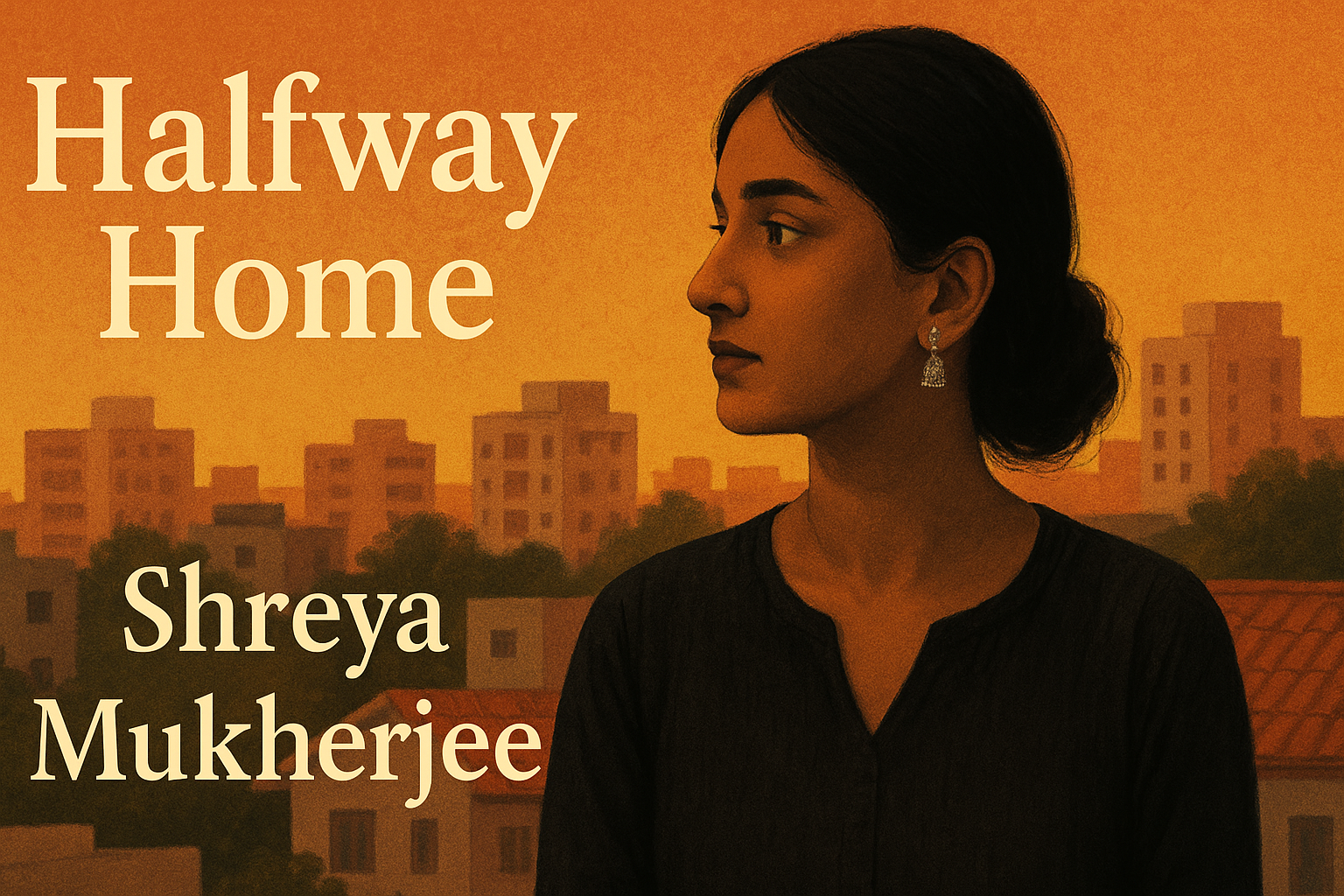

Shreya Mukherjee
The air in the Bangalore metro smelt faintly of wet concrete and deodorant. Anaya Sen adjusted her tote bag, balancing herself as the train jerked forward. Her headphones were in, but the music was off. She wasn’t in the mood for playlists. Not this morning.
Outside, the city passed by in a blur of glass facades, auto-rickshaws, and trees trying their best to stay green. Inside, her inbox buzzed with reminders of the town hall meeting she had helped organize — the one everyone was quietly dreading. After the leak last week, things had been spiraling. Whispers. Slack messages with eyes emojis. That anonymous post on Instagram about the head of operations. And through it all, Anaya had done what she was best at: perform calm.
She got off at Trinity Circle, dodging hurried techies and delivery boys, and made her way toward the office — a steel-and-glass building that smelled of ambition and stress. The security guard nodded at her with the same forced politeness he gave everyone. The kind of smile that didn’t reach his eyes. She returned it. She always did.
The floor was unusually quiet. Naman, her cubicle neighbor, looked up from his monitor. “Anaya, town hall at four, right? Are you running the Q&A?”
“I guess,” she shrugged, unlocking her laptop. “Depends on whether we’re still pretending we care about transparency.”
He gave her a quick smirk, but said nothing. The HR had issued a fresh code-of-conduct mail in the morning, and everyone was watching what they said.
Anaya poured herself black coffee from the pantry, wincing at the burnt taste. She had been working here for five years. Long enough to remember when the company was a startup with bad chairs and good ideas. Now it was a well-oiled machine. The kind that paid well but asked for your soul in return.
Around noon, a message popped up on her screen.
Rehaan (old-school): Hey, Sen. Long time. Free for coffee today?
She stared at the name. Rehaan. School friend. Debater. Occasional nuisance. She hadn’t seen him in four years, not since that loud argument at their college farewell about capitalism and comfort zones. He had chosen to work with NGOs. She had chosen to pay rent. They hadn’t kept in touch.
Still, she typed back.
Anaya: 6 PM. Third Wave, Indiranagar?
His reply came quick.
Rehaan: Done. Wearing a mask and ideals. Don’t judge.
She smiled despite herself. Some people didn’t change. Or maybe, some people refused to.
The town hall went as expected. The CEO said the right words in the right tone. The accused team lead was “on leave pending investigation.” HR nodded through every question. The tension in the room could’ve cut through glass. Anaya didn’t ask the questions she had prepared. She just stood in the back, watching colleagues nod along like nothing had broken.
By evening, the clouds had rolled in, heavy and sullen. She reached the café five minutes early. It was one of those exposed-brick places with Edison bulbs and overpriced pastries. Rehaan was already there, typing something furiously on his phone. He looked up, caught her eye, and grinned. Same messy hair. Same crooked smile.
“Sen. You look exactly the same.”
“Lie better, Rehaan. I’ve got at least three new frown lines.”
He laughed. “Battle scars of the corporate battlefield?”
She sat down, shrugging off her jacket. “Something like that.”
They talked. Slowly at first, then in full sentences. About school, about mutual friends, about the Delhi trip in class ten when they got scolded for sneaking out past curfew. Then, the conversation turned.
“You heard about what happened at your workplace, right?” he asked, tone suddenly sober.
“I was there,” she said, fingers tightening around her cup.
He didn’t press. “Must be hard. Playing neutral.”
“I’m not neutral. I’m just… tired.”
Rehaan nodded. “Sometimes I think that’s worse.”
Anaya didn’t reply. Instead, she stared at the rain as it began to drum gently on the glass. Rehaan was saying something about a new shelter he was helping fund — a safe space for trans youth — when her phone buzzed. A news alert. She glanced at it. A female employee from a neighboring tech firm had died by suicide. The report hinted at internal harassment. The comments were already full of blame and misogyny.
She put the phone down.
“You okay?” Rehaan asked.
“Just another reminder,” she said softly, “that nothing really changes. Just the names and the floors.”
Rehaan leaned back. “Then maybe it’s not enough to survive quietly, Sen. Maybe it’s time to be loud.”
She looked at him. Really looked. Not the teenage boy she once beat in inter-school debate finals. Not the college idealist she dismissed. But a man still holding on to purpose like it mattered.
And in that moment, Anaya felt something shift. A slow, almost imperceptible uncoiling inside her.
“Maybe,” she said, sipping her coffee, “I’m tired of being halfway anything.”
He raised his cup in a quiet toast. “To the halfway home, then. Until you find your full one.”
And she clinked it gently. Not because she believed she would. But because she wanted to.
***
The next morning, Anaya woke to a sky that looked like wet cotton — grey, heavy, undecided. Her apartment on the twelfth floor felt unusually quiet, even though the city was already up and buzzing. The pressure cooker in a neighboring flat hissed three times before falling silent again. Bangalore was full of these symphonies — distant horns, door slams, and the occasional dog barking at nothing in particular.
She moved through her routine like muscle memory. Black coffee. Skim through the news. Scroll through emails. Then, for a few seconds longer than necessary, she stared at her laptop screen before shutting it again. It was Saturday. She didn’t need to log in. Not unless she wanted to get ahead of the “quarterly narrative alignment deck” — whatever that meant.
Instead, she opened a folder she hadn’t touched in months. “Personal.” Inside were half-written essays, unused blog drafts, photos from a Himachal trip with her college roommates, and an old folder named “K.” She clicked it. A dozen videos of her younger brother, Kunal, danced onto the screen. Him laughing, him singing badly into a wooden spoon, him trying to pet a stray dog with cautious affection. Anaya watched one without sound.
Kunal had been diagnosed with bipolar disorder four years ago. Their parents were still in denial. “He’s just moody,” her mother would insist. “Let him sleep it off.” But Anaya had read the medical reports. She had paid the therapist. She had flown down in emergencies and sent money when no one asked. And now, she avoided the subject like one avoids touching a bruise too long. Because every time she thought of home, she felt like a daughter on leave.
The phone rang. Her father. She let it ring once, twice, then picked up.
“Anu,” his voice always started soft, cautious. “Free?”
She pressed the phone to her ear and stood by the window. “Sort of. What’s up?”
“Your Ma said you haven’t called since last Sunday.”
“I’ve been busy,” she said, watching a boy below walk his golden retriever in lazy loops.
There was a pause. “Kunal’s doing okay,” he said finally. “He went to that art workshop last week.”
“Good.”
“He asked about you.”
Anaya swallowed. “Tell him I’ll visit soon.”
“You’ve been saying that.”
“I know.”
There was no anger in his voice. Just a tiredness that wrapped itself around her ribs. After a few more pleasantries and reassurances, they hung up. Anaya sat on the edge of the bed, phone still in hand. Guilt was a constant roommate — sometimes loud, sometimes just present. Always there.
Around noon, Rehaan texted.
Rehaan: Want to come visit our center today? We’re doing an open mic. Might be more interesting than your Google calendar.
Anaya: You do assume I have a calendar. I’m not that corporate.
Rehaan: You definitely color-code. 3 PM, Indiranagar?
She hesitated, then typed back.
Anaya: See you.
The center was a low-rise building tucked behind a row of shops. Bright murals covered the outer walls — dancing figures, trees with human eyes, poetry scrawled in purple. Inside, the walls were lined with mismatched chairs and bean bags. There was no stage, just a small rug and a mic. A sign read: Speak your truth. Someone is listening.
Rehaan was already there, in conversation with a young woman with buzzed hair and a nose ring. He waved when he saw her.
“Glad you came,” he said.
“I needed… less ceiling,” she replied.
He introduced her to a few people. A poet. A rapper. A sociology student from Delhi who now ran menstrual health campaigns in rural Karnataka. The air buzzed with stories.
The open mic began. One by one, people stood and shared. Some read poetry. Some shared diary entries. One boy sang a Kannada song that silenced the entire room. It was about a father who once loved to draw but now worked at a toll booth.
Anaya didn’t speak. She listened. And something about the way the room held space — not for answers but for presence — made her chest ache in the best possible way.
Afterward, they sat on the steps outside, the evening light slanting across the pavement.
“Why don’t you come here more often?” Rehaan asked.
“I don’t know,” she replied. “I think I’ve spent so long pretending to be functional that I forgot how to be honest.”
“That sounds like the tagline of our generation.”
She chuckled. “Maybe. But also… there’s a comfort in not being seen. Especially when you feel like a mess.”
Rehaan picked up a leaf and spun it between his fingers. “You know, messes make the best stories.”
Anaya looked at him. “You always were too poetic for your own good.”
“Maybe. But you always used to write better.”
She looked away. “I stopped.”
“Why?”
She hesitated. “Because every time I started writing, it turned into a list of apologies I didn’t know how to send.”
Rehaan was quiet for a beat. Then he said, “Maybe you’re not supposed to send them. Maybe you’re just supposed to understand them.”
The streetlight flickered on. Somewhere in the background, a scooter engine growled to life. Anaya felt the city lean in — not harsh, not forgiving, just present.
For the first time in a long while, she felt like she wasn’t drifting.
Maybe she wasn’t home.
But maybe she wasn’t completely lost either.
Just halfway.
***
Anaya didn’t sleep well that night. It wasn’t insomnia exactly. More like her brain had opened too many tabs and forgot to shut them down. Around 3 a.m., she gave up and made herself chamomile tea, standing barefoot in the kitchen as the city pulsed softly outside her window — blinking tail-lights, a distant auto horn, someone playing old Kishore Kumar on low volume. Bangalore never truly slept, just like her.
Her mind kept circling back to the center. The boy singing about the toll booth. The girl who stammered halfway through her poem and then laughed and kept going. The applause that followed — not out of politeness, but solidarity. That kind of room — unpolished, uncurated — was something her world didn’t have. The startup meetings were full of slides and sanitized vulnerability, “safe spaces” that were mostly lip service. She couldn’t remember the last time she felt safe enough to speak and not edit herself in real time.
She opened her laptop, instinctively moving toward her work inbox. Then paused. Instead, she clicked open a blank document. Titled it “Things I Forgot to Say.” And just started typing.
No agenda. No grammar check.
Just the act of putting something into the world that wasn’t for appraisal.
By morning, she had written three pages.
It was Sunday, and the city moved a little slower. Her phone buzzed at 9:07 a.m.
Ma calling.
She considered letting it ring. Then picked up.
“Anu, good morning. Did you eat?”
“I’m still in bed, Ma.”
“Well, eat something light. It’s hot. I told Kunal to drink ORS but you know how he is. That boy will listen to no one.”
Anaya waited for the inevitable shift in tone.
“So, your father said you might come down this month?”
“Maybe.”
“Just a few days. Your uncle’s son is getting married. You could wear that blue sari I sent you.”
“I don’t think I can make it, Ma. Work’s crazy.”
A long sigh followed. “You always say that. You miss everything.”
Anaya felt her throat tighten. She swallowed. “Let’s talk later, Ma. I’ve got to step out.”
There was silence, then a curt goodbye. The line went dead.
She stared at the phone screen. Guilt and anger played rock-paper-scissors in her head.
Later, when she stepped out for a walk, she didn’t take her headphones. She wanted to hear the city breathe. On a whim, she turned down a street she’d never walked before — a quiet lane filled with gulmohar trees and shuttered bookshops. It was there that she saw it.
A handwritten sign outside a crumbling bungalow:
“Feminist Reading Circle – Sundays at 11 AM. All welcome. Back garden.”
Anaya paused. The gate was slightly ajar. She peeked through. A cluster of women — and a few men — sat on mats under a large mango tree. A stack of books lay in the center. Someone was reading aloud.
Before she could change her mind, she walked in.
No one looked surprised. A few smiled. Someone offered her tea in a steel tumbler. She sat down, half-expecting discomfort. But the voice reading was calm, confident. It was a passage from Audre Lorde about self-care as self-preservation. The words hit harder than she expected.
During the discussion, a woman in her fifties spoke about raising daughters to be opinionated and then punishing them when they were. A college student shared a breakup story where she was called “too intense.” Anaya listened, her heartbeat strangely loud in her chest.
When the group began to wrap up, someone asked, “Anyone new want to introduce themselves?”
She hesitated. Then spoke.
“My name is Anaya. I work in tech. I… I’m relearning how to speak. Not just in meetings. But in life.”
A few people nodded. A woman beside her touched her arm gently. “You’re in the right place.”
Later that evening, Rehaan messaged.
Rehaan: I heard from Simran you turned up at the reading circle. You’re on a roll.
Anaya: Didn’t plan it. Just wandered in.
Rehaan: Most good things begin like that.
Anaya: So what happens when you start showing up in places that feel real?
Rehaan: You start showing up for yourself, too.
She stared at the screen for a while. Then typed:
Anaya: I wrote something last night. Not for work. Not for likes. Just… words.
Rehaan: Send it to me?
She hesitated. Then attached the file. No edits. No overthinking.
He read it. A long pause.
Rehaan: This is powerful. Raw. Honest. I think you’ve found your voice, Sen.
She smiled at the screen.
Maybe not all the way yet.
But certainly halfway there.
***
Monday began like most others — a race against time disguised as a routine. Anaya’s phone alarm buzzed at 7:15 a.m., followed by the familiar litany: brush, scroll, sip, skip breakfast, check calendar. The day’s first meeting was at 9, an “alignment sync” that promised little alignment and zero sync. Still, she joined, half-listening as words like leverage, bandwidth, and culture-fit floated across the screen.
The HR lead, Meenal, dropped a reminder about the upcoming diversity initiative week — another round of poster campaigns, LinkedIn posts, and one panel discussion featuring the same two “safe” employees talking about their journeys. Anaya muted her mic, stared at her reflection in the darkened webcam, and thought, What would happen if someone said what they really felt here?
After the call, she opened her draft folder again. Her piece from the other night sat unread by anyone but Rehaan. The memory of his reply — This is powerful — still warmed her ribs. But it also terrified her. Power, once released, was hard to recall.
A new message pinged. From Naman.
Naman: You saw the internal memo?
Anaya: No. What’s up?
Naman: They’ve decided not to release findings of the harassment probe. Saying “not enough evidence.”
Anaya stared at the message. Then checked her inbox. The memo was there, written in corporate softness:
“After thorough investigation and due diligence, we have found no actionable breach. We remain committed to fostering a respectful and inclusive workplace.”
The pit in her stomach wasn’t new. But it deepened. That woman — the intern who had spoken up — had quit two weeks ago. Just… vanished from the system. A line in an Excel sheet. Anaya remembered her wide eyes and the way her hands trembled during the coffee-room confession. “I just want to be heard,” she had said.
And now, she wouldn’t be.
At lunchtime, Anaya took the stairs down instead of the elevator. Five floors of concrete and fluorescent lights, footsteps echoing. She needed the silence between decisions.
Instead of heading to the cafeteria, she called Rehaan.
He picked up after two rings. “Hey. You okay?”
“No,” she said simply.
A pause. Then: “Where are you?”
“Basement. At work.”
“Want me to come?”
“No. I don’t think I need rescuing today. I just… need to say something and not be told to be careful.”
“Then say it.”
Anaya took a breath. “I feel like I’m helping this place maintain its illusion of fairness. Like I’m painting windows on prison walls and calling it a view.”
“That’s not nothing,” he said gently. “That’s clarity.”
“I want to speak up. But I also want to pay rent. I want to write. But I also want to not be called difficult.”
“You don’t have to choose in one day.”
“But I do have to choose.”
There was silence on the other end. Not avoidance — presence.
Then Rehaan said, “You know what I think? I think you’re already making the choice. Just slowly.”
That evening, she did something she hadn’t done in years.
She opened Medium, created a new anonymous profile — no photo, no bio — and published her piece. The essay was titled:
“On Being the Good Girl at a Bad Company.”
She didn’t name names. She didn’t point fingers. But every line bled with truth — about complicity, about silence, about smiling through meetings that felt like performances in ethical gaslighting. She ended it with a line she hadn’t planned but had written without thinking:
“I don’t want to be brave. I just want to be honest. And sometimes, that’s the same thing.”
She closed her laptop and went for a walk, not checking views, not refreshing for likes.
At 9:22 p.m., her phone buzzed. A DM. From someone named Priya.
Priya (anon): I read your piece. I think you wrote what I was too scared to say. Thank you.
Anaya sat on the footpath near her building, blinking at the screen. The streetlights made halos on the wet pavement. A scooter whooshed by. Somewhere, a dog barked at nothing.
She replied: You’re not alone. I see you.
And meant it.
Inside her apartment, she pulled a thin shawl around her and sat by the window.
She didn’t feel free.
But she felt less caged.
She didn’t feel fearless.
But she felt less alone.
She didn’t feel whole.
But she felt — finally — like she was moving.
Maybe that’s what halfway home meant.
Not lost.
Not found.
Just walking.
With open eyes.
And the quiet, stubborn will to keep going.
***
On Tuesday morning, Anaya wore a rust-colored kurta to work — not because it was special, but because it reminded her of home. The kind of cotton her mother folded with lavender-scented naphthalene, the kind her brother once spilled paint on and tried to fix with a patch. Her apartment mirror showed her the same tired face, but something behind her eyes felt a little more settled. Or maybe it was just sleep. She had finally slept.
The Medium post had been viewed over three thousand times. She didn’t check the analytics obsessively. But the DMs trickled in — some anonymous, others cautiously open. A woman from another tech firm wrote: “I thought I was crazy. Reading your piece reminded me I wasn’t.” A man wrote, “You’re going to be called angry. Don’t let that stop you.”
And then there were a few anonymous trolls. “Attention seeker.” “Bitter corporate reject.” She read them. Then closed the tab. For once, she didn’t spiral.
In the office, things moved on. As always.
The cafeteria served over-sweet tea. The new interns huddled in polite awkwardness. The HR team organized a laughter yoga session for Wellness Wednesday. The irony was too easy. No one mentioned the memo anymore. It was yesterday’s fire.
Around lunch, Naman stopped by her desk, leaning in slightly. “Hey. That Medium article — the one that went viral. That wasn’t… you, right?”
Anaya smiled. “Why? Did it sound like me?”
He looked surprised. Then amused. “It sounded like someone with a backbone.”
She raised an eyebrow. “Thanks. I think.”
“No, really. It was… kind of electric. I’ve never seen someone talk about this world with so much clarity.”
“Well, sometimes clarity comes from exhaustion.”
Naman hesitated. “You know, if you ever leave this place, I might finally have the courage to quit too.”
“Don’t wait for someone else’s exit to make your own,” she said gently.
He nodded, a little stunned. Then walked away.
By evening, Rehaan called. “I saw your post. You told me you were just writing for yourself.”
“I was.”
“But you also wrote for every person who’s ever sat in a glass building wondering if they’re the only one suffocating.”
Anaya leaned back in her chair, legs folded beneath her. “Do you think it matters?”
“I think it already did.”
He told her about a new case he was working on — a housing scam targeting lower-income families. The legal system was dragging its feet, as always. “Sometimes I feel like I’m moving sand with a spoon,” he admitted.
“Better than pretending the desert isn’t real.”
“Look at you, becoming a poet.”
She laughed. It felt good. It felt real.
That night, she attended the reading circle again. This time, she brought along one of her old poems — something she had written at twenty-three, drunk on the idea of freedom, before bills and managers took over. It was clumsy and raw and full of metaphor. But she read it. Voice trembling. Hands cold.
When she finished, someone clapped. Someone else whispered, “God, that line — I want a life where my yes means yes, not maybe if no one minds — hit so hard.”
And Anaya realized something strange.
She had spent years waiting to be heard.
Now, people were listening.
After the session, a girl with maroon hair and combat boots came up to her. “Hey, are you the one who wrote that Medium piece?”
Anaya froze. “Maybe.”
“I figured. I just wanted to say — I work at MitraWorks, the company where that intern was from. We’re having similar issues. And now… now we’re organizing.”
Anaya blinked. “Really?”
“Yeah. Quietly. Carefully. But it’s happening.”
She handed Anaya a flyer — a small note with a QR code. Below it, handwritten: Change begins in the spaces they forgot to monitor.
Anaya folded the paper and slipped it into her bag.
She walked home in the crisp Bangalore night, alone but not lonely. She passed a bookstore, closed for the day. A fruit vendor swatting flies. A kid flying a plastic kite off a balcony. Ordinary moments. But they shimmered.
At her apartment, she poured herself a glass of water and stood on the balcony. The sky above the city was hazy, but she could see one or two stubborn stars. She thought of Kunal — her brother — painting in his small room back in Kolkata, lost in color. She made a mental note to call him tomorrow. No excuses.
Then she opened her laptop. A blank document. This one, she titled:
“Letters I Will Write Anyway.”
And she began.
Not because she had the answers.
But because she finally had the will to ask the questions.
Because halfway home didn’t mean halfway heart.
It meant walking — forward, honest, and whole.
***
By Thursday, the office had fully moved on. The leaked memo was now digital debris, buried under project deadlines and chai breaks. No one brought it up anymore — not even in hushed kitchen whispers. Anaya observed the silence like an anthropologist studying polite denial.
She noticed how people smiled wider in meetings. How Meenal from HR now used phrases like “resilience training” and “emotional bandwidth” without blinking. The irony was clinical. But Anaya no longer felt rage. Just a kind of lucid disassociation — like watching a sitcom she’d already outgrown.
She got through the morning by focusing on smaller things: ticking off emails, finalizing a quarterly pitch deck, helping a new intern with logins. These motions, once automatic, now felt faintly absurd — like moving furniture on a sinking boat. But she moved anyway. For now.
At 3 p.m., she received a call from an unknown number. She hesitated, then answered.
“Hi, is this Anaya Sen?”
“Yes. Who’s this?”
“This is Ira Menon. I work with The Scroll Mirror. We came across your recent article. I hope this isn’t intrusive — I just wanted to ask if you’d be open to a short conversation. Off the record. About corporate culture, whistleblowing, and anonymous storytelling.”
Anaya blinked. “You found my number?”
“Through the reading circle network,” Ira said gently. “Someone passed it along, said you might be willing. We’re trying to collect stories — not exposés, just testimonies. Your voice really stood out.”
Anaya took a breath. “Okay. But no recording. No names.”
“Of course. Just a conversation.”
They spoke for seventeen minutes.
Anaya didn’t say anything new, but she said it without flinching. About fear, silence, the pressure to smile. About how complicity starts as survival. About being exhausted of pretending strength. About wanting more — not just for herself, but for the girls who come next.
When she hung up, she sat for a while, staring at her hands. They looked older than she remembered. But steadier too.
Later that evening, she met Rehaan outside a tiny dosa joint on a side street in Koramangala. They ordered filter coffee and sat on a bench with uneven legs.
“You spoke to a journalist?” he asked, half-impressed, half-concerned.
“Yes. I didn’t name names.”
“I’m not worried about the company. I’m worried about you.”
She looked at him. “I think for the first time, I’m not.”
He smiled. “You’re changing.”
“No. I’m just remembering who I was before I got tired.”
They sat in silence, sipping coffee, watching traffic stutter by.
“Do you ever think about quitting?” she asked suddenly.
“Every week,” he replied. “But then someone shows up at the center and says, ‘I thought I was the only one.’ And then I stay.”
“I envy that.”
“You’ll find your version of it.”
“I’m scared I already found it and it’s too late.”
Rehaan looked at her, seriously now. “It’s never too late to walk toward your voice. Especially when you’ve spent years walking away from it.”
She didn’t reply. But she felt something unfurl quietly in her chest — not clarity, not peace, just permission. To change. To continue.
When she returned home, the lights in her building’s corridor were flickering — that familiar Bangalore voltage hiccup. She let herself in, took off her shoes, and walked straight to her window.
The city blinked in the dark — a thousand apartments, a thousand lives, all humming toward sleep or silence or stories.
She opened her laptop. This time, not to write. But to resign.
She didn’t send the email yet. She just drafted it.
Simple. Direct. No bitterness.
Just a quiet note that read:
“It’s time. Thank you for what this place taught me — especially what not to accept.”
She saved it. Then turned off the screen.
Later that night, she dreamt of Kolkata. Of her childhood home. Of Kunal painting a mango on the wall with watercolor, and her mother pretending to be angry. In the dream, she was laughing. Not at something. Just because it felt right.
When she woke, it was 5:12 a.m.
She stepped out to the balcony. The sky was slowly shifting — from navy to grey to a kind of tentative silver. Dawn in progress.
She took a breath.
No decisions today. No declarations.
But she was closer.
Closer to her name.
Closer to her truth.
Closer to home.
Halfway still. But walking.
Always walking.
***
Anaya didn’t send the resignation email on Friday.
Not because she had changed her mind, but because something in her told her to wait. Not for a sign — she was done romanticizing the universe — but for the right breath. The one that comes not out of anger or fatigue, but from a quiet alignment of self.
The day moved like molasses. Her manager, Pratik, called for a 1:1, likely to discuss next quarter’s roadmap. He didn’t know she was already halfway out the door.
“Anaya,” he began, “I’ve been meaning to tell you — your contributions to the culture deck and wellness strategy have been noted at the leadership level.”
She almost laughed. Culture deck. That document full of aspirational words and photos of employees who had already quit.
“We’ve been thinking,” Pratik continued, “you’d be a great fit for the new diversity and inclusion liaison role. It’s part-time, internal, but visible. I think you’d bring empathy to it.”
“Visible,” she repeated.
“Yes. You’ve got… presence. People listen when you speak.”
“Even when I’m not saying what they want to hear?”
He paused. “Especially then.”
She nodded, letting his words linger in the room. Part of her wondered if this was a real offer — or damage control masked as opportunity. Either way, she didn’t owe this place more of her inner life.
“I’ll think about it,” she said.
“Take your time. No pressure.”
After the meeting, she texted Rehaan.
Anaya: Got offered a soft-power role. D&I liaison. Internal visibility. No real authority.
Rehaan: Ah, the honorary conscience of the company.
Anaya: Exactly.
Rehaan: What do you want?
She stared at the screen. What a simple, dangerous question.
What did she want?
Not applause.
Not a title.
Not the illusion of influence.
She wanted mornings that didn’t begin with dread. Work that didn’t require emotional amputation. Conversations where truth didn’t have to wear formal shoes.
Later in the day, she joined a Zoom session organized by a collective of corporate employees from different companies — a closed-door support group for those navigating toxic workplace cultures. It had no cameras on, no last names. Just voices.
People shared stories — about gaslighting bosses, brushed-over harassment, fake mental health days that were actually productivity campaigns. Anaya didn’t speak at first. She just listened.
Then, slowly, she unmuted.
“My name is Anaya. And I think I stayed too long at a place that taught me to fear my own voice. I started writing again recently. Just small things. But they feel more real than anything in my job description.”
Someone replied, “Writing is resistance.”
Another added, “So is staying kind in a place that demands compliance.”
And Anaya felt it again — that ripple, that possibility — that maybe truth, once spoken, doesn’t disappear. It echoes. It finds its people.
That night, she found herself standing in front of her bedroom mirror, holding the sari her mother had mailed last year. The deep blue one with silver borders. It still smelled like naphthalene and home.
She draped it. Poorly. It wrinkled and fell. But she didn’t fix it. She just stood there, looking at herself — at a woman neither fearless nor defeated, not polished, but real.
The next morning, Saturday, she took a cab to her favorite bookstore. Blossom’s — that maze of wooden shelves and out-of-print treasures. She hadn’t been in months.
Inside, she wandered without aim. Picked up a copy of The Dispossessed by Ursula Le Guin. Then The Fire Next Time by James Baldwin. Then a thin, used poetry chapbook by an unknown author with a smudged dedication on the inside cover: “To those finding their way out of rooms they were never meant to stay in.”
It felt like a message.
Outside, Rehaan was waiting, leaning against a lamppost, sipping coconut water like it was wine.
“Books and sunlight,” he said, grinning. “You look almost joyful.”
“I’m not joyful,” she replied. “I’m just… less afraid.”
He handed her a folded piece of paper.
“What’s this?”
“A flyer. We’re starting a monthly storytelling night. Real stories. Anonymous or not. You should come.”
“Should I read or listen?”
“Whichever feels truer.”
She tucked the flyer into her book. “You really believe words can fix things, don’t you?”
Rehaan looked at her, serious now. “Not fix. But they can stop the bleeding. Sometimes that’s enough.”
They walked in silence, past graffiti walls and street dogs napping under parked scooters.
Anaya felt no need to fill the air.
For the first time in years, she wasn’t trying to perform her own life.
She was just living it.
No declarations.
No grand exits.
Just a quiet inching forward.
Halfway still.
But closer.
Always closer.
***
Monday came like any other day, but it didn’t feel the same.
Anaya dressed simply — black cotton kurta, silver earrings, no makeup. Her laptop bag felt lighter, though she hadn’t removed anything from it. She had packed the essentials: charger, water bottle, resignation letter printed and folded, and a pen she’d borrowed from Rehaan weeks ago and forgotten to return.
She reached the office at 9:10 a.m., nodded to the guard like always. But this time, she paused and asked him his name. “Mahadev, ma’am,” he said, blinking in surprise. She smiled. “Thanks, Mahadev. For always opening the door before I even press the button.”
He grinned. “You’re welcome, madam.”
Her floor buzzed with the usual hum — keyboards clacking, phones vibrating, someone microwaving last night’s biryani. She placed her bag down, opened her laptop, and then — before doubt could leak in — pulled out the envelope with her letter and walked toward Pratik’s cabin.
He was mid-scroll on Slack when she entered.
“Hey, Anaya. I was just about to ping you about the D&I role.”
She placed the envelope on his desk.
He looked at it, then at her. “What’s this?”
“My resignation.”
He frowned. “Is this about the role? You don’t want it?”
“I don’t want to manage optics anymore,” she said quietly. “I want to write. To work somewhere I can speak without decoding myself first. And maybe… just rest, for a while.”
“This is sudden.”
“Not really,” she said. “It just looks sudden because I’ve been quiet.”
Pratik leaned back. “Is there anything we can do to change your mind?”
She shook her head. “No. But thank you for asking.”
There was no drama. No shouting. Just a moment of mutual understanding that some exits aren’t escapes — they’re returns.
Back at her desk, she sent a short mail to her team.
Subject: Signing off, for real
Body:
Thank you for the laughter, the memes, and the chai runs. I’ve learned so much here — about work, and about myself. I hope we all find spaces where we don’t have to armor up every day. Stay kind.
—Anaya
She shut down her system, packed her bag, and walked out.
The elevator was empty.
The ride down felt like exhaling.
Outside, Bangalore greeted her with filtered sunlight and a faint whiff of rain still clinging to the trees. She didn’t take a cab. She walked.
Past the tea stall she always ignored. Past the bookstore she now visited weekly. Past the circle where the boy with the guitar sometimes sang Jagjit Singh with a cracked voice that made strangers stop and listen.
She found herself in the reading circle garden.
A few people were already there. Familiar faces. New ones. A gentle buzz of greetings.
Simran saw her first. “You look… free.”
“I feel a little more like myself,” Anaya said.
Rehaan arrived a few minutes later, waving at her with a smile that didn’t ask questions.
She sat on the mat, poem in hand.
Her voice trembled at first. But as she read, it steadied. The poem was new. Unpublished. Unshared.
It was about doors — the ones we knock on, the ones we never open, and the ones we build ourselves.
When she finished, there was silence. Not polite, but full. Then, slow applause. Not loud, but certain.
Later, as the sun dipped behind a cluster of tiled roofs, she and Rehaan walked toward the chai shop.
“You really left?” he asked.
“Yes.”
“And now?”
“I don’t have a ten-year plan. Or even a one-month plan. I just know I want to feel my life as I live it.”
“Feels like the start of a different kind of resume.”
She laughed. “A softer one. More verbs than metrics.”
They drank chai in clay cups.
Anaya looked at the steam rising from hers.
“I used to think I had to be brave to change. Now I think I just had to be honest.”
“And tired of pretending,” Rehaan added.
They toasted without clinking.
The air felt kinder. Even the traffic seemed more bearable.
Anaya didn’t know what would come next. Freelance writing? Teaching? A book? Therapy, maybe. Mornings without meetings. Dinners without Slack.
But for the first time in years, she wasn’t walking away from something.
She was walking toward herself.
No longer lost.
Not entirely found.
But finally,
fully,
home.
[The End]