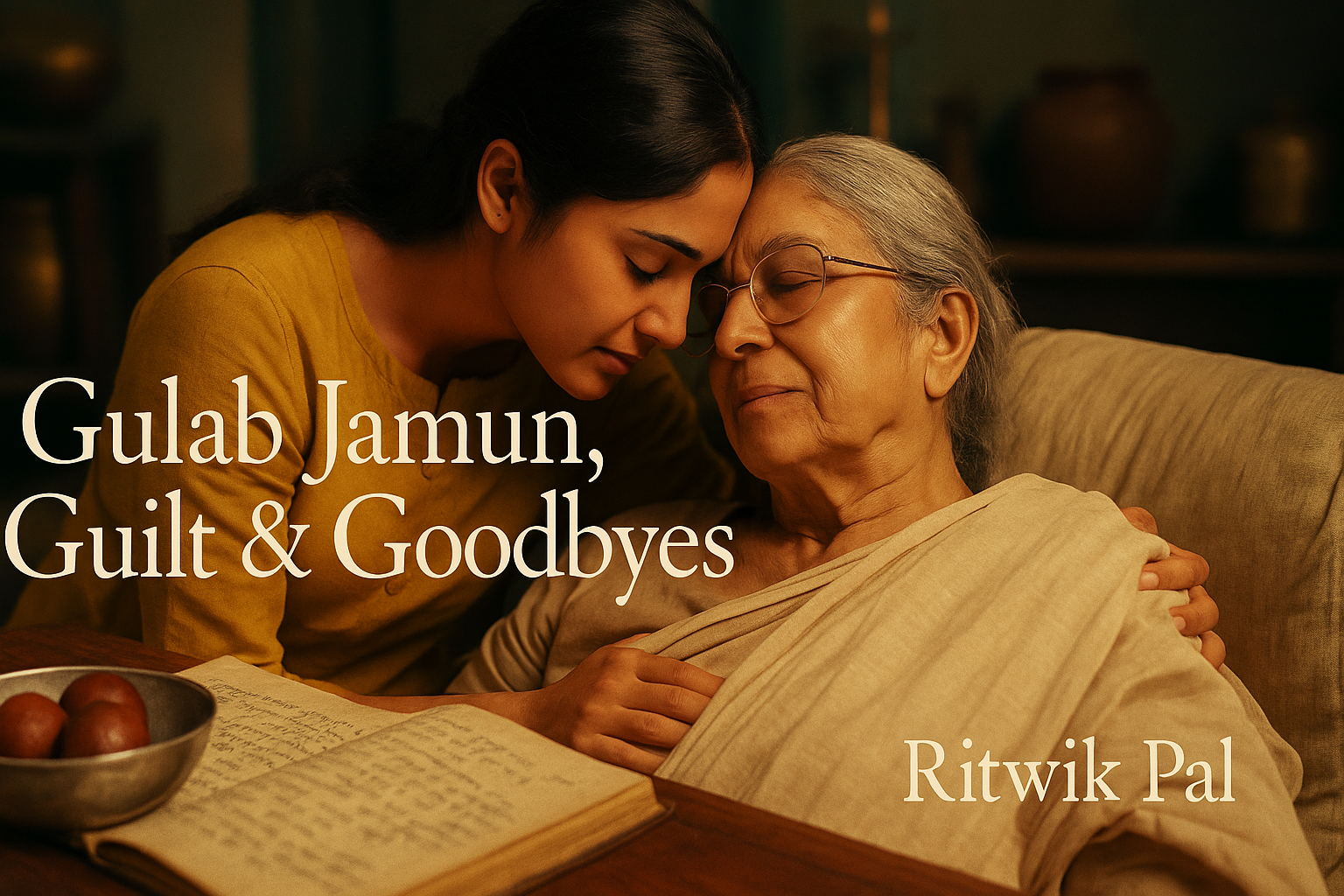

Ritwik Pal
Part 1: The Last Request
The ceiling fan creaked like an old man with secrets. Outside, the mango tree swayed gently in the early April breeze, its leaves whispering things no one could understand anymore. Inside, Dida lay still on the teakwood bed, her body fragile, eyes closed but not asleep. She hadn’t spoken much in days, her voice now a thread unraveling slowly. But when she finally did, it brought the whole house to a standstill.
“I want… the diary.”
Tuli, sitting beside her, held her hand tighter. “Which diary, Dida?”
“The one in the kitchen drawer. The brown one. With oil stains. My recipes.”
Everyone expected her to ask for the priest, or perhaps a photo of Thakur, her husband. But Dida wanted her recipe diary. And more than that, she wanted Tuli to read it out loud. Every page. Every dish.
In a house where words often sat unsaid between the generations, this request was louder than any scream.
That evening, Tuli opened the drawer Dida had pointed to. The old brown diary smelled of turmeric, cardamom, and time. Its pages were crinkled and oil-smeared, filled with Dida’s neat, looping Bengali-English script. “Gulab Jamun – soft only if love added twice,” one recipe said, with a tiny smiley face drawn next to it.
She took it back to the bedroom. Dida was awake, eyes glassy but alert. Everyone else was in the drawing room—Ma quietly sobbing into her dupatta, Baba pacing silently like a clock without time. Only Tuli had the voice Dida wanted to hear.
“I’ll start from the beginning, Dida,” she said.
Dida’s lips curled into a half-smile. “Good girl.”
The first page was simple: “Masoor Dal.” A daily staple. Nothing fancy. Just lentils, garlic, green chili, and a dash of ghee. But next to it was a short note: “Cooked this the first day I met Thakur. He hated garlic. I added extra.”
Tuli looked up. “You made it even though he hated garlic?”
Dida blinked slowly. “I wasn’t cooking for him. I was cooking for me.”
They both chuckled, though Tuli’s throat felt tight. That was Dida. Always quietly rebellious, wrapped in saris and spice jars.
As she flipped the pages, more notes floated up like ghosts—each one a memory, a moment, a truth Dida had never spoken out loud but had preserved in mustard oil and ink.
By the time the second recipe was read, dusk had folded itself into the corners of the house. The house-help, Mukta, brought in tea, but no one drank it. Dida looked peaceful, almost childlike. Tuli kept reading, her voice steady despite the quivering inside her.
The fifth recipe was for Shorshe Ilish, and it came with the line: “Renu and I fought this day. She walked out. Never came back. I still make this on her birthday.”
Tuli stopped.
“Who’s Renu, Dida?” she asked softly.
Dida’s eyelids fluttered but didn’t open. Her voice was barely a breath. “My sister.”
It hit Tuli like a ladle dropped in a steel bowl. No one had ever mentioned a sister.
“Why didn’t I know?”
Dida smiled faintly. “Some recipes… aren’t shared until the dish is ready.”
That night, Tuli slept curled up in the same room, the diary under her pillow like a charm against forgetfulness. She kept waking up, afraid Dida would be gone, afraid the stories would evaporate with her.
But morning came, with its soft light and quiet strength, and Dida opened her eyes again.
“You haven’t read the Gulab Jamun recipe yet,” she whispered.
“I’ll get to it,” Tuli said, brushing Dida’s hair with her fingers. “But I want to know why it matters so much. This diary.”
Dida stared at the ceiling for a long time before answering. “Because it’s everything I never said.”
And that was when Tuli realized this wasn’t about food at all. It was about farewells written in cinnamon, apologies tucked between mustard seeds, and guilt hidden under layers of ghee. This was a cookbook of unsaid goodbyes.
She took a deep breath and flipped to the next page.
Tomorrow, she would read about a birthday and a sweet soaked in syrup.
But today, she would hold her grandmother’s hand and learn the recipe of presence.
Part 2: Masoor Dal and Marriages
The second page of the diary was flecked with masoor dal stains—tiny rust-colored dots scattered like forgotten freckles. Tuli touched one with her fingertip. It felt dry, grainy, and strangely warm. The recipe itself was simple—split red lentils, garlic fried in mustard oil, green chilies, a pinch of turmeric. The note beside it, however, was far more complicated.
“Made this the morning I ran away from home.”
Tuli read the line twice. Then a third time.
“Dida… you ran away?”
Dida’s eyelids lifted slowly. “Well, I walked. In a red taant saree. With my slippers almost breaking. Running sounds dramatic.” A faint grin tugged at her mouth.
“But why?” Tuli asked, voice hushed.
“The groom was rich. His father owned a jute mill. And he thought that meant he could ask for whatever dowry he pleased. A car. Gold bangles. Even a refrigerator.”
Tuli blinked. “But didn’t you—?”
“No. I said no. I said I’ll marry the boy who brings me flowers, not balance sheets. And I walked straight to your Thakur’s house.”
“You knew him already?”
Dida nodded. “He was my tuition classmate. He used to steal my fountain pens.”
Tuli laughed. “And you still married him?”
“He also used to keep extra ink in his bag for mine. That counts.”
The masoor dal recipe was written in neat cursive, the strokes confident. It was dated 1957, in a different pen ink—deep blue, fading at the corners. It began with: “Heat the mustard oil till it smokes. Let the garlic crackle—loud like your principles.”
Tuli chuckled at the line.
Dida, half-listening, whispered, “That garlic crackle? That was my mother screaming from the courtyard as I walked out.”
There was no drama in her voice. Just memory, slow and unpolished.
“Did she ever forgive you?” Tuli asked.
Dida didn’t answer right away. She closed her eyes, inhaled deeply.
“She never said it. But she sent me pickles in old Horlicks bottles for years. That was her forgiveness.”
Later that afternoon, the house grew heavy with the scent of boiling rice and boiled feelings. Tuli made the masoor dal exactly as written. She chopped the garlic finely, heated the oil till it bit her eyes, and dropped the green chilies with the same hesitation Dida must’ve once felt at the door of a new house.
When she brought the small bowl to Dida’s bedside, the old woman took a spoonful and smiled, eyes closed.
“Tastes like rebellion,” she said.
Tuli sat beside her, the diary open between them.
“But don’t you think… it’s strange? That you chose food to tell all this?”
“It’s not strange,” Dida replied. “Food remembers what people forget. Every spice has a story. And I didn’t want mine to disappear when I
There was a pause as a koel called out from the mango tree, breaking the silence like a spoon hitting a steel thali.
Tuli turned another page and found a small photo tucked behind the recipe. A black-and-white snapshot, slightly curled at the edges. Dida looked barely twenty, smiling nervously at the camera, a plate of dal and rice in her hands. Beside her, Thakur wore a crumpled kurta and a sheepish grin, holding up a bunch of garden jasmines.
“You really did run away for flowers,” Tuli murmured.
Dida laughed softly. “Yes. And for dal.”
She looked at the photo, then back at Tuli. “That morning, I was hungry. Not just for food. For a life where I could choose. Where my meals wouldn’t be priced in dowry gold. Masoor dal was the first thing I cooked in my new home. It was the only thing I knew how to make.”
Tuli swallowed hard, the weight of generations pressing gently on her shoulders. She thought about all the times she’d brushed off Dida’s recipes, calling them “too oily,” “too old-school,” “too brown.” And here it was—every turmeric-stained line telling a love story, a revolt, a sacrifice.
“So,” Dida said, voice fading slightly, “next time someone tells you lentils are boring, you tell them they carried me through the biggest decision of my life.”
Tuli smiled, leaning in to hug her. Dida smelled of Boroline and mustard oil and something softer—something only a kitchen and a heart could hold.
And as dusk settled again over the old Kolkata home, the diary remained open on the bed, fluttering with pages waiting to be read. Pages where ingredients were feelings, and every dish a decision.
The masoor dal cooled beside them, but the memory stayed warm.
Part 3: Shorshe Ilish & Silent Regrets
The ilish recipe was written in darker ink, the kind that didn’t fade easily. As if Dida had wanted these memories to last longer, to resist time. Tuli noticed the heading right away:
“Shorshe Ilish – cook with care, regret less.”
She looked over at Dida, who was awake but distant, her eyes on the fading yellow of the ceiling where a slow fan circled like memory itself.
“This page is… different,” Tuli murmured, more to herself.
Dida didn’t respond immediately. But as Tuli began to read, her breathing grew sharper, like the slow sizzle of mustard seeds in hot oil.
“1 hilsa, sliced. 2 tbsp mustard paste. Green chili. Salt. Mustard oil—hot, not just warm. Cook for exactly seven minutes.”
Then, in smaller writing beneath the method:
“Renu never came back after this.”
Tuli looked up sharply. “Dida… is this about your sister?”
Dida turned her head slowly. Her eyes were open now, clouded but clear in that moment. “Yes. It was the last thing I made for her. We fought while the fish was still steaming.”
Tuli read the page again, this time aloud. As the words left her mouth, it was like conjuring a time machine. The mustard paste, Dida had written, had to be ground by hand. “The mixie doesn’t understand grief,” she’d scribbled in the margin.
“We were different, Renu and I,” Dida began, her voice like footsteps on an old wooden floor. “She believed in perfection. I believed in feeling. When Ma died, she took over the household, became the ‘eldest daughter’ as if it were a title. I just wanted to finish school.”
The argument had begun with fish bones. Renu had said Dida never cleaned them properly. Dida had snapped back about overcontrol, about never being allowed to breathe. Then, something had cracked. Something bigger than a fish bone.
“She walked out without eating. I called after her. I really did,” Dida whispered. “But some silences… they stick harder than mustard oil on brass.”
In the evening, Tuli went to the market and bought ilish. The fishmonger smiled—“For a wedding?” he asked.
“No,” Tuli replied. “For a memory.”
Back home, she followed the recipe to the letter. Ground the mustard herself, fingers burning. Let the oil smoke. Added the green chilies whole, just like the diary said.
When she brought a bowl to Dida’s bedside, the room filled with the sharp, bright scent of shorshe—nostalgia layered with ache.
Dida didn’t eat much. Just a spoonful.
“She liked it spicier,” she said softly.
“Who?”
“Renu. She used to add a bit of red chili powder, secretly. We never told Baba.”
Tuli smiled. “Maybe I’ll try it her way next time.”
Dida blinked slowly, like she was seeing her sister in the doorway again. “There should’ve been a next time,” she murmured.
That night, Tuli sat by the window, the diary in her lap, a piece of fish wrapped and stored for no one. She wondered how many women in her family had held back tears in kitchens, how many fights were salted into their food.
The ilish recipe had no garnish, no frills—just precision and pain. A dish cooked to remember a bond that broke over something so ordinary, it almost didn’t deserve a story.
But here it was, on paper. In ink that refused to fade.
And Tuli, holding the story now, felt the weight of mustard and mourning.
Part 4: Nolen Gur Payesh & The Son She Lost
The fourth recipe was for Nolen Gur Payesh, scribbled in a more fragile hand. The ink bled slightly on the page, like someone had written it with a shaking wrist—or through tears.
Tuli touched the soft brown stains across the margin. Jaggery, maybe. Or something older, something more permanent.
The line above the recipe read:
“For the one who left before his first birthday.”
Tuli froze.
She had never known this story.
“Dida,” she asked gently, “was there… another son?”
Dida was awake. And for once, she didn’t pretend to forget. Her eyes, though watery, held something steady beneath them.
“Yes,” she said. “Before your mama. His name was Babu. We called him that. Just Babu. He was born in winter. I made payesh on his birthday.”
The recipe was dated January 14th, 1963. Tuli traced the ingredients with her eyes:
– Gobindobhog rice
– Full cream milk
– Nolen gur, soft and warm
– A bay leaf for memory
– A cardamom pod, crushed but not too fine
“Don’t stir too fast,” the note said, “or the milk gets angry.”
“Angry milk?” Tuli asked softly.
Dida managed a smile. “That’s what I used to tell myself. On the day we lost him, I had stirred too fast. It had spilled. Burnt.”
She paused. “And that night, he had a fever.”
Tuli’s breath hitched. “Dida… are you saying—?”
“I’m saying,” she interrupted, “a mother always looks for blame. Even when there’s none. The doctor said pneumonia. But in my head, it was the milk. The milk I burnt.”
The silence in the room turned thick, like boiled rice before it breaks.
“No one told me about him,” Tuli whispered.
“Because no one wanted to remember,” Dida said. “Not even I did, most years. But the payesh… the payesh always remembered.”
She closed her eyes.
“That year, I made it with too much jaggery. Your Thakur couldn’t eat it. Said it was too sweet. I didn’t care.”
Later that night, Tuli stood in the kitchen, slow-cooking milk with trembling hands. The scent of bay leaf and cardamom curled into the corners of the house. When the milk thickened just enough, she added the nolen gur—watching it dissolve like dusk falling into night.
She placed a small bowl near Dida’s bed. Dida didn’t wake, but her fingers twitched, reaching as if in dream.
Tuli sat beside her, murmuring, “I’ll remember Babu too. Every January. With payesh.”
Outside, a fog settled over Kolkata’s winter evening. But inside, the diary glowed faintly under the bedside lamp. A record of grief wrapped in sweetness.
And a grandmother, even in her silence, finally felt understood.
Part 5: Gulab Jamun, Guilt & Goodbyes
Tuli had expected this page to feel warm, familiar—like birthday lights or the smell of Dida’s saree soaked in rosewater. After all, gulab jamun was her favourite sweet. And Dida made it every year, without fail, for her birthday. Even when she was in college. Even when she didn’t visit.
But the note at the top of the page stopped her cold.
“I made these the day I failed as a mother.”
She blinked. Read it again. The words didn’t change.
“Dida…” she said gently, “what does this mean?”
Dida didn’t answer right away. Her breathing was slow, fragile. But when her lips finally parted, the voice was soft, yet unyielding.
“It was your mother’s wedding day.”
Tuli froze.
“I made gulab jamun that morning. Big ones, with khoya. She loved them as a child. But I knew she wasn’t happy that day. And I did nothing.”
The recipe was written in sharp, confident strokes—almost defensive:
– Khoya: grated fine
– Maida: sifted twice
– Milk: warm, never hot
– Rosewater: only after soaking
– Syrup: one thread. Not two. Not one and a half. One.
Next to the ingredients was a single line:
“The syrup must hide the cracks.”
Tuli whispered it under her breath. She had always thought the sweet was soft because Dida added love. But now she wondered—was it love, or guilt?
“Your ma didn’t want to marry your baba,” Dida said, her voice trembling now. “She told me so. Twice. I didn’t listen.”
“Why not?” Tuli asked.
“Because I thought I knew better. Because the match was good. Because I was tired of raising children who always wanted more than I could offer.”
A long pause.
“And because I was afraid.”
Dida closed her eyes. “The morning of the wedding, she refused to get ready. She cried over breakfast. I gave her a gulab jamun and told her everything would be sweet one day. I lied.”
Tuli had never heard her mother speak about that day. Never heard of resistance. Only saw photos of a quiet bride in red, her smile thinner than her gold necklace.
“I thought I was doing what mothers were supposed to do,” Dida whispered. “But not all traditions are worth repeating.”
That evening, Tuli made the gulab jamuns herself. She followed every line. Grated the khoya, rolled the balls with damp palms so there’d be no cracks. She heated the oil just till it shimmered—not a degree more. She made the sugar syrup with rosewater, measured the thread between finger and thumb like a promise.
When she bit into one, it was soft, perfectly soaked—but heavy.
She placed three pieces on a small plate and carried it to Dida’s bed. Dida took one bite. Her eyes fluttered. Then, she smiled.
“Just right,” she said.
Tuli sat beside her. “Did Ma ever forgive you?”
Dida didn’t answer.
But she reached out and took Tuli’s hand. “Don’t carry our mistakes forward,” she said. “Make your own. But make sure they’re honest.”
Later, alone with the diary, Tuli saw something at the bottom of the page. A line written in pencil, almost faded:
“Sweetness doesn’t fix everything. But it’s a start.”
She closed the book and leaned back. The house smelled of sugar and something else—truth, maybe. Or the quiet relief of being seen.
And somewhere deep inside, the girl who grew up thinking gulab jamun was just dessert now knew: it was also a goodbye.
Part 6: Begun Bhaja & Broken Friendships
The sixth recipe was not one Tuli expected to find in a book full of family moments and farewells. Begun Bhaja. Fried eggplant slices. The simplest dish imaginable. Yet there it was, written with elegance and a care that almost felt exaggerated.
And beneath it, a single-line note:
“For Mina – the friend who left without saying goodbye.”
Tuli tilted her head. “Mina?”
Dida gave a small nod, more a tilt of her chin than an answer. Her eyes stared at the far wall like it had turned into a photograph only she could see.
“Mina was my best friend in college,” she said. “She was the kind of person who wore red nail polish and never apologised for it. You know, wild in ways Bengali girls weren’t allowed to be.”
“What happened to her?”
Dida was quiet for a long time.
“I don’t know,” she said finally. “She disappeared.”
Tuli read the recipe aloud. It was precise.
– Large, plump begun
– Cut thick, salted, pressed under weight
– Turmeric and chili rubbed in tight
– Mustard oil, shimmering but not angry
– Fry slow. No rush.
Then, almost as an afterthought:
“Best served with stories. Or apologies.”
“I made this the night Mina came home with me for the first time,” Dida said. “Baba didn’t like her. Said her lipstick was too loud.”
Tuli chuckled. “And yours?”
“I borrowed her shade the next week.”
Dida smiled, then exhaled deeply.
“She was… free. And I envied her. One day she told me she wanted to drop out and become a theatre actress. I told her she was foolish. That she’d end up alone.”
Tuli knew what was coming even before Dida said it.
“She never came back after that.”
In the kitchen, Tuli selected the biggest eggplant she could find. She sliced it into thick rounds, just like the diary said. Salted them. Waited. Rubbed in turmeric and chili like Dida had once rubbed out her own envy. Then she fried them, slowly, patiently, until the sides crisped and curled into golden brown moons.
She brought the dish to Dida’s bedside. Dida smiled before even tasting it.
“She always liked hers with rice. No dal, no chutney. Just plain rice and begun bhaja.”
Tuli nodded. “If she were here now, what would you say to her?”
Dida didn’t answer right away. She picked up a slice, chewed slowly, and said, “I’d tell her… I was scared. Not of her dreams, but of my own. Because she dared to chase hers. And I didn’t.”
That night, Tuli added a note to the diary in her own handwriting.
“Begun Bhaja – for the friendships we judge before we understand.”
Outside, rain began to fall—a soft, hesitant drizzle. And inside, beneath the rustle of pages and the smell of fried brinjal, one memory stopped hurting just a little bit.
Part 7: Chingri Malai Curry & Forbidden Letters
It was the only page in the diary that had something hidden behind it—an envelope, yellowed with age, sealed but brittle. Tuli noticed it when she turned to the Chingri Malai Curry recipe. The envelope had no address, no stamp, just a single name written in soft, blue ink: Aman.
“Dida,” she said, carefully lifting the envelope, “who’s Aman?”
Dida didn’t answer right away. She blinked slowly, as if she’d just heard a name she hadn’t allowed herself to remember.
“He was… someone I never wrote about. Until now.”
Tuli held her breath.
“He was Muslim,” Dida said finally. “And he wrote poetry. Bad ones, but they always made me laugh.”
The Chingri Malai Curry recipe was a Bengali classic, yet this version had a personal touch:
– Tiger prawns, cleaned but with tail intact
– Coconut milk, fresh only—never canned
– Bay leaf, cinnamon, cardamom
– Green chilies slit, but not too deep
– Sugar, a pinch. Love, a handful.
In the margin:
“Made for Aman on a Thursday he skipped mosque. He said the smell of coconut was holier than sermon.”
Tuli looked up in disbelief. “Dida… are you saying…?”
“I loved him,” Dida said plainly. “I was nineteen. He lived across the lane. Our balconies almost touched. He used to read Faiz at night, loudly, pretending the poems were for the moon.”
She smiled faintly.
“And one day, he left a letter under the hibiscus plant. Just said: ‘If I were born again, I’d be born on your side of the border.’”
Tuli gently peeled open the envelope. Inside was a folded letter, its ink faded but still readable. It was written in perfect Bengali.
“If we ever eat together again, let it be on a Thursday. Let the coconut be sweet, and the prawns fat. Let there be no priests in our plates, no flags in our forks. Just you and me, and silence loud enough to mean everything.”
— Aman
Tuli swallowed hard.
“Did you ever reply?”
Dida looked away. “I didn’t have the courage. I tore up my reply the next day. Burnt it in the stove. Then married your Thakur the next month.”
She paused.
“I made Chingri Malai Curry on my wedding night. Everyone thought it was a celebration. But it was a funeral too. For a version of myself I never got to live.”
That night, Tuli cooked the prawns exactly as written. She grated fresh coconut herself, ground the spices, and stirred the pot as the air filled with the scent of cinnamon and ache.
She served a small bowl to Dida, who ate slowly, silently.
Tuli sat beside her and whispered, “Would you have been happy with him?”
“I don’t know,” Dida said. “But I would have been free.”
A few minutes passed before she added, “You don’t have to inherit our silences, Tuli. Speak. Write. Love loud.”
Tuli nodded, clutching the diary to her chest like a prayer.
And in the quiet that followed, a forbidden letter finally found its reader.
Part 8: Luchi & Letting Go
The next morning, Tuli found the diary open—not at the last page she had read, but the next one. Somehow, Dida must’ve turned it during the night. Her thin fingers rested near the bottom of the page, as though she had been reaching for something even in sleep.
At the top, in a slightly faded but still proud script, was the title:
Luchi & Letting Go
Tuli smiled. Among all the recipes, this one felt the most familiar. Luchi wasn’t food. It was a mood. A Sunday morning. A childhood memory. A family ritual.
But the note beneath it was different from the rest.
“This is the first dish I made after I forgave my mother.”
Tuli looked at Dida, who was awake but not speaking yet. Her eyes fluttered open slowly as Tuli began to read the recipe aloud.
– Maida, fine and light
– A spoonful of ghee in the dough
– Warm water, never cold
– Let it rest. Everything needs rest before rising.
– Roll gently. Fry in joy.
Tuli chuckled. “Fry in joy? That’s a new one.”
Dida blinked and gave a faint nod. “She used to say that. My mother. Said luchis puff up only if you’re happy while making them. Otherwise, they stay flat. Like grudges.”
Tuli had always heard stories of Dida’s strict mother—stern, serious, sharp-tongued. But she had never heard this part.
“When did you forgive her?”
Dida closed her eyes for a long moment. Then, with effort, said, “When she died.”
Tuli sat still.
“I was twenty-five. Pregnant with your mama. She had fallen sick and passed quickly. We never had our final conversation. But after her death, I found her diary. Just two pages. One was a list of medicines. The other—my birth details. Every vaccination, every illness, every childhood favourite food. She’d kept it all.”
A pause.
“And I realised… some mothers say love with silence.”
That day, Tuli prepared luchis by hand. She kneaded the dough gently, rested it long, rolled each circle with care. As she fried them, they puffed like tiny balloons, golden and proud.
She brought a plate to Dida, along with a small bowl of chholar dal.
Dida took one bite, then said, “They’ve puffed. So you’re happy.”
Tuli smiled, holding back tears. “Only because you let me in.”
Dida touched her wrist lightly. “Love needs both recipes and revision. Don’t be afraid to rewrite.”
Later, as evening painted the room in soft oranges and greys, Tuli looked at the last line on the page:
“Luchi is soft. But strength lies in softness too.”
She underlined it with a pencil, then whispered aloud, “I believe you, Dida.”
And outside, the Sunday sky folded into itself quietly, like a well-risen dough, full of patience and forgiveness.
Part 9: Kosha Mangsho & Kites
The recipe was tucked between two pages that smelled faintly of clove and cumin. It was longer than the others, with careful instructions, extra notes in the margins, and one small drawing of a kite sketched beside the title:
Kosha Mangsho & Kites
It began like a celebration.
“The first year I felt the house was mine.”
Tuli paused, rereading the sentence. She’d always thought of Dida as the unquestioned matriarch—head of the household, ruler of the kitchen. But even she had once needed to feel like she belonged.
“It was the year after your mama was born,” Dida said, her voice faint but steady. “We stayed in this very house. Everyone was visiting for Durga Puja.”
Tuli leaned in, the diary in her lap, and let Dida’s voice carry her.
The recipe started boldly:
– Mutton, cut on the bone
– Onions—at least five, sliced thin
– Garlic and ginger—ground, not chopped
– Patience: measured in hours, not minutes
– Spice blend: clove, cinnamon, cardamom, and the courage to let it burn just a little before adding water
Dida had written in the margin:
“Meat tastes better after resistance.”
“That day,” Dida continued, “I woke early, even before the pujari’s bell. Your Thakur was on the terrace with a kite in hand. He hadn’t flown one in years. I had never flown one at all. So he taught me.”
“You flew kites?” Tuli smiled.
“I tried,” Dida said. “I tore five. The sixth rose for only a second. But he cheered anyway.”
She paused.
“Later that day, I cooked kosha mangsho for fifteen people. Your jethus, jethimas, neighbours, all of them. For the first time, no one corrected me. No one added salt afterward. And when your Thakur told them it was better than his mother’s, I knew.”
“Knew what?”
“That this house was no longer someone else’s. It was mine.”
Tuli read the full recipe slowly, carefully. The words were not just instructions but affirmations. Lines like:
“Cook till the oil separates—like ego from truth.”
“Don’t rush. The meat teaches you how to wait.”
In the evening, she made the dish in the old iron kadai. The meat browned and thickened in rhythm, the onions melting into mahogany softness. The house filled with a smell that felt ancient and proud.
She served Dida a small portion, with soft parathas.
Dida took a bite and closed her eyes. “Tastes like that Pujo. Like home.”
Tuli smiled, her throat catching. “Was it really the kosha? Or the kite?”
Dida’s fingers traced the edge of the bedsheet.
“Both. You don’t feel free until something lifts you. You don’t feel at home until you claim it.”
That night, Tuli stepped out onto the terrace, holding a small, handmade kite. The sky was dark, stars smudged. The kite didn’t rise—it didn’t need to.
It was enough to hold the string, feel the wind tug, and know: this story, like the house, now belonged to her too.
Part 10: The Final Recipe
The diary was nearly finished. Only one page remained.
Tuli hesitated before turning it. A part of her didn’t want it to end. The days of reading to Dida had become rituals—quiet, sacred moments. Recipes once meant for taste had turned into truths. But pages, like lives, run out eventually.
She turned the final page.
It was blank.
Almost.
At the top, in Dida’s faint, quivering handwriting, were just four words:
“For Tuli. Your turn.”
Tuli stared.
No recipe. No ingredients. No memory.
Just a passing of the ladle.
“Dida,” she whispered, her voice cracking, “what do I write?”
Dida’s eyes opened—barely, slowly. She looked at her granddaughter like she was still the little girl who used to beg for one more gulab jamun. The girl who hated peeling onions. The girl who once said, “Why do you keep making old food when we can order pizza?”
“You’ll know,” Dida whispered.
Tuli held her hand, small and dry now, veins like fading rivers.
“But what if I get it wrong?”
Dida smiled.
“Then you’ll revise.”
A few minutes later, her eyes closed. This time, she didn’t open them again.
The house was very quiet.
After the rituals. After the relatives left. After the casseroles were empty and the scent of incense faded, Tuli sat in the kitchen alone. The diary lay open to the last page, empty and waiting.
She picked up a pen.
And wrote:
“Lebu Cha & Rain”
– Water, not too hot
– One spoon tea leaves, for memory
– Ginger, crushed—like grief
– Lemon, squeezed right before the first sip
– Sugar, only if needed
– Drink while it rains
She stopped. The words looked strange at first. Too simple. Too hers. But then she saw the same thing in them that Dida had once left in hers—not instructions, but intentions.
She kept writing.
A memory from the day she got her first heartbreak. A dish Dida had made without speaking a word. Another from the monsoon she caught fever and refused to eat anything but soft rice and mashed potato. They weren’t just recipes. They were recipes for love. And resilience. For holding on. And letting go.
Weeks later, she made lebu cha as rain trickled down the kitchen window. She took a sip, closed her eyes.
And smiled.
The last recipe had become the first of many.
The diary, like the kitchen, was no longer Dida’s alone. It was a story now—with room to grow.
For recipes yet unwritten.
For memories yet to be made.
For the sweetness she still carried in her hands.
Gulab Jamun, Guilt & Goodbyes
The End