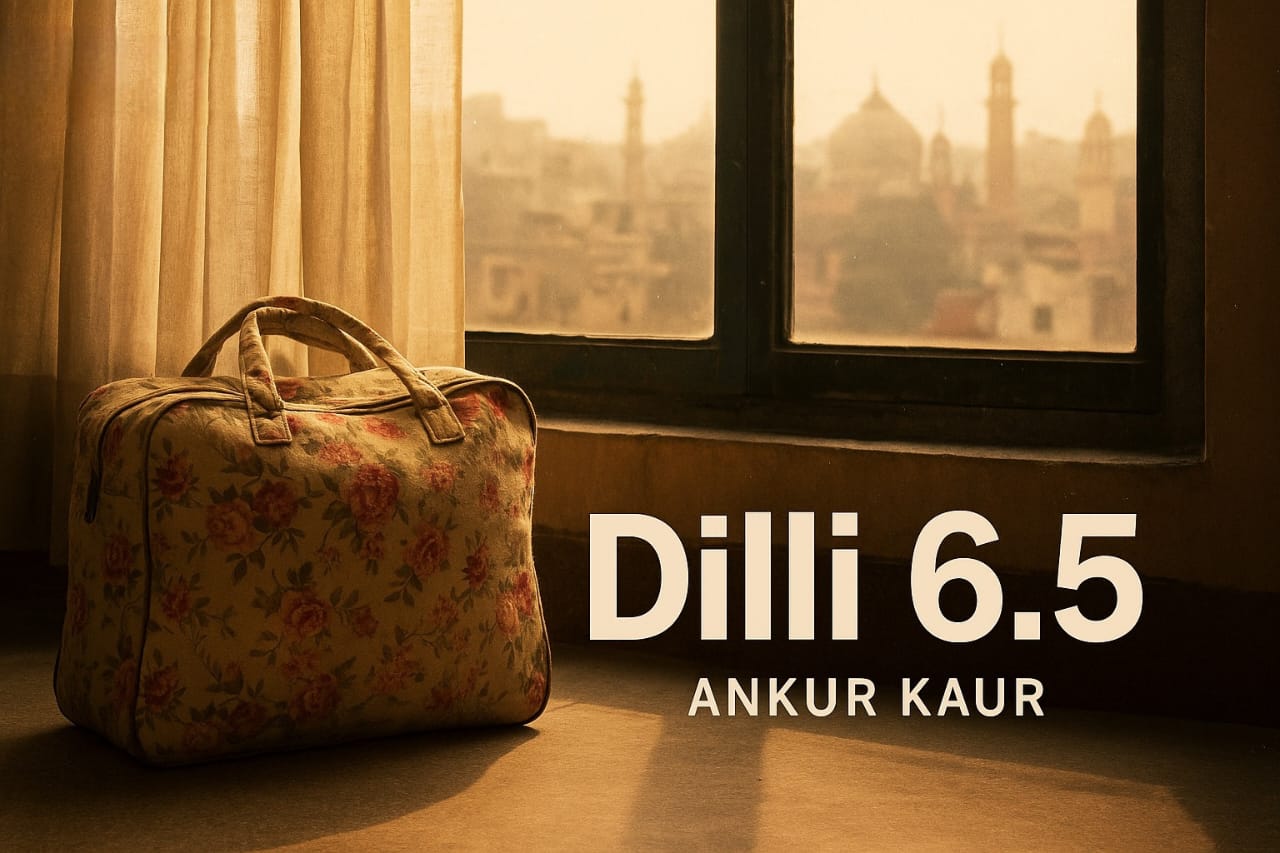

Ankur Kaur
Part 1: The Bag That Wouldn’t Leave
The morning sun rose over Old Delhi with the usual chorus of honks, hawkers, and the sizzle of parathas on the tawa. In a narrow bylane of Chawri Bazaar, where every house shared its secrets through the cracks in their walls, the Khurana family was preparing for an exodus. Not the biblical kind. More like the modern middle-class one—from chaos to “development,” from pigeons to peacocks, from Dilli 6 to Gurgaon.
Mrs. Saroj Khurana stood in the middle of the living room, hands on hips, commanding like a general. “Harpreet! Don’t forget the achar bottles. And for God’s sake, wrap them properly this time! I still remember what happened during cousin Lajo’s shaadi—achar ka tsunami ho gaya tha!”
Her husband, Mr. Harpreet Khurana, forty-nine and freshly retired from the CPWD, nodded without looking up from his prized tea set, which he was wrapping individually in socks.
Their daughter, Meher, was on Instagram Live, documenting the chaos. “And here we are—moving from heritage to high-rise. From gali number teen to DLF Phase 3. The Khurana family bids adieu to Mughal charm and says hello to overpriced coffee.”
In the corner of the room, near the peeling wooden almirah, sat a large, faded, floral-printed bag. The kind of bag that’s too ugly to throw but too sentimental to forget. It had no brand, no zippers left, and at least three safety pins keeping it from bursting open. Nobody remembered when it came into the house, but like the neighbor’s cat, it had always been there.
“Yeh kapdon wala bag kaun le jaa raha hai?” asked Saroj.
“Abhi tak yahin hai?” Harpreet furrowed his brow.
Meher looked up from her phone. “That thing? Why not just throw it away?”
Saroj looked horrified. “Throw it away? It has Papa ji’s old kurta from Partition days. And your frock from your first birthday!”
“It smells like ghosts,” Meher muttered.
Still, the bag made it into the truck.
The family’s belongings were finally loaded into the most reluctant-looking tempo. The driver, a sleepy-eyed man named Kailash with a Krishna keychain and a mouth full of gutkha, glanced at the bag skeptically as if it too might demand a seatbelt.
“Ye bag kaafi heavy lag raha hai,” he said.
Harpreet chuckled. “Emotional baggage hai. Bahut kuch hai isme.”
Kailash didn’t smile. “Main bata raha hoon—yeh bag kuch alag lagta hai.”
And thus began the journey to Gurgaon.
The drive was uneventful, except for the part where they took a wrong turn into a farmhouse wedding and Meher live-streamed the chaos. The reels got 3,000 views in an hour. By the time they reached their new 3BHK in Gurgaon, complete with modular kitchen and a balcony facing another balcony, everyone was too tired to care about the bag.
Except it was already waiting inside.
“Tum logon ne isey andar rakha?” Harpreet asked, staring at the bag now sitting calmly in the hallway.
“Nahi,” Saroj said. “Main toh kitchen unpack kar rahi thi.”
“Main toh bedroom mein thi,” Meher added, slightly spooked.
Kailash had left thirty minutes ago. The bag, however, had arrived before them.
“It must’ve been the security guard,” Harpreet concluded, half-heartedly. “Chalo, thak gaye hain. Let’s eat.”
But that night, as the Gurgaon skyline twinkled like a birthday cake lit with too many candles, the bag moved again. Only slightly, from one side of the hallway to the other. The sound was soft, like cloth rubbing against marble.
Saroj, awake to check if the milk was boiled, saw it shift.
She blinked.
The bag didn’t move.
She shook her head. “Garmi ka asar hai. Bas thoda hallucination.”
But the next morning, the bag had unzipped itself.
Just a little.
Meher poked it with a Swiggy menu.
It farted out a crumpled dupatta.
“What in the Stranger Things—” she began.
Saroj picked up the dupatta with reverence. “This is mummyji’s. She wore it the day she slapped our landlord.”
“Should we call a priest?” Meher whispered, mostly joking. Mostly.
Harpreet declared, “Enough. We’ll empty it and repack it properly.”
The bag had other plans.
Every time they tried to unzip it completely, the zipper got stuck. Every time they tried to lift it, it felt heavier than before. By the third day, the bag had become a fixture in their new home. Guests started asking about it.
“Oh, that?” Meher said once, laughing nervously. “Family heirloom. It chooses its own corner.”
A week passed.
One night, the family came home from CyberHub after a tragic sushi experiment. They opened the door.
The bag was on the sofa.
Meher screamed.
Harpreet dropped his wallet.
Saroj fainted—half from fear, half from wasabi indigestion.
The next morning, Harpreet called his cousin Balbir who dealt in “energy alignments.”
Balbir arrived wearing four Rudraksha malas, a Nehru jacket, and smelling strongly of sandalwood soap.
“Yeh koi ordinary bag nahi hai,” he pronounced after poking it with a fork and chanting something in Sanskrit mixed with Punjabi.
“Thanks,” said Meher dryly. “We hadn’t figured that out.”
“It’s not just baggage,” Balbir said gravely. “It’s karma.”
Saroj blinked. “Toh kya karen?”
“Kuch nahi. Let it stay. It’ll leave when its story is complete.”
Meher rolled her eyes. “Great. Now we’re Airbnb-ing for a haunted handbag.”
And so, the bag remained.
In the living room.
In their lives.
In their dreams.
And Gurgaon, for all its skyscrapers and sanitized cafés, slowly made space for one stubborn bag from Dilli 6.
Part 2: Of Ghosts, Gutters, and Gurugram Greens
Harpreet Khurana prided himself on being a man of logic. He didn’t believe in vastu, ghosts, or the idea that eating papaya could affect luck. But that confidence began to erode the day he found the floral bag sitting cross-legged—yes, cross-legged—on their IKEA beanbag, looking like it was in tapasya.
“Is it just me,” he whispered to Saroj, “or is this bag… meditating?”
Saroj glanced at it nervously. “Main toh bolti hoon, bhajan chalu kar dete hain. Har din। Subah.”
“You want to scare the bag, or the neighbours?”
The next day, Saroj set up a small puja corner beside the television, installed a Bluetooth speaker, and began each morning with a Shree Hanuman Chalisa remix featuring techno beats. The bag did not move. But it didn’t leave either.
Meanwhile, Meher had declared it a “manifestation of intergenerational trauma” on Instagram.
“Think about it,” she said over her daily oat milk smoothie. “It represents all the things we don’t want to carry, but do. Like Dadi’s casual sexism. Or Papa’s obsession with hoarding plastic containers.”
Harpreet sighed. “Can we stop turning our paranormal infestation into content?”
Meher ignored him and created a new series: #BaggageDiaries. The first reel—“Haunted But Make It Aesthetic”—crossed 10k views. People flooded the comments with emojis, tarot readings, and dramatic suggestions like “BURN IT WITH SAGE!!!” and “What’s its star sign?”
Things escalated on a Sunday.
Harpreet was in the bathroom, humming old Mohd. Rafi songs, when the lights flickered. He froze mid-rinse.
“Power cut?” he muttered.
Then the geyser growled.
Then the mirror fogged up in seconds—even though the tap was running cold.
And then, in the fog, a word appeared:
“Bhookh.”
He stumbled out with shampoo in his eyes and foam on his head. “SAROJ! THE BAG IS HUNGRY!”
Saroj, armed with a spatula, stared at the bag. “Yeh toh ghar ka naya daamaad nikla. Roz khaana chahiye?”
They decided to test it.
That evening, they placed a steel thali with plain dal, two rotis, and a spoonful of rice in front of the bag.
Next morning?
The rotis were gone.
The dal had vanished.
The spoon was licked clean.
Harpreet inspected the floor. “No insects. No rats.”
Saroj examined the bag. “It looks… fuller. Like us after Shaadi season.”
From then on, the bag was fed daily.
It seemed content with leftovers—sometimes rajma, sometimes sabzi, never karela. One time Saroj offered lauki and the next morning, the entire apartment reeked of incense and wet socks. A warning, clearly.
Even the building guard, Gajendra, noticed something strange.
“Sir, aapke ghar se raat ko awaazein aati hain,” he said one morning.
“What kind of awaazein?”
“Jaise koi purani Hindi film chal rahi ho. Waise gaane. But sad ones. Like someone’s remembering an ex.”
Meher perked up. “Are you telling me our bag has a broken heart?”
Gajendra nodded gravely. “Mujhe toh lagta hai… woh kisi se bichhad gaya hai.”
For some reason, that made Saroj deeply emotional.
She sat near the bag that evening and gently whispered, “Kya tumhara bhi koi tha? Jiske kapde leke baithi ho? Batao beta.”
Meher uploaded a reel called “The Bag That Loved Too Much”. Twenty-two thousand views.
By now, the bag had its own identity. Saroj began referring to it as Phoolmati Ji—a name she said just felt right.
Harpreet installed an air purifier. “If this thing’s staying, it’s contributing to air quality at least.”
Their new neighbours, the Chopra family from Tower B, visited one evening. The Chopras were the kind who had robotic vacuum cleaners and children named Vihaan and Shanaya.
“Oh,” said Mrs. Chopra, spotting the bag. “Vintage piece?”
“Family,” said Saroj.
“It’s… alive,” Meher added helpfully.
Mr. Chopra nudged it with his Louboutin. It responded by belching out an old cassette tape. Lata Mangeshkar. 1983. Title handwritten: Prem Kabhi Nahi Marta.
The Chopras left early.
Two days later, the Chopra kids reported their Alexa started speaking in Punjabi.
Word spread across the complex.
People came to see “the haunted bag of Tower A.” Some brought gifts. One woman tried to get a selfie with it. Another asked if it could predict the stock market.
Then came the YouTubers.
“Bhaiyo aur behno, welcome to another episode of Desi Urban Legends! Aaj hum Gurgaon mein hain, jahan ek bag—haan, kapdon ka bag—logon ke sapne mein aa raha hai.”
They left screaming after the bag flung a chappal at them. Size 8, Bata. Dated 1992.
By the end of the week, Harpreet installed a polite wooden placard:
“Phoolmati Ji Is Resting. Please Do Not Disturb.”
Meher updated her Instagram bio to: Content creator + emotional support daughter of haunted bag.
Saroj lit incense in the mornings and whispered news headlines to the bag like a devoted radio host.
Harpreet quietly googled “moving back to Old Delhi” and “how to evict a ghost respectfully.”
But it was no use.
The bag—Phoolmati Ji—was now family.
And in a city of glass towers and gated lawns, where everyone wore masks and carried secrets, maybe having a bag that refused to leave wasn’t such a bad thing.
At least she was honest about her baggage.
Part 3: Housing Society Mein Phoolmati Ji
By now, everyone in Magnolia Enclave Tower A knew about the Khurana family and their bag.
Not just any bag, of course.
Phoolmati Ji—the floral-printed matriarch of leftover secrets.
The housing society, until then a peaceful blend of espresso machines, yoga WhatsApp groups, and balcony plants named after influencers, had found a new obsession. Every morning, under the pink bougainvillea beside the jogging track, the aunties gathered and discussed her latest “leela.”
“Kal raat na, Latha ne dekha, bag ke andar se koi awaaz aa rahi thi!” declared Mrs. Arora.
“Kaisi awaaz?” asked Mrs. Gupta, pausing her Surya Namaskar mid-pose.
“Jaise koi keh raha ho—‘Sambhal ke rakhna, ye yaadein hain…’”
Goosebumps.
They forgot their stretches and immediately made a group: #PhoolmatiWatch.
Saroj, meanwhile, had gone full custodian mode. She placed marigold flowers beside the bag each day and read out one paragraph from the Dainik Bhaskar. “Taaki duniya ki khabar rahe tumko bhi, Phoolmati Ji.”
Meher filmed it all, obviously. “Today’s episode: Bag Talks and Budget Cuts.”
Online theories had gone wild.
One Reddit thread claimed the bag was a portal to Mughal times.
A psychic from Karol Bagh DM’d Meher, asking if she could “touch the bag virtually.”
Even Netflix’s content intern liked one reel and commented: “This needs a mini-series.”
Harpreet, ever the realist, had other worries. The building’s RWA.
“Mr. Khurana,” said Mr. Dhingra, the Chairman, during a Sunday meeting, “we respect cultural sensitivity. But this… entity is not in the registry.”
“She’s a bag, not a bulldog!” Harpreet protested.
Dhingra adjusted his thick glasses. “There have been complaints.”
“Complaints? From whom?”
“From Tower C. Someone claims Phoolmati Ji telepathically called their son ‘useless.’”
Saroj didn’t deny it. “Well, if the shoe fits—”
“Ma!” Meher giggled.
Harpreet sighed. “She doesn’t even have vocal cords!”
“That’s the scary part,” muttered Dhingra.
The RWA handed over a formal letter with bullet points:
- The bag causes unnecessary public attention
- The bag has not been registered as a resident or guest
- The bag has potentially supernatural tendencies
“In short,” Dhingra concluded, “either the bag gets packed, or the family does.”
Harpreet came home fuming. “We’re being evicted by a tote!”
Saroj clutched her pearls. “Phoolmati Ji? Bahar? In this heat?”
Meher, predictably, made content. “CANCELLED BY RWA: A Bag’s Fight for Her Rights.”
The video went viral. Over fifty thousand views. People commented:
- “Justice for Phoolmati Ji!”
- “Let the bag live her truth!”
- “India’s first non-human tenant!”
Then came the interviews.
A leftist podcast asked Saroj if Phoolmati Ji was a metaphor for suppressed femininity.
A Gurgaon FM station asked Harpreet if she was “haunting or just vibing.”
Even a Noida-based political satire page did a meme: Bag vs Bureaucracy: A Battle of Fabric and Fury.
But all that online fame didn’t help when Saroj found Phoolmati Ji outside the flat one morning.
Alone.
Displaced.
The placard had been snapped in half.
Harpreet stood silently, holding his morning tea.
Meher stopped mid-sip. “They threw her out?”
The family went downstairs. The lobby guard looked nervous. “RWA ne order diya tha, Sir. Main kya karta?”
The bag sat quietly beside the shoe rack, looking… smaller. Dimmer.
Something about it felt violated.
“Bas. Main ab chup nahi rahungi,” Saroj announced.
And then, something no one expected happened.
Phoolmati Ji unzipped herself.
There was a whisper.
Soft. Delicate. Like a song from a radio forgotten in an old car.
Then, from inside the folds of the bag, floated out a photograph.
Sepia-toned.
A man in a wool coat, standing beside a woman in a sari, holding a little girl.
Harpreet picked it up. His hands trembled.
“This… this is my father.”
Saroj’s voice cracked. “And that’s… that’s Meher as a child.”
Meher stared. “Wait… what?! I’ve never seen this photo in my life.”
The photograph wasn’t just old. It was impossible.
Because in it, there were three generations—together in a place, in a year, that never should have overlapped.
And on the back, in fading ink, it read:
“Dilli ke bagal mein ek yaad basa ke rakhna. Taaki koi bhool na paaye.”
(Keep a memory beside Delhi, so no one forgets.)
There was silence.
No cameras.
No reels.
Just stillness.
Phoolmati Ji zipped herself again. No drama. No sound.
She’d spoken her truth.
From that day, the Khurana family made no more jokes.
Saroj polished the bag gently every Sunday.
Harpreet placed the photograph on the living room shelf, in a silver frame.
Meher changed her bio to: Daughter of Phoolmati Ji. Respectfully.
And as for the RWA?
They received a thousand postcards.
All of them reading:
“Let the bag stay.”
So they did.
Because in Gurgaon, among the fake lawns and 3BHK dreams, something real had finally made a home.
Part 4: The Resident of Flat 14C
The official society noticeboard—usually reserved for complaints about water pressure, missing milk packets, and reminders for Diwali melas—now displayed a laminated paper that read:
“Resident List: Updated as of April 30”
Flat 14C: Mr. Harpreet Khurana, Mrs. Saroj Khurana, Miss Meher Khurana… and Ms. Phoolmati (Unclassified)
The unclassified tag caused confusion, laughter, and one angry letter from a retired customs officer who claimed this was a violation of Section Something-Or-The-Other. But most people accepted it. Phoolmati Ji was no longer a secret. She was folklore.
Inside the Khurana flat, life had adopted a rhythm. Morning tea, doorbell rings, the daily scroll of society gossip, and Phoolmati Ji. She didn’t move much now—just sat quietly in her chosen spot by the window, overlooking the gulmohar tree.
“She likes the light,” Saroj said one afternoon.
“She’s a plant now?” Harpreet muttered.
“No, she’s more like… an old aunt who never married but knows everyone’s secrets,” Meher replied. “Like bua without the judgment.”
But just when peace had returned, enter:
The Cleanliness Drive.
Initiated by none other than Mr. Dhingra, who now seemed to have taken Phoolmati’s existence as a personal insult.
“We must sanitize our environment—mentally and physically!” he declared in the lobby, pointing at invisible dust with great moral outrage.
“Start with your WhatsApp forwards,” someone muttered.
The new plan involved monthly audits, random checks, and a surprise “purity inspection” of each flat. Dhingra claimed it would “uplift the energy of the building.”
Meher dubbed it #ApartmentSwachhAndolan on her stories. “Day 1. Surveillance disguised as Swachhta. Civil war imminent. Phoolmati Ji preparing spells.”
Saroj wasn’t amused. “I have a bad feeling about this.”
And she was right.
The inspection team came knocking one Sunday. A mix of RWA members, two overenthusiastic interns from a home-cleaning startup, and Mrs. Chopra who brought her own air quality meter.
“Routine check,” Dhingra said with a plastic smile. “And a little… spiritual hygiene too.”
“Spiritual hygiene?” Harpreet raised an eyebrow.
“Just positive vibes,” Chopra added, already sniffing corners like a Labrador with lavender addiction.
Everything was fine until they reached the window.
And the bag.
“Oh,” said one of the interns. “This is the… item?”
Dhingra clicked his tongue. “Let’s open it, shall we?”
“No,” Saroj said sharply.
“It’s part of the audit.”
“Over my dead roti,” she said, stepping in front of Phoolmati Ji.
Meher had already started recording.
“This is a violation of her space,” she said dramatically. “Phoolmati Ji is a senior citizen by fabric standards.”
“Please,” Chopra sniffed. “It’s unsanitary. What if there are bed bugs?”
“She is the bed bug queen,” Harpreet muttered under his breath.
Then, Dhingra did the unthinkable.
He reached for the zip.
The moment his hand touched the metal tab, the lights flickered.
The purifier beeped.
The ceiling fan slowed and began to creak—rhythmically, like it was chanting something in Morse code.
And from deep inside the bag, came a slow, echoing hum.
It wasn’t angry. It was… disappointed.
As if someone had tried to open a diary not meant for them.
Suddenly, a gust of wind blew in through the sealed window.
Papers flew. The air turned musty. And from the center of the bag, floated a single piece of yellowed paper.
A list.
Names.
Dates.
In what appeared to be… multiple handwritings.
Saroj grabbed it.
At the top, it said:
“Carried But Forgotten.”
Names of family members long passed. Neighbors from Old Delhi. Teachers. Even a tailor’s assistant who once stitched Harpreet’s school uniform.
Each name carried a short memory. A smell. A dialogue.
Saroj’s eyes welled up. “This bag… remembers what we forget.”
Even Dhingra stepped back, unnerved.
The bag zipped itself shut. Not angrily. Just… firmly.
The room was silent except for the gentle beep of Chopra’s air quality meter, now blinking “High Emotion Detected.”
The team left quietly.
Saroj framed the list and placed it next to the photograph from Part 3.
Harpreet sat down with a sigh. “We live with a living archive.”
“Better than a nosy neighbor,” Meher said.
Phoolmati Ji didn’t move for three days.
But then, on the fourth, Meher came home from college to find something odd.
A new item had appeared beside the bag.
A small embroidered handkerchief.
She picked it up, puzzled. “This isn’t ours.”
Saroj joined her. “No… this belongs to Shanno Aunty. Our old neighbor. The one who passed last year.”
Harpreet leaned in. “Why would it show up now?”
Meher frowned. “Maybe… maybe the bag’s not done yet.”
Saroj nodded slowly. “Maybe she still has stories left to return.”
Outside, the wind rustled the gulmohar leaves.
And inside, beneath a floral shell, memory waited.
Alive. Threaded. And patient.
Part 5: Return to Sender
The next few weeks, something strange became routine.
Every few days, an object—old, faded, usually from a forgotten corner of the past—would appear beside Phoolmati Ji.
Once it was a broken toy rickshaw with a missing wheel.
Another time, a packet of barley with “Best Before 1998” printed on it.
And each time, the item had a memory attached. A name. A whisper of a place.
Saroj had started a logbook. Meher had created a web series. Harpreet had stopped arguing.
“We live with a time capsule,” he muttered one morning, brushing his teeth while the packet of barley sat next to his shaving kit.
But one object changed everything.
It was a letter.
Handwritten, in Urdu. The paper was yellowed, the ink smudged in places, but the emotion bled through.
Saroj stared at it for a long time. Then read it aloud.
“Jab tu paida hua tha, main dari ke kone pe baithi thi. Dar se, pyaar se, dono se ro rahi thi. Socha tha, is duniya mein tu kya dekhega? Par tu toh roshni ban gaya mere liye. Jahan bhi jaaye, yaad rakh—main tere liye dua hoon, hamesha.”
It wasn’t signed.
But Saroj knew.
“My mother never got to meet Meher. This was for Harpreet.”
Harpreet swallowed hard. “I thought I lost this letter during the Diwali clean-up in 2005.”
“And yet,” Saroj whispered, “here it is.”
Phoolmati Ji was silent, as always.
But it became clear—she wasn’t just holding memories anymore.
She was giving them back.
“Maybe this is why she came with us,” Meher said one evening. “To return what we didn’t know we lost.”
It became a ritual. Whenever a new object appeared, they’d sit together, decode it, share its story. Some made them laugh—a comb with half its teeth missing (Harpreet’s college rebellion phase); others made them cry—a button from Saroj’s father’s coat; a coin Meher once swallowed as a toddler.
It was emotional archaeology.
One Sunday, while cleaning, Saroj found the khurpi (hand hoe) her mother used in the balcony garden in Old Delhi. It hadn’t been packed. She was sure of it.
“Is this… is she bringing back the house too?” Saroj whispered.
Harpreet looked nervous. “If I find the bathroom tap that never stopped leaking, I’m moving to Noida.”
But the next day, a twist.
Instead of something appearing beside Phoolmati Ji, something vanished.
Saroj’s favorite steel tiffin.
Meher’s old diary.
Harpreet’s fountain pen.
At first, they panicked.
Then they noticed—these weren’t lost things. They were unfinished things.
The diary had only blank pages left. The pen hadn’t worked in years. The tiffin was cracked.
“Maybe she’s… decluttering?” Meher offered.
“Or maybe,” Saroj said quietly, “she’s making space.”
Then came the most unexpected development of all.
A letter. Mailed.
Real post. With a stamp.
Addressed to:
Ms. Phoolmati
C/O The Khurana Family
Flat 14C, Magnolia Enclave, Gurgaon
Haryana – 122001
Inside was a single sheet of lined paper. In scrawled Hindi:
“Agar aap Dilli 6 se aayi hain, toh kya mera sweater wapas milega? Woh neela wala. Jo mummy ke haath ka bana tha. Maine kahin rakh diya tha, phir yaad hi nahi aaya.”
No name. No sender address.
Just that.
Saroj was stunned.
Harpreet laughed. “We have fan mail now.”
Meher posted a story: “Dear Phoolmati Ji, Gurgaon’s unofficial postmaster of the past.”
And somehow, the next day, the blue sweater appeared.
Folded neatly.
As if it had always been there.
That’s when the letters started pouring in.
From all over.
Some written in shaky handwriting. Others typed. A few on tissue paper.
- “A cassette with my dadi’s voice.”
- “A gold earring I lost before my wedding.”
- “A recipe book I left in Chawri Bazaar.”
- “The last Rakhi my sister tied.”
Some hopeful. Some desperate. Some absurd.
But all deeply human.
“Do we reply?” Saroj asked one night.
“No,” said Meher. “We return.”
And so began Operation Phoolmati.
They sorted requests.
Categorized by: “Possible,” “Too vague,” and “Probably metaphor.”
Phoolmati Ji, for her part, responded selectively.
Sometimes she returned things the very next day.
Sometimes, nothing.
“Maybe she knows when we’re ready,” Saroj said.
One evening, Meher opened an envelope from someone named Altaf in Lucknow.
Inside: “My grandfather’s poem. Lost in a flood. If it still exists, send it back. If not, send peace.”
Meher placed the letter beside the bag.
The next day, a brittle sheet of paper appeared—handwritten verses, ink bleeding from age.
They sent it.
Three days later, a courier arrived at 14C.
Inside: a box of Lucknowi sweets. And a note:
“You returned memory. I send you mithai. May you always live in both.”
That evening, Saroj served soan papdi to everyone in the building.
Even Mr. Dhingra.
Who cried, quietly, while eating.
Phoolmati Ji just sat in her corner, still as ever.
But they all felt it.
Her warmth.
Her purpose.
She wasn’t just a bag.
She was a postbox for the past.
A gentle reminder that sometimes, the things we lose… still remember us.
Part 6: Viral Video, Vintage Soul
The reel that changed everything was just 18 seconds long.
Shot in warm afternoon light, it showed Phoolmati Ji resting quietly beside the gulmohar-framed window. In the background, a scratchy record played a Talat Mahmood song, and Meher whispered:
“Some bags carry groceries. Ours carries history.”
No edits.
No transitions.
Just silence, nostalgia, and fabric.
By evening, the reel had over 100K views.
By night, it crossed a million.
The comments flooded in.
- “This is art.”
- “Why am I crying over a bag?”
- “She reminds me of my nani’s house.”
- “Delhi 6 to Sector 56, emotions travel in cloth.”
- “I want to touch it once. Just once.”
Meher stared at the screen, stunned. “Guys, I think… Phoolmati Ji’s famous now.”
Harpreet blinked. “Great. Next she’ll ask for brand collaborations.”
Saroj was already planning. “We’ll need a new bedsheet for her. Something festive. Maybe cotton silk.”
Requests started arriving from journalists, cultural historians, even a foreign blogger who wanted to call her “India’s Sentient Suitcase.”
Saroj snapped. “She’s a bag, not a circus exhibit!”
But the attention didn’t stop.
Magnolia Enclave, once a sleepy building with grumbling elevators and overzealous Diwali lights, was now on the map. People came to take selfies at the gate. Some brought gifts—chikki, old coins, a tattered Hindi pulp novel titled “Khooni Mehfil.”
“Why would she want murder fiction?” Harpreet frowned.
“She’s seen plenty,” Saroj replied sagely.
The society was divided.
Half were proud. “First bagfluencer of India!” they declared.
The other half were worried. “What if we get haunted by a purse next?”
Mr. Dhingra tried to issue a new rule banning “unsanctioned spirit activity,” but his WhatsApp poll got only 4 votes—all from his own family.
Then came the documentary crew.
They introduced themselves as minimalist filmmakers from Mumbai.
“We’re doing a series on nostalgia and objects that carry memory,” said Rhea, the lead. She wore horn-rimmed glasses and smelled faintly of lemongrass and existential dread.
“Phoolmati Ji is… extraordinary,” said Arvind, holding a camera like it was a newborn.
Saroj wasn’t sure. “What if she doesn’t like the spotlight?”
Meher smiled. “She already knows she’s famous. She hasn’t unzipped in two weeks. Diva behavior.”
The crew set up one rainy Thursday. Dim lighting. A soft rug. Saroj made chai for everyone. Harpreet hovered anxiously, muttering about electricity bills.
The interview began.
Rhea spoke to the camera. “We’re here to explore a simple truth: Can memory live in fabric? And if so, what happens when we listen?”
They filmed the photograph, the list, the sweater, the letters. They filmed the family telling stories. Laughing. Crying. Repeating things they hadn’t said aloud in years.
Then, as if on cue, the bag shifted.
A small rustle. A sigh.
Everyone froze.
Then, something soft slid out.
A postcard.
Faded, but intact.
On one side—a picture of Jama Masjid in the 1980s.
On the other—a note in block letters: “Dilli kab wapas aaoge?”
It wasn’t signed.
Rhea gasped.
Arvind zoomed in.
Meher whispered, “Is it… for us?”
Saroj shook her head. “No. I think it’s for someone watching.”
The documentary was titled “The Bag That Remembered.”
It premiered on YouTube. Within a week, it had five million views.
Schools started referencing it in cultural studies.
A famous poet tweeted, “Objects may not speak, but they never forget.”
A Delhi café printed Phoolmati Ji’s silhouette on their new menu.
One man came all the way from Bijnor claiming the bag once belonged to his great-aunt. He brought halwa as proof.
“She liked floral things,” he insisted. “And once lost a suitcase in Daryaganj in 1973. This could be it.”
Harpreet was polite. “It’s not a lost and found. It’s more like… found and stayed.”
But amidst all the buzz, a change crept in.
Phoolmati Ji began to fade—not in presence, but in weight.
She felt lighter.
Her colors softened.
She no longer unzipped, or produced objects. She just… rested.
Saroj noticed it first.
“She’s tired,” she said, one morning. “Or maybe she’s… full.”
Meher knelt beside the bag, gently touching the faded cloth. “You’ve given so much. Maybe it’s okay to rest.”
That night, for the first time, the Khuranas left her alone.
No photos. No fanfare. Just a soft goodnight.
And in the morning, she was gone.
No drama.
No noise.
Just an empty spot near the window.
Harpreet searched the flat. Saroj checked every cupboard. Meher ran downstairs.
Nothing.
No clue. No cloth. No goodbye.
Just a faint scent of sandalwood.
And a single object left behind.
A mirror.
Framed in old brass. Small. Cracked at the edges.
When they looked into it, they didn’t see themselves.
They saw Old Delhi.
A faint glimpse of a courtyard. A cup of chai on a parapet. A radio playing in another room. And a voice saying—
“Sab kuch yahin tha. Tumne sirf bhool gaya tha dekhna.”
(Everything was always here. You had just forgotten to look.)
Phoolmati Ji was gone.
But she had returned what mattered.
And somewhere, perhaps in another flat, in another city, a different bag was waking up.
Ready to remember.
Part 7: Empty Spaces and Other Full Things
After Phoolmati Ji vanished, a peculiar quiet settled over Flat 14C.
It wasn’t a sad silence—not the kind that hangs like a wet towel on memory. It was… still. Like an old harmonium that’s finally found its last note.
Saroj tried to resume normal routines.
She watered the tulsi plant. Whispered headlines to no one. Folded laundry with a touch of nostalgia, as though half expecting a dupatta to whisper back.
Harpreet, who had once ranted about “haunted home décor,” now found himself lingering by the window longer than necessary, waiting—though he didn’t know for what.
And Meher?
She stopped posting reels for a while.
The followers messaged constantly:
- “Where’s the bag?”
- “Did she die?”
- “Did she transcend?”
- “Are you guys safe??”
One even said: “She healed my breakup. Tell her thank you.”
Meher didn’t reply. She just kept the comments open like little candles flickering in the dark.
A week passed.
Then another.
The world moved on, as it always does. Algorithms changed. A new viral cat took over Instagram. The documentary was shortlisted for an indie film award. Mr. Dhingra announced a “New Energy Vision Plan” involving windchimes in every corridor.
But in the quiet heart of Flat 14C, Phoolmati Ji’s absence remained a presence.
Until one day, Saroj found something unusual in the grocery bag.
Not something new.
Something very, very old.
A token from the Delhi Metro.
Paper. The pre-card kind.
“Who even uses these anymore?” Meher asked.
Harpreet squinted. “This isn’t ours. Look—it says Trial Day – 2002.”
They looked at each other.
Could it be?
Saroj placed it beside the mirror Phoolmati had left behind.
The reflection didn’t change. The courtyard still glowed faintly. The radio still played.
But now, the mirror blinked.
Once.
A flicker.
A sign.
“She’s… not gone,” Saroj whispered. “She’s just not here.”
Meher sat down, legs crossed, facing the mirror like a disciple. “Maybe this is what she wanted. For us to remember how to remember.”
That evening, the family did something strange.
They emptied one entire shelf of their cupboard.
No Marie biscuit packets. No thermal flasks. No warranty papers for fans no one ever claimed.
Just an empty space.
They called it The Memory Shelf.
No one was allowed to put anything functional there. Only objects with stories.
Saroj placed the old Rakhi Meher had made in kindergarten.
Harpreet added the fountain pen—yes, the same one that vanished earlier but was now quietly sitting beside the sugar jar.
Meher added a printed screenshot of Phoolmati Ji’s first viral reel. Caption: “She was never lost. She was waiting.”
Soon, the shelf grew.
A cracked mug.
An old coin.
A cassette without a label.
Each object brought with it a little monsoon of memory.
The shelf became their new ritual.
Meher posted a photo with the caption:
“You don’t need ghosts to remember. You just need a shelf.”
The response was electric.
People began tagging her.
#MyMemoryShelf
#BagInspired
#Dilli65Effect
Strangers shared their own shelves—one girl in Pune had her dadi’s rolling pin displayed under fairy lights. A man in Chennai had framed a wedding invite from 1987, his parents’ anniversary date.
Stories poured in.
Small. Tender. Universal.
The bag had vanished.
But its idea had stayed.
Even Mr. Dhingra was seen one morning quietly placing his late wife’s knitting needles on a wooden ledge in his study.
When asked, he said, “My home feels less empty now. And that’s enough.”
Then came a message.
From an anonymous email ID.
Subject: “Dilli 6.5 continues.”
Inside was a single sentence:
“You remembered. Now let others.”
And attached, a photograph.
A similar floral bag.
But this one rested on a windowsill in Bhopal.
Beside it, a typewriter and a faded wedding photo.
Saroj gasped. “She’s found someone else.”
Meher replied with shaking fingers.
“Take care of her. She carries more than cloth.”
The response came instantly:
“We know. Yesterday, she returned our grandfather’s watch.”
That night, Saroj lit a candle beside the memory shelf.
“She’s not ours alone,” she said.
“She never was,” Harpreet added.
“She’s Dilli,” Meher whispered. “And beyond.”
From Old Delhi to Gurgaon to Bhopal… perhaps even further… a silent revolution was unfolding.
A movement stitched in floral fabric.
A protest against forgetting.
A celebration of small things that once meant everything.
And in Flat 14C, the family no longer waited for Phoolmati Ji to return.
Because now, they knew—
She never really left.
She just moved on to the next story.
Part 8: The Dilli in the Drawer
It was Meher who first noticed it.
Not in the mirror. Not in the shelf. Not even in the old photos that now softly guarded the memory corner of their home.
It was in the drawer.
The one nobody used—the stiff, squeaky one under the TV cabinet that had long been demoted to storing cable wires, expired batteries, and mystery remotes that controlled nothing.
She was cleaning one lazy Sunday afternoon, half-distracted by a rerun of Office Office, when the drawer jammed halfway.
She tugged harder.
And there it was.
A folded page. Carefully kept. Slightly perfumed.
It wasn’t in any of their handwriting.
The ink was blue. The strokes unsure.
She unfolded it slowly, breath held.
It read:
“If you’re reading this, then I left too soon.”
“But memory doesn’t need presence. It just needs space.”
“Dilli never forgets her people. And some people never forget Dilli.”
— Yours in thread, always.
P.
Meher sat down on the floor.
She didn’t cry.
She smiled.
Because somehow, somewhere, even after everything—Phoolmati Ji had written a letter.
The next day, she read it aloud to Saroj and Harpreet over breakfast.
There was no dramatic reaction.
Just silence. Toast. And a shared look between the three that meant: Yes. This matters.
It was Harpreet who broke the silence.
“We should go back.”
Saroj blinked. “Where?”
“Old Delhi. Our old house. The gali. The neighbour with the bird who cursed too much. The paanwala who still owes me fifty.”
Meher’s spoon froze mid-air. “You serious?”
“More than I’ve been in a while.”
Saroj nodded slowly. “It’s time.”
They took the metro.
Changed at Rajiv Chowk.
Exited at Chawri Bazaar.
And as they climbed the steps into the belly of the old city, everything returned at once.
The sound of cycle bells and temple bells mixing without permission.
The smell of kachori, copper polish, and the dust of centuries.
The narrow lanes.
The even narrower memories.
Their old home hadn’t changed much.
Same peeling paint.
Same locked gate.
But something new bloomed on the wall beside it.
A mural.
Painted in soft strokes.
Of a floral-printed bag, floating in the wind.
Below it, someone had written:
“Some homes travel with you.”
Saroj touched the bricks.
“They remember us.”
Harpreet smiled. “Looks like we’re famous here too.”
A small boy appeared with a kulfi stick in one hand and curiosity in both eyes.
“Are you… the bag people?”
Meher laughed. “Yes. But we didn’t carry the bag. She carried us.”
The boy nodded like he understood the weight of what she meant.
He pointed further down the street.
“There’s another one,” he said.
“Another what?”
“Bag. Like hers. In that house. She just came.”
They followed his finger.
At the end of the lane, a green door stood half-open.
Inside, an old man with cataracts and a gentle face sat sipping chai.
Beside him—resting on a jute mat—was another bag.
Faded.
Different design.
Same feeling.
The man saw them, smiled warmly.
“She was yours too?”
They nodded.
“She came to me yesterday,” he said softly. “Brought back my wife’s anklet. I hadn’t heard its sound in twenty years.”
They sat with him for hours.
Listened.
Shared stories.
No cameras.
No interviews.
Just remembrance.
When they got up to leave, the man said, “We thought forgetting meant healing. But maybe healing begins when we remember.”
Back home in Gurgaon, the Khuranas felt lighter.
Not because something had been taken away.
But because something had returned.
Not a person.
Not a bag.
Just…
Dilli.
Not the place.
But the feeling.
That scent of lived-in air.
That noise of too many things happening at once.
That beautiful chaos stitched into every heartbeat.
They didn’t need to hold onto it anymore.
Because now, they were it.
Part 9: The Bag Is a City
A month later, Flat 14C had settled into its post-Phoolmati rhythm.
Saroj’s tulsi plant was blooming like a teenager in first love.
Harpreet had joined a senior citizens’ laughing club called Jeevan Muskaan (though he mostly chuckled awkwardly and stretched).
Meher was writing again—actual writing, not just captions. A long-form essay titled “The Bag That Became a Bridge.”
But the world hadn’t stopped asking.
Emails poured in.
DMs, letters, and one very enthusiastic postcard with a dancing peacock on it that simply read:
“When will she return? She owes me my summer of 1994.”
And then, one evening, something unexpected happened.
There was a ring at the door.
Not a ding-dong.
Not a knock.
A cycle bell.
They opened the door.
A young courier boy stood there, holding a package. “Delivery for Meher Khurana.”
Meher frowned. “I didn’t order anything.”
He shrugged. “Return from an unknown sender. It’s paid.”
She signed the slip.
Inside the package: a photo album.
On the cover: “Dilli 6.5” handwritten in blue marker.
The pages were filled with photographs.
Not theirs.
Other families.
Other cities.
Other bags.
Some floral. Some polka-dotted. One even knitted.
And in each image, someone was crying, laughing, remembering.
The final page held a single quote:
“Memory, like home, doesn’t always need bricks. Sometimes, cloth is enough.”
Saroj held the album to her chest.
Harpreet sniffled. “It’s a franchise now.”
Meher said nothing. But her eyes sparkled like someone who’d seen the future—and it was soft, stitched, and filled with postcards.
The next morning, they started something new.
An open call.
“Have you been visited by a bag? Share your story.”
They built a website.
Simple. Quiet. White background. No ads.
Just a form.
Within 48 hours, over 300 responses came in.
A tailor in Ludhiana said a bag returned his mother’s sewing kit.
A woman in Goa said she found her lost sketchbook next to a banyan tree.
A schoolteacher from Ajmer wrote: “It didn’t return my report card. Just the smell of my classroom. That was enough.”
They created a map.
Dots began to appear—Lucknow, Indore, Patna, Siliguri.
Meher named it:
Bag Spots.
Saroj said, “Like chicken pox, but sentimental.”
The project gained traction.
A radio station in Jaipur interviewed them.
A Chennai blogger made stickers—“Phoolmati Lives Here.”
Someone in Kolkata painted a rickshaw with a giant bag floating among stars.
But even amidst all the attention, Flat 14C remained the same.
A little more open. A little more grateful.
And on a particularly breezy Friday evening, something magical happened.
Meher heard a soft rustle near the balcony.
She turned.
There was no bag.
But on the memory shelf, nestled between the Rakhi and the pen, sat a single moth.
Wings patterned with tiny flowers.
She smiled.
She didn’t need more proof.
Phoolmati Ji was everywhere.
In the folds of stories.
In the pockets of homes.
In the zippered edges of emotion.
She was not a ghost.
Not a joke.
Not even a miracle.
She was a city.
A city that traveled.
That unpacked itself in people.
That showed up not when summoned—but when needed.
And maybe—just maybe—the only reason she left was to make more room.
For others to remember.
To return.
To begin.
Part 10: Not the End, Just a Zip
On the first winter morning of the year, the fog in Gurgaon hung like nostalgia—thick, sleepy, refusing to lift.
Saroj sat in the balcony with her knitted shawl, sipping chai, staring at the empty corner by the window. Not with longing. But with warmth. Like someone remembering an old neighbour who once borrowed sugar and never returned it, but left behind a story instead.
Harpreet came out with a blanket tucked around his shoulders. “What if we never see her again?”
Saroj shrugged. “What if we already did—enough?”
Inside, Meher opened her laptop and stared at her draft.
“The Bag That Was a Home.”
She’d written 18 chapters. Publishers were calling. Someone from a streaming platform sent a one-line email: “Is she still around? We want to talk.”
But none of that mattered.
Because the story—her story—was already being written elsewhere.
All across the country, bags were appearing.
In Jaipur, someone found one outside a hospital with an old lullaby recorded on cassette.
In Guwahati, a woman found a bag with her childhood earrings wrapped in newspaper.
In Cochin, a bag appeared in a church pew, containing a tattered recipe book—handwritten by a grandmother gone ten years.
The memory map lit up like Diwali.
Dots turned into stories. Stories turned into hope.
Saroj began receiving postcards with pressed flowers.
Harpreet was invited to speak at a college seminar titled: “The Metaphysics of Cloth.”
Even Mr. Dhingra started his own podcast. The first episode: “I Once Feared a Bag. Now I Knit One.”
And yet, in the quiet corners of Flat 14C, there was no noise. No drama. Only presence.
One day, a small envelope arrived.
No name.
No stamp.
Just placed gently on the doormat.
Inside:
A single key.
Rusty. Unlabelled.
And a tiny note:
“Some locks are never meant to be opened. Just remembered.”
They placed it on the shelf, beside everything else that once seemed ordinary but never was.
By then, Meher had begun something called The Zipper Project.
A digital archive of forgotten things.
Users could upload a photo of an item, or even just a memory.
It wasn’t meant to go viral.
It was meant to go inward.
She added a tagline at the bottom of the site:
“You don’t need to believe. You just need to remember.”
But even as the world buzzed, one truth anchored them.
Phoolmati Ji had taught them something no degree, no religion, no therapy could quite articulate:
Not everything that moves is alive.
Not everything that stays is dead.
Sometimes, a thing just is.
It sits beside you.
Carries you.
Holds your broken timelines.
Waits for you to be ready.
And when you finally are—it leaves.
Not in anger.
Not in grief.
But with the silence of a zip closing for the last time.
One day, years later, Meher would find herself in a different city, in a different flat, facing a different kind of emptiness.
And just when she’d feel she couldn’t take it anymore, she’d see it—
A bag.
Floral.
Familiar.
Resting quietly in the corner.
And she’d smile.
Because she’d know—
Phoolmati Ji never left.
She just changed address.
THE END
(Or just the beginning, if you ever find a bag at your door.)