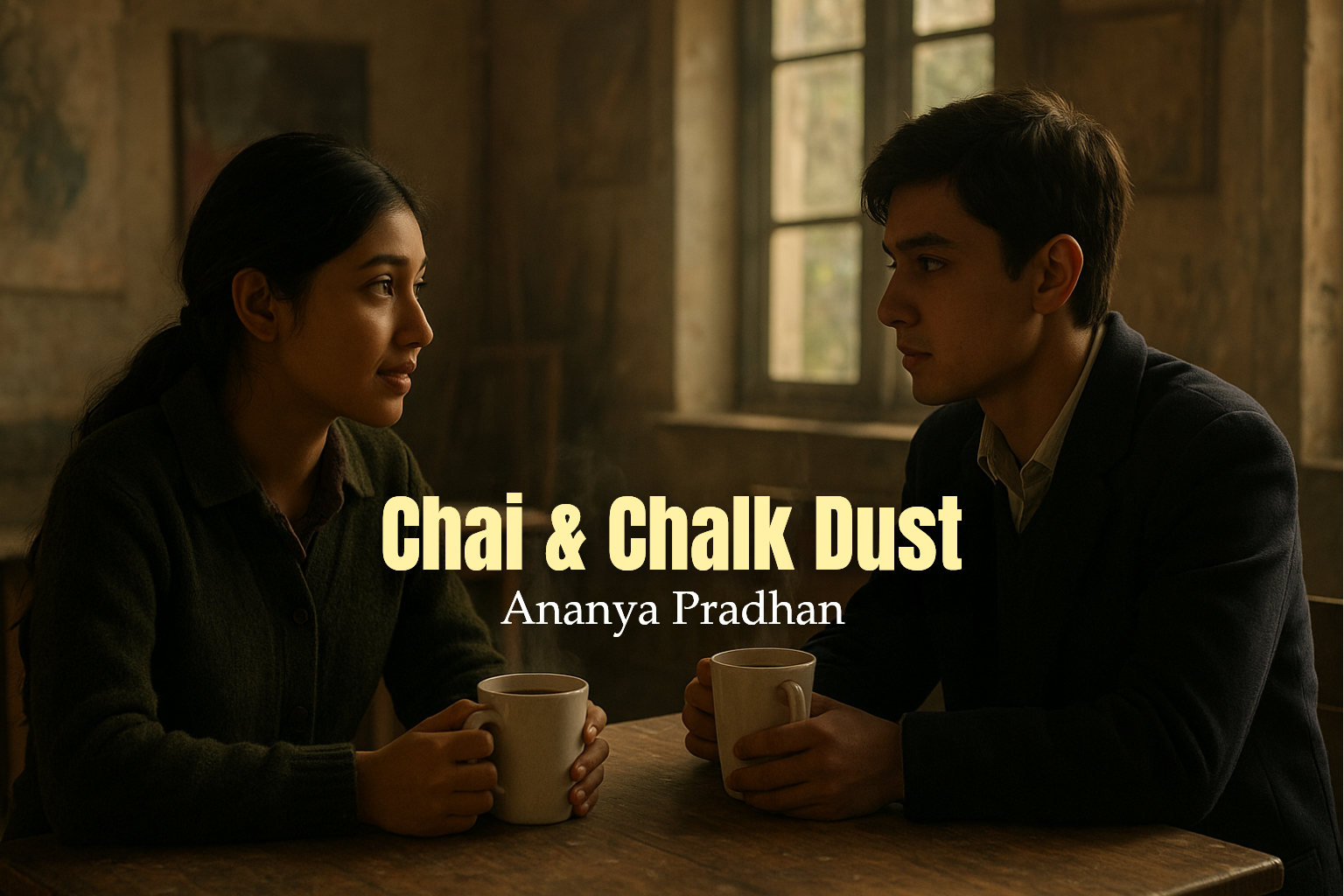

Ananya Pradhan
One
The mist clung thickly to the hills of Darjeeling that September evening, wrapping the sleepy town in a soft, silver-gray blanket. Outside the gates of St. Augustine’s Hill School, where ancient pines swayed gently in the cool breeze, Anaya Gurung tended the modest tea stall her mother had set up years ago. The worn wooden counter was streaked with years of spilled chai and chalk dust, a testament to its humble history. As the sun dipped below the horizon, the streetlamps flickered on, casting pools of warm yellow light on the wet cobblestones. Anaya moved with quiet efficiency, ladling steaming chai into chipped cups, the spicy aroma of ginger and cardamom rising in delicate wisps that mingled with the earthy scent of damp soil and fallen leaves. She greeted familiar faces with soft smiles, but her eyes often drifted toward the school gates, watching the last groups of students trickle inside, eager to escape the descending chill.
It was then that Vivaan Das appeared—a new boy, carrying the cautious energy of someone unfamiliar with this tight-knit world. He approached the stall hesitantly, eyes briefly meeting Anaya’s before dropping shyly to the ground. When he asked for chai, but without sugar, Anaya raised an eyebrow in surprise. Sugarless chai was a rare request among the students, who preferred it sweetened and creamy. She poured the hot brew carefully, the hiss of the kettle punctuating the quiet street like a secret note. Their brief exchange was marked by a delicate awkwardness, but beneath it lay a strange sense of familiarity, as if they had met before in a forgotten dream. Vivaan’s hands wrapped tightly around the steaming cup, and he lingered longer than most would, savoring the warmth against the evening chill. As he walked away, Anaya found herself staring after him, curiosity and a subtle pull of something unspoken stirring within her.
That night, the schoolyard emptied, and the fog deepened into a thick, ghostly shroud over the hills. Anaya sat on the narrow ledge of the school’s abandoned art room, the cold slate beneath her fingertips rough and uneven. She picked up a piece of chalk, absentmindedly tracing lines and shapes, but her mind kept drifting back to the boy with the sugarless chai. Without realizing it, her fingers began to sketch his face—soft shadows under tousled hair, eyes full of quiet secrets. The chalk dust swirled in the dim light like smoke, and the image on the slate took on an almost lifelike presence. Somewhere between the steam rising from her mother’s kettle and the fading light of day, Anaya felt the first fragile threads of connection being woven—a silent promise of stories yet to unfold, wrapped in the gentle ritual of chai and the dusty echoes of forgotten chalk.
Two
Vivaan’s first days at St. Augustine’s Hill School were marked by quiet observation and cautious steps. The sprawling campus, with its red-brick buildings cloaked in ivy and mist, felt foreign to him, despite its familiar mountain air. He kept to the edges of groups, his gaze often fixed on the ground or lost in the swirling fog that drifted through the pine trees. The other students noticed his silence—some whispered that he was aloof, others speculated about his past. Vivaan didn’t offer any stories or explanations; when asked about his family, he would smile politely but evade the question, changing the subject with practiced ease. This only fueled the gossip, and slowly a small circle of curiosity formed around the boy who refused to share his roots. Meanwhile, Anaya watched from her usual spot by the tea stall, her interest piqued by the mystery but tempered by caution.
One afternoon, as the schoolyard buzzed with the excitement of a basketball game, fate brought Vivaan back into Anaya’s world in a new way. The players scrambled and shouted beneath the fading sun, their breath visible in the chilly air. Vivaan, eager to fit in despite his quiet nature, had joined the game, moving with tentative determination. But a sudden collision sent him sprawling to the ground, a sharp pain shooting through his ankle. The game paused as classmates crowded around, unsure whether to help or watch. Anaya, who had been closing up her stall nearby, rushed over with a cloth and a small bottle of antiseptic she always kept handy. Her hands were gentle as she cleaned the scrape, and Vivaan’s guarded expression softened for the first time in days. Without words, a bridge was built—between the boy who hid behind silence and the girl who offered quiet kindness over a cup of chai. It was a moment of unspoken understanding, a crack in the walls both had carefully constructed.
Later that evening, Anaya and Vivaan found themselves seated on opposite ends of her mother’s stall, sharing a simple meal of steaming chai and leftover biscuits. The noise of the school faded behind them as the twilight deepened, leaving only the soft patter of distant rain. Maya Rai, Anaya’s spirited friend, approached with a knowing smile and a teasing comment about Vivaan’s mysterious past. Anaya shared what little she’d gleaned—that Vivaan avoided family talk and kept his identity close like a well-guarded secret. Vivaan listened quietly, then finally allowed himself a small, weary smile. The guard was still there, but something had shifted—a subtle invitation to trust, to perhaps let someone in. In the cool evening air, over the ritual of chai and the comfort of simple companionship, a fragile friendship began to take root, promising warmth against the chill of secrets yet to be unveiled.
Three
The early morning mist still clung to the rolling hills when Anaya set out with her usual tray of steaming chai cups, weaving carefully through the narrow corridors of St. Augustine’s Hill School. Her mother’s tea stall had long been a quiet fixture just outside the school gates, but today Anaya carried the chai inside to the teachers’ common room—a rare privilege she had earned through years of friendly familiarity. As she opened the door, the soft murmur of voices greeted her, punctuated by the faint clinking of teacups and the scratch of pens on paper. She paused at the threshold, carrying the tray with steady hands, when snippets of conversation floated to her ears—words like “student council elections,” “road expansion project,” and “community opposition.” The teachers spoke in low, serious tones about the growing unrest in the nearby tea gardens, where workers and locals were protesting the government’s plans to widen a road that would cut through their land. Anaya felt a pang of worry, knowing this was the same land her mother and neighbors relied on for their livelihoods.
Later that afternoon, Anaya found herself walking alongside Vivaan as the sun cast long shadows across the schoolyard. The air was thick with the scent of damp earth and brewing storm clouds. After a silence that seemed to stretch between them, Vivaan suddenly lowered his gaze and spoke in a hushed voice. He revealed that his father was not just any politician, but a powerful minister in Delhi, deeply involved in decisions affecting projects like the one stirring trouble here in Darjeeling. The weight of the confession hung between them, fragile and heavy all at once. Vivaan’s voice was steady but cautious as he asked Anaya to keep this knowledge to herself, fearing the complicated consequences that might follow if others knew. Anaya felt the gravity of his trust and the burden it placed on her own shoulders. For the first time, the boy she had watched quietly sip his chai was no longer just a mystery but a young man entangled in the intricate web of politics and power—a world she only glimpsed from the margins.
That evening, under the soft glow of lanterns outside her mother’s tea stall, Anaya and Vivaan sat close, the steam from their cups swirling in the cool night air like whispered secrets. Their conversation danced carefully around the unspoken tensions that now seemed to stretch between the school and the community beyond its gates. Anaya’s thoughts wandered to the faces she knew in the tea gardens—the laborers, her mother, her neighbors—all caught in the uncertain crossfire of progress and protest. Vivaan’s confession had planted a seed of connection between them, one rooted in fragile trust and shared understanding. As the stars began to pierce the dark velvet sky, the first threads of their friendship wove tighter, binding them in a quiet pact—a promise to navigate the coming storms together, bound by the ritual of chai, chalk dust, and the whispered hopes of a hill town on the edge of change.
Four
On a soft golden afternoon, Vivaan wandered through the quiet corridors of St. Augustine’s, seeking refuge from the buzz of classrooms and the curious eyes that seemed to follow him everywhere. His footsteps led him to a narrow door tucked away near the east wing—a forgotten entrance to the school’s abandoned art room. Peering inside, he was surprised to find Anaya seated cross-legged on the wooden floor, her fingers deftly tracing shapes on a slate with chalk dust swirling gently around her. The room smelled faintly of aged paper and damp wood, sunlight filtering through cracked windows and casting a warm glow on her focused face. For a long moment, Vivaan watched silently, captivated by her quiet concentration and the way the dust hung like tiny stars in the air. Tentatively, he stepped inside, breaking the silence with a soft greeting. Anaya looked up, startled but pleased, and in that moment an unspoken invitation was extended—a shared sanctuary away from the pressures of school and secrets.
From that day forward, the abandoned art room became their hidden retreat. In the late afternoons, when the sun dipped low and the school’s corridors emptied, they met there to exchange stories and sip on chai Vivaan would bring from Anaya’s mother’s stall. Between chalk sketches and whispered conversations, the walls bore witness to the slow weaving of trust and understanding. Vivaan, usually so guarded, began to reveal fragments of himself—his love for poetry, his quiet longing for normalcy, and his fears of the world beyond the hills. One day, he surprised Anaya with a small, well-worn book of poems, his fingers marking a delicate crease on the page where his favorite line was inscribed: “We meet in the quiet corners of the day.” Anaya traced the words with a smile, feeling the weight of their shared moments sealed in those verses. The promise of their friendship, fragile yet unbreakable, seemed to float in the chalk-dusted air, blending with the faint scent of brewed tea and the distant hum of the hills.
But as their bond deepened in that secret haven, the currents of school politics churned restlessly outside. Nikhil Khanna, the charismatic yet cunning student council president, watched Vivaan’s growing popularity with unease. To Nikhil, Vivaan’s quiet confidence and mysterious background posed a challenge to his carefully maintained influence. Whispers began circulating—questions about Vivaan’s intentions, his real identity, and his sudden closeness with Anaya, a girl far from the privileged circles. Nikhil’s eyes narrowed as he plotted to unseat Vivaan from this budding position of trust among classmates. The art room, once a sanctuary, became a symbol of unseen alliances forming in the shadows. Yet, amid the looming storm of rivalry and suspicion, Vivaan and Anaya clung to their chalk dust promises—moments of calm, connection, and hope that transcended the tumult outside.
Five
The fragile peace of Darjeeling’s hills was shattered one crisp morning when news of the road expansion project spread like wildfire through the town and the school. The plan, meant to widen the narrow mountain roads to accommodate more traffic and tourists, threatened to carve through centuries-old tea gardens, uprooting not just the land but the livelihoods of countless workers. Anaya’s mother was among those who joined the growing protests, her voice rising with the others in defiant chants against what they saw as greed disguised as progress. Within the school walls, the news ignited fierce debates. Classrooms buzzed with heated discussions, student groups split between those urging solidarity with the workers and others warning of the dangers of mixing politics with education. Posters appeared overnight on notice boards, slogans painted in bright colors calling for justice, while whispers of tension grew louder in the hallways.
Vivaan sat through these debates like a shadow, his silence heavier than any voice raised. His usual calm façade began to crack, though none but Anaya seemed to notice. While others argued passionately, he remained quiet, eyes often cast downward, fingers nervously tapping the worn cover of his poetry book. Anaya’s frustration mounted with each meeting and whispered conversation. She needed Vivaan’s voice, his clarity, his courage—yet he withheld himself, as if trapped by invisible chains. Unbeknownst to her, the reasons ran deeper than mere fear of peer judgment. Vivaan’s father, a powerful minister back in Delhi, had been instrumental in pushing similar infrastructure projects through despite public outcry. The political storm swirling around his family made Vivaan wary of revealing his stance, worried that any declaration could be twisted to serve agendas far beyond the school or tea gardens. This burden of legacy silenced him, making him an unwilling observer of the conflict unfolding around him.
The divide in the school mirrored the cracks appearing in Vivaan and Anaya’s fragile connection. Anaya confronted him one evening near the tea stall, her voice tinged with both hurt and disbelief. “Why won’t you say something? We need you—your voice matters,” she urged, eyes searching his for a sign of resistance. Vivaan looked away, the weight of his secret heavy on his shoulders. For the first time, Anaya sensed the depth of the walls he had built to protect himself, walls she couldn’t yet breach. The clash between personal loyalty and public responsibility settled between them like a silent rift. Yet, despite the tension, the steam from their shared chai lingered in the cool air—a reminder that even amidst cracks and divides, connections could hold, waiting to be mended in time.
Six
The monsoon rains came suddenly that afternoon, turning the narrow lanes of Darjeeling into glistening rivers of rushing water. The students of St. Augustine’s hurried to find shelter, umbrellas blooming like colorful mushrooms in the grey drizzle. In the crowded corridors, whispered conversations turned to loud gossip as a careless remark escaped the lips of a classmate during an impromptu huddle. “Did you know Vivaan’s real last name is Kapoor?” someone said, voice carrying farther than intended. Like sparks thrown onto dry leaves, the revelation ignited a wildfire of rumours. Within hours, the secret that Vivaan had guarded so carefully was no longer his alone. The halls buzzed with questions and sideways glances, and soon the whispers morphed into outright accusations. Some students expressed sympathy, but others, led by the ever-watchful Nikhil Khanna, seized the opportunity to brand Vivaan as a political pawn, a privileged son planted to manipulate the protests and control the student body.
Nikhil wasted no time in turning the gossip into ammunition. In the next student council meeting, his voice rang loud and sharp as he accused Vivaan of hiding behind a false identity to influence the school’s stance on the road expansion protests. “Who does he really represent?” Nikhil demanded, eyes narrowing with suspicion. “His family’s interests? The politicians back in Delhi? How can we trust a voice so clearly tied to power and privilege?” The room fractured along new fault lines, students divided between defending Vivaan’s right to privacy and fearing the shadow of politics creeping into their haven. Vivaan found himself cornered, the weight of the revelations pressing on him like the relentless rain outside. Yet he remained silent, unwilling to fuel the storm further but unable to quell the rising tide of mistrust. The boy who once sought refuge in quiet corners now stood exposed, vulnerable to the very forces he had tried to escape.
That evening, drenched and weary, Anaya sought out Vivaan at her mother’s tea stall, the familiar scent of brewing chai a fragile comfort amid the chaos. Her eyes were filled with hurt and confusion as she confronted him. “Why didn’t you tell me the whole truth?” she asked, voice trembling. “It’s more than just your name you kept hidden—there’s a world you won’t let me see.” Vivaan looked away, the sting of betrayal mirrored in his own gaze. He wanted to explain, to lay bare the complexities of his family’s politics and his own fears, but words tangled in silence. The trust they had carefully nurtured felt cracked, the invisible thread between them fraying under the weight of secrets. Yet, as the rain softened to a drizzle and the night deepened, the steam rising from their shared cups of chai seemed to whisper a quiet hope—that even amid storms of doubt, some bonds could be mended with time and truth.
Seven
The soft glow of the lanterns outside the tea stall cast long shadows on the rain-soaked ground as Vivaan finally broke his silence. The weight he had carried for so long pressed heavily on his chest, and in the quiet that enveloped them, he found the courage to speak. He told Anaya about the scandal that had engulfed his father’s political career—a web of corruption allegations, betrayals, and broken promises that had shaken their family and thrust him into unwanted limelight. Vivaan’s voice wavered as he described the struggle to carve out his own identity, separate from the heavy legacy of power and politics that seemed to define him in the eyes of others. Anaya listened, her heart aching not just for the boy before her, but for the boy trapped within—a young man caught between the worlds of loyalty to family and the longing for truth and freedom.
Though hurt by the years of silence and secrets, Anaya found herself understanding the fear that had held Vivaan captive. She admitted to him that her frustration was born from love and hope—that she had wanted to believe in the honesty between them. Yet, she also recognized the complicated shadows cast by the world beyond their small hill station—the pressures of family expectations, public scrutiny, and the dangerous consequences of speaking out. Their conversation stretched late into the night, weaving between moments of vulnerability and tentative hope. The fragile threads of trust that had once wavered began to strengthen, binding them in a shared resolve to face the challenges ahead together, even if the path was uncertain and fraught with risk.
Outside the sanctuary of their friendship, the protests around the tea gardens intensified. The arrival of police forces to disperse the workers marked a turning point, injecting tension and fear into the community. News of clashes and arrests filtered into the school, casting a heavy pall over its grounds. Amid the turmoil, Mr. Ravi Pradhan, the history teacher known for his quiet wisdom, sought Vivaan out. In a hushed conversation beneath the ancient oak trees lining the campus, he urged the young man to find his voice and decide where he truly stood. “Sometimes,” Mr. Pradhan said gently, “the hardest battles are those we fight within ourselves. But silence can speak louder than words—and sometimes, it is the truth that must be bolder than fear.” The words lingered in Vivaan’s mind, stirring something deep within. As the night wore on, the boy who once hid behind shadows began to sense the stirring of courage—the first spark toward embracing not just his heritage, but his own convictions.
Eight
The once-unified halls of St. Augustine’s Hill School were now fractured by voices raised in fervent debate, echoing like distant thunder rolling over the Darjeeling hills. The students found themselves caught in a fierce divide—one side rallying in solidarity with the tea garden workers whose livelihoods were under threat, and the other, led by Nikhil Khanna, urging caution and the belief that the school should remain apolitical, a sanctuary free from external conflicts. Posters advocating both views sprouted overnight across notice boards and walls, their bold colors and impassioned slogans clashing like the storm clouds gathering beyond the misty pines. In classrooms and corridors, whispered conversations quickly turned into heated arguments, and the once-comforting routines of school life gave way to a charged atmosphere thick with tension and anticipation.
Amidst this growing turmoil, Vivaan found himself compelled to step out from the shadows that had long cloaked him. In the bustling assembly hall, filled with expectant faces and nervous energy, he spoke for the first time in a clear, unwavering voice. He expressed his support for the workers, acknowledging the pain and uncertainty they faced, and urged his fellow students to stand in solidarity with the community that nurtured them. His words were met with a mixture of applause and scorn; some students admired his courage and sincerity, while others, swayed by Nikhil’s rhetoric, viewed his stance as reckless and divisive. Vivaan’s public declaration shattered the fragile balance, drawing both allies and adversaries closer into the unfolding struggle. The boy who had once hidden behind silence now stood firmly in the eye of the storm, aware that his choice marked a turning point not only for himself but for the school and its future.
That very evening, as twilight settled softly over the hills and the air grew cool with the promise of rain, Anaya’s world was shaken in a more personal way. Returning to the tea stall she had tended for years alongside her mother, she found the once-welcoming space marred by vandalism—cups shattered on the ground, the wooden counter scarred with crude graffiti, and a lingering scent of smoke curling from a small, hastily extinguished fire. The damage was not just physical but symbolic, a silent warning from unseen hands displeased with the growing alliance between the students and the protesting workers. Anaya’s heart pounded with fear and anger, her sense of safety fractured alongside the stall’s battered wood. Yet even in the face of intimidation, the faint warmth of the evening chai’s aroma lingered—a reminder of resilience, community, and the unyielding spirit that bound her to Vivaan and the hill town she called home. In the shadows cast by smoke and fear, their fight for justice and understanding had only just begun.
Nine
The weekend dawned heavy with anticipation and the scent of damp earth as the protest march was set to wind through the winding roads of Darjeeling’s tea gardens. The atmosphere at St. Augustine’s was charged; classrooms emptied early and hallways buzzed with hushed whispers of resolve and fear. Vivaan found himself at the center of a storm he hadn’t fully chosen, grappling with mounting threats from Nikhil’s faction—sharp words veiled in intimidation, veiled warnings slipped in passing, all urging him to abandon his public stance. At home, the pressure was no less suffocating. His mother’s anxious eyes and veiled phone calls from political aides reminded him that silence was expected, demanded even, to protect the family’s fragile reputation. Yet beneath the weight of this dual burden, Vivaan’s resolve solidified. He knew that the quiet corners where he once hid could no longer shelter him from the truth demanding to be heard.
Anaya, too, faced her own crucible. Despite knowing the risks—a vandalized tea stall, her family’s fragile livelihood at stake—she chose to stand with the workers whose voices had echoed in her heart from the very beginning. That morning, wrapped in a woolen shawl against the biting chill, she joined the growing crowd gathering at the edge of the tea gardens. Faces weathered by years of labor lifted with hope, hands clutching banners, voices rising in chants that carried through the misty hills. As the march began winding its way through winding lanes and beneath towering rhododendrons, Anaya’s thoughts swirled between fear and fierce determination. Each step was a statement, each breath a declaration that roots—of land, community, and identity—mattered beyond politics and power.
Then, as the procession rounded a bend and the murmurs of onlookers grew louder, Vivaan emerged from the crowd beside Anaya, a placard held firmly in his hands bearing her chalked slogan: “Roots Matter.” The surprise was palpable—a moment suspended in time as the two walked side by side, their quiet defiance speaking louder than any shouted slogan. For a brief stretch of road, the weight of fear and expectation lifted, replaced by the simple strength of shared conviction. Nikhil’s threats seemed distant, the calls from distant Delhi muted beneath the steady rhythm of footsteps and the chant of the crowd. In that moment, beneath the gray sky and amidst the rolling hills that had witnessed generations of struggle, Vivaan and Anaya stood united—not just as friends, but as voices for a future where truth and loyalty could coexist. The march pressed onward, but the image of two cups of steaming chai, held side by side against the cold, lingered in the minds of those who watched—a symbol of courage brewed quietly in the heart of the hills.
Ten
The dawn broke gently over Darjeeling’s misty hills, casting soft hues of gold and pink across the tea gardens that stretched like emerald waves beneath the waking sky. The protest march, which had gathered strength and courage in the days before, ended with a calm resolve—the workers and students dispersing peacefully after the local government agreed to temporarily halt the road expansion project pending further review. The victory was bittersweet; the road remained a looming possibility, but the community had made its voice heard, a testament to the power of unity and determination. Vivaan stood at the edge of the crowd, breathing in the crisp mountain air with a newfound clarity. The silence that once cloaked his identity had lifted. In a quiet but deliberate step, he chose to reclaim his true name—Vivaan Kapoor—and, more importantly, to stay in Darjeeling, to stand with the people and land that had come to feel like home.
Meanwhile, back at the familiar tea stall, Anaya took her own step toward healing and hope. Armed with brushes and vibrant paints, she began to transform the battered wall that had once been vandalized into a canvas of resilience and promise. Slowly, a mural emerged—an early morning sunrise spilling warm colors over rolling hills and verdant tea gardens, and in the foreground, two steaming cups of chai sitting side by side on a wooden table. The image captured the quiet essence of their journey—simple moments of connection amidst the larger storms of change. Passersby paused to admire the mural, finding in it a symbol of peace, solidarity, and the delicate beauty of new beginnings. For Anaya, the act of painting was more than artistry; it was a reclaiming of space, a bold statement that life, hope, and community would endure.
That evening, as twilight softened the sky into shades of lavender and indigo, Vivaan and Anaya sat together at the tea stall, sharing cups of warm chai steeped in the fragrant spices of the hills. No grand declarations or promises were exchanged—only the quiet companionship born of shared struggles and mutual understanding. Their eyes met with a gentle recognition that some bonds need not be defined by words or vows. Instead, they agreed to meet again in the quiet corners of their days, where the noise of the world softened and the simple comfort of chai and chalk dust lingered. As the stars began to shimmer above the hills, their friendship settled into a steady rhythm—an unspoken promise that whatever the future held, they would face it together, grounded in the roots of trust, courage, and the gentle warmth of a shared cup.
End