
Shubrangshu Roy
Shadows Beneath the Sky, opens with Mira’s world pressed in tightly around her, as though every breath she takes has to fight its way through invisible walls of worry. At sixteen, she often feels like a spectator in her own life, watching her classmates laugh and chatter as if they belong to a world just beyond her reach. Every morning is a struggle, each step into the bustling corridors of school amplifying her sense of being out of place. Crowds make her heart quicken, sudden noises coil around her nerves, and even silence at night is filled with an unrelenting chorus of restless thoughts. She doesn’t quite know how to name it—whether it’s fear, sadness, or a strange mixture of both—but the constant unease is her shadow, one she cannot shake off. For Mira, the sky itself feels too heavy, as though even the stars are dimmed by the fog of her inner storm, leaving her stranded in a world that never seems to pause long enough for her to catch up.
Mira’s first astronomy club meeting begins with a hesitation that feels like standing on the edge of a cliff, unsure if she can take the step forward. All morning she had debated whether to go, her mind rehearsing excuses—headache, homework, anything that might justify retreat. But something about the poster’s words, find your place among the stars, kept tugging at her. So when the school day ends, she finds herself slowly walking toward the science wing, every step weighed down by nerves. Her palms are damp, her hands trembling as she grips her notebook like a shield. The classroom door is slightly ajar, spilling soft laughter and the faint clatter of chairs being arranged. Mira lingers outside, torn between slipping away unnoticed and gathering enough courage to cross the threshold. Her chest feels tight, her thoughts spiraling: they’ll see how awkward I am, they’ll know I don’t belong here. But before she can escape, a cheerful voice calls out, “Hey, are you here for astronomy?” and she has no choice but to step inside.
The room is smaller than she expected, but cozy, with posters of galaxies and constellations taped across the walls. A telescope stands near the window like a sentinel, its lens pointing at the faint streaks of daylight outside. Around the table sit only a handful of students—far fewer than Mira imagined—but each with a quiet energy that feels different from the bustling chaos of the rest of the school. There’s a tall boy with messy hair scribbling constellations on a scrap of paper, a girl with glasses balancing a stack of books on black holes, and two others setting up a laptop for a slideshow. No one seems larger-than-life or intimidating; instead, they seem absorbed, content, even a little quirky in their own ways. When Mira steps closer, the boy with messy hair grins and waves her over, introducing himself as Arjun, the unofficial “star-mapper.” The girl with glasses, Leena, nods warmly and makes space beside her. Their ease disarms Mira, and though her nerves still buzz beneath her skin, she finds herself sinking into a chair instead of fleeing. She notices that her breathing, while still uneven, isn’t as suffocating as before. For once, her presence doesn’t feel like an intrusion.
As the meeting begins, the faculty advisor—a gentle teacher with a calm smile—asks everyone to share what draws them to the stars. One by one, the students speak: Arjun talks about sketching constellations since childhood, Leena admits she wants to understand how black holes bend time, another member describes stargazing with their grandfather. When it’s Mira’s turn, the air seems to thicken around her. Her voice falters at first, her hands clutching her notebook tightly, but she manages to whisper, “I just… wanted to look up instead of down all the time.” The room falls into a brief silence, not of judgment but of understanding, and Mira feels a warmth spread through her chest when the others nod. For the first time in what feels like forever, she is not dismissed or misunderstood. The advisor ends the session by announcing a stargazing night planned for the weekend, and the group’s chatter fills the room with excitement. Mira stays quiet, but she listens, her nerves slowly easing into something unfamiliar—hope. As she leaves the classroom, the dusk sky stretches above her, streaked with the first hints of twilight, and she realizes that the door she glimpsed days ago has opened just a little wider.
–
Constellations of Strangers, opens with Mira quietly observing the group during their second meeting, her nervousness not gone but softened by the memory of their kind welcome. The room feels less foreign now—the posters of nebulae and spiral galaxies have become familiar companions, and the hum of chatter no longer seems like noise but something almost comforting. Yet what strikes her most is not the telescopes or the diagrams scattered across the desks, but the way each member carries themselves, as if beneath the surface of their smiles lies a heaviness they don’t quite name. Arjun, with his restless sketches of constellations, laughs often but Mira notices the shadows beneath his eyes, the way he avoids speaking about his family. Leena, confident when rattling off facts about quasars and star systems, has a trembling edge in her voice whenever someone compliments her, as though she cannot fully accept being seen. Even the quietest member, Sameer, who spends more time listening than talking, fiddles constantly with the frayed sleeve of his hoodie, his silence thick with words left unsaid. Mira begins to sense that this small club is not just a gathering of students who love the sky—it is a fragile constellation of strangers, each hiding their own battles behind the veil of starlight.
The turning point comes when their advisor encourages the group to talk about what first drew them to astronomy, not just as a subject but as something personal. At first, the stories are light—memories of childhood stargazing, documentaries that sparked curiosity—but soon the words grow heavier, carrying fragments of unspoken pain. Arjun admits he began mapping stars on nights when his parents fought, tracing order in the sky when his home felt like chaos. Leena confesses she buried herself in science after losing her grandmother, believing that understanding the universe might ease the emptiness of loss. Sameer speaks haltingly about how the stars became his quiet refuge from loneliness, a place where silence felt like comfort instead of punishment. Listening to them, Mira feels the tight grip of her anxiety loosen just a little. For so long she had assumed her fear, her restlessness, her sense of isolation made her different, defective even—but here were others, each carrying grief, insecurity, or loneliness, finding their own solace in the vastness above. She realizes that their fascination with the stars is not just about science or wonder; it is about survival, about searching for light when the world around them grows dark.
When it is Mira’s turn to speak, she does not give a polished explanation. Instead, her words tumble out raw and uncertain: how nights often feel endless, how her thoughts trap her, how she looked at the poster and for the first time wondered if maybe the sky had room for someone like her. The room grows still, but instead of pity or dismissal, she sees recognition in their faces—a silent acknowledgment that they understand. It is in that moment, Mira feels something delicate shift between them. Their unspoken struggles, when pieced together, form a fragile constellation, one held not by perfection but by shared vulnerability. The chapter closes with the group stepping outside after the meeting, the first stars appearing in the twilight. Mira tilts her head back, her anxiety still lingering but less suffocating, her chest filled with the faint warmth of belonging. For the first time, the stars above do not seem impossibly far away; they feel like companions, each one a reminder that even in darkness, scattered lights can form patterns that hold people together.
–
Through the Telescope’s Eye, begins with Mira stepping onto the school’s roof for the club’s first stargazing night. The sky is a deep indigo, streaked with the faint glow of early stars, and a cool breeze carries the distant hum of the city below. Mira feels her heart racing—not from fear this time, but anticipation tinged with a strange nervous excitement. She walks past the scattered equipment, telescopes pointed skyward, and sees her friends already adjusting lenses and whispering to each other in low, eager tones. Arjun is kneeling beside one of the larger telescopes, checking the alignment, while Leena carefully plots constellations on her notebook. Mira lingers at the edge for a moment, her anxiety fluttering like moth wings, before a soft voice—Sameer’s—invites her over. Hesitant but drawn forward, she approaches, and for the first time in weeks, she feels a small thread of connection tug at her, anchoring her to the group and to something larger than herself.
When it is her turn at the telescope, Mira takes a shaky breath, her fingers brushing the cold metal of the eyepiece. She peers through, expecting only a blurred image or a tiny smudge of light, but the sight that meets her eyes halts her breath. Saturn floats in the darkness, its rings stretching gracefully around it, delicate yet immense, almost unreal in its perfection. For a long moment, Mira forgets to breathe, her mind stilling beneath the immensity of what she sees. Anxiety that usually coils around her like a vice feels suddenly small, almost laughable in comparison to the serene vastness of space. The planet seems to hover in its quiet orbit, distant and unchanging, yet somehow close enough to touch with her imagination. Mira’s chest loosens as a sense of awe washes over her, a rare feeling that feels both humbling and comforting. In that instant, she glimpses why the others keep returning, night after night, drawn not merely to study but to be part of a universe larger than their worries, a universe that holds room for them despite everything.
As the night stretches on, Mira observes more constellations, the moon’s pale glow, and distant clusters of stars that seem to sparkle just for her. She listens to Arjun describe Saturn’s moons, Leena pointing out the pattern of Orion’s Belt, and Sameer quietly noting the trajectory of a passing satellite. Their excitement is infectious, yet there is no judgment, no pressure—only the shared wonder of discovery. Mira finds herself asking questions she had never thought to ask before, her voice gaining confidence with each answer, her earlier fears fading into curiosity. When the group finally settles on the rooftop to lie on mats and watch the night sky, Mira stretches out beside them, feeling the cool concrete beneath her and the endless canopy above. For the first time, the vastness of space mirrors something within her: an openness, a quiet possibility that her worries, though persistent, do not define her. The chapter closes with Mira staring at the stars, her heart lighter, her anxiety softened, and a new sense of belonging beginning to take root—a feeling that the universe, with all its immensity, can be a sanctuary, and perhaps she, too, has a place within it.
–
Begins with Mira returning to the rooftop for another late-night observation session, her steps lighter than before. The city’s hum fades beneath the soft whisper of the wind, and the telescopes, notebooks, and scattered blankets create a quiet world suspended between the earth and the stars. Mira notices how different everything feels now—the chairs no longer seem intimidating, the faces of her fellow club members no longer distant. Arjun waves her over with a grin, Leena adjusts the telescope with her usual careful precision, and Sameer quietly sets up a small chart of constellations. As she joins them, Mira feels an unfamiliar warmth spreading through her chest. Her hands, which once trembled at the thought of entering the club, now rest easily on the rooftop ledge. Conversation flows naturally tonight, about planets and galaxies at first, but gradually moving into deeper currents—their fears, regrets, and secret dreams. The stars above seem to reflect these confessions, tiny lights connecting them across the dark expanse, and Mira begins to sense a gravity that is not in the sky but among the people around her.
As the hours pass, laughter mingles with hushed conversation, and Mira finds herself speaking without pretense for the first time in months. Arjun jokes about his messy star sketches, making everyone chuckle, and Mira joins in, surprised at how freeing it feels to laugh without the usual knot of anxiety tightening her chest. Leena shares a story about a failed science project and the disappointment she hid from her parents, her vulnerability met with understanding instead of judgment. Even Sameer, typically reserved, talks about a night he spent on the rooftop alone, imagining stories for every constellation he could see. Listening to them, Mira feels her own walls cracking. She begins to share small pieces of herself—about the restless thoughts that keep her awake, the sense of isolation that has shadowed her for as long as she can remember, and the tiny moments of hope that have driven her here tonight. Each revelation is met with quiet acknowledgment, smiles, and gentle encouragement, a network of unseen connections forming between them like the invisible orbits of planets.
By the end of the night, Mira leans back on the rooftop mat, gazing at the sky with a sense of wonder that is now inseparable from the warmth of belonging. She notices patterns in the stars she had never recognized before, each one reminding her of the subtle bonds she is beginning to form with her fellow club members. The conversations they shared have woven an invisible tether, pulling her closer into a circle where she no longer feels like an outsider. There is still anxiety, still the occasional flicker of self-doubt, but it no longer dominates her. Instead, it is counterbalanced by a growing sense of trust, companionship, and joy. Mira begins to understand what it means to orbit alongside others—not just physically in the starlit space of the rooftop, but emotionally, moving in rhythms of shared laughter, empathy, and understanding. The chapter closes with Mira staring at a streak of light from a distant shooting star, silently wishing that the orbit she has found among her friends continues to expand, carrying her away from isolation and toward the warmth of human connection, just as the planets remain held in their eternal dance around the sun.
–
Eclipses and Shadows, opens with Mira preparing nervously for a science presentation in her classroom, a task that now feels monumental rather than routine. Her stomach churns as she rehearses lines in her head, her palms clammy despite the encouraging words of friends still lingering in her mind. The thought of standing in front of her classmates, of their eyes on her, feels like stepping into a vast, unending void. She begins confidently enough, but as soon as she faces the room, her voice falters, her throat tightening in a familiar, suffocating grip. Words stumble out in fragments, and her anxiety grows, magnifying every rustle of paper, every cough, every glance. A wave of panic rises, and Mira feels trapped in a sudden, overwhelming darkness, convinced that she has failed not just in the moment but in everything she has worked for. By the time the teacher offers her a gentle nod to continue, Mira feels herself shrinking inward, desperate to escape the eyes she imagines judging her every misstep.
The aftermath leaves her shaken. That evening, she hesitates at the threshold of the club’s usual rooftop meeting, torn between showing up and retreating into the safety of solitude. Her mind churns with thoughts of inadequacy: I don’t belong here. I never really did. The familiar warmth of the group now feels distant, and Mira considers quitting entirely, retreating into the comfort of her room where the world cannot see her fail. Yet when she finally steps onto the rooftop, the city’s lights shimmering below and the night sky stretching above, she finds that her friends have begun to share more intimate stories. Leena talks quietly about a failed research project that left her questioning her abilities, admitting she sometimes hides her fear of disappointing others beneath jokes and confident explanations. Arjun mentions a recent family argument that shook his sense of stability, revealing cracks in the composure he usually wears like armor. Hearing them speak, Mira is struck by the realization that even those who seem most secure carry shadows of their own, battles she cannot see at first glance. Their honesty creates a space where vulnerability is not weakness but a form of courage, a quiet recognition that struggles are part of everyone’s story.
By the end of the night, Mira sits beside the telescope, staring at the soft glow of Saturn’s rings projected in her mind’s eye, remembering the calm she felt through the telescope the first time she looked. The anxiety from earlier still lingers, like an eclipse partially blocking the light, but it no longer feels insurmountable. She begins to understand that healing and growth are not linear trajectories; setbacks do not erase progress, and self-doubt is not a signal to retreat. The shared stories of her friends, their willingness to reveal their own fears, teach her that being part of a community does not require perfection—it requires presence, trust, and the courage to continue even when shadows fall across the path. Mira leaves the rooftop that night with a fragile but resolute hope, realizing that just as the moon passes before the sun only to reveal its light again, her moments of darkness are temporary, part of a larger cycle in which she can still find her place among the stars.
–
Mapping the Unknown, opens with Mira and the club preparing for their long-awaited camping trip, a night dedicated to watching the annual meteor shower from a remote hill outside the city. The anticipation hangs in the air like the first hints of twilight, and Mira feels her heart flutter between excitement and unease. Carrying her small backpack, she follows the group along the winding trail, the crunch of gravel underfoot and the distant rustle of leaves offering a rhythm that calms her racing thoughts. Arjun carries the telescopes, joking about who will “catch the fastest shooting star,” while Leena maps out the constellations they hope to spot, her voice steady yet warm. Sameer, quiet as ever, guides Mira through the turns, pointing out faint traces of starlight peeking through gaps in the trees. Each step into the wilderness feels like a step away from the familiar confines of her anxiety, and yet the vastness of the night ahead reminds her that she is venturing into unknown territory—not just physically, but emotionally.
Once the group reaches the clearing atop the hill, the city lights fading below them, Mira feels a rush of awe at the open sky stretching endlessly above. Blankets are spread, telescopes set up, and the first streaks of meteors begin to flash across the horizon, bright and fleeting. Mira adjusts her telescope, her hands steady for the first time in what feels like months, and watches the sky in wonder. The others chatter softly about the paths of the meteors, the origins of comets, and the distant galaxies invisible to the naked eye. But after a moment, as the world below feels small and her chest lighter, Mira feels the weight of her own experiences pressing forward, no longer containable. She takes a deep breath and begins to speak, voice trembling but honest, recounting the restless nights, the anxiety that often consumes her, and the fear that she would never feel understood. Her words hang in the cool night air, fragile as the meteors streaking above, and for a heartbeat she worries she has misstepped, that the confessions will alienate her from the friends she has begun to trust.
Instead of judgment or awkward silence, Mira is met with understanding. Arjun shares a night he spent wrestling with panic attacks in secret, revealing the pressures of family expectations that often left him breathless and uncertain. Leena admits that even with her outward confidence, she too struggles with moments of self-doubt, hiding them beneath layers of preparation and knowledge. Sameer nods quietly, his eyes reflecting the meteors above, telling Mira that everyone has invisible stars to navigate, unseen battles that shape who they are. Hearing them speak, Mira feels the tension within her begin to ease, replaced by a warmth she has not known before—a recognition that vulnerability does not isolate but connects. As meteors continue to streak across the sky, the group lies back together, tracing constellations and sharing quiet laughter, forming bonds that feel as enduring as the heavens above. Mira realizes that mapping the unknown is not just about stars and galaxies; it is about acknowledging one’s own struggles, sharing them with others, and finding solidarity in the knowledge that even in darkness, no one truly navigates alone. The chapter closes with Mira’s heart lighter, her gaze lifted to the infinite sky, and a deep sense of belonging rooted in both the vast universe and the fragile, brilliant network of friendships she has come to trust.
–
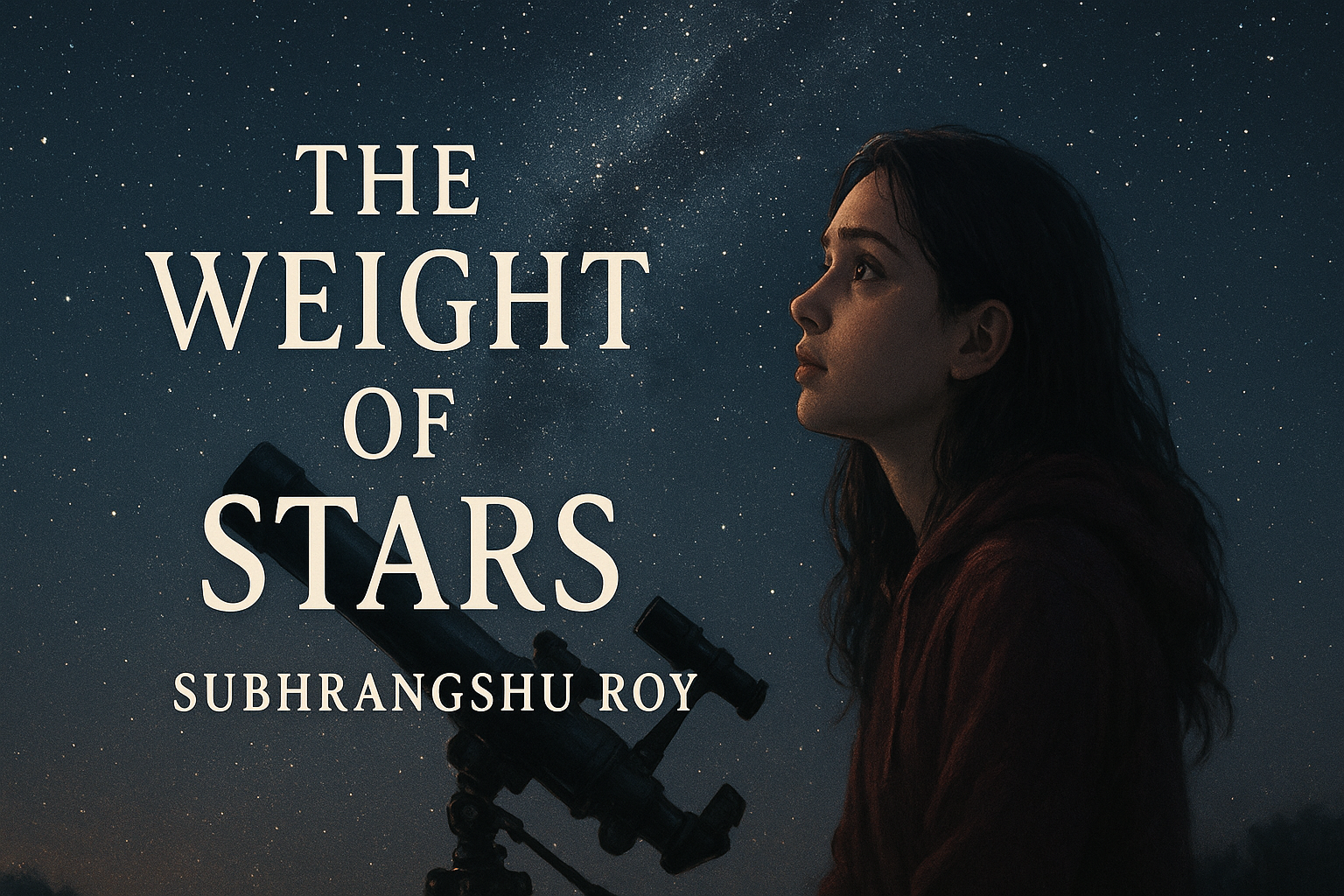
The Weight of Stars, opens with Mira sitting quietly on the edge of the hilltop clearing, the cool night breeze brushing against her face as the meteor shower unfolds above. The sky is alive with streaks of light, each meteor a fleeting reminder of something distant yet brilliant, burning across the dark canvas of night. Mira’s heart beats in time with the rhythm of the falling stars, her anxiety that once felt like a heavy, immovable weight beginning to take on a different shape. She thinks of the stars themselves—immense spheres of fire, immense and distant, yet shining relentlessly, their light traveling across unimaginable expanses to reach her eyes. There is a strange comfort in this thought: even the brightest lights bear weight, pressure, and heat, yet they continue to shine. And perhaps, Mira realizes, she too can carry her own burdens and still glow.
As the club members chatter softly around her, pointing out particularly bright meteors or recalling stories of famous showers past, Mira turns her gaze inward. She recalls the nights when anxiety gripped her chest so tightly that sleep became impossible, the moments when every social interaction felt like a test she was destined to fail, the overwhelming sense of being too much for the world to bear. And yet, as she watches the meteors blaze across the sky, those nights no longer feel like failures but like fragments of a story she is still writing. She thinks of Arjun mapping constellations, of Leena’s patient explanations, of Sameer quietly guiding her along the path tonight; each of them has carried invisible burdens, yet they are here, alive and shining in their own ways. Mira feels a subtle shift within herself—a quiet acceptance that anxiety is not a mark of weakness, but a part of her narrative, a weight she can acknowledge and still move forward under. It does not define her, she realizes; it coexists with her courage, her curiosity, and her growing connection to the world and to the people around her.
By the end of the night, Mira finds herself sharing a small, private smile with the sky above, the meteors reflecting the fragile hope blooming within her. Each streak of light reminds her that brilliance does not require perfection, that weight does not preclude beauty. She sits back on the soft ground, her notebook open in her lap, and sketches constellations, tracing invisible lines between points of light and, in a quiet way, connecting the fragments of her own experiences. The friends around her laugh and whisper under the vast sky, their voices a gentle background to the rhythm of the universe, yet Mira feels her story expanding in a similar cadence—heavy at times, yes, but radiant nonetheless. As she looks upward, she realizes that the stars, like her, endure, burn, and leave traces of themselves even across impossible distances. And in that realization, Mira embraces a new understanding: that her own weight, her own struggles, are part of what allows her light to reach outward, however far or faint. The chapter closes with her heart lighter yet steady, the meteors fading into memory, and a quiet certainty that she can carry her story—and shine—without apology.
–
Supernovas of Change, opens with Mira waking early one morning, the soft light of dawn spilling into her room like a quiet promise. For the first time in months, she feels a mixture of anticipation and determination, a subtle shift in the way she carries herself. The small victories she has experienced in the astronomy club—the laughter, the shared stories, the late-night observation sessions—linger in her mind, giving her courage. She dresses carefully, her movements deliberate but unhurried, and heads to school with a sense of purpose she had long thought impossible. In class, when the teacher poses a question, Mira raises her hand, her voice tentative at first, then firmer with each word. Her classmates, some surprised, some encouraging, listen as she offers her thoughts. It is a small act, seemingly ordinary, but for Mira, it is monumental—a spark igniting a new sense of self. The anxiety that would have once crushed her under its weight still hovers nearby, but it no longer dominates; instead, it becomes part of the rhythm of her courage, a reminder of what she has endured and the strength she now possesses.
After school, Mira finds herself walking home with a quiet confidence, deciding to speak honestly with her parents about her struggles. She explains the restless nights, the moments when anxiety feels unbearable, and the ways she has tried to cope. Her parents listen, surprised at first, but their concern and gentle reassurances create a space of understanding she has rarely known. The conversation does not erase her struggles, nor does it instantly fix all the misunderstandings that have lingered at home, but it brings a release, a lifting of invisible weight she has carried alone. Later that evening, she joins the astronomy club on the rooftop, bringing a sketchbook filled with constellation maps and observations she has made on her own. Arjun comments on her meticulous notes, Leena smiles at the thoughtful details, and Sameer quietly nods in approval. Mira realizes that the courage she is cultivating outside the club—the willingness to show up, to speak, to share—feeds back into her safe space under the stars. Her confidence, small and fragile at first, is beginning to radiate outward, illuminating her world in ways that feel both exhilarating and unfamiliar.
By the end of the week, Mira notices a pattern emerging in herself: each act of openness, each step into discomfort, creates a ripple effect, much like a star exploding in a supernova. The release of pent-up thoughts, the bravery to speak despite fear, and the choice to show vulnerability all generate a beauty that is at once personal and shared. She finds herself laughing more freely with friends, volunteering ideas in group discussions, and even offering quiet support to classmates who seem anxious or uncertain. Mira feels a deepening connection to the universe she has come to love, seeing herself not just as a solitary observer but as part of a network of lives, experiences, and emotions that mirror the constellations she traces in her notebook. The chapter closes with Mira standing under the night sky alone for a moment, feeling the wind brush her face, and understanding something profound: that transformation is often explosive, dazzling, and beautiful, and that even the heaviest burdens, when acknowledged and released, can create light that reaches farther than one ever imagined.
–
Infinite Horizons, opens with Mira climbing the familiar steps to the school rooftop, her backpack slung lightly over one shoulder, carrying a quiet sense of anticipation. The final gathering of the astronomy club for the year is unfolding under a sky already painted with the deep indigo of early night, and the first stars are beginning to shimmer faintly above the horizon. The rooftop feels warmer tonight, not because of the weather but because of the presence of her friends—Arjun adjusting the telescope with a familiar ease, Leena tracing constellations with precise fingers, and Sameer quietly setting up the charts and blankets as he always does. Mira’s chest feels steady; the nervous tightness that once defined her every step has softened, replaced by a sense of belonging that spreads like gentle gravity, holding her in place without constraint. She pauses for a moment, looking out at the city lights below, and marvels at how far she has traveled—from a girl afraid to raise her hand, to someone who now feels woven into a constellation of shared stories, laughter, and understanding.
As the night deepens, the club members take turns pointing out planets, meteors, and distant galaxies, but the conversations naturally drift into reflection. They share the lessons they’ve learned, the moments that challenged them, and the ways the stars have guided them through uncertainty. Mira listens first, absorbing the words of her friends, before realizing that it is her turn to speak. She speaks quietly at first, recounting her journey through anxiety, doubt, and fear, and how the club, the telescopes, and the nights under the vast sky have transformed her perspective. Her words flow more easily than they would have months ago, and when she pauses, there is no awkward silence, only understanding nods and gentle smiles. The stars above seem to respond in kind, tiny points of light stretching across the sky, each one a reminder of endurance, resilience, and quiet beauty. Mira realizes that looking outward—toward the heavens—has taught her to look inward with kindness, to recognize that she can carry her fears and still shine, and that her story is a part of a broader universe that includes not only stars but companions who will orbit with her.
By the time the gathering winds down, the meteors streak faintly across the horizon, fleeting yet brilliant, and Mira feels a profound calm settling in her chest. She lies back on the rooftop mat beside her friends, the cool concrete grounding her while the vastness of space stretches above. For the first time, she experiences a deep harmony between her inner and outer worlds—the quiet confidence she has nurtured, the bonds she has formed, and the knowledge that while the stars remain immense and distant, they no longer feel unreachable. They are companions in both the literal and figurative sense, mirrors of courage, hope, and the beauty of imperfection. Mira smiles, letting herself savor the moment, knowing that while this chapter of her life is ending, the lessons she has learned and the connections she has forged will continue to guide her. The night closes gently around them, infinite horizons above and within her, and Mira, once lost beneath the weight of her own anxieties, now feels steady, luminous, and connected to a universe that is vast yet welcoming, full of light, and endlessly alive.
End
Leave a Reply