
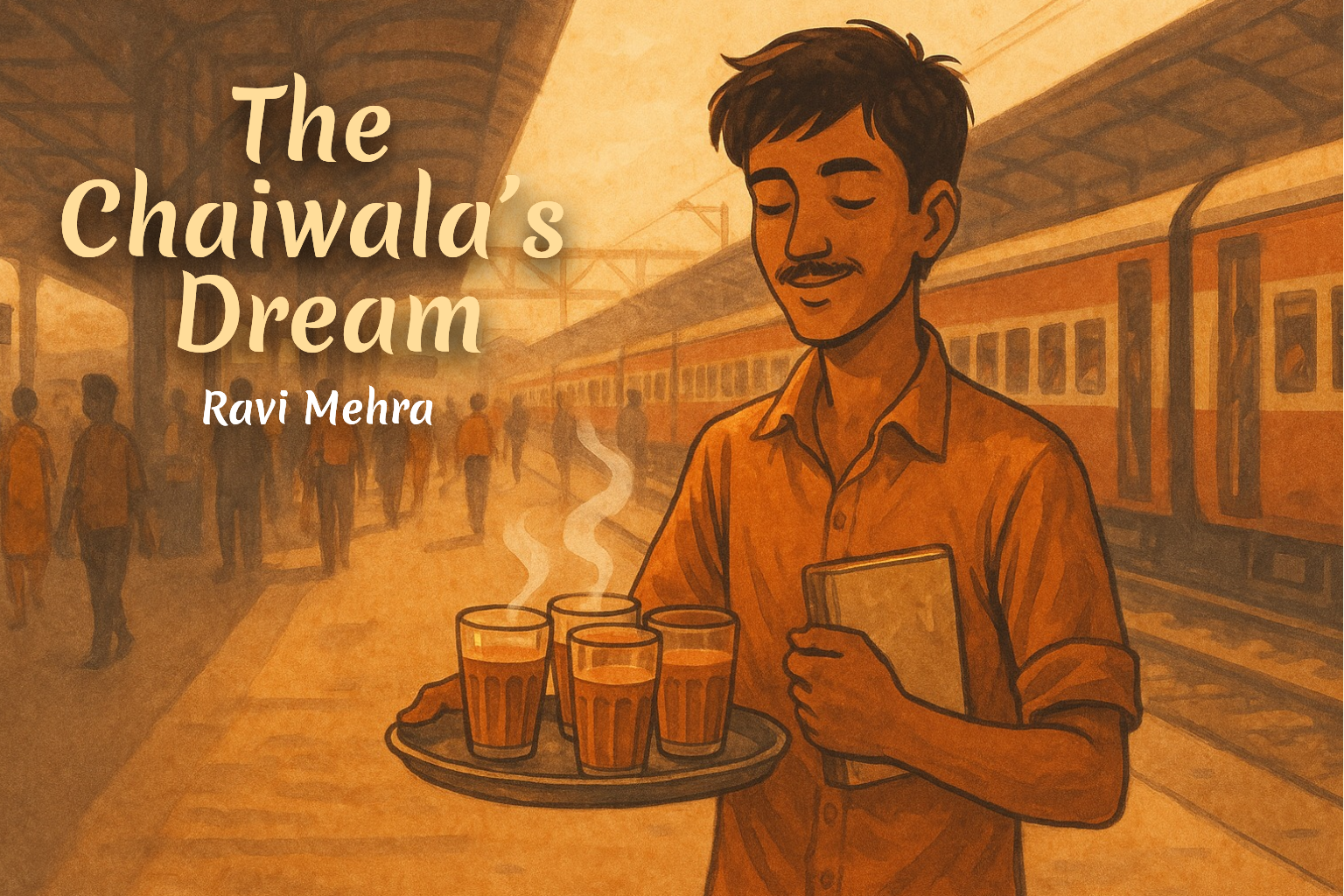
Ravi Mehra
Chapter 1: The Platform Poet
The shrill whistle of the incoming train mingled with the smell of hot, spiced tea wafting from Arjun’s modest stall. The platform teemed with people—commuters rushing to their offices, families heading to ancestral homes, beggars weaving between luggage and legs. Amid the chaos, Arjun balanced a tray of steaming cups, his brown eyes darting from passenger to passenger, searching for potential customers.
“Chai, garam chai!” he called out in a voice roughened by long days of shouting and bargaining. His clothes—simple kurta and faded jeans—were splattered with tea stains that testified to his trade. But in his shirt pocket rested a small, dog-eared notebook—a secret he guarded as fiercely as the last coin in his cash box.
When the crowds thinned, Arjun retreated to the relative quiet of a pillar near the station’s end. He wiped sweat from his brow, rummaged in his pocket, and pulled out the battered notebook. Its pages were filled with scrawled lines of Bengali and English poetry, written in hurried, uneven letters. Each line told a story—a fleeting image of the sea of humanity that passed him by every day.
A ragged man with a harmonium in hand had inspired a poem about music and poverty. A weeping woman with a broken suitcase gave birth to verses about loss. And always, beneath every word, beat the rhythm of longing—the yearning of a chaiwala who dared to dream of something beyond the station’s steel and grime.
He flipped to a fresh page and began to write:
“Platform beneath my feet,
Trains thunder and retreat,
Dreams scattered like tickets,
Yet I sip hope with every cup.”
“Arjun bhaiya!”
He jumped. It was Meera, the bright-eyed college student who always bought her evening tea from him. Her canvas bag bulged with textbooks, and a smile lit her face.
“Sorry, did I scare you?” she asked.
Arjun shook his head, slipping the notebook back into his pocket. “No, no. Just thinking.”
Meera handed him a five-rupee coin. “One cup, please.”
As he poured the tea, she asked, “What were you writing this time? More poems?”
Arjun hesitated. “Just some lines. Nothing important.”
She leaned forward. “Arjun, your poems are beautiful! Remember the one you showed me about the rain? It was so raw, so real.”
He smiled shyly, handing her the cup. “It’s just something I do to pass the time.”
Meera shook her head. “You’re wasting your talent on this platform. You should share your poetry with the world.”
Arjun stared at her, uncertain. “How?”
“Start a blog. You have a phone, right?”
He nodded. “But I don’t know how to make a blog.”
“I can help,” she offered. “Meet me tomorrow after my class. We’ll set it up.”
He hesitated. His father had always told him that selling tea was their family’s lifeline. Poetry wouldn’t put food on the table. As if reading his mind, Meera added, “Your poems deserve to be heard. Trust me.”
He met her gaze, seeing genuine kindness there. “Okay,” he said finally. “Tomorrow.”
That night, in the cramped room he shared with his parents and younger brother, Arjun lay awake listening to the hum of ceiling fans and the distant whistle of trains. His mother snored softly beside his father. A single bulb flickered above, casting shadows on the cracked walls. He reached for his notebook and reread his own words, feeling a strange mix of pride and fear.
His father’s voice echoed in his mind: “Poems won’t feed you, beta. Tea will.”
But as the platform’s sounds drifted through the night, he couldn’t help but dream. What if his words could reach beyond the station’s soot-covered platforms? What if he could be more than a chaiwala?
Sleep finally came, but even in his dreams, Arjun stood on the platform—tea tray in one hand, notebook in the other—watching trains arrive and depart, each carrying stories that might one day be told through his pen.
Morning came too soon. Arjun rose before dawn to help his father prepare the tea stall. Water boiled in dented kettles, milk simmered, and the aroma of cardamom drifted through the air. As he worked, he noticed his father watching him with a mixture of pride and weariness.
“Beta,” his father said gruffly, “business is tough these days. You need to work harder if we want to keep this spot.”
Arjun nodded silently, though his mind wandered to Meera’s offer. Could he juggle both worlds—the responsibility of the tea stall and the passion for poetry?
By late afternoon, the platform buzzed with life. Arjun balanced his tray and called out, “Chai! Garam chai!” But his heart wasn’t in it today. Every customer became a character, every snippet of conversation a potential poem.
As the sun dipped low, Meera appeared again, her smile as bright as ever. “Ready to start your blog?”
Arjun hesitated. “Yes. But what if—”
“No what-ifs,” she interrupted. “We’ll do it together.”
They found a quiet bench. Meera guided him through setting up a simple blog. They chose a name: “Verses from the Platform.”
Arjun typed his first post—a short poem titled “The Journey”—his hands trembling with excitement. As he hit ‘publish,’ he felt a surge of pride and fear.
Meera squeezed his arm. “You’ve taken the first step, Arjun. I’m proud of you.”
Arjun looked out at the bustling station, the trains chugging past, the hawkers shouting their wares. For the first time, he felt he was part of something bigger than himself.
He was still a chaiwala. But now, he was a chaiwala with a dream.
Chapter 2: Echoes of Dreams
A week had passed since Arjun posted his first poem on the blog. Between pouring tea and collecting coins, he stole glances at his phone, marveling at every comment and like. The words of strangers—“beautiful,” “raw,” “authentic”—felt like small victories. Each time he read them, his heart swelled with a pride he had never known.
The platform, once just a noisy backdrop to his tea-selling, now became a wellspring of inspiration. Every traveler carried a story, every bag a burden, every tear a reason to write.
One rainy afternoon, he found himself serving tea to an old man with a weathered face and trembling hands. The man’s eyes glistened with unspoken grief.
“Bhaiya,” he whispered, “do you have a minute to spare?”
Arjun nodded and handed him a cup.
“I’m going to Varanasi,” the old man said. “To scatter my wife’s ashes.”
Arjun’s throat tightened. “I’m sorry for your loss.”
The man sipped his tea and stared into the distance. “Fifty years she stood by me. Now I stand alone.”
Later that night, Arjun penned his thoughts:
“Hands trembling,
Eyes empty,
A man with a cup of tea,
Carrying half a century
Of love in an urn.”
His fingers trembled as he posted it on his blog. Within hours, comments poured in:
“This made me cry.”
“So simple yet so powerful.”
“You’ve captured the pain beautifully.”
A local journalist, Subir Roy, stumbled across the post and messaged him: “Would love to feature you in tomorrow’s paper. Let’s meet tomorrow morning at the station.”
Arjun could barely sleep. A feature in the newspaper? He imagined his father’s reaction—pride, perhaps, but more likely worry about neglecting the tea stall.
The next day, Subir arrived with a notepad and an eager grin. He asked about Arjun’s life, his blog, and his dreams.
“So, you’re a chaiwala-poet,” Subir laughed softly.
Arjun shifted uncomfortably. “Yes, but I don’t want to stop being a chaiwala. I want to capture the stories that pass through this platform. They’re all around us.”
Subir nodded, scribbling furiously. “That’s what makes you different.”
An hour later, Subir left, promising to send him the article. As Arjun watched him disappear into the crowd, a strange mix of excitement and anxiety bubbled inside him.
That evening, as the newspaper hit the stands, passengers and vendors alike crowded around Arjun’s stall. The headline read: “Verses from the Platform: A Chaiwala’s Poetic Journey.”
“Arjun bhaiya, you’re famous now!” someone teased.
Another vendor smirked. “So now you’ll leave us behind, become a big-shot poet?”
Arjun forced a smile, but inside he felt exposed. Fame brought attention, but also scrutiny. He thought of his father’s words: “Tea first, dreams later.”
When his father arrived that night, he carried the newspaper folded under his arm. He didn’t speak at first, just handed it to Arjun.
“So now everyone knows, huh?” his father said. His voice held no anger, only fatigue.
“I didn’t mean to embarrass you, Baba,” Arjun stammered. “It’s just… people liked my words.”
His father sighed and sat down on a bench, the weight of years settling on his shoulders. “Arjun, poetry is beautiful, but it doesn’t fill our stomachs. Don’t forget why we sell tea.”
Arjun nodded, his heart heavy. “I know, Baba. I won’t stop helping.”
His father patted his shoulder. “Just remember where you came from.”
Days turned to weeks, and Arjun juggled his double life—tea seller by day, poet by night. The blog gained followers; people began to call him the “Platform Poet.” Yet the station’s rhythms remained the same. Trains roared in, hawkers shouted, passengers hurried past. But now, every face carried a story Arjun longed to tell.
One evening, Meera arrived, excitement in her eyes. “Arjun, I showed your blog to my professor. He loved it! There’s a city-wide poetry slam next month. You should enter.”
Arjun froze. “A poetry slam? Me? But I’ve never performed on a stage.”
“You’ve performed every day on this platform,” she argued. “Every cup you sell is a story, every smile a verse. You belong on that stage.”
He felt his heart hammering. “I don’t know, Meera. Baba would never approve. And what if I fail?”
She took his hand. “You can’t live in fear of what-ifs. This is your chance to show the world who you are.”
Arjun looked around—at the chugging trains, the shouting vendors, the weary travelers. He saw stories waiting to be told, poems yet to be written.
He exhaled, a slow, determined breath. “Okay. I’ll do it.”
Meera grinned. “That’s my poet.”
That night, as Arjun prepared his father’s accounts, he felt the weight of the upcoming challenge. He knew it wouldn’t be easy. The station’s demands, his family’s needs, the harsh realities of survival—they wouldn’t vanish overnight. But within his heart, a small fire burned.
He flipped open his notebook, the pages worn and ink-stained. On the last page, he scribbled:
“Between cups of tea,
I find the world’s tears and laughter,
And somewhere in that brew,
I find myself.”
The next morning, he rose before dawn. The trains thundered on, but now their roar carried the echo of a dream—a dream that might one day carry him beyond the platform.
Chapter 3: Brewing New Beginnings
Arjun had never felt nerves like this. The night before the poetry slam, he sat cross-legged on his cot, his notebook open in his lap. The walls of the small room seemed to close in on him. His father was already asleep, the lines of worry carved into his brow even in dreams. The station outside was quieter than usual—a lull before the first morning train arrived to shatter the calm.
He read his poem aloud, the words trembling on his tongue:
“In every cup I pour,
Dreams swirl, stories steep,
A chaiwala’s journey,
Beyond steam and sip.”
His voice faltered. What if he stumbled on stage? What if the audience laughed? What if he forgot the words?
Meera’s voice echoed in his mind: “You’ve performed on this platform every day.”
He closed his eyes and took a deep breath. She was right. Every face he had served, every conversation, every story—he carried them all with him.
Morning came. The station was already alive with its usual symphony of sounds—trains arriving and departing, porters yelling, hawkers selling their wares. Arjun worked the stall, his father by his side. The familiar routine grounded him. As he poured steaming chai into dented cups, he thought of the stage that awaited him that evening.
“Beta,” his father said, his voice softer than usual. “I read your new poem.”
Arjun’s hands froze. “You did?”
His father nodded. “It’s good. You write from the heart.”
A small smile flickered across Arjun’s face. “Thank you, Baba.”
His father placed a rough hand on his shoulder. “Just remember—no matter what, you’re my son. Make me proud.”
The poetry slam was held in a small community hall in central Kolkata. The air inside buzzed with anticipation as poets, artists, and students crowded the room. The walls were decorated with strings of fairy lights and vibrant posters proclaiming: “Kolkata Poetry Slam: Give Voice to Your Dreams.”
Arjun stood backstage, his notebook clutched like a talisman. He watched as poets took the stage one by one—some with fiery words, others with quiet reflections. Each received applause, cheers, and sometimes tears.
“Next up,” the announcer called, “we have Arjun Sen—chaiwala and poet.”
A hush fell over the room. Arjun felt his heart leap into his throat. He stepped onto the stage, the spotlight blinding him for a moment. He could see Meera in the crowd, her hands clasped in encouragement.
He took a deep breath. “Good evening. My name is Arjun. I serve tea at Howrah Station. But today, I’m here to share a story—a story in the shape of a poem.”
He opened his notebook and began:
“Between the clatter of trains,
In the dance of steam and glass,
I brew more than tea—I brew dreams.
In each sip, a stranger’s tale,
A mother’s goodbye,
A child’s laughter,
A lover’s sigh.”
His voice grew stronger with each line:
“I am the platform poet,
A witness to journeys,
A keeper of stories,
And in my cup,
Hope steeps,
For all who pass by.”
When he finished, the hall was silent. Then a single clap. Then another. And suddenly, the room erupted in applause. Some stood, others whistled, a few wiped tears from their eyes.
Arjun felt tears prick his own eyes. For a moment, he couldn’t move. Then he smiled—a smile that reached deep into his heart.
After the show, people crowded around him. A publisher handed him a card. “Your poems have a soul,” she said. “Let’s talk about a book.”
An NGO worker approached, too. “We run a program for underprivileged children who want to learn to write. You’d be perfect as a mentor.”
Arjun’s head spun. Opportunities he had never imagined were unfolding. Amid the excitement, he felt a hand slip into his. It was Meera, beaming.
“You did it, Arjun,” she whispered. “You let them see the poet I always saw.”
He squeezed her hand. “I couldn’t have done it without you.”
Back at the station that night, Arjun’s father waited at the stall, a smile breaking through his usual stoic expression.
“How did it go?” he asked.
Arjun grinned. “Baba, they clapped. They want to publish my poems.”
His father’s eyes shone. “Then we’ll need more tea to celebrate,” he said with a laugh.
Together, they brewed a fresh batch, the steam rising into the night air. Arjun’s heart felt lighter than it had in years.
Months passed. Arjun balanced his tea stall and his writing, his heart always open to the stories that the station shared with him. His book—“Verses from the Platform”—hit the shelves and found eager readers. Children from the NGO gathered around him every week, eager to learn.
One evening, as he scribbled in his notebook, he wrote:
“Once a chaiwala,
Now a poet,
Forever a dreamer.
For in every cup,
Lies a world waiting to be told.”
And as the last train of the night rumbled away, Arjun looked out at the empty platform. He was still a chaiwala. But now, he was also a poet—a poet who had found his voice, and in doing so, had given voice to others.
Chapter 4: The Final Brew
It had been a year since Arjun’s poetry slam debut. Life had changed in ways he could never have imagined. His blog had grown from a small corner of the internet to a gathering place for thousands of readers hungry for his words. The book deal had turned into a published collection, Verses from the Platform, and he had become a mentor at the NGO, inspiring kids to chase their own dreams.
Yet, some things remained the same. The station still echoed with the clatter of trains and the shouts of hawkers. The aroma of freshly brewed chai still rose from his stall, wrapping passengers in its warmth. And every cup he served still carried stories.
One chilly winter morning, Arjun arrived at the station before dawn. His father had taken ill the previous night, his chest rattling with each breath. Arjun had stayed up all night, tending to him, worrying about fevers and hospital bills.
“Baba,” he had whispered, “you rest. I’ll take care of the stall.”
His father’s eyes had softened. “You’re a good son, Arjun. Don’t let this poetry take you away from your roots.”
Arjun had nodded, though his heart ached. He had always tried to balance both worlds—the platform poet and the chaiwala son.
That morning, the station felt colder than usual. The first train rolled in, and passengers poured out, sleepy-eyed and burdened with bags. Arjun worked quickly, pouring tea, handing out biscuits, taking coins, returning change.
Between customers, he scribbled lines in his notebook:
“Cold winds cut deep, But the warmth of tea Wraps me in stories That refuse to die.”
He barely looked up when a familiar voice called, “Arjun bhaiya!”
It was Meera, her smile as bright as the sun. “How’s Baba?” she asked.
“He’s resting,” Arjun said. “I’ll take him to the doctor after my shift.”
She nodded, then her eyes sparkled with excitement. “I have news! The Kolkata Literature Festival wants you to speak at their opening session. They’ve read your blog and your book—and they’re calling you the ‘People’s Poet.’”
Arjun froze. The Kolkata Literature Festival. A stage that poets across the country dreamed of. But he thought of Baba, of the stall, of the boiling kettles and clinking cups. Could he really leave it all behind, even for a day?
That evening, as the station quieted, Arjun found his father awake, sipping warm water. His face was pale, but his eyes were clear.
“Baba,” Arjun said, “they’ve invited me to the Literature Festival. They want me to share my poems. It’s a big stage.”
His father studied him for a long moment. “And what do you want, beta?”
Arjun hesitated. “I want to go. But I also want to be here for you, for the stall.”
His father chuckled weakly. “I’ve always known you’d go places beyond this station, Arjun. The stall will wait. But opportunities like this… they don’t.”
Arjun felt tears well up. “You’ve always given me wings, Baba.”
His father reached out, his hand trembling. “Then fly, my son.”
The next morning, with Meera by his side, Arjun stood at the festival’s entrance. Banners flapped in the breeze, bearing his name alongside famous authors and poets. He felt small, insignificant, but also alive with possibility.
Inside, the auditorium buzzed with energy. A thousand eager faces waited, their eyes reflecting the dreams they carried. When Arjun stepped onto the stage, he felt the same nerves he had felt at the poetry slam—but also a deep calm. He carried the station with him, its stories, its voices, its hope.
He began: “I am Arjun, Chaiwala by trade, Poet by heart. I come from a place where Dreams travel on trains, Where every cup holds a journey, And every face a tale. I am the chaiwala’s son, But today, I am also the platform’s voice.”
The hall held its breath. His words, simple and sincere, wove a tapestry of humanity. He spoke of the old man’s ashes, the mother’s goodbye, the child’s laughter, the lover’s sigh. He spoke of tea that comforted and connected.
When he finished, the applause thundered. Some people rose to their feet. Others cried. And in that moment, Arjun felt more than pride—he felt a calling fulfilled.
After the session, publishers approached, journalists asked for interviews, and fans lined up for autographs. But in his heart, Arjun knew where he truly belonged. That evening, he returned to Howrah Station. The last train had departed, leaving only the echoes of footsteps and the distant whistle of a departing engine. He lit the stove, boiled the water, and poured a cup of chai for a weary porter.
“Bhaiya,” the porter said, “I saw you on TV! You’re famous now.”
Arjun smiled. “Fame comes and goes. But chai—chai is forever.”
He scribbled one last line in his notebook:
“In every sip, I find a world waiting to be shared. And in every story, I find my own.”
The station lights flickered. The night air carried the scent of possibilities. And as Arjun poured another cup of chai, he knew that no matter where his journey took him, he would always be the chaiwala’s son—the poet of the platform.
The End.
Leave a Reply