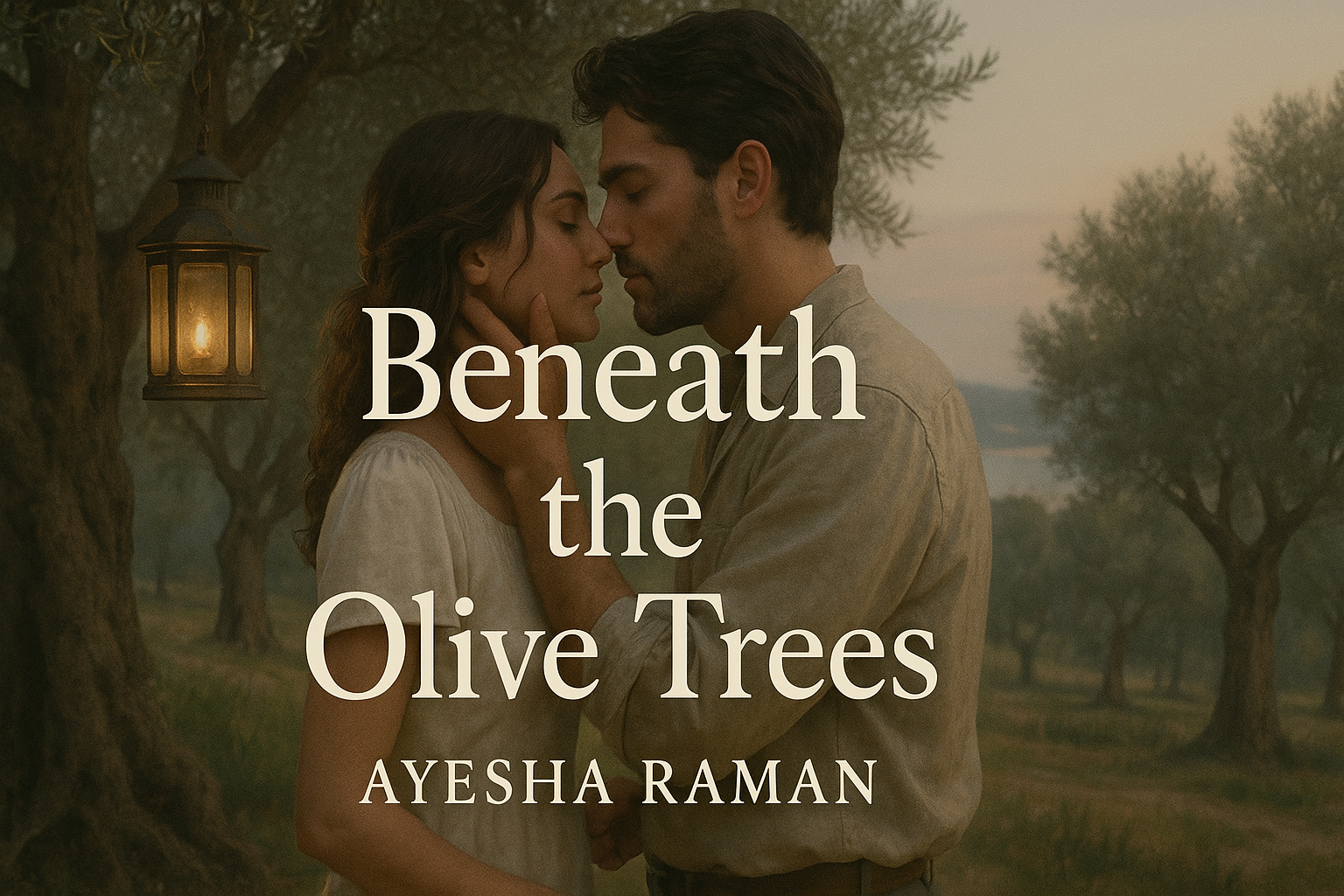

Ayesha Raman
Part 1 – The Orchard at Dusk
Leila’s camera strap dug lightly into her shoulder as she balanced her tripod against the uneven stones of the village path. The late September sky was folding itself into shades of orange and violet, each layer softer than the last, the horizon bleeding into the sea. She had been chasing this light all day, running from alley to alley, through terracotta rooftops and bougainvillea-draped balconies, but it was here—at the edge of the town—that the light seemed most alive. She spotted a hillock lined with olive trees, their silver leaves catching the sinking sun. Without thinking, she ducked through the wooden gate, heart thrumming with the urgency of a shot that might slip away if she hesitated.
The orchard was alive with a stillness she hadn’t known in years. The crickets had begun their chorus, and the air smelled of earth and salt. She unfolded her tripod, framing the angle: the low-hanging branches bending under ripe fruit, the thin threads of web glinting like silk strings in the wind. Just as she pressed her shutter, a voice broke through the silence.
“What do you think you’re doing?”
Leila turned sharply, startled, her lens still pointed at the trees. A man stood there, broad-shouldered, dark curls tumbling across his forehead, a basket of olives slung under one arm. His shirt was rolled up to his elbows, his skin bronzed by the sun, and his eyes—not unkind, but sharp—studied her as though she were an intruder.
“I—I’m sorry,” she stammered, lowering the camera. “I didn’t mean to trespass. I just needed this light, this angle—”
“This is private land,” he cut in, his voice low, steady, carrying an accent softened by years of village air. “These trees aren’t for tourists’ photographs.”
Leila flushed. “I’m not a tourist. I’m here on assignment. Food photography.” She gestured vaguely at her camera, as if the device itself might explain her presence. “The mayor asked me to cover the harvest festival.”
The man’s expression shifted, skepticism flickering into something else—curiosity, maybe, or a trace of recognition. He adjusted the basket on his hip. “So you work for the festival? And you thought breaking into orchards was part of the job?”
Leila bristled. “It wasn’t breaking in. The gate wasn’t locked.”
He gave a small, humorless laugh, shaking his head. “Locked or not, these trees have roots older than the walls of your city. You don’t just walk in.”
Something in his tone made her pause. The orchard, the gnarled bark, the heavy fruit—it wasn’t just land to him, she realized. It was bloodline. History. She closed her tripod, slinging the camera back across her shoulder. “You’re right. I shouldn’t have. I’ll go.”
As she passed him, her eyes met his, just briefly. There was a quiet storm in them, but not cruelty. She thought she saw fatigue too, the kind that settles in when one is carrying more than they can admit aloud. She left without another word, the gate creaking shut behind her.
Back in her rented room above the bakery, the encounter replayed in her head. She had traveled across oceans to capture stories through food—bread, oil, wine, fruit—but it was people who made the stories breathe. That man in the orchard—his voice rough with suspicion, his eyes tethered to the land—was already a thread in the fabric of her work, though she had only just met him.
She set the camera down, scrolling through the images from the day. Her heart caught when she saw the frame she’d taken just before he appeared. The branches arched like arms over the soil, holding shadows of gold. And there, barely visible at the edge of the frame, was his silhouette—half light, half shadow, as if the orchard itself had offered her not just a picture, but a beginning.
Part 2 – The Mayor’s Request
The next morning, Leila was woken by the scent of yeast and sugar drifting up from the bakery below. She padded across the wooden floorboards, her camera bag still unpacked, yesterday’s memory pressing against her mind like an unanswered question. The man in the orchard. His sharp voice. His rootedness. She almost laughed at herself—how could a five-minute encounter feel so heavy? Yet as she sipped the bitter coffee the landlady had left outside her door, she found herself wondering what his name was.
The village was alive with preparations. Colorful banners were strung between balconies, stalls erected on cobbled lanes, and children darted past with baskets of flowers. Leila wandered through, clicking frames: a woman braiding garlic bulbs, old men mending fishing nets, teenagers painting wooden signs for the harvest feast. It was here that she found the mayor, or rather, he found her.
“Ah, Miss Leila!” His voice boomed with cheerful authority. “You’ve begun already. Good, good.” He was a stout man with a mustache that curled like a comma at each end, his belly round with years of festival wine. “But come, come. There is one person you must photograph—Elias.”
Leila’s breath stalled. “Elias?”
“Yes, yes,” the mayor continued, oblivious to her pause. “The orchard keeper. His family has supplied olives for this town since before my grandfather’s grandfather. The festival cannot exist without them. He is young now, but with an old soul. You will see.”
Leila almost protested, but the mayor had already taken her arm, steering her past the stalls, toward the very gate she had slipped through the night before. Her pulse quickened as she saw the orchard again, bathed now in late-morning light. And there he was—shirt damp with sweat, sleeves rolled high, hands darkened with soil as he pruned branches.
“Elias!” the mayor called. “Come, meet our guest. The photographer.”
Elias looked up. His eyes flickered with recognition, then narrowed slightly. He wiped his hands on his trousers and approached slowly, like someone reluctant to give ground. “We’ve already met,” he said flatly.
Leila felt her cheeks flush. “Yes. Last evening. I’m… sorry about that.”
The mayor blinked, glancing between them. “Good, then no introductions needed. Leila, you will take photos of Elias and his harvest. Elias, you will not be your usual stubborn self. Do as she asks. The festival depends on it.” He laughed at his own words and waddled off, leaving silence in his wake.
Elias folded his arms. “So the mayor sent you.”
Leila steadied her camera strap. “I’m just doing my job.”
He studied her for a long moment before turning back to his trees. “Then take your pictures. But don’t expect me to pose.”
She exhaled, kneeling to capture the sheen of olives against his weathered basket, the texture of bark, the movement of his hands as he worked. He did not smile, did not acknowledge her, yet she could not deny the strange magnetism of his presence. His gestures were rough, but precise—each cut, each touch to the branches, an unspoken conversation with the land.
At one point, she crouched to shoot upward, framing him against the sky. He paused, sensing her lens on him, and their eyes met again. For a heartbeat, she forgot to breathe. She pressed the shutter anyway, the click loud in the quiet air.
By the time she lowered the camera, he had turned away, muttering something under his breath. She caught only one word: outsiders.
Later, as she walked back through the village, she scrolled through the images on her screen. To her surprise, they were alive—sunlight woven into branches, olives glowing like jewels, and Elias, unposed, caught mid-motion, his face shadowed but striking. These were not just documentation; they were fragments of a story.
At the bakery, her landlady, a woman with eyes sharp as peppercorns, peered at the photos. “Ah, Elias,” she said softly, almost wistfully. “His father died last winter. The orchard is all he has now.”
Leila looked up. “He seems… guarded.”
The woman shrugged. “When you love land, you learn to guard it. Perhaps too fiercely.” She handed Leila a warm roll, the crust cracking. “Eat. You will need strength for dealing with him.”
That night, Leila walked down to the harbor, the sea lapping at stone steps, the lamps flickering in the breeze. She thought about her own life, about why she had accepted this assignment so far from home. She had told her agency it was for the colors, the textures, the chance to expand her portfolio. But in truth, it was also to escape. From the pressure of always being perfect, from a city that demanded more than she could give, from herself.
And now, in this foreign village, she had stumbled into someone else’s story—someone who didn’t want her in it. Yet, somehow, she could not shake the sense that her lens was meant to find him, that the orchard had drawn her in for more than a photograph.
When she finally returned to her room, she pulled up the image she had taken earlier—the one where Elias had looked straight at her, sky blazing behind him. His eyes seemed to hold more than defiance. They held a silence heavy with something unspoken, something waiting.
She whispered to herself, as if admitting a secret: “This is only the beginning.”
Part 3 – Festival Preparations
The village square was beginning to glow with festival anticipation. Strings of paper lanterns crisscrossed overhead, women kneaded dough for the communal bread, and children rehearsed dances with awkward but eager steps. Leila moved through it all with her camera, documenting laughter, color, the scent of roasted chestnuts swirling in the air. Yet everywhere her lens turned, she was aware of Elias’s shadow lingering at the edges, as though the orchard’s gravity reached even here.
On the second afternoon of her work, the mayor intercepted her again. “Leila, we need you at the rehearsal for the olive ceremony,” he declared, his face flushed from too much wine. “And Elias must be there as well, of course. You two will work together.”
Leila almost protested, but his tone made it clear this wasn’t a suggestion. Moments later, she found herself following the mayor to the town’s amphitheater-like courtyard, where Elias stood beside a cart stacked with olive branches and earthen jars of oil. He saw her, his jaw tightening.
“You again.”
She adjusted the strap of her bag. “I’m starting to think this village is smaller than it looks.”
He didn’t smile, but something flickered in his eyes before he turned to the task at hand. The children practicing their dance needed olive branches to wave, and it was Elias who distributed them, his large hands surprisingly gentle as he showed them how not to break the stems. Leila raised her camera, snapping quietly. In one frame, he was stooping to help a little boy, his face softened, his sternness melted into patience. She caught it without thinking.
When the rehearsal ended, Elias began loading the jars back onto his cart. Leila, hesitating, stepped forward. “Do you need help?”
He shook his head, but she reached for one anyway, nearly dropping it at the sudden weight. He caught it easily, his hand brushing hers as he steadied it. The touch was brief, but it lingered in the air between them.
“You’re not used to this,” he said.
“No,” she admitted, cheeks warming. “In Kolkata I mostly carry lenses, not olive oil.”
That surprised a laugh out of him—a low sound, quickly stifled, but real. For the first time, she saw what he looked like when his guard cracked open. It changed him.
They walked together toward the orchard, silence filling the gaps. The road dipped and curved, the sea winking silver through the trees. At one point she dared to ask, “Why do you do it? Stay here, when you could be anywhere?”
He glanced at her. “Because this is my anywhere. These trees are my inheritance. My father died believing they would outlast him, and me too. I owe him that.”
There was no bitterness in his tone—only conviction. Leila looked at the lines of his face, the way the orchard seemed to be etched into him. She thought of her own father, who had wanted her to take over the family publishing business, and how she had run instead toward images and flavors. She wondered what Elias would say if she told him.
Back at the orchard, he unloaded the jars. She lingered by the gate, unsure if she was welcome further. He noticed, gestured once. “If you want more photographs, now is the time. Evening light is best.”
She entered, her chest tightening as though she had been invited into a secret. The orchard glowed—branches bending with fruit, shadows long and tender. She photographed silently, capturing more than she could name. Elias moved among the trees, not posing, not speaking, but existing so fully that every frame carried him within it.
As the sun dipped, she lowered her camera. He was standing by one of the oldest trees, hand resting on its gnarled trunk. “My father planted this with me,” he said suddenly, his voice almost lost to the wind. “I was seven. I remember because he told me trees remember everything, even the hands that placed them in the soil. I don’t know if it’s true, but I like to believe it.”
Leila felt a lump rise in her throat. “Then they’ll remember you. And him. Always.”
He looked at her then, something shifting in his gaze—not suspicion, not annoyance, but a quiet recognition. A moment stretched between them, fragile as glass.
A bell rang from the village, shattering it. Elias exhaled, stepping back. “The feast starts soon. You should go.”
She nodded, though part of her wanted to stay, to ask him more, to keep pressing until the silence gave way to confession. Instead, she gathered her things and walked back toward the square.
That night, surrounded by music and laughter, she found herself distracted. Plates of roasted lamb, pitchers of wine, the swirl of dancing skirts—all blurred at the edges. In her mind, she saw only the orchard bathed in evening light, and a man whose eyes carried both weight and wonder.
She pulled out her camera to review the day’s shots. In one frame, Elias stood beneath the old tree, his hand on its trunk, the sun a halo behind him. The image was imperfect—slightly blurred—but it drew her in. Not as an assignment, not as documentation, but as something else entirely.
Something beginning.
Part 4 – The Harvest Begins
The first day of harvest dawned with a sky pale as milk, the hills still wrapped in mist. Leila followed the winding road to the orchard, her boots crunching on gravel. She could hear voices before she saw them—women laughing, men calling instructions, the rhythmic rustle of branches. The orchard was alive with bodies moving among the trees, baskets lined up, nets spread on the ground to catch the olives as they fell.
Elias was there at the center, of course. His sleeves rolled, hair damp with dew, he moved with a quiet authority, not barking orders but setting pace with his own work. Leila hesitated at the gate, camera raised, unsure if she would be welcome. He caught her eye across the branches, gave the barest nod. Permission.
She stepped in, the lens clicking as she documented the ritual. Children ran between rows carrying small baskets, women sang low songs, their voices weaving into the wind. Elias climbed a ladder, striking the branches with a wooden rod so the olives showered onto the nets below. His movements were efficient, but there was something almost sacred in the rhythm. Leila framed him against the rising sun, the dark fruit tumbling like jewels around him.
At one point a basket tipped, olives rolling across the soil. Leila instinctively crouched to help gather them. Elias descended, kneeling opposite her. Their hands brushed as they reached for the same fruit, pausing there, both frozen by the contact. She looked up, and for a fleeting second his face softened, the sternness slipping to reveal something vulnerable beneath.
“You don’t have to,” he said quietly.
“I want to,” she replied.
They worked side by side for the rest of the morning, her hands clumsy but eager. He showed her how to hold the rod, how not to damage the branches. She laughed at her failed attempts, and to her surprise, he laughed too—a deep, unguarded sound that startled even him. It carried through the orchard, drawing curious glances.
When the baskets were full, the workers gathered beneath the largest tree to rest. Bread, cheese, and figs were passed around. Leila sat cross-legged on the grass, her camera set aside, her fingers sticky with fruit. Elias handed her a clay cup of water, his gaze lingering as she accepted it. For a moment, the silence between them was companionable, easy.
She dared to ask, “Do you ever wish you could leave? Travel? See other places?”
He tore a piece of bread slowly. “When my father was alive, I thought about it. There was a girl once—she wanted me to go with her to Athens. But he fell ill, and the orchard needed me. She left. I stayed.”
Leila’s chest tightened. “And you never regretted it?”
His eyes darkened, but he shook his head. “Regret is a waste. What you choose is what you live with.”
The words hit her harder than she expected. She thought of the choices she had made—running from her father’s expectations, choosing a life of images over ledgers. She lived with those choices, yes, but had she ever fully embraced them?
After the break, work resumed. This time Elias invited her to climb the ladder with him. “Hold steady,” he warned, his hand briefly at her back as she balanced. From above, the orchard spread like a silver-green sea, the horizon shimmering where land met water. She struck at the branches, clumsy but laughing, the olives raining down. His voice guided her, steadying her, and for once she forgot the weight of her camera, the pressure of her assignment. She was simply there, under the same sky, sharing the same tree.
By evening, the baskets overflowed. The workers carried them toward the press house, singing again. Leila followed, capturing the stream of bodies against the dying light. The press house was old stone, its floor dark with centuries of oil. The workers tipped the olives into the great wheel, and the grinding began, slow and heavy. The air filled with the scent of crushed fruit, green and pungent.
Elias showed her the first stream of oil, thick and golden, slipping into an earthen jar. “This is what we work for,” he said, pride quiet but fierce in his tone. “All year for this moment.”
She raised her camera, then lowered it. Some things were meant to be remembered without a lens. “It’s beautiful,” she said simply.
He looked at her then, not just at her face but into her, as though testing the truth of her words. After a long pause, he nodded. “Maybe you see more than I thought.”
That night, back in her room, Leila uploaded the day’s photographs. Her fingers trembled as she sorted through them—the nets heavy with fruit, the sunlight through branches, children laughing with olives in their hands. But her eyes lingered longest on the images of Elias. Him against the sun. Him laughing. Him reaching out to steady her. These weren’t just photographs. They were fragments of a man she was beginning to know.
And perhaps, in some small way, fragments of herself too.
She closed her laptop, heart thrumming. Tomorrow would bring more work, more harvest. More chances to step into the story that was unfolding, one olive, one moment at a time.
Part 5 – Lantern Night
By the time the festival night arrived, the village glowed as if the stars themselves had descended. Lanterns hung from balconies and olive branches were woven into wreaths around doorways. The square brimmed with music, the clang of tambourines, and the rise and fall of voices singing songs older than memory. Leila stood with her camera slung against her hip, but for once she did not raise it. The square was alive in a way no frame could contain.
She found herself searching the crowd for one figure. And when she saw him—Elias, shoulders broad beneath a clean white shirt, hair brushed back but still unruly—her breath caught. He moved through the throng with baskets of bread and jugs of oil, greeting villagers with brief nods, his presence steady as the earth beneath them. He hadn’t seen her yet, but she already felt tethered to him, as though the lantern light carried a line between them.
The mayor, resplendent in his festival sash, clapped his hands for silence. “Tonight we honor the harvest, the olives, the trees, and the hands that care for them! And we honor those who keep our traditions alive.” He gestured toward Elias, who stiffened but did not step forward. Instead, villagers drew him into the center, cheering his name.
Leila watched through the blur of color and light, her heart pounding. Elias stood awkwardly, unused to such attention, but when he caught sight of her at the edge of the crowd, his gaze held. Just for a moment. She felt it across the distance—the flicker of recognition, like the echo of something unspoken.
As music swelled again, dancers spilled into the square. Leila was pulled into the circle by laughing children, her hands linked with strangers as feet stamped in rhythm. She stumbled at first, but then surrendered to the beat, her laughter rising unbidden. And then Elias was there, drawn in despite himself. Their hands brushed, then clasped, the circle spinning them together. For the first time she saw him smile without restraint, and it transformed him, softening the planes of his face, opening something deep inside her chest.
When the dance ended, breathless and flushed, she slipped away from the crowd, needing air. She wandered down the narrow lane that led to the harbor, lanterns swaying above, sea shimmering with reflected fire. She thought she was alone until footsteps followed.
“You left,” Elias said behind her.
She turned. He stood a few feet away, expression unreadable. “I needed quiet,” she said softly.
He nodded once, stepping closer. “So did I.”
The silence between them stretched, charged. She wanted to tell him how she saw him differently now—not just as the stern guardian of trees but as someone carrying grief, pride, and a tenderness he tried too hard to hide. Instead, she said, “The village loves you.”
He gave a small shrug. “They love the orchard. I’m just the one who tends it.”
Her eyes held his. “No. They love you. I can see it.”
Something flickered in his gaze—disbelief, maybe, or a longing he didn’t dare claim. The waves lapped against stone, the lanterns swayed, and the space between them grew smaller without either of them moving.
Leila’s fingers itched to reach for her camera, but she didn’t. Some moments demanded nothing but presence.
Elias finally spoke, his voice low. “Why do you really take pictures?”
She blinked. “To remember. To catch beauty before it slips away.”
He tilted his head, eyes searching hers. “Or maybe because you’re afraid of losing it.”
The words cut too close, and she looked away. He had named something she rarely admitted, even to herself—that she clung to images because she feared the impermanence of life.
Before she could answer, music swelled again in the distance, laughter drifting toward them. Elias exhaled, as though shaking off the heaviness. “Come,” he said, softer now. “There’s something I want to show you.”
He led her through winding alleys until they reached the edge of the orchard, lanterns strung between trees like floating suns. Beneath the oldest olive tree, villagers had left offerings—bread, oil, garlands of flowers. Elias touched the trunk reverently.
“My father used to say the trees listen on festival night,” he murmured. “That if you tell them your secret, they carry it into the earth, keep it safe.”
Leila felt her throat tighten. “And what secret would you tell?”
He glanced at her, then back at the tree. “That I’m afraid. Afraid of losing this land. Afraid of being the last to remember what it means.”
His voice cracked slightly, and in that moment she saw all his walls fall. She stepped closer, without thinking, her hand brushing his arm. “You’re not alone,” she whispered.
He looked at her then—truly looked—and the world narrowed to the space between their breaths. For an instant she thought he would close it, that his mouth would find hers under the lanterns, that the orchard itself would bear witness. Her heart raced, ready, wanting.
But he stepped back suddenly, as if startled by his own nearness. His jaw tightened, the shutters slamming back into place. “You should get some rest,” he said quietly. “Tomorrow is another long day.”
Leila’s chest ached, but she only nodded. She turned away, her eyes stinging, her body alive with everything unspoken.
Later, lying in her small room above the bakery, she replayed it all—the dance, the harbor, the orchard, the almost that never came. She touched her lips as if they carried the ghost of something that hadn’t happened.
And she knew with a certainty that unsettled her: this wasn’t just a story she was photographing. This was something she was stepping into, with her heart, with her entire self.
Something she could neither capture nor control.
Part 6 – The Last Baskets
The orchard woke early on the final days of harvest. Nets stretched wide beneath the trees, baskets heavy with fruit, the air thick with the smell of earth and oil. Leila moved among the workers with her camera slung low, but her mind was still tangled in the night before—the lanterns, Elias’s voice confessing his fear, the almost-kiss that still hummed in her skin like a pulse. Every time she caught sight of him, her chest tightened, though he barely looked her way.
He had built the walls back up again. He worked with relentless focus, his arms strong as he shook the branches, his voice quiet when he gave instructions. If he noticed her watching, he gave no sign. And yet she felt the tether, invisible but unyielding, pulling her toward him.
At midday, the workers gathered in the shade to eat. Leila sat apart, unwrapping bread the landlady had packed for her, when a boy from the orchard ran up to her, his dark eyes wide. “Elias says you should come,” he said breathlessly.
Her heart skipped. She followed the boy down a row of trees to where Elias stood by the press house. A great wooden beam lay askew, too heavy for him to lift alone. He gestured at it. “I need another pair of hands.”
Leila blinked. “Me?”
“Do you see anyone else?” His tone was dry, but his eyes held the faintest trace of mischief.
She laughed despite herself, dropping her bag to the ground. Together they heaved the beam, her palms burning, her shoulder brushing his as they strained. When at last it thudded into place, she collapsed onto the grass, breathless. Elias lowered himself beside her, wiping sweat from his brow.
For a while neither spoke. The hum of insects filled the silence. Then Elias said, almost reluctantly, “You’re stronger than you look.”
Leila smirked. “And you’re less impossible when you try.”
He gave a short laugh, shaking his head. “Careful. You’ll ruin my reputation.”
Something loosened between them then, like a knot slowly untangling. Leila leaned back on her elbows, staring at the shifting light through the branches. “Do you ever wonder what it would be like to live another life?” she asked softly.
He glanced at her, brow furrowing. “Another life?”
“One where you didn’t have to stay. Where you could just… go. See the world. Leave the orchard behind.”
Elias was quiet for a long time. Finally he said, “Sometimes. But then I think—what if the world I’m meant to see is right here? What if I’d spend a lifetime chasing something that was already in my hands?”
Her throat tightened. She wanted to tell him that he was her world right now, that she had never felt more awake than in this orchard, beneath this light, beside him. But the words caught in her chest, too raw to release.
Instead she said, “You make it sound simple.”
“It isn’t,” he admitted. His gaze flickered to hers, steady, searching. “But neither are you.”
Her breath caught at the unexpected intimacy of it. She looked away, heat rushing to her face. Before she could answer, one of the women called out, and Elias stood, brushing soil from his hands. “Come,” he said, offering her a hand up. She hesitated only a second before taking it, the roughness of his palm grounding her more than any photograph could.
By evening, the last baskets were carried to the press house. The workers sang as they poured olives into the great wheel, the air rich with the sharp tang of crushed fruit. Leila took her photos, but her focus slipped. Her eyes kept finding Elias—his hands stained green, his jaw tense with effort, his silhouette caught in golden light. She thought of the words he had spoken under the lanterns, his fears, his strength. She thought of her own fears too—of leaving, of staying, of wanting too much.
When the final jar of oil was sealed, the workers cheered. The harvest was done. The festival would close with the blessing of the orchard tomorrow, a ritual older than anyone could name. Leila knew her assignment was nearly over. Soon she would return to Kolkata, to deadlines and traffic and everything she had left behind. The thought filled her not with relief, but with an ache she couldn’t shake.
That night, as she packed her equipment, a knock came at her door. She opened it to find Elias standing there, lantern in hand, his expression unreadable.
“Walk with me,” he said simply.
She followed him through the quiet streets, the sea whispering beyond the walls. They walked without speaking until they reached the orchard. The lantern cast shifting shadows across the branches, the air still heavy with the day’s labor.
Elias stopped by the old tree, the one he had once told her remembered everything. He set the lantern down and turned to her. For a moment he said nothing, his gaze locked on hers, as if words were too fragile to hold what he carried.
Finally he spoke, low and rough. “I don’t know what this is, Leila. But I know I don’t want it to end when you leave.”
Her heart surged, her throat tightening with a thousand unsaid things. She stepped closer, every nerve alive. “Then don’t let it end,” she whispered.
The space between them disappeared. His hand cupped her face, rough and tender all at once, and then his mouth found hers beneath the branches. The kiss was not gentle—it was fierce, hungry, as if both had been holding it back for too long. She clung to him, the orchard spinning, the earth tilting beneath their feet.
When they finally broke apart, breathless, Elias rested his forehead against hers. “The trees will remember this too,” he murmured.
Leila closed her eyes, her lips still trembling. “So will I.”
Part 7 – Shadows of Departure
The morning after the kiss, the village stirred as if nothing had changed. Women swept their stoops, children chased goats down the alleys, fishermen mended nets by the shore. But for Leila, everything was altered. She woke with her lips still tingling, her mind replaying the press of Elias’s mouth, the roughness of his hand on her cheek, the way the orchard seemed to breathe around them. She tried to steady herself, to think of her assignment, her photographs, her return ticket. Yet each thought dissolved into the memory of him.
When she reached the square, the mayor waved her over with a grin. “Leila! Good, good. I need you at the blessing this evening. You will capture the moment when we light the lanterns in the orchard.” His voice dropped into a conspiratorial tone. “And perhaps a portrait of Elias, yes? The town should see him as we see him.”
Leila forced a smile, her chest tightening. Portraits. She had already taken dozens, but none of them carried what she truly saw—the man beneath the stoicism, the boy who planted trees with his father, the man who had kissed her as if the world were ending.
As the mayor bustled away, her phone buzzed in her pocket. She pulled it out, squinting against the sun. An email from her agency blinked on the screen. She read it once, then again, her pulse quickening. Paris assignment confirmed. Three months. Start date in ten days.
Her knees went weak. Paris—the dream she had whispered to herself for years, a place of light and art and endless possibility. And now it was real, placed in her hands like a gift. But as she looked up at the silver-green shimmer of the olive trees, her stomach turned. Because Paris meant leaving. Paris meant Elias fading into memory.
That evening, the villagers gathered at the orchard. Lanterns hung from branches, casting warm halos across the ground. Children carried garlands of flowers to the roots of the oldest tree, singing softly. Leila moved among them with her camera, but her fingers shook on the shutter. The scene was luminous—faces glowing, oil jars lined like sentinels, Elias standing tall among his people. Yet all she saw was the shadow of goodbye creeping toward her.
After the ceremony, she found him near the press house, watching the lanterns sway in the breeze. He turned as she approached, his eyes searching hers. For a long moment they stood without words, the festival’s music fading behind them.
Finally she said, her voice low, “I got news today. A new assignment.”
Something in his posture stiffened. “Where?”
“Paris. Three months. I’d have to leave next week.”
The silence that followed was sharp, cutting. He looked away, jaw clenched. “So it was always temporary.”
Her throat burned. “Elias, I didn’t know when I came here. I didn’t know—”
“That we would end up here?” His voice was rough, almost bitter. “That we would kiss under my father’s tree?”
She flinched, shame rising hot in her chest. “I didn’t plan this. But I don’t want it to end either.”
His eyes met hers again, storm-dark. “And what do you expect me to do? Follow you to Paris? Leave everything behind?”
“No,” she whispered. “I would never ask that.”
He exhaled hard, raking a hand through his hair. “Then what are you asking?”
She didn’t answer. Because she didn’t know. All she knew was the ache of wanting two lives at once—Paris with its promise of dreams, and this orchard with its promise of him.
The music swelled again in the distance. Elias stepped back, the space between them widening. “Enjoy Paris, Leila. Take your pictures. Catch your beauty before it slips away.” His words carried a sting, echoing what he had once said about her fear.
Tears blurred her vision. She wanted to reach for him, to hold him, to tell him that her dream had shifted, that beauty wasn’t slipping away—it was standing right in front of her. But he had already turned, his figure swallowed by the shadows of the trees.
Leila stood alone beneath the lanterns, the camera heavy in her hands. She lifted it slowly, framing the old tree glowing against the night sky. She pressed the shutter, the click breaking the silence. When she looked at the image, it felt hollow. For the first time, her lens had failed her. Because what she wanted to capture wasn’t the tree, or the lanterns, or the festival. It was him. And he was already walking away.
That night, lying in her narrow bed, Leila stared at the ceiling, her chest aching with a weight she couldn’t release. Paris waited like a shining promise. But the orchard had planted something in her too—something that refused to let go.
She closed her eyes, whispering into the dark, “What do I choose?”
But the night gave no answer. Only the distant echo of waves and the remembered taste of his kiss.
Part 8 – Crossroads
The days after the blessing blurred together, heavy with silence. Leila roamed the streets with her camera, documenting the aftermath of the festival—the wilted garlands, children chasing scraps of ribbon, the sea glittering under calmer skies. But every image she captured seemed hollow, as if the light had drained from the village. The truth was simpler: the light had drained from her. Elias’s absence pressed against her ribs like a bruise.
He was still in the orchard, of course. She glimpsed him from a distance—hauling baskets, speaking with workers, his back rigid. Once, their eyes met across the square. He looked away first.
Leila counted her days. Seven until Paris. Six. Each one both a gift and a burden. She told herself she should feel excited, that the dream she had chased since she first picked up a camera was within reach. But every time she tried to picture Paris—the boulevards, the galleries, the promise of her name printed beneath glossy spreads—Elias’s face rose instead, his hands stained with soil, his voice rough and quiet when he spoke of trees remembering everything.
On the fifth day, the landlady found her hunched over her laptop, editing in silence. “You look like someone has stolen your appetite,” the woman said, setting down a plate of figs and honey.
Leila managed a weak smile. “Maybe they have.”
The landlady studied her for a long time, then sighed. “Elias’s mother once told me something, before she died. She said love is not about choosing between two lives. It is about building one together.” She tapped the table gently. “Don’t be foolish, girl. Dreams mean nothing if you live them alone.”
The words struck deeper than Leila expected. She thought of her father in Kolkata, disappointed when she had left his business. She thought of herself in Paris, surrounded by beauty but empty inside. And then she thought of Elias, standing under the old tree, saying he didn’t want this to end.
That evening, she walked to the harbor. Fishing boats rocked gently, the sky a wash of amber. She saw him there, hauling nets with two younger men. Her breath caught, but she forced herself forward.
“Elias.”
He froze, then straightened, wiping his hands on a rag. “Leila.” His tone was flat, but his eyes betrayed a flicker of conflict.
“I need to talk to you.”
The younger men exchanged glances and quietly drifted away. Elias turned to her, arms folded. “About Paris?”
“Yes.” She swallowed hard. “I leave in three days.”
His jaw tightened. “Congratulations.”
“Don’t,” she whispered. “Don’t make this harder.”
He looked at her then, something breaking through his guardedness. “What do you want me to say, Leila? That I’ll beg you to stay? That I’ll drop everything and follow you to Paris? I can’t. This is my life. These trees, this land. They are all I know.”
She stepped closer, her heart hammering. “I’m not asking you to leave. I’m asking you to believe that we can find a way. That love doesn’t have to be either-or.”
Silence fell heavy between them, broken only by the lapping of waves. His face was etched with turmoil, torn between the weight of his inheritance and the pull of his heart.
At last he said, voice raw, “You don’t understand. If I let myself hope, and you leave anyway… it will break me.”
Leila’s throat ached. “And if I go without telling you that I love you, it will break me too.”
The words hung in the air, fragile as glass. For the first time, she had said it aloud. She loved him. Not the orchard, not the idea of him, but him—stubborn, guarded, tender beneath the stone.
Elias closed his eyes, his shoulders tense as if carrying a burden too heavy. Then he shook his head slowly. “Love doesn’t change the fact that you’re leaving.”
Tears burned at the corners of her eyes. She turned before he could see them, walking quickly up the harbor steps, the world blurring. She didn’t stop until she reached her room, where she collapsed onto the bed, sobs shaking her.
That night she dreamed of olive branches burning, their leaves curling into ash, while Elias’s voice called her name from somewhere she could not reach. She woke with her cheeks wet and her heart torn in two.
The next morning, she packed her bag. Clothes, camera, lenses, chargers—all folded into neat compartments. She touched the jar of olive oil the landlady had given her and placed it carefully at the bottom of her suitcase. It felt like carrying the orchard with her.
She stared at the half-empty room, the narrow bed, the window overlooking the square. Her chest ached with the thought of leaving it all behind. But Paris was waiting. And Elias—Elias was not coming after her.
Two days until departure.
Two days until she chose.
Part 9 – The Departure Hour
The dawn before her journey broke pale and restless. Leila stood at her window, suitcase by the bed, watching the village stir awake. The bakery below was already alive, the smell of bread rising with the steam of the first kettles. Children darted across the square, and beyond, the sea stretched endless, its horizon faintly rose-colored. She raised her camera out of habit, then lowered it again. The moment felt too raw, too final, to be trapped in pixels.
Her ticket was printed, tucked into her bag. Paris shimmered like a faraway promise, a dream carved from ambition. Yet her chest felt heavy, as though her ribs themselves resisted the idea of flight. She dressed slowly, pulling her scarf tight around her shoulders, delaying every step, as if hesitation itself could buy her more time.
By midmorning she walked through the village one last time. The square buzzed with its usual rhythm—market stalls clattering open, vendors calling prices, olive oil gleaming in glass jars. She paused at the orchard gate. The trees swayed lightly in the breeze, their silver leaves whispering secrets. She wanted to step inside, to see him one last time. But she didn’t. The memory of their last conversation at the harbor still stung, and she knew if she saw him again, leaving might become impossible.
At the bakery, the landlady pressed a loaf into her hands. “For the journey,” she said, her eyes kind but sharp. “And remember what I told you. Don’t mistake pride for love.”
Leila nodded, swallowing the lump in her throat. “Thank you—for everything.”
The bus to Athens was scheduled for noon. She sat at the edge of the square, suitcase at her feet, camera strap looped around her wrist, waiting for the sound of its approach. Villagers passed with baskets, waving goodbyes, their faces warm. But one face was missing. One face she searched for despite herself.
And then, just as the church bells tolled eleven, she heard her name.
“Leila!”
She turned. Elias was running across the square, breathless, his shirt half-buttoned, hair wild as if he’d come straight from the orchard. People stopped to stare, but he didn’t care. He stopped in front of her, chest heaving, eyes burning with something she had never seen so unguarded—fear, longing, and resolve all at once.
“You can’t leave,” he said hoarsely.
Her lips parted. “Elias—”
“I tried,” he cut in, voice cracking. “I tried to tell myself I could let you go, that it would be easier. But I can’t. I don’t want easy. I want you.”
The square seemed to fall silent around them. Leila’s heart thudded so loud she thought the whole village might hear it.
“But your orchard,” she whispered.
His jaw tightened. “The orchard will always be here. Maybe I’ll lose it someday, maybe I won’t. But if I lose you without even trying—” He broke off, shaking his head, eyes fierce. “I’ll regret it forever.”
Leila’s throat closed. She reached for his hand, rough and calloused, and held it tight. “I don’t want to leave you either. But Paris—”
“We’ll find a way,” he said. “Go, if you must. But don’t end it here. Don’t let this be the last chapter.”
Tears blurred her vision. She had imagined this moment a hundred times in sleepless nights, but never like this—with the village watching, with his voice shaking, with the choice suddenly bigger than trains and planes.
The bus horn echoed from down the road. People shifted, murmuring. Time was shrinking.
Leila looked at him, at the sweat glistening on his brow, at the way his hand trembled in hers. “If I go,” she whispered, “promise me you’ll wait.”
His eyes didn’t waver. “For you? Always.”
The bus pulled into the square, brakes hissing. The driver leaned out, calling for passengers. Leila clutched her suitcase, her heart splitting open. She could step on, chase the dream that had guided her for years. Or she could stay, surrender to the unknown that pulsed between her and Elias.
The villagers watched, silent witnesses to her choice. Elias’s gaze held hers, steady, unflinching, offering no command, only truth.
Leila exhaled, a sound half sob, half laugh. She let go of the suitcase handle. It toppled gently against the stones. Gasps rippled through the crowd.
The driver called again. She shook her head, backing away, her hand still locked in Elias’s. “Not today,” she said, her voice trembling but certain. “Paris can wait. But you—” She pressed her forehead against his, tears streaking her cheeks. “I can’t lose you.”
The bus rumbled, then pulled away, leaving dust swirling in the square. Leila stood rooted, Elias’s arms wrapping around her, the orchard’s scent clinging to his skin.
For the first time in years, she wasn’t chasing light with her lens. She was stepping into it.
Part 10 – Beneath the Olive Trees
The bus disappeared down the road, its dust settling slowly back into the stones of the square. Leila stood still, her suitcase forgotten, Elias’s arms still holding her as if afraid she might vanish if he loosened his grip. The villagers clapped softly at first, then louder, some laughing, some wiping their eyes. But soon they drifted back to their own errands, leaving the two of them in a silence that belonged only to them.
Elias pulled back just enough to look at her. “You really stayed,” he murmured, disbelief softening his features.
Leila touched his cheek, her fingers trembling. “I didn’t stay,” she corrected gently. “I chose.”
They walked together through the winding alleys, her suitcase rolling behind them. Past the bakery, past the church, past the harbor where waves shimmered silver-blue, until they reached the orchard. The trees welcomed them with a hush, leaves whispering against one another as the breeze wound through. The old tree stood at the center, steady and patient, as if waiting for them.
Elias stopped there, his hand brushing the bark. “All my life, I thought this was the only story I could belong to,” he said quietly. “The orchard, the harvest, the land. But maybe stories aren’t meant to be only one thing.”
Leila stepped closer, placing her palm beside his. “Maybe stories are meant to be shared.”
They sat together under the tree as the sun slid lower, staining the world in shades of gold and rose. Leila leaned against him, her head resting on his shoulder. For the first time since she had arrived, she didn’t feel like an outsider documenting someone else’s life. She felt like she had stepped inside it, become part of it, rooted in it.
In the days that followed, life resumed its rhythm. Elias returned to the orchard, and Leila helped where she could, her clumsy hands learning the weight of baskets and the feel of soil. But she also kept her camera close, capturing not just the harvest but the quiet moments—the way Elias wiped sweat from his brow with the back of his hand, the laughter of children racing between rows, the soft glow of oil in jars lined like sentinels.
At night they shared bread and figs in the press house, lantern light flickering over stone. Sometimes they spoke of dreams—Paris, Athens, the books Elias once thought he’d never have time to read. Sometimes they sat in silence, content in the nearness of each other, the orchard humming with its eternal patience.
One evening, as the first winter rains began to fall, Elias handed her a small wooden box. Inside was a silver pendant shaped like an olive leaf, worn smooth from years of handling.
“It was my mother’s,” he said softly. “She wore it to every festival. I want you to have it.”
Leila’s breath caught. “Elias—”
He shook his head gently. “You don’t need to promise me forever. Just promise me today. Promise me now.”
She clasped the pendant in her hand, her eyes shining. “Then today, and now, and every tomorrow I can give.”
They kissed again, slower this time, not fierce like the first but steady, certain, as if sealing not just their lips but their lives together.
Weeks later, her agency called again, urging her to Paris. Leila told them the truth—that she wasn’t ready to leave. Maybe one day, she thought. Maybe she and Elias would travel together, walk the boulevards, take photographs in the galleries. But not yet. For now, her world was here, in the small coastal village, in the orchard that remembered, in the arms of the man who had taught her that sometimes the greatest adventure was not chasing light but standing still long enough to let it find you.
On the final night of the season, the village gathered once more in the orchard, lanterns glowing under the branches. Leila lifted her camera and snapped a frame. The image showed Elias beside her, lantern light soft on his face, the trees arching above like guardians.
She lowered the camera slowly, pressing the moment into her memory. Some things were worth capturing. Others were worth simply living.
Hand in hand, they stood beneath the olive trees as the villagers sang, the roots beneath their feet deep and ancient, the sky above them vast and infinite. And for the first time, Leila felt no conflict, no split between dream and love. She felt whole.
Because her dream was no longer only hers. It was theirs.
And it had begun, quite simply, beneath the olive trees.
The End