
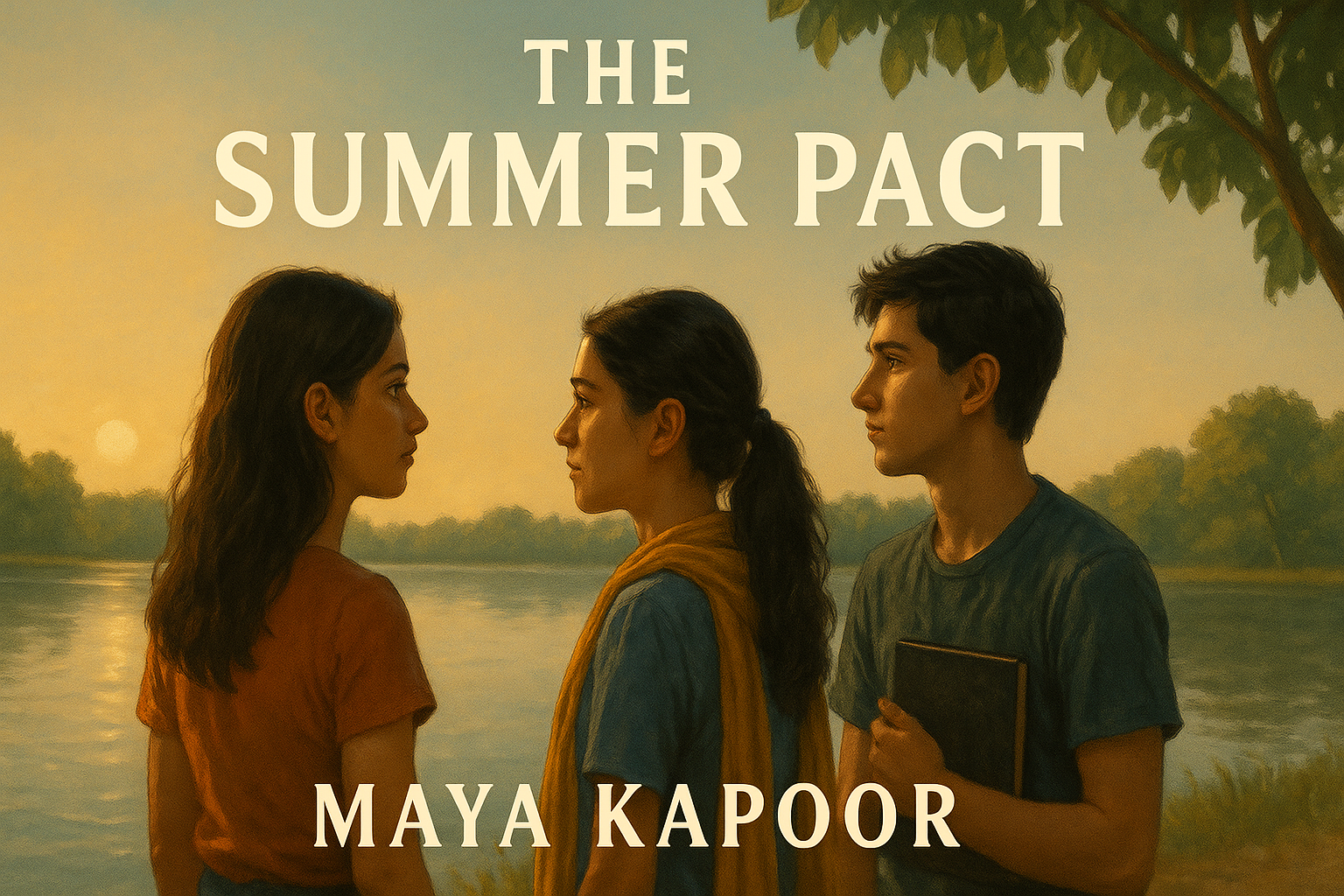
Maya Kapoor
First Bell of Summer
The last day of school always felt like a door being slammed shut and another thrown wide open. The classrooms still smelled faintly of chalk dust and overheated computers, the air buzzing with the kind of restless energy that only came when you knew you wouldn’t be trapped here again for another three months.
I shoved my history notebook deep into my bag, even though I’d never open it again. Around me, voices rose in a mixture of laughter and relief. “Freedom!” someone shouted from the back row, and it set off a chain of cheers that rippled through the hallways like firecrackers.
For me, though, summer didn’t feel like freedom. It felt like standing at the edge of something I couldn’t see clearly yet. A little terrifying, a little thrilling, like the space between thunder and lightning.
“Samira!” I turned at the sound of my name. Ayesha came running toward me, her thick braid bouncing against her back, her face glowing with the kind of happiness that only she could carry so effortlessly. Ayesha was my best friend, and the kind of girl who knew everyone, remembered everyone’s birthday, and could make even the teachers laugh.
“You’re coming to the station, right?” she asked, slightly breathless. “We’re meeting him at four.”
I knew who she meant, of course. Her cousin, Arjun. The mysterious boy who was moving to our town this summer to live with Ayesha’s family. I had heard about him for weeks, in the way people talk about an unfamiliar character before he walks on stage. Arjun the quiet one. Arjun who used to draw all the time. Arjun who hadn’t been the same since last year, though Ayesha never explained what that meant.
“Yeah,” I said, adjusting the strap of my bag. “I’ll come.”
Outside, the sun was already burning with that sharp heat that promised summer storms by evening. The asphalt shimmered as we crossed the school gates. Ayesha chattered about her plans—movie marathons, mango milkshakes, a trip to her grandparents’ village—and I let her words carry me along, half-listening, half-lost in my own thoughts.
At home, the ceiling fan turned lazily above my bed as I tried to read, but my mind kept wandering to the train station. Meeting someone new always made me nervous. What if Arjun was arrogant? What if he hated this town? What if he thought I was boring?
By the time the clock struck three-thirty, I gave up pretending to read and changed into my favorite blue kurta. Simple, comfortable, safe. I caught my reflection in the mirror—brown eyes too wide, hair frizzing at the ends—and sighed. It didn’t matter. He was Ayesha’s cousin, not mine.
The station was crowded, as always. Families gathered with baskets and plastic suitcases, vendors sold tea in tiny clay cups, and the air smelled of diesel, dust, and fried samosas. Ayesha was already there, waving at me wildly from the platform. Beside her stood her mother, elegant in a pale yellow sari, scanning the arrivals board with practiced calm.
“Train’s on time,” Ayesha said. “Just imagine. In five minutes, we’ll finally see him.”
I smiled faintly, pretending to match her excitement. The loudspeaker crackled, announcing the arrival, and soon the train screeched into view, slowing with a metallic groan. Passengers spilled out in waves—porters carrying heavy trunks, children tugging their parents’ hands, people calling out names in joy.
And then, through the crowd, I saw him.
Arjun was taller than I expected, his hair falling slightly into his eyes, a worn backpack slung over one shoulder. He moved with a kind of deliberate slowness, like he was measuring each step before he took it. His gaze was distant, fixed somewhere above us, until Ayesha ran forward and threw her arms around him.
“Arjun! Finally!” she said, her voice muffled in his shirt.
He hugged her back briefly, then let go, his eyes flicking to me. For a moment, I thought he might smile. Instead, he simply nodded, like he had been expecting me all along.
“This is Samira,” Ayesha introduced. “My best friend. You’ll see her around a lot.”
“Hi,” I managed, raising a hand in a half-wave.
“Hey,” he said. His voice was quiet but steady, and then he looked away, scanning the platform like he was still searching for something.
The ride back to their house was filled with Ayesha’s chatter. She told him everything—the new café that opened on Main Street, the teacher who slipped on the stairs last week, the neighbor’s cat who had adopted their garden. Arjun listened silently, occasionally nodding, his gaze fixed out of the window. I sat beside him, trying not to notice the silence pressing like glass between us.
At the house, Ayesha’s mother fussed over him with plates of food. I excused myself after an hour, feeling oddly out of place in the middle of their reunion. As I walked home through the dusky lanes, I couldn’t shake the memory of his eyes. They weren’t empty, exactly. More like they were carrying a story too heavy to be spoken aloud.
That night, I dreamt of trains pulling away into endless darkness, and of a boy who stood on the platform, staring at the sky as though it held all his answers.
The next morning, the summer truly began.
When I reached Ayesha’s gate, she was already outside, tugging Arjun by the wrist. “Come on! We’re going to the lake. It’s tradition,” she declared.
He looked reluctant, his backpack slung across his shoulder again like he couldn’t put it down. But he came. And so did I, because somehow it already felt like the three of us were going to spend this summer bound together, whether we chose to or not.
The lake shimmered in the morning light, dragonflies skimming over the surface, the air heavy with the smell of wet earth. Ayesha kicked off her sandals and splashed into the shallows, laughing. I stayed on the bank, watching her.
Arjun stood a little apart, sketchbook in hand. I hadn’t noticed it before. He sat on a rock, pencil moving swiftly, eyes fixed on the water. I edged closer, curious.
“Do you draw a lot?” I asked softly.
He didn’t look up. “Used to.”
“What are you drawing now?”
Finally, he tilted the book, just enough for me to glimpse. The page was filled with quick, sharp lines, the lake captured in strokes that seemed alive. But there was something else too, a shadow behind the water, a darkness curling at the edges.
“It doesn’t look like the lake,” I said before I could stop myself.
“It looks like how it feels,” he replied. And for the first time, he glanced at me directly, his eyes dark and searching, as though daring me to understand.
Something shifted then, like the first bell of summer ringing out, marking the start of everything that would follow.
Episode 2: The Lake and the Silence
Summer mornings in our town had a rhythm of their own. Birds began their chorus long before the sun lifted over the rooftops, shop shutters clattered open one by one, and the air smelled of frying pakoras drifting from tea stalls. But down by the lake, time seemed suspended. The water held its breath, reflecting the sky with a kind of restless calm, like it was waiting for something.
We came here every summer, Ayesha and I. It was our secret corner, our claim on the world. She used to say the lake listened better than people did. I never argued. But that morning, it felt like the lake was listening to someone new.
Arjun sat on the rock, his sketchbook balanced on his knees, pencil scratching across paper. Ayesha darted in and out of the shallows, splashing water onto her shalwar, her laughter rising like birds. I lingered somewhere in between—close enough to catch Arjun’s lines on paper, far enough to pretend I wasn’t staring.
“Why do you always draw in black and white?” I asked finally, unable to bear the silence pressing between us.
Arjun didn’t pause. “Colors distract,” he said flatly.
I frowned. “But the world is full of colors.”
“Not the important parts,” he replied, his pencil sliding dark and certain across the page.
Ayesha bounded over then, dripping water, her braid stuck to her back. “He’s always been like that,” she said cheerfully, peering over his shoulder. “Even when we were little, he’d draw everything in shades of storm.”
Arjun shut the sketchbook before she could say more, slipping it back into his bag. “I’m done.”
There was something in the way he said it, like the words carried more weight than just finishing a drawing. Ayesha didn’t notice. She was already dragging us toward the grove beyond the lake, where wildflowers tangled through the grass and the smell of mud hung heavy after last night’s storm.
We sprawled under a banyan tree, the three of us, as if we’d always belonged here. Ayesha kept up a steady stream of chatter—plans for the summer, gossip about classmates, wild dreams of adventures that might never happen. I let her voice wash over me, but my eyes strayed to Arjun. He was quiet, always quiet, his gaze locked somewhere far away, like he was tuned to a frequency only he could hear.
After a while, I asked softly, “Do you like it here?”
He turned his head toward me, slow, deliberate. “It’s quieter than the city,” he said. Then, after a pause: “That’s good.”
There was more he didn’t say, I could feel it. A shadow behind his words, something unspoken but heavy. Ayesha reached over and nudged him with her foot. “See? You’ll like it here. We’ll make sure of it.”
He didn’t smile, but I thought I saw a flicker in his eyes, something softening.
That afternoon, the heat grew unbearable. The air shimmered above the road as we walked back. Ayesha skipped ahead, humming a song off-key, while Arjun and I trailed behind.
“You don’t talk much,” I said, trying again.
He glanced at me, his expression unreadable. “Does it bother you?”
“No,” I admitted, after a moment. “It just… feels like you’re carrying conversations in your head that we can’t hear.”
Something flickered across his face then, a shadow, a memory maybe. But he didn’t answer, and I didn’t press.
At Ayesha’s house, her mother greeted us with tall glasses of cold lemonade, condensation dripping down the sides. Arjun sipped slowly, his gaze fixed on the floor, and I wondered if he even tasted it.
When I got home, the silence in my own room felt different. Not heavy, like it sometimes did, but alive—like it was echoing with all the words Arjun hadn’t said.
The days began to blur after that, stitched together with heat and dust and the endless song of cicadas. We settled into a strange new rhythm. Ayesha was the sun, pulling us into her orbit with energy and laughter. Arjun was the shadow, trailing quiet but steady. And I was somewhere in between, trying to balance both.
We went to the market together, where Arjun refused to eat the jalebis Ayesha shoved at him, though his eyes softened when a street musician played a haunting tune on his flute. We visited the old library, where Arjun’s fingers lingered over books with cracked spines, though he didn’t check any out. We even climbed to the roof of Ayesha’s house at night, staring at the stars while the power cut plunged the neighborhood into darkness.
It was in those quiet nights that I noticed it most—the way Arjun’s eyes weren’t empty, but too full. Like he was holding onto something he couldn’t put down.
One evening, as Ayesha dozed off mid-sentence on the terrace, I found myself sitting beside him in the glow of the lantern. The air smelled of jasmine and smoke from distant fires.
“You draw the lake like it’s dangerous,” I said quietly.
Arjun’s pencil stilled on the page. He looked at me then, and for the first time his gaze didn’t slide away.
“Because it is,” he said softly. “Everything is.”
My chest tightened, though I didn’t know why. “Did something happen?”
His jaw clenched, and he shut the sketchbook with finality. “Not everything needs to be told.”
The silence between us stretched, thick and unyielding. I wanted to say something, anything, but the words tangled in my throat. Finally, he stood, slipping the sketchbook into his bag. “Goodnight, Samira.”
And then he was gone, his figure melting into the shadows of the stairwell.
The next day, Ayesha announced we were taking a bus to the old fort outside town. She was unstoppable, radiant with plans, as if she could drown out every silence with her voice. Arjun came without complaint, though he barely spoke the whole ride.
The fort was crumbling, its red sandstone walls cracked with vines, but to us it felt like a kingdom. We climbed the ramparts, shouting into the wind, our voices carried back in echoes. Ayesha declared herself queen, draping her scarf like a crown. I laughed, chasing after her, but Arjun stayed back, sketching the broken arches with intense concentration.
When I wandered over, I saw his drawing. The fort was there, but not as it was. In his version, the walls were collapsing, swallowed by darkness, the arches bending inward like teeth.
“It’s not what it looks like,” I whispered.
“It’s what it feels like,” he said again.
This time, though, I thought I understood.
That evening, I found myself lying awake, the ceiling fan creaking above me. I thought of Ayesha’s laughter ringing through the fort, of Arjun’s hands smudged with graphite, of the shadows that clung to his drawings.
Summer had only just begun, but already it felt like we were standing on the edge of something. Something fragile, something dangerous, something inevitable.
And for the first time, I wondered if this summer would change everything.
Episode 3: Echoes in the Fort
The morning after the fort trip, the world felt quieter, as though it had swallowed our laughter and held it inside its broken stone walls. I kept thinking of the way Arjun’s sketch had twisted the fort into something dark, something collapsing. And I couldn’t shake the sense that he wasn’t just drawing ruins, he was remembering them.
Ayesha, of course, bounced back like sunlight after rain. She burst into my house before breakfast, pulling me out by the wrist. “Samira! We’re going back today—Arjun wants to finish his sketches. You’re coming, no excuses.”
I barely had time to grab my sandals before we were on the bus again, its rattling windows framing fields stretching endlessly under the sun. Arjun sat by the window, his sketchbook balanced on his lap, pencil already in hand. He didn’t look up once.
When we reached the fort, it was almost empty, only a few tourists wandering aimlessly. The air was thick with the smell of dust and wild grass. Ayesha darted ahead, climbing the crumbling steps, her laughter echoing against the walls.
Arjun stayed behind, lowering himself onto the ground near the old archway. His eyes seemed to drink in every crack, every shadow. I sat near him, though not too close.
“You really like this place,” I said quietly.
He kept drawing. “It reminds me of something.”
“What?”
For a long time, there was only the scratch of pencil on paper. Then he said, so softly I almost missed it: “A fire.”
I turned to him, startled. “What do you mean?”
He finally looked at me, his eyes unreadable. “Not here. Somewhere else. Long ago. But the smell, the way the stones look… it’s the same.”
A chill prickled down my arms despite the heat. Before I could ask more, Ayesha’s voice rang out from the tower above us. “Come up here, you two! The view is insane!”
Arjun closed his sketchbook with a snap. “Let’s go.”
We climbed the winding stairs, the stone cool under our palms. At the top, the whole town stretched before us, fields and rooftops and the shimmer of the lake in the distance. Ayesha spread her arms wide like she was ready to embrace the sky itself.
“This is ours,” she declared. “All of it. This summer, this fort, this view. Ours.”
For a moment, standing there with the wind tugging at my hair, I almost believed her.
That night, the dreams came again. I saw the fort crumbling, flames licking the sky, and a boy standing in the smoke with charcoal-stained hands. When I woke, sweat clung to my skin, and I couldn’t tell if the boy was Arjun or someone else.
The days that followed blurred into a pattern. The three of us roaming the town, Ayesha dragging us from one adventure to the next, Arjun sketching in silence, me caught somewhere between watching and wanting to understand.
One afternoon, when Ayesha ran off to buy sweets, I found myself alone with him again in the old library. The ceiling fans whirred lazily, stirring the scent of yellowed pages. Arjun’s fingers traced the spine of a book about architecture.
“You draw like you’re remembering something painful,” I said softly.
He froze. Then, without looking at me, he murmured, “Maybe I am.”
I waited, but he didn’t say more. I wanted to reach for the book in his hands, to break the silence with something ordinary, but before I could, Ayesha came bouncing back, sugar already staining her lips. The moment slipped away.
It wasn’t until the evening of the monsoon’s first storm that I saw him differently.
We were on the terrace again, candles flickering as thunder rumbled in the distance. Rain began to fall, soft at first, then heavy, drumming against the roof. Ayesha danced in it, spinning with her arms thrown wide, her laughter swallowed by the storm.
I stayed under the overhang, but Arjun stepped out into the downpour, lifting his face to the sky. For once, his sketchbook wasn’t in his hands. For once, he looked alive.
I watched as the rain plastered his hair to his forehead, traced lines down his cheeks. His eyes were closed, but there was a kind of raw relief on his face, like the storm was washing something away.
When he opened his eyes, he caught me staring. And this time, he smiled. Not much, just a faint curve of his lips, but it was enough to make my chest tighten.
“You like the rain,” I said, my voice almost lost in the storm.
“It drowns out everything else,” he replied.
I didn’t know what he meant, but I felt the truth of it settle between us, heavy and real.
The next day, Ayesha announced another plan—she always had plans—but I found myself distracted, caught in the memory of his smile. I kept thinking of the way the rain had transformed him, if only for a moment.
As the summer deepened, I began to realize something I couldn’t admit even to myself: I wanted to be the one who made him smile like that again.
But the shadows were never far.
One evening, as we walked home from the lake, we passed an abandoned house at the edge of town. Its windows were shattered, the garden wild with weeds. Arjun slowed, his eyes fixed on it.
“What is it?” I asked.
He didn’t answer, just stared, his jaw tight, his hands clenched at his sides. Then, suddenly, he turned away and kept walking.
Ayesha glanced at me, frowning, but said nothing.
Later that night, I saw him from my window. He was standing alone on the street, staring up at that same house, rain dripping from the eaves around him.
And I knew then that whatever shadows haunted Arjun weren’t just memories. They were here, in this town, waiting.
Summer was supposed to be easy. Light, laughter, freedom. But I could feel the ground shifting under our feet, the way the air before a storm holds its breath.
I didn’t know yet what secrets Arjun carried. I only knew that they were pulling me toward him, like gravity, like fate.
And that something in me was changing, too.
Episode 4: The House of Broken Windows
The abandoned house at the edge of town was something we had always passed without thought. For years, kids dared each other to throw stones at its broken windows or sneak inside at night. Ayesha and I had never bothered. It was just another ruin, one of many. But ever since that evening, it wasn’t just a house anymore. It was the place where Arjun’s gaze lingered too long.
I couldn’t stop thinking about it.
The next morning, when Ayesha showed up at my gate armed with her usual excitement—plans for cycling to the river, for trying the new pani puri stall—I surprised both of us. “Let’s go to the old house,” I said.
Her face fell. “Why there?”
I didn’t answer right away. My eyes flicked to Arjun, who stood a little behind her, his backpack slung across one shoulder as if it were glued to him. He was watching me carefully, like he already knew what I was about to suggest.
Ayesha groaned. “Samira, you and your creepy curiosity. Fine. But only for half an hour.”
We walked through the dusty lanes, past children flying kites, past the sweetshop where the owner sprinkled sugar with a heavy hand. The house stood alone at the end of the road, vines climbing its cracked walls, its roof sagging. The gate creaked when Ayesha pushed it open, loud enough to make a dog bark in the distance.
Inside, the air was thick with damp and neglect. Dust motes swirled in shafts of sunlight, and the smell of rust hung heavy. The floorboards groaned under our feet.
“Okay, we’ve seen it. Can we go now?” Ayesha whispered, her bravado fading.
But Arjun stepped further in. His eyes roamed the walls, the ceiling, every detail, with an intensity that made my skin prickle. He paused in the middle of the room, where the ceiling had caved in slightly, and crouched to touch the floor.
“This house…” His voice was so soft I almost missed it. “It feels like something’s still here.”
Ayesha shifted uncomfortably. “Like what? Ghosts? Don’t start.”
But Arjun wasn’t joking. His hand trembled as he traced a crack in the wall. His expression was distant, almost haunted.
I crouched beside him. “Have you been here before?” I asked.
His eyes flicked to mine, then away. “No,” he said too quickly.
Ayesha tugged at my arm. “Samira, let’s go. This place gives me the creeps.”
We left, though I glanced back at Arjun. His shoulders were rigid, his jaw tight, as though he was dragging himself away.
That night, I couldn’t sleep. I kept seeing the way his hand had shaken, the way his eyes had searched the ruined walls as if for something lost.
And then the dream came again—this time sharper. I was inside that same house, but it wasn’t abandoned. The walls were painted pale blue, curtains billowed at the windows, and laughter echoed faintly. Then, suddenly, fire. Smoke choking the air, the curtains burning, the walls collapsing.
When I woke, my chest was tight, my palms slick with sweat.
The following day, Ayesha insisted on something lighter. “Enough with creepy ruins. Let’s go swimming at the lake. It’ll cool our brains.”
She wore her bright red dupatta like a cape, running ahead as always. Arjun trailed behind, silent. I walked beside him, my mind still stuck in the abandoned house.
“You know something about it,” I said finally. “Don’t you?”
His steps faltered. For a moment, I thought he might tell me. But then he shook his head. “You shouldn’t ask questions you don’t want answered.”
His words chilled me more than the dream had.
At the lake, Ayesha dove into the shallows, her laughter breaking the tension. I stayed on the bank, toes digging into the mud, while Arjun sat on the rock again, sketching.
Curiosity got the better of me. I leaned closer to see.
This time, the page showed the abandoned house—not as it was, but as it must have been once. Walls whole, windows unbroken, flowers blooming in the garden. It was drawn with such tenderness it made my chest ache.
But in the corner, he had begun shading flames creeping up the walls.
I looked at him sharply. “You’ve seen it like this before. Haven’t you?”
His pencil stilled. For a moment, he looked at me, really looked, as though deciding whether to let me in. Then he shut the book.
“Not everything is meant to be drawn,” he murmured.
That evening, Ayesha threw a fit. “You two have been acting like characters in some mystery novel,” she snapped as we walked back. “Enough with secrets and shadows. It’s summer. We’re supposed to be having fun.”
Her words stung, mostly because they were true. I wanted to tell her that I didn’t mean to be caught in Arjun’s silences, but it was like a magnet—I couldn’t look away.
Arjun said nothing. He only walked a little faster, as though trying to outpace her voice.
Later that night, as I sat by my window, I saw him again. Standing outside the abandoned house, the moonlight painting him silver. His sketchbook was open in his hands, his face pale and intent.
Without thinking, I slipped on my sandals and crept out. The street was silent except for the buzz of crickets.
“Arjun,” I whispered when I reached him.
He didn’t flinch, though he must have known I was there. His eyes stayed fixed on the house.
“It burned once,” he said finally. His voice was low, heavy. “A family lived here. A fire took everything. I… I was there.”
My breath caught. “You? How—”
But he snapped the sketchbook shut. “Not tonight.”
And before I could say more, he walked away, leaving me with the ruined house and a hundred questions burning in my chest.
I stood there long after he was gone, staring at the broken windows. For the first time, the house didn’t just look abandoned. It looked alive, watching, remembering.
And I realized something then. Whatever Arjun carried, whatever shadows clung to him—they weren’t just his anymore. Somehow, without meaning to, I had stepped into them too.
Episode 5: The Fire That Stays
The morning after I saw Arjun at the abandoned house, I woke with a weight in my chest, the memory of his words still echoing: I was there.
It played on repeat in my head, twisting itself into questions I couldn’t untangle. What did he mean? How could he have been there, in a fire that destroyed a house he didn’t live in? And why hadn’t Ayesha mentioned anything about it?
When I saw him that afternoon at Ayesha’s veranda, sitting with his sketchbook balanced on his knees, I wanted to demand answers. But his face was calm, almost distant, as if the night before hadn’t happened.
Ayesha burst out of the house with her usual whirlwind of energy, holding a cricket bat in one hand. “Come on, both of you! Match in the lane. Winner gets ice cream.”
Her joy was contagious, and for a while I let it sweep me up. The narrow lane echoed with our laughter, our shouts, the crack of bat against ball. Even Arjun joined in reluctantly, his face softening when Ayesha teased him for missing an easy catch.
For a moment, everything felt normal. Almost.
But when the game ended, and we sat panting on the curb with our cones dripping sticky sweetness onto our fingers, I caught Arjun staring down the road. Toward the house. His jaw tightened, and the shadow slipped back over him.
Later that evening, when Ayesha went inside to fetch drinks, I finally asked. “That night… you said you were there. At the fire.”
He didn’t answer immediately. He flipped open his sketchbook instead, turning past pages filled with ruins, shadows, flames. Then he stopped, showing me one page.
It was the house—whole, alive, with a family drawn in faint outlines on the veranda. A man, a woman, a little girl with braids. And in the corner, another figure, smaller, clutching a toy.
“That’s me,” Arjun said softly.
My breath caught. “You lived there?”
He nodded. “Until the fire. It was my home.”
The air thickened around us, heavy with the truth settling between us. “What happened?” I whispered.
His voice was flat, almost mechanical, like he was forcing the words out. “There was a short circuit. The house caught fire in the middle of the night. I was asleep. My parents…” His throat tightened. “They didn’t make it out. Neither did my sister.”
I felt my stomach twist. “Oh, Arjun…”
“I don’t remember much. Just the smoke, the heat, my mother’s voice shouting my name. I woke up outside, in the garden. They told me a neighbor pulled me out. I never saw them again.”
The silence that followed was unbearable. I wanted to reach for his hand, but my fingers froze on my lap.
“I draw it,” he continued, his eyes fixed on the page. “Because it’s the only way to keep them real. Otherwise… they fade.”
Tears burned the back of my eyes, but I blinked them away. This was his grief, not mine. Still, something inside me ached at the sight of him sitting there, shoulders bent under a weight too heavy for anyone, let alone someone our age.
When Ayesha returned, humming, carrying glasses of lemonade, Arjun shut the sketchbook quickly. His face returned to its careful mask. She didn’t notice a thing.
But I did.
The next few days, I watched him differently. Every silence he held seemed sharper, every shadow on his face heavier. When Ayesha joked with him, trying to pull him into her orbit, I could see how hard he tried to respond, to give her what she wanted. But his eyes always carried something else—something locked away.
I wanted to tell Ayesha what he had told me. But the words stuck in my throat. It felt like a secret he had given only to me, and somehow I couldn’t betray that trust. Not yet.
Instead, I kept walking with them, kept pretending our summer was normal. We went to the river, where Ayesha skipped stones and Arjun sketched the ripples. We biked through the market, weaving between vendors and laughing when Ayesha almost toppled into a pile of guavas. From the outside, we must have looked like any three teenagers wasting away a summer.
But underneath, I could feel the fire still smoldering.
One evening, Ayesha convinced us to go back to the fort again. She loved it there, loved climbing the ramparts and declaring herself queen. The wind was sharp on the walls, carrying the scent of rain.
While Ayesha scrambled higher, waving her scarf dramatically, Arjun and I stood near the edge.
“She doesn’t know, does she?” I asked quietly.
He shook his head. “Her parents never told her. They thought it was better that way. She was too little to remember.”
I frowned. “But she’s your cousin. She should know.”
His eyes darkened. “What good would it do? She’d look at me differently. Pity me. That’s worse than silence.”
I didn’t answer. Maybe he was right. Maybe not. But a part of me wanted to believe Ayesha was strong enough to know the truth.
That night, the storm came hard. Rain lashed the windows, thunder rattled the glass. I lay awake, listening, when a knock came at my door.
Startled, I slipped out of bed and opened it to find Arjun, soaked to the skin, his hair plastered to his forehead. His eyes were wild, desperate.
“Can I come in?” he asked.
I nodded, stepping aside. He stood in my room, dripping rainwater onto the floor, clutching his sketchbook so tightly his knuckles were white.
“I dreamt of it again,” he whispered. “The fire. I can’t breathe when it comes. I thought if I stayed in that house tonight, it would stop. But it didn’t. It never does.”
His voice cracked, and for the first time, he looked younger than he was—fragile, terrified.
Without thinking, I reached for his hand. His skin was ice-cold, trembling.
“You don’t have to face it alone,” I said softly. “Not anymore.”
For a long moment, he just stood there, staring at our joined hands. Then, slowly, he sank onto the edge of my bed, his shoulders slumping.
And for the first time since I’d met him, Arjun let the tears come.
The storm outside raged, but inside, the silence between us shifted. It wasn’t empty anymore. It was full—of grief, of truth, of something fragile that felt like the start of trust.
I didn’t know what it meant, or what would come next. All I knew was that this summer was no longer just about Ayesha’s laughter or my quiet dreams.
It was about Arjun’s fire.
And whether we were ready or not, we were all standing inside it now.
Episode 6: Fault Lines
By morning, the storm had wrung the town clean. Puddles cupped the sky in their shallow palms, and fallen neem leaves stuck to the road like green coins. I stood at my window longer than usual, trying to craft an ordinary day out of a night that refused to be ordinary.
Arjun’s knock had been soft. His tears had not. I could still feel the cold of his hand in mine, the way silence had turned from a wall into a bridge. I didn’t know what we were now—friends, witnesses, something unnamed—but I knew the ground under us had shifted.
At ten, Ayesha bounded into my lane like nothing in the world could be complicated. “Mela tonight!” she announced, arms thrown wide. “Monsoon fair, riverbank. Lights, food, bad music. We’re going.”
Behind her, Arjun hovered with that careful posture I’d started to recognize—the way he occupied space as if asking permission from it. He met my eyes for half a second. There was a quiet nod in his gaze, a thank you folded so small no one else could see it.
“Obviously we’re going,” I said, and Ayesha beamed like I’d passed a test.
We spent the afternoon making the kind of plans that don’t need plans. Which stall first, which ride was least likely to kill us, who would hold the money (me). On the verandah, while Ayesha practiced bargaining on a line-up of mangoes, Arjun sat with his sketchbook shut, fingers tracing its spine. Ayesha didn’t notice. I did.
When evening fell, the town dressed itself in light. Paper lanterns swung from strings like drifting moons, and the river threw the whole thing back at us, doubled. The fair bloomed along the bank—rows of stalls, a Ferris wheel thudding slowly against the sky, the smell of frying batter and wet earth tangled in the breeze. Children ran past with pinwheels, faces sticky with syrup. Somewhere, a singer with more enthusiasm than tune stretched a love song to brave lengths.
“This is what life is for,” Ayesha declared, grabbing each of us by the wrist and hauling us into the crowd. “Samosas first. Then the wheel. Then sugarcane juice. In that order.”
We let her drag us. It was easier that way, like stepping into a current and letting it carry you. At the samosa stall, she stole the crispiest one from my plate with infuriating grace. At the ring toss, she missed every bottle and swore the game was rigged. Arjun watched everything with alert, guarded eyes, like a deer that had agreed to come to town but not to trust it.
“Ferris wheel?” Ayesha said, bouncing on her toes.
Arjun hesitated. The wheel creaked, rising and falling, a giant coin flipping decisions in the air. He glanced at me. The question was simple: are we doing this?
“Let’s,” I said.
We squeezed into a rattling car that smelled faintly of rust and sugar. As we climbed, the fair laid itself out beneath us like a board game—bright squares, moving pieces, chance. The river went dark and deep, swallowing light, giving it back in broken shimmer.
Ayesha leaned out (dangerously) to whoop at someone below who whooped back. Then she turned to me, hair slapping my cheek in the wind. “Promise me we’ll do this every year,” she said. “No matter what.”
“Every year,” I lied, because you can only make promises inside moments like this.
On the third rotation, when the wheel paused to let people on and off, the sky cracked—a small pop, then a sudden blaze of gold above the river. Fireworks weren’t supposed to start yet, but some impatient soul had found a match.
The sound was not loud, not really. But it was sharp. It reached for Arjun and found him like it had been given his name.
His body went still. Then all at once, it didn’t—his breath hitched, his hand found the metal bar and clamped so hard the tendons stood out. The light from the fireworks painted and unpainted his face. His eyes were somewhere else entirely.
“Arjun?” I said, carefully.
He didn’t answer. The next firework screamed higher, burst brighter. He flinched like the air had teeth.
I moved closer, the car dipping. “Hey. Look at me.” My voice was low, steady, pulling. “Five things you can see.”
His mouth barely moved. “Lantern… river… wheel… stall…” His eyes darted, unfocused. “…your bracelet.”
“Four you can feel,” I said, counting with him. “Metal bar. Wind. Shirt. Seat.” I placed my palm over his, letting him press back. “Three you can hear.”
“Music. Wheel. You.”
“Two you can smell.”
“Oil. Rain.”
“One you can taste.”
He swallowed. “Samosa.”
The firework faded. The crowd clapped. The wheel creaked forward again as if nothing had happened. Beside me, Arjun’s breath slowed, his shoulders unhooked from his ears. Very quietly, he said, “Thank you.”
Across from us, Ayesha’s joy had collapsed into concern so fast it made a different kind of ache. “What was that?” she asked. “Are you okay? What—Samira, why did you count—what is happening?”
I looked at Arjun. His fingers tightened under mine, then loosened. He didn’t hide inside silence this time.
“I get… flashes,” he said. “Sometimes the sounds turn into something else. I’m fine.”
“You are not fine,” Ayesha snapped, fear sharpening her words. “You’re shaking.”
“I’m fine now,” he said. He wasn’t, not fully. But he had found the shore again.
The wheel emptied us gently back onto the ground. The crowd folded around us, all warm bodies and unbothered noise. Another crack split the air—more fireworks—and Arjun flinched despite himself. Ayesha saw it. Something in her face buckled.
“We should go somewhere quieter,” I said.
We found a pocket of dark behind the sugarcane press, where the smell of crushed green drowned the gunpowder tang. A boy fed stalks into the machine in rhythmic prayer; the metal swam with juice. The fireworks kept blooming on the far side of the fair, their reflections breaking over the river like promises no one had asked for.
“Talk,” Ayesha said, arms crossed over her chest like armor. “Now. Please.”
Arjun’s jaw worked. He glanced at me and away. Then he looked at his cousin, really looked, the way people do when they are measuring whether the truth will bruise or heal.
“My parents,” he said. “And my sister. There was a fire. I survived. I… didn’t tell you because I didn’t want to be that story. I didn’t know how to be anything else once I said it out loud.”
Ayesha’s breath went out of her as if someone had pulled a plug. For a long moment, she said nothing. She uncrossed her arms slowly, like setting a weapon down.
“Why didn’t you tell me?” she asked, and the question wasn’t accusation so much as heartbreak at the door.
“Because you smile at me like I’m not made of glass here,” he said. “I wanted to keep that.”
Ayesha’s eyes filled without spilling. She stepped forward and did what she has always done best—she reached. Not with words, but with both arms, pulling him into a hug that was the opposite of fragile. Arjun stood stiff for a second, then leaned, one millimeter, then two. When they pulled apart, something old had changed shape.
“You’re not glass,” she said fiercely. “You’re a person. My person. Both of you are.” She brushed at her eyes, furious with them. “And I’m mad you didn’t tell me. And I’m not leaving.”
“Okay,” he said. It sounded like the first honest okay of the summer.
We didn’t go back to the rides. We found the river instead, the three of us on the low steps where the water came up to argue with our ankles. The fireworks kept trying to be important across the current. They weren’t, not here.
“Grounding,” Ayesha said after a while, nudging my shoulder. “That counting thing. You always act like you’re not practical, and then you do a magic trick.”
“It’s not magic,” I said. “It’s what my mother does with anxious patients at the clinic. It helps.”
Ayesha rocked back on her palms. “You’ll teach me?”
“Of course,” I said.
Arjun was quiet, but it was a different quiet. The kind that’s tired and soft, not defensive. He took out his sketchbook, and for the first time since I’d known him, he didn’t draw ruins. He drew the three of us, small and stubborn on the river steps, lanterns wobbling overhead like a string of patient stars. In the corner, he touched his pencil to the page and left the faintest hint of blue. It might have been the river. It might have been the sky.
“You used color,” I said, startled.
“It sneaked in,” he replied, and almost smiled.
When we finally stood to go, the fair was thinning, the night gentling around its edges. We walked Ayesha home first. She paused at her gate and turned to us measured and bright, like the moon after rain.
“Tomorrow,” she said, “we go to the lake. No plans, no fireworks, no catastrophes. We just… be.”
“Tomorrow,” Arjun said.
She went in. The gate clicked. The road exhaled. Arjun and I walked the quiet part together, our shadows stitching and unstitching under the streetlights.
“I’m sorry,” he said after a bit. “For last night. For tonight. For making you hold parts of me that feel like broken glass.”
“You didn’t make me,” I said. “I chose to.”
We reached the corner where our ways split. He handed me a torn page from his book. It was the sketch of the three of us on the steps, the thread of blue intact.
“For you,” he said. “So I don’t forget.”
“You won’t,” I told him. “Not anymore.”
When I lay in bed later, the page propped against my lamp, the fair’s last echo a distant yawn, I thought about promises. How we make them on ferris wheels and river steps and in the soft corners of ordinary days. How sometimes they hold, and sometimes they don’t, but the trying is the part that makes us human.
Fault lines don’t only mark where we break, I realized. They mark where we move.
And in that movement, maybe, is how we stay.
Episode 7: The Summer Pact
The morning after the fair, the world felt calmer, as if the storm of fireworks and confessions had washed something clean. The streets were slick with last night’s rain, the air smelled faintly of wet dust and fried pakoras from the corner stall.
At Ayesha’s house, we sprawled on her veranda, the three of us too full of unspoken words to pretend everything was ordinary. Ayesha twisted the ends of her braid around her finger, eyes darting between me and Arjun.
“Okay,” she said finally, breaking the silence. “Enough secrets. No more carrying storms alone. From now on, whatever it is—good, bad, terrifying—we share it. All of it. Deal?”
She held out her hand, palm open like a challenge.
I placed mine on hers without hesitation.
Arjun hesitated longer, his eyes searching Ayesha’s face. Then, slowly, he added his hand to the pile. His fingers were cold, but steady.
“It’s a pact,” Ayesha declared. “The Summer Pact. No shadows too dark, no laughter too loud. We’re in this together.”
And for the first time since he’d arrived, I saw something shift in Arjun’s eyes—caution giving way to something like belief.
We spent the day at the lake, as Ayesha had demanded. No plans, no drama, no fireworks. Just the three of us stretched on the grass, the sun warming our backs, dragonflies weaving silver threads over the water.
Ayesha sang off-key, her voice rising and falling with no rhythm. Arjun sketched quietly, though this time I noticed his lines were softer, less harsh. The lake looked like itself, not a shadow. He even let me flip through a few finished pages, though I handled them carefully, as if they were made of glass.
At one point, Ayesha dozed off under the banyan tree, her dupatta covering her face. Arjun and I sat a few feet away, listening to the cicadas.
“You told her,” I said softly. “Last night. About the fire.”
He nodded. “It felt… different than I expected. Not easier. But lighter.”
“She’s stronger than you think.”
He glanced at me. “And you?”
“What about me?”
“You keep showing up. Even when I tell you not to ask questions. Why?”
The answer slipped out before I could dress it in caution. “Because I don’t want you to disappear into silence.”
For a moment, the weight of his gaze was almost unbearable. Then he looked away, flipping his pencil between his fingers.
“You remind me of my sister sometimes,” he said quietly. “She always asked questions. Always pushed.”
Something in my chest twisted. “What was her name?”
“Anaya,” he said. The word was soft, reverent. “She was eight.”
I whispered the name back, like a prayer. Anaya.
Arjun shut his sketchbook. “I don’t say it often. It hurts. But I don’t want to forget, either.”
“You won’t,” I promised.
And I meant it.
That evening, we built a small fire near the lake. Nothing grand—just twigs and scraps Ayesha had gathered, flames flickering against the dusk. We roasted corn, laughed when Ayesha burned hers black, and let the smoke sting our eyes.
“See?” Ayesha said, waving her half-charred cob like a trophy. “This is summer. Not fireworks or ghosts or secrets. Just this.”
“Just this,” I echoed.
Arjun didn’t say anything, but I saw the way he leaned a little closer to the fire, his eyes reflecting its glow without flinching.
Later, when the flames dwindled, Ayesha carved our initials into the bark of the banyan tree with a small knife she carried for no reason other than drama.
“S.A.A.,” she announced. “Samira, Arjun, Ayesha. Summer Pact.”
It was childish, maybe. But as I traced the rough letters with my fingertips, I felt the truth of it settle into my bones.
The next week unfolded in a strange balance.
We spent mornings at the market, afternoons at the library, evenings at the lake. Sometimes Arjun spoke more than usual, telling small stories about his old school, about the way the city lights drowned out the stars. Sometimes he went quiet, his gaze drifting to places only he could see. But he no longer shut us out completely.
And between us, something else grew—something delicate, unnamed.
One night, we sat on the terrace, Ayesha asleep beside us, her head on a pillow, soft snores escaping. The stars were scattered thick above us, the air cool after a day of relentless heat.
Arjun turned to me. “You’re different with her.”
“How?”
“You laugh more. Softer. With me, you’re… sharper. Like you’re trying to see through me.”
I smiled faintly. “Maybe I am.”
“Do you?” His voice was steady.
“Not yet,” I admitted. “But I’m trying.”
He studied me for a long moment. Then, unexpectedly, he said, “You’re the first person I’ve told about the fire in years.”
My heart stumbled. “Why me?”
His gaze lingered. “Because you don’t look away.”
The silence that followed was thick, but not heavy. It was a silence that hummed, alive, fragile.
And then Ayesha snorted in her sleep, rolling over, and the moment broke into quiet laughter.
But summer has a way of reminding you that it doesn’t last forever.
At the end of the week, Ayesha’s father returned from his work trip. He greeted us warmly, carrying boxes of sweets, asking about our adventures. But when his eyes fell on Arjun, something flickered—quick, restrained.
That night, as I left their house, I overheard voices from the living room. Ayesha’s father, low and tense: “He’s still not ready. He shouldn’t be carrying all that here.”
And Arjun’s voice, sharper than I’d ever heard it: “It’s not yours to decide.”
I walked home with my pulse racing, the pact carved into the banyan tree heavy in my mind.
The next morning, Arjun wasn’t on the veranda. Ayesha looked worried, though she tried to hide it behind chatter.
“He’ll come,” she said. “He always does.”
But I wasn’t so sure. The fire in his voice last night, the tension in her father’s—it felt like another fault line had opened.
I went to the banyan tree after lunch. The initials were still there, carved into bark, stubborn and raw. And beneath them, in faint graphite strokes, someone had added a fourth line.
A & S & A & A.
Four letters now. Anaya’s.
I touched the carving gently, my throat tight.
Arjun was still here. Still fighting not to fade.
And somehow, I knew the summer pact was about to be tested in ways none of us could have imagined.
Episode 8: The Storm at the Gate
The rhythm of our days faltered after Ayesha’s father came home. He was kind to me, always had been, offering mangoes from the fridge or asking about school. But with Arjun, there was a stiffness, like an invisible line neither of them could step across.
At first, I thought I imagined it. But the signs were everywhere: the way Arjun avoided the living room when his uncle sat reading the newspaper, the way his uncle’s eyes lingered on Arjun’s sketchbook like it carried weight he didn’t want in his house.
One evening, as we sat on the veranda, Ayesha chattered about a film playing in town. Arjun was sketching the outline of the lake, his pencil gentle for once. Her father stepped out then, sipping tea.
“Still drawing?” he asked casually, but the tone wasn’t casual.
“Yes,” Arjun said, without looking up.
His uncle’s jaw tightened. “You can’t live in the past forever.”
Ayesha froze mid-sentence. I held my breath.
Arjun’s pencil stilled. Then, very quietly, he said, “I’m not. I’m trying to live at all.”
The silence that followed was heavier than thunder. Finally, his uncle turned away, muttering something about chores.
Ayesha’s smile came back too quickly, stretched thin. “Okay! Movie tomorrow, both of you. No excuses.”
But I saw the way Arjun’s hand trembled when he closed the sketchbook.
The next day, we went to the movie anyway. A cheesy action film with too many car chases, too many improbable explosions. Ayesha laughed until she cried, throwing popcorn at me when I teased her for knowing every dialogue.
Arjun didn’t laugh. But he didn’t retreat either. He watched, eyes wide, flinching only once when a car on screen burst into flames. My hand twitched on the armrest, wanting to steady him, but I held back.
Afterward, Ayesha dragged us for ice cream, her laughter loud enough to cover everything. But when we walked home, Arjun slowed near the banyan tree. He touched the bark where our initials were carved, fingers resting on the extra letter he’d added.
“She’d have liked you both,” he said softly. “Anaya.”
Ayesha’s face softened. “Then we’ll like her back. That’s part of the pact.”
For a moment, the storm eased.
But storms don’t stay away forever.
One evening, as rain clouds gathered low, I stopped by their house to find the gate shut, voices raised inside. Ayesha’s father, sharp: “He needs discipline, not sympathy.”
Arjun, louder than I’d ever heard him: “I don’t need saving. I need space.”
I hesitated, my hand on the gate. Then Ayesha flung it open, her eyes bright with anger. “Samira, come.”
Inside, the tension was a wall. Arjun stood rigid, his sketchbook clutched to his chest. His uncle’s face was dark with frustration.
“He skips meals,” his uncle said to me, as if I were an ally. “He stays out late. Draws ruins and fire. How is this healthy? He needs to stop drowning in the past.”
Arjun’s voice shook, but it was steady. “It’s not drowning. It’s remembering. If I don’t draw, they disappear.”
“They already disappeared!” his uncle snapped. “You’re here. They’re not. Accept it.”
The words hit like a slap. Ayesha gasped. I stepped forward before I could think. “He’s not hurting anyone,” I said. “He’s surviving.”
Arjun’s uncle turned on me. “You don’t understand. This isn’t your burden.”
“Maybe not,” I said. “But it’s his. And you can’t tell him how to carry it.”
For a heartbeat, no one moved. The storm outside cracked, thunder rolling close.
Then Arjun’s uncle sighed, heavy, defeated. “Do what you want. But don’t bring that fire into my house.” He walked away, the sound of his sandals sharp on the floor.
Arjun stood frozen, his knuckles white around the sketchbook. Ayesha reached for him, but he stepped back.
“I can’t stay here,” he whispered. “Not like this.”
The storm broke then, rain hammering the roof.
That night, I couldn’t sleep. The sound of rain was too close to the memory of Arjun’s trembling voice. I thought of the pact carved into the tree, of promises made with corn and laughter and initials. Promises tested now, when it mattered most.
The next morning, I found him at the lake. He sat on the rock, rain still dripping from the banyan leaves, his sketchbook open on his lap. He was drawing the house again—the abandoned one, the fire frozen in graphite flames.
“I can’t breathe there,” he said when he noticed me. “Every corner feels like it’s waiting for me to burn again.”
“Then don’t go back,” I said quietly.
He shook his head. “Where else would I go?”
I sat beside him, the grass wet against my legs. “Here. With us. The pact wasn’t just words, Arjun. You don’t have to do this alone.”
For a long time, he didn’t answer. Then he tore the page from his sketchbook, crumpled it, and let the wind carry it into the water.
It sank slowly, the graphite bleeding into ripples.
“I don’t know how to stop remembering,” he whispered.
“You don’t have to stop,” I said. “You just have to let it live beside you, not inside you.”
He looked at me then, eyes wide, searching. Something softened, almost broke.
And for the first time, I thought he might believe me.
That evening, the three of us sat under the banyan tree again, the initials above our heads like guardians. The rain had passed, leaving the air cool and clean.
“We’ll find a way,” Ayesha said firmly, her hands gripping ours. “Whatever it takes. Together.”
Arjun didn’t speak. But he didn’t pull away either.
And in that silence, I heard it—the storm shifting, the fire dimming, the promise of something fragile but real.
The summer pact held. For now.
Episode 9: The Breaking Point
The days after the storm felt sharper, like the air had been scraped clean and left raw. Even the sunlight looked different, harsh at noon, golden at dusk, always restless. The three of us still met every morning, still carried out our rituals of lake walks and market errands, but something had shifted. Arjun’s uncle no longer spoke much when we passed through the veranda, and when he did, his voice carried the edge of swallowed anger.
Arjun kept quieter, too. He showed up, he sketched, he let Ayesha tease him into board games and ice cream trips, but the shadows beneath his eyes deepened. He was still holding on—but it looked harder every day.
One evening, as the sky blushed into orange, Ayesha and I sat on the steps outside her gate. Arjun had slipped away early, muttering about needing air.
“He’s not sleeping,” Ayesha said suddenly, her voice low. “I hear him at night. Walking, sometimes drawing, sometimes just sitting on the terrace. He doesn’t let me say anything, but…” Her words trailed off.
I nodded. I had noticed, too—the way his hands trembled when he thought no one was watching, the way his gaze sometimes fixed on nothing, as though the fire replayed in his mind with merciless clarity.
“We can’t lose him,” Ayesha whispered, fierce. “Not to the past. Not to silence.”
“We won’t,” I said. The words felt too big for me, but I held them like armor.
The breaking point came two nights later.
I woke to pounding on my window. Startled, I pushed it open to find Ayesha, her face pale, eyes wide with panic. “Come—please, Samira. It’s Arjun.”
We ran through the sleeping streets, sandals slapping against wet stone. She led me not to her house, but to the abandoned one at the edge of town—the house with broken windows, the one Arjun never stopped sketching.
He was inside.
The door hung open, moonlight spilling through shattered panes. Arjun stood in the middle of the ruined room, his sketchbook on the floor, pages torn and scattered like wounded birds. He was shaking, his breath coming in ragged bursts.
“Arjun!” Ayesha cried, rushing to him.
He flinched away, eyes wild. “I had to come back,” he said, his voice hoarse. “I thought… if I stood here long enough, maybe I’d remember differently. Maybe it wouldn’t end in fire.”
The words twisted in my chest. I stepped closer carefully, like approaching a wounded animal. “What did you remember?”
He pressed his fists against his temples. “Smoke. Screaming. The roof falling. I keep trying to change it—every time I close my eyes, I try—but it always ends the same.” His knees buckled, and he sank to the floor, surrounded by sketches of flames.
Ayesha knelt beside him, tears streaking her face. “You don’t have to change it,” she said desperately. “You don’t. You just have to stay with us.”
“I can’t,” he whispered. “They died, and I didn’t. That’s all I see. That’s all I am.”
“No,” I said firmly. My voice surprised me with its strength. “That’s what happened. Not who you are. You’re here. With us. Drawing, breathing, fighting. That’s who you are.”
His eyes flicked to me, desperate, searching. “But why me? Why not them?”
The question hung heavy, unanswerable. Ayesha sobbed quietly, clutching his arm.
I knelt, reaching for one of his torn sketches. It showed the house in flames again, but in the corner, there was a small figure—himself, a child, clutching a toy. The lines were jagged, frantic.
“Because you survived,” I said softly. “And maybe the answer isn’t why. Maybe it’s what you do with it.”
He stared at the page, then at me. His breath hitched, broke, steadied.
For the first time, he didn’t push the silence away. He let it hold him.
We stayed there until dawn, the three of us curled on the dusty floor, the broken windows bleeding in the first light. Ayesha’s head rested on Arjun’s shoulder, his sketchbook closed but not destroyed, my hand near his though not touching.
When the sun rose, pale and cautious, he finally spoke. “I don’t want to draw fire anymore.”
“Then don’t,” Ayesha murmured, half-asleep.
“I want to draw them,” he continued. “Not the way they died. The way they lived. My mother’s bangles. My father’s garden. Anaya’s laugh.”
The words cracked me open. “Then start today,” I whispered.
He nodded, slow but certain.
That afternoon, back at the lake, he opened a fresh page. His pencil moved with hesitant strokes at first, then steadier. A woman’s hand, slender, wearing bangles. A little girl’s braid, neat but messy at the end. A man’s glasses resting on a book.
Not fire. Not ruins. Fragments of life.
Ayesha watched, her eyes bright with tears and pride. “See? That’s the pact working. Shadows or sunlight—we hold them together.”
Arjun didn’t look up, but I saw the corner of his mouth twitch, almost a smile.
But not everyone welcomed this shift.
That evening, his uncle returned home earlier than usual, catching us on the veranda. Arjun was sketching, Ayesha leaning over his shoulder, laughing at a doodle of me with exaggerated hair.
His uncle’s face darkened. “Again with the drawing?”
Arjun’s hand stilled, but he didn’t shut the sketchbook this time. He looked up, his voice calm. “Yes.”
His uncle’s mouth tightened. “You think paper will change what happened?”
“No,” Arjun said. “But it changes me.”
The words hung in the air. His uncle opened his mouth to reply, but stopped. Something unreadable flickered across his face—anger, grief, maybe both. He turned away without another word.
Ayesha exhaled loudly once he was gone. “One day he’ll understand. Until then, we’ve got you.”
Arjun closed his sketchbook gently. “Until then, that’s enough.”
That night, I sat at my desk, the torn sketch he’d left at the lake drying beside me. The flames blurred into water now, no longer sharp.
And I realized the truth: survival wasn’t a single act. It was choosing, every day, not to vanish.
Arjun had chosen.
But summer was ending, and choices had consequences.
Something told me the breaking point wasn’t the end. It was the beginning of everything that came next.
Episode 10: What the Sky Remembers
The last week of summer slid in quietly, like the hush that follows a bell. Shops brought out stacks of new notebooks and squeaky shoes, the lake shed its furious green for a calmer blue, and the banyan tree’s shade felt a little thinner, as if it, too, knew time was moving on.
We met there every morning anyway. Ayesha arrived with improbable snacks and louder plans. Arjun came with his sketchbook—and now, a small tin of colored pencils he’d bought from the market with the sort of ceremony most people reserve for birthdays. He didn’t use them much. But they sat beside him like a promise.
“First day back,” Ayesha said one morning, flopping down with a sigh. “I refuse to let the school bell own my soul.”
“Tragic,” I said.
“Heroic,” she corrected. “Also, we need one last thing. A goodbye that isn’t really a goodbye.”
Arjun glanced up. His hair had grown long enough to curl along his temple. “We’re not going anywhere.”
“Exactly,” Ayesha said. “So we make something that stays when everything else starts moving.”
She had thought of everything, of course. That evening, she marched us to the library, where Mrs. Fernandes—the librarian, who loved strict silence and sentimental novels—reluctantly agreed to let us put up a small board in the back corner. Ayesha wrote the title in careful letters: Fragments of Light. Underneath, Arjun pinned three sketches with trembling fingers: his father’s glasses, his mother’s bangles, Anaya’s braid. No fire, no ruin. Just life, caught and kept.
People drifted by. A teacher from our school. Two college students. An old man who stood for so long we thought he had fallen asleep. No one spoke loudly; no one needed to. When we were leaving, Mrs. Fernandes slid a handkerchief toward Arjun and murmured, “You must come back with more.”
Outside, dusk pooled along the sidewalk. Ayesha squeezed us both, eyes bright. “See? Not a goodbye.”
But endings have a way of making themselves known. The next afternoon, Arjun’s uncle came home early again. He stopped in the doorway when he saw the colored tin on the table and the sketches spread like maps.
“I saw the board,” he said finally. His voice had no edges this time, only a kind of tired bewilderment. “Your aunt sent me a picture.”
Arjun’s shoulders tightened. “If it’s a problem, I’ll take them down.”
“No,” his uncle said, and the word surprised all of us, even him. He cleared his throat. “I keep thinking discipline is the same as protection. It isn’t. I… lost my sister in that fire too.” He looked at the sketches as if they might answer him. “I don’t know how to hold that. So I tell you to stop drawing because it scares me that you won’t.”
The room seemed to tilt, and then right itself.
Arjun’s voice was small. “I don’t know how to be here without them.”
His uncle nodded once, slowly. “Then don’t be without them. Be with us. And with them, the way you can.” He reached into his pocket and set a small, tarnished locket on the table. Inside, a faded photo—Arjun’s mother, laughing at something out of frame. “Your mother gave me this when you were born. I’ve been carrying it like a debt. Maybe it’s a bridge.”
For the first time, Arjun stepped forward. He took the locket in both hands, like accepting a fragile truth. “Thank you,” he said. Not loud. Not brave. But true.
After that, the house breathed easier. Not healed—healing rarely announces itself—but less afraid.
A day later, Ayesha presented us with paper, glue, and candles. “Final-not-final ritual,” she declared at the lake. “We build boats.”
They were uneven, a little ridiculous, and perfect. We wrote names inside them. On mine: Anaya. On Arjun’s: Ma and Baba. On Ayesha’s, to my surprise: Courage. She shrugged at our looks. “Someone has to keep us honest.”
At sunset, we set the paper boats on the lake and lit the candles. They drifted out, small flames trembling across water, a quiet procession of what we had carried and would keep carrying. A boy on the bank pointed and asked his sister if stars could learn to swim. I wanted to tell him yes.
Arjun watched the boats until they blurred. “If they go out,” he said, “it doesn’t mean they’re gone.”
“We know,” I said.
He opened the tin and chose a pencil the color of the lake at dusk—something between blue and not-blue. He looked at it like he had earned it.
The night before school, we climbed the fort one last time. The wind smelled like wet stone and new plans. Ayesha, queen of every height, stood on the rampart and shouted, “We decree: the Summer Pact extends into all acceptable seasons!”
“Define acceptable,” I said.
“Any with you two in it,” she replied, and even I didn’t have a snark for that.
Arjun sketched quickly, catching her scarf mid-flight, the curve of the wall, my hair perpetually escaping whatever tried to hold it. In the corner, he drew a thread of color again. It wasn’t just the sky now. It was us.
On the way down, we passed the abandoned house. The municipality had stenciled a notice on the gate: Demolition Scheduled. A rectangle of official future.
We stood there a long time. Finally, Arjun spoke. “I thought I wanted it to stay. Proof that it happened. But maybe proof can be held in other ways.”
“We already do,” Ayesha said. “In boards and boats and bark.”
“And breath,” I added.
He nodded. “And breath.”
On the morning the bell rang us back to hallways and timetables, we met at the station—Ayesha’s idea, full circle. The platform smelled like tea and diesel, voices stacked in excited columns. I remembered the day Arjun arrived, how he had moved through the noise like a shadow looking for edges. He didn’t move like that now. He stood next to us, backpack slung careless, locket warm against his palm in his pocket. The loudspeaker crackled. Someone shouted. Somewhere a train breathed in.
Ayesha bumped her shoulder against mine. “Think the lake will miss us?”
“It keeps secrets,” I said. “It’ll be fine.”
“And you two?” she asked, the playfulness dropping for just a moment. “You’ll keep… showing up?”
I looked at Arjun. He looked back, steady. “Yes,” we said together, the easiest promise either of us had ever made.
At school, the world resumed its old habit of pretending it had always been this way—bells and benches and chalk dust. But there were new things, too. A flyer on the notice board: Art Club restarting. Student-led. Arjun’s name was not on it. Yet. A schedule stuffed into my bag, already inked with plans Ayesha had made for us. A message from Mrs. Fernandes asking when the next sketches would arrive.
At lunch, under the neem tree, Arjun opened his sketchbook. He drew the courtyard, the cricket pitch, the line of girls arguing about who had stolen whose pen. The page filled with movement and noise, and then—carefully—he reached for the pencil the color of possibility and touched it down. Not to shade what hurt, but to underline what stayed.
When the final bell spilled us into afternoon, we didn’t rush. We walked home the long way, past the market and the library, past the lane where the fair had been. At the corner where our paths split, Arjun tore a page from his book and handed it to Ayesha. “For your wall,” he said. It was the three of us at the lake, paper boats glowing like fallen constellations.
“Royal treasure,” she declared, tucking it into her bag as if anyone might try to steal it.
He gave me another—a smaller sketch, softer. The banyan bark, our initials, and beneath them, one more line: & Sky. I laughed. “You added the sky to our pact?”
“It was already there,” he said.
That evening, I pinned the sketch above my desk. The paper caught the late light and learned how to keep it. I thought of everything summer had moved—fault lines into pathways, silence into bridges, fire into fragments of light.
Maybe that’s what the title had meant all along. Not distance. Not the unknown. The sky between us was the space we learned to share.
Outside, the first clouds of the new season gathered, full of rain we hadn’t earned yet. Inside, I began my homework, then didn’t. I opened my window. Somewhere, at another desk, I knew Arjun was drawing, and Ayesha was mapping an impossible weekend. The bell would ring again tomorrow. So would the train. So would laughter, and sometimes, the thunder.
We would answer.
END
Leave a Reply