
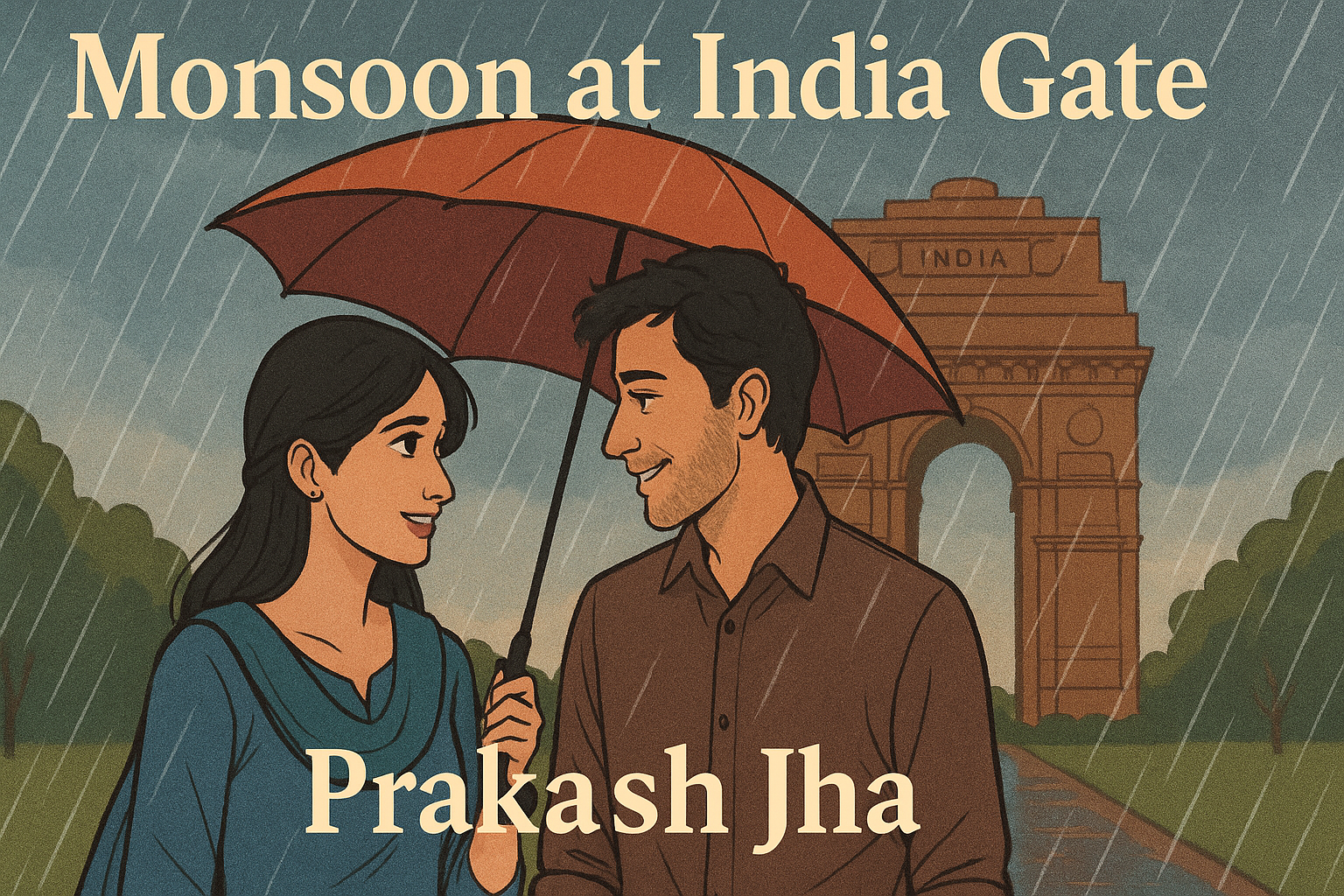
Prakash Jha
The First Glance
The Delhi sky wore the look of brooding poetry — thick grey clouds drifting low, full of unspent rain. July had entered like a wandering musician, with sudden showers and stolen breezes, giving the city its brief but beautiful monsoon glow. Aahana stood just at the edge of India Gate, her eyes scanning the horizon beyond the crowd. She was dressed in a soft blue kurta, her dupatta wrapped loosely around her neck, as if it, too, shared her mood of restless detachment.
She hadn’t come here with a plan. After a morning argument with her fiancé about something trivial — flowers for the wedding décor — she had stormed out of the café in Connaught Place and walked till her anger blurred into fatigue. Her phone buzzed in her bag, messages blinking like stubborn reminders. She ignored them.
Across the lawns, the India Gate stood with quiet grandeur. Families picnicked on the grass. A couple posed for selfies under an umbrella shaped like a watermelon slice. The ice cream vendor was doing brisk business despite the threat of rain. Aahana moved towards one of the benches near the fountain, brushing past children who squealed as they jumped over puddles.
And that was when he saw her.
Ved had been sitting there for over an hour, sketchbook on his lap, headphones in, watching the world go by with the detached interest of an observer. He wasn’t waiting for anyone. He often came here to sketch faces — strangers offered the most honest expressions. But when he saw her, there was something he couldn’t quite place: a kind of tired fire in her walk, the way her eyes darted everywhere yet avoided looking at anyone directly.
He picked up his pencil. First the outline of her stance, then the tilt of her chin, and then the shadow in her eyes.
It wasn’t until she walked closer — almost directly towards him — that their eyes met.
Aahana noticed the sketchpad first. Then the face behind it. A tall, slightly scruffy man in his late twenties, with kind eyes and ink-smudged fingers.
She slowed her steps.
“Are you drawing me?” she asked, a smile playing at the corners of her lips.
Ved blinked, caught in the act. “I guess I am.”
She raised an eyebrow. “Isn’t that rude?”
He chuckled. “Only if I get your nose wrong.”
That made her laugh, a real laugh that escaped before she could hold it back. Something shifted in the air between them. The distant sky grumbled.
“Can I see?” she asked, nodding toward the sketchbook.
Ved hesitated, then turned it around. It wasn’t perfect — it was raw, incomplete — but it caught something of her she hadn’t seen in a long time. A stillness behind her restlessness.
She looked at him for a long second. “That’s… surprisingly accurate.”
“Surprisingly?” he grinned.
“Well, I don’t usually look like someone in a painting.”
“Maybe you’re in the right frame now.”
Before she could respond, the first raindrop landed between them.
And so it began.
Serendipity and Chai
It rained all evening that day, soaking Delhi in silver streaks and a quiet kind of magic. Aahana didn’t expect to see him again. People you meet on rainy afternoons near monuments don’t usually return the next day. But when she found herself back near the same bench the following afternoon — umbrella in hand, wearing a different kurta — she tried to convince herself it was just a coincidence.
Ved was already there.
He looked up from his sketchpad with a sheepish smile. “You again?”
“I could say the same,” she replied, folding her umbrella. “Do you always haunt India Gate with a sketchbook?”
“Only when I’m procrastinating.”
She laughed and sat down beside him without asking. There was no awkwardness. No introductions. Just the comfort of something unexplained and strangely soothing.
That afternoon turned into a habit.
They met again. And again.
Over the next week, they began to map the city together. Humayun’s Tomb on a cloudy Wednesday. Lodhi Gardens on a misty Friday. Sunday at Khan Market, where they argued over which bookstore had the better coffee. Ved liked the chaos of Delhi’s streets; Aahana liked its silences hidden in corners — abandoned havelis, forgotten museums, tombs where no one went.
“I collect stories,” she told him one day. “Lost ones. Things people forget.”
Ved smiled. “I draw what people miss.”
They were, in some way, doing the same thing — archiving emotion.
Still, she didn’t tell him everything. Not about the wedding just two weeks away, not about the man she was supposed to marry — the polite banker with expensive cologne and a calendar full of meetings. With Ved, time folded. There was no pressure, no future talk, just the now — chai in clay kulhads, laughter over the absurdity of Delhi traffic, sketchbooks, and silence.
He didn’t ask too many questions either. He seemed to understand the value of letting things unfold.
But some silences began to speak louder.
One evening, they were sitting under the neem tree near India Gate again. The sky was lavender with the last of daylight, the ground still wet from a short rain. Aahana was tracing circles on the rim of her empty tea cup.
“I should probably tell you something,” she said quietly.
Ved didn’t respond immediately. Instead, he handed her his sketchpad. She flipped through — quick charcoal portraits, details of fountains, a skyline at dusk. And then — her. In different moods. Laughing. Thinking. Watching the rain.
She looked up, eyes wide.
“I know,” Ved said, his voice soft. “You don’t have to explain.”
“But—”
“You don’t owe me anything, Aahana.”
She wanted to believe that. But her heart ached at the weight of the truth — that she was falling for someone she wasn’t supposed to meet.
The wind rustled the pages between them. She whispered, “I wish I had met you earlier.”
Ved didn’t say anything.
But he stayed.
The Choice
A week before her wedding, Delhi wore a strange stillness. The monsoon rains had paused, leaving behind a humid hush that clung to the city like an unfinished poem. Aahana hadn’t returned to India Gate in three days.
She told herself she was busy — dress fittings, final guest lists, endless messages from her mother. But deep down, she knew she was hiding. From herself. From him.
On Raksha Bandhan, the city burst briefly into life. Siblings gathered, rakhis exchanged, laughter filled homes. Aahana sat in her room, watching raindrops gather on the windowpane. Her phone buzzed again — her fiancé texting about seating arrangements. She put it down and stared at the sky.
He hadn’t messaged. Ved. No calls. No sketches. No sign.
It was better this way, wasn’t it?
On the third day, restlessness overpowered reason. She took an auto to India Gate in the late afternoon, hoping — but not knowing — what she might find.
He wasn’t there.
The neem tree stood alone, its leaves dripping with memory. But as she turned to leave, something fluttered on the bark — a sketch, pinned with a rusted thumbtack. Her breath caught.
It was her — again. This time, she was smiling, umbrella hanging from her arm, the chaos of the crowd blurred behind her. There was something peaceful in her eyes — something she hadn’t seen in her own reflection for years.
Next to the sketch, scrawled in pencil, were the words:
“Some storms are meant to pass. Others are meant to change the sky.”
Her fingers trembled. She read it again.
That night, she didn’t sleep. She stared at the ceiling fan, listening to the city hum quietly outside her window. Her mother knocked twice. Her phone blinked with messages. But Aahana was somewhere else — beneath a neem tree, beside a boy with quiet eyes and a sketchbook full of her.
The next morning, she cancelled the wedding.
She told her mother first. Then her fiancé. Then her friends. There were tears, arguments, confusion. But through it all, she felt calm. She felt honest.
Days passed. The monsoon returned — a soft, warm rain that bathed Delhi in silver light. She wandered the city again, not looking for Ved this time, but for herself. She visited the places they had explored, carried his sketch in her bag like a compass.
It was nearly Diwali when she found him again.
He was sketching at Lodhi Gardens, under the same frangipani tree they’d once sat beneath. She didn’t say anything. Just sat beside him.
Ved looked up, blinking in surprise. “You came back.”
“I had to,” she said. “You changed the sky.”
He smiled — the same quiet smile from that first day.
They didn’t kiss. Not yet. They just sat together, watching the sun drip gold over the ruins, the air between them thick with everything unsaid, but understood.
And as Delhi lit up in celebration, two people found home — not in the city, not even in love, but in the simple truth of being seen.
Together.
END
Leave a Reply