
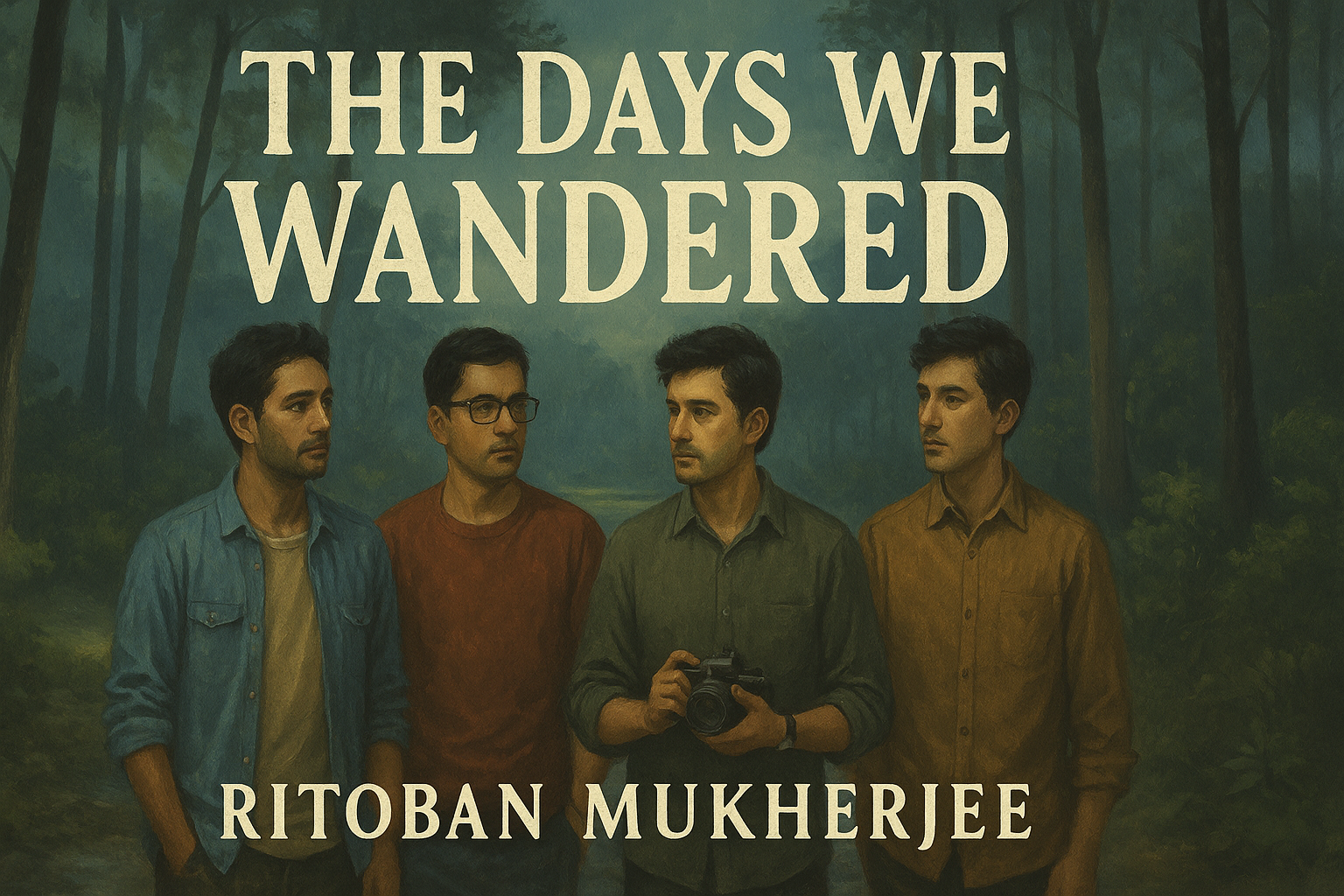
Ritoban Mukherjee
The Escape Begins
It started with a silence between four friends who had known each other since college but hadn’t spoken properly in months. The kind of silence that grows not out of absence but the slow sediment of routine. It was Pramit who broke it one humid Kolkata afternoon by posting a message in the group chat none of them had used in weeks: “I’m losing my mind. Let’s leave.”
The others didn’t ask where or why. Only Tushar replied with a thumbs up emoji. Ranjan added, “I’ll bring the flask.” And Neel, the most reluctant of the lot, sent a selfie with his overgrown beard and the words, “I already look like a vagabond.”
By the next morning, they had thrown duffel bags into the trunk of Ranjan’s battered Ford Ikon and were out of the city before sunrise. No wives, no girlfriends, no office emails, no explanation. Just four men in their thirties who hadn’t laughed freely in too long. They didn’t care about a destination. It was about escape—escape from schedules, from performance reviews, from gas bills and relationships that had long stopped singing.
They took the road north, deciding only at breakfast that they’d avoid all known tourist spots. Darjeeling, Kalimpong, even Shantiniketan were declared too “colonised by the bored upper middle class.” They wanted dirt roads, unknown trails, and guest houses that didn’t take online bookings. Somewhere remote, almost forgotten.
They stopped at tea stalls, small dhabas, and once at a riverbank where buffaloes outnumbered people. Tushar, ever the romantic, pulled out his Nikon and began capturing still lives of rusted fences and sleeping dogs. Pramit, who worked as a financial analyst and carried stress like a second skin, finally smiled. Ranjan, divorced and perpetually broke, sang old Suman Chatterjee songs behind the wheel while Neel scowled at the lyrics and kept adjusting the AC.
By late evening, they had left the main highway and entered the Sal forests of Jhargram. A local man at a tea shop, spotting their exhausted faces and dust-caked shoes, told them about a forest bungalow—abandoned mostly, barely maintained, but with beds and water. That was enough.
The bungalow sat in the heart of the forest, its green paint faded into the trees. One ancient caretaker unlocked it with the air of someone surprised they were still needed. Inside, cobwebs draped the windows like gauze and a single naked bulb buzzed like it resented its own light. But the silence was divine. No horns. No phones ringing. Just cicadas and the occasional hoot of something unseen.
That night, after rice, dal, and potatoes cooked in mustard oil by the caretaker’s wife, they sat outside under a sky brimming with stars. Real stars. Not the apologetic dots one saw from city rooftops. Pramit lay on the ground, arms outstretched, and said, “I want to disappear for a month.”
“Disappearing isn’t freedom,” Neel muttered, already sketching something in his pocket diary.
“Then what is?” asked Ranjan, sipping Old Monk from his steel flask.
Tushar didn’t answer. He was photographing the moon.
They didn’t speak of work or wives or politics. Only stories. College pranks. Broken hearts. Songs they remembered. Poetry they’d half-written and buried under deadlines. They laughed like boys and drank like men who didn’t need to perform for each other anymore.
At midnight, a sudden gust of wind swept through the trees, and a fox barked somewhere far. Tushar, startled, looked up and said, “It’s going to rain tomorrow. We should stay another day.”
“We don’t even know where we’re going,” said Neel.
“Exactly,” grinned Pramit.
Sleep came late and deep. Ranjan snored. Neel muttered lines of verse in his sleep. Tushar dreamt of a woman dancing barefoot under trees. Pramit, for the first time in months, dreamt of nothing.
The forest, old and wise, held them gently, as if it too had been waiting for company.
Whispers of the Forest
Morning arrived without the usual chaos of alarms or honking traffic. Only the persistent call of a koel sliced through the canopy, waking the men one by one. Ranjan was the first to stir, scratching his beard and stepping outside, barefoot, into dew-kissed grass. He lit a cigarette and looked at the trees like they were old friends who had grown silent over the years.
Neel sat cross-legged on the verandah, scribbling into his diary. The smoke from Ranjan’s cigarette curled over his words, but he didn’t mind. He liked recording fragments—images that had no narrative but felt important anyway. “One bird. One distant engine. One ant carrying a dead wing.”
Inside, Tushar was trying to frame the morning light as it fell unevenly across a cracked windowpane. He whispered to himself, testing the title for a photograph he hadn’t yet taken. Pramit, still half-asleep, leaned against the doorframe and said, “If you name that ‘Morning Nostalgia’ or some crap like that, I’ll kill you.”
“You wouldn’t know art if it danced naked in front of you,” Tushar shot back, grinning.
After a breakfast of leftover rice and spicy omelette, they decided to explore. The caretaker, a bent man who introduced himself only as Hari, pointed them down a path that “led to a forgotten temple and a river with no name.” That’s how he said it. “A river with no name.” It sounded like poetry. Or prophecy.
They walked single file, the forest growing thicker around them. Sal trees towered like ancient sentinels. The air was cool and rich with the scent of damp soil and leaf decay. The sunlight filtered through the high canopy in slanted beams that made the trail feel almost sacred. No one spoke much. Only the rustle of leaves underfoot and the occasional whirr of cicadas filled the silence.
They passed termite mounds tall as children, and once, a chameleon, perfectly still on a tree trunk, blinked at them with supreme disinterest. At one point, they crossed a clearing where the ground was soft with moss, and Tushar insisted they all lie down. Just like that. Four grown men flat on their backs, arms spread like fallen leaves, staring at a patch of sky rimmed in green.
“What if this is all life should be?” Pramit asked. “Waking, walking, eating, sleeping. With nothing to prove.”
“Then why do we always run away from it?” Neel murmured.
No one answered.
Eventually, they reached the temple—if one could call it that. It was more of a stone ruin, overtaken by vines and roots. The deity’s face had been worn smooth by time or neglect. Someone had placed a fresh marigold garland on the moss-covered idol, though. Signs of faith always lingered, even when belief did not.
Beyond the temple, the river was little more than a wide, lazy stream, its waters dark and slow, reflecting branches like ink on glass. Ranjan took off his shirt and waded in. The others joined, hesitant at first, then carefree. Laughter echoed off the water. They splashed, floated, shouted into the trees. They were thirty-five going on fifteen.
Neel stayed on the bank, sketching. He was drawing Tushar in mid-leap, water droplets suspended in the air around him like falling stars.
“Why don’t you ever join in?” Tushar called to him.
“Because I don’t want to ruin the stillness,” Neel replied, without looking up.
When they returned to the bungalow, Hari was gone. In his place, a small clay pot of rice and egg curry steamed gently on the verandah table. Ranjan whistled. “Forest hospitality,” he declared, and they ate like men who had earned hunger.
The rest of the afternoon passed in slow motion. Tushar developed some photos on his old DSLR. Pramit attempted to nap but ended up reading a book of Tagore poems he found tucked behind a broken cabinet. Ranjan, always restless, took to repairing a broken chair with twine and some vague sense of purpose. Neel paced the verandah like a caged poet, occasionally stopping to stare at ants or peel the bark from a stick.
Evening fell suddenly. The forest doesn’t soften its transitions. Light vanished, replaced by a dense blue, and the forest began its nightly opera—crickets, frogs, the distant growl of something that may or may not have been real.
They lit a fire just outside the bungalow. Wood crackled. Shadows danced on their faces. They drank again, not to forget but to remember differently.
Tushar, tipsy and thoughtful, said, “We’ll go back to our lives and call this a ‘trip’—like it was an item we ticked off. But this… this feels like something else.”
“Like what?” asked Pramit.
“A pause. A sentence before it finishes. A breath before the next heartbreak.”
“I think I fell in love with a tree today,” said Ranjan, very seriously.
They laughed until their sides hurt.
Later, as they drifted off to sleep, a sudden gust of wind slammed a door shut. No one moved. Outside, the forest whispered again—its old, strange lullaby.
And somewhere deep inside it, something heard them.
Among Strangers, We Belong
They had only planned to stay a day or two, but the forest had its own calendar, and the men had lost their need for clocks. On the fourth morning, Hari reappeared with a packet of beedis and news: a village a few kilometres deeper was hosting a local festival that night—Bhadu Utsav, he said. Music, dance, fire torches, rice wine, body paint. It happened once a year, rarely witnessed by outsiders.
The decision was unanimous. They packed a cloth bag with biscuits, salt, and two flasks—one filled with water, the other not. They followed Hari on foot, through trails so narrow they had to walk sideways in places, thorns scratching at their jeans, spiderwebs sticking like memories you didn’t ask for. Tushar documented the journey with quiet reverence, his lens capturing everything—gnarled roots, a green beetle, a string of prayer flags tied to a nameless tree.
By noon, the forest thinned and the village emerged like a forgotten painting. Mud houses stood in loose circles, their walls decorated with alpona and tribal symbols in white rice paste. Chickens ran free, children stared with open curiosity, and smoke curled from chimneys that belonged to stoves older than any of them. It was a world stitched together by rhythm and repetition, but nothing felt tired.
An elderly woman, skin creased like riverbeds, stepped forward with a firm smile and offered them water from a steel glass. “You are guests,” she said in halting Bengali, “and tonight is a good night for guests.”
There were no hotels here. No resorts or tariffs. They were given a small empty hut to rest in and sweet rice wrapped in sal pata. The villagers went about preparing for the festival—painting walls, drying garlands, hanging coloured bulbs powered by a long black wire connected to a dusty generator. The air grew festive not from decoration but from spirit.
Pramit lay on the mud floor, hands under his head. “You know, when I was a kid, I used to imagine running away to a village like this. No city, no offices. Just earth, food, and songs.”
“You’d last two days,” Neel muttered, sharpening his pencil with a borrowed blade.
“Maybe,” Pramit admitted. “But in those two days, I’d breathe more than I do in a year.”
That evening, as dusk slid over the village like a shawl, drums began to beat. Slow at first, then faster. Children with lamps danced in circles, their shadows leaping across walls. Women, wrapped in red-bordered sarees, carried clay pots on their heads, swaying to rhythms that seemed older than language. A man with a painted face performed a mock play about love, betrayal, and rain. Tushar stood frozen, his camera at his side, overwhelmed. Ranjan clapped along. Pramit joined a group of men drinking mahua under a neem tree. Neel sat quietly, watching a young girl paint a wall with white patterns that looked like constellations.
Later, one of the village boys led them to a raised bamboo platform. “Dance,” he said, simply. At first they hesitated. But then the music took hold—raw, percussive, urgent. One by one, they gave in. Neel even smiled. Tushar danced badly but with joy. Ranjan spun with a local boy like a drunk peacock. Pramit closed his eyes and moved with the kind of freedom he didn’t know he had missed.
There were no selfies, no reels, no hashtags. Just sweat and soil, sound and silence.
After the dancing ended, they were given more food—boiled yams, spicy fish, and puffed rice. The elders drank under the banyan, telling stories of tigers that had become spirits, of lovers turned into trees. Tushar tried translating one of them but gave up halfway, laughing.
“You don’t translate stories like these,” he said. “You just absorb them.”
They slept that night on straw mats under a thatched roof. Ranjan snored like a tractor. Neel whispered to himself in rhymes. Tushar kept a small diya burning beside his pillow. Pramit stared at the bamboo ceiling, wondering if maybe this too was a kind of truth—the kind you don’t measure with logic or ambition.
At dawn, they woke to the sounds of goats bleating and a woman singing near the well. The world here didn’t ask permission to begin again.
Before they left, the girl who had painted the constellations gave Neel a bundle of dry leaves tied with thread. “For luck,” she said, eyes clear and sure.
They walked back through the forest in silence, the kind that comes not from awkwardness but fullness. The trees now felt familiar. The earth remembered their steps.
At the bungalow, Hari was boiling rice. “You came back,” he said, without turning.
“We belonged for a moment,” Pramit replied. “Maybe that’s enough.”
Neel placed the bundle of leaves on the verandah railing like an offering.
Inside, Tushar uploaded a single picture onto his camera’s preview screen—the night’s bonfire glowing behind a half-circle of dancers, blurred in motion, unnamed, unforgettable.
He didn’t caption it. Some things weren’t meant to be explained.
Evenings of Fire and Philosophy
The days slowed into amber. The forest seemed to accept their presence now—not as tourists, but as temporary inhabitants. Mornings were no longer rushed; they moved with the rhythm of birdsong and wind. No alarms. No urgency. They woke when their dreams had finished speaking.
After their return from the village, something shifted. They spoke less, but the silences between them felt richer, like riverbeds deepening over time. Ranjan began writing letters to his ex-wife that he never intended to send. Pramit took to walking barefoot through the forest, as if trying to memorize its texture. Neel drew the same tree again and again from different angles. Tushar stared at the sky like it owed him an answer.
One evening, they decided to build a larger fire. Ranjan had found a dry patch of wood behind the bungalow, and Neel carved out a shallow pit with a flat stone. The sun dipped slowly, bleeding orange through the trees, and as dusk thickened, they lit the flame.
No one spoke for a while. They simply sat—four silhouettes huddled around a pulse of light, listening to the crackle. The forest around them hummed with its nightly choir, a concert they had begun to understand in layers—frog, owl, wind, insect, distance.
Pramit broke the silence. “Do you ever feel like you missed a turn? Like life was offering you something else but you chose the wrong door?”
Ranjan chuckled. “All the time. But then again, maybe there was no right door. Just doors.”
Neel took a swig from the flask and said, “What if it’s not about doors at all? What if it’s about how we walk through whichever one we choose?”
Tushar tossed a twig into the fire. “I think I’ve spent more time documenting life than living it. Always behind the camera, always looking at others feel things.”
“And yet you’re the one who sees it all,” said Pramit.
“Seeing isn’t the same as feeling,” Tushar said. “Not always.”
Ranjan lay back, his head on a folded towel. “You know, when I was married, I thought comfort was happiness. A working fan, a hot meal, a soft voice at the end of the day. But it turns out comfort isn’t love. And love isn’t comfort.”
No one interrupted. The fire flickered in agreement.
Neel, who rarely spoke of emotions, suddenly said, “I think we confuse roles with reality. I’ve been a son, a colleague, an artist. But I don’t know who I am when no one’s watching.”
Tushar looked at him, surprised. “And who do you think you are here?”
“Scared,” Neel replied. “And free.”
They sat like that for hours—no phones, no news cycles, no curated opinions. Just words that rose and fell like embers, drifting into the forest. Pramit told a story about his father’s silence. Ranjan recited a poem he had once written on a train but never shared. Tushar described a dream where he drowned in light. Neel finally confessed he hadn’t drawn anything real in years.
They roasted small potatoes in the fire, their skins charred and cracking, the insides soft and hot. It was the best meal they’d had in days. Not because of taste, but timing. Food tastes different when your soul is open.
At one point, a fox passed by the edge of the clearing. None of them moved. It paused, looked at them, and vanished into the dark like a forgotten thought.
“Do you think we’ll remember this night?” Pramit asked.
“Not with precision,” said Tushar. “But we’ll remember how it felt.”
Ranjan looked up at the stars. “Maybe this is all a friendship really is. Sitting quietly and letting someone else’s thoughts enter your silence.”
They stayed by the fire until the last log surrendered. Then, slowly, they drifted back into the bungalow. Not all at once—like autumn leaves falling in staggered rhythm.
That night, the wind howled. The kind of sound that stirs memories you didn’t know you still carried. Neel dreamed of a girl he once kissed in a library. Ranjan dreamed of home, but it wasn’t his. Tushar didn’t sleep. He watched the dying embers from the window. Pramit, for the first time, didn’t dream at all. His mind was still.
Outside, the forest continued its quiet breathing, unaware of the transformations it had sparked. Or maybe it knew. Maybe it had seen this kind of unraveling before.
Maybe this was its gift—not wonder or wisdom—but the gentle peeling away of everything you thought you had to be.
A Girl with Anklets
They first saw her by the stream, on a day soaked with sun and stillness. The air was heavy with the scent of shiuli and damp moss. Tushar was the first to notice—a flicker of movement, not bird, not leaf, but human. A girl stood on a flat rock in the middle of the stream, her feet bare, her skirt lifted slightly to avoid the water, her silver anklets catching sunlight like laughter. She was humming something. Not a song they recognized—just a tune the forest must have taught her.
She noticed them too but didn’t move. Just smiled, then bent to pick something from the water. A leaf maybe. Or a lost idea.
Ranjan muttered, “This is the start of a poem.”
Tushar raised his camera but didn’t click. “Some frames aren’t meant to be captured,” he said. “Just remembered.”
She disappeared into the woods without a word. No trace. Only the echo of her presence, and that soft metallic jingle.
Back at the bungalow, none of them mentioned her directly. But their sentences twisted toward her like vines seeking sunlight. Neel began sketching feet in motion. Ranjan composed three bad couplets and one haunting line. Tushar roamed the same stretch of stream twice that afternoon. Even Pramit, who rarely romanticized anything, cleaned his shirt and combed his hair before the evening tea.
The next morning, she was there again—this time collecting firewood in a woven basket. She wore a mustard saree tied above her knees and had two long braids that danced with each step. This time, she spoke.
“Tourists don’t usually stay this long,” she said, her Bengali lilting with a rural rhythm.
“We’re not tourists,” said Pramit.
“Then what are you?” she asked, arching an eyebrow.
“Lost,” Neel replied, without looking up from his notebook.
She laughed. It was brief, but not mocking. “Lost things often end up here.”
Her name was Jaya. She lived in a small cluster of huts near the eastern edge of the forest with her grandmother and two goats named after Hindi film stars. She studied in a town college once, but dropped out when her father died. “I don’t miss the college,” she said, “but I miss the reading.”
Over the next few days, she appeared often—sometimes by chance, sometimes with purpose. She brought them hand-woven baskets, once a clay diya, and once, boiled jackfruit wrapped in sal leaves. She never stayed long. Just long enough to disorient them.
Especially Tushar.
He followed her with his eyes like she was a story he didn’t know how to tell. Not lust, not fantasy—something stranger. A photographer’s curse: the need to preserve what was never his.
One late afternoon, while the others slept, Tushar found her by the temple ruins. She was tracing patterns into the dust with her toe.
“I’m not used to people who don’t want to leave,” she said.
“And I’m not used to places that make me want to stay,” he replied.
They didn’t flirt. Not in the usual way. But their words leaned toward each other, like bodies in a crowded room.
“Why do you carry that camera everywhere?” she asked.
“To remember.”
“Then what do you carry when you want to forget?”
Tushar had no answer.
She left him there, with shadows lengthening and a strange ache in his chest. He didn’t follow. But he watched until even her footprints were gone.
That evening, he didn’t drink. Didn’t joke. Just sat by the fire, silent. The others noticed, but no one asked. Sometimes the heart shifts in such quiet ways that language becomes disrespectful.
Later that night, Neel found him sitting alone by the verandah.
“You’re not in love,” Neel said, lighting a cigarette. “You’re in awe.”
“What’s the difference?”
“In love, you think you deserve something. In awe, you know you never can.”
Tushar exhaled. “She has bells on her feet, Neel. Even her walking feels like music.”
Neel didn’t reply. Just passed him the cigarette. They sat, wordless, listening to the forest whisper things neither of them could translate.
The next morning, Jaya didn’t appear. Nor the day after.
Tushar searched the stream, the temple, the village paths. Nothing. Ranjan said maybe she was a dream. Neel joked maybe she was the forest in disguise.
Only Pramit looked serious. “Some people come into our lives not to stay, but to stir.”
On the third evening, a small cloth pouch arrived with Hari. Inside was a scrap of paper with a short note: “Don’t wait. The forest has already given you what you needed.”
There was also a silver bell. Just one.
Tushar didn’t cry. But that night, he didn’t sleep.
He sat up till dawn, the bell in his hand, the forest all around him, vast and unknowable.
And somewhere, in a corner of that infinite quiet, a girl with anklets walked away forever—her echo still trailing behind.
Letters Never Sent
The rain arrived without drama—no thunder, no warning. Just a steady, hushed curtain falling over the forest, soaking leaves, earth, thoughts. The four of them sat huddled inside the bungalow, their belongings pulled close, as if touch might protect them from the quiet unraveling they all sensed but didn’t speak of.
Ranjan was the first to grow restless. “I need to walk,” he said, rising abruptly. “This bungalow is shrinking.”
“Don’t be dramatic,” Pramit said. “It’s the weather.”
“No. It’s the waiting,” Ranjan replied, already pulling on his sandals.
He didn’t say what he was waiting for. Perhaps none of them knew what exactly had begun to shift—but they all felt it. As if the forest, after cradling them for days, was now preparing to let them go.
By late afternoon, the rain softened into a mist, and they ventured out together. The ground squelched underfoot, the air smelled of wet bark and soft rot. They followed a trail none of them remembered choosing. That’s how most of their days had gone—instinct over itinerary.
After an hour’s walk, they found the building.
It stood alone in a clearing, brick and tin, more ruin than structure. The windows were shattered, and a neem tree had grown right through its roof. A wooden sign hung by one rusted nail: Post & Telegraph Office – Dighari Forest Sector. The words were barely legible.
“This is from a different world,” Tushar whispered.
Inside, time had stopped. Dust coated everything. A pigeon fluttered past. A faded calendar from 1996 still hung on a crooked nail. A wooden desk stood in the middle, its drawers swollen shut from damp. In one corner, a rusted mailbox overflowed with cobwebs and dead insects.
Pramit walked to the desk and opened a single notebook. The pages were brittle, but some ink still clung to the lines—entries in Bengali, English, and Hindi. Mostly undelivered letters.
To mothers. To sons. To gods. To lovers who never replied.
“People wrote things here and never posted them,” Pramit said.
“Maybe they didn’t want them posted,” Neel replied.
Ranjan sat down on the floor and picked up a dry sheet of paper. “Let’s write,” he said.
“To whom?” Tushar asked.
“To whoever we still carry.”
No one argued. They didn’t even joke about it.
The next hour passed in the kind of silence that feels sacred. They found yellowed paper, the backs of old receipts, torn pages from ledgers. Each man sat in his corner of the broken office, scribbling. The sound of rain resumed outside, soft against the roof, like fingers drumming gently on a door left half-open.
Tushar wrote to Jaya. He didn’t mention her name, but the rhythm of her feet, the glint of her anklets, the way she spoke without needing explanation. He ended it with: “I didn’t fall in love. I remembered what it felt like.”
Neel wrote to no one and everyone. A strange, lyrical note to the forest itself. “You peeled me back without touch. You showed me the mirror before I was ready. You were cruel. And perfect.”
Ranjan wrote to his ex-wife. Not to ask for forgiveness, not to rekindle, but to explain. “I left long before I left. I know that now. And maybe that’s what hurts most.”
Pramit wrote to himself. Or to a younger version, full of hunger and confusion. “You will carry things longer than you should. But you will also learn to put them down. Slowly. Carefully. Without drama.”
When they finished, they didn’t share their letters. They placed them gently inside the rusted mailbox, sealing it with a stone. Not for delivery, but for release.
As they stepped back into the mist, Ranjan said, “We’ve sent them to the right address, finally.”
“What address is that?” Tushar asked.
“The one that doesn’t expect a reply.”
They returned to the bungalow in the last light of day, their shoes soaked, their hearts strangely light.
That evening, they didn’t speak much. The fire crackled softly. Rain tapped the roof like an old friend arriving late. Neel sketched the broken post office from memory, drawing their four shadows elongated across the wet floor.
Tushar developed one photo from earlier—the rusted mailbox, just after they placed their letters inside. No people. No hands. Just the box and rain-blurred glass behind it. He titled it “For the Unsent.”
Pramit read the last page of the notebook he’d found, a line scribbled in hurried English: “If no one hears your voice, write anyway. The forest will listen.”
They slept better that night. No dreams. No tossing. Only the soft certainty of having unburdened something they didn’t know they were carrying.
And outside, under trees older than memory, the forest cradled their words gently, like fallen feathers.
Storms Outside, Quieter Within
The storm came in the middle of the night, sudden and wild. The trees thrashed like drowning men. Thunder cracked the sky open. Rain poured as if the heavens had broken something they couldn’t fix. Inside the bungalow, the four men sat awake in the flickering light of a single lantern, their shadows trembling across the walls.
No one tried to sleep.
Water began to seep in under the back door. Ranjan stuffed it with towels. Tushar stood by the window, counting the time between lightning and thunder. Neel wrapped his sketchbook in a plastic sheet and placed it high on a shelf. Pramit, unusually quiet, simply stared at the fire, coaxing it to stay alive.
“Feels like the forest wants us gone,” Ranjan said, wringing out his wet towel.
“Or maybe it wants us to stay till we’re hollowed out completely,” Neel muttered.
“You think places can… read us?” Tushar asked. “Like they know who we are before we say a word?”
“Some places don’t read you,” Pramit said. “They remember you.”
The storm didn’t let up. It grew angrier, more insistent. The roof leaked in three places. A tree branch slammed hard against the side of the bungalow. Yet somehow, inside, they didn’t panic. The fear was physical, yes—but also strangely meditative, like nature itself was trying to wash something off them.
By dawn, the storm had not stopped, but it had slowed—tamed into steady rain. They stepped out together, raincoats and makeshift covers over their heads, and saw the wreckage. Branches everywhere. A nearby path blocked by a fallen jackfruit tree. The bamboo fence Hari had built was gone. The trail toward the stream now looked like a river.
And yet, the air was cool. Sweet, even.
They walked without speaking. The rain soaked them, but no one turned back. Mud sucked at their shoes. Birds, brave and loud, had already begun their post-storm arias.
They stopped near the clearing where they’d first seen Jaya. The rock in the stream still stood, half-submerged now. Her absence felt even more present in the aftermath.
Ranjan sat on the wet grass and said, “I think I’ve never really let myself break. I just… crack a little every year.”
Neel nodded. “I always thought healing meant going back to who you were. But maybe it means becoming someone new.”
Pramit crouched beside the stream, watching the water swirl. “I spent ten years planning every step of my life. And now, I’m here, with no signal, no watch, no clue what comes next. And weirdly… I feel safe.”
Tushar took a picture of the rock, now empty. “I think I needed this place to tell me what I already knew.”
“What’s that?” Ranjan asked.
“That I don’t need to hold on to everything to prove it mattered.”
They stayed like that for a while—sitting, thinking, unthinking. The storm had done something to them. Or perhaps revealed what was already undone.
Back at the bungalow, they changed into dry clothes and made tea with the last of the milk powder. The fire had gone out, but none of them tried to relight it. The warmth was within now.
Later that afternoon, Pramit finally opened his laptop. Not to check emails, but to write something. Not a report. Not a presentation. Just a few lines he didn’t intend to save:
“What the city took with schedules, the forest gave back with silence. And maybe silence isn’t empty after all. Maybe it’s just full of things we forgot how to listen to.”
Neel copied that into his notebook, without asking. Pramit didn’t mind.
That evening, they didn’t speak much. But there was no tension—only a quiet that felt earned. Tushar passed around his camera and let each of them scroll through the pictures. No one critiqued. No one posed. These weren’t images for sharing. They were proof of having been.
Ranjan cooked dinner—khichuri, improvised with whatever was left. Neel sliced onions. Pramit found a few dry sticks and lit a small fire again. The simplicity of the moment made it beautiful.
As they ate, the storm fully passed, and a moon peeked through frayed clouds. Not bright. Just enough.
Tushar raised his tin cup. “To the storm.”
They clinked their cups, not loudly. Not ceremoniously. But with the weight of people who had survived something intangible.
And somewhere deep in the dark woods, as the trees whispered once more, the forest listened.
Return with Dust in Our Eyes
They left just after sunrise.
No announcement. No final ceremony. Only a quiet understanding that the forest had given them what it could, and staying longer would be like overwatering a flower that had already bloomed. Hari stood on the porch, his hands folded behind his back, watching them load the car. He didn’t ask where they were going. No goodbyes. Only a nod that felt heavier than speech.
The road out was half-flooded and littered with fallen branches, but they didn’t rush. No one looked at their phones. No music played. Ranjan drove slower than usual. Each bump on the road felt like punctuation—a full stop, a comma, an ellipsis.
In the rearview mirror, the forest shrank but didn’t disappear. It clung to them in invisible ways—in the creases of their shirts, the mud on their shoes, the silence in their throats. Neel had a small leaf tucked between the pages of his sketchbook. Tushar held the silver bell in his fist, not like an artifact but like a promise. Pramit wore the same clothes he had arrived in, but something about his shoulders was softer. Lighter.
They stopped at a roadside stall just before the highway met the world again. Clay cups of tea. Toasted bread with salty butter. The shopkeeper tried making conversation, but they weren’t ready yet. Their words were still recovering from the weight of too much honesty.
It wasn’t until hours later, when the skyline of the city returned like a forgotten enemy, that Ranjan finally said, “We’re going to forget this.”
“No,” said Tushar. “We’ll just remember it differently.”
Neel added, “Not as a place. But as a moment.”
They dropped each other off one by one.
Neel was the first to go, back to his one-room studio near Southern Avenue. He didn’t wave. Just nodded and stepped out, his bag slung across his back like a burden he now knew how to carry.
Ranjan was next. He lived in an apartment that echoed more than it used to. As he entered the gate, he looked back once—not at the car, but at the empty street behind it. Like he was saying goodbye to a version of himself still walking somewhere barefoot in the woods.
Tushar went last. His home was filled with photographs that now felt posed. He plugged in his camera and copied the folder titled “Forest_September” to his desktop. Then, without hesitation, he deleted it from the memory card. He didn’t need the digital proof.
That night, Pramit stood alone on his balcony. The city hummed around him—traffic, voices, advertisements blinking across buildings. He held a cup of tea and looked up at the sky. There were no stars.
But in the cup’s reflection, a single light flickered. Like the diya Jaya once carried. Or maybe just a plane.
He smiled. Not because he was happy. But because he was real.
In the days that followed, they all returned to their routines—but not quite. Ranjan started volunteering at a night school for children who had never heard of Shakespeare. Neel took on fewer clients and more blank pages. Tushar submitted an exhibit proposal titled Uncaptured. Pramit turned off his work phone on Sundays. For the first time in years.
They met again, three weeks later, in a coffee shop with glass walls and expensive cakes. No one wore forest clothes. No one smelled of earth. But something in their eyes had changed.
They talked about small things—traffic, cricket scores, office jokes. But under the table, Ranjan passed them each a copy of a small, self-published book. The cover was plain brown. No title. No author name.
Inside, a single line on the first page: “To the forest, which remembered us better than we remembered ourselves.”
The rest of the pages were blank.
Tushar smiled and said, “Perfect.”
They didn’t speak of going back. Because maybe the forest didn’t need them again.
But one day, they might find another trail. Another detour.
Because men like them didn’t travel for the scenery anymore.
They traveled for the silence between footsteps.
For strangers who spoke without words.
For places that broke them gently.
For fires that didn’t burn but warmed.
And above all, they traveled not to escape the world.
But to remember how to belong to it again.
END
Leave a Reply