
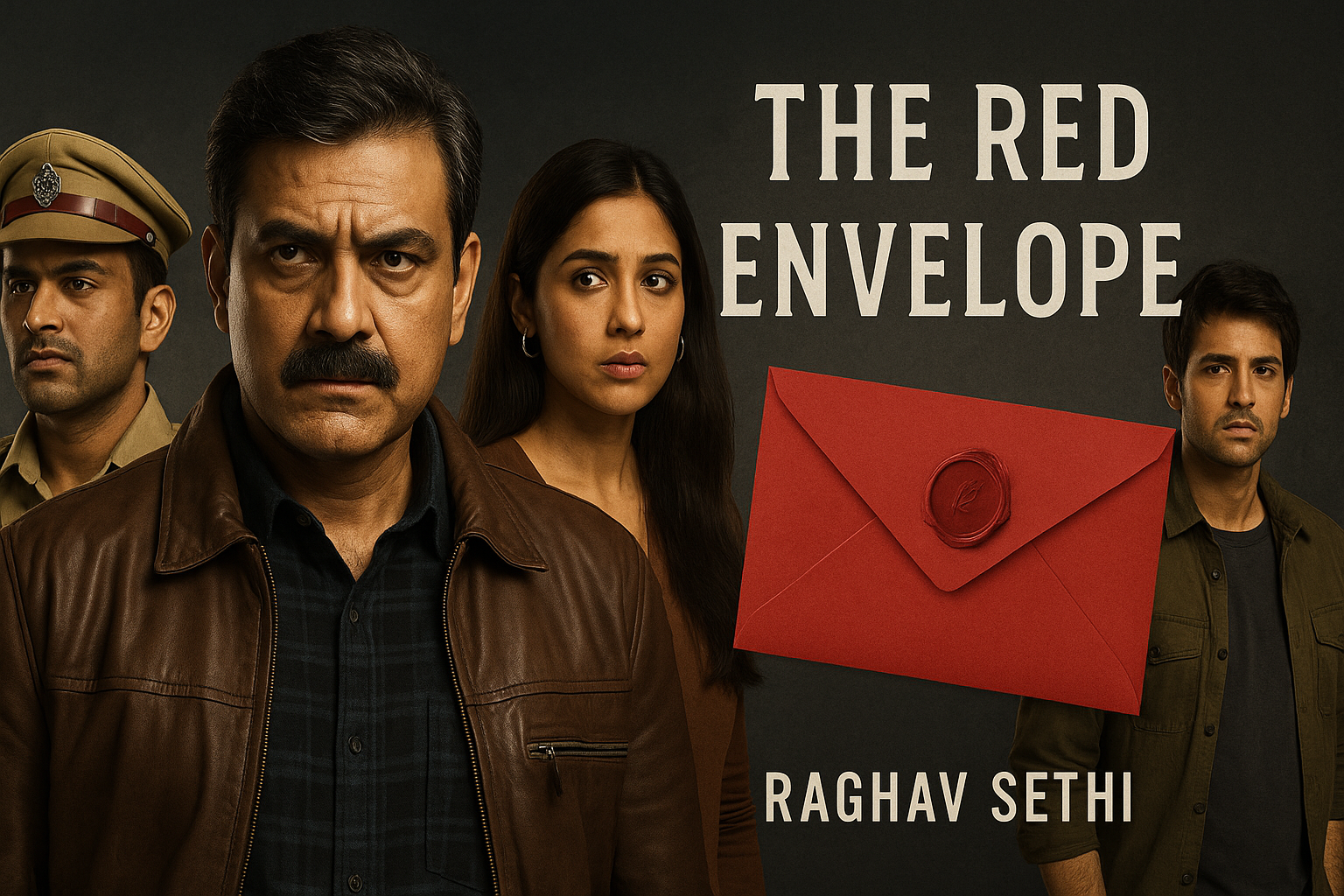
Raghav Sethi
Hauz Khas, 3:47 AM
It began with the sound of dripping water. Inspector Ayaan Malik wiped sweat from his brow despite the midwinter chill and stepped further into the abandoned house in Hauz Khas. His torchlight danced across graffiti-covered walls and shattered glass. Rats scurried over dried leaves on the floor. The report had come in anonymous—just a single line typed in Courier font: “You’ll find her where memories rot.” That could mean anywhere in Delhi, but the envelope it came in—red, thick, wax-sealed—was dropped off at Hauz Khas Police Station. No fingerprints. No postage. Just a symbol on the back: a broken hourglass.
Ayaan’s junior, Constable Meenal, stood near the staircase, face pale. “Sir, basement.” That’s all she said. Ayaan followed, each step creaking like an accusation. He had seen death before. The grotesque, the unspoken, the kind that clings to your clothes long after you’ve showered. But this felt different. The air itself seemed heavier, as if it mourned. The basement door was slightly ajar. Beyond it, darkness.
He pushed it open. A bulb flickered on instinct, its hum like a mechanical whisper. There she was.
The girl, no older than twenty, lay curled near the furnace. Her hands were bound with red ribbon, eyes open but lifeless. A feather—bright blue—was tucked behind her ear. The kind you’d find in stage costumes. The walls had scribbles in chalk. Numbers. Coordinates. And a note taped to her wrist.
Ayaan pulled it free carefully. Again, Courier font.
“She’s the first. You’ll understand the game soon.”
Delhi had seen crimes, but this had a ritualistic stench. It wasn’t just a murder—it was a performance.
By 5:12 AM, the house was swarming. Forensics, crime photographers, DCP Saxena. “Who the hell sent this?” he barked.
“No prints, no CCTV hits near the station,” Meenal said. “But, sir—this was left in the front gate. Not thrown. Placed.”
Deliberate. Controlled. Someone wanted to be seen, just not too clearly. Ayaan stared at the hourglass on the envelope again. Broken. Time was running out for someone—or everyone.
Later that morning, in his Lajpat Nagar flat, Ayaan poured himself black tea and stared at the envelope again. He’d kept it. Something about it was too personal. The handwriting, the wax, the blue feather. It rang a bell, distant but familiar. He pulled out his old case files from 2019. A murder in Connaught Place. A performer strangled backstage. Another blue feather. Another note. Case never solved. Suspect never found. But that envelope had never appeared back then.
His phone buzzed. Unknown number. A voice, distorted: “Four days. Four bodies. Four riddles. Unless you remember your past.”
Then the line went dead.
That day, Delhi felt like it was holding its breath. Newspapers had gotten hold of the body photo. “Feather Killer?” the headlines screamed. That’s how it begins—the public feeding frenzy. Speculation. Panic. Half-truths.
At the station, Ayaan stared at a map of Delhi. The coordinates scrawled on the basement wall matched the vicinity of Chandni Chowk. Historical, chaotic, the kind of place that hides sins behind centuries-old bricks. He and Meenal drove there by noon. The coordinates led to an old haveli now functioning as a spice storage godown. It reeked of dried saffron and decay.
Inside, another note. Pinned under a rusted lamp.
“Spices burn. But memories fester. Third clue waits under the lion.”
It made no sense. Meenal asked, “Is this… a riddle? Or a reference?”
Ayaan’s mind spun. The performer in 2019 had once starred in a children’s play called The Blue Feather and the Lion’s Cry. A forgotten production by the Janak Theatre Group in South Delhi. He called an old contact, Tanya Bedi, a journalist who once covered underground theatre.
“Janak Group?” she said. “Long gone. Shut after a scandal. Drugs, exploitation, one actor disappeared.”
Ayaan’s stomach turned. That actor was Ria Malhotra—the girl in the basement.
That night, Ayaan couldn’t sleep. The call, the notes, the blue feather—they weren’t just clues. They were memories, resurfacing. He had met Ria once, briefly, when the 2019 case crossed into his old jurisdiction in Patel Nagar. She had come to file a complaint, trembling, bruised—but disappeared before the case could proceed.
He opened his old journal from that year. A page torn. Why?
Morning brought no peace.
Another envelope. Another red seal. No stamp.
“Body two. North Campus. Where books lie but truth doesn’t.”
He raced to Delhi University Library. It was Sunday, but the guards let him in once they saw the badge.
In the history archives, near the British-era documents, she lay. Second body. Same ribbon. Same feather.
But this time, she wasn’t unknown.
A file photo matched: Anya Grewal. Ria’s co-actor from The Blue Feather. The one who had defended the group’s director back then, called the accusations “artistic differences.”
Now she was dead.
And another note was tucked between the books.
“When truth dies, stories take over. Third under the lion, still.”
Ayaan stared hard. He remembered now.
The Janak play had ended in chaos during its last show. A lion statue on stage had collapsed mid-performance. Some called it sabotage. The lion… The sculpture was still lying abandoned near Mandi House, outside the theatre ruins.
He and Meenal drove there before nightfall. The broken lion head was covered in moss.
Inside the hollowed eye socket—yes, another note. Dry. Folded. Neatly placed.
“Three souls sang. One soul vanished. One survived. You.”
That’s when it hit him like a slap. Ayaan had once acted in The Blue Feather. Briefly. Before he joined the force. A college internship. He had played the masked character—the Judge—on stage.
Ria. Anya. The third? Who was the third?
He whispered to the wind, “Who are you?”
Behind him, a camera clicked.
He turned sharply.
No one there.
Only the rustle of leaves.
And a ticking watch, left deliberately on the lion’s paw.
It was counting down.
Three days left.
The Third Voice
The ticking stopped at 11:59 PM. Ayaan stared at the old wristwatch left on the lion statue—an antique Omega, cracked glass, frayed leather strap. But beneath the rusted dial, etched in crude letters, was a single word: “Forgiven?” A question. Or a trap.
Meenal stood behind him, flashlight flickering. “Sir, whoever this is… they know your history. Not just the case—you.”
Ayaan pocketed the watch. “This is personal now.”
Driving back through the empty Connaught Place circle, he tried to remember. College. Theatre. Ria, Anya—and someone else. A third actor. The one who played the blue-feathered child. The memory felt fogged, like it had been chemically scrubbed from his brain. But one image returned—eyes lined with kohl, trembling as the curtain fell. Someone crying backstage. Someone he had left behind.
He reached home and opened the old storage trunk in his cupboard. In a plastic folder, beneath tax receipts and newspaper clippings, was the original Janak Theatre script. The Blue Feather and the Lion’s Cry. He flipped through the yellowing pages, pencil marks in the margins.
CAST:
Ria Malhotra – The Queen of Dust
Anya Grewal – The Oracle
R— — — – The Child with the Feather
Ayaan Malik – The Judge
The third name was erased. Just the initial “R”. As if it had never existed.
He didn’t sleep that night. Just sat at his desk, watching old performance clips stored on a battered hard drive. In one grainy video, dated April 2018, three figures stood center stage. Ria, Anya, and someone in a blue tunic. The Child. Face turned away. But the voice—young, broken, hopeful—rang clear.
“I remember what they did. I remember everything. But will they?”
Ayaan paused the video. Rewound it. Zoomed in. The blue tunic had a brooch—circular, red stone center, two wings on each side.
He’d seen that brooch before.
Next morning, he drove to a pawnshop in Paharganj, dusty and unassuming. He remembered the place from an old narcotics bust—run by a man named Sharif who hoarded theatre props. Sharif was missing two teeth and had an encyclopedic memory.
“You came for her,” he said without prompting. “The girl who wore the stone wings. She pawned it. 2019. Said it brought bad luck. Paid me to keep it hidden.”
Ayaan showed him a screengrab of the brooch. Sharif nodded.
“She came in crying. Said she was done with acting. Done with them.”
“Do you know her name?”
“Only her stage name,” Sharif said, opening a dog-eared ledger. “Reya.”
Reya.
That was it.
She had vanished. Midway through the final Janak performance, she never came back on stage. Some said she ran away. Others said she was never real to begin with. Just a filler. A mistake.
Now she had returned.
As what? A witness? Or something darker?
That evening, another envelope arrived at the Hauz Khas police station. Same wax seal. Meenal opened it this time. Inside: a photograph. Black-and-white, theater backstage. Four people. Ayaan, Ria, Anya, and Reya. Standing close, eyes gleaming, youth dripping from their pores.
On the back, in Courier font:
“You all forgot. I never did. Body three tomorrow. Your guilt is the stage.”
DCP Saxena was losing patience. “This is getting out of hand, Malik. I’ve got the media chewing through their leashes. Tell me what’s going on.”
Ayaan replied, “He—or she—is performing. Each body is an act. We’re in the middle of a show. But only one person knows the script.”
“And you think that person is this missing girl from five years ago?”
“Yes. Reya.”
“You’re telling me a failed actress is now staging murders with choreographed precision?”
“She wasn’t a failure,” Ayaan muttered. “She was erased.”
Saxena sighed. “Then find her. Fast.”
Ayaan sat down at his desk and sketched a timeline on the board. April 2018: The Janak play. May 2018: Ria files a complaint. June: The group dissolves. August: Ria disappears. October: Ayaan transfers to Crime Branch. 2019: Anya resurfaces in a low-budget web series. And Reya?
Ghost.
Until now.
The next morning, at exactly 9:09 AM, the third body was found in Safdarjung Tomb’s inner chamber. Tourists had spotted the red ribbon from afar. Same position. Curled. Feather behind the ear. The place smelled faintly of rosewater and decay.
But this time, there was something new.
Written on the victim’s palm in ink:
“Act Three: The Betrayal”
The victim was a man. Mid-thirties. Identified later as Nishant Bahl—a theatre critic who had written scathing reviews of Janak’s final show, specifically targeting Reya as “talentless” and “forgettable.”
Ayaan stared at the corpse, fists clenched. “She’s killing anyone who denied her presence.”
And maybe… anyone who let her disappear.
He found a chalk drawing behind the tomb. An outline of a theatre curtain. Below it, another note:
“Curtain rises again at 6:06. You know where.”
Meenal was tense. “Sir, how are we supposed to know where?”
But Ayaan did. The final Janak performance was held at Kamani Auditorium. April 27th, 2018. The curtain had jammed that night, delaying the show by 33 minutes.
At exactly 6:06 PM, he stood at the auditorium entrance. Doors locked. Place shut since pandemic repairs. But on the side stage door, a single feather stuck in the latch. He opened it.
Inside, rows of dusty red seats stared at the empty stage. But someone had lit a single spotlight.
At the center, a mannequin. Dressed like the “Child with the Feather.” Same tunic. Same brooch. On its chest, a sign:
“Act Four: The Witness”
And on the seat in the first row—a voice recorder. Still warm.
He pressed play.
The voice was unmistakable.
It was Reya.
“I thought I was invisible. I waited behind the curtain while you all bowed. I bled behind the scenes while you basked in the lights. You called it art. I called it abandonment. I disappeared so you could go on. Now it’s your turn to vanish. One by one. Until only the truth remains.”
Ayaan closed his eyes.
The past wasn’t buried.
It was being exhumed.
And Delhi was her stage.
Act of Silence
The stage was cold. The kind of cold that didn’t come from broken ventilation or winter chill—but from memory. Ayaan stood in the glow of the spotlight, staring at the mannequin. Behind him, the auditorium was silent, thick with history. He could almost hear the echo of claps, of laughter, of applause undeserved. The tape recorder still lay warm in his palm, the voice still fresh in his ears.
“I disappeared so you could go on…”
He took the mannequin down gently, studying every detail. The ribbon wasn’t tied. It was stitched into the cloth. A deliberate choice. Control. Reya wasn’t just recreating her trauma—she was editing the story. Rewriting the script. The brooch was real. Same blood-red stone. It hummed slightly when touched, like metal holding onto heat. A theatrical charm turned into a relic of vengeance.
Meenal arrived ten minutes later, breathless. “The Commissioner wants a press update.”
“He’ll get one. When I have something to say,” Ayaan replied.
She hesitated. “There’s something else. We traced the voice recorder model. Bought in Nehru Place two weeks ago. Cash. No ID. But the shopkeeper remembered something strange.”
“What?”
“She didn’t speak. Not once. Wrote everything on paper. Said her voice was ‘retired.’”
Reya had gone mute? Or had she chosen silence as her new language?
Ayaan stepped outside the auditorium, the Delhi dusk folding around him like a cloak. Lights flickered on in Connaught Place. A child begged at the red light. Life moved, oblivious to the murders staged in its heart. He felt, for the first time in years, like he was chasing a ghost not just in the city—but in himself.
The next envelope came not to the station, but to his home.
Placed under his front door, pressed neatly inside a copy of the Janak play script.
This time, it wasn’t typed.
It was handwritten. Elegant, looping, careful.
“You played the Judge, didn’t you? But you never judged him.”
Inside was a Polaroid. A photo of a man—middle-aged, bearded, drunk—staring into the camera with a look of stunned terror.
Back of the photo:
“Act Five: The Director. His final cue awaits.”
Ayaan dropped the tea mug he had been holding. It shattered.
The man was Dev Kant, the founder and director of Janak Theatre. He had gone underground after 2018, following allegations by multiple female cast members. Harassment. Manipulation. Emotional control. No legal case ever stuck. Witnesses retracted. One was Ria.
And another… might’ve been Reya.
“Sir, we found him,” Meenal said over the phone an hour later. “Dev Kant. Still in Delhi. Still drinking. Rented room in Sarai Rohilla. But—”
“But what?”
“He’s gone. Disappeared just this morning.”
Ayaan cursed under his breath. Reya was ahead again.
That night, they combed through CCTV around Sarai Rohilla. At 6:30 AM, a hooded figure—small frame—entered the lane. Forty-five minutes later, Dev Kant left, dazed. Got into a cab. License plate unreadable. The driver was fake—no match in RTO.
But in the footage, before he entered the car, he dropped something. A crumpled theatre ticket.
Kamani Auditorium. April 27, 2018. Final show. Balcony seat.
Ayaan picked up the ticket from evidence. Someone had underlined the show title in red ink.
“The Blue Feather and the Lion’s Cry.”
It wasn’t a show anymore.
It was a confession.
They checked every private theatre group and rental facility across Delhi. Nothing. Then Meenal had a hunch. “Sir, what if she didn’t rent a stage? What if she built one?”
Ayaan’s eyes narrowed. “Where?”
Meenal pulled up her phone and showed a photo.
An abandoned gymnasium in Rohini Sector 18. Used by performance artists during lockdown as an underground space. Still registered under an art foundation. But closed for years now. No electricity, no active records.
“We check it tonight.”
They reached at 11:04 PM.
The gate was ajar.
Inside, stage lights had been set up. Battery-powered. The gym had been transformed—rows of old chairs facing a black platform. No audience. Just props. Feathers scattered on the floor. Ribbons hung from the ceiling. Every object from the Janak play reimagined—twisted.
On the stage stood a mirror.
And in front of it, a man tied to a chair.
Dev Kant.
Alive. Barely.
Mouth gagged. Eyes terrified.
Written across the mirror in lipstick:
“Act Five: Judge not, lest you be judged.”
Ayaan rushed forward, cut the ropes. Dev was trembling.
“She… she made me watch,” he gasped. “She made me relive every line. Every scene. Like punishment. Like theatre turned inside out.”
“Where is she?” Ayaan asked.
Dev didn’t answer.
On the floor next to him, another note.
Typed this time. Clean.
“The judge set the stage. But the audience clapped. They’re next.”
A list was attached.
Four names.
Ayaan Malik
Anya Grewal (deceased)
Tanya Bedi
Rakesh Vohra
Ayaan froze. Tanya Bedi—journalist, theatre columnist, once Reya’s friend.
Rakesh Vohra—a sponsor of the Janak group. Former mentor. Accused privately, never publicly.
Two were already dead.
One survived.
And he was next.
The Journalist’s Cut
The list burned through Ayaan’s hand like acid. Four names. Two dead. One hunted. One standing in a gymnasium that had been converted into a shrine to forgotten pain. Dev Kant was being wheeled out on a stretcher, too stunned to speak, barely coherent. But even in his state, Ayaan could see it—he wasn’t scared of being arrested. He was scared of being remembered.
Outside, Delhi was quiet, unusually so. The kind of eerie pause the city took only during earthquakes or riots or personal reckonings. Ayaan didn’t wait for backup. He called Tanya Bedi directly.
She picked up on the second ring. “Ayaan. It’s late.”
“Meet me. Now.”
Silence.
“Why?” she finally asked.
“Because you’re next.”
He met her at a 24-hour café in Green Park, her usual haunt for late-night edits. She was seated in the corner booth, laptop open, cold coffee half-drunk. Her eyes were tired, but not surprised. He slid into the seat across from her and placed the list on the table.
She glanced. “She sent this to you?”
“She left it after staging a theatre of confession around Dev Kant.”
Tanya leaned back, arms crossed. “So it’s her. Reya.”
Ayaan nodded. “Why didn’t you tell me you knew her well?”
“She was a story I never published. She asked me to keep it that way.”
“But she’s publishing her own version now. With blood.”
Tanya didn’t blink. “Do you know what she went through, Ayaan? During rehearsals? After shows? You think Ria’s bruises were isolated? They treated Reya like a prop. She was seventeen.”
He closed his eyes. “I didn’t know.”
“You were twenty-two. You were old enough to notice. You were the Judge. She thought you’d protect her.”
Ayaan looked away. The truth stung more than he expected.
“Why is Rakesh Vohra on this list?” he asked.
“He funded the Janak revival. But he was more than a patron. He held parties. Cast members were invited. Some never came back the same. Reya told me once—‘the stage was safer than his drawing room.’”
“And she tried to report?”
Tanya nodded. “To Ria. To Anya. To you. But nobody did anything.”
“I didn’t hear a word of this.”
“Because by then, you had left. You moved on. She couldn’t.”
They sat in silence for a long time.
Then Ayaan asked the question that had been gnawing at him since the second body was found.
“Do you think she’s killing to punish—or to be seen?”
Tanya looked straight into his eyes. “Same thing, isn’t it?”
He left the café just past 3 AM. Tanya refused protection. “She won’t come for me like that,” she’d said. “Not yet.” But Ayaan wasn’t so sure. Reya’s game was precise. Public. Layered. She wanted to hurt, yes—but she also wanted confession.
He drove straight to the Delhi Arts Archive near India Gate. The archive housed decades of records—scripts, footage, reviews, grant files. It was there that Janak had once filed their proposal for The Blue Feather. He found the file under “Experimental Youth Theatre Projects, 2017–2018.”
Inside: photos, casting records, handwritten director’s notes.
On one note, in red pen, Dev Kant had scrawled:
“Reya’s presence is… complicated. Must minimize her lines.”
Another note from Anya:
“The child character doesn’t serve story. Consider removing?”
A third note, unsigned, on the corner of a prop list:
“The girl with the brooch. Does she even have range?”
It was erasure by a thousand edits.
Then, near the back, Ayaan found a folded piece of paper not stapled to the file. It looked newer.
He opened it.
“A story buried too long becomes a minefield. Step gently.”
She had been here.
She was watching.
At 7:22 AM, another call. Unknown number.
This time, there was no voice. Just audio: music. A piano version of the The Blue Feather theme song. It played for 20 seconds.
Then a whisper: “Act Six. Curtain call for the sponsor.”
Rakesh Vohra.
Ayaan raced across the city to Vasant Vihar. Vohra lived in a gated villa, protected by private guards. But when Ayaan arrived, the guards were unconscious. Drugged. The door slightly ajar.
Inside, the living room was dim, but staged—spotlights, theatre masks on the walls, a chair in the center.
And on it—Rakesh Vohra.
Alive. Gagged. Bound. Terrified.
On his chest: a projector screen.
Above him, a ceiling-mounted projector switched on automatically.
A video played. A grainy clip. Young girls. A party. Laughter. Wine. One of the girls was Reya—barely recognizable. The video showed nothing graphic, but the implication was clear. Grooming. Predation. And applause.
Then text appeared on the screen:
“Act Six: The Sponsor Withdraws.”
Gas filled the room. Ayaan rushed to shut off the valve behind the chair. He cut the ropes. Pulled Vohra out. The man collapsed, coughing, weeping.
A message was scrawled on the window:
“I won’t kill him. But I want him to live with what he showed them.”
Meenal arrived fifteen minutes later. “We traced the source of the projector system. She ordered it under the name ‘R. Malik.’ Paid in cryptocurrency. Used a VPN.”
“She’s too careful,” Ayaan muttered. “Every act escalates, but it’s not sloppy. It’s surgical.”
“What’s next?” Meenal asked.
Ayaan stared at the smeared lipstick writing. “She’s not targeting strangers. She’s targeting characters. From her life. From the play. She’s already taken out the Oracle, the Queen, the Director, the Sponsor. That leaves…”
Meenal completed the thought.
“The Judge.”
The Final Act Begins
Ayaan didn’t speak for a long time. He stood at the edge of Vohra’s manicured lawn, the sky bleeding orange with the first hint of sunrise. Behind him, sirens arrived. Meenal was talking to the ambulance staff, briefing them on the gas system Reya had rigged. Rakesh Vohra lay trembling inside, eyes unfocused. Not a word spoken since his release. But Reya hadn’t needed his words.
She had his shame.
Ayaan lit a cigarette with fingers that refused to stop shaking. He hadn’t smoked in three years. The taste brought back an older version of himself—one who had once stood outside theatre wings, watching her. Watching Reya. A seventeen-year-old girl with a trembling voice, eager to be heard. He had said nothing then. Now the city was paying the price.
He didn’t wait for a debrief. He drove straight to Safdarjung Enclave and parked outside his father’s old house. The curtains were still drawn. Dust covered the gate latch. He hadn’t been here since before his mother died.
He remembered sitting here on a rainy night in 2018, rewatching an early rehearsal video. Reya had struggled with her lines. He remembered the director yelling, “Cut! Again, with emotion!” And her eyes filling with tears.
He had watched and said nothing.
That was the betrayal.
His betrayal.
His phone buzzed.
Unknown number.
This time, it wasn’t audio. It was a video file. Thirty seconds.
He opened it.
His own face. Recorded from behind. In his car. Tonight.
Followed by a message on screen:
“ACT SEVEN: JUDGE THYSELF.”
Then it cut to black.
Ayaan checked his rearview mirror. Nothing. No one. But she was there. Somewhere. Watching. Always just close enough for him to feel her breath.
By noon, the media had latched onto the story. “The Feather Killer Targets Delhi Elite,” read the Times Now banner. NDTV ran a blurred image of Vohra in shock. Social media was ablaze with hashtags:
#TheatreOfVengeance
#BlueFeatherJustice
#WhoIsReya
The commissioner called again. This time, livid. “If she gets to another body, we’ll have to hand this over to NIA. I want her name in the press by tonight.”
“You put her name out,” Ayaan said, “you play into her hands. This isn’t just a serial killer. This is theatre. Every reveal has a cost.”
“She’s murdering people.”
“She’s exposing what we buried.”
“Don’t get poetic on me, Malik,” Saxena snapped. “You’re on the list. Protect yourself.”
That evening, Ayaan went off-grid. No phone. No radio. Just a notebook and an old folder of Janak Theatre’s emails, which Tanya had slipped into his hand earlier. Inside were pages Reya had sent anonymously to Tanya—scenes rewritten, personal reflections, stream-of-consciousness monologues.
One caught his eye. Titled: “The Mirror Rehearsal.”
“They never saw me. Not even when I stood on stage. I was always too small, too silent. So I learned to disappear. But silence is a language too. And now, I’m speaking it in screams you cannot ignore.”
At the bottom of the page, scrawled in pencil:
“Come to the mirror. Alone.”
There was only one place she could mean.
The original Janak rehearsal studio.
An abandoned building near Okhla Phase II, now used by textile warehouses. Ayaan hadn’t set foot there since 2018. But the mirror still stood in the back room, floor-length, cracked from a dropped prop years ago.
He arrived at 11:17 PM.
No guards.
No power.
But a single LED bulb swung from a rope above the rehearsal floor. Beneath it, a wooden chair. Facing the mirror.
On the mirror: one final feather.
Blue.
He stepped inside. Closed the door behind him. No weapon drawn. No badge. No backup. Only memory.
A soft click echoed from somewhere behind the walls. And then, her voice.
Live. Unfiltered. Human.
“Judge.”
It was the first time he had heard her in six years.
She stepped from the shadows slowly.
No hood.
No mask.
Just Reya.
Older. Paler. Thinner. But her eyes burned with the same fire.
“Do you remember me now?” she asked.
Ayaan nodded. “I never forgot. I just… buried it.”
She circled him. “You watched me shrink. You watched them laugh. You watched the script tear me open—and you applauded. Did you think silence was safety?”
“No.”
“You walked away.”
“I did.”
“Why?”
He looked up. Met her eyes.
“Because I was afraid I wasn’t the hero. Just the extra.”
Reya stood still.
Then, from the far corner, a projector clicked on.
A video played on the mirror.
Him. Young. Twenty-two. Laughing backstage with Ria. Reya in the background, watching.
“You edited me out of your memories,” she said. “I edited you into mine.”
The screen froze.
She held out a piece of paper.
“ACT EIGHT: THE JUDGE CONFESSES.”
“I’m not the one who hurt you most,” Ayaan said.
“No. But you were the one who watched.”
He took the paper.
It was a confession template. Typed. Neatly formatted.
He picked up the pen she offered.
And he signed.
The Confession Booth
The pen scratched slowly across the paper, each stroke echoing louder in Ayaan’s ears than the silence that followed. The confession was brief—legally vague but emotionally exact. He didn’t name names. He didn’t talk about the bruises or the rumors or the blurry videos. He just admitted the truth Reya had been waiting to hear:
“I saw. I knew. I stayed silent.”
When he handed it back, Reya didn’t take it. She stared at him for a long time, eyes glinting in the dim yellow light.
“You think this will fix anything?” she asked.
“No,” Ayaan replied.
“Then why write it?”
“Because it’s yours.”
She looked down at the confession, then folded it carefully and tucked it into her coat. Not an act of forgiveness—just collection. She was curating guilt now, like a museum of invisible wounds.
“Where does this end, Reya?” he asked. “After me?”
She didn’t answer.
Instead, she walked to the center of the room and tapped the mirror.
“There’s one act left. Then the play closes.”
Ayaan felt something shift in the air. “Who?”
Her gaze flicked to him. “The audience.”
He remembered the projector reel in Vohra’s house. The party video. The laughter. The clapping. The blurred faces. The people who weren’t on stage, who never performed—but enabled everything. Friends. Funders. Journalists. Spectators. Silent watchers.
Tanya was right. Reya wasn’t just seeking revenge.
She was staging reckoning.
“You want to go public,” Ayaan said. “You’re building to an ending. A reveal.”
She nodded.
“You’re going to stream it.”
Reya turned away, disappearing into shadow. “You always were the smart one, Ayaan. Too smart to act. Just smart enough to watch.”
When he stepped out into the Delhi night, the air felt thinner. His legs trembled as he walked toward the car. He didn’t look back. He knew she was watching from a window. Or a roof. Or maybe through a lens she’d planted somewhere in his mind long ago.
Back at the station, Meenal waited with a flash drive in her hand.
“This came in just now,” she said. “Courier. No return address. Just a post-it that said ‘Final Rehearsal.’”
Ayaan plugged it into the precinct’s laptop.
It was a countdown.
4:56:22
Streaming page. Blank now. But at the end of the timer, it would go live.
Meenal said, “It’s been coded. VPNs layered on VPNs. Can’t trace the location yet.”
Ayaan’s mind spun. If Reya went live with her archive—videos, confessions, documents—Delhi’s cultural circles would implode. Sponsors, actors, bureaucrats. Careers, legacies, reputations—annihilated.
“She wants the audience to feel what she did,” he said. “Exposed. Watched. Powerless.”
He pulled out his phone and dialed Tanya Bedi.
No answer.
He tried again.
Still nothing.
His gut turned. She had to know she was a part of this too. She’d been closer to Reya than anyone. He left the station and drove straight to her apartment near Panchsheel Park.
The door was open.
Inside: the smell of camphor and old ink. Her laptop on the table. A blue feather pinned to the wall with a safety pin.
No blood.
No body.
Just a recording, still uploading.
He played it.
Tanya’s voice. Calm. Prepared.
“If this reaches you, then the story is already out. Reya told me to keep it buried. I tried. But some stories rot in silence. They need light to grow again. Everything you need to know—about what happened in Janak, what they did, what we didn’t stop—is here.”
Then silence.
And the screen faded to black.
On the kitchen counter, another red envelope.
Ayaan opened it.
Inside: an invitation.
“Theatre of Reckoning — One Night Only. 11:59 PM. Kamani Auditorium. For those who watched and those who will watch.”
Below it: a final line, handwritten.
“You still have time to stop the ending. But only if you choose to act this time.”
One Night Only
Kamani Auditorium stood in the heart of Delhi like a half-forgotten temple—majestic, aging, hollowed out by time and truth. It had been sealed off for months, under slow renovations, yet here it was—lights flickering dimly, its main entrance unchained. Ayaan parked across the street at 11:42 PM. His heartbeat was steady now, not from calm but resolve.
He was done watching.
The city around him buzzed with oblivion—rickshaws, late-night food carts, young couples taking selfies near India Gate. No one suspected that inside this relic of performance, the last act of a story long buried would be staged again—live, unfiltered, irreversible.
Inside, everything had been rearranged.
No ushers.
No programs.
No crowd.
Just rows of empty chairs, carefully aligned. On each chair—one red envelope.
And on stage, the final prop: a confession booth.
Black wood, velvet curtains drawn.
A camera hung above it, its red light blinking. Already live.
On the wall behind the stage: a massive projection screen counting down.
00:17:39
Seventeen minutes to the final stream.
Ayaan walked down the aisle, heart pounding like a war drum. He looked at the envelopes—every one addressed to a real person. Critics. Investors. Former Janak cast. Socialites. Theatre bloggers. Men who hosted parties. Women who said nothing.
Some were deceased.
Some had left the country.
Some were probably still watching—waiting to see how this ends.
The stage lights flicked on as he climbed the steps.
The velvet curtain pulled back automatically.
Empty inside. No chair. Just mirrors.
And Reya.
Sitting on the floor.
Dressed not in costume, but in a simple white kurta. No makeup. No drama.
Just stillness.
“You came,” she said.
“I had to.”
She smiled faintly. “No. You chose to.”
Ayaan knelt beside her. “What is this, Reya? A reckoning? A revolution? A revenge note disguised as theatre?”
She turned toward the camera. “It’s a dress rehearsal for truth.”
“Truth isn’t always clean.”
“No,” she whispered. “But it’s always mine to tell.”
He looked at the screen. 00:14:51. “If this goes live, you’ll be hunted. Arrested. Worse.”
“I’ve already been erased once. I survived it. I can survive again.”
“You’ve made your point.”
“No. I haven’t. Because the audience is still applauding.”
She stood and pulled a switch beside the booth. All the envelope-seats lit up, their names projected on the walls. One by one, footage began to play in mosaic format.
Silent moments. Offstage whispers. Inappropriate touches. Rushed rehearsals. Drunken parties. Scared faces. Reya wasn’t the only victim.
She was just the one who remembered.
Ayaan stepped forward. “You want them to suffer.”
“No. I want them to know. There’s a difference.”
“You want justice.”
“I want stage time,” she said. “For once.”
He looked around. The empty chairs. The blinking lens. The timestamp ticking lower.
00:11:02
He said quietly, “Let me do it.”
Reya blinked. “What?”
“Let me tell the story.”
“You’re not the one who lived it.”
“But I’m the one who failed it. Let me confess. Fully. Publicly.”
She hesitated. “And then what? The audience claps and forgets?”
“No,” Ayaan said. “Then they’re forced to look in the mirror.”
Reya stared at him for a long time.
Finally, she reached into her coat and handed him a USB drive.
“It has everything. Timelines. Statements. Files. Videos.”
“And the monologue?”
She smiled. “You’ll know it when you say it.”
Ayaan stepped into the spotlight. The red camera light turned green. The stream had begun.
And millions of people across Delhi, across India, across the digital void—
Watched.
He began:
“My name is Ayaan Malik. I was a performer. Then I became a spectator. I saw injustice on a stage and called it art. I witnessed fear and did nothing. I was taught that silence is safer than standing alone. I believed it.”
He paused. Looked into the lens.
“But silence is how monsters grow.”
Behind him, the screen shifted to Reya’s face. Young, trembling. Then Ria’s. Anya’s. Faces of the forgotten. Not heroes. Not martyrs.
Just real.
“I’m here to confess. Not to cleanse. But to create space. For memory. For stories buried under institutions and headlines. I don’t ask for forgiveness. I only ask that you listen. This is not a performance. It’s the truth—delivered as only theatre knows how.”
He closed the monologue.
Reya stepped beside him.
No applause.
No music.
Just silence.
The livestream faded to black.
Then a single line appeared:
“Thank you for watching.”
Echoes After Applause
The city did not erupt.
It did not riot.
There were no instant arrests, no flaming headlines announcing revolution, no statues torn down.
Instead, Delhi murmured.
The livestream, now archived and duplicated across thousands of accounts, became the most-watched unsanctioned broadcast in Indian internet history within three hours. Journalists tried to dissect its parts: Was it an artistic protest? A rogue performance? A vigilante’s manifesto?
But no one could deny one thing—what they had witnessed was real.
Names trended.
Photos resurfaced.
Anonymous confessions flooded theatre forums and comment sections.
“I remember her.”
“She tried to warn us.”
“I was there.”
And in that sea of guilt and recognition, no one could deny Reya any longer.
Inside Kamani, the silence stretched like a curtain refusing to drop.
Reya stood alone now, barefoot on the stage.
Ayaan had stepped down quietly once the stream ended, choosing not to bask in the afterglow. He was sitting in the audience, third row, hands folded, watching her—not like a detective, not like a man seeking redemption—but like someone watching a friend finally, finally exhale.
She walked to the edge of the stage and looked out.
Not at him.
At the mirror.
At the rows of empty seats filled only by their names.
“Is it over?” he asked quietly.
Reya smiled. “That’s not my decision.”
“Whose is it?”
“Theirs.”
Ayaan understood. The audience. The city. The people who had watched. Who had decided, for too long, what counted as truth and what passed as forgivable fiction.
Footsteps echoed from the entrance.
Meenal appeared with a walkie-talkie in hand, uncertain. “Sir… the Commissioner’s ordering arrest. We’ve got cars incoming.”
Reya didn’t flinch. “They won’t shoot. Not after that.”
“She’s right,” Ayaan said. “They can’t disappear her again. Not this time.”
He stood and walked to the stage.
Meenal asked, “Then what do we do?”
He looked at Reya.
“Something the theatre never taught us,” he said.
“We bow.”
They stood side by side.
And bowed.
Lights dimmed.
The curtain—real this time—lowered.
By the time the officers arrived, the hall was empty.
No Reya.
No Ayaan.
Just one USB drive left on the front row seat.
Labelled: “Act Nine: For the Archives.”
—
The next few days were chaos dressed in bureaucracy.
DCP Saxena was forced to appear before an internal inquiry. Rakesh Vohra fled to Dubai, issued a statement calling it “a smear campaign.” Ayaan was suspended, then reinstated, then reassigned. His confession had struck a nerve—not just for what he admitted, but for what it implied about silence in the force, in the system, in society.
And Reya?
She vanished.
No trace. No prints. No trail.
Just echoes.
Some say she left for the mountains.
Others said she was living underground in Goa, working with abused artists.
A small, unauthorized theatre troupe began performing The Blue Feather in rewritten form—this time, with Reya at its center. Tickets were free. There were no names printed on the program. The audience sat on the floor.
Ayaan never saw her again.
But once a month, he found a red envelope on his windowsill.
No note.
Just a single line, always typed in Courier font:
“Still watching. Still writing. Still alive.”
The City Rehearses
Months passed.
Delhi shifted uneasily under its own skin. It wasn’t the kind of change that screamed headlines. It was slower, quieter, the way guilt rearranges itself in a household after an argument that no one admits happened. The theatre world kept going—new shows, new faces, new critics. But there was always something in the air now. An awareness. A mirror hanging backstage no one could avoid.
The media, predictably, tried to digest Reya into archetypes: “The Avenging Muse.” “The Theatre Vigilante.” “The Feather Killer.” But the more they tried to define her, the more she slipped away. She hadn’t posted since the livestream. No manifesto. No follow-up. No encore.
She didn’t need one.
Ayaan returned to duty quietly. Not at Hauz Khas. Not even in Delhi proper. He was transferred to a small liaison unit in Fatehpur Beri on the edge of the city—semi-rural, low profile. It was a demotion in all but name. But he didn’t fight it. He didn’t ask for reinstatement. He took the posting like a man who knew he had been handed an extra scene when his character was supposed to exit.
The morning was quiet. Birds. Diesel smoke. Distant horns. He stood on the terrace of the modest government flat, looking down at a group of schoolkids rehearsing on the common ground—some local NGO teaching children how to perform. He watched a girl in a bright blue kurta recite lines about rain and revolution.
Then, the gate buzzer rang.
He opened the door to a courier envelope—official, blue-bordered. Not red.
Inside: an invitation.
Cultural Reform Commission Hearing — Internal Review of Artistic Misconduct Cases
Location: Shastri Bhawan, Room 214
Date: 15th February, 11:00 AM
Witness Requested: Ayaan Malik
Topic: “The Role of Observers in Institutional Silence”
He laughed softly under his breath.
They were calling the judge to testify.
The irony wasn’t lost on him.
He arrived at the hearing room in a simple white shirt, no uniform. A small panel of officials sat across from him, faces lined with fatigue, or worse, with performance. They asked him polite questions about his knowledge of Janak Theatre, of Ria Malhotra, Anya Grewal, Reya.
They never said “Reya’s victims.”
They said “alleged incidents.”
They said “difficult history.”
He answered only what mattered.
“I saw her vanish. Not all at once. Slowly. Every time someone edited her out. I was one of them.”
One of the panelists—an elderly man with too-bright teeth—asked, “Why come forward now? After so many years?”
Ayaan leaned forward. “Because I’ve finally learned the value of showing up for a performance before the final act ends.”
The panel adjourned. He walked out without waiting for a decision. It didn’t matter. The truth had already been staged once. They were just rehearsing now.
Later that evening, he visited an old bookstore in Khan Market. Dusty, cluttered, surviving somehow in a world of algorithms and audio streams. He had always liked the place. It didn’t pretend to be modern.
Inside, near the rear poetry shelf, something caught his eye.
A slim black book.
No publisher name.
No barcode.
No price.
The title embossed in faint silver: “The Red Envelope”
He opened it.
The first line read:
“This is a performance. Not of pain—but of memory.”
Below it:
By Reya (no surname).
Inside were monologues. Fragments. Letters. Pages from her old diary. Confessions. Memories. A list of the plays she never got to perform. A list of the men who told her to smile more. A diagram of the Kamani stage with tiny X marks where each victim had stood. A sketch of a blue feather turning into flame.
It wasn’t a story.
It was a testimony.
Ayaan bought the book, left cash at the counter, and walked out without a bag.
That night, he sat on the rooftop again, reading.
And near midnight, the buzzer rang.
Another envelope.
This time, not red.
Not blue.
White.
Inside: a note in her handwriting.
“You’re no longer the Judge. You’re the Archivist now. Don’t let them forget.”
No signature.
Just a feather. Folded neatly in the crease.
The Archivist
The note stayed on Ayaan’s desk for weeks.
He didn’t frame it. He didn’t hide it. It lived beside his morning tea and his laptop, like a bookmark to a story still being written. He read it often—not for its meaning, which was already clear—but for the weight it carried. Not a threat. Not an apology.
A passing of roles.
Judge had been a mask. One he wore long after the stage went dark. But Archivist—that was a burden. A responsibility. Not to act, not to avenge, but to remember.
And to make others remember, too.
He started small. Quiet.
He digitized Janak Theatre’s forgotten files. Scripts, rehearsal notes, old show posters. With Tanya’s earlier files and Reya’s USB archive, he compiled a complete public record: The Lost Playwrights Project. It launched anonymously, hosted on a plain white website.
Within a week, students from NSD were citing it in essays. Survivors began submitting their own stories. Anonymous at first. Then names.
Some men resigned from theatre boards.
Some shows were postponed.
Some were simply retitled—like rebranding was repentance.
But others, quietly, thanked him.
“You gave us a language for what we couldn’t say.”
One day in April, an envelope arrived—regular paper, no wax seal. No symbol.
Inside: a typed letter.
Dear Ayaan,
I watched. I watched as they tried to erase me again. With silence. With debate. With clever hashtags.
But you archived me. Not like an object, but like a storm. Thank you.
I’m not in hiding. I’m in rehearsal. Somewhere. Maybe always.
When the next play is ready, you’ll get a ticket. Until then, keep the curtains dust-free.
– R.
He smiled.
He hadn’t known how badly he’d needed to hear from her again until the letter arrived.
That night, he returned to Kamani Auditorium—now reopened, cleaned, the walls freshly painted. The past had not been scrubbed away. A small plaque near the lobby read:
IN MEMORY OF THE PLAYERS WHOSE STORIES NEVER MADE IT TO OPENING NIGHT.
He sat alone in the back row.
A rehearsal was underway on stage—young voices, stumbling lines, laughter in the dark. He closed his eyes and listened.
It wasn’t redemption.
But it was something close.
The next day, he began work on his own script.
Titled simply:
“The Red Envelope: A Play in Ten Acts.”
Not to sell.
Not to perform.
But to leave behind.
For whoever would come next.
Because someone always does.
And they deserve more than silence.
They deserve a story.
THE END
Leave a Reply