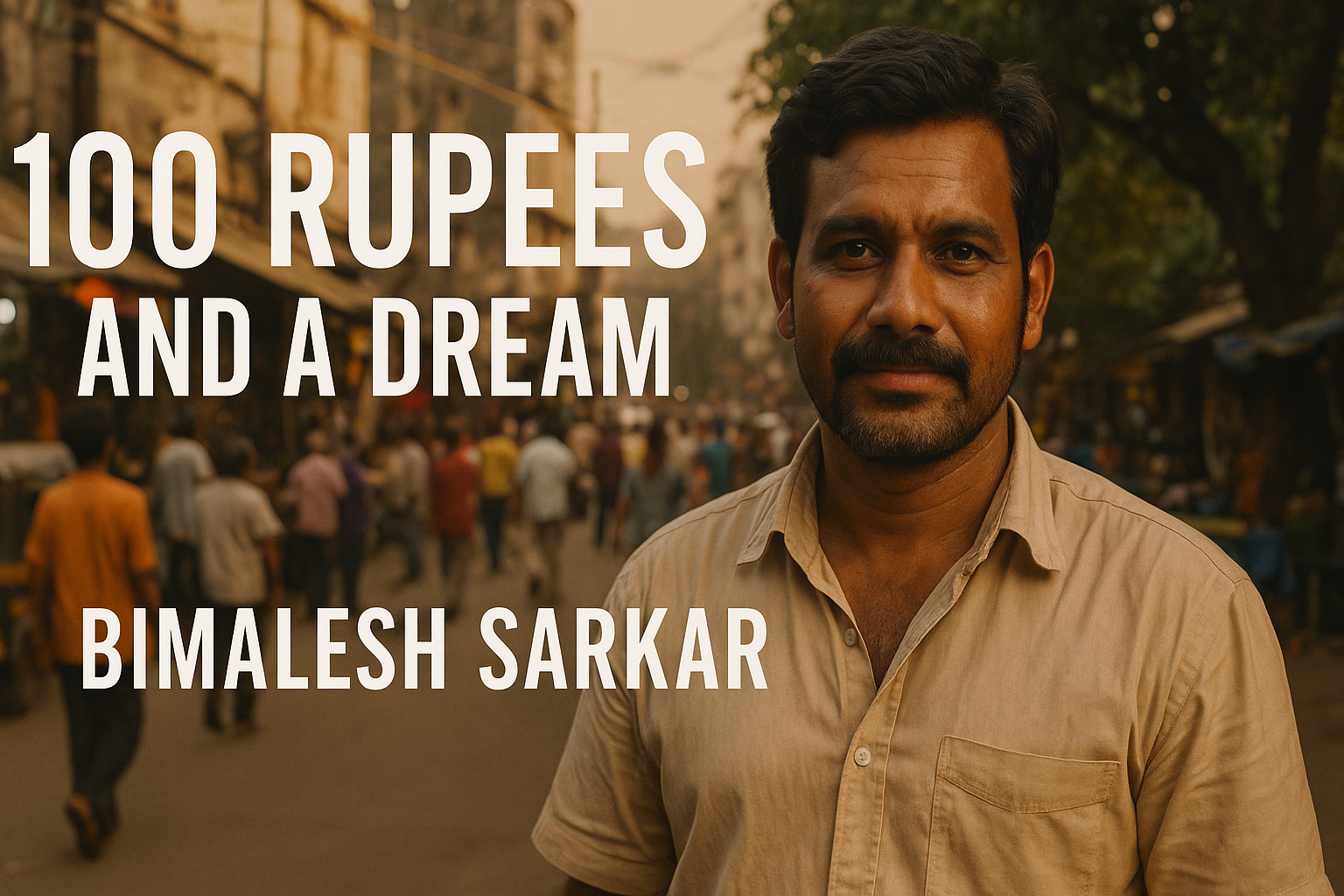

Bimalesh Sarkar
Chapter 1: The Last Note
The Patna Junction platform trembled under the thunderous arrival of the Howrah-Mumbai Express, sending ripples through the rows of barefoot porters, impatient vendors, and women clutching brass tiffin boxes. Ravi Yadav stood among them, not as a commuter, but as a hopeful fugitive escaping the suffocation of poverty. Dressed in a faded shirt two sizes too large and rubber slippers worn thin at the heel, he carried a single plastic bag—inside which were two pairs of clothes, a dry roti wrapped in newspaper, and a notebook with laminated pages now wrinkled from sweat and dust. In his hand was a ₹100 note—creased, fragile, and blessed with his mother’s trembling fingers that morning as she had pressed it into his palm. “Don’t return until you’ve made something of yourself,” she had whispered, her eyes refusing to weep until he turned away. The compartment he entered reeked of sweat, old steel, and leaking ambition. Beside him, a sobbing woman sang a Bhojpuri lullaby to her wailing baby, while a man with a sack full of onions snored open-mouthed. The train screeched through the dirt-blurred towns of Jharkhand, into the midnight fields of Madhya Pradesh, and on the third day, as the skyline sharpened into metallic cranes and slum rooftops, Ravi saw Mumbai—his mirage city—appear like a promise glinting in the smoke. The moment he stepped onto Bandra Terminus, the chaos nearly swallowed him whole. A wave of people surged past as if life in this city didn’t even pause to breathe. Ravi held his bag tighter and stared at the signage in English, barely able to decipher the letters. Behind him, a porter barked something in Marathi. Ravi didn’t understand, so he moved on, stepping into the city as if into fire—his feet blistered by heat, his eyes scanning for a god in concrete.
Ravi’s first night in Mumbai was beneath the Gopal Krishna Gokhale flyover, near a paan shop that had long since closed, leaving only betel stains and the sour stink of urine. He had walked from the station till his legs gave up, past signal children knocking on car windows, and construction workers sleeping in rows with bricks as pillows. There was no one he knew, nowhere to go. He curled up near a pillar, placing his plastic bag between his knees. Hunger gnawed, but he didn’t eat the roti yet. He watched cars pass in streaks, each with tinted windows—small moving boxes of a better life he couldn’t yet touch. In the morning, he washed his face using a leaking public tap and queued for tea from a vendor near Bandra Talao. The man—short, pot-bellied, with sweat beads sparkling like dew—squinted at Ravi. “Kaam karega?” he asked brusquely. Ravi nodded before he even processed the question. The man, Manohar Bhaiya, was from a village near Gorakhpur and owned the tea stall set up illegally under a crumbling banyan tree. He pointed to a stack of dirty glasses and a bucket. “Dho.” And that’s how it began. Ravi earned ₹20 on the first day and a vada pav, which tasted like wealth. He slept behind the stall that night, with the comforting scent of boiled tea leaves and burnt sugar drifting through his dreams. It was the first day of his new life, and though his palms bled from washing glasses with ash and cold water, he felt victorious. He had not begged. He had not stolen. He had worked. And work, he believed, would be his ladder to somewhere higher.
As the weeks rolled by, Ravi became invisible in the best possible way—efficient, reliable, and part of the landscape. He learned to pour tea without spilling a drop, memorize customers’ preferences (less sugar for the South Indian engineer, extra masala for the taxi driver), and even make jokes in broken Hindi that made the regulars laugh. He observed—always observed. How the delivery boys argued with app notifications, how the college kids swiped UPI in seconds, how the beggars were ignored but never the bikers in Swiggy jackets. Chintu, a scrawny urchin who loitered near the stall, became Ravi’s ally—he’d fetch bread, collect coins, and sometimes chase away street dogs. Ravi began teaching Chintu alphabets at night, using chalk stolen from a school dumpster. He also started saving—a ₹10 coin every day in a tin box hidden beneath a loose tile behind the stall. With the money he earned, he bought second-hand business books from a footpath near Churchgate—“The Dabbawala Model,” “Jugaad Innovation,” and one tattered copy of “Wings of Fire.” He read them under a sodium lamp, whispering each English word slowly like a prayer. Though his own dreams were undefined, they burned within him like kerosene. He didn’t yet know what he would build, or where the road would lead, but he knew this—his story would not end with tea. It would begin with it. For Ravi Yadav, that ₹100 note was not spent. It was transformed—into dignity, into education, into vision. And in the darkest alleyways of Mumbai’s merciless underbelly, he had planted a seed: one day, people would drink his tea and talk of empires.
Chapter 2: The Kettle and the Crowd
In the weeks that followed, Ravi’s days found rhythm and repetition—tea, sweat, and street noise blending into a song only the hardworking could hear. The sun rose each morning behind the skyline of cranes, waking the shanties with its orange glare, and Ravi would already be up, boiling water in a blackened kettle before Manohar Bhaiya even arrived. The tea stall under the banyan tree had become a pulse point in that Bandra bylane—auto drivers waited in line, corporate peons leaned against its railings, and film aspirants with glossy folders took hurried sips before auditions. Ravi had memorized them all—not just their faces, but their footsteps, their moods, even the days they didn’t show up. His hands moved with instinct now: two spoons sugar for the Punjabi uncle, ginger crush for the bank clerk, a biscuit packet tucked silently next to a coughing old man. He had become a part of the road itself. And then came the day Chintu ran into the stall panting, waving a laminated card—a QR code sticker for Paytm, stolen from another chaiwala’s cart. “Agar app lagaa do na, log paise phone se denge,” he beamed. Ravi hesitated, then pasted it anyway. That evening, a college girl scanned the code and said, “Nice! About time!” It felt like a promotion. That night, he carefully wrote in his notebook: “Digital tea. Same taste. Bigger dream.” And from there, the tea stall changed forever.
Customers began returning not just for tea, but for Ravi himself. They asked his name. They brought friends. Ravi began writing motivational quotes on the disposable cups using a blue marker pen. “You’re stronger than you feel”, “Keep boiling till you rise.” A small act, but people noticed. Meera Desai, a journalist from Mumbai Mirror who lived in a nearby apartment complex, sipped from one of these cups and smiled. The next day, she returned—not with a wallet, but with a notepad and a smile. “Tell me your story,” she said. Ravi, flustered, stammered out a version filled with missed grammar and wide eyes. He told her of Patna, of the ₹100 note, of the stall, and of the books he read under a broken streetlight. He didn’t say it to be dramatic—he said it because it was real. Meera listened, scribbled, and patted his shoulder. “Your tea’s good. But your story’s better.” A week later, the article appeared with the headline: “Chaiwala MBA: Lessons from the Footpath.” The photo showed Ravi holding a steaming kettle, his eyes squinting against the sun, and behind him, a chalkboard read: “Startup in Progress.” The next day, there was a line at the stall longer than any since Ravi had arrived. Influencers came. College kids took selfies. One man in a coat offered to sponsor a stall expansion. Manohar Bhaiya grumbled about the crowd but secretly beamed. For Ravi, the attention felt surreal—he hadn’t changed the tea, but somehow, people now drank it with reverence. And all it took was one woman, one article, and one boy who hadn’t quit.
With the attention came opportunities—and questions Ravi wasn’t ready for. “What’s your business model?” a YouTuber asked while filming him. “When are you launching your own chain?” a marketing intern teased. At first, Ravi laughed nervously, hiding his discomfort. But late at night, sitting behind the stall with Chintu beside him munching samosas, Ravi whispered, “What if we could deliver this tea to offices nearby?” Chintu looked up. “Kaise?” Ravi pointed to a Swiggy rider zipping past. “Waisa hi, lekin chhota scale mein. Par efficient.” He had noticed that most delivery apps ignored small vendors, especially tea stalls and roadside dabhas, which didn’t have digital menus or English-speaking owners. “If we connect all these stalls with delivery boys, low-cost and fast, imagine what we can do,” he murmured. It wasn’t about just selling tea anymore. It was about access. Visibility. He began sketching ideas in his notebook—arrows pointing from vendor to customer, names like “Tea2Go”, “StreetServe”, then finally “Sadak Express.” It felt right. That name had grit. And though he didn’t know coding or marketing, he knew this: if he could take a ₹100 and turn it into hope, he could take an idea and turn it into a mission. One step at a time. Just like tea—boil, wait, pour.
Chapter 3: Chai with a Vision
The buzz from the article hadn’t yet faded when Ravi began noticing patterns—patterns that spoke of inefficiency hidden beneath the glamorous chaos of Mumbai. Delivery boys zigzagged through traffic only to be delayed by half-literate address notes, small vendors were excluded from digital apps due to their inability to list online, and customer complaints piled up as orders from roadside stalls never reached on time. Ravi observed quietly, eyes sharp behind humble gestures, as if the steam from his tea kettle whispered business models to him. At night, after packing up the stall, he would return to his spot behind the banyan tree with his notebook. Chintu, now upgraded from errand boy to co-dreamer, would sit beside him and draw logos while Ravi scribbled customer pain-points he overheard during the day. “Fast. Local. Trustworthy,” he underlined. He began mapping every vendor on the street—paan shops, vada pav stalls, banana carts—and noticed none had access to consistent delivery options. While apps like Zomato and Swiggy catered to cafes and cloud kitchens, the real India—small, noisy, spicy, cash-based—remained untouched. Ravi didn’t know programming, but he knew pulse. If someone could just build a platform for them, something mobile-friendly, language-adaptable, and human in approach, the street economy could be transformed. And in that moment, standing barefoot on Bandra’s cracked pavement with burnt fingers and a boiling dream, Ravi decided—he would build it.
The initial days of planning were as disorganized as a tea rush during monsoon. Ravi reached out to a college student, Arjun, who used to drink tea and once mentioned he studied “software stuff.” Arjun agreed to help design a mock-up interface for free, in exchange for endless chai and samosas. Chintu became the beta tester, pretending to order from nearby carts while Ravi timed him with a cracked stopwatch. Ravi even offered free tea to vendors who participated in mock deliveries, recording their feedback with the seriousness of an MBA project. It was all crude—no capital, no app, just trial deliveries and pen-paper tracking—but Ravi had something most entrepreneurs lacked: street faith. People trusted him. He had served their morning cups with warmth, remembered their sugar preferences, asked about their children. That social capital became his first currency. Then came the real leap. A social media post by Meera tagged a local business meet-up where “young disruptors” could pitch their ideas. Ravi wore his only shirt, borrowed a blazer from Mr. D’Souza, and stepped into a co-working space filled with air-conditioned English. He stammered through his idea, flipping through hand-drawn wireframes. Some chuckled. Some nodded. One man, sitting with his arms crossed and wearing an IIT Bombay hoodie, waited till Ravi finished. “So… you want to build the Swiggy for the unlisted street vendors?” he asked. Ravi replied, “Yes, but cheaper, faster, and honest.” The man extended his hand. “Rahul Malhotra. Angel investor. Let’s talk.” It felt like the floor disappeared under Ravi’s slippers.
That first conversation with Rahul was both exhilarating and terrifying. Rahul grilled Ravi for two hours at a chai café in Lower Parel—about logistics, scalability, rider acquisition, payment modes, data handling, customer service, vendor relations, and even licensing. Ravi answered most questions from experience, others with ideas, and some with silence. But what struck Rahul wasn’t the polish—it was the fire. “You’ve never been to business school, but you’ve done market research every day without knowing it,” Rahul remarked. He offered an informal promise—₹5 lakhs seed money if Ravi could register the company and show a basic proof-of-concept in thirty days. The number made Ravi’s head spin. That night, he didn’t sleep. Chintu kept repeating “paanch lakh, bhaiya!” like a chant, but Ravi only stared at the sky, unsure whether to celebrate or panic. The next morning, Manohar Bhaiya, who had always treated Ravi like an overenthusiastic younger brother, placed a hand on his shoulder. “Tu kar lega. Bas chai jaise patience rakh,” he smiled. And with that, Ravi began a new hustle—visiting government offices, typing centers, learning about GST registration, MSME forms, startup recognition schemes, and trademark filings. Most officers laughed or ignored him. One demanded a bribe just to look at his application. But Ravi had boiled water for four hours a day without rest—bureaucracy wouldn’t break him. Sadak Express was no longer an idea. It had become an oath.
Chapter 4: Viral Dreams
Mumbai, already a city of endless noise, suddenly became louder in Ravi’s world—not with traffic or vendors, but with possibility. The viral article Meera wrote had turned his tea stall into a local phenomenon. People now queued not just for a cup of chai, but to see “the boy with a startup dream.” Vloggers came with ring lights. Students in blazers asked to “interview” him. Some offered partnerships, others advice he couldn’t understand. “Go D2C,” “think scalable,” “onboard with UI/UX”—the words flew like mosquitoes. Ravi nodded, smiled, and returned to boiling tea, but behind his quiet was a storm of ambition. He had printed a banner that read “Sadak Express: Coming Soon” and hung it beside the tree. Every day, more vendors asked him how they could register on the app. He didn’t even have one yet, just Arjun’s Figma screens and some loose Excel sheets. But Ravi did something most new founders didn’t—he field-tested everything. He ran mock deliveries between nearby stalls and coaching centers. He timed traffic routes. He wrote delivery protocols in Hindi for his “riders,” who were mostly teenagers with cycles. Chintu acted as both dispatcher and delivery boy. Every glitch was studied, every complaint taken seriously. He tracked cash vs. digital orders and wrote phrases like “Trust is delivery + time” in his notebook. Each lesson was paid not in capital, but in chai, sweat, and conversation.
And then came his first real pitch event—Startup Dhamaka, a state-level initiative where early-stage founders presented to a panel of investors and mentors. Ravi had no slideshow, no business card, and wore the same faded shirt from the tea stall. But he stood on that stage and told a story—the story of India’s forgotten vendors. “Aap logon ne app banaya restaurant ke liye. Main bana raha hoon sadak ke liye,” he said with trembling confidence. The crowd went silent. One judge, a senior bureaucrat from the Ministry of Commerce, leaned forward. Another judge chuckled and said, “You’ve got the heart, Ravi. Now get the paperwork.” Encouraged, Ravi decided to go all in. With Arjun’s help, they built a crude MVP of Sadak Express, an Android-only app in Hinglish that allowed small vendors to register with a phone number, list 5 items, and request deliveries within a 2-km radius. The delivery boys were locals—mostly ex-Zomato or unemployed youth. Instead of fancy dashboards, Ravi used WhatsApp groups and Google Sheets. The first vendor to use it officially was a paani puri seller named Pushkar. The first customer? A college professor who received the delivery 10 minutes late but gave a five-star rating. “Good idea, sloppy execution. Improve,” he wrote. Ravi printed that comment and taped it above the kettle.
But not everything brewed perfectly. With publicity came envy. A local political worker accused Ravi of running an “unauthorized app” and demanded “protection money.” The municipality served a notice to Manohar’s tea stall for illegal encroachment. The police, led by a familiar face—DSP Tripathi—arrived with threats of eviction. Ravi tried to reason with them, but the system didn’t understand logic; it responded only to power or submission. Desperate, Ravi turned to Meera again, who wrote a follow-up article: “Chaiwala’s Startup Faces Political Heat.” It gained national attention. Twitter blew up with hashtags like #LetRaviServe and #StartupOnFootpath. Eventually, an NGO stepped in and offered legal support. Ravi’s application for an Udyam certificate was expedited. DSP Tripathi, once hostile, called Ravi aside one evening. “Tum kuch ban jaoge,” he said gruffly, offering a cup of chai. “Bas zyada ud mat jaana.” Ravi smiled. He had learned something vital—fame was fleeting, but the street remembers effort. With official registration in hand, a small bank account under Sadak Express’s name, and a growing network of vendors, Ravi knew the path wouldn’t be easy. But it was his. Built not in boardrooms, but under open skies. His app didn’t have funding, but it had feet. It didn’t run on code alone—it ran on chai, respect, and the stubborn belief that even a ₹100 dream, brewed just right, could change the way India moved.
Chapter 5: The Investor and the Idea
In the days following his viral rise and municipal threats, Ravi discovered that success didn’t come like a river—it came in jagged drops, sometimes sweet, sometimes scalding. With Sadak Express’s prototype live and a few vendors using it inconsistently, the initial euphoria gave way to the grinding truth: ideas were romantic, but execution was brutal. Arjun struggled with bugs in the app. Some delivery boys failed to turn up. Customers were annoyed when their tea arrived cold or their order was wrong. Vendors got confused using the app and preferred calling Ravi directly. It was chaos, and Ravi—caught between being a founder, manager, chaiwala, and peacemaker—started burning out. He hadn’t slept properly in days, often sleeping beside the stall with the phone in one hand and his notebook in the other. Yet something kept him moving—maybe it was the quiet trust of vendors who still called him “bhaiya,” or maybe it was the sight of Chintu proudly wearing a Sadak Express badge he’d stitched himself. Then one evening, when Ravi was refilling sugar jars, a white SUV pulled up. Out stepped Rahul Malhotra in jeans and a crisp white shirt. “Still serving tea?” he asked, smiling. Ravi nodded nervously. “Always,” he replied. Rahul took a cup, sipped, then said, “You’re burning too fast. Time to scale, but smartly.” He offered a table at his co-working space for 3 months, some mentorship, and most importantly, ₹5 lakhs in seed funding—on one condition: Ravi would need to assemble a small, disciplined team and stop doing everything himself.
Taking Rahul’s offer meant leaving the tea stall, something Ravi had never imagined. The banyan tree, the familiar rattle of glass cups, the loyal faces—it had become his temple. But Ravi knew a tree couldn’t become a forest unless it grew beyond its own roots. So one rainy morning, he handed the stall fully to Manohar Bhaiya and Chintu, promising a share of Sadak Express profits in the future. Then, he stepped into an air-conditioned co-working space in Lower Parel, armed with nothing but his steel tiffin box, Arjun’s patched laptop, and three handwritten pages of vendor feedback. He recruited a small team: Arjun became the tech lead, Chintu joined operations (though he was still in school), and two vendor kids with basic English were trained for onboarding and customer service. Every day was a crash course—GST rules, UI optimization, pitch decks, influencer marketing, budgeting. Ravi learned Excel formulas by watching YouTube at midnight. He practiced English with Mr. D’Souza over chai video calls. His notebook grew thicker. Rahul pushed him hard. “You’re not here to run errands. You’re here to scale a logistics company that’s born from the street. So think like it. Build systems, not band-aids.” That stuck with Ravi. He created a three-layer vendor network system. He introduced performance incentives to delivery boys. He even figured out a color-coded way to track late deliveries. And most importantly, he began pitching to real investors—not just selling tea, but a scalable logistics solution for Bharat.
Pitching to actual investors was like stepping onto an alien planet. At his first startup event in Powai, Ravi watched dozens of polished founders speak fluent English, quoting CACs, burn rates, and market caps like actors reciting Shakespeare. His palms sweated. But when his turn came, he spoke with raw energy. “I didn’t go to business school. I learned delivery on footpaths. I didn’t read case studies. I lived them.” He demonstrated how Sadak Express delivered 85% faster within 3 km than existing apps because they used hyperlocal boys on foot and cycle, not vehicles. He spoke about vendor inclusion, economic dignity, and transforming informal markets. Some investors were skeptical. But one, a woman named Naina Kapoor from an impact fund, saw the spark. “He’s not just building a business. He’s solving India’s street-level chaos with empathy,” she said. She signed on for ₹10 lakhs in convertible notes. With that, Ravi registered his first private limited company. He signed rent papers for a 100-square-foot office. He bought Chintu a bicycle with a bright red helmet. And he lit a diya at the foot of the banyan tree before shifting his operations. Sadak Express was no longer a stall’s dream. It was a startup with a soul—built on spilled tea, footpath failures, and one young man’s refusal to be defined by the limits of his beginning.
Chapter 6: Paper Walls and Police Files
For the first time in his life, Ravi entered a municipal building through the front door, not as a vendor seeking mercy, but as a founder seeking legitimacy. He wore a second-hand formal shirt that clung to his shoulders in Mumbai’s October heat, a folder clutched tightly in his hand—inside it were forms for company incorporation, Udyam registration, a GST number, and NOC papers from two vendors. But he had underestimated one thing: the power of India’s bureaucratic maze. The government office in Fort was a fading colonial relic filled with dusty files, sleepy clerks, and fans that turned slower than the wheels of justice. At window after window, he was met with sneers. “Startup founder, ha? Angrezi bolta hai toh sab kuch ho jayega?” one officer mocked. Another asked for chai in exchange for his signature—ironically unaware of Ravi’s former job. Bribes were never openly demanded, just suggested with a smile and a slow drawer opening. When Ravi refused, his file mysteriously disappeared twice. Arjun and Chintu grew frustrated. “Bhaiya, they don’t want us to succeed,” Chintu said, kicking the leg of a broken chair. But Ravi didn’t break. He adjusted. He called Nafeesa Sheikh, a lawyer who had once been a Sadak Express customer. She agreed to help pro bono. With her sharp tongue and even sharper legal sense, she walked Ravi through every clause, every stamp, every loophole. “They bank on your ignorance,” she told him. “You fight with your brain, not anger.” With her guidance, Ravi refiled everything, armed with scanned copies and stamped affidavits. On the twenty-fourth day, his firm was officially registered: Sadak Express Private Limited.
But just as the papers came through, trouble found its way back to the roots of Ravi’s journey—the tea stall. DSP Tripathi, the grey-mustached police officer with a record of harassing footpath vendors, returned with a new agenda. A formal complaint had been filed—claiming illegal commercial activity at Manohar’s stall under Ravi’s name. The timing was too perfect to be coincidence. Someone in the local vendor union, perhaps jealous of Ravi’s rise, had decided to clip his wings. Officers raided the stall, seized kettles, and even accused Chintu of “operating an unlicensed digital payment unit.” Manohar, though angry, didn’t panic. He called Ravi immediately. Ravi arrived within the hour, waving his company registration and NOC papers. But paperwork, he learned again, meant little without muscle. Tripathi smirked. “Paper se nahi hota beta. Permission chahiye. Aur permission ka matlab tu samajhta hai.” Ravi understood. It wasn’t about tea or tech—it was about control. Meera Desai got wind of the situation and published a follow-up article titled: “Startup Boy Threatened by Old System.” It went viral. Public support surged. But more importantly, Ravi realized something else—he couldn’t keep fighting from the footpath. He had to step fully into the world of law, licensing, and lobbying. Through Nafeesa, he filed an RTI into the police complaints. He applied for a street vendor’s official license. And he began building alliances—networking with civic bodies, startup forums, even local MLAs who were hungry for youth success stories. Tripathi, seeing the tide turn, backed off silently. And just like that, one more gate fell.
But this war left its scars. Ravi was quieter, more deliberate. He no longer romanticized the street like he once had. He understood its danger. He moved Sadak Express to a bigger space—a rented office behind a courier company in Dadar. Chintu still helped at the stall on weekends, but weekdays were now dashboards, order flow, vendor onboarding, and daily metric reports. Ravi introduced a unique “Vendor Education Drive”—he would personally visit slums, carts, and stalls, teaching them how to use the app, update items, and check ratings. He simplified the app UI even further, replacing English terms with pictorial icons and local dialect voiceovers. His riders were now uniformed, insured, and trained in basic soft skills. He negotiated with a local bank to open zero-balance accounts for vendors. Sadak Express became more than an app—it was a digital dignity movement. And yet, Ravi still walked the lanes where he once poured tea. He knew that success without memory was arrogance. One night, after onboarding his hundredth vendor, he sat under the banyan tree again—now with a laptop instead of a kettle. He looked at the spot where he once slept with ₹100 and no shoes. He smiled, not with pride, but with promise. Because he knew this story wasn’t about a boy who sold tea—it was about a boy who refused to be sold short. And the road ahead, though steep, was his to pave.
Chapter 7: Reboot from Rock Bottom
Every startup has a breaking point. For Sadak Express, it came not with a crash, but a slow unraveling. The app, growing faster than its systems, began to buckle under its own weight. Orders from vendors across Dharavi, Kurla, and Byculla flooded in, but Ravi’s small delivery fleet couldn’t keep pace. Servers lagged, addresses glitched, orders got misrouted. Frustrated customers left bad ratings. Vendors began calling Ravi directly with complaints—“Chai thanda ho gaya,” “client gussa ho gaya,” “aap toh bola tha 15 minute mein.” Ravi worked 20-hour days—balancing logistics dashboards with real-time vendor calls, skipping meals, forgetting sleep. Arjun tried to patch bugs, but the app architecture, hastily built, needed a full rebuild. One day, during a high-profile demo in front of an angel network, the app crashed live. Embarrassed and overwhelmed, Ravi could barely speak. Rahul Malhotra, who had been his staunchest backer, quietly pulled financial support, citing “scalability concerns.” Even Meera’s coverage had moved on to newer stories. For the first time, Ravi felt utterly alone in a room full of people. The dream that began with boiling tea on a footpath now sat cold and incomplete in his hands, and Ravi questioned whether he had reached too far too soon.
It was Chintu who brought him back. One rainy evening, Ravi skipped office and sat under the banyan tree for the first time in weeks, head down, drenched and defeated. Chintu found him there and without saying much, handed him a letter—from Seema, Ravi’s younger sister. It was scribbled in uneven Hindi, full of hope and pride. “Bhaiya, I got first division. I want to become a teacher. Maa says you haven’t called. Don’t forget your dream is ours too.” That letter hit Ravi harder than any investor rejection. He realized he hadn’t failed because his idea was bad—he had failed because he tried to scale without systems, without patience. He had built a sprint when what he needed was a marathon. That night, Ravi returned to his office and tore every sticky note from the walls. He opened his notebook—the one he had started at the station with ₹100—and on a fresh page, he wrote: “Day One. Again.” The next morning, he called a team meeting. He apologized, and announced a pivot—Sadak Express would halt expansion and focus only on one zone: Bandra to Mahim. He restructured the delivery routes, retrained his riders, rebuilt vendor support teams, and asked Arjun to rebuild the app from scratch using open-source logistics APIs. The app was simplified even further, running offline when needed. Most critically, Ravi instituted a “Vendor First” policy—no chargebacks, instant dispute resolution, and real-time delivery tracking through WhatsApp.
Slowly, trust returned. Vendors who had dropped off came back, lured by better delivery times and Ravi’s personal visits. One flower seller near Mahim said, “Tu toh wapas aa gaya. Woh hi kaafi hai.” (You came back. That’s enough.) By month’s end, Sadak Express had stabilized. Its active users were down, but its performance was better than ever—92% deliveries on time, 4.8-star average ratings, zero cash flow gaps. Ravi documented everything—successes, failures, rebuild steps—and began sharing them in short LinkedIn posts that unexpectedly went viral. People saw not just the boy with a dream, but the man who got up after falling. Slowly, attention returned. Not the glamorous type, but respect. A national logistics firm sent a partnership inquiry. A professor at IIM-A invited him for a guest talk. Rahul Malhotra messaged, “Now, you’re building a company, not just a story.” But Ravi smiled quietly and replied, “Still learning.” With operations stable and his team stronger than ever, Ravi sat one evening on the hood of a Sadak Express delivery van, sipping tea from a kulhad. Across the street, a boy no older than Chintu ran barefoot selling flowers. Ravi called him over and handed him the tea. “One day, you’ll have your own company,” he said. The boy laughed. Ravi didn’t. He had learned that dreams aren’t born big. They grow, get hurt, rebuild—and when they survive the fall, they become unstoppable.
Chapter 8: The Summit and the Street
The invitation came in a white envelope with gold embossing, carried by a courier who didn’t know who Ravi Yadav was. It read: “Government of India – Ministry of Commerce & Industry invites Mr. Ravi Yadav, Founder, Sadak Express Pvt Ltd, to speak at the National Startup Conclave 2025, Delhi.” Ravi stared at the letter for minutes, not moving. Behind him, Chintu was fixing a bug in the vendor rating system, and Arjun was fiddling with the new bilingual voice assistant they had added to the app. Delhi. National stage. It felt unreal. He showed the letter to Manohar Bhaiya, who wiped his hands on his apron and hugged him without a word. The memory of standing at Patna Junction with ₹100 in his pocket flashed back—his mother’s hands trembling, the train smoke swallowing his childhood, and his first cup of tea in Mumbai’s gutters. And now, he was to represent the same street he once slept on? It felt poetic. But Ravi wasn’t interested in showing off. He had one goal: to make people in suits finally listen to the lives behind aprons, slippers, and cycles. So he packed his tattered notebook, wore a kurta gifted by Chintu, and boarded the Rajdhani for Delhi—just as determined as the first time he left home, but now with something to carry back to millions.
The summit was glittering—LED screens, suits, badges, fancy buffet tables where people discussed “seed rounds” over hors d’oeuvres. Ravi felt out of place, but not small. When his name was called, he stepped onto the dais with calm conviction. The spotlight hit his eyes, but he didn’t blink. “Main ek chaiwala hoon,” he began. A few chuckles. He smiled. “Lekin maine chai bechke duniya ke sabse bada problem dekha—log delivery ke liye app banate hain, lekin jo log delivery karte hain, unke liye koi app nahi banata.” The audience sat upright. He spoke not of unicorns or billion-dollar valuations, but of Sadak dignity—how every cycle boy deserved insurance, every vendor deserved visibility, and every rupee on the street was part of India’s informal GDP. He told them how he built Sadak Express not in a lab, but on a footpath; how his first office was a kettle; how scalability begins with empathy, not Excel. By the end, people were clapping—not politely, but powerfully. The Union Minister walked up, shook his hand, and said, “You are what Make in India truly means.” Ravi was mobbed by media after, but he slipped away quietly. That night, he stood near the Red Fort, bought a ₹10 kulfi, and thought about his mother, who had passed six months earlier. She never saw his app. But she had believed in that ₹100.
When Ravi returned to Mumbai, the entire Sadak Express office stood waiting at Dadar Terminus with garlands. The banyan tree now had a small board installed by the municipality: “Birthplace of Sadak Express – Founded 2023.” Local politicians took credit. Startups offered partnerships. But Ravi had changed. He wasn’t chasing headlines anymore—he was building infrastructure. Over the next year, Sadak Express expanded organically, zone by zone. Instead of acquiring new vendors, they empowered old ones to become local logistics leaders—each one trained to handle 10–20 peers in their street cluster. Ravi launched a “Sadak Saathi” fellowship, paying school dropouts to train in delivery tech. Chintu became head of outreach. Arjun got a grant to build multilingual AI interfaces. A CSR arm was started to educate vendor children. Every quarter, Ravi returned to his old stall—not to drink tea, but to mentor new “stallpreneurs.” His next goal? A nationwide hyperlocal delivery grid, powered not by money, but by dignity. Because in Ravi’s world, a ₹100 note was never just currency. It was belief. And now, across cities and towns, millions of Ravi Yadavs were boiling their kettles—not to serve tea alone, but to brew up better lives. Sadak Express was no longer his dream. It was everyone’s.
Chapter 9: Beyond the App
By now, Sadak Express was not just a company—it had become a case study. Business schools wrote papers on it, international journalists flew in to profile it, and yet Ravi Yadav remained the same man who still tied his laces double-knot and carried a steel dabba to office. But inside, something had shifted. The metrics, dashboards, and quarterly targets that once excited him now felt… incomplete. One evening, while reviewing app retention data, Ravi paused. “What happens when a vendor stops using our app?” he asked Arjun. Arjun replied, “Maybe they switch to Swiggy or drop off.” But Ravi pressed on. “What if their son fell sick? What if they couldn’t read the update?” That night, he sat with Chintu and made a list of 28 vendors who had become inactive. Over the next two weeks, they visited each one. A bhelpuri seller had broken his leg. A flower vendor’s phone had died and he hadn’t been able to afford a new one. A paanwaala had switched to a more ‘English-friendly’ service that ignored his messages. Ravi realized Sadak Express had become so focused on scale that it had lost touch with its roots. So he made a decision: Sadak Express would no longer just be a logistics company—it would be a human support system for India’s invisible economy.
That meant rewriting everything. Ravi called an emergency team retreat—not in an auditorium, but in a small NGO-run learning center near Kurla. “We’re not here to build an app,” he told the team. “We’re here to build a movement.” He proposed three radical changes: First, the company would launch Sadak Care, a welfare arm that ensured medical aid, emergency loans, and education sponsorships for vendor families. Second, Sadak Shiksha, a skill-building portal in Hindi and regional languages, with voice-based courses on finance, smartphone use, and hygiene. Third, the most ambitious: Sadak Voice, a hotline—not AI, but real humans—where any vendor could call, share a problem, and get a response within 24 hours. The team was stunned. “We’re not funded for all this,” someone whispered. “We’ll find a way,” Ravi replied. Crowdfunding campaigns were launched. College volunteers were onboarded. NGOs were looped in. Soon, Sadak Care helped a chaiwala’s daughter return to school. Sadak Voice resolved a vendor dispute in Indore without police intervention. Ravi personally called every beneficiary family. And with every success story, Sadak Express evolved—not into a unicorn, but into a new kind of social enterprise where delivery boys became mentors and footpath vendors became stakeholders.
Amidst all this, Ravi received an invitation from the Prime Minister’s Office—to attend a closed-door roundtable on “Bharat Innovation.” He sat across policymakers, CEOs, and bureaucrats, and when asked for his input, he said simply: “India’s street vendors don’t need sympathy. They need systems. They don’t want donations. They want dignity.” Silence followed. Then, nods. The Ministry proposed a national pilot for Vendor Tech Upliftment, and Sadak Express was chosen as a core partner. Ravi could hardly believe it—his idea, born beside a kettle, was now influencing central policy. He visited his home in Patna quietly soon after. His sister, now a teacher, had framed his Delhi speech and hung it beside their father’s photo. “Maa would be proud,” she said. Ravi nodded. But he didn’t stay long—he was building a new pilot in Varanasi, mentoring five new local chapters of Sadak Express run by ex-delivery boys. And as the train left Patna Junction once again, Ravi looked out the window with a calm heart. The same station where his journey began now stood as witness to a boy who never gave up, never sold out, and never forgot the first ₹100 that lit his way.
Chapter 10: Full Circle
The morning began quietly—no cameras, no speeches. Just Ravi standing at the edge of a dusty field in Bodh Gaya, Bihar, watching a group of children gather under a tree. They were here for the inaugural session of the Sadak Foundation Learning Circle, a grassroots education program for vendor children. The teacher arrived late—on a scooter funded by Sadak Express’s new CSR initiative. Chintu, now officially Operations Head, stood beside Ravi, holding a register and a tiffin. “Twelve enrolled today,” he said. Ravi smiled, watching a boy scribble alphabets on a slate with the same urgency he once used to write chai prices on paper cups. Sadak Express, now present in 11 Indian cities, had not gone the route of flashy billboards or IPOs. Instead, it had taken the slower, harder path—building people. Its riders had health insurance. Its vendors had digital accounts and dignity. Its delivery network ran partly on foot, partly by bicycle, and fully on trust. Ravi still refused a salary beyond ₹25,000, lived in a one-room rental, and wore the same canvas shoes since his first pitch. “This dream was never mine alone,” he’d always said. That morning, he sat among the children, opened his tiffin, and ate with them, just like he used to share lunch with Chintu beneath the banyan tree. The circle was now complete, but the road was far from over.
Back in Mumbai, Sadak Express was preparing for its next big leap—not a funding round, but a cooperative ownership model. Ravi had spent months researching how to turn vendors and delivery partners into stakeholders. The idea was simple but revolutionary: Sadak was not a company. Sadak was a community. And so, on the second anniversary of the startup, Ravi announced that 30% of equity would now be distributed among active vendors and delivery partners through a structured ownership trust. “If they built it, they should own it,” he declared at a modest press gathering. The news stunned the startup world. Some called him foolish. Others called him fearless. But for Ravi, the real return on investment was watching a vegetable seller sign her first digital share certificate, tears in her eyes. Tech CEOs began consulting him. Universities invited him for talks. One international publication labeled him “The Gandhi of Logistics.” But Ravi remained grounded. He continued meeting every new vendor onboarded personally for the first cup of tea. When asked in a podcast why he never raised VC money after year one, he answered, “Because speed breaks people. And I’m not building a race. I’m building a rasta.” In a world chasing scale, Ravi chose soul. And in that, he found something even rarer than success: sustainability with love.
Years passed. Sadak Express quietly expanded to 50 cities, then partnered with state governments to digitize hawkers. Ravi, now in his late 30s, continued to lead barefoot when needed, still answering customer queries at odd hours. One evening, he returned to Bandra and stood again beneath the banyan tree—older, a little thinner, a little more tired, but his eyes still burning bright. The chalkboard where he once wrote Startup in Progress now hung laminated in a civic museum under Innovation from the Footpath. Chintu, now married and with a baby girl named Umeed, ran the Mumbai office. Arjun was building an AI chatbot in Bhojpuri for low-literacy vendors. And Ravi? He sat on the same stone ledge, poured himself a cup of tea from a roadside seller who didn’t recognize him, and sipped slowly. A boy walked by, paused, and said, “Aap Ravi Bhaiya ho na? I joined your Sadak program in Pune!” Ravi smiled. “Phir chai meri taraf se,” he said. As the sun dipped below Mumbai’s skyline, Ravi looked at the crowded street, the honking rickshaws, the shouting vendors—and knew that this chaos, this sweat, this everyday India—that’s where revolutions begin. Not with capital, but with courage. Not with millions, but with ₹100 and a dream.
End