
N. V. Rao
One
Kartik Rajan had written about many strange things in Delhi—forgotten cinema halls with broken projectors still facing empty screens, a clocktower in Chandni Chowk that ticked in reverse during an eclipse, and a hermit who claimed to dream in languages that no longer existed. But when his editor slid a dusty manila folder across the desk marked “Malcha Mahal – DO NOT ENTER,” he scoffed. It was the kind of gimmicky fluff assigned to rookies or burned-out writers nearing retirement. “Ghost Story Saturday,” they called it—an online weekend column for bored readers. Still, something about the old photograph clipped inside the folder halted him. A black-and-white image of the ruined palace showed an overgrown path leading to its archway, and in the background—a blur that looked alarmingly like his sister, Tara, who had disappeared when they were children. The photo was dated 1996. Tara vanished in 1995. Kartik stared at the blur for minutes, his hand trembling as if the past had reached out and touched his shoulder.
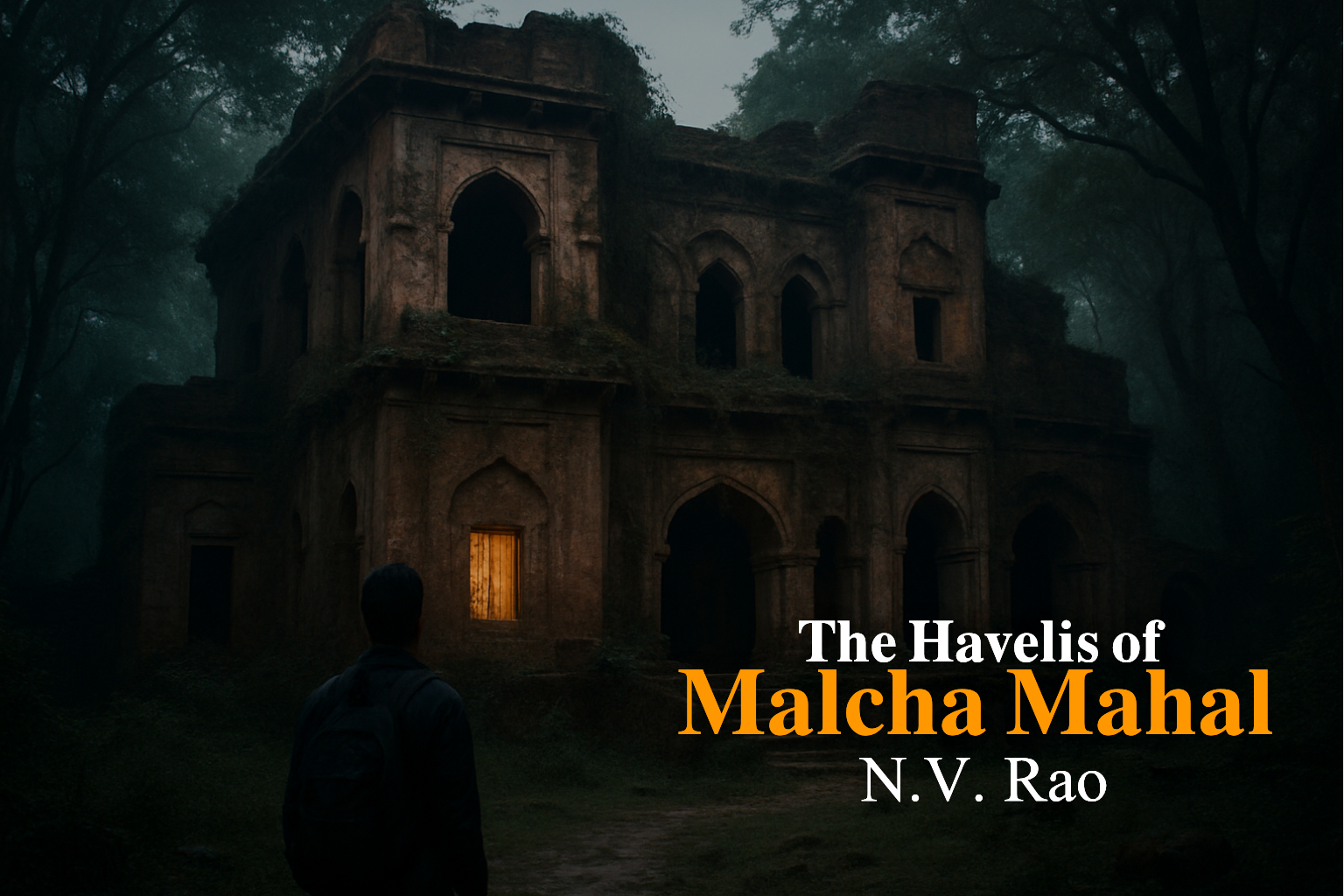
The next morning, Kartik made his way to the Chanakyapuri forest, camera and notebook in hand, ignoring the warnings in the file. It was summer, but inside the dense green of the ridge, it felt damp and cold, like the forest was holding its breath. Malcha Mahal sat hidden behind a rusted iron gate with no lock, vines crawling up its sandstone face like fingers. The haveli wasn’t grand like Lutyens-era bungalows; it was older, Persian in style—arched, quiet, regal, and somehow…waiting. A crumbling noticeboard stood by the entrance, half-swallowed by ivy. It read: “Trespassers will be prosecuted. Wild Dogs. Danger. Haunted.” Below that, a government-issued plaque from the 80s mentioned the palace being allotted to Begum Wilayat Mahal, a woman who claimed royal Oudh lineage. Kartik walked through the gate. The inside smelled of wet earth, rust, and something floral that didn’t belong. The stone corridors were blackened with soot in places. Some doors were nailed shut; others creaked open into nothing but dust and decayed fabric. The silence was dense—pressing. Even the birds didn’t seem to chirp near the Mahal.
After an hour of wandering and taking notes, Kartik returned to a tea stall he’d passed near the road. The vendor, Ramesh Bhaiya, a wiry man in a faded Nehru jacket, gave him his chai with a frown. “You went inside, didn’t you?” he asked, not waiting for an answer. “People hear her voice, even now. The Begum’s. She used to sit on that very stone and write letters to the Prime Minister, every day. Even after she died.” Kartik raised an eyebrow. “Died? There was no official record of her death in the file.” Ramesh leaned in. “That’s because no official ever went inside. Her children buried her themselves—dug the earth with their hands. After that, they stopped answering the gate. First the daughter went missing. Then the son. Nobody goes near the Mahal now. It remembers people.” Kartik returned to his flat in Jangpura that night feeling heavier, his curiosity now sharpened into something colder. He poured over the photo again. The girl in the background had Tara’s same wide forehead, that awkward stance. What if this wasn’t just another ghost story? What if this was the beginning of something he was never meant to find?
Two
Kartik returned to Malcha Mahal the next day at dawn, determined to see the palace in the pale light of morning rather than the waning sun that had cast long shadows yesterday. The forest seemed less ominous under the soft mist, but the silence remained oppressive—thick enough to swallow footsteps whole. The gate stood open this time, the rusted ironwork creaking faintly as he pushed through. He stepped onto the overgrown path, the scent of damp earth mixed with a faint trace of rosewater still clinging to the crumbling walls. As he moved closer, the scale of the ruin became clearer: the once grand arches now chipped and cracked, windows like hollow eyes staring out onto a wild tangle of trees reclaiming the stone. The palace had an unnatural stillness, as if time had stopped here decades ago and refused to move forward. Kartik’s camera shutter clicked repeatedly, capturing peeling frescoes, moss-covered pillars, and doorways leading to empty, dust-choked rooms. Yet, every so often, the air seemed to shift—cooler, heavier—and he caught faint sounds: the whisper of footsteps behind him, or a soft sigh that could have been the wind—or something else.
Near the main hall, Kartik found a faded sign warning visitors in broken English: “Danger. Keep Out. Wild Dogs and Spirits Roam After Dark.” He smiled at the absurdity but felt a cold prickle at the back of his neck. A few steps further, the stone floor bore strange marks—scratches too deliberate to be natural. There were scorch marks around one heavy wooden door, and beyond the threshold, faint voices echoed, distant and unintelligible. A sudden rustling startled him, and turning, he saw a small group of monkeys watching from the treetops, their eyes reflecting a strange intelligence. Kartik jotted down every detail, but the forest seemed to resist documentation; camera lenses fogged inexplicably, audio recorders picked up bursts of static. On the way out, he met Ramesh Bhaiya again, who shook his head as if the day’s light had done nothing to dispel the darkness around the place. “You don’t belong here,” he muttered. “The Mahal doesn’t like outsiders, and it doesn’t forget.”
Later that evening, Kartik poured over the scant historical documents he had gathered. Begum Wilayat Mahal had petitioned the Indian government for recognition of her royal family’s claims, but the letters had been ignored or lost. The palace, allotted to her family in 1985, had soon fallen into disuse after her death and subsequent disappearances of her children. Official records were sparse, conflicting, and strangely incomplete. Locals told whispered stories of lights flickering in the windows after midnight and strange figures seen walking the forest edges. Kartik’s rational mind wrestled with the growing sensation that the palace was more than just a relic. It was a sentinel of forgotten grief and anger—a place where history and memory tangled into something dark and alive. As he closed his notebook, he caught sight of the blurry photograph again—this time, the figure at the archway seemed clearer, almost reaching out. The night outside his window deepened, and with it, a growing certainty that his investigation had only just begun.
Three
Kartik knew he couldn’t unravel Malcha Mahal’s mysteries alone, so he reached out to Zoya Bhasin, a historian and folklore researcher at JNU who specialized in Delhi’s forgotten architecture and royal lineages. Zoya was cautious but intrigued when Kartik explained his discoveries and suspicions. They met at a cluttered café near the university, where walls were plastered with faded posters of plays and protests. Over steaming cups of chai, Zoya unfolded the story of the Mahal’s last occupants: Begum Wilayat Mahal and her children, Mirza Faizan Shah and his sister. The Begum had spent years petitioning the government for recognition as the rightful heirs of the Oudh royal family, only to be dismissed and isolated. After being granted Malcha Mahal in the mid-80s—a palace shunned by the public and surrounded by dense forest—the family withdrew into seclusion. “They lived like ghosts,” Zoya said, her voice softening, “never quite part of the city that grew around them.” She revealed that the Begum died inside the Mahal, her death unrecorded officially, and soon after, her children vanished without trace. “Some say the family never left the palace,” Zoya whispered, “and that the walls still hold their sorrow.”
Armed with this context, Kartik and Zoya planned a joint visit to the Mahal, intent on exploring areas he hadn’t dared enter alone. As they wandered through the shadowed corridors, Zoya pointed out faded Persian inscriptions, intricate floral patterns carved into the sandstone, and a hidden alcove where the Begum reportedly wrote letters to the government. The air felt thick with memory, each step stirring echoes of a past that refused to rest. As dusk settled, a strange energy seemed to awaken; Zoya’s usual calm faltered as she caught fleeting glimpses of figures standing just beyond her sight. Whispered Urdu phrases brushed the edges of their hearing, and once, a cold breath against Kartik’s neck made him spin around—only to find empty stone walls. “This place is like a wound,” Zoya said later, her voice strained. “It bleeds history and grief, and it resists forgetting.” They exchanged uneasy glances, realizing the boundaries between fact and folklore were dissolving faster than either could have predicted.
Back in his apartment, Kartik sifted through piles of archival documents and news clippings with renewed urgency. He found reports of missing persons connected to Malcha Mahal—journalists, researchers, even government officials who’d ventured too close. Among these cases, he spotted a blurred photograph from 1996 that chilled him to the bone: a young girl standing near the Mahal’s entrance, her face partially obscured by shadows—but the forehead and stance unmistakably his sister Tara’s. Questions flooded his mind. Was Malcha Mahal merely a site of tragic isolation, or was something more sinister at work? And how deeply was his own past entwined with this place? As night deepened outside, Kartik stared at the faded photograph again, feeling the weight of history pressing down, and the faint but persistent tug of a secret waiting to be uncovered—one that might change everything he thought he knew about his family, the Mahal, and the ghosts that haunted them both.
Four
The next morning, Kartik and Zoya returned to Malcha Mahal with renewed determination. This time, they brought flashlights, gloves, and a sense of unease that neither wanted to admit aloud. Inside the palace, the air was thick with dust and the faint scent of rose attar—an aroma that seemed to linger stubbornly in the faded hallways and peeling walls. They made their way to the writing room, a small chamber near the back of the Mahal, where the Begum was said to have spent hours penning letters to the Prime Minister, pleading for recognition and justice. The room was frozen in time: a heavy wooden desk covered with brittle papers, ink pots dried to a crust, and a chair draped with a moth-eaten shawl. As Zoya carefully sifted through the scattered pages, Kartik’s flashlight flickered across a stack of loose sheets that were hidden beneath a floorboard, almost as if someone had tried to bury them. To their astonishment, the letters bore dates well beyond the Begum’s official death in 1993—some as late as 1999 and 2001. The handwriting matched the samples in government archives perfectly, but these letters had never been sent or recorded. It was as if the Begum had continued writing from beyond the grave.
As they examined the letters, an unsettling pattern emerged: the texts were filled not only with pleas for recognition but cryptic warnings—mentions of a “shadow beneath the stone,” of “voices in the walls,” and references to people who had come seeking answers but never returned. The final letter, smudged and partially burnt, ended abruptly with the phrase: “The gate is open, but the way out is lost.” Zoya’s face paled as she read aloud lines that seemed less like correspondence and more like incantations, prayers to forces beyond understanding. Suddenly, Kartik heard a soft whisper, a faint echo of Urdu words drifting through the air, impossible to pin down but chilling nonetheless. He looked toward the doorway, half-expecting to see someone—or something—lurking there. For the first time, the rational skepticism he clung to faltered. Had they disturbed something best left alone? Outside, the forest wind howled softly, as if responding to the long-forgotten voices inside the walls.
Later that evening, back at Kartik’s apartment, the letters weighed heavily on their minds. Kartik couldn’t shake the feeling that the Mahal itself was alive—more than stone and timber, it was a repository of memory, grief, and something darker. He began to experience strange dreams: corridors stretching infinitely, shadows moving just beyond his vision, and the persistent sensation of being watched. One dream, in particular, stayed with him—a young woman in white, writing feverishly by candlelight, tears staining the parchment as voices murmured around her. Kartik awoke with the scent of rose attar lingering in his room. The boundary between the past and present seemed to blur, and he wondered whether the letters were a message—or a trap. Meanwhile, Zoya confessed that she too felt haunted, as if the history they had uncovered was seeping into their very souls. Together, they stood at the threshold of a mystery that refused to stay buried, their lives quietly unraveling as the secrets of Malcha Mahal began to take hold.
Five
The entrance to the hidden room was almost an accident. Kartik had leaned against a bookshelf in the palace’s main corridor, exhausted and dazed, when the shelf shifted slightly with a groan of long-stuck hinges. Dust poured out like smoke. Behind it, a narrow passage revealed itself—no more than shoulder-width, dark and uneven, with walls that seemed damp despite the dry heat of the Delhi afternoon. Zoya stepped in first, holding her flashlight steady, her voice tight with disbelief: “This wasn’t here before.” Kartik followed, heart thudding louder than his footsteps. The passage led them into a chamber with no windows and no apparent entrance except the one they had just emerged through. And on its far wall, illuminated by the quivering beam of light, were photographs. Dozens of them. Old, grainy, curled at the corners—taped, pinned, and in some cases nailed to the stone. Faces stared back at them—young men, women, children. Each picture had a name and a date scribbled below. Zoya’s voice caught as she read them aloud. “Vikram Seth – 1991. Nilofer Khan – 1997. Anil Sharma – 2003…” All names that Kartik recognized from archived disappearance reports.
But what froze him completely was the final photograph, nestled near the center. It was him. Or someone who looked exactly like him—same eyes, same unruly hair, same scar on the right eyebrow. Beneath the photo, the scrawl read: “K. Rajan – 2005.” Kartik felt his breath stop. “That’s not possible,” he whispered, his fingers trembling as he reached toward the image. “I’ve never been here before this week.” Zoya tried to speak, but her words dissolved into a whisper of disbelief. Kartik’s mind reeled: was this some elaborate fabrication? A trap? Or something far worse—a memory the Mahal had of him, from a time he couldn’t recall? The scent of rose attar returned, heavier now, and the temperature dropped. The silence in the chamber was no longer passive—it throbbed like a heartbeat. Suddenly, all the flashlights dimmed at once. A shadow flickered across the wall, separate from their own. And then came a whisper, from behind them, so close it could have been breath: “You returned late, but you returned.”
They fled the chamber in near-darkness, the air behind them collapsing inward with a pressure that felt like drowning. Outside in the fading daylight, Kartik vomited against the palace’s outer wall, his whole body trembling. Zoya crouched beside him, her face pale and stunned. “That was your photo, Kartik. We both saw it. But if the date is right—what happened to you in 2005?” Kartik shook his head. “Nothing. Nothing I remember. I was fifteen. My sister had already disappeared. Everything after that… was a blur.” Zoya placed a hand on his shoulder, but her eyes were distant, afraid. She suggested they step away from the Mahal for a few days, gather their thoughts, but Kartik knew in his gut that they were already in too deep. Whatever was buried in the Mahal wasn’t just a ghost story—it was something older, something alive. And if the Mahal remembered him, if it had already written his name on its wall of the disappeared, then the line between past and present wasn’t just thin—it had already been crossed.
Six
Kartik didn’t believe in ghosts, but the man standing at the forest’s edge that evening made him question everything he’d ever known. Zoya had chosen to stay back at the university archives to study handwritten records, still shaken by the encounter with the hidden chamber. Kartik returned alone to Malcha Mahal—compelled by something deeper than curiosity. Twilight settled like a veil over the dense trees as he stood near the palace gate. That’s when he saw him: a tall, gaunt figure cloaked in a flowing sherwani, standing perfectly still between two trees, half in shadow. The man’s face was regal but pale, almost translucent under the fading sun. “You shouldn’t be here,” he said in a voice rich with old-world refinement, the Urdu accent pronounced, musical. “It’s too late for questions.” Kartik blinked hard. “Who are you?” he asked. The man stepped forward, and the leaves didn’t crunch beneath his feet. “You already know,” he said quietly. “I am Faizan. Son of Wilayat Mahal.” Kartik’s blood ran cold. Mirza Faizan Shah—the Begum’s reclusive son—was declared missing, presumed dead, nearly three decades ago. And yet, here he stood, in flesh or something like it.
Kartik’s rational mind grasped for logic. “You’re… alive? All this time?” But Faizan only smiled with weary sadness. “Alive, perhaps not. Bound? Yes. To this place. To memory. To blood.” Kartik followed him deeper into the clearing, away from the ruins, where the trees grew unnaturally close. Faizan spoke as if he were reading from a history book no one else had access to. “My mother thought herself royalty, and the world laughed. She thought letters could resurrect kingdoms. They couldn’t. But they did summon… something else.” His eyes grew distant. “We lived alone in this palace, but we were never alone. The walls listened. The soil remembered. And the Mahal… it learned to keep what we loved.” Faizan stopped beside a hollow tree. He reached inside and pulled out a faded doll—its head broken, its dress torn. “Your sister played with this once,” he said softly. Kartik’s heart jolted. “Tara?” he breathed. “You knew her?” Faizan nodded slowly, eyes full of quiet grief. “She came here. She wasn’t meant to. But the Mahal liked her. She stayed.” Kartik backed away, pulse pounding. “Where is she now?” Faizan didn’t answer. Instead, he turned and began walking back toward the Mahal. “The more you seek,” he called over his shoulder, “the more it takes.”
Kartik returned home just past midnight, shaking, sweat clinging to his skin though the air was cool. He paced his room for hours, replaying every word Faizan had said. It had to be a performance, he tried to tell himself—a squatter playing a role, or a hallucination born from stress. But deep down, he knew better. Faizan had spoken about Tara with intimate detail—things no one else could have known. And the doll. Kartik remembered it from their childhood, before Tara vanished, before his family fell apart. Zoya called him the next morning with tremors in her voice. “I checked something,” she said. “The signature on the 1999 letter matches Faizan’s writing… from 1988. Perfectly. No degradation, no shakiness. As if he never aged.” Kartik stared at the photo of himself in the hidden room again. His own face, frozen in time, labeled as lost. The Mahal didn’t just trap people—it trapped time, memory, identity. And if Faizan was right, the palace was more than just haunted—it was sentient. And it was watching him.
Seven
Zoya had insisted they wait. She begged Kartik to stop going back alone—to give themselves time to process, to gather evidence, to stay grounded. But Kartik couldn’t stop. Something was calling him, deep within the blackened walls of Malcha Mahal. The memory of Faizan, the doll, Tara’s name—each clue gnawed at him like rot beneath the floorboards. Against his better judgment, he returned to the Mahal the next morning and waited near the clearing, hoping to see Faizan again. But hours passed. Nothing. The forest was quiet, too quiet, like a breath held too long. That evening, Zoya called, her voice steady but urgent. “I’m going back inside,” she said. “Not to follow shadows, but to find the truth. I need to see the writing room again. Something’s there—we missed it.” Kartik hesitated. “Wait for me. I’ll come with you.” But the line had already gone dead.
By the time he reached the Mahal, the sun had nearly set. The forest corridor felt tighter, the trees closer than before. Kartik’s flashlight flickered as he entered, and for a few terrifying moments, he called Zoya’s name and heard only his own echo. Inside the writing room, the air was freezing. The scent of rose attar had soured into something metallic and burnt. His flashlight beam landed on the desk—and the blood. A thick smear across the surface, congealed and dark, as if dragged by a hand. One of Zoya’s silver earrings lay on the ground beside the chair, twisted out of shape. Panic gripped him. He searched the rooms one by one, but the Mahal had shifted. Corridors no longer led where they had the day before. Doors now opened into bricked walls, or worse—into rooms where the furniture was no longer dust-covered, but arranged freshly, as if someone had just stepped out. Shadows danced where no light fell. From behind one door, he heard weeping. He pushed it open—only to find another version of the writing room, untouched and glowing faintly blue. On the desk sat a notebook, open. His own handwriting stared back at him: She called your name three times before the door closed.
Kartik stumbled out of the room, gasping for air, the walls seeming to pulse like veins. The palace was no longer decaying—it was alive, reconfiguring itself, growing like a wounded mind building new delusions. He found himself in the courtyard where the Begum was rumored to be buried. The earth beneath the fig tree was disturbed, as if recently dug up and hastily filled again. The air was heavy with loss, and Kartik suddenly felt as though the Mahal was not just a place—but a trap designed for those who could not let go. As night fell completely, he sat on the edge of the broken fountain, clutching Zoya’s earring, whispering her name over and over. The Mahal had taken her. It had taken Tara. And if he didn’t find a way to fight it, he knew it would take him too. But fight what? A house? A memory? A curse? The answer, he feared, lay not in escaping the Mahal—but in surrendering to its truth, buried in blood and stone.
Eight
Kartik left Malcha Mahal at dawn, eyes bloodshot and hands still clutching Zoya’s earring like a talisman. The city looked wrong now—too clean, too fast, as if Delhi had moved on while something inside him had cracked. He didn’t sleep. Instead, he dug through newspaper archives, police databases, any scrap of record about those who had entered the Mahal and vanished. One name kept reappearing, scribbled in the margins of old case files and forgotten by everyone else: Inspector Dhruv Narang, retired, once assigned to investigate the palace in the late ’90s. Kartik found him in a crumbling house in Civil Lines—an old man wrapped in a shawl despite the heat, chain-smoking in a living room filled with dust and unopened boxes. Narang barely reacted when Kartik mentioned the Mahal. “I told them to brick it shut,” he muttered, staring at nothing. “They said it was just a ruin. Just bricks and vines. But it breathes. It remembers.” Kartik begged for help. “Zoya’s missing. People are still disappearing.” Narang stood slowly and disappeared into another room, returning with a battered leather diary wrapped in plastic. “I was supposed to destroy this,” he said. “But I couldn’t. It didn’t feel like it belonged to the police. It felt… borrowed.”
Back at home, Kartik opened the diary and instantly felt sick. The handwriting was eerily familiar—his own, or close enough to unsettle him. He flipped through the pages, expecting field notes or crime scene reports, but instead, he found entries—narratives. Each line recounted what he had done in the last few days, almost word for word. July 12: Kartik returns to the writing room. Finds blood. Finds the earring. Screams her name. The Mahal does not answer. Kartik felt ice crawl down his spine. The entries were written in the past tense, but none were older than a week. The further he read, the more disturbing they became. July 14: Kartik finds the inspector. He’s too late. The diary’s already rewritten. Flipping to the next blank page, he saw that the ink was faint—but there, in trembling strokes, appeared his own hand again, forming words as he watched: You cannot escape a place that writes you. He dropped the diary. The lights in his room dimmed, and the scent of rose attar suddenly returned—faint, but unmistakable. Somewhere behind him, the floor creaked. Kartik spun around. Nothing.
He called Narang that night, but no one answered. When he visited the Civil Lines house again, the doors were locked, the windows covered, and the neighbors said it had been vacant for years. No one had seen Narang in over a decade. Kartik staggered back into the street, breathing hard. Time was unraveling—folding in on itself like pages torn from a diary and glued out of order. He opened the book again and flipped to the very last page. A final sentence had been scrawled in what looked like blood: If you’re reading this, the Mahal already knows you’re inside. Kartik looked up at the sky—colorless, smoggy, distant. He wasn’t sure what day it was anymore. Maybe the palace had never let him leave. Maybe he was still inside its heart, wandering between memories and hallucinations. And if that was true, then Zoya wasn’t just missing. She was part of the house now. Just like Tara. Just like Faizan. Just like him.
Nine
Kartik returned to Malcha Mahal for what he knew could be the last time. There was no more doubt, no more pretending that this was just a ruin wrapped in rumor. The Mahal had unwrapped itself for him—revealed a mind, a hunger, a plan. He walked without fear now, as if the walls already knew him. Maybe they did. He passed through the scorched archway into the courtyard, where the fig tree loomed dark against the sky, its roots curling like fingers over a broken slab. There, he found her. Zoya stood at the center of the courtyard, barefoot, face pale and distant. Her clothes were covered in ash, and her eyes looked… different. Like she had seen centuries pass in seconds. “You shouldn’t have come,” she whispered. “It’s too late.” Kartik rushed to her, but she didn’t move. She only stared at the palace behind him, and said, “It wants you now.” Before he could speak, the walls trembled. A sound—low and groaning—rose from the ground, like the sigh of something enormous waking beneath the stone. The air thickened, the wind died, and the scent of rose attar turned sour, like decay.
Zoya began to speak in fragments, as if channeling voices not her own. She described what the Mahal had shown her: a loop of sorrow, grief trapped in architecture. How the Begum, in her final days, had grown convinced the walls could listen—and speak back. She whispered about a pact, not with gods or ghosts, but with the palace itself. “It’s alive,” she said, trembling. “Not with blood or breath—but with memory. It doesn’t haunt you. It becomes you.” Kartik held her tightly, trying to pull her from whatever hold the Mahal had over her, but the ground beneath them pulsed—once, twice—like a heartbeat. Doors that had once led to empty rooms now opened into scenes from his past: his mother’s kitchen, the room where Tara had last slept, the mirror where he first saw himself crying after she vanished. Zoya tugged at his sleeve. “It’s showing you your grief. That’s how it feeds.” Kartik realized with horror that every visitor the Mahal had ever claimed had been bound by something unresolved—regret, loss, guilt. It didn’t lure strangers. It lured survivors.
As the night deepened, the palace began to shift. Stone corridors melted into endless loops. Kartik and Zoya tried to retrace their steps, but every hallway returned them to the same room: the writing chamber, now burning dimly with spectral light. On the desk, his own journal lay open, its pages still writing themselves. One line repeated again and again: Stay and remember. Stay and remember. Stay and remember. Kartik screamed at the walls, at the air, at the house itself. “What do you want from me?” The palace answered not with words, but with a creak of doors closing one by one, a rising wind that hissed through the cracks like a thousand whispered names. Tara. Faizan. Zoya. Kartik. It had learned their names. It had tasted their stories. And now, it wanted to keep them—not as prisoners, but as pieces of itself. As history. As myth. As memory. Zoya collapsed, whispering his name one last time before vanishing into thin air, leaving behind only the warmth of her hand in his. Kartik sank to the floor, heart pounding, eyes wide with terror and awe. The Mahal did not want to kill him. It wanted him to belong.
Ten
Kartik awoke inside a room he had never seen before, yet somehow knew. The walls were smooth and clean, the floor made of uncracked red sandstone, and sunlight poured in from high, arched windows. There was no dust, no vines, no decay—only stillness and warmth, like a palace caught in the moment before abandonment. He rose slowly. The journal lay beside him, shut now, its pages blank once more. In the corner sat a small writing desk with a mirror above it. Kartik stepped toward it, and the reflection struck him cold: it wasn’t his present face that stared back—it was him at age fifteen, the same look he had the morning after Tara vanished, confusion etched deep into his features. Behind him in the mirror stood someone else. He turned. The room was empty. The Mahal had brought him full circle. This wasn’t just a haunting—it was a loop. A trap disguised as remembrance. He remembered Zoya’s words: It doesn’t haunt you. It becomes you. And he now understood what that meant. Every memory, every regret, every longing—it was architecture. It built the palace. And now, it had finished building a version of him.
He wandered the halls again, but they had changed. No longer broken and overgrown, they shone with the glory of their imagined past. Servants moved in silence. The air buzzed with invisible life. Kartik passed by rooms where the Begum sat writing. In another, Faizan played chess with someone he couldn’t see. No one acknowledged him. He was both within the memory and apart from it—a witness, or maybe a ghost himself. In the courtyard, Tara stood beneath the fig tree, dressed in white, her eyes bright and far away. “Why didn’t you look for me?” she asked gently. Kartik fell to his knees. “I didn’t know how,” he whispered. She smiled. “Then why are you here now?” The question echoed through his mind. Was it guilt that brought him back? Or love? Was this his punishment or his redemption? The Mahal didn’t answer, but the fig tree’s branches moved as if stirred by thought. Tara reached out and touched his face. “If you leave now, you might forget. You’ll live. You’ll write. But you’ll forget us all.” She stepped back. “Or you can stay. And remember. Forever.” The words carved themselves into the air around him. Stay and remember. Or leave and forget.
Somewhere deep in the Mahal, a door creaked open. A breeze, light and golden, swept through the corridor. It smelled not of rose attar or death—but of home. Real home. Jangpura. Morning chai. The street vendor’s call. Kartik rose slowly. The journal was in his hands again, blank still, as if waiting for the first word. Tara watched him. She wasn’t pleading. She was offering. Kartik stepped away from her, turned toward the breeze. The air grew lighter with each step. The palace didn’t resist him. Not this time. It let him go, because he had seen enough. Felt enough. Given enough. When he stepped out into the forest again, the trees looked taller, more alive. The gate behind him closed without a sound. And the Mahal… was gone. Not crumbled. Not abandoned. Gone. Only grass and dust remained. Kartik stood there for a long time, the journal pressed to his chest. He remembered. Every face. Every whisper. Every name. But he also walked away. Because sometimes, surviving is the final haunting. And sometimes, the story you write isn’t to reveal the ghost—
It’s to keep them alive.
End
Leave a Reply